Effective Methods for Diophantine Equations
Proefschrift
ter verkrijging van
de graad van Doctor aan de Universiteit Leiden,
op gezag van de Rector Magnificus Dr. D. D. Breimer,
hoogleraar in de faculteit der Wiskunde en
Natuurwetenschappen en die der Geneeskunde,
volgens besluit van het College voor Promoties
te verdedigen op donderdag 27 januari 2005
te klokke 14.15 uur
door
Szabolcs Tengely
referent: Dr. L. Hajdu (Universiteit van Debrecen, Hongarije)
overige leden: Prof. dr. F. Beukers (Universiteit Utrecht) Dr. J. H. Evertse
E
ff
ective Methods for Diophantine
Equations
K¨olcsey Ferenc: Himnusz (1823)
Isten, ´aldd meg a magyart, J´o kedvvel, b˝os´eggel, Ny´ujts fel´eje v´ed˝o kart, Ha k¨uzd ellens´eggel; Bal sors akit r´egen t´ep, Hozz r´a v´ıg esztend˝ot, Megb˝unh˝odte m´ar e n´ep A m´ultat s j¨ovend˝ot!
˝
Oseinket felhoz´ad K´arp´at szent b´erc´ere,
´
Altalad nyert sz´ep haz´at Bendeg´uznak v´ere. S merre z´ugnak habjai Tisz´anak, Dun´anak,
´
Arp´ad h˝os magzatjai Felvir´agoz´anak.
´
Ert¨unk Kuns´ag mezein ´
Ert kal´aszt lengett´el, Tokaj sz˝ol˝ovesszein Nekt´art csepegtett´el. Z´aszl´onk gyakran pl´ant´al´ad Vad t¨or¨ok s´anc´ara,
S ny¨ogte M´aty´as b´us had´at B´ecsnek b¨uszke v´ara.
Hajh, de b˝uneink miatt Gy´ult harag kebledben, S els´ujt´ad villamidat D¨org˝o fellegedben, Most rabl´o mongol nyil´at Z´ugattad felett¨unk, Majd t¨or¨okt˝ol rabig´at V´allainkra vett¨unk.
H´anyszor zengett ajkain Ozm´an vad n´ep´enek Vert hadunk csonthalmain Gy˝ozedelmi ´enek! H´anyszor t´amadt tenfiad Sz´ep haz´am, kebledre, S lett´el magzatod miatt Magzatod hamvvedre!
B´ujt az ¨uld¨oz¨ott s fel´e Kard ny´ul barlangj´aban, Szert n´ezett, s nem lel´e Honj´at a haz´aban,
B´ercre h´ag, ´es v¨olgybe sz´all, B´u s k´ets´eg mellette, V´er¨oz¨on l´abain´al, S l´angtenger felette.
V´ar ´allott, most k˝ohalom; Kedv s ¨or¨om r¨opkedtek, Hal´alh¨org´es, siralom Zajlik m´ar helyettek. S ah, szabads´ag nem vir´ul A holtnak v´er´eb˝ol, K´ınz´o rabs´ag k¨onnye hull
´
Arv´ak h˝o szem´eb˝ol!
Contents
1 Introduction 1
2 Runge-type Diophantine Equations 11
2.1 Introduction . . . 11
2.2 The case F(x)=G(y) with gcd(deg G,deg F)>1 . . . 13
2.2.1 Description of the algorithm . . . 16
2.2.2 Examples . . . 19
3 Exponential Diophantine Equations 25 3.1 On the Diophantine equation x2+a2=2yp . . . 25
3.1.1 Equations of the form x2+a2=2yp . . . 26
3.1.2 Resolution of x2+a2=byp . . . 36
3.1.3 Remark on the case of fixed p . . . . 38
3.2 On the Diophantine equation x2+q2m=2yp . . . . 39
3.2.1 A finiteness result . . . 40
3.2.2 Fixed y . . . . 46
3.2.3 Fixed q . . . . 47
4 Mixed powers in arithmetic progressions 57 4.1 Parametrization . . . 58
4.2 The cases (2,2,2,3) and (3,2,2,2) . . . 59
4.3 The cases (2,2,3,2) and (2,3,2,2) . . . 61
4.4 The cases (3,2,3,2) and (2,3,2,3) . . . 63
Bibliography 65
Samenvatting 73
Curriculum Vitae 74
Sz. Tengely, On the Diophantine equation F(x)=G(y), Acta Arith., 110 (2003), 185-200.
Section 1 in Chapter 3 has, except for some minor modifications, appeared as Sz. Tengely, On the Diophantine equation x2+a2=2yp,
Chapter 1
Introduction
In the thesis we shall solve Diophantine equations effectively by various methods, more
precisely by Runge’s method, Baker’s method and Chabauty’s method. To put our results
in the proper context we summarize some of the relevant history.
A Diophantine equation is an equation of the form f (x1,x2, . . . ,xn)=0,where f is a given
function and the unknowns x1,x2, . . . ,xnare required to be rational numbers or to be integers.
As a generalisation of the concept one may consider rational or integral solutions over a
number field. In the study of Diophantine equations there are some natural questions:
• Is the equation solvable?
• Is the number of solutions finite or infinite?
• Is it possible to determine all solutions?
Diophantus was a mathematician who lived in Alexandria around 300 A.D. Six Greek books out of thirteen of Diophantus’ Arithmetica have been known for a long time. The most famous
Latin translation is due to Bachet in 1621. In 1968 an Arabic manuscript was found in Iran,
which is a translation from a Greek text written in Alexandria, but probable it was written by some of Diophantus’ commentators. In his works he stated mathematical problems and
provided rational solutions. To give an idea of the kind of problems we mention here two of them. The first problem is (problem 20 of book 4) to find four numbers such that the product
of any two of them increased by 1 is a perfect square. A set with this property is called a
(rational) Diophantine quadruple. The set with this property which Diophantus constructed
is{161,3316,174,10516}.In fact
1 16·
33
16+1 =
17 16 !2 , 1 16· 17
4 +1 =
9 8 !2 , 1 16 · 105
16 +1 =
19 16 !2 , 33 16· 17
4 +1 =
25 8 !2 , 33 16 · 105
16 +1 =
61 16 !2 , 17 4 · 105
16 +1 =
43 8
!2
.
The second problem is problem 17 of book 6 of the Arabic manuscript of Arithmetica which comes down to find positive rational solutions to y2 = x6+x2+1.Diophantus constructed
the solution x=12,y=98.
Fermat’s Last Theorem concerns the Diophantine equation
xn+yn =zn.
Fermat (1601-1665) wrote in the margin of an edition of Diophantus’ book that he had proved
that there do not exist any positive integer solutions with n>2.His proof was never found and in all likelyhood he did not have it. Using the method of descent, which was introduced
by him, Fermat showed that the equation x4 +y4 = z2 has no non-trivial solutions. An
easy consequence is that Fermat’s Last Theorem is true in case of n =4.By means of the
method of descent Fermat could solve several Diophantine problems. Fermat claimed that
there cannot be four squares in arithmetic progression. If x2,y2,z2,w2are consecutive terms of an arithmetic progression, then
x2+z2=2y2,
y2+w2=2z2.
3
equation x3+y3=z3has only trivial solutions. Euler conjectured that for every integer n>2,
the sum of n−1 n-th powers of positive integers cannot be an n-th power. This conjecture
is an extension of Fermat’s Last Theorem, but it was disproved by Lander and Parkin [47] in 1966. They gave a counterexample,
275+845+1105+1335=1445.
Elkies [37] in 1988 found the quartic counterexample
26824404+153656394+187967604=206156734.
Furthermore Euler showed that the only consecutive positive integers among squares and
cubes are 8 and 9. That is, he solved the Diophantine equation
x3−y2=±1, x>0,y>0.
In 1844 Catalan conjectured that the Diophantine equation
xm−yn=1
admits only the solution x =n = 3,y= m =2 in positive integers. So Euler had already
solved the special case m=3,n=2. Let
P(X,Y)= m
X
i=0
n
X
j=0
ai,jXiYj,
where ai,j ∈ Z and m > 0,n > 0,which is irreducible inQ[X,Y].Let λ > 0.Then the
λ−leading part of P,Pλ(X,Y),is the sum of all terms ai,jXiYjof P for which i+λj is maximal.
The leading part of P,denoted by ˜P(X,Y),is the sum of all monomials of P which appear
in any Pλ as λvaries. Then P satisfies Runge’s condition unless there exists a λso that
˜
P=Pλis a constant multiple of a power of an irreducible polynomial inQ[X,Y].One of the
first general results on Diophantine equations is due to Runge [74] who proved the following theorem in 1887.
We present two examples for which the theorem implies the finiteness of integer solutions. The first example is given by
P(X,Y)=X2−Y8−Y7−Y2−3Y+5,
where Pλ(X,Y)=X2,X2−Y8,−Y8according asλ <14, λ= 14, λ > 14,thus ˜P(X,Y)=X2−Y8=
(X−Y4)(X+Y4).The second is
P(X,Y)=X(X+1)(X+2)(X+3)−Y(Y+1)· · ·(Y+5),
where we obtain that ˜P(X,Y)=X4−Y6.
Another general result was given by Thue [89] in 1909 who proved that if F(X,Y) is an
irreducible homogeneous polynomial of degree n≥3 with integer coefficients, and m,0 is
an integer, then the equation
F(x,y)=m in x,y∈Z
has only finitely many solutions. Siegel [78] in 1926 proved that the hyperelliptic equation
y2=a0xn+a1xn−1+. . .+an=: f (x)
has only a finite number of integer solutions if f has at least three simple roots. The same method implies that the equation ym=a
0xn+a1xn−1+. . .+anwith m>2 has only a finite
number of integer solutions. In 1929 Siegel [79] classified all irreducible algebraic curves
overQon which there are infinitely many integral points. These curves must be of genus 0
and have at most 2 infinite valuations. These results are ineffective, that is, their proofs do not provide any algorithm for finding the solutions.
In the 1960’s Baker [6], [9] gave explicit lower bounds for linear forms in logarithms of the form
Λ = n
X
i=1
bilogαi,0,
where bi∈Zfor i=1, . . . ,n andα1, . . . , αnare algebraic numbers (,0,1),and
logαi, . . . ,logαn denote fixed determinations of the logarithms. Using his estimates Baker
5
class of Diophantine equations
f (x)=ymin x,y∈Z, (1.1)
where f is an irreducible polynomial of degree n ≥ 3 with integer coefficients and m ≥ 2
is a given integer. If m = 2,then equation (1.1) is called hyperelliptic equation, otherwise it is called superelliptic equation. Baker’s method has been applied for many other types of
Diophantine equations, see the papers by Bilu [15],[16], the survey by Gy˝ory [42] and the book by Smart [81] and the references given there. In practice Baker’s method provides very
large upper bounds for the unknowns of a given equation. In 1969 Baker and Davenport
[11] proved that the only Diophantine quadruple of the form{1,3,8,x}is{1,3,8,120},the one due to Fermat. They used Baker’s method and a reduction algorithm based on continued
fractions.
In 1976 Tijdeman [90] proved that Catalan’s equation xp−yq = 1 has only finitely many
solutions in integers p>1, q>1, x>1, y>1.He used a refinement of Baker’s estimates for linear form in logarithms of algebraic numbers.
Schinzel and Tijdeman [76] in 1976 proved that if a polynomial P(X) with rational coefficients has at least two distinct zeros then the equation P(x) =ym, where x,y∈ Zwith
y,0, implies that m<c(P) where c(P) is a computable constant.
In 1982 Lenstra, Lenstra and Lov´asz [50] introduced the so-called LLL-basis reduction
algorithm which enables one in many cases to reduce the high bounds found by applying
Baker’s method considerably. See de Weger [93].
In 1983 Faltings [38] proved the following result conjectured by Mordell.
Theorem. Let K be a number field, and let C/K be a curve of genus g ≥2.Then C(K) is finite.
It follows from this theorem that for every integer n≥3 the Fermat equation xn+yn=znhas
only finitely many coprime solutions x,y,z.
In 1993 Wiles claimed to have a proof of a large part of the Taniyama-Shimura conjecture on
the modularity of elliptic curves and thereby of Fermat’s Last Theorem. His proof involved deep results on elliptic curves and modular forms. Some gap was found in the original proof
but in 1995 Wiles and Taylor managed to nail it down and to complete the proof of Fermat’s
In 1997 Darmon and Merel [34] proved following Wiles’ approach that Denes’ conjecture is true, that is there are no 3-term arithmetic progressions of equal powers greater than two.
A common generalisation of Fermat’s equation and Catalan’s equation is
Axr+Bys=Czt (1.2)
in integers r,s,t ∈ N≥2,x,y,z∈ Zand A,B,C ∈ Zgiven integers with ABC , 0.In 1995
Darmon and Granville [33] proved the following theorem.
Theorem. Let A,B,C∈Z,ABC,0 and r,s,t∈N≥2such that 1/r+1/s+1/t<1.Then the
equation (1.2) has only finitely many solutions x,y,z∈Zwith gcd(x,y,z)=1.
If r,s,t are positive integers with 1/r+1/s+1/t >1,then there may exist infinitely many coprime integers x,y,z such that (1.2) holds. The following theorem is due to Beukers [13].
Theorem. Let A,B,C ∈Z,ABC , 0 and r,s,t ∈ N≥2such that 1/r+1/s+1/t >1.Then
the equation (1.2) has either zero or infinitely many solutions x,y,z∈Zwith gcd(x,y,z)=1.
Moreover, there exists a finite set of triples X,Y,Z ∈ Q[U,V] with gcd(X,Y,Z) = 1 and AXr +BYs = CZt such that for every primitive integral solution (x,y,z) there is a triple
(X,Y,Z) and u,v∈Qsuch that x=X(u,v),y=Y(u,v),z=Z(u,v).
Moreover Beukers [13] in Appendix A gives sets of parametrizations yielding all integer
solutions in case of A=B=C=1 for{p,q,r}={2,3,3}and{2,3,4}.These parametrizations
were found by Zagier. Explicit parametrizations in case x2+y3 = z5 have been given by
Edwards [36]. In case 1/r+1/s+1/t=1 we have (r,s,t)=(3,3,3),(4,4,2) or (2,3,6).In all three cases one has to study rational points on curves of genus 1. The following conjecture (also known as the Beal Prize Problem) was made by Tijdeman in a lecture on the Fermat
Day in Utrecht in 1993.
Conjecture. Let x,y,z,r,s,t be positive integers with r,s,t >2.If xr+ys =zt then x,y,z have a factor in common.
This conjecture was motivated by computations by Beukers and Zagier made for the same
7
are as follows:
1r+23=32 (r>6),
25+72 =34,
73+132=29,
27+173=712,
35+114=1222,
177+762713=210639282,
14143+22134592=657,
92623+153122832=1137,
438+962223=300429072,
338+15490342=156133.
They found the five large solutions. Note that always a square is involved.
Catalan’s conjecture was resolved completely in 2002 by Mihˇailescu [60]. In his proof he
used results and tools from classical algebraic number theory, theory of cyclotomic fields,
transcendental number theory and a Runge-type Diophantine argument. Thus 8 and 9 are the only consecutive positive powers indeed.
In the thesis we report on the following research. In Chapter 2 we consider the Runge-type
Diophantine equation
F(x)=G(y), (1.3)
where F,G∈Z[X] are monic polynomials of degree n and m respectively, such that F(X)−
G(Y) is irreducible inQ[X,Y] and gcd(n,m)>1.We present an upper bound for the size of the integer solutions to equation (1.3) in case gcd(n,m)> 1.We further give an algorithm to find all integral solutions of equation (1.3). In Section 2.2.2 we make comparisons with
previously published computational solutions of Diophantine equations by Runge’s method. It turns out that in some cases our algorithm involves considerably fewer calculations. Our
algorithm was implemented in Magma [21]. Some examples are given in Table 1.1.
Equation # Solutions CPU time (sec)
x2=y8+y7+y2+3y−5 4 0.16
x3=y9+2y8−5y7−11y6−y5+2y4+7y2−2y−3 1 0.75 x5=y25+y24+. . .+y+7 1 5.69
x2=y8−7y7−2y4−y+5 0 4.79
x2=y4
−99y3
−37y2
−51y+100 2 1.83
x2−3x+5=y8−y7+9y6−7y5+4y4−y3 6 0.72 x3−5x2+45x−713=y9−3y8+9y7−17y6+38y5−
199y4−261y3+789y2+234y
1 0.38
x(x+1)(x+2)(x+3)=y(y+1)· · ·(y+5) 28 0.23
Table 1.1: Results of a run of the procedure Runge.m on an AMD-Athlon 1 GHz PC.
In Section 1 (it is based on [88]) we provide a method to resolve the equation x2+a2 =
2yn in integers n > 2,x,y for any fixed a.In particular we compute all solutions of the
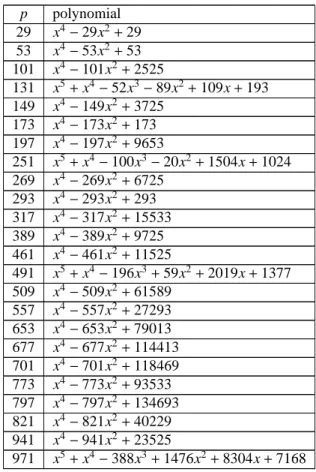
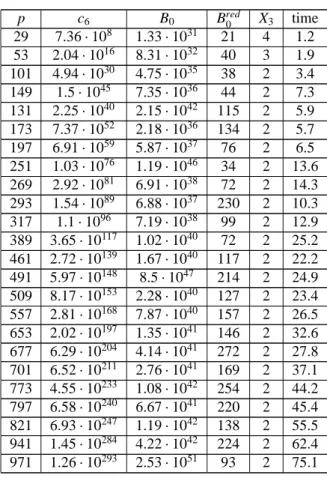
equations x2 +a2 = yp and x2 +a2 = 2yp for odd a with 3 ≤ a ≤ 501.In Section 2 we consider the Diophantine equation x2+q2m =2yp where m,p,q,x,y are integer unknowns
with m>0,p and q are odd primes and gcd(x,y)=1.We prove that there are only finitely many solutions (m,p,q,x,y) for which y is not of the form 2v2 ±2v+1. We also study
the above equation with fixed y and with fixed q.We completely resolve the equation x2+
q2m = 2·17p.At the end of the section it is proved that if the Diophantine equation x2+
32m = 2yp with m > 0 and p prime admits a coprime integer solution (x,y),then either
p ∈ {59,83,107,179,227,347,419,443,467,563,587,659,683,827,947}or (x,y,m,p) ∈
{(79,5,1,5),(545,53,3,3)}.
In Chapter 4 some generalisations of Fermat’s problem on arithmetic progressions of length
4 consisting of squares are discussed. All arithmetic progressions are described which satisfy one of the following conditions
four consecutive terms are of the form x20,x21,x22,x33,
four consecutive terms are of the form x20,x21,x32,x23,
four consecutive terms are of the form x30,x21,x32,x23.
(1.4)
In the first two cases we show that it is sufficient to find all rational points on certain
hyperelliptic curves of genus 2 to obtain all progressions with gcd(x0,x1,x2,x3)=1. These
hyperelliptic curves are given by
Y2 =X6+18X5+75X4+120X3+120X2+72X+28,
9
In both cases the rank of the Jacobian is 1, therefore Chabauty’s method can be applied. In the third case one can obtain a genus 2 curve without using any parametrisation, which enable
us to get rid of the condition gcd(x0,x1,x2,x3)=1.The curve is given by
C : Y2=−X6+2X3+3.
We prove thatC(Q) = {(−1,0),(1,±2)}.These rational points gives rise to two families of progressions of the form x30,x21,x32,x23given by
x0=−2t2,x1=0,x2=2t2,x3=±4t3for some t∈Z,
x0=t2,x1=±t3,x2=t2,x3=±t3for some t∈Z.
Chapter 2
Runge-type Diophantine
Equations
2.1
Introduction
Consider a polynomial
P(X,Y)= m
X
i=0
n
X
j=0
ai,jXiYj,
where ai,j ∈ Zand m> 0,n> 0, which is irreducible inQ[X,Y].We recall Runge’s result
[74] on Diophantine equations:
if there are infinitely many (x,y) ∈ Z2 such that P(x,y) = 0 then the following properties hold:
• ai,n =am,j=0 for all non-zero i and j,
• for every term ai,jXiYjof P one has ni+m j≤mn,
• the sum of all monomials ai,jXiYjof P for which ni+m j=mn is up to a constant factor
a power of an irreducible polynomial inZ[X,Y],
• there is only one system of conjugate Puiseux expansions at x =∞for the algebraic
function y=y(x) defined by P(x,y)=0.
The latter two properties have been sharpened by Schinzel [75] and by Ayad [5]. The fourth property implies the three others. If the fourth statement does not hold, we say
that P satisfies Runge’s condition. Runge’s method of proof is effective, that is, it yields
computable upper bounds for the sizes of the integer solutions to these equations provided
Runge’s condition is satisfied. Using this method upper bounds were obtained by Hilliker
and Straus [45] and by Walsh [92]. Grytczuk and Schinzel [41] applied a method of
Skolem [80] based on elimination theory to obtain upper bounds for the solutions. Laurent
and Poulakis [48] obtained an effective version of Runge’s theorem over number fields by
interpolation determinants. Their result extends Walsh’s result which holds for the field of rational numbers.
If P(X,Y) =Yn−R(X) is irreducible inQ[X,Y], R is monic and gcd(n,deg R) >1, then P
satisfies Runge’s Condition. Masser [58] considered equation yn =R(x) in the special case n=2,deg R=4, and Walsh [92] gave a bound for the general case. In [73] Poulakis described
an elementary method for computing the solutions of the equation y2 =R(x), where R is a
monic quartic polynomial which is not a perfect square. Szalay [84] generalized the result
of Poulakis by giving an algorithm for solving the equation y2 = R(x) where R is a monic
polynomial of even degree. Recently, Szalay [85] established a generalization to equations yp=R(x), where R is a monic polynomial and p|deg R.
Several authors (for references see e.g.[14],[20],[35]) have studied the question if the equation
F(x)=G(y) has finitely or infinitely many solutions in x,y∈Z,where F,G are polynomials with rational coefficients. Bilu and Tichy [20] completely classified those polynomials F,G∈
Q[X] for which the equation F(x)=G(y) has infinitely many integer solutions. The methods used in [14],[20],[35] are ineffective so they do not lead to algorithms to find all the solutions.
In this chapter we will prove the following theorem.
Theorem. Let F,G∈ Z[X] be monic polynomials with deg F =n≤deg G =m,such that F(X)−G(Y) is irreducible inQ[X,Y] and gcd(n,m)>1.Let d>1 be a divisor of gcd(n,m).
If (x,y)∈Z2is a solution of the Diophantine equation F(x)=G(y),then
max{|x|,|y|} ≤d2m2d −m(m+1)
3m 2d(m
d +1) 3m
2(h+1)
m2+mn+m d +2m,
where h = max{H(F),H(G)}and H(·) denotes the classical height, that is the maximal absolute value of the coefficients.
We provide an algorithm to determine all the solutions, and show by examples how it works
2.2. The case F(x)=G(y) with gcd(deg G,deg F)>1 13
2.2
The case F(x)
=
G(y) with gcd(deg G,
deg F)
>
1
We deal with the Diophantine equation
F(x)=G(y), (2.1)
where F,G∈Z[X] are monic polynomials with deg F=n,deg G=m,such that F(X)−G(Y) is irreducible inQ[X,Y] and gcd(n,m)>1.Then Runge’s condition is satisfied. Let d>1 be a divisor of gcd(n,m).Without loss of generality we can assume m≥n.By H(·) we denote the classical height, that is the maximal absolute value of the coefficients.
In the following theorem we extend a result of Walsh [92] concerning superelliptic equations
for which Runge’s condition is satisfied.
Theorem 2.2.1. If (x,y)∈Z2is a solution of (2.1) where F and G satisfy the above mentioned
conditions then
max{|x|,|y|} ≤d2m2d −m(m+1)
3m 2d(m
d +1) 3m
2(h+1)
m2+mn+m d +2m,
where h=max{H(F),H(G)}.
In the special case that G(Y)=YmWalsh [92, Theorem 3] obtained a far better result for the
integer solutions of (2.1), viz.
|x| ≤d2n−d n
d+2 d
(h+1)n+d.
In the Corollary of Theorem 1 [92] Walsh has shown that if P(X,Y) satisfies Runge’s
condition, then all integer solutions of the Diophantine equation P(X,Y)=0 satisfy max{|x|,|y|}<(2m)18m7h12m6,
where m=degYP,and h=H(P).Grytczuk and Schinzel [41] have stated in their Corollary that if P(X,Y) satisfies Runge’s condition, then
max{|x|,|y|}<
(45h)250 if m=2,
(4m3)8m2h96m 11
if m>2.
with the Theorem. We note that in the special case (2.1) our theorem gives a far better upper bound.
We will need the concept of resultant. The resultant of two polynomials f,g∈ C[X,Y] of degrees r,t in Y,respectively, say f (X,Y)=a0(X)Yr+a1(X)Yr−1+. . .+ar(X) with a0(X).0
and g(X,Y)=b0(X)Yt+b1(X)Yt−1+. . .+bt(X) with b0(X).0 is defined by
ResY( f (X,Y),g(X,Y))=
a0(X) . . . ar(X)
. .. . ..
a0(X) . . . ar(X)
b0(X) . . . bt(X)
. .. . .. . .. . ..
b0(X) . . . bt(X)
We use the following result in the proof of the Theorem.
Lemma 2.2.1. There exist Puiseux expansions (in this case even Laurent expansions)
u(X)=
∞ X
i=−n d
fiX−iand
v(X)=
∞ X
i=−m d
giX−i
of the algebraic functions U,V defined by Ud=F(X),Vd =G(X),such that d2(n/d+i)−1f
i∈Zfor all i>−nd,similarly d2(m/d+i)−1gi∈Zfor all i>−md,and f−n d =g−
m d =1.
Furthermore|fi| ≤(H(F)+1)
n
d+i+1for i≥ −n
d and|gi| ≤(H(G)+1)
m
d+i+1for i≥ −m
d.
Proof. See [92] pp. 169-170.
Proof of the Theorem. Let (2.1) admit a solution (x,y)∈Z2.Applying the lemma we write F(X)=
X∞
i=−n d
fiX−i
d
, G(Y)=
X∞
i=−m d
giY−i
d
,
where|fi|and|gi|are bounded by expressions given in the lemma. It follows from the lemma
thatd 2m
d−1fk
tk
< 2k1+1 for|t|>4d 2m
d−1(H(F)+1) n
d+2=: x0.Thus we have|P∞
i=1d
2m
d−1fit−i|< 1 2.
Similarly if|t|>4d2md−1(H(G)+1) m
d+2 =: y0then|P∞
i=1d
2m
d−1git−i|< 1
2.2. The case F(x)=G(y) with gcd(deg G,deg F)>1 15
we have u(x)d−v(y)d=0,that is
(u(x)−v(y))u(x)d−1+u(x)d−2v(y)+. . .+v(y)d−1=0, if d is odd,
u(x)2−v(y)2 u(x)d−2+u(x)d−4v(y)2+. . .+v(y)d−2=0, if d is even. First assume that d is odd and
u(x)d−1+u(x)d−2v(y)+. . .+v(y)d−1=0. (2.2) Suppose v(y),0.In this case we can divide (2.2) by v(y)d−1,and we get
u(x) v(y)
!d−1
+ u(x)
v(y) !d−2
+. . .+ u(x)
v(y) !
+1=0.
It suffices to observe thatttk−1
−1 has no real root if k is odd. Thus v(y)=0 and u(x)=0.
Now assume that d is even. Note that
u(x)d−2+u(x)d−4v(y)2+. . .+v(y)d−2=0 can only happen if u(x)=v(y)=0.By the above considerations we have
u(x)=v(y) if d is odd, and
u(x)=±v(y) if d is even.
Let|x|>x0,|y|>y0.Then we obtain from
0=|u(x)±v(y)|=
∞ X
i=−n d
fix−i±
∞ X
i=−m d
giy−i
that 0 X
i=−n d
d2md−1fix−i± 0
X
i=−m d
d2md−1giy−i
<1. Since d2md−1fi∈Zfor i=−n
d, . . . ,0 and d
2m
d−1gi∈Zfor i=−m
d, . . . ,0 we have
Q(x,y) :=
n d
X
i=0
d2md−1f
−ixi±
m d
X
i=0
d2md−1g
−iyi=0.
ResX(F(X)−G(Y),Q(X,Y)) = 0. We note that these resultants are non-zero polynomials
since F(X)−G(Y) is irreducible overQ[X,Y] of degree n in X and of degree m in Y,whereas degXQ(X,Y) = dn,and degYQ(X,Y) = md.By applying Lemma 1 of Grytczuk and Schinzel
[41] we obtain the following bounds for|x|and|y|:
|x| ≤h(n+1)√m+1
m d
d2md−1(h+1)n +m d +2(n
d+1) r
m d +1
!m
,
|y| ≤h(m+1)√n+1
n d
d2md−1(h+1) n+m
d +2(m
d +1) r
n d+1
!n
.
(2.3)
By combining the bounds x0,y0and (2.3) obtained for|x|,|y|we get the bound given in the
theorem.
2.2.1
Description of the algorithm
In this section we give an algorithm to find all integral solutions of concrete Diophantine
equations of the form (2.1) by adapting the proof of the theorem. Let p be the smallest prime divisor of gcd(m,n).Let u(X) = P0i=
−n p
fiX−i and v(X) = P0i=−m p
giX−i be the polynomial
part of the Puiseux expansions at∞ of u(X)p = F(X),v(X)p = G(X),respectively, with
f−n p =g−
m
p =1.Denote by D the least common multiple of both the non-zero denominators
of fifor i∈ {−np, . . . ,−1}and of gifor i∈ {−mp, . . . ,−1}and of f0−g0.Let t be a positive real
number. The leading coefficients of F(X)−(u(X)−t)pand F(X)−(u(X)+t)phave opposite signs, similarly in the case of the polynomials G(X)−(v(X)−t)p and G(X)−(v(X)+t)p.
Hence we have that either
(u(x)−t)p <F(x)<(u(x)+t)por (u(x)+t)p<F(x)<(u(x)−t)p,
if|x|is large enough. Similarly we have that either
(v(x)−t)p<G(x)<(v(x)+t)por (v(x)+t)p <G(x)<(v(x)−t)p,
2.2. The case F(x)=G(y) with gcd(deg G,deg F)>1 17
The same holds for G(X)−(v(X)−t)pand G(X)−(v(X)+t)p.Let
x−t =min{{0} ∪ {x∈R: F(x)−(u(x)−t)p=0 or F(x)−(u(x)+t)p=0}},
x+t =max{{0} ∪ {x∈R: F(x)−(u(x)−t)p=0 or F(x)−(u(x)+t)p =0}},
y−t =min{{0} ∪ {x∈R: G(x)−(v(x)−t)p =0 or G(x)−(v(x)+t)p=0}},
y+t =max{{0} ∪ {x∈R: G(x)−(v(x)−t)p=0 or G(x)−(v(x)+t)p=0}}.
Suppose that p is odd. Then we have
(u(x)−t)p <F(x)<(u(x)+t)pfor x<[x−t,x+t],
(v(y)−t)p<G(y)<(v(y)+t)pfor y<[y−t,y+t].
If (x,y) is a solution (2.1) such that x<[x−t,x+
t] and y<[y−t,y+t],then
(u(x)−t)p−(v(y)+t)p<F(x)−G(y)<(u(x)+t)p−(v(y)−t)p.
Thus
(u(x)−v(y)−2t)
p−1
X
k=0
(u(x)−t)p−1−k(v(y)+t)k
<0, (2.4)
(u(x)−v(y)+2t)
p−1
X
k=0
(u(x)+t)p−1−k(v(y)−t)k
>0. (2.5)
Either u(x)−t,0 or v(y)+t,0 since otherwise u(x)−v(y)−2t=0,a contradiction. Similarly, either u(x)+t,0 or v(y)−t,0 since otherwise u(x)−v(y)+2t=0,a contradiction. Without loss of generality we may assume that v(x)−t,0 and v(x)+t,0.We rewrite (2.4) and (2.5) as follows
(u(x)−v(y)−2t) 1
(v(y)+t)p−1
p−1
X
k=0
u(x)−t v(y)+t
!k
<0,
(u(x)−v(y)+2t) 1
(v(y)−t)p−1
p−1
X
k=0
u(x)+t v(y)−t
!k
>0.
Since p−1 is even andPkp=−01sk≥1
2 for s∈Rwe obtain that
There are only finitely many rational numbers with bounded denominator between−2t and 2t.It follows from Lemma 2.2.1 that the denominator of u(x)−v(y) divides p2mp−1,so D |
p2mp−1.Hence x is a solution of ResY(F(X)−G(Y),u(X)−v(Y)−T ) for some rational number
−2t<T <2t with denominator dividing D.To resolve a concrete equation of the form (2.1) it is sufficient to find all integral solutions of the following equations
F(x)=G(k) for some k∈[y−t,y+t],
G(y)=F(k) for some k∈[x−t,x+t],
ResY(F(X)−G(Y),u(X)−v(Y)−T )=0 for some T ∈Q,|T|<2t
with denominator dividing D.
(2.6)
The number of equations to be solved depends on t,a good choice can reduce the time of the computation.
In the special case p=2 if n−n/d and m−m/d are even, then the previous argument works. Otherwise four cases can occur.
1.
(u(x)−t)2<F(x)<(u(x)+t)2,
(v(y)−t)2 <G(y)<(v(y)+t)2.
In this case it follows that−2t<u(x)−v(y)<2t.
2.
(u(x)−t)2<F(x)<(u(x)+t)2,
(v(y)+t)2 <G(y)<(v(y)−t)2.
We obtain that−2t<u(x)+v(y)<2t.
3.
(u(x)+t)2<F(x)<(u(x)−t)2,
(v(y)−t)2 <G(y)<(v(y)+t)2.
2.2. The case F(x)=G(y) with gcd(deg G,deg F)>1 19
4.
(u(x)+t)2 <F(x)<(u(x)−t)2,
(v(y)+t)2<G(y)<(v(y)−t)2.
In this case it follows that−2t<u(x)−v(y)<2t.
If p=2 then we can apply the above arguments to conclude that each solution (x,y)∈Z2of
(2.1) satisfies at least one of the following equations:
F(x)=G(k) for some k∈[y−t,y+t],
G(y)=F(k) for some k∈[x−t,x+t],
ResY(F(X)−G(Y),u(X)−v(Y)−T )=0 for some T ∈Q,|T|<2t
with denominator dividing D,
ResY(F(X)−G(Y),u(X)+v(Y)−T )=0 for some T ∈Q,|T|<2t
with denominator dividing D.
(2.7)
In the algorithm we need to compute the approximate values of the smallest real roots and the largest real roots of certain polynomials. One can apply for example the method of Collins
and Akritas [32], based on Descartes’ rule of signs, or Sch¨onhage’s algorithm [77], which is
implemented in Magma [21]. Denote by NumofEq(t) the number of equations corresponding with t.It is x+
t −x−t +yt+−y−t +4Dt+1 if p is odd and xt+−x−t +y+t −y−t +8Dt if p=2.The
remaining question is how we should fix the parameter t such that the number of equations to be solved becomes as small as possible. We perform a reduction algorithm as follows. We let
t= 2D1 .In this way if x<[x−t,x+
t],y<[y−t,y+t],we have that−1<D(u(x)±v(y))<1.Since
D(u(x)±v(y)) is an integer the only possibility is u(x)±v(y)=0.In this case there is only one resultant equation to be solved if p is odd and two if p=2.Then we compute NumofEq(2t),
if it is smaller than NumofEq(t),then we replace t by 2t and proceed, otherwise the procedure returns the actual values of x+
t,x−t,yt+,y−t,t.Finally we compute the integer solutions of the
polynomial equations (2.6) if p is odd, and (2.7) if p=2.
2.2.2
Examples
I implemented the algorithm in the computer algebra program package Magma [21]. The
t #equations [x−t,x+t,y−t,y+t]
1/256 1278 [ -350, 353, -253, 318 ]
1/128 628 [ -174, 177, -98, 171 ]
1/64 311 [ -86, 89, -24, 96 ]
1/32 195 [ -42, 45, -20, 56 ]
1/16 158 [ -20, 23, -16, 35 ]
Table 2.1: Information on the reduction.
Example 1. Consider the Diophantine equation
x2−3x+5=y8−y7+9y6−7y5+4y4−y3.
We have
u(X)=X−3 2, v(Y)=Y4−1 2Y
3+35
8Y
2
−2116Y−1053
128.
In Table 2.1 we collect information on the reduction.
It remains to solve the following equations:
ResY(F(X)−G(Y),u(X)−v(Y)−k)=0, for k∈ {−15, . . . ,15},
ResY(F(X)−G(Y),u(X)+v(Y)−k)=0, for k∈ {−15, . . . ,15},
G(y)=F(x), for x∈ {−20, . . . ,23},
F(x)=G(y), for y∈ {−16, . . . ,35}.
The complete list of the integral solutions of these equations turns out to be:
{(−657,5),(−3,−1),(0,1),(3,1),(6,−1),(660,5)}.
Computation time in seconds: 0.72.
Example 2. We apply the method to the Diophantine equation
2.2. The case F(x)=G(y) with gcd(deg G,deg F)>1 21
t #equations [x−t,x+t,y−t,y+t]
1/6 177 [ -86, 45, -32, 11 ]
1/3 95 [ -48, 15, -18, 9 ]
2/3 67 [ -27, 13, -10, 8 ]
4/3 52 [ -16, 11, -2, 6 ]
Table 2.2: Information on the reduction.
We obtain that
u(X)=X−5 3,
v(Y)=Y3−Y2+2Y−4 3.
In Table 2.2 we collect information on the reduction.
In this case we solve the following equations:
ResY(F(X)−G(Y),u(X)−v(Y)−k)=0, for k∈ {−7, . . . ,7},
G(y)=F(x), for x∈ {−16, . . . ,11},
F(x)=G(y), for y∈ {−2, . . . ,6},
The only integral solution of these equations is (x,y)=(−11,−2).
Computation time in seconds: 0.38.
Example 3. ([43] Theorem 1. a) Consider the Diophantine equation
x(x+1)(x+2)(x+3)=y(y+1)· · ·(y+5).
There are many results in the literature concerning similar equations (cf. [14], [57]). We
compute that
u(X)=X2+3X+1,
v(Y)=Y3+15
2Y
2+115
8 Y+
75 16.
t #equations [x−t,x+t,y−t,y+t]
1/32 108 [ -6, 3, -50, 45 ]
1/16 62 [ -5, 2, -26, 21 ]
1/8 46 [ -4, 1, -15, 10 ]
Table 2.3: Information on the reduction.
It remains to solve the following equations:
ResY(F(X)−G(Y),u(X)−v(Y)−k)=0, for k∈ {−3, . . . ,3},
ResY(F(X)−G(Y),u(X)+v(Y)−k)=0, for k∈ {−3, . . . ,3},
G(y)=F(x), for x∈ {−4, . . . ,1},
F(x)=G(y), for y∈ {−15, . . . ,10}.
The complete list of non-trivial integral solutions of these equations turns out to be:
{(−10,−7),(−10,2),(7,−7),(7,2)}.Computation time in seconds: 0.23.
The following examples are from [85]. The method described in that paper is similar to ours in the sense that one has to find all the integral solutions of polynomial equations P(x)=0,
where P∈ Z[X].We compare both methods by comparing the number of equations which
have to be solved. We remark that our algorithm works for equations F(x) =G(y),where
F,G ∈ Z[X] are monic polynomials with deg F =n,deg G =m,such that F(X)−G(Y) is
irreducible inQ[X,Y] and gcd(n,m) >1,while Szalay’s algorithm can be applied only for the special case G(y)=ym.
Equation 1. x2=y4−99y3−37y2−51y+100,
Equation 2. x2=y8−7y7−2y4−y+5,
Equation 3. x2=y8+y7+y2+3y−5,
Equation 4. x3=y9+2y8−5y7−11y6−y5+2y4+7y2−2y−3.
Equation 1 985360 5930
Equation 2 118546 1951
Equation 3 16 22
Equation 4 420 85
2.2. The case F(x)=G(y) with gcd(deg G,deg F)>1 23
and in the second column the numbers of equations to be solved by applying the method described in [85]. In all but the third case one has to solve fewer equations by using our
algorithm.
Acknowledgement. I thank Robert Tijdeman and Jan-Hendrik Evertse for their valuable
Chapter 3
Exponential Diophantine
Equations
3.1
On the Diophantine equation x
2+
a
2=
2y
pA common generalisation of Fermat’s equation and Catalan’s equation is
Axp+Byq=Czr
in integers r,s,t∈N≥2,x,y,z∈Zand A,B,C∈Zgiven integers with ABC,0.Darmon and
Granville [33] wrote down a parametrization for each case when 1/p+1/q+1/r >1 and A=B=C =1.Beukers [13] showed that for any nonzero integers A,B,C,p,q,r for which 1/p+1/q+1/r>1 all solutions of Axp+Byq =Czr can be obtained from a finite number
of parametrized solutions. The theory of binary quadratic forms (see e.g. [61], Chapter 14)
applies to the case{p,q,r}={2,2,k}and a set of parametrizations can be found easily. We will make use of the fact, that in case of the title equation the parametrization is reducible.
It follows from Schinzel and Tijdeman [76] that for given non-zero integers A,B,C the
equation Ax2 +B = Cyn has only a finite number of integer solutions x,y,n > 2,which
can be effectively determined. For special values of A,B and C this equation was investigated by several authors see e.g. [12], [28], [31], [46], [51], [53], [54],[67], [83] and the references
given there.
There are many results concerning the more general Diophantine equation
Ax2+pz1
1 · · ·p
zs
s =Cy n
,
where piis prime for all i and ziis an unknown non-negative integer, see e.g. [1], [64], [2],
[65], [66], [4], [3], [22], [26], [30], [55], [56], [59], [63], [62], [70]. Here the elegant result
of Bilu, Hanrot and Voutier [19] on the existence of primitive divisors of Lucas and Lehmer numbers has turned out to be a very powerful tool. In [70] Pink considered the equation
x2+(pz1
1 · · ·p
zs
s)2 =2yn,and gave an explicit upper bound for n depending only on max pi
and s.
In [52] Ljunggren proved that if p is a given prime such that p2−1 is exactly divisible by an odd power of 2, then the equation x2+p2 =ynhas only a finite number of solutions in x,y
and n with n>1.He provided a method to find all the solutions in this case.
The equation x2+1=2ynwas solved by Cohn [29]. Pink and Tengely [71] considered the
title equation and they gave an upper bound for the exponent n depending only on a,and they
completely resolved the equation with 1≤a≤1000 and 3≤n≤80.The theorems in the
present section provide a method to resolve the equation x2+a2=2ynin integers n>2,x,y
for any fixed a.In particular we compute all solutions for odd a with 3≤a≤501.
3.1.1
Equations of the form x
2+
a
2=
2y
pConsider the Diophantine equation
x2+a2=2yp, (3.1)
where a is a given positive integer and x,y∈Nsuch that gcd(x,y)=1 and p≥3 a prime. Put
δ=
1 if p≡1 (mod 4),
−1 if p≡3 (mod 4).
(3.2)
After having read the paper [71], Bugeaud suggested to use linear forms in only two logarithms in order to improve the bound for the exponent. Following this approach we
get a far better bound than Pink and Tengely did in [71], that is, than p<291527a10.
Theorem 3.1.1. If (x,y,p) is a solution of x2+a2=2ypwith y>50000 then
p≤max1.85 log a,4651 .
3.1. On the Diophantine equation x2+a2=2yp 27
y=u2+v2such that
x = <((1+i)(u+iv)p)=: Fp(u,v),
a = =((1+i)(u+iv)p)=: Gp(u,v).
Here Fpand Gpare homogeneous polynomials inZ[X,Y].
In the proof we will use the following result of Mignotte [19, Theorem A.1.3]. Letαbe
an algebraic number, whose minimal polynomial overZ is AQdi=1(X−α(i)).The absolute
logarithmic height ofαis defined by h(α)=1
d log|A|+
d
X
i=1
log max(1,|α(i)|) .
Lemma 3.1.1. Letαbe a complex algebraic number with|α|=1,but not a root of unity, and logαthe principal value of the logarithm. Put D=[Q(α) :Q]/2.Consider the linear form
Λ =b1iπ−b2logα,
where b1,b2are positive integers. Letλbe a real number satisfying 1.8≤λ <4,and put
ρ=eλ, K=0.5ρπ+Dh(α), B=max(13,b1,b2),
t= 1
6πρ −
1
48πρ(1+2πρ/3λ), T =
1/3+ √1/9+2λt
λ
!2
,
H=maxn3λ,D log B+log 1
πρ +
1 2K
!
−log√T+0.886 !
+
+3λ
2 +
1 T
1 6ρπ+
1 3K
!
+0.023o.
Then
log|Λ|>−(8πTρλ−1H2+0.23)K−2H−2 log H+0.5λ+2 logλ−(D+2) log 2.
We shall use the following statement in the proof of Theorem 3.1.1. The result can be found as Corollary 3.12 at p. 41 of [68].
Lemma 3.1.2. IfΘ =2πr for some rational number r,then the only rational values of the tangent and the cotangent functions atΘcan be 0,±1.
compute an upper bound for|xx+−aiai−1|:
x+ai x−ai−1
≤
√
2a
yp/2. (3.3)
We have
x+ai x−ai=
(1+i)(u+iv)p
(1−i)(u−iv)p =i
(u+iv)p
(u−iv)p.
Ifi(u(u+iv)p −iv)p −1
> 13then p≤ log 500004 log 6 <2000, a contradiction. Thus
i
(u+iv)p (u−iv)p −1
≤
1 3. Since|log z| ≤2|z−1|for|z−1| ≤ 13,we obtain
i
(u+iv)p
(u−iv)p −1
≥ 1 2 log i
(u+iv)p
(u−iv)p
.
Consider the corresponding linear form in two logarithms (πi=log(−1))
Λ =2kσπi−p log δ
u−iv
−v+iu σ!
,
where logarithms have their principal values,|2k| ≤ p andσ =sign(k).We apply Lemma
3.1.1 withα=δ(u−iv
−v+iu)
σ,b
1=2kσand b2=p.
Supposeαis a root of unity. Then u−iv
−v+iu σ
= −2uv
u2+v2 +
σ(−u2+v2) u2+v2 i=exp
2πi j n
!
,
for some integers j,n with 0≤j≤n−1.Therefore tan 2πj
n !
=σ(−u
2+v2)
−2uv ∈Q.
Hence, by Lemma 3.1.2, (u22uv−v2) ∈ {0,1,−1}.This implies that uv = 0 or|u| = |v|,but this is excluded by the requirement that the solutions x,y of (3.1) are relatively prime and that y>50000.Thereforeαis not a root of unity.
3.1. On the Diophantine equation x2+a2=2yp 29
Therefore h(α)= 12log y.Setλ=1.8.We have D=1 and B=p and 14.91265≤K<9.5028+1
2log y, 0.008633<t<0.008634,
0.155768<T <0.155769,
H<log p+2.285949,
log y>10.819778,
(3.4)
By applying (3.3)-(3.4) and Lemma 3.1.1 we obtain
log 2√2a− p
2log y≥log|Λ| ≥ −(13.16H
2+0.23)K
−2H−2 log H−0.004. (3.5)
This yields by (3.4) an upper bound C(a,y) for p depending only on a and y.If yp <a20,then
p<log y20 log a<1.85 log a,otherwise we obtain that
0.9p≤36.32 log(p)2+166.39 log(p)+0.37 log(log(p)+2.29)+190.96.
Hence we conclude that p≤4651.Thus we obtain the bound p≤max1.85 log a,4651 .
Theorem 3.1.2 gives us a tool to resolve Diophantine equations of type (3.1) for given a
completely. We make use of the fact that the parametrization is reducible and one of the factors is linear. This linear factor, u+δv,is a divisor a0of a.If u+δv,a,then we have
p|a−a0,which provides a bound for p.This case is covered by the set S1.In the remaining
cases we deal with u+δv=a.The set S2contains solutions of Gp(u,v)=a for which p is
small. We need to consider these cases separately because the later arguments do not work
for p=3,5,7.To have a better bound for p we consider the equation x2+a2 =2ypfor each y<50000 separately. In all cases we obtain a bound for p and we test if 2yp−a2is a square
or not for all primes p up to this bound. The set S3covers this case. It remains to deal with
the ”large” solutions, where y=u2+v2 ≥50000.If there is such a large solution (u,v) with
|v|>1 of Gp(u,v)=a,thenvais a convergent ofβ+δ,whereβis a root of Gp(X,1).Therefore
Theorem 3.1.2. Let
A(C)=[ p≤C
(
tan(4k+3)π
4p : 0≤k≤p−1
) , T =
lcm(ordu(v),ordv(u)) if min{|u|,|v|} ≥2,
max{|u|,|v|}otherwise,
andδis defined by (3.2). If (x,y,p) is a solution of x2+a2=2ypsuch that gcd(x,y)=1,then there exist integers u,v satisfying (u,v,p)∈S1∪S2∪S3∪S4∪S5where
S1 =
n
(u,v,p) : u+δv=a0,a0,a,a0|a,p|a−a0,Gp(−δv+a0,v)=a
o
,
S2 =
n
(u,v,p) : u+δv=a,p∈ {3,5,7},Gp(−δv+a,v)=a
o
,
S3 =
n
(u,v,p) : u+δv=a,u2+v2≤50000,11≤p≤C(a,u2+v2),
p≡ ±1 mod To,
S4 =
n
(u,v,p) : u+δv=a,|u|>223,|v|=1,11≤p≤C(a,50000),
p≡ ±1 mod To,
S5 =
n
(u,v,p) : u+δv=a,u2+v2>50000,|v| ≥2,11≤p≤C(a,50000),
a
vis a convergent ofβ+δfor someβ∈ A(C(a,50000)) o
.
To prove Theorem 3.1.2 we need the following lemmas.
Lemma 3.1.3. If l is an odd positive integer, then
(u−δv) | Fl(u,v),
(u+δv) | Gl(u,v).
Proof. If l≡1 (mod 4) then
Fl(u,u)=
ul 2((1+i)
l+1+(1
−i)l+1)=0,
and also
Gl(u,−u)=
ul
2i((1−i)
l−1
−(1+i)l−1)=0.
3.1. On the Diophantine equation x2+a2=2yp 31
Lemma 3.1.4. We have
Gp(X,1)= p−1
Y
k=0
X−tan(4k+3)π 4p
!
.
Proof. By definition Gp(X,1)==((1+i)(X+i)p).We have
2i cos(4k+3)π 4p
!p
Gp(tan
(4k+3)π
4p ,1)=
=ip(1+i)(−1)k exp −3iπ 4
!
−i exp 3iπ 4
!!
=0.
Hence Gp(tan(4k4p+3)π,1)=0 for 0≤k≤p−1.Since Gp(X,1) has degree p and Gpis monic,
the lemma follows.
Proof of Theorem 3.1.2. We have seen that a==((1+i)(u+iv)p)=: G
p(u,v).Hence Lemma
3.1.3 implies that u+δv|a,that is, there exists an integer a0such that a0|a and u+δv=a0.
Define a function s :N→ {±1}as follows:
s(k)=
1 if k≡0,1 (mod 4),
−1 if k≡2,3 (mod 4).
It follows that
a=Gp(−δv+a0,v)=
p
X
k=0
s(k) p k !
(−δv+a0)p−kvk,
hence
a≡(−δv+a0)p+δvp≡a0 (mod p).
If a0,a then it remains to solve the polynomial equations
Gp(−δv+a0,v)=a, for a0|a,a0,a and p|a−a0. (3.6)
That is the first instance mentioned in Theorem 3.1.2.
From now on we assume that a0=a=u+δv.We claim p≡ ±1 mod T.We note that
1≡Gp(u,v) u+δv ≡u
p−1+(p
−δ)up−2v mod v2,
1≡Gp(u,v) u+δv ≡v
p−1+(p