PRACTICUM EXPERIENCES: EFFECTS ON CLINICAL SELF-CONFIDENCE OF SENIOR DENTAL HYGIENE STUDENTS
Whitney Zanella Simonian
A thesis submitted to the faculty of the University of North Carolina at Chapel Hill in partial fulfillment of the requirements for the degree of Master of Science in Dental Hygiene
Education in the Department of Dental Ecology, School of Dentistry.
Chapel Hill 2014
Approved by: Rebecca S. Wilder
© 2014
ABSTRACT
Whitney Zanella Simonian: Practicum Experiences: Effects on Clinical Self-Confidence of Senior Dental Hygiene Students
(Under the direction of Rebecca S. Wilder)
ACKNOWLEDGEMENTS
I would like to thank my thesis research committee, Rebecca Wilder, Jennifer Brame, and Lynne Hunt, for your time, commitment, support, and helping me to complete my thesis. I would also like to thank Dr. Ceib Phillips for her statistical expertise.
A big thanks to my amazing classmates: Kristin Dillow, Jessica Holloman, and Brittany Minichbauer. I could not have been luckier to get such a wonderful group of ladies to experience the last 2 years with—I have gained lifelong friends.
Finally, I would like to thank my family. To my parents, Steve and Doreen, thank you for being my biggest fans and helping me realize I can achieve anything that I put my mind to. To my brothers, Austin and Brady, thank you for always encouraging me. To my husband, Kyle, thank you for taking care of me, for being you, and for helping me to achieve this challenging goal.
TABLE OF CONTENTS
LIST OF TABLES ………...vi
LIST OF ABBREVIATIONS ………vii
Chapter I. INTRODUCTION ………1
II. REVIEW OF THE LITERATURE ………..3
Practicum Experiences Defined ………..3
Practicum Experiences in Pre-Doctoral Dental Education ……….4
Practicum Experiences in Dental Hygiene Education ………7
Practicum Experiences and Reflection ………...9
Purpose of This Study ...………11
III. INTRODUCTION AND REVIEW OF THE LITERATURE ………12
IV. METHODS ……….18
V. RESULTS ………...21
VI. DISCUSSION………..23
VII. CONCLUSION...……….28
APPENDIX………..33
Dental Hygiene Clinical Self-Confidence Survey………...33
LIST OF TABLES
Table 1 Dental hygiene students’ clinical self-confidence after a practicum
experience………29 Table 2 Representative reflective journal entry comments supporting survey
results……….………..31 Table 3 Representative reflective journal entry comments on overall clinical
LIST OF ABBREVIATIONS
ADEA American Dental Education Association ADHA American Dental Hygienists’ Association CODA Commission on Dental Accreditation CIT Critical Incident Technique
INTRODUCTION
Curricula in a dental hygiene program should support the development of a confident and well-rounded dental hygienist. The challenges of educators to prepare dental hygiene students to succeed in an evolving profession are ever present. The American Dental Education Association (ADEA) has recommended that dental institutions “develop the knowledge and skills necessary to serve a diverse population, provide experiences of oral health care delivery in community-based and nontraditional settings, and encourage externships in underserved areas.”1 Moreover, the Commission on Dental Accreditation (CODA) standards require students to have a sufficient number of hours in clinical practice to develop appropriate clinical judgment, as well as experience in providing care to children, adolescents, adults, geriatric patients, and special needs patients.2 Practicum experiences are one of the ways that dental hygiene programs follow ADEA’s recommendations and fulfill CODA standards because they have proven to provide many experiences with diverse patients with a variety of needs.3-8
REVIEW OF THE LITERATURE
Practicum Experiences Defined
The practicum experience is a type of experiential learning that includes hands on practice, reflection, abstraction, and application of the new experience.14 Experiential learning serves to put what students have learned into action and helps to make connections from theory to practice.15 Students may encounter experiential learning in a school’s clinic or lab setting, but the situation may not be a practical situation due to the academic
environment. Often occurring near the end of an educational program, practicum
experiences typically last several weeks, allowing students to gain insight into their future career. Practicum experiences typically take place in a setting outside of a school, giving students practical experiences. This not only benefits the students, but may also benefit the community as well.3,6,7,12 Practicum experiences are also referred to as service learning, outreach placements, community-based experiences, external placements, extramural rotations, or externships. 3-11,13,16-19
Practicum Experiences in Pre-Doctoral Dental Education
CODA’s Accreditation Standards for Dental Education Programs requires academic institutions to prepare students to treat a diverse patient population with a variety of needs and to make community based learning experiences available to students.20 Practicum experiences are used by academic institutions to fulfill the standards set by CODA. Studies conducted on dental students have concluded that students find practicum experiences to be valuable to their education21,22 and aid in preparing students for licensure by enhancing clinical skill and knowledge,4,5,10,11,16,21,23 as well as provide benefits to the community.7,12
Another valuable outcome of dental students’ practicum experiences is an increased awareness of professionalism.4,5,10,16 A study conducted at the University of North Carolina at Chapel Hill examined the themes from dental students’ reflections after an eight-week community-based experience.10 Themes from the reflections included professional growth and increased awareness of ethical dilemmas.10 Some students reported concern over ethical dilemmas regarding lack of communication of treatment options. Others discussed the importance of empathy and being a caring healthcare provider.10 Two studies from the University of Sheffield in the United Kingdom examined the outcomes of outreach placements of dental, dental therapy, and dental hygiene students—one study looked at students’ perspectives5 while the other looked at the staff’s perspectives.4 Students and staff both agreed that the outreach placements aided in an appreciation of working as a team,4,5 which is an important part of being a dental health care professional.
Practicum experiences have also been shown to increase clinical knowledge and performance in dental students.4,5,10,11,17,21,23 Rohra et al. reports that 74% of dental students were exposed to different techniques and materials than their school’s dental clinic during their community-based education.21 An Australian study conducted by Manakil et al.
assessed final year dental students’ self-perceived work preparedness.23 Fifty-two percent of the dental students thought that a combination of treating patients in the school’s clinic and the community placements contributed to their work preparedness, while 47% reported that the community placements provided a more real-world learning experience than the school’s clinic.23 A study conducted by Mashabi et al. measured productivity and efficiency by
by completing more procedures in less time.11 Similarly, a study conducted by Mascarenhas et al. showed that dental students completed more procedures per week as each week of the externship passed.24 The investigators conceded that longer externships increase clinical confidence, efficiency, and skill.24
Few studies have investigated dental students’ self-reported increase in knowledge or self-confidence in performing dental procedures after practicum experiences. A study from the United Kingdom conducted by Smith et al. assessed senior dental students’ clinical confidence after a 5-week outreach placement by rating their pre- and post-outreach
placement clinical confidence.13 When compared to the control group, who remained in the school’s clinic, the group that participated in the outreach placement scored higher in the transition judgment than the control.13 A then-test, a retrospective pre-test, showed that the outreach group reported being overoptimistic about their baseline scores, while the control reported that their baseline was accurate.13 The investigators conclude that dental outreach training may be more effective than school-based training alone in increasing clinical confidence.13
Similar to the Skelton et al. study, Lynch et al. also measured the effect of a
community-based program on dental students’ confidence.13 The study took place at Cardiff University in the United Kingdom where dental students’ attend a dental clinic in a hospital one day a week throughout their final year, for a total of 28 days.13 Students’ took a 5-point pre- and post- confidence questionnaire based on 36 skill areas.13 Results showed a
statistically significant increase in students’ confidence in 30/36 skill areas including
diagnosis, radiography, treatment planning, patient management, and restorative dentistry.13
Practicum Experiences in Dental Hygiene Education
Although dental students perform different procedures, studies on dental hygiene students’ practicum experiences have shown similar benefits as dental students’ practicum experiences, but fewer studies have been conducted on dental hygiene students. Similar to dental students’ reports, dental hygiene students have reported that practicum experiences were valuable to their education and exposed them to a variety of clinical skills.8,18,19
Dental hygiene students’ practicum experiences have also shown to increase
awareness of the importance of professionalism.4-6,25 Investigators have found that practicum experiences may facilitate good communication, teamwork, and treating patients in an ethical manner.4-6,25 Aston-Brown conducted a mixed-methods study on dental hygiene students’ service learning placements in a public health setting.6 Reflections revealed that students’ experiences regarding ethics included language barriers, clinical asepsis, recognizing the need for respect, and whether other staff members treated patients with compassion.6
Increases in clinical knowledge and performance have also been found to be outcomes of dental hygiene students’ practicum experiences.4,8,18,19,25,26 Ledford et al. surveyed dental hygienists who graduated from the University of North Carolina between 1987-1998 that participated in a specialty track experience and found that 62% of
respondents felt that their clinical skills improved as a result.18 An Australian study
conducted by Taylor et al. assessed final year dental hygiene students’ opinions about their 6-week external placement.19 Students responded to a questionnaire about their experiences and were overall positive in their responses.19 They reported providing a variety of dental hygiene clinical procedures throughout their external placement.19 Investigators also noted that
students had the opportunity to gain an appreciation for time management.19
also out of the United Kingdom was conducted by Lynch et al. on dental hygiene and dental therapy students’ feedback and evaluation of community based clinical teaching.26 The investigators used a questionnaire that consisted of open and closed questions, yielding both quantitative and qualitative data.26 Fifty-seven percent of former and current students reported an increase in confidence in administering local anesthesia, 77% reported an
increase in confidence in scaling and 50% reported an increase in confidence in working as a part of the dental team.26 Furthermore, one student reported, “…I feel that as I have
progressed in St.David’s my confidence has greatly improved due to increased independence and being allowed to make my own decisions clinically…”26
Butters et al. evaluated dental hygiene students’ perceived clinical competence in 19 different areas of clinical dental hygiene care after a 4-week community based clinical rotation based on pre- and post-rotation surveys.8 The rotations included private dental offices, public health clinics, and military-based clinics. Data was collected from 1992-1998.8 The investigators found that students perceived an increase in clinical competence in six areas: radiographic technique, scaling periodontally involved teeth, child patient
management, clinical speed, clinical accuracy, and clinical judgment.8 To date, this is the only study on dental hygiene students’ perceptions of clinical competence after a practicum experience based on different aspects of dental hygiene care.
Practicum Experiences and Reflection
conjunction with clinical and practicum experiences. Dental and dental hygiene students have found reflection to be relevant and useful, to enhance learning, and to be a source of self-assessment for dental and dental hygiene students.28-31 In dental education, studies in which students have practiced reflection on clinical experiences, awareness of clinical and professional development increased.16, 30,32 Burch cites reflections and self-assessment measures as ways to assess the outcomes of practicum experiences.33 Several studies
assessing dental and dental hygiene students’ practicum experiences have utilized reflections as qualitative data.3,6,25,10,16,30
According to Strauss et al., the experiences students have during their practicum rotations may not fully develop knowledge and desired skills without reflection.16 The investigators recommend that students reflect on practicum experiences in order to recognize the value of their experiences and to ultimately encourage lifelong self-assessment
practices.16 Furthermore, Mofidi et al. concedes that reflective practice during practicum experiences is necessary to develop a well-rounded practitioner in order to be successful in an evolving healthcare environment.10 Therefore, when implemented, reflective journaling may aid in fulfilling CODA standards for dental hygiene programs requiring graduates to “…be competent in the application of self-assessment skills to prepare them for life-long learning.”1
problems.”34 The CIT was used in Mofidi et al.’s study to guide dental students’ reflections after a practicum rotation, resulting in three themes from the reflections: personal and professional growth, enhanced awareness, and commitment to service.10The students in Mofidi et al.’s study acknowledged the value in their incidents, describing them as
“awakening, unforgettable, memorable, and transformative.”10 Similarly, FitzGerald et al. concluded that the CIT is an appropriate research method in dental education, and could provide many benefits to dental education.35
Purpose of This Study
INTRODUCTION AND REVIEW OF THE LITERATURE
Curricula in a dental hygiene program should support the development of a confident and well-rounded dental hygienist, prepared to treat a variety of patients in traditional and nontraditional settings. The challenges of educators to prepare dental hygiene students to succeed in an evolving profession are ever present. The American Dental Education
Association (ADEA) has recommended that dental institutions “develop the knowledge and skills necessary to serve a diverse population, provide experiences of oral health care delivery in community-based and nontraditional settings, and encourage externships in underserved areas.”1 Moreover, the American Dental Association’s (ADA) Commission on Dental Accreditation (CODA) standards require students to have a sufficient number of hours in clinical practice to develop appropriate clinical judgment, as well as experience in
providing care to children, adolescents, adults, geriatric patients, and special needs patients.2 Practicum experiences are one of the ways that dental hygiene programs follow ADEA’s recommendations and fulfill ADA’s CODA standards because they have proven to provide many experiences with diverse patients with a variety of needs.3-8
lab setting, but the situation may not be a practical situation due to the academic environment.
Practicum experiences in dental education are also referred to as service learning, outreach placements, community-based experiences, external placements, extramural
rotations, service learning or community-externships.3-11,13,16-19 The benefit of the practicum experience is that it provides students an opportunity to apply what they have learned in school to practical situations in a variety of community-based settings. Often occurring near the end of an educational program, practicum experiences typically last several weeks, allowing students to gain insight into their future career. The efficacy and value of practicum experiences in dental education has been studied using various quantitative and qualitative methodologies. Smith et al. found that dental, dental therapy, and dental hygiene students were overall positive about their experiences.5 The students felt that they gained experience with diverse patients in various settings, and increased awareness of the different possible careers in dental hygiene.5 Likewise, an Australian study using a cross-sectional survey of dental hygiene students’ practicum experiences also reported positive feelings towards the community-based placements and described exposure to a variety of clinical skills.19 Ledford et al. found that 46% of dental hygiene graduates that participated in a practicum experience felt that it made them more likely to seek a career in an alternative practice setting.18 Sixty percent of the students also felt that their practicum experience enhanced their knowledge of the specialty, while 88% thought it was an important part of their education.18
patient care delivery after their practicum experiences.5 Another study by Butters et al. evaluated dental hygiene students’ self-perceptions of clinical competence in 19 different areas of clinical dental hygiene care after a practicum experience based on pre and post surveys.8 They found that students perceived an increase in clinical competence in six areas: radiographic technique, scaling periodontally involved teeth, child patient management, clinical speed, clinical accuracy, and clinical judgment.8
Several studies have drawn similar conclusions regarding practicum experiences for dental and dental hygiene students, such as, enhancing their clinical knowledge and skills,4-6, 8, 10-12,16 increasing speed and efficiency,5,8,11 and facilitating professional growth.6,10,16
Advantages also include awareness of ethical dilemmas,6, 10 benefits to the community, and comfort and awareness of vulnerable, underserved populations.3,6,7,12 Enhancing
communication and teamwork among dental professionals are also noted advantages from participation in an externship.4,5 Moreover, dental and dental hygiene students have shown an interest in different career opportunities after their practicum experiences.5-7
The experiences students have during their practicum rotations may not fully develop knowledge and desired skills without reflection.16,17 Reflective journaling has been widely used in nursing education as a means of self-assessment and critical thinking, and is accepted as an essential part of the learning process.19 In dental education, studies in which students have practiced reflection regarding clinical experiences, awareness of clinical and
professional development increased.16, 30,32 Several studies assessing dental and dental hygiene students’ practicum experiences have utilized reflections as qualitative
self-assessment practices.16 Therefore, reflective journaling may aid in fulfilling ADA’s CODA standards for dental hygiene programs requiring graduates to “…be competent in the application of self-assessment skills to prepare them for life-long learning.”1 Furthermore, Mofidi et al. conceded that reflective practice during practicum experiences is necessary to develop a well-rounded practitioner in order to be successful in an evolving healthcare environment.10
The Critical Incident Technique (CIT) was first described by Flanagan in 1954, who defined it as “a set of procedures for collecting direct observations of human behavior in such a way as to facilitate their potential usefulness in solving practical problems.”34 The CIT was used in Mofidi et al.’s study to guide dental students’ reflections after a practicum rotation. Dental students in Mofidi et al.’s study acknowledged the value in their incidents, describing them as “awakening, unforgettable, memorable, and transformative.”10 Similarly, FitzGerald et al. concluded that the CIT is an appropriate research method in dental education, and could provide many benefits to dental education.35
Limited studies have been conducted on dental hygiene students’ practicum experiences and particularly in how the experience may have affected their clinical self-confidence. For example, the Ledford et al. study found that most dental hygiene graduates who participated in a practicum found it to be beneficial and a significant part of their dental hygiene education;18 however, the study did not look at the effect it had on their clinical self-confidence in the dental hygiene process of care. A study conducted by Butters et al.
dimensions assessed significantly improved, but to date it is the only published study conducted on dental hygiene students assessing specific clinical aspects.8
Educational methodologies should continuously be assessed in order to ensure the goals are being met. Therefore, the outcomes of practicum experiences should be assessed to determine the success of the program. CODA requires dental hygiene programs to support the development of students that are competent in the dental hygiene process of care.2 A successful practicum experience would show that students are gaining clinical self-confidence in all areas of the dental hygiene process of care.
UNC SoD’s Dental Hygiene Program Practicum Experience
The curriculum in the University of North Carolina-Chapel Hill School of Dentistry’s (UNC SoD) Dental Hygiene Program includes a three-week practicum experience in
students’ senior year, last semester of the program. The goal for the practicum experience is for the dental hygiene students to gain strong and diverse clinical experiences, and to
METHODS
The UNC Biomedical Institutional Review Board rendered this study no more than minimal risk to human subjects and exempted this study.
Scheduling of the Practicum Experience:
Thirty-two students were separated into two groups for the practicum experience so that sites could be utilized twice. While one group was participating in the practicum for 3 weeks (group 1, N=16), the other group remained in UNC SoD’s clinic. When the first group returned, the second group of students (group 2, N=16) participated in the practicum. Practicum sites for the study period included the following: health departments, a prison, UNC SoD Graduate Periodontics Clinic, hospitals, veteran’s dental clinics, and community health centers.
Clinical Self-Confidence Survey
with six UNC dental hygiene graduates from the previous year (2012) and revisions were incorporated based on respondents’ suggestions. Senior dental hygiene students (n=32) were asked to complete the pre-practicum clinical self-confidence survey one week before their practicum experience. One week after the practicum experience, which included a week of patient care in UNC SoD’s clinics, students completed the post-practicum clinical self-confidence survey. The survey was confidentially coded in order to encourage honest responses, protect the identity of the respondent, and to match pre and post surveys to assess for change. Students were made aware that participating was voluntary and they could choose not to participate at any given time without penalty.
The stratified Mantel Haenszel row mean score test with the subject as strata as a repeated measures was used to assess whether on average across subjects, there was no change in the respondents’ pre- to post-practicum scores. The Mantel Haenszel row mean score test of the change in score from pre- to post-practicum was used to compare the two groups. Level of significance was set at alpha<0.05.
Reflective Journaling
RESULTS
Completed pre- and post practicum clinical self-confidence surveys were obtained from 31 out of the 32 senior dental hygiene students for a 97% response rate. One student was absent on the day the pre-practicum survey was administered. All 32 students submitted their reflective journal entries to the study.
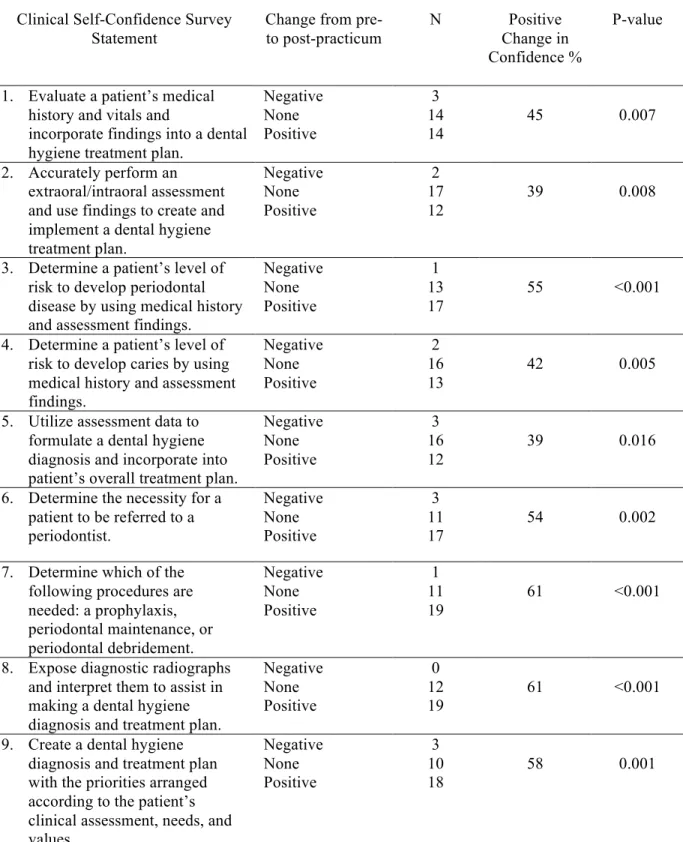
The average change in clinical self-confidence from pre-to post-practicum was statistically significant for all of the 20 statements (Table 1) indicating an overall positive gain in clinical self-confidence from the practicum experience. Greater than 50% of the students reported an increase in confidence for 14 out of the 20 statements. Several students reported no change in confidence from pre- to post-practicum, while a small number of students reported a decrease in confidence for many of the statements. (Table 1)
Group 1 and group 2 were significantly different in the average change scores for statement 9 (P=0.001) and 19 (P=0.001). For both statements (Table 1), the proportion of students that participated in the first practicum who reported positive changes was
substantially higher than the proportion of students in the second practicum (Statement 9: 75% vs 40%; Statement 19: 56% vs 20%).
Although the findings from the pre- and post-practicum surveys indicated a significant increase in confidence following the practicum experience, the students’
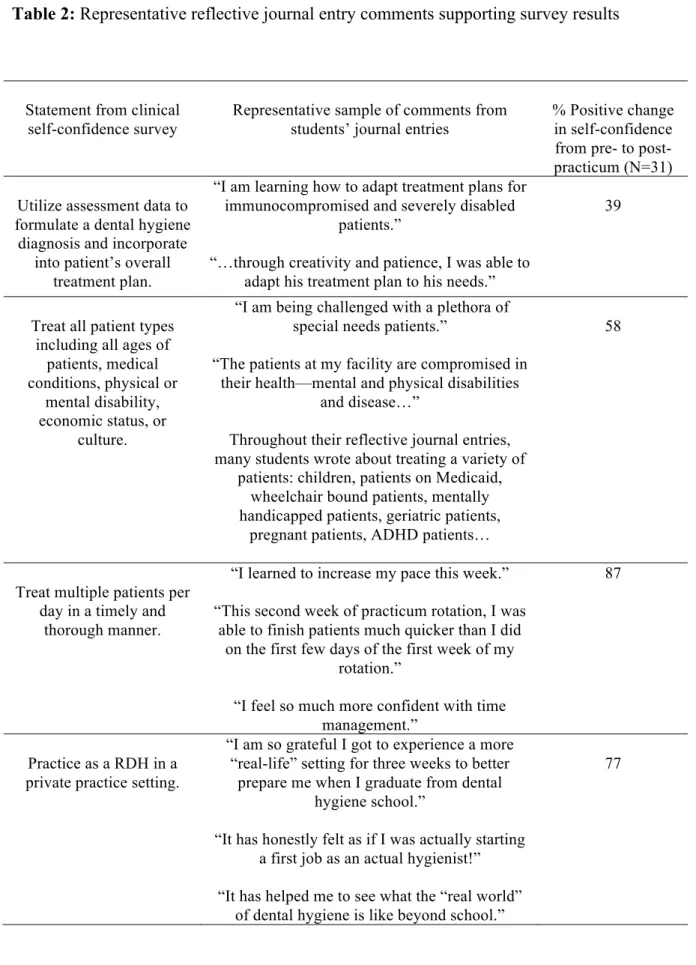
setting, and overall clinical self-confidence. Table 2 reports a representation of comments from students’ reflective journal entries that support the survey results. Table 3 reports a representation of comments from students’ reflective journal entries in which students discussed their overall self-confidence.
Eighty-seven percent of the students reported an increase in confidence in treating multiple patients per day in a timely and thorough manner. In the reflective journal entries, many students commented on treating patients at a quicker pace during their practicum experiences. (Table 2) One student wrote, “This second week of practicum rotation, I was able to finish patients much quicker than I did on the first few days of the first week of my rotation.”
The reflective journal entries also revealed that many students treated a variety of patients. Fifty eight percent of students reported an increase in confidence in treating all patient types. In their reflective journal entries, students reported treating children, geriatric patients, pregnant patients as well as patients with mental or physical disabilities. (Table 2) Seventy-seven percent of students reported an increase in confidence in practicing as a registered dental hygienist in a private practice setting after the practicum experience. One student reflected, “I am so grateful I got to experience a more “real-life” setting for three weeks to better prepare me when I graduate from dental hygiene school.” (Table 2)
DISCUSSION
As dental hygiene students approach graduation and the beginning of their careers as licensed professionals, it is necessary to ensure that they are confident in implementing all parts of the dental hygiene process of care. CODA requires dental hygiene programs to support the development of dental hygienists who are competent in providing the dental hygiene process of care.2 The results of this study indicate a significant increase in the clinical self-confidence of 31 dental hygiene students at UNC SoD for each of the surveyed aspects of the dental hygiene process of care after a 3-week practicum experience.
Comments from students’ journal entries also reflected an increase in clinical self-confidence in particular aspects.
Butters et al. found dental hygiene students to have an increased perception of clinical competence in clinical speed after an extramural education program.8 Similarly, the students in this study were more confident in treating multiple patients per day in a timely and through manner, with 87% of the students reporting a positive change from pre- to post- practicum. A comment from one student’s journal entry read, “This second week of practicum rotation I was able to finish patients much quicker than I did on the first few days of the first week of my rotation.” According to the student, the progression of the student’s pace improved from the previous week at the practicum site. This can likely be attributed to repetitive practice and is an indicator that students may benefit more from a multiple-week practicum
experience. Studies conducted on dental students have also shown that the students did more procedures in less time as a result of practicum experiences.11,24 Mascarenhas et al. found that as each week of the dental students’ externship progressed, more procedures were performed.24 Likewise, Mashabi et al. found that revenue increased as a result of increased productivity after dental students’ returned from a 10-week externship.11
Lynch et al. found that dental students reported an increase in confidence in taking radiographs and treatment planning after participating in a community-based teaching program.9 This is similar to this study’s findings with 61% of dental hygiene students reporting an increased confidence in exposing and interpreting radiographs and 58%
reporting an increased confidence in creating a dental hygiene diagnosis and treatment plan. Furthermore, Butters et al. found that dental hygiene students perceived an increase in clinical competence in radiographic technique after a 4-week extramural rotation.8
as well as patients with mental or physical disabilities. Fifty-eight percent of students reported an increase in confidence in treating all patient types. This is consistent with literature that has found that students were more aware and comfortable in treating
underserved and vulnerable populations after practicum experiences.3-5,7,21,22 As for students who did not increase in self-confidence in this aspect, perhaps their practicum site did not provide them with a variety of patients or perhaps they already felt confident prior to their practicum in treating all patient types.
Students’ reflections supplied several comments that relate to an overall increase in clinical self-confidence. One student stated, “I have learned greater independence and greater confidence in my ability as a clinician.” Likewise, other studies have found
practicum experiences to produce an increase in overall clinical self-confidence in dental and dental hygiene students.4,8-13 Similarly, 77% percent of the students in this study felt more confident to practice as a registered dental hygienist in a private practice setting after the practicum experience. A few students referred to their experiences in their reflections as giving them a sample of the “real world.”
Although a significant increase in self-confidence was found for each statement in the survey, a notable amount of students reported no change in self-confidence for the
with experiences needed to increase confidence. The various practicum sites cannot possibly ensure the same patient experiences and should be individually evaluated for effectiveness.
An unexpected finding of this study was that group 1 had a significantly higher change in row mean score than group 2 for statements 9 & 19 on the clinical self-confidence survey. These results indicate that in regards to these two statements, group 2 appeared to be more self-confident than group 1 before participating in the practicum experience. Although these results cannot be explained, Group 2 participated in their practicum experiences 3 weeks after group 1, therefore group 2 was treating patients in UNC SoD’s clinic throughout that time. By having more time in UNC SoD’s clinic before practicum, with the dental hygiene instructors for guidance, group 2 may have had more experience in creating a dental hygiene diagnosis and treatment plan and documenting discussions and interactions, resulting in being confident prior to beginning the practicum experience.
It can be argued that just because a student reports being confident or not confident it does not necessarily mean that they are competent or not. Each individual is different and some students may be harder on themselves than others. Hopefully, if a student is confident in implementing the dental hygiene process of care, it means that they feel that they have enough knowledge and experiences to feel comfortable in caring for their patients without very much supervision. If anything, a pre- and post-practicum survey may be useful in making the student more aware of their strengths and weaknesses. The reflective journal entries may also contribute to making the student more aware of their clinical
measure for students. Burch has also recommended reflections and self-assessment measures to be utilized as strategies for assessing service learning in dental hygiene education.33
As this study was conducted at just one university with a limited number of subjects, the results cannot be generalized. A response-shift bias may affect the validity of the pre- and post- survey design. Due to the practicum experience being a requirement for students in UNC SoD’s Dental Hygiene Program, a control group was not feasible for this study;
however students’ comments from their journal entries supplied evidence that practicum experiences provided valuable, practical experiences that they would not otherwise have obtained. Further studies including more dental hygiene programs and subjects should be done to confirm results, using a control group if possible. Future studies could also compare faculty members’ opinions of students’ abilities in the dental hygiene process of care after a practicum experience. Another study could assess how many dental hygiene programs are currently requiring students to participate in a multiple week practicum.
CONCLUSION
Table 1: Dental hygiene students’ clinical self-confidence after a practicum experience (N=31)
Clinical Self-Confidence Survey Statement
Change from pre- to post-practicum
N Positive
Change in Confidence %
P-value
1. Evaluate a patient’s medical
history and vitals and
incorporate findings into a dental hygiene treatment plan.
Negative None Positive 3 14 14
45 0.007
2. Accurately perform an
extraoral/intraoral assessment and use findings to create and implement a dental hygiene treatment plan. Negative None Positive 2 17 12
39 0.008
3. Determine a patient’s level of
risk to develop periodontal disease by using medical history and assessment findings.
Negative None Positive 1 13 17
55 <0.001
4. Determine a patient’s level of
risk to develop caries by using medical history and assessment findings. Negative None Positive 2 16 13
42 0.005
5. Utilize assessment data to
formulate a dental hygiene diagnosis and incorporate into patient’s overall treatment plan.
Negative None Positive 3 16 12
39 0.016
6. Determine the necessity for a
patient to be referred to a periodontist. Negative None Positive 3 11
17 54 0.002
7. Determine which of the
following procedures are needed: a prophylaxis, periodontal maintenance, or periodontal debridement. Negative None Positive 1 11 19
61 <0.001
8. Expose diagnostic radiographs
and interpret them to assist in making a dental hygiene diagnosis and treatment plan.
Negative None Positive
0 12
19 61 <0.001
9. Create a dental hygiene
diagnosis and treatment plan with the priorities arranged according to the patient’s clinical assessment, needs, and
Negative None Positive 3 10 18
10. Utilize all possible resources to facilitate patient care including communication with dental specialists and medical providers. Negative None Positive 1 10
20 65 <0.001
11. Communicate with the dentist
about a patient’s overall care.
Negative None Positive 2 11 18 58 <0.001
12. Detect suspicious restorations
and/or areas of possible decay and relay these findings to the dentist. Negative None Positive 0 10 21
68 <0.001
13. Discuss dental hygiene treatment
plan with a patient (and/or their legal guardian/caregiver) including rationale, risks, benefits, possible outcomes, alternatives, and prognosis.
Negative None Positive 3 10 18
58 0.004
14. Treat all patient types, including
all ages of patients, medical conditions, physical or mental disability, economic status, or culture. Negative None Positive 2 11 18
58 <0.001
15. Use hand instruments and
determine where and when an unfamiliar instrument is to be used based on its design.
Negative None Positive 1 7 23
74 <0.001
16. Treat multiple patients per day
in a timely and thorough manner. Negative None Positive 1 3 27
87 <0.001
17. Evaluate outcomes of dental
hygiene care and determine the need for further treatment, oral hygiene instruction, or referral.
Negative None Positive 1 10 17
65 <0.001
18. Document all parts of the dental
hygiene process care: assessment, dental hygiene diagnosis, dental hygiene treatment plan, implementation, and evaluation. Negative None Positive 2 21 8
26 0.046
19. Document discussions and
interactions between the patient and all dental personnel that are relevant to the patient’s dental care. Negative None Positive 0 19 12
39 0.001
20. Practice as a Registered Dental
Hygienist in a private practice setting. Negative None Positive 1 6 24
Table 2: Representative reflective journal entry comments supporting survey results
Statement from clinical self-confidence survey
Representative sample of comments from students’ journal entries
% Positive change in self-confidence from pre- to post-practicum (N=31)
Utilize assessment data to formulate a dental hygiene
diagnosis and incorporate into patient’s overall
treatment plan.
“I am learning how to adapt treatment plans for immunocompromised and severely disabled
patients.”
“…through creativity and patience, I was able to adapt his treatment plan to his needs.”
39
Treat all patient types including all ages of
patients, medical conditions, physical or
mental disability, economic status, or
culture.
“I am being challenged with a plethora of special needs patients.”
“The patients at my facility are compromised in their health—mental and physical disabilities
and disease…”
Throughout their reflective journal entries, many students wrote about treating a variety of
patients: children, patients on Medicaid, wheelchair bound patients, mentally handicapped patients, geriatric patients,
pregnant patients, ADHD patients…
58
Treat multiple patients per day in a timely and
thorough manner.
“I learned to increase my pace this week.”
“This second week of practicum rotation, I was able to finish patients much quicker than I did
on the first few days of the first week of my rotation.”
“I feel so much more confident with time management.”
87
Practice as a RDH in a private practice setting.
“I am so grateful I got to experience a more “real-life” setting for three weeks to better
prepare me when I graduate from dental hygiene school.”
“It has honestly felt as if I was actually starting a first job as an actual hygienist!”
“It has helped me to see what the “real world” of dental hygiene is like beyond school.”
Table 3: Representative reflective journal entry comments on overall clinical self-confidence
“Moments like these help build confidence and help form special revision skills for appointments…”
“(My supervising RDH) told me that she has seen many hygiene students rotate through the site and that she thinks I am prepared for the “real world.” I was so happy to have this confidence boost.”
“This week really helped my confidence level with patient care.”
APPENDIX
CODE _________________
Dental Hygiene Clinical Self-Confidence Survey
By participating in this survey, you agree to be a part of this study. All surveys are coded to protect the identity of respondents.
Please circle the number that most accurately reflects your level of self-confidence for each of the statements below.
0=Not at all confident 1=Lacking in confidence 2=Undecided
3=Reasonably confident 4=Totally confident
1. Evaluate a patient’s medical history and
vitals and incorporate findings into a dental hygiene treatment plan.
2. Accurately perform an extraoral/intraoral
assessment and use findings to create and implement a dental hygiene treatment plan.
3. Determine a patient’s level of risk to
develop periodontal disease by using medical history and assessment findings.
4. Determine a patient’s level of risk to
develop caries by using medical history and assessment findings.
5. Utilize assessment data to formulate a
dental hygiene diagnosis and incorporate into patient’s overall treatment plan.
6. Determine the necessity for a patient to be
referred to a periodontist.
7. Determine which of the following
procedures are needed: a prophylaxis, periodontal maintenance, or periodontal debridement.
0 1 2 3 4
0 1 2 3 4
0 1 2 3 4
0 1 2 3 4
0 1 2 3 4
0 1 2 3 4
0=Not at all confident 1=Lacking in confidence 2=Undecided
3=Reasonably confident 4=Totally confident
8. Expose diagnostic radiographs and
interpret them to assist in making a dental hygiene diagnosis and treatment plan.
9. Create a dental hygiene diagnosis and
treatment plan with the priorities arranged according to the patient’s clinical
assessment, needs, and values.
10. Utilize all possible resources to facilitate
patient care including communication with dental specialists and medical providers.
11. Communicate with the dentist about a
patient’s overall care.
12. Detect suspicious restorations and/or areas
of possible decay and relay these findings to the dentist.
13. Discuss dental hygiene treatment plan
with a patient (and/or their legal guardian/caregiver) including rationale, risks, benefits, possible outcomes, alternatives, and prognosis.
14. Treat all patient types, including all ages
of patients, medical conditions, physical or mental disability, economic status, or culture.
15. Use hand instruments and determine
where and when an unfamiliar instrument is to be used based on its design.
16. Treat multiple patients per day in a timely
and thorough manner.
0 1 2 3 4
0 1 2 3 4
0 1 2 3 4
0 1 2 3 4
0 1 2 3 4
0 1 2 3 4
0 1 2 3 4
0 1 2 3 4
0=Not at all confident 1=Lacking in confidence 2=Undecided
3=Reasonably confident 4=Totally confident
17. Evaluate outcomes of dental hygiene care
and determine the need for further treatment, oral hygiene instruction, or referral.
18. Document all parts of the dental hygiene
process care: assessment, dental hygiene diagnosis, dental hygiene treatment plan, implementation, and evaluation.
19. Document discussions and interactions
between the patient and all dental
personnel that are relevant to the patient’s dental care.
20. Practice as a Registered Dental Hygienist
in a private practice setting.
0 1 2 3 4
0 1 2 3 4
0 1 2 3 4
REFERENCES
1. American Dental Education Association. Recommendations for improving oral health status of all Americans: roles and responsibilities of academic institutions. The Report of the ADEA President’s Commission. 2003: 15-17.
2. Commission on Dental Accreditation. Accreditation standards for dental hygiene education programs. Chicago: American Dental Association, 2013.
3. Branson BG, Gadbury-Amyot, CC, Brown RE. Increasing access to oral health care in underserved areas of Missouri: dental hygiene students in AHEC rotations. J Allied Health. 2007, Spring; 36(1): 47-64.
4. Smith M, Lennon MA, Brook AH, Robinson PG. Perspectives of staff on student outreach placements. Eur J Dent Educ. 2006; 10: 44-51.
5. Smith M, Lennon MA, Brook AH, Ritucci L, Robinson PG. Student perspectives on their recent dental outreach placement experiences. Eur J Dent Educ. 2006; 20: 80-86.
6. Aston-Brown RE, Branson B, Gadbury-Amyot CC, Bray KK. Utilizing public health clinics for service-learning rotations in dental hygiene: a four-year retrospective study. J
Dent Educ. 2008; 73(3): 358-374.
7. Kuthy RA, Heller KE, Riniker KJ, McQuistan MR, Qian F. Students’ opinions about treating vulnerable populations immediately after completing community-based clinical experiences. J Dent Educ. 2007; 71(5): 646-654.
8. Butters Jm, Vaught RL. The effect of an extramural education program on the perceived clinical competence of dental hygiene students. J Dent Educ. 1999; 63(5): 415-420.
9. Lynch CD, Ash PJ, Chadwick BL, Hannigan A. Effect of community-based clinical teaching programs on student confidence: a view from the United Kingdom. J Dent Educ. 2010; 74(5): 510-516.
10. Mofidi M, Strauss R, Pitner LL, Sandler ES. Dental students’ reflections on their community-based experiences: the use of critical incidents. J Dent Educ. 2003; 67(5):515-523.
13. Smith M, Lennon MA, Brook AH, Robinson PG. A randomized controlled trial of an outreach placement’s effect on dental students’ clinical confidence. J Dent Educ. 2006; 70(5): 566-570.
14. Stehno, JJ. The application and integration of experiential education in higher education. Touch of Nature Environmental Center, Southern Illinois University, Carbondale, IL: 1986; (ERIC Document Reproduction Service No. ED 285-465).
15. Itin, CM. Reasserting the philosophy of experiential education as a vehicle for change in the 21st century. J Exp Educ. 1999; 22(2): 91-98.
16. Strauss R, Mofidi M, Sandler ES, Williamson III R, McMurtry BA, Carl, LS, Neal EM. Reflective learning in community-based dental education. J Dent Educ. 2003; 67(11): 1234-1242.
17. Skelton J, Raynor MR, Kaplan AL, West KP, Smith TA. University of Kentucky
community-based field experience: program description. J Dent Educ. 2001; 65: 1238-1242. 18. Ledford JM, Wilder RS, Chichester SR, George MC. Practice trends of dental hygiene students completing specialty tracks. J Dent Hyg. 2004 Summer; 78(3): 4. Epub 2004 July 1.
19. Taylor JA, Hayes MJ, Wallace L. Dental hygiene student experiences in external placements in Australia. J Dent Educ. 2012; 76(5):651-655.
20. Commission on Dental Accreditation. Accreditation standards for dental education programs. Chicago: American Dental Association, 2013.
21. Rohra AK, Piskorowski WA, Inglehart MR, Habil P. Community-based dental education and dentists’ attitudes and behavior concerning patients from underserved populations. J
Dent Educ. 2014; 78(1): 119-130.
22. Thind A, Atchison K, Andersen R. What determines positive student perceptions of extramural clinical rotations? an analysis using 2003 ADEA senior survey data. J Dent Educ. 2005; 69(3): 355-362.
23. Manakil J, George R. Self-perceived work preparedness of the graduating dental students.
Eur J Dent Educ. 2013; 101-105.
24. Mascarenhas AK, Freilich SR, Henshaw MM, Jones JA, Mann ML, Frankl SN.
Evaluating externship programs: impact of program length on clinical productivity. J Dent Educ. 71(4): 516-523.
26. Lynch CD, Ash PJ, Chadwick BL. Evaluation of a community-based clinical teaching programme by current and former student dental therapists and dental hygienists: a pilot investigation. Br Dent J. 2011; 210(10): 481-485.
27. Epp S. The value of reflective journaling in undergraduate nursing education: a literature review. Int J Nurs Stud. 2008; 45:1379-1388.
28. Tsang AK, Walsh LJ. Oral health students’ perceptions of clinical reflective learning-relevance to their development as evolving professionals. Eur J Dent Educ. 2010: 99-105. 29. Gwozdek AE, Klausner CP, Kerschbaum WE. Online directed journaling in dental hygiene clinical education. J Dent Hyg. 2009; 83(1): 1-8.
30. Brondani MA. Students’ reflective learning within a community service-learning dental module. J Dent Educ. 2012; 74(6): 628-636.
31. Asadoorian J, Schonwetter DJ, Lavigne SE. Developing reflective health care practitioners: learning from experience in dental hygiene education. J Dent Educ. 2011; 75(4): 472-484.
32. Tsang AK. Oral health students as reflective practitioners: changing patterns of student clinical reflections over a period of 12 months. J Dent Hyg. 2012 Spring; 86(2): 120-129. 33. Burch S. Strategies for service-learning assessment in dental hygiene education. J Dent Hyg. 2013; 87(5): 265-270.
34. Flanagan JC. The critical incident technique. Psychol Bull. 1954; 51(4):327-358. 35. Fitzgerald K, Seale NS, Kerins CA, McElvaney R. The critical incident technique: a useful tool for conducting qualitative research. J Dent Educ. 2008; 72(3): 299-304.
36. American Dental Hygienists’ Association: Standards for clinical dental hygiene practice, Chicago, 2008 (March 10).