Annex 9
1
Review of mobile tariffs in the UK and US
IntroductionA1.1 This Annex provides a review of the current structure of main mobile tariffs offered by the main mobile operators in the UK and US.
A1.2 The wholesale mobile termination regime in the UK is CPNP. Broadly speaking, the US wholesale mobile termination regime can be considered B&K (see Annex 8.1). Mobile operators can charge the termination rate set by the relevant state regulator for fixed termination, but operators can opt for B&K if they wish to do so. Our understanding is that the majority of calls terminating on mobile networks are governed by B&K arrangements. This means that average mobile termination rates are very low and close to zero.1
A1.3 A good understanding of the retail price structures in the UK and US may help to predict, at least in part, what the UK retail price structure may look like if UK mobile termination rates were reduced further and possibly be set close to zero.
Review of UK mobile tariffs Tariff data
A1.4 We have used tariff data from the UK Mobile Pricing Factbook published in the final quarter of 2008.2 We focus our analysis on tariffs available from the five UK mobile network operators (O2, Vodafone, T-Mobile, Orange and 3).
Post-pay tariffs
A1.5 For our review of post-pay tariffs, we have focussed on standard retail, any-network, any-time tariffs available on an 18 month contract. In particular we focused on:
1.5.1 Retail tariffs – tariffs that can be purchased from most retailers. Online tariffs3, SIM only plans4 and business plans5 are not included in this analysis. Also, we have not taken account of add-ons6 or special offers7;
1
Access fee payments still apply between some operators. See “Call Termination Fees: The U.S. in global perspective”, presented at the 4th ZEW Conference on the Economics of Information and Communication Technologies, Mannheim, Germany, July 2004. Available at: ftp://ftp.zew.de/pub/zew-docs/div/IKT04/Paper_Marcus_Parallel_Session.pdf.
2
This is published by Pure Pricing. 3
Operators sometimes offer additional discounts if the tariff is purchased online from the operator’s own website.
4
SIM-only monthly plans (handset not included) offer more minutes / texts than standard pay-monthly tariffs and usually require only 30 days notice to cancel.
5
Tariffs available to business customers only. 6
On some networks, customers can pay an additional monthly fee for certain add-ons (e.g. unlimited on-net calls, unlimited weekend calls, unlimited fixed calls, additional any-network any-time minutes, additional / unlimited texts, data pack, picture messages, video calling minutes)
7
1.5.2 Any-network, any-time tariffs – these are tariffs that offer mainly any-network, any-time call minutes. We have not included in this analysis plans which offer less any-network, any-time call minutes in exchange for more texts, more off-peak call minutes, more fixed call minutes, or more on-net minutes; and
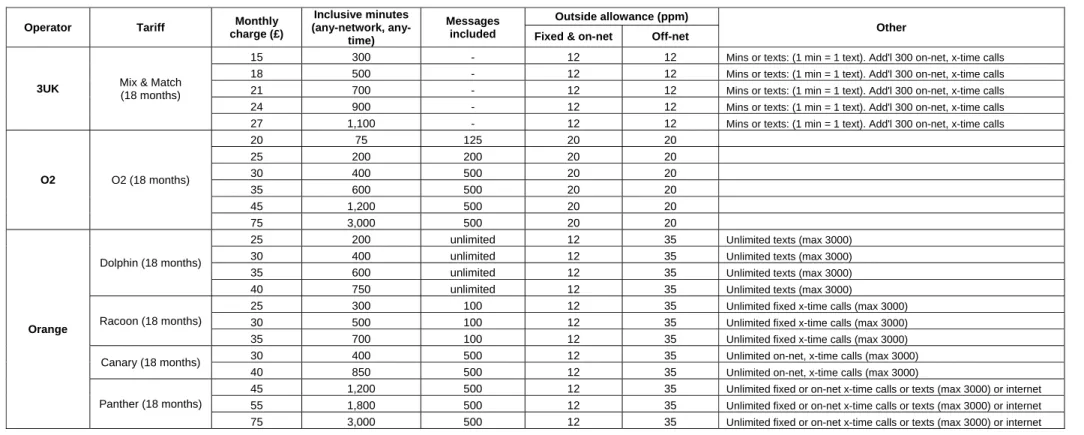
1.5.3 18 month contracts – 12 and 24 month contracts are not included.8 A1.6 Table 1 shows all the post-pay tariffs included in the UK Mobile Pricing Factbook
(Q4 2008), that meet the criteria set out above.
8
84% of new mobile contract connections were 18 month contracts in the first quarter of 2008. See Ofcom’s Communications Market Report 2008, Figure 5.56.
Table 1: Post-pay tariffs in the UK (standard retail, any-network any-time, 18 month tariffs) Operator Tariff Monthly
charge (£) Inclusive minutes (network, any-time) Messages included Outside allowance (ppm) Other Fixed & on-net Off-net
3UK Mix & Match (18 months)
15 300 - 12 12 Mins or texts: (1 min = 1 text). Add'l 300 on-net, x-time calls 18 500 - 12 12 Mins or texts: (1 min = 1 text). Add'l 300 on-net, x-time calls 21 700 - 12 12 Mins or texts: (1 min = 1 text). Add'l 300 on-net, x-time calls 24 900 - 12 12 Mins or texts: (1 min = 1 text). Add'l 300 on-net, x-time calls 27 1,100 - 12 12 Mins or texts: (1 min = 1 text). Add'l 300 on-net, x-time calls
O2 O2 (18 months) 20 75 125 20 20 25 200 200 20 20 30 400 500 20 20 35 600 500 20 20 45 1,200 500 20 20 75 3,000 500 20 20 Orange Dolphin (18 months)
25 200 unlimited 12 35 Unlimited texts (max 3000)
30 400 unlimited 12 35 Unlimited texts (max 3000)
35 600 unlimited 12 35 Unlimited texts (max 3000)
40 750 unlimited 12 35 Unlimited texts (max 3000)
Racoon (18 months)
25 300 100 12 35 Unlimited fixed x-time calls (max 3000)
30 500 100 12 35 Unlimited fixed x-time calls (max 3000)
35 700 100 12 35 Unlimited fixed x-time calls (max 3000)
Canary (18 months) 30 400 500 12 35 Unlimited on-net, x-time calls (max 3000)
40 850 500 12 35 Unlimited on-net, x-time calls (max 3000)
Panther (18 months)
45 1,200 500 12 35 Unlimited fixed or on-net x-time calls or texts (max 3000) or internet 55 1,800 500 12 35 Unlimited fixed or on-net x-time calls or texts (max 3000) or internet 75 3,000 500 12 35 Unlimited fixed or on-net x-time calls or texts (max 3000) or internet
Operator Tariff Monthly charge (£) Inclusive minutes (network, any-time) Messages
included Outside allowance (ppm) Other
T-Mobile Combi (18 months) 15 100 100 30 30 20 200 200 30 30 25 300 300 30 30 30 700 400 30 30 35 800 500 30 30 40 1,000 500 30 30 Flext (18 months)
30 700 - 20 20 Allowance - can be spent on voice, texts, or pictures 35 1,000 - 20 20 Allowance - can be spent on voice, texts, or pictures 40 1,250 - 20 20 Allowance - can be spent on voice, texts, or pictures 50 1,750 - 20 20 Allowance - can be spent on voice, texts, or pictures 75 3,250 - 20 20 Allowance - can be spent on voice, texts, or pictures
Vodafone Vodafone (18 months)
20 100 50 18 40
25 250 100 18 40
30 500 100 15 40
35 700 250 15 35 Choice: unlimited calls to fixed or on-net
40 900 500 15 35 Choice: unlimited calls to fixed or on-net
50 1,500 500 15 35 Choice: unlimited calls to fixed or on-net
75 3,000 500 15 35 Choice: unlimited calls to fixed or on-net
Inclusive minutes
A1.7 Bundles in the UK have been getting larger in recent years, with all five operators now offering some tariffs that include over 1,000 any-network, any-time minutes. Such an allowance is unlikely to be exceeded by most users, and so at least for these large bundle tariffs, most revenues are raised from the fixed monthly charge as opposed to per minute call charges. In general though, these “big-bucket” tariffs cost over £40 per month.
A1.8 Although not as widespread as in the US, there are few examples of unlimited on-net calls on post-pay tariffs in the UK. Both Orange and Vodafone include unlimited fixed and/or on-net (any-time) minutes on a selection of their tariffs, while 3 includes 300 additional on-net any-time minutes on all of their tariffs.
A1.9 In contrast to the US, tariffs with very low inclusive minutes exist in the UK. O2, T-Mobile and Vodafone all offer tariffs that include only 100 minutes or fewer.
On-/off-net price differential
A1.10 3, O2 and T-Mobile charge the same for both on-net and off-net calls made once the allowance is used up, so the on-/off-net price differential is zero in these cases. However, it is not necessarily so for calls within the bundle.
A1.11 Orange charges 12 ppm for on-net calls and 35 ppm for off-net calls once the allowance is used up, giving an on-/off-net price differential of 23 ppm. Where the tariff includes unlimited on-net calls, the effective differential between on-net calls (which are free) and off-net calls is even greater. In reality, in most cases the bundle sizes are so large (e.g. Panther tariffs) that off-net calls are also effectively unlimited for most customers.
A1.12 On lowest priced tariffs, Vodafone charges 18 ppm and 40 ppm for on-net and off-net calls respectively outside of the allowance (on-/off-off-net price differential: 22 ppm). For tariffs charging over £30 per month, these charges fall to 15 ppm and 35 ppm giving a slightly lower on-/off-net price differential of 20 ppm. Where customers opt for unlimited on-net calls, the effective differential is of course even greater, but in most cases the bundle size is so large that off-net calls are effectively unlimited (i.e. a zero differential).
Pre-pay tariffs
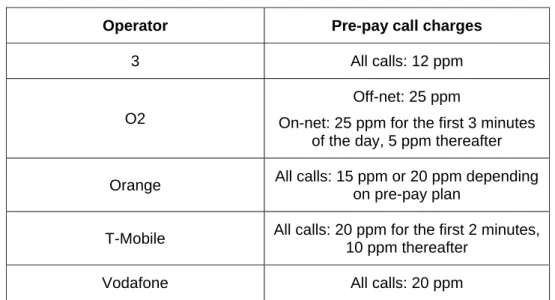
A1.13 Unlike the US, the majority of subscriptions in the UK are pre-pay (64% in 2007). Table 2 summarises the call charges that apply on UK pre-pay tariff packages available from the five mobile network operators.
Table 2: Call charges on pre-pay tariffs in the UK
Operator Pre-pay call charges
3 All calls: 12 ppm
O2
Off-net: 25 ppm
On-net: 25 ppm for the first 3 minutes of the day, 5 ppm thereafter Orange All calls: 15 ppm or 20 ppm depending
on pre-pay plan
T-Mobile All calls: 20 ppm for the first 2 minutes, 10 ppm thereafter
Vodafone All calls: 20 ppm
Source: UK Mobile Pricing Factbook, Pure Pricing, Q4 2008
A1.14 These operators also offer bundles9 or top-up rewards10 on their pre-pay tariffs: 1.14.1 3 customers can purchase a bundle of “units”, where 1 unit = 1 minute or 1
text (valid for 30 days). T-Mobilepre-pay customers can purchase text and talk “boosters”, which give them a bundle of texts or minutes valid for 5 days;
1.14.2 O2andOrange reward customers with a call or text allowance when they top up by a certain amount. The size of the allowance depends on the amount of credit purchased; and
1.14.3 Vodafone offers pre-pay customers top-up rewards (additional texts when they top up by a certain amount). Vodafone pre-pay customers can also purchase bundles of texts and minutes that are valid for 30 days.
Credit expiry
A1.15 Credit does not expire for any operator, and most operators give rewards (minutes or texts) when the customer buys top-up of a particular value. Some operators offer bundles of texts and/or minutes that can be purchased and last for a given period of time (usually 30 days).
Call charges
A1.16 Except for O2, the operators charge the same rate for on-net and off-net calls. A1.17 On 3, Orange and Vodafone this charge is independent of the length of the call,
whereas on T-Mobile call charges are “stepped”, that is, calls are charged at 20 ppm for the first 2 minutes, then 10 ppm thereafter. On O2, fixed and on-net call charges are stepped (25 ppm for the first 2 minutes of the day, 5 ppm thereafter) whereas off-net calls are charged at a flat rate (25 ppm). In general, it can be said that the pre-pay on-/off-net price differential is close to zero.
9
Bundles can be purchased that give an allowance of minutes and texts. 10
Review of US mobile tariffs Tariff data
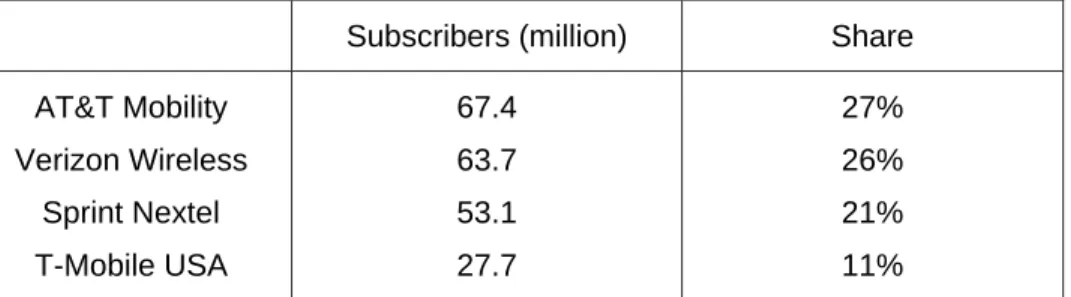
A1.18 We have looked at some of the pre-pay and post-pay tariffs available in October 2008 from the four largest US operators (by subscriber numbers). These currently cover about 85% of US subscribers (see Table 3).
Table 3: Subscribers to the four largest US mobile operators
Subscribers (million) Share
AT&T Mobility Verizon Wireless Sprint Nextel T-Mobile USA 67.4 63.7 53.1 27.7 27% 26% 21% 11% Source: Analysys Mason.
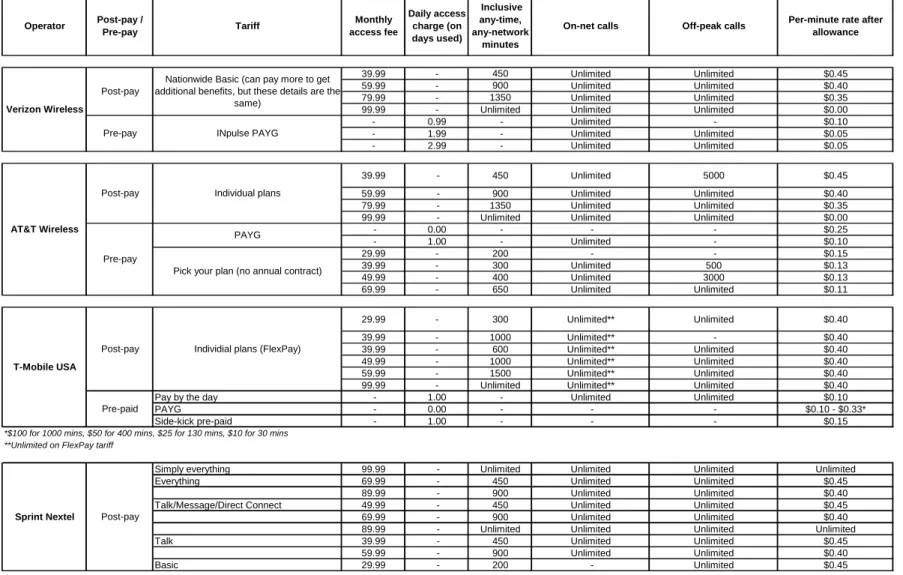
A1.19 Table 4 below summarises a selection of the standard, individual pre-pay and post-pay tariffs available from these four US operators. The information was collected from the operators’ websites in October 2008.
Table 4: Pre-pay and post-pay tariffs in the US (standard retail individual tariffs) Operator Post-pay / Pre-pay Tariff Monthly access fee Daily access charge (on days used) Inclusive any-time, any-network minutes
On-net calls Off-peak calls Per-minute rate after
allowance
39.99 - 450 Unlimited Unlimited $0.45 59.99 - 900 Unlimited Unlimited $0.40 79.99 - 1350 Unlimited Unlimited $0.35 99.99 - Unlimited Unlimited Unlimited $0.00 - 0.99 - Unlimited - $0.10 - 1.99 - Unlimited Unlimited $0.05 - 2.99 - Unlimited Unlimited $0.05 39.99 - 450 Unlimited 5000 $0.45 59.99 - 900 Unlimited Unlimited $0.40 79.99 - 1350 Unlimited Unlimited $0.35 99.99 - Unlimited Unlimited Unlimited $0.00 - 0.00 - - - $0.25 - 1.00 - Unlimited - $0.10 29.99 - 200 - - $0.15 39.99 - 300 Unlimited 500 $0.13 49.99 - 400 Unlimited 3000 $0.13 69.99 - 650 Unlimited Unlimited $0.11 29.99 - 300 Unlimited** Unlimited $0.40 39.99 - 1000 Unlimited** - $0.40 39.99 - 600 Unlimited** Unlimited $0.40 49.99 - 1000 Unlimited** Unlimited $0.40 59.99 - 1500 Unlimited** Unlimited $0.40 99.99 - Unlimited Unlimited** Unlimited $0.40 Pay by the day - 1.00 - Unlimited Unlimited $0.10 PAYG - 0.00 - - - $0.10 - $0.33* Side-kick pre-paid - 1.00 - - - $0.15
*$100 for 1000 mins, $50 for 400 mins, $25 for 130 mins, $10 for 30 mins **Unlimited on FlexPay tariff
Simply everything 99.99 - Unlimited Unlimited Unlimited Unlimited Everything 69.99 - 450 Unlimited Unlimited $0.45
89.99 - 900 Unlimited Unlimited $0.40 Talk/Message/Direct Connect 49.99 - 450 Unlimited Unlimited $0.45 69.99 - 900 Unlimited Unlimited $0.40 89.99 - Unlimited Unlimited Unlimited Unlimited Talk 39.99 - 450 Unlimited Unlimited $0.45
59.99 - 900 Unlimited Unlimited $0.40 Basic 29.99 - 200 - Unlimited $0.45 Standard, individual, pre-pay and post-pay tariffs as available on 14th October 2008
Verizon Wireless
Pre-pay Post-pay
Nationwide Basic (can pay more to get additional benefits, but these details are the
same) INpulse PAYG
Pick your plan (no annual contract) PAYG Individual plans AT&T Wireless Pre-pay Post-pay Post-pay Sprint Nextel
Individial plans (FlexPay)
Pre-paid Post-pay
Post-pay tariffs
A1.20 The majority of post-pay bundles are much larger (in terms of included minutes) in the US compared to the UK. The majority of tariffs includes unlimited on-net calls as well as unlimited off-peak (i.e. evening/night and weekend) calls to any networks. Moreover, for a larger fixed fee, the operators charge lower per-minute out-of-allowance call charges.
A1.21 This suggests that operators raise most of their revenues from the fixed monthly charge. Therefore, it appears that in a market with (very) low mobile termination rates, a large proportion of revenues is raised via the fixed monthly charges. A1.22 We also note that the price per minute for calls outside of the allowance is in the
range of $0.40, which is much higher than the average price within the bundle. Operators may use these charges to aggressively push consumers onto the next tariff with more inclusive minutes.
Pre-pay tariffs
A1.23 AT&T, Verizon and T-Mobile offer pre-pay tariffs with a daily access charge (payable only on days when the phone is used). This is akin to a fixed fee (in relation to the minutes of use). It appears that they are willing to offer lower per-minute call charges, and more unlimited/bundled per-minutes in exchange for a fixed daily charge.
On-/off-net price differential
A1.24 On-net and off-net (domestic) calls outside the allowance for all tariff packages are always charged at the same rate. However, as most post-pay tariffs (and some pre-pay tariffs) offer unlimited on-net calls, once the allowance of off-net calls is used up, there is an effective differential between the price of on-net calls (which are always free) and off-net calls (charged at a flat rate beyond the allowance). A1.25 In reality though, the bundle sizes are so large that off-net calls are effectively
unlimited for a large number of customers. Therefore, the on-/off-net price differential is close to zero for most users.
Incoming versus outgoing call charges
A1.26 In the US consumers are charged both for making and receiving calls. For all main tariffs surveyed here, all the bundles include both incoming and outgoing minutes11 and the call charges, if the limit in the bundles in exceeded, are the same. This is the case for all operators and all the main tariffs. The above information means that all operators for all levels of output charge the same price for both types of calls. A1.27 This may provide some interesting information as to the relative value consumers
assign on average to make and receive calls. If we assumed that the cost of origination is equal to the cost of termination,12 then any difference in caller and
11
The evidence reveals that incoming and outgoing calls count equally against any allowance of minutes - i.e. a one minute incoming call = a one minute outgoing call = one minute’s worth of allowance.
12
In reality, the cost of origination may be marginally higher as it includes the cost of transit which is borne by the caller but not by the receiver.
recipient charges would point to a difference between the level and shape of the demand curves for receiving a call and for making a call, respectively.
A1.28 Given that the costs are likely to be very similar – under the quasi-B&K system in the US the cost of the call is effectively equally shared between caller and receiver13 - the most plausible implication seems to be that consumers value incoming calls as much as they value outgoing calls. Indeed, if consumers valued receiving calls less than making calls, operators would have incentives to price receiving calls lower than making calls.
A1.29 An alternative possible explanation as to why charges to make and receive calls are identical could be that consumers value simple tariffs and, hence, if the difference in valuation were not very large, operators may provide simple tariff structures.
However, given consumers’ ability to deal with relatively complex mobile retail price structures this does not appear at first sight a convincing explanation.
A1.30 This suggest that if hypothetically the US introduced a wholesale CPNP system that made the caller bear all the cost of the call, there would be a positive externality enjoyed by the recipient of the call. Whether consumers could take action to internalise this, is a separate question which will have to be addressed separately. Underlying cost structure
A1.31 Under B&K a network does not face a termination fee to terminate a call onto another network (off-net calls). On the contrary, it may face a cost to terminate it on its own networks (on-net calls). Therefore, one would expect that the retail tariffs of mobile networks would provide some incentives to terminate calls off-net. To some extent this could be seen as a version on the “hot potato issue” which is often raised as a concern under B&K whereby the originating operator may have an incentive to pass on some of the cost to the terminating operator. In this case instead the originating operator would have an incentive to “offload” as many calls as possible. A1.32 Absent other considerations, this would only be true if networks felt that there was a variable per minute cost that they should recover through a variable – not a fixed – retail charge. If the cost of on-net calls was felt to vary by minute, operators would be expected to recover it through a per minute charge. At the same time because they perceive that (marginal) cost for per minute of off-net calls does not include termination rate, one would also expect that the retail call charge for off-net calls, if it existed, should be lower than for on-net calls.
A1.33 What we observe from these retail tariffs seems to suggest that the perceived per minute cost is zero or close to zero:
1.33.1 They recover most of their costs through fixed fees - this may suggest that they do not face high per minute marginal costs either for on- or off-net calls; and
1.33.2 Their retail charges do not distinguish in any significant way between on and off-net calls. To be precise, it appears that the retail on-net call charges are set at zero (the majority of tariffs give unlimited on-net calls) while for off-net calls most tariffs include unlimited off-peak calls and charge some
13
In practice, the caller may also bear the cost of conveyance and hence pay slightly more than half of the costs.
positive rate for peak off-net calls. This may further suggest that the
marginal cost for on-net calls may not be that different from that from off-net calls (which is close to zero on average).