Plan for JDF and Process Automation
Implementation Analysis
Final Report for Perry Judd’s
by
Deepak Kumar Mohan Kumar
Western Michigan University, MI
December 20, 2005
CIP4 Disclaimer: Many printers have asked how they should go about analyzing their situation
and determining where to begin their JDF-enabled process automation programs. CIP4 hired an intern, Deepak Kumar, who worked with Ed Bacsik, General Manager of Perry-Judd’s Inc. Madison, Wisconsin, who volunteered and graciously opened Perry-Judd’s doors to Deepak for the purpose of creating this sample analysis. Deepak’s role was to act as a consultant to Perry-Judd’s and he was to treat Mr. Bacsik as his client.
The resulting report, (this document), is provided as an example that printer’s may use to organize their own initial look at process automation. CIP4 does not guarantee or warrant that the facts or opinions expressed in this document are true, and the statements and conclusions made in this document do not reflect any official position or statement from CIP4. All prospective enabled process automation users are strongly encouraged to seek out current specifications for JDF-enabled products and services directly from vendors and providers, and should not rely on any information contained herein.
Plan for JDF and Process Automation
Implementation Analysis
Final Report 1.0
For Perry Judd’s
by Deepak Kumar Mohan Kumar
Table of Contents
Section Page
Table of Contents ... 1
Executive Overview ... 2
Analysis of Current Operations and Systems ... 3
Customer priorities for process improvement ... 6
Operational and Budgetary goals ... 6
Options for improvements Equipment choices for each option with benefits, risks and mitigating factors... 7
Recommendations Recommendation and Justification based upon Options... 18
Further study ... 19
Implementation in steps and Timeline ... 19
Acceptance testing... 20
Project budget... 20
Return on Investment ... 21
Executive Summary:
Perry Judd’s is one of the major printer / publishers in the US. Perry Judd’s has production facilities in 4 different locations in USA with the corporate office located in Waterloo, Wisconsin. Perry Judd’s is located at Waterloo (WI), Madison (WI), Baraboo (WI), Spencer (IA) and Strasburg (VA). Among the 4 production facilities, Madison Division is a dedicated prepress division and Strasburg is another location that has prepress along with the press facility.
Perry Judd’s is well equipped with 26 state of the art printing presses along with a huge array of prepress and post press equipment.
Introduction to Madison Division:
Perry Judd’s Madison Division is a digital prepress catering to both the internal needs of the company and also the external clients. Madison Division produces plate ready digital files that are eventually imaged at different printing facilities of the company using Computer to Plate (CTP) technology. Madison Division works round the clock producing approximately 20,000 “Plate ready” digital files every month. Majority of the jobs are magazine book makeup with some exception of advertising related jobs.
List of Departments:
1. Customer Service Representative
2. Color Systems (Scanning and Digital Proofing) 3. Image Retouching
4. Page Layout 5. Imposition
Analysis of Current Operations and Systems:
Different forms of Communication:
1) Production Time Response (initiated from Estimators @ Corporate Office, Waterloo, WI and meant for CSRs at the branches)
2) Customer Profile (only in Color System) 3) Job Information Sheet (Initiated by CSR)
4) Job Docket Sheet (a part of Job Information Sheet that is attached to the job docket)
5) Customer instructions are received by Fax, Phone, email and written instructions are also received in most of the cases.
Different tools of Communication: 1) Microsoft Excel (Job Information Sheet)
2) FileMaker Pro (Used by CSRs to create Job Docket Sheet) 3) Litho Traxx (To track the production time of a job)
4) Job Docket Sheet (printed sheet that moves around the departments)
List of equipment in different departments: 1. Customer Service Representative
a. Personal Computers, 8 units, either P3 or P4s with a minimum of 512 MB RAM and 20 GB hard disk.
2. Color Systems (Scanning)
a. Hell Chromagraph S3900 Drum Scanner b. Microtek Scanmaker X12 Flatbed Scanner
c. Apple Macintosh Workstations, 3 units, either G3 or G4 with 2 GB RAM and at least 40 GB hard disks.
d. Personal Computers, 5 units, either P3 or P4s with a minimum of 512 MB RAM and 20 GB hard disk, these PCs are used to drive different output devices.
e. Color Guidance Wide Format Proofer f. Kodak Approval XP Proofer
g. Kodak Approval PS Classic Proofer h. GretagMacbeth Spectroscan
3. Image Retouching
a. Apple Macintosh Workstations 4. Page Layout
a. Apple Macintosh Workstations 5. Imposition
a. Apple Macintosh
List of software in different departments: 1) Customer Service Representative
a) Microsoft Excel b) FileMaker Pro c) Litho Traxx
2) Color Systems (Scanning) a) Adobe Photoshop 3) Image Retouching
a) Adobe Photoshop
b) VISU CoCo – Adobe Photoshop Plug-in 4) Page Layout
a) QuarkXpress 5) Imposition
a) Artwork System’s NexusRIP for imposition. NexusRIP is the standard house RIP and it can drive all the large format printers on the network. NexusRIP also produces plate-ready imposed pages for platesetters (Computer to Plate -CTP) at the printing branches of Perry Judd’s. Once the imposed page is ready the file is transferred over the Internet to the printing branches and stored on to the file servers of respective branches. At the printing branches, as per the requirement of the job, the plates are made on the CTP using these imposed, plate-ready files.
Servers:
Perry Judd’s Madison, Wisconsin branch has three different kinds of file servers, Web server, Work-in-progress (WIP) and Imposition server.
Web server having 2 terabytes capacity stores the raw data from the clients that is received through FTP, email and removable media. Web server can be accessed by all workstations and files are archived in the native application formats. WIP server, with a total capacity of 2.5 terabytes (multiple servers) stores all the jobs running. Imposition server has a capacity of 2 terabytes and stores the final imposed layouts of the job.
Observations:
Madison division has many job dependant workflow paths. There is NO single, complete, paperless mode of communication existing among the departments and divisions.
Schematic Diagram of Current Workflow Process at Perry Judd’s, Madison Divison, Wisconsin
Customer priorities for process improvement:
1. Quicker response time 2. Faster turnaround time 3. Value added service 4. Error-free product
5. Advantage of Cost reduction
Operational and Budgetary goals:
1. Reduce overall cost of production
a. Improved communication through Job Ticketing cost of production will be lower 2. Reduce production cycle time
a. As the complete job information is readily available throughout the job cycle, shorter make-ready time a reduced production cycle time can be expected
3. More throughput with less staff
a. With the reduced production cycle time, number of manual hours required will be less hence more throughput can be expected with the same or less number of staff 4. Development of integrated process
a. Print production process can be seamlessly integrated with job information made available from the stage of inception to completion of the job, including MIS.
5. Optimization of equipment utilization
a. Elaborative Job scheduling that takes into account the machine on which a job would be produced would enable optimum planning of the machine hour usage.
6. Quicker Return on Investment
Observed pitfalls:
1. Different tools and forms of communication practices between the departments 2. Fragmented job information
Options for improvement:
Equipment choices for each option with benefit, risk and mitigating factors:
An in-depth study of software available for each department was conducted and the findings about each of the software are as shown below.
Prism-Win: Strength:
1. Faster and accurate quotes from templates, standard models or existing quotes with similar specification.
2. Quote letters are automatically generated
3. Purchase orders, invoices and dispatch instructions are generated automatically 4. Easy comparison of actual cost with quoted cost and material usage
5. Comprehensive job costing report provides a very detailed analysis of single job or on the basis of ranges of jobs, by customer, product type and processes
6. A detailed trend analysis, production loading and budgeting
7. Strong inventory control with automatic reordering, stock details and prices
8. Can record bin and stock locations for comprehensive inventory management that can make even individual tracking easy
9. Easy shop floor management with the help of electronic timesheets and automatic transfer of information
10. Tailor made reports to suit the individual requirement, Ad hoc report creation using a report writing application and can also provide management analysis reports.
Weakness:
1. Lacks control over the sections of process such as production planning, human resource management, online file submission, JDF Preflighting, soft Proofing, imposition, press, postpress and delivery.
Graphisoft-Integrale: Strength:
1. Effective customer management with extensive information about the customer and handling of activity reports by sales representatives.
2. Detailed Estimation Tool incorporates the most economical production process depending on the equipment available for the job.
3. Production Management and Control Tool can forecast time and material consumption to great accuracy
4. Inventory Control Tool can consider historical data to keep track of material consumption and accurate management of raw materials. The record of actual consumption by any given job helps in better billing of the job.
5. Information and Resources Management allows real-time sharing of information with all the employees in the company
Weakness:
1. Concentrates mainly on the estimating and management control and lacks control over the sections of process like JDF Preflighting, Soft Proofing, Imposition, Press, Postpress and Delivery.
Creo-Synapse Prepare: Strength:
1. Links creative and production processes with easy creation of PDF files
2. Production ready and Error-free PDF creation due to predefined PDF parameters that represent the creation preference of a particular production environment
3. Extension to applications like, QuarkXPress, Adobe InDesign and a drag and drop Synapse Prepare applet or hot folder for Postscript or PDF makes it easy to use
Weakness:
1. Available only on Macintosh platform DALiM – PRiNTEMPO:
Strength:
1. DALiM PRiNTEMPO is much more than a preflight tool, it is a web-based automated JDF imposition and deadline management tool.
2. Supports Job Ticket definition 3. Can provide real time job status
4. Can send automatic emails on job status change (job creation, pages status, imposition status, etc.)
5. Supports Job and job sections deadline management 6. Efficient production planning tool
7. Centralized web-based application
8. JDF-based Automatic imposition tool that supports Signature creation and web-based validation
9. Supports separation re-mapping
10. Web-based "soft-interpretation" file preflight and JDF preflight is an option 11. Automatic page normalization to "Print Predictable" state
12. Web-based soft proofing and validation for pages and signatures 13. Has an intelligent page version management
14. Supports automated page-numbering settings with manual override option 15. Pagination can be re-ordered at any time
16. Can accommodate last minute imposition changes like, translation, rotation or scaling at page-level
17. Can also accommodate last minute press changes with database-accessed imposition templates
Weakness:
1. DALiM PRiNTEMPO requires DALiM TWiST automated workflow system EFI-PrinterSite Internal:
Strength:
1. It can run on laptop, desktop or latest PDA 2. Clear specification of jobs
3. Can receive estimates 4. Can generate Letter of quote 5. Easily track job status 6. Easy viewing of invoices
7. Reviewing account history is possible 8. Job reordering
9. Estimators, CSRs and back office can share information
10. Integration with EFI Hagen OA, Logic SQL and PSI Print management system makes it a complete online process and paperless to a great extent
Weakness:
1. Viewing and checking of page contents of job is not possible Heidelberg-Prinect Prinance:
Strength:
1. Estimation of jobs is done considering all the relevant production steps by pre-structuring of work steps prepress through finishing
2. Electronic job ticket carries the job data to other Heidelberg software products along the workflow and hence multiple entries of job data is avoided
3. Continuous monitoring of costing and statistical evaluation through other Heidelberg software solutions
4. Automatic generation of quotation and transfer to the sales designated person’s Microsoft Outlook Date Management software
5. Other documents like delivery notes and invoices are automatically generated without any additional manual intervention
6. Customer calls are monitored through special Computer Telephony Integration (CTI) software that identifies the customer through the customer’s ISDN number and opens a window containing all relevant job information about the customer
7. Material management is easy and comprises of storage site management of both raw material and finished products
8. Supports re-ordering process of raw materials Weakness:
1. Complete advantage of all the features can only be availed with other hardware and software solutions from Heidelberg such as, Prinect Data Control, Prinect Signa Station, Prinect Printready System, Prinect CP2000 Center, and Prinect FCS 100. This demands extensive investment on these solutions.
Creo-Synapse Insite: Strength:
1. Secure login (SSL-Secure Sockets Layer) to print buyers that is restricted to only their jobs 2. Job uploading and downloading
4. Integrated remote proofing
5. Change requesting can be done by remote and email notification 6. Customized HTML interface
7. Option to use down-sampled images with option to view high-resolution, production-file data on demand with great control over zoom, pan, annotate and collaboration with multiple users and multiple sites simultaneously
8. Detailed transaction log that is included in jobs
9. Internal management of jobs and customer information by a browser interface requiring no special plug-in
Weakness:
1. Requires Creo Brisque / Prinergy to support many features EFI-Hagen OA:
Strength:
1. Versatile database integration even with external databases such as Oracle and DB2/400. 2. Robust SQL based enterprise applications are robust, scalable and secure on almost any
client/server environment.
3. Intelligent estimating system with better control over estimating, quoting, order entry, job management, purchasing, scheduling, inventory and fulfillment
4. Browser-based data collection 5. Remote production monitoring 6. Budgeted hourly rates
7. Standard and custom reporting Weakness:
1. Lacks capabilities like Online File Submission, JDF Preflighting, Soft Proofing, Job Approval, Integrate CSR, Imposition and Delivery
Heidelberg-Prinect: Strength:
1. Precise pre and post-costing of job
2. Seamless job data exchange within the entire production processes of prepress, press and postpress
3. Clear job preparation by determination of all the production steps required for the entire job with specification of deadlines
4. Robust archiving and asset management system allows access to all production-related data 5. Data generated in prepress can be successfully used in press and postpress to preset the
equipment to be job specific
6. Press operator can initiate the process of plate making even in the absence of prepress personnel
Weakness:
1. Areas such as sales management, human resource management, online file submission by client, JDF preflighting and delivery logistics are not given attention
2. In order to avail all the advantages mentioned above, it is required to have the complete range of hardware and software solutions from Heidelberg such as: Prinect Prinance, Prinect Data Control, Prinect Signa Station, Prinect Printready System, Prinect CP2000 Center, Prinect Online Kit, P-Net / Compucut and Prinect FCS 100
Creo- Prinergy: Strength:
1. End-to-End native PDF processing 2. Scalable and configurable infrastructure 3. Supports JDF
4. Efficient Job and Production management 5. Automation as easy as click-and-go 6. Robust Oracle database
7. Macintosh and Windows interface 8. Automated PDF trapping
9. Color matching and management tool 10. Supports Hexachrome colors
11. Database based archiving Weakness:
1. Need to purchase the entire package of solution in Prinergy that consists of - Prinergy Connect, Direct, Powerpack and Synapse Prepare, InSite and Link
AGFA-Delano: Strength:
1. Excellent solutions for better customer relations that encompass a common workspace that simplifies and accelerates project planning and production with a strong link to customers. 2. Automated, simplified process of planning, staffing and tracking jobs using simple graphic
icons
3. Hot folder based file handling and page processing
4. Highly JMF savvy that allows devices to exchange of status information and hence better messaging throughout the entire print process
Weakness:
1. No tools to support Invoicing, Accounting, Sales Management, Estimation, Material Management and Imposition but it can integrate with applications or tools with these functionalities
DALiM –Mistral: Strength:
1. Very strong tool to display, track and administer print projects
2. Apparently covers all the requirements from Online File Submission to Delivery Weakness:
1. Completely lacks important capabilities such as invoicing, estimating, accounting, sales management, order processing, production planning, human resources and material management.
Heidelberg-MetaDimension: Strength:
1. Job ticket driven RIP and workflow solution 2. Supports Open Prepress Interface (OPI) 3. Supports trapping
4. Supports automatic page positioning 5. Supports color management and screening
6. Supports different kinds of proofs such as, form proofs, color proofs and concept proofs 7. Special screening pattern - Satin Screening is supported for better image quality
Weakness:
1. Full advantage of all the features can be availed with other hardware and software solutions from Heidelberg like, Prinect Prinance, Prinect Signa Station, Prinect Printready System, Prinect CP2000 Center, and Prinect FCS 100
Heidelberg-Signa Station: Strength:
1. Easy imposition
2. Imposition is flexible to accommodate last minute modifications, product and production requirements
3. Quick, transparent and reliable job processing using different modes 4. User friendly display
5. Customizable color control marks and line marks Weakness:
1. Complete range of advantages of all the features can be availed with other hardware and software solutions from Heidelberg like, Prinect Prinance, Prinect MetaDimension, Prinect Printready System, Prinect CP2000 Center, and Prinect FCS 100
Heidelberg-AutoRegister: Strength:
1. World’s first and only sheetfed press measuring and register control system 2. Accurate registering even at changing printing speeds and ink settings
3. Corrections made by the press operator is stored as a reference file in Prinect CP 2000 Center
Weakness:
1. Must be used as a part of Heidelberg Prinect solution and not as stand-alone software Heidelberg-CP2000 Center:
Strength:
1. Preset data from Prinect Prepress Interface can be transferred online 2. Preset data can be transferred between presses
3. Software module connects to MIS, Prinect Data Control and Prinect Prinance and hence press and job status is available online all the time
5. Online, remote service facility for Heidelberg Speedmaster presses 6. Reduced waiting time for UV ink wash up, using a software module 7. Can set dryer parameters directly
8. Joint washing of impression and blanket cylinder on Speedmaster SM 102 Weakness:
1. A part of solution in the Heidelberg Prinect package of solutions Heidelberg-Compucut:
Strength:
1. Cutting programs for machines such as Polar can be created to optimize the workflow 2. Time savings and production cost savings are two big advantages
3. Complete visualization and documentation of the process 4. Flexible production
5. Maximum utilization of machine capacity 6. Improved Quality of production
Heidelberg-FCS 100: Strength:
1. Easy creation of programs for folders along with Heidelberg Compufold
2. Using Heidelberg Compustitch, programs for saddlestitchers can be easily created using data from Signa Station
3. Precise production data from folders and saddlestitchers can be obtained
4. Along with Heidelberg Production Data Management (PDM) software, time and production cost reduction is easily achievable
5. High utilization of finishing machine capacity Weakness:
1. Heidelberg Production Data Management (PDM) software is a must along with FCS 100 to get production data from finishing machinery
2. Heidelberg Compufold is required to generate programs for folders Heidelberg-Compufold:
Strength:
2. In case of standalone version, a detailed printout can be provided to the folding machine operator
3. Selection of a particular folding machine configuration
4. Folding machine configuration can be displayed graphically in detail 5. Easy changes in folding sequence from the fold-type catalog
6. Presettings for folders can be easily defined depending on folding sequence 7. Processing of JDF folding data
Weakness:
1. Can be used only along with FCS 100 Graphic Microsystem-ColorQuick:
Strength:
1. Closed loop color control system for most of web offset presses 2. Reduces make ready time tremendously by using digital ink key presets 3. Extensive Color Manager Statistical Process Control (SPC) Reporting package
4. Manpower reallocation can be done due to less manual attention requirement in production 5. Consistent quality is easy to achieve with closed loop color controlling
6. Spectrophotometer along with the video technology makes the system more efficient
7. Wide range of press integration due to close working with major printing equipment manufacturers
8. Remote diagnosis via modem enables testing, upgrade and analysis of the equipment by GMI support and engineering staff
9. Add-on interface would support the flow of JDF data from either imagesetter or platesetter Weakness:
1. It is available to web offset presses and not for sheetfed presses Graphic Microsystem-MicroColor:
Strength:
1. Full-featured digital computer ink key control system for most sheetfed and web offset presses
2. Can be retrofit onto an existing press or fitted to a new press
4. Very precise ink key settings using patented digital servomotor 5. Customizable design components to match over 400 press models
6. Varying factors such as, speed, fountain sweep, color sequence and ink coverage of the job are taking into consideration
7. Add-on interface would support the flow of JDF data from either imagesetter or platesetter Graphic Microsystem-PrintQuick:
Strength:
1. Closed-loop register control system for web and newspaper presses 2. Superior optics with tiny targets makes it very effective
3. Highly sophisticated image analysis helps
4. Wide field of view allows high control over the process in locating the target and locking 5. Live camera view allows continuous monitoring of the targets and register status
6. Unique positioning on the unsupported web after the last printing unit negates many obstacles in achieving continuous registering even at high speeds
EFI-Auto-Count 1000: Strength:
1. Easy to use windows interface with user-friendly Graphic User Interface (GUI) 2. Can be used on sheetfed, web, digital and postpress equipment
3. Self-sustaining equipment with its own server and networking to support multiple auto-count systems dedicated to equipment in press and postpress
4. Collects real-time press and production statistics that covers the entire plant and also identification of the product on the skids, generation of load ticket and labeling of skids 5. Connected to the corporate network and hence management can get a clear picture 6. Control over the equipment to even shut it down after the required quantity is produced 7. Eliminates overruns, underruns and reruns and hence eliminates wastage also provides a
means of monitoring the performance of personnel and machines so that better scheduling of men and machinery can be achieved
Weakness:
Recommendations:
A wide range of software and hardware products that support JDF were considered and evaluated. Many of the products had similar functionalities and it was difficult to find a single, complete solution. JDF technology being updated regularly, the software and hardware solutions available in the market need to incorporate many more functionalities to be more effective.
Keeping in mind the customer priorities like the following,
1. Quicker response time: Improved communication and integrated process results in quicker response time by easy access to job specific information throughout the process.
2. Faster turnaround time: Fragmented job information can be eliminated and with the implementation of JDF, make-ready time is drastically cut down facilitating a faster turnaround time and increased throughput in the given time because of ready availability of required information. Optimal production planning and coordination of deadlines would also influence faster turnaround time.
3. Value added service: Seamless integration of print process from inception to delivery gives customers, the luxury of job information at any point of production which could be a great value added service.
4. Error-free product: Unambiguous, readily available, job information would facilitate better intra and inter department communication hence chances of human error related to communication could be eliminated to a great extent
5. Advantage of Cost reduction: Different objectives successfully achieved like, better throughput with less staff, quicker response time, faster turnaround time, error-free product, and optimal equipment utilization would result in cost reduction. Expected Return On Investment as shown in Page 21 would effectively demonstrate the advantage of cost reduction.
Other advantages like, enhanced transparency that allows flexibility in production planning and allocation of resources like men and machinery can be achieved. Instant notification of customer feedback like correction or approval can be notified to CSR and production planning teams in real time.
Considering the management and customer priorities of Perry Judd’s, combination of Graphisoft – Integrale, Dalim Printempo and Mistral would be an ideal software combination. Graphisoft –
Integrale is powerful in the areas of customer management, estimation, production management, inventory control, information and resources management tool. Dalim Printempo is strong in the areas of preflight, JDF imposition, deadline management, web based, page normalization, versatile to accommodate last minute changes in translation, rotation and scaling. Dalim Mistral covers apparently all the requirements from online file submission to delivery hence this makes it a very strong tool in the area of production.
Further study:
After successful implementation of JDF in the areas of design and prepress, further study upon the impact of JDF on press, prepress and delivery should be conducted. It should be noted that this research also covers the areas of press, prepress and delivery hence this study can be used in future as the baseline for further actions to be taken.
Implementation in steps and Timeline:
Timeline for implementation of JDF can be estimated at anywhere between 9 to 15 months due to the fact that, the interaction of management and equipment provider would take anywhere between 4 – 6 months that would cover discussions on technical and pricing fronts. Employee training and orientation on the issues of the need to implement JDF and basic training on the software and hardware under consideration would require 3 – 5 months. Installation of the hardware and software solutions and tailoring them to the needs of the management would take around 2 – 4 months.
Timeframe for JDF Implementation 0 2 4 6 8 10 12 14 16 M ont hs
Negotiations Training Customizing
Timeframe for JDF implementation
Maximum Time Minimum Time
Acceptance testing:
The proposed implementation of JDF would be tested best on-site after the completion of all the installations as recommended in the study. Most of the important factors have been considered doing the study and only a real-life work atmosphere can provide us with the minutest details required for a through testing because every production plant is different and any given job might have many different workflows under different situations. Recommended acceptance testing would involve sample re-running of completed job to make sure that all the management and customer objectives are achieved and all the benefits are realized.
Project Budget:
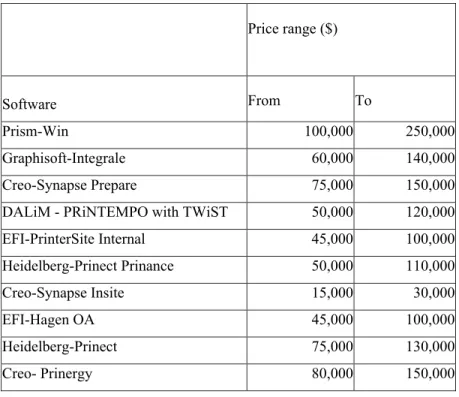
The pricing on Graphisoft – Integrale and Dalim products Printempo, Mistral and Twist are also attractive as shown in Table 1. The thesis research done has been extended to press, postpress and delivery but at the moment the focus is on the design and the prepress. Total cost of implementation would range between $ 170,000 and $360,000. The expected benefits to be achieved are quicker job turnaround, value addition and cost savings.
Table 1: Estimation of Software Pricing
Price range ($) Software From To Prism-Win 100,000 250,000 Graphisoft-Integrale 60,000 140,000 Creo-Synapse Prepare 75,000 150,000 DALiM - PRiNTEMPO with TWiST 50,000 120,000 EFI-PrinterSite Internal 45,000 100,000 Heidelberg-Prinect Prinance 50,000 110,000 Creo-Synapse Insite 15,000 30,000 EFI-Hagen OA 45,000 100,000 Heidelberg-Prinect 75,000 130,000 Creo- Prinergy 80,000 150,000
AGFA-Delano 70,000 160,000 DALiM –Mistral 60,000 100,000 Heidelberg-MetaDimension 15,000 75,000 Heidelberg-Signa Station 7,500 15,000 Heidelberg-AutoRegister 35,000 75,000 Heidelberg-CP2000 Center 350,000 500,000 Heidelberg-Compucut 10,000 25,000 Heidelberg-FCS 100 8,000 20,000 Heidelberg-Compufold 7,500 15,000 Graphic Microsystem-ColorQuick 75,000 120,000 Graphic Microsystem-MicroColor 100,000 140,000 Graphic Microsystem-PrintQuick 120,000 180,000 EFI-Auto-Count 1000 20,000 45,000
Return on Investment (ROI):
Considering the time spent on redundant tasks like gathering the job data, tracking changes and its communication both within and between the departments take approximately 0.75 hours to 2 hours per 8 hour shift, depending on the department. It should also be considered that, average salary and benefit paid per employee is $65,000 hence savings of around $6,000 to $16,000 per employee labor dollars can be saved annually. Considering the workforce of around 40 employees the average total savings in one year would be from $240,000 to $640,000.
Average Time Spent on Information Gathering
Average time spent on information gathering (per employee per 8 hour shift)
0.75
2.00 5.75
As the project of implementing JDF demands a total budget of approximately $170,000 to $360,000, breakeven point can be estimated as 7 to 9 months. Considering the depreciation rate of 33% annum, Return On Investment of over 100% could be expected in around two years. It should also be taken into consideration that more jobs can be turned around and the customer satisfaction is increased considerably so this case makes it a very strong reason to implement JDF.
Conclusion:
Considering all the above mention factors, one can conclude that though this is not end-end JDF implementation, this is a good starting point which is specific need and short term goal oriented. Once the desired objectives are achieved with effective ROI realization, a bigger move to make JDF / JMF an integral part of the production process can be planned with focus on a broader scope of integrating other processes, departments and production plant facilities. This is made possible with the very characteristics of JDF being the common interchange format that is platform independent and future proof. The lessons learnt during the practical implementation of the proposed JDF path can be of great value in future projects resulting in designing and implementation of integrated process automation systems.