Riverbed Optimization System (RiOS) 6.5
A Technical Overview
TABLE OF CONTENTS
Introduction ... 2
Why Customers Choose Riverbed ... 3
The RiOS TCP-Proxy Architecture ... 4
Application-independent Foundation ... 7
Additional Application-specific Optimizations ... 8
Universal Data Store ... 8
Smart Communication Architecture ... 9
Microsoft Office OpLock Optimization ... 9
Designed to Evolve ... 10
Proven Approach ... 10
RiOS - The WAN optimization Approach ... 10
Data Streamlining ... 10
Data Deduplication ... 11
Transport Streamlining ... 12
Window Scaling and Virtual Window Expansion ... 12
High Speed TCP and Max Speed TCP ... 13
Connection Pooling ... 14
SSL Acceleration ... 14
Application Streamlining ... 15
Application Streamlining Modules ... 15
Windows File Sharing (CIFS) Optimization ... 16
SMB Signing Support ... 16
Lotus Notes Optimization ... 16
Exchange (MAPI) Optimization ... 16
HTTP and HTTPS Acceleration ... 17
Oracle 11i and 12 Optimization ... 18
Disaster Recovery Acceleration ... 18
Virtual Desktop Infrastructure (Citrix and VMware) Optimization ... 19
Centralized Print Optimization ... 19
Transparent Pre-Population ... 19
Selective Optimization for SRDF ... 20
Management Streamlining ... 21
Device Configuration and Management ... 21
RiOS Deployment Options ... 24
Quality of Service (QoS) ... 25
Riverbed Services Platform (RSP) ... 27
Proxy File Service ... 28
Riverbed Interceptor ... 30
End-to-End Data Security ... 31
Summary ... 32
Appendix ... 33
THE RIVERBED OPTIMIZATION SYSTEM (RIOS)
IntroductionThe Riverbed Optimization System (RiOS™) is the software that powers Riverbed’s unique award-winning line of Steelhead™ application acceleration appliances and Steelhead Mobile client software. RiOS is based on patented technologies that solve a range of problems affecting wide area networks (WANs) and
application performance, including: • Insufficient WAN bandwidth
• Inefficient transport protocols in high-latency environments • Inefficient application protocols in high-latency environments
With RiOS technology, enterprises can implement solutions that help them empower their distributed workforce while eliminating IT capital expenditures and simplifying IT management. Organizations often can achieve the following results with RiOS:
• More productive users. Applications can be accelerated by up to 100x, providing LAN-like application performance regardless of a user’s location.
• Consolidated IT Infrastructure. LAN-like application performance means that IT can be virtualized and centralized with no degradation in the end-user experience.
• Reduced bandwidth utilization. Organizations can cut bandwidth expenses and defer WAN upgrades to control costs.
• Enhanced backup, recovery, and replication. Backup, restoration, and data replication operations are accelerated helping minimize data loss and achieve shorter recovery point and time objectives
(RPO/RTO). File servers, application servers and even virtual machine images can be backed up in minutes instead of hours or days.
• Improved data security. Data in remote offices can be centralized to remediate exposure points and risk to the organization, and backup tapes can be eliminated in branch offices.
• Secure application acceleration. Optimize SSL traffic without compromising the end-to-end trust model. Companies subject to compliance regulations such as SOX, HIPAA or PCI can deliver both performance and security for applications regardless of location
• Enable the mobile workforce. Overcome sub-optimal application performance for remote workers to bring productivity and performance expectations on par with in-office workers.
RiOS is designed to provide the highest performance across the applications that enterprises care about the most, while at the same time making it easy to deploy, manage, and monitor WAN optimization. RiOS provides an integrated framework for data reduction, TCP optimization, application-level optimization, remote-office file services, and management services to provide a comprehensive solution for enterprise WAN optimization. RiOS scales across a range of applications and network topologies.
This paper is designed to introduce the major components of RiOS, and explain how they benefit the user. RiOS is designed with an application-independent foundation that enables Riverbed to build additional, application-specific optimizations on top of it. The components of RiOS can be broken into four major groups, each with a different, but complementary goal:
Technology Description Result
Data Streamlining Data deduplication to optimize WAN bandwidth utilization WAN bandwidth utilization reduced by up to 60% to 95% Prioritize applications by bandwidth and latency Transport Streamlining Eliminate transport protocol inefficiencies Applications accelerated by up to 100x
Up to 98% reduction in packet roundtrips Application Streamlining Optimize application protocol performance on WANs
Management Streamlining Enable transparent deployment, centralized management, and virtualized branch office services Fewer IT resources required for deployment and management. Simplify branch office infrastructure by virtualizing core services.
The RiOS technology is implemented in software that can be delivered in two forms: the Riverbed
Steelhead, an easy-to-use hardware appliance, and Steelhead Mobile, a software client that can be installed on Microsoft Windows laptops and desktops. This paper describes RiOS technology, but also refers to Riverbed Steelhead appliances and Steelhead Mobile.
Why Customers Choose Riverbed
Customers choose Riverbed Technology to accelerate their applications for three main reasons: (1) best performance across a range of key enterprise applications, (2) greatest scalability, and (3) easiest to deploy, manage, and monitor.
Riverbed Steelhead products accelerate the broadest scope of key enterprise applications using a multi-tiered optimization approach that yields significant performance gains for customers. Riverbed’s technology leverages a superior data reduction algorithm and transport layer optimization to provide a foundation for acceleration of all TCP-based traffic. Above this foundation, RiOS further optimizes several application protocols via application-specific modules. The combination of this multi-tiered approach yields the best performance for key enterprise applications.
The Riverbed WAN optimization solution was built from the ground up with an architecture that offers the greatest scalability on a number of dimensions. Steelhead products’ universal data store combined with a patented hierarchical encoding provides unparalleled storage scalability and data reduction efficiency. Auto-discovery enables support for full mesh MPLS and complex network environments, giving organizations a faster ramp-up capability as well. The resulting customer adoption has led to large-scale Steelhead deployments in hundreds of sites around the world. Our common architecture platform also allows us to offer a unified solution between datacenters, branch offices, and mobile workers wherever they may be. Many customers can deploy Steelhead products in a matter of minutes and with minimal ongoing
administrative overhead. This virtually plug-and-play deployment capability helps customers achieve their optimization goals faster. In addition, Steelhead support for a bevy of network environments and topologies provides flexible and seamless network integration into existing infrastructure. Steelhead products give customers even greater flexibility by providing three WAN visibility modes for deployment (more information on WAN visibility modes is available in the “Transparency” section below). While other solutions force customers to make changes to their network in order to “fit” the solution in, Riverbed provides customers with optional modes of operation so they can decide which mode is most appropriate for their network infrastructure.
From a product architecture perspective, Riverbed has been at the forefront of WAN optimization technology. Riverbed’s award-winning products have consistently proven themselves as the highest performing accelerators across the broad spectrum of applications that enterprises depend on. Exhibiting
technological leadership, Riverbed has been selected as the “Technology of the Year - WAN Accelerators” by InfoWorld for five years running (2005, 2006, 2007, 2008, and 2009), Most Innovative Technology by the Wall Street Journal (2005), and Gartner has positioned the company as the market leader in their Magic Quadrant report three years in a row (Research Note G00141742, October 4, 2006; Research Note G00153256, December 14, 2007; Research Note G00165875, June 30, 2009).
Figure-1: RiOS significantly accelerates a broad range of applications for the enterprise.
The RiOS TCP-Proxy Architecture
RiOS operates as a transparent TCP proxy. During TCP connection setup with Riverbed Steelhead Appliances, RiOS implements the logical single end-to-end TCP connection with three back-to-back TCP connections. The TCP proxy connections are established in a one-to-one ratio with no encapsulation, traffic mixing, or tunnel configuration. The two “outer” connections seen by the client or server look the same as an unoptimized single connection, while the “inner” connection is invisible to client and server, and allows RiOS to perform a variety of performance improvements for transmissions across the WAN. This design allows RiOS-powered products to optimize transfers across the WAN with no disruption or reconfiguration of clients, servers, or routers.
Figure-2: RiOS creates a new TCP sessions across the WAN, which allows it to optimize WAN transfers with no changes to existing infrastructure.
With the Steelhead Mobile Client, RiOS acts as the WAN optimization endpoint while running on the remote computing device. In this scenario, RiOS replaces the original single end-to-end TCP connection with two back-to-back TCP connections. The server-side connection appears the same as its original connections, while the RiOS optimized connection accelerates traffic over the WAN directly from the remote computing device.
Figure-3: RiOS optimizes TCP connections over the WAN directly from the remote user’s computer
Transparency
With regard to WAN optimization, “transparency” is often used to refer to the use of endpoint source and destination IP header information as optimized traffic flows through an appliance. The claimed advantage is that this practice provides an easier route to implementation and greater traffic visibility. While there are some corner cases where fully transparent solutions may be applicable, the reality for customers is that transparency can often create significant problems working with firewalls and mis-routing traffic. For more information on transparency and its challenges, please refer to the white paper, “Understanding the Hidden Caveats of Network Transparency.”
Riverbed recognizes that organizations have varying network designs and visibility needs for their traffic. Consequently, RiOS provides three WAN visibility modes to give customers flexibility when deploying Steelhead products in their network. The three visibility modes are: Correct Addressing, Correct Addressing plus Port Transparency, and Full IP Address and Port Transparency. The paragraphs below offer a high-level description of each mode and a brief overview of the scenarios where one would utilize one mode over another. It is worth noting that Riverbed is the only WAN optimization vendor that gives customers this level of flexibility rather than forcing a specific transparency mode onto the customer’s network.
Correct Addressing
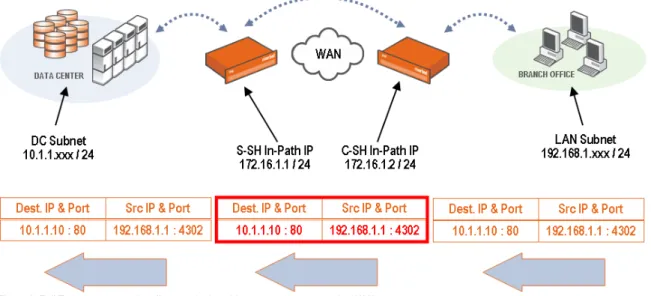
Correct Addressing refers to a mode in which RiOS addresses optimized traffic across the WAN so as to accurately reflect the source, destination, and nature of each packet. The endpoint source and destination IP addresses are used on the LAN portion of the network for the unoptimized traffic seen by the endpoints. However, optimized traffic over the WAN flows from a Steelhead appliance to a Steelhead appliance and is meaningful only to those appliances, so Correct Addressing sends that traffic using the appliance
addresses. . When performing Correct Addressing, RiOS also utilizes port 7800 for optimized traffic flows by default. Using this dedicated port in Correct Addressing mode does not tunnel traffic over the WAN. Instead, the traffic remains unencapsulated and TCP flows are proxied on a one-to-one basis for each connection.
Correct Addressing is the most commonly implemented visibility mode for Riverbed customers, because it is the easiest and most reliable mode to deploy. Many organizations also use Correct Addressing in
conjunction with real-time traffic such as VoIP, videoconferencing, and other QoS traffic, and RiOS functions seamlessly in this mode. In addition, Steelhead appliances using Correct Addressing can perform NetFlow exports for customers who desire greater visibility as well. The diagram below shows how traffic is
Figure-4: Correct Addressing mode uses Steelhead appliance addresses and ports over the WAN This is the default mode of operation and the vast majority of implementations are deployed in this fashion.
Correct Addressing plus Port Transparency
Correct Addressing plus Port Transparency introduces a mild form of “spoofing” for the traffic sent over the WAN. Although the appliances are actually sending optimized traffic that looks different to network
inspection devices than the “original” unoptimized traffic, Port Transparency uses those same original source and destination ports for optimized traffic sent across the WAN. However, in this mode the WAN traffic is still addressed to and from the appliances’ IP addresses – only the port information is spoofed. Customers using this mode keep the benefits of Correct Addressing in terms of reliability and ease of deployment, and also gain the ability to solve some problems that are more easily addressed by spoofing ports. For example, integrating into some port-based traffic classification or reporting systems on the WAN side of Steelhead appliances can be easier by using Port Transparency.. Port Transparency still needs to be used with some caution since it can lead to unexpected results, especially with any technologies that inspect traffic and check for anomalies; but it also has the significant benefit of avoiding the more dangerous risks associated with spoofing source or destination IP addresses.
Figure 5: Correct Addressing plus Port Transparency mode utilizes Steelhead appliance addresses with endpoint ports over the WAN
Full IP Address and Port Transparency
With Full IP Address and Port Transparency, RiOS offers a complete address-spoofing option. With Full IP Address and Port Transparency, optimized traffic across the WAN is addressed identically to unoptimized traffic on the LAN. Spoofing IP addresses in complex networks may introduce substantial risks of routing loops or misdirected traffic, but it can also solve unusual network integration issues that are hard to solve in any other way, particularly when there is IP-address-based classification or reporting on the WAN side of the Steelhead appliances – in particular, with service provider reporting that is based on endpoint IP addresses Although Full IP Address and Port Transparency might appear to be the “easiest” approach for network integration, deployment experience to date has proven the superiority of Correct Addressing in most
networks. In general, customers are likely to have the best results by avoiding the use of spoofing. However, RiOS provides the spoofing options to ensure the tools are available to handle even the most complex network integration problems. RiOS also supports the use of different addressing modes simultaneously for different traffic, so the need to use Full IP Address and Port Transparency in one part of the network or for one traffic type does not require its use everywhere.
Figure 6: Full Transparency mode utilizes endpoint addresses and ports over the WAN
Transparency functionality has also been further enhanced to allow smoother interoperability with stateful packet inspection (SPI) firewalls. This includes support for NAT, PBR, lossy networks, asymmetric routing, NetFlow, etc. and works with such firewalls as ATT Netgate, Cisco PIX/ASA, Juniper/Netscreen, and Checkpoint.
Application-independent Foundation
With RiOS, all TCP traffic, regardless of the application that generated it, can be intercepted and accelerated. Riverbed’s data streamlining algorithms remove redundancy from that traffic to reduce bandwidth utilization. Data streamlining is not limited to a “silo” of a particular application, but can apply optimizations across all application traffic. In addition, transport streamlining optimizes the behavior of TCP on the WAN. And with RiOS, both data streamlining and transport streamlining can be applied to SSL-encrypted data as well as data in the clear.
Contrast this to other approaches, such as caching, that require knowledge of the application protocol in order to perform data reduction optimizations. These approaches are limited in what applications they can support and generally cannot optimize transfers based on previous data from other applications.
Additional Application-specific Optimizations
For many widely used applications like Windows file sharing or Exchange email, the application protocols are often the limiting factors to performance across the WAN. In order to have an even greater impact on these applications’ performance over the WAN, optimizations must be made to the application protocol itself. Riverbed delivers this capability by including additional application streamlining modules in the architecture. Application Streamlining enables RiOS to address application-specific bottlenecks in addition to the
underlying data streamlining and transport streamlining optimizations. Application streamlining allows Riverbed to deliver and improve those optimizations incrementally, without any architectural changes. Approaches such as TCP optimizers or data compression devices have tried to include such application-specific optimizations, but have shown limited performance gains because the system was not designed to support application-independent as well as application-specific optimizations. With RiOS, all applications benefit from the application-agnostic foundation, and the applications that enterprises care about the most, further benefit from application-specific optimizations.
Universal Data Store
Building on top of its disk-based architecture, RiOS’ universal data store allows the data reduction process to efficiently scale across multiple peers. By avoiding the inherent scalability and performance limitations of per-peer data stores, organizations can save costs on appliance storage and leverage the data reduction benefits of multiple peers feeding a universal store.
Figure-8: Per-Peer Data Store requires more storage and offers limited scaling benefits with multiple peers.
As detailed in the two figures above, even with identical data used at each remote site, per-peer data store requirements increase incrementally with each additional optimization peer. For example, with per-peer data stores in full mesh environments, the WAN optimization storage requirements can increase significantly as each data store establishes a peer relationship with all the connected sites. Consequently, the per-peer architecture can create a severe scalability limitation as companies seek to grow their WAN optimization implementation. In a deployment with multiple sites, per-peer segmentation could reduce usable disk space to only a few gigabytes of disk for each branch resulting in frequent data store “misses” or “cold hits.” In contrast, the RiOS architecture supports efficient sharing in a large-scale enterprise environment – a difference that shows up as higher performance, day in and day out, for the Riverbed system.
Smart Communication Architecture
With the RiOS single-copy optimization architecture, all client requests are passed through to the server, just as if the Steelhead appliances were not present. The origin server handles permissions and file locking, as it was designed to do. The client is always assured that the data being sent is the correct data, and not an out-of-date copy. This approach ensures that a client is always working on the original data. Contrast this to approaches that try to short-circuit the application server’s permission system by creating multiple local copies of data in branch offices. These approaches introduce the possibility of data integrity issues, data security challenges, and versioning and data coherency problems that can complicate auditing for compliance.
Microsoft Office OpLock Optimization
An additional RiOS feature for Microsoft Office mean latency optimizations over CIFS now remain enabled for all users even in times of contention for the same file, sometimes referred to as “overlapping opens”. This optimization improves access times specifically for Microsoft Word and Microsoft Excel files.
Flexible Network Integration
RiOS technology supports virtually any network topology and/or technology capable of handling TCP traffic. RiOS uses a TCP proxy approach to network deployment that does not require the use of tunnels. This methodology allows customers to easily deploy Steelhead appliances and mobile software without modifications to the infrastructure. Organizations can also use Web Cache Communications Protocol
(WCCP), Policy-Based Routing (PBR), or other out-of-path deployment options if these methods are desired as well. The absence of tunnels enables RiOS to auto-discover peers and support full mesh environments such as MPLS with minimal configuration, as well as scale efficiently in the largest enterprise environments. RiOS utilizes a TCP-based transport which adheres to standards for traffic management on shared network infrastructure. Using a standards-based transport helps avoid pitfalls associated with proprietary network transport implementations. RiOS also works easily with existing QoS, VoIP, and video conferencing, and provides the ability to mark and enforce QoS traffic on Steelhead appliances based on both latency and bandwidth. In addition to Correct Addressing, RiOS offers two other WAN visibility modes to provide additional flexibility for customers and their WAN optimization implementation.
Designed to Evolve
RiOS combines the benefits of an application-independent foundation and layer 7 protocol optimizations to enable the system to evolve quickly over time. As enterprises implement new applications, use new protocols, and face new demands, RiOS can quickly and effectively adapt to meet that need, while still applying data streamlining and transport streamlining optimization to all TCP-based WAN traffic. Other architectures are stuck with a “big bang” approach that requires a complete software redesign in order to provide new functionality, or even worse, a “bolt and glue” mentality whereby vendors acquire various products and try to combine them into one device.
Proven Approach
With tens of thousands of Steelheads deployed in production environments around the world, RiOS has proven its optimization capabilities with thousands of enterprises and varied network topologies. Riverbed has taken the lead in innovating in the WAN optimization space with multiple vendors now trying to emulate the RiOS architecture and approach. Riverbed continues to build its technological lead through an ongoing process of learning and communication with customers as design partners. As a company, Riverbed has continued to deliver on its promises from a product development standpoint release after release and will continue this customer-focused approach.
RiOS - The WAN optimization Approach
RiOS takes a multi-faceted approach to WAN optimization that addresses the problems of bandwidth, latency and application protocol chattiness through a unified solution. With enterprise management capabilities and numerous deployment options, RiOS gives customers flexibility with minimal configuration requirements.
Data Streamlining
RiOS data streamlining works across all TCP-based applications including Microsoft Office, Lotus Notes, CAD, Oracle, ERP, databases, and data backup & replication systems; and across all TCP-based protocols
• Reduce WAN Bandwidth Utilization by 60 – 95%
• Eliminate redundant data transfers at the byte-sequence level • Perform cross-application optimization
• Provide Quality-of-Service marking and enforcement for all TCP and UDP
including, but not limited to, CIFS, MAPI (2000, 2003, and 2007, 2010) both encrypted and unencrypted, TDS (MS-SQL), NFS, FTP, HTTP, HTTPS, and Oracle Forms. Data streamlining ensures the same data is never sent more than once over the WAN. Data streamlining reduces bandwidth consumption for many applications dramatically, typically by 60% to 95%.
Data streamlining also supports rules-based policy administration of optimization classes, packet marking, and enforcement for Quality of Service (QoS) and route control.
Data Deduplication
RiOS intercepts and analyzes TCP traffic, segmenting the data and indexing it. Once the data has been indexed, it is compared to data on the disk or in memory. A segment of data that has been seen before is not transferred across the WAN; instead, a reference is sent in its place. This process enables duplicate data that has been previously sent across the WAN to be replaced by a small reference instead. By using a patented hierarchical structure, a single reference can represent many segments, and thus multiple
megabytes of data.
Figure-9: RiOS data references can represent a very large amount of data. Thus, a single reference may represent megabytes of data previously sent over the WAN.
If the data has never been seen by RiOS before, the segments are compressed using a Lempel-Ziv (LZ) based algorithm and sent to the counterpart RiOS-powered device on the far side of the WAN. There, segments of data are also stored on the counterpart appliance or endpoint. Finally, the original traffic is reconstructed using new data and references to existing data and passed through to the client. The level of LZ compression may be tuned to find the right balance of higher compression or faster throughput for a given environment and requirements.
RiOS data streamlining is highly scalable, with peak compression ratios that can be 100:1 or higher. These compression ratios (as a result of eliminating the transfer of redundant data) are far higher than what typical TCP compression devices could provide. At the same time, data streamlining can find fine-grained changes because the average size of a segment stored on disk is approximately 100 bytes, or about the same as a sentence of text. Through its support of SSL encryption, RiOS can apply this data reduction to encrypted traffic as well (see the section on “Transport Streamlining for more information on SSL).
The scalable data reduction (SDR) operation can be performed interchangeably on the Steelhead appliance, either on disk (as SDR – for more matches and greater data reduction) or in memory (as SDR-M – for faster throughput), or adaptively in either location or both (as SDR-A) for the best fit of each particular connections data and overall workload. This functionality dynamically and granularly maximizes the efficient utilization of available resources such as CPU, disk, and memory. Some Steelhead appliances will also have solid-state disks (SSDs) for even faster performance seek, read, and write operations.
It is important to note that this segmentation process occurs at the byte-sequence level. If, for example, a user is emailing an edited file to a colleague, only the changes need to be sent across the WAN. As long as
similar byte sequences are crossing the network, data streamlining will be effective even if the user changes the file name or uses a different mechanism to send the data over the WAN. For example, if the second colleague sends the file back using a document management system or file server instead of email, data streamlining will still recognize redundant data segments and only send the changes across the WAN. This segmentation process differs radically from other cache-based solutions by eliminating redundancies across all TCP traffic. A simple file cache, however, would not recognize that the data being transferred is the same. (For more information on caching and how it differs from RiOS, please see “The Five Ugly Truths about WAFS and Caching” from Riverbed.)
Transport Streamlining
RiOS overcomes the chattiness of transport protocols through transport streamlining. Transport streamlining is a set of features that reduce the number of round trips necessary to transport information across the WAN while maintaining the reliability and resiliency of the transport. This is accomplished through a combination of window scaling, intelligent repacking of payloads, connection management, and other protocol
optimization techniques.
RiOS accomplishes these improvements while still maintaining TCP as the transport protocol. As a result, RiOS transport streamlining adapts to network conditions on-the-fly, responding appropriately to events such as congestion or packet loss while still providing a reliable transport protocol that is a “good neighbor” to other traffic. In contrast, other approaches choose unsafe methodologies such as tunnels or proprietary protocols that achieve their optimization by stealing bandwidth from other traffic.
It is useful to underscore that Riverbed’s “inner” connection between appliances is not a tunnel, but a
proxied TCP connection that directly corresponds to each “outer” TCP connection between client and server. Although competitors may bring up confusing and vexing problems such as traffic mixing, MTU sizes, or TCP-over-TCP performance issues, these problems simply do not arise in the RiOS architecture.
Window Scaling and Virtual Window Expansion
A well-known method for improving TCP throughput is the use of larger windows in order to increase the number of bytes that can be “in flight” without being acknowledged. By increasing the window size, the maximum amount of data per round trip goes up, increasing the net throughput when the TCP window is the bottleneck. Although window scaling is available in most client and server TCP implementations, it is often challenging to configure correctly. In many Windows versions, correctly configuring window scaling requires esoteric knowledge of relevant settings and a willingness to edit the Windows registry – requirements that place window scaling out of reach for many organizations. Even with the appropriate knowledge and skill set, making these changes on every server in a large enterprise may require large amounts of administrative
• Applications run up to 100 times faster
• Reduce transport protocol chattiness by 65% to 98%
• Automatically adjust transfer parameters based on network conditions • Enable up to 95% utilization on high-bandwidth, high latency connections
overhead and may not be a very scalable approach.
RiOS enables automatic window scaling across the WAN without requiring the user to make any changes to clients, servers, or the routing infrastructure. Beyond simple window scaling, however, is the software’s ability to virtually expand TCP windows and enable capacity that is hundreds of times greater than basic TCP payloads. As a TCP proxy, RiOS effectively repacks TCP payloads with a mixture of data and references to data. As noted in the data streamlining section, recognized data that would have been transported is instead replaced by a reference, which can represent a very large amount of data. In this manner, RiOS virtually expands the TCP frame, often by a factor of several hundred or more. This Virtual Window Expansion (VWE) dramatically reduces the number of roundtrips that need to be taken to deliver a given amount of data.
Figure-10: Virtual Window Expansion massively increases TCP payload by intelligently repacking the TCP Payload.
High Speed TCP and Max Speed TCP
A less-well-known problem is that it is often hard for a TCP connection to take advantage of available bandwidth on high-bandwidth, high-latency links, or in situations where packet loss is high. The RiOS implementations of High Speed TCP (HS-TCP) and Max Speed TCP (MX-TCP) can accelerate TCP-based applications so that a single connection runs at hundreds of Mbps (up to OC-12, 622 Mb/s) even when round-trip latencies are high. The potential benefits include:
• Higher throughput over long distance high bandwidth links • Faster replication, backup and mirroring over very long distances • Better utilization of high bandwidth links
HS-TCP achieves full utilization of investments in network bandwidth without losing or compromising any of the essential characteristics and benefits of TCP. These benefits include safe congestion control, even when HS-TCP connections share WAN links with “normal” TCP connections. Familiar TCP performance
characteristics have been preserved. For example, there is no need to pre-determine available WAN bandwidth – HS-TCP self-adjusts transmission throughput appropriately.
In contrast, MX-TCP allows administrators to take advantage of 100% of a prescribed amount of bandwidth connectivity between any two locations. Whereas HS-TCP will back down in speed as a result of significant packet loss or congestion, MX-TCP is designed to use a set amount of bandwidth regardless of congestion or packet loss. Administrators can easily set the bandwidth limit for MX-TCP, enabling this functionality without requiring use of the total bandwidth available on a given connection.
Connection Pooling
Some applications are designed to open many TCP connections in order to accomplish required data transfers. Many of these connections are short-lived, yet each requires significant overhead to initiate communications.
Such short-lived connections can result in significant reductions in application speeds. For example, loading a single ordinary Web page can require a client to open 10 or more TCP connections.
Connection pooling enables RiOS to maintain a pool of open connections at all times for short-lived TCP connections. When a client makes a request that requires new TCP connections, the appliance can use an already-opened connection instead of incurring the overhead associated with opening a new connection. Note that such an already-opened connection is not recycled from a previous use: it is simple “pre-opened” before it is required for data transfer. With connection pooling, overhead associated with short-lived TCP connections can be reduced by 50% or more.
SSL Acceleration
Use of SSL as an encryption mechanism is a widely used security approach within many organizations. On Steelhead appliances and the Steelhead Mobile Client, RiOS provides a patent-pending approach to accelerating SSL-encrypted traffic that maintains organizations’ preferred trust model. Using RiOS, SSL acceleration can be achieved while keeping all private keys within the data center and without requiring fake certificates in branch offices. Both Steelhead appliances and the Steelhead Mobile Client can auto-discover their SSL peers and begin optimizing SSL traffic, and RiOS also provides centralized management of SSL acceleration capabilities for the enterprise via the Central Management Console (CMC). Steelhead Mobile provides the enhanced security of an integrated Certificate Authority as a part of the Steelhead Mobile Controller, this allows organizations the flexibility of using their own security certificates or generating a new certificate for distribution as a part of the licensing process.
Other approaches to SSL require fake certificates or server private keys on branch office appliances. These approaches compromise the security of an organization’s infrastructure because keys must be distributed across the enterprise, making SSL sessions more vulnerable to attack. RiOS only distributes temporary session keys to branch office appliances.
Using this approach, RiOS can apply its world-class data streamlining, transport streamlining, and
application streamlining mechanisms to SSL encrypted traffic without compromising the preferred security model.
Application Streamlining
RiOS was designed as an application-independent foundation that would provide optimization to all enterprise applications, but also support additional acceleration and ease-of-use functionality as needed. Application streamlining is the realization of that flexibility and power.
Application streamlining allows RiOS to provide additional layer 7 acceleration to important (but poorly behaved) protocols through transaction prediction and pre-population features. Additionally, application streamlining allows for key office-in-a-box functionality by precluding the need to deploy additional application and database servers in remote offices. Enterprise application services can now be simply deployed and managed via a consolidated IT model and accelerated with RiOS.
Application Streamlining Modules
Application streamlining modules provide additional performance improvement for applications built on particular facilities such as Microsoft Windows file systems (the CIFS protocol), Microsoft Office, Microsoft Exchange messaging (the MAPI protocol) including encrypted email, Microsoft SQL Server databases (the TDS protocol), Lotus Notes, HTTP and HTTPS, NFS, or Oracle 11i. These modules are application protocol-specific and dramatically reduce application protocol roundtrips.
Application streamlining modules eliminate upcoming roundtrips that would have been generated by the application protocol. Reducing roundtrips can be necessary even with a very efficient implementation of TCP, because otherwise the inefficiency of the application-level protocol can overwhelm any improvements made at the transport layer. Application streamlining modules can eliminate up to 98% of the roundtrips taken by specific applications, delivering a significant improvement in throughput, in addition to what data streamlining and transport streamlining already provide.
Figure-11: Application streamlining can eliminate up to 98% of roundtrips generated by application protocols. • Applications run up to 100 times faster
• Reduce application protocol chattiness by 65% to 98%
• Address the most important application protocols: CIFS, NFS, MAPI (2000 - 2010), HTTP(S),
MS-SQL, Oracle 11i
It is easy to talk about “application streamlining” as a concept, but harder to deliver real performance improvement. Riverbed was the first vendor to deliver this method of layer 7 application protocol
optimization, and no other vendor has as complete a range of application-level optimizations. Even vendors who offer some application-level optimizations for CIFS or MAPI often don’t deliver the quality or depth of optimizations that RiOS does. With application streamlining, the evaluator of various technologies must dig beneath a standard checklist to see how deep and in what ways a vendor can streamline the application. It should be noted that Steelhead Mobile provides acceleration of all applications running over TCP, but certain application streamlining modules are not currently available for the software client. More details on product specific features can be found in the feature table at the end of this document.
Windows File Sharing (CIFS) Optimization
Many vendors claim to have application-level support for CIFS. Yet, if a user makes changes early on in a file (for example, changing the title of a Word document), some other vendors’ products treat the rest of the file as though it were completely new data. Additionally, there are many ways to use CIFS. When some competitors claim they ‘do’ CIFS optimization, often they only optimize drag-and-drop file copies. RiOS contains about a dozen CIFS optimizations for various operations such as file sharing, folder browsing, accessing files from within other applications, and more. Furthermore, some applications make use of CIFS with complex file-locking arrangements. Other application acceleration approaches may break these locks, or simply not be able to optimize performance in these cases. RiOS has built-in technology which allows application acceleration to be optimized, with appropriate file locking maintained.
Even Apple Mac clients for CIFS can benefit from these same application specific optimizations to overcome latency. This optimization works for Mac OS 10.5.x (Leopard) and newer clients when they connect via Steelhead appliances to typical CIFS file servers such as Windows Server and NetApp.
SMB Signing Support
This feature allows customers who serve files from domain controllers where Microsoft’s SMB signing is set to required by default to protect themselves from “man in the middle” attacks. This feature gives support for CIFS latency optimizations in the presence of signed packets. SMB signing support has been further enhanced for easier configuration and to work across multiple network domains. RiOS supports both SMB v1 and SMB v2 signing support natively.
Lotus Notes Optimization
Developed with IBM, this application specific optimization improves the sending of large email attachments with a performance gain of up to 8X to 25X. This release also optimizes server-to-server replication, calendaring, and more. RiOS transparently switches off transport compression so Notes/Domino traffic for all applications can be more effectively optimized by the Steelhead appliance.
Exchange (MAPI) Optimization
RiOS also delivers significant performance gains for the Microsoft Exchange MAPI protocol and is the only WAN optimization solution to provide support for the Exchange 2000, 2003, 2007 and 2010 MAPI protocol. Competitive solutions in the market will downplay the lack of MAPI 2003, 2007 or 2010 support and
encourage customers to use Cache Mode. The downside of Cache Mode is that no data reduction
techniques are applied to traffic so there are no benefits from a network utilization perspective. This means that Cache Mode does nothing to accelerate email retrieval for users receiving large attachments or re-syncing their Inbox after traveling resulting in further delays for end-users. RiOS gives customers flexibility by supporting both Cache and non-Cache Mode for Exchange 2003, 2007 and 2010, again exhibiting broader and deeper support at the application tier.
RiOS MAPI acceleration also provides the ability to pre-populate MAPI traffic to further alleviate the morning rush when users login and pull down email. In many environments, this daily practice can cripple a branch office WAN link. Additionally, because RiOS operates transparently with unchanged clients and servers, no plug-ins are required with the Steelhead solution – whereas some competitive products require plug-in installs on every email client. RiOS delivers full spectrum optimization for Outlook Anywhere delivering the same level of optimizations as for the MAPI client. This delivers both bandwidth and latency optimization for MAPI over HTTP (encrypted and unencrypted), the transport for Outlook Anywhere.
Finally, with the release of Exchange 2010, Encrypted Mode is enabled by default, and Riverbed’s encrypted MAPI support extends RiOS MAPI acceleration benefits to secure Steelhead appliance customer
environments where email encryption is used (often by default) between the client and host servers.
HTTP and HTTPS Acceleration
Riverbed provides additional layer 7 optimizations for HTTP and HTTPS that go beyond its traditional methodologies of WAN optimization. With these additional tools, organizations can make their key web-based applications faster than ever before. Applications such as SharePoint, intranet portals, web-web-based document management systems, as well as web-enabled ERP and CRM applications like SAP NetWeaver, JD Edwards, and Siebel, all receive significant application acceleration with RiOS’s HTTP(S) capabilities. In addition to standard data streamlining and transport streamlining functionality, RiOS enables several mechanisms to further optimize HTTP(S) traffic. For static web content, a “learning mechanism”, that allows a client-side Steelhead to track the objects that are requested for a particular web page, accelerates future requests by using the learned information and pre-fetching associated content. In addition, HTTP(S) leverages the learned information to send normally sequential data requests in parallel creating additional optimization benefits.
For dynamic web content, RiOS performs a parse-and-pre-fetch of embedded objects on dynamic web pages. When requests for dynamic content occur, RiOS parses the retrieved dynamic HTML page and immediately pre-fetches embedded objects to accelerate webpage load times. The net result is a significant reduction in roundtrips across the WAN for dynamic content that is often leveraged by web-based enterprise applications.
Another performance enhancing feature for HTTP(S) is the object prefetch table. This enables the Steelhead appliance datastore to cache complete web page objects, allowing these to be served up immediately as a whole locally rather than reassembled from data references or transferred across the WAN. Unlike other cache approaches, consistency and “freshness” is maintained as RiOS will always still deliver the latest version of the object being requested.
RiOS accelerates HTTP(S) traffic further by also optimizing metadata through its 304 Fast Response capability. If the local Steelhead appliance receives an “If-Modified” request within a specified expiration
parameter, it will respond with a “Not Modified” response, and the client will retrieve the web content from its own local web browser cache. This eliminates roundtrips across the WAN and minimizes delay for end-users. This combined multilayer approach to HTTP(S) optimization delivers acceleration benefits to a range of web content and application scenarios.
Oracle 11i and 12 Optimization
Expanding its support for enterprise applications, RiOS also enables the optimization of Oracle Forms traffic found throughout the Oracle 11i and 12 E-Business application suites. This optimization applies specifically to the Oracle 11i and 12 Forms Web browser plug-in running in HTTP or socket/native mode. In order to optimize Oracle traffic, RiOS recognizes a client session has been initiated and intercepts the Oracle Forms request. This traffic is essentially unscrambled from its native format to apply data streamlining and
transport streamlining and optimize the client-server traffic bi-directionally. This is true for both the older Oracle JInitiator and now standard Sun JRE types of Java Virtual Machines (JVMs.) Data streamlining also significantly accelerates the initial download of bulky java applets at startup time, allowing user login and startup to complete in seconds rather than minutes. The net effect creates significant data reduction for Oracle Forms traffic and additional bandwidth savings, as well as improved application performance up to 50X.
Disaster Recovery Acceleration
RiOS’s out-of-the-box acceleration of backup and replication operations already generated significant performance gains for data transfer jobs. Since RiOS 4.1, Riverbed has had a Behavioral Traffic
Recognition algorithm for large-scale data transfers to accelerate backup and replication jobs even further. The traffic recognition capability identifies a large-scale data transfer flowing through a Steelhead appliance and applies some specific system optimizations to enhance the throughput and handling of rate, high-volume backup data sets.
Other Business Continuity improvements enable Steelhead appliances to scale for high-throughput disaster recovery environments, with up to four Gigabit LAN-side throughput and often up to 3:1 to 8:1 data
reduction. These enhancements enable acceleration of asynchronous replication solutions such as EMC SRDF/A, CA XOsoft, IBM Tivoli Storage Manager, and more. Steelhead appliances are qualified by EMC for SRDF/A and HDS for Hitachi TrueCopy, Universal Replicator, and H-NAS, along with other leading storage vendors’ products. In addition, Riverbed Steelhead appliances are the first and only WAN
optimization controllers that give IT professionals the ability to track and tune optimization for EMC SRDF on a per RDF-group basis, thereby increasing the overall optimization and performance of SRDF traffic and ultimately leading to improved Recovery Point Objectives (RPO).
These additional optimizations improve disk utilization, while also dynamically applying data reduction and compression algorithms. The resulting throughput enhancement further reduces the time required to complete a backup or replication operation beyond previous acceleration norms. A variety of options including tunable LZ compression, choices like SDR-M or Adaptive SDR, and granularity to have the data streamlining mode dynamically toggled per flow all enable RiOS to deliver the best balance of high throughput versus maximum bandwidth reduction. Some environments might be highly bandwidth constrained, others may need the fastest possible throughput, and yet others may need to share the WAN connections between DR operations and other business applications, and Riverbed is extremely high performance and as flexible as required.
Figure-12: SRDF/A and FCIP Illustrated
Virtual Desktop Infrastructure (Citrix and VMware) Optimization
Riverbed can optimize the traffic associated with delivery of virtual desktops for leading solutions like Citrix ICA and VMware View. This is simply enabled by automatically switching to RiOS compression and
encryption in place of the less effective native compression and encryption options in the VDI products. Also Riverbed SDR-M can be utilized to efficiently reduce the bandwidth requirements in memory for high
throughput results. Typical results show that up to twice as many desktops can be supported on the same WAN (by halving the bandwidth requirements of each), and end user response times can improve by up to 80% (over uncompressed traffic) making for more satisfactory performance. Further, Citrix desktops can be optimized utilizing QoS markings, to prioritize interactive activities like desktop input and display over less time sensitive operations such as printing.
Centralized Print Optimization
Some customers want to consolidate as much of the IT footprint as possible to the data center for higher utilization, lower hardware costs, and easier maintenance, and may choose to do this with print servers specifically. If printing operations are delivered across the WAN with a centralized print server, this could create a lot of extra WAN traffic and greatly hurt the performance of printing (and other applications.) RiOS can address this problem by optimizing the data transfers associated with printing across the WAN, using similar features as those for CIFS, and reducing bandwidth requirements by up to 75% and improving performance as much as 4X.
Transparent Pre-Population
To minimize the frequency of requests that must wait for new data to be sent across the WAN, RiOS can transfer the segments of a file or email to the remote RiOS-powered device before it is requested by any client. This transparent pre-population process allows the initial end-user access of any new file or email to be accelerated.
Sometimes the first client to request particular content suffers a “miss penalty” as the new content is transferred across the WAN for the first time. Transparent pre-population improves the user experience by carrying out the necessary data transfer in advance of the first request, so that all clients experience similar
accelerated performance. Transparent pre-population works with file servers, Exchange emails, or any other type of data that must be replicated across the WAN. The method that RiOS uses to pre-populate file servers requires no agent, thus simplifying infrastructure management while eliminating the miss penalty for predictable new content.
Steelhead appliances also support a pre-population mechanism for MAPI (Microsoft Exchange email). When users in a branch office close their email clients, the client-side Steelhead appliance optionally keeps the Exchange TCP connection alive. Thus, as emails arrive their component segments are pulled across the WAN using all of the RiOS acceleration techniques. When users log in again to request their email, all the data is then available to the Steelheads to optimize the transfers at maximum speed. This technique avoids big surges in email requests, such as the spikes that occur at the start of a work day that can bring the rest of a branch office’s applications to a halt.
Selective Optimization for SRDF
Silver Peak is trying to change the playing field by claiming that playing dumb at the IP layer is all you’d have to do. Riverbed has shown significant benefits from some of its prior DR-focused app-level optimizations (DIF/FCIP header isolation for improved data reduction, SRDF compression auto-negotiation).
With SAN replication, it’s common to have multiple types of data interleaved within a single replication connection. By using Riverbed’s app-level knowledge of how the transactions are “bucketed” on the wire, different Optimization Policies can be applied for each type of data. This allows for overall higher throughput by not wasting resources on trying to reduce uncompressible data. Also, with Riverbed’s knowledge of these “buckets” granular visibility can be provided to how much traffic is being transferred for each storage group, which is something that even cheap bandwidth can never allow you to do. And while EMC SRDF is the first protocol that is being targeted for this approach, the same value can be provided to similar technologies like SnapMirror or IBM XIV replication as storage partners choose to open up their protocol specs to us.
Management Streamlining
Unlike other approaches to application acceleration, RiOS was designed specifically to simplify deployment and management of WAN optimization devices. In fact, many customers can deploy devices running RiOS, such as the Riverbed Steelhead appliance, in just 15 minutes. Steelhead Mobile clients can also be easily deployed to remote workers using Riverbed’s MSI package creator to build installation and update
packages. The net effect is an application acceleration solution with minimal administrative overhead. Deployment is further simplified, because RiOS’s approach requires no changes to servers, clients, or routers, and offers highly flexible network design options. In addition, the Central Management Console (CMC) and Steelhead Mobile Controller (SMC) provide management capabilities for enterprise-wide reporting, configuration, and deployment options.
Device Configuration and Management
Every RiOS-powered Steelhead appliance supports individual device management via SSH command line and an HTTP or HTTPS graphical user interface. Deploying Steelhead appliances follows a very simple configuration process that essentially involves configuring interface IP and duplex information, subnet and management information, and then plugging the appliance into the network. Every device also supports SNMP traps and email alerts for conditions that require attention or intervention. This has been enhanced to include support for both SNMP v.2 and v.3 (for more security), for more detailed MIB information, to allow thesholds and alerts on MIBS, and for integration of a configurable XML/SOAP API. SNMP traps include accounting and audit alerts such as user login/logout, configuration changes, TCPDump started, etc. The API allows a broad set of reporting and management actions to be taken from external Network
Management Systems (e.g. HP Openview). Most statistics are exposed and a number of configuration actions can be taken remotely. Collectively, these tools allow for easy management of the appliances and straightforward integration into existing network management systems such as HP OpenView.
Simplifying configuration even further, the patent-pending RiOS auto-discovery capability automates the establishment of optimization peering relationships throughout the enterprise. This gives large firms a method to efficiently scale WAN optimization deployments globally without creating additional complexity and overhead. Auto-discovery also enables easy integration with “any-to-any” networks, which is common to many of today’s WAN architectures, thereby circumventing problems specific to tunnel-based optimization technologies.
Steelhead Mobile software installations overcome many of the challenges with deploying client software packages. The solution comes with an MSI package builder to construct installations and upgrades, which can then be installed using deployment software such as SMS, Altiris, LANDesk, or other solutions. In addition, installs can be performed using a silent installation mode so users do not need to engage with the
• Plug-and-play deployment of Steelhead appliances
• Auto-discovery supports any-to-any networks
• Comprehensive network visibility
• Centralized reporting and management
installation process.
Comprehensive Network Visibility
By providing outstanding network visibility, RiOS ensures that its application acceleration capabilities do not cloud enterprises’ reporting capabilities. RiOS technology can automatically assign application names to port numbers, allowing users to quickly see what applications are driving traffic across the WAN. Reports will also show per application stats for traffic that is passed through unoptimized. Finally, Steelhead appliances can show acceleration per RiOS QoS class (if QoS is enabled on the appliance).
RiOS also provides the ability to export detailed real-time flows from a Steelhead appliance or mobile client to Cascade or a third- party NetFlow v. 5 collector for greater visibility, analysis and diagnosis of issues. From the NetFlow collector, enterprises can view byte counts per port, per src/dest IP address, and from a specific interface. IT administrators can obtain traffic views for optimized vs. pass-thru traffic separately or in aggregate and obtain top talker/listener tallies from a NetFlow compatible collector. In addition, NetFlow v. 9 is supported and the newer flexible formats allow us to export all the data a customer needs to build a site report (inbound and outbound LAN and WAN traffic) from a single Steelhead appliance. This will provide the information that Cascade and other external reporting solutions need to generate reports without needing to correlate data from multiple flow sources.
Figure-13: Traffic visibility and optimization from the Central Management Console
Pass through traffic reporting gives visibility into which connections are being optimized and which are not. It further qualifies the reason for pass through, whether this is due to the protocol (UDP, VoIP, etc.) or because the maximum capacity or number of connections for the Steelhead appliance model was exceeded.
Optimization benefit reporting helps quantify the improvements on WAN made by RiOS features such a application specific and TCP latency features. This detailed report can show the number of roundtrips saved as well as the reduction in data.
Central Management Console (CMC)
RiOS also allows centralized monitoring and management of a complete network of appliances via the Riverbed Central Management Console (CMC). The CMC provides complete enterprise management, configuration and reporting capabilities from a single console. Deployment of Steelhead appliances can be simplified even further through the CMC. Unconfigured Steelhead appliances can auto-discover the CMC via a DNS lookup and register with the CMC to receive a pre-arranged configuration. This powerful feature, called touchless configuration for Steelhead appliances, helps deploy devices quickly while achieving unparalleled management scale. Whether using touchless configuration or not, administrators can use the CMC to deploy configurations and optimization policies to appliances individually, in groups, or en masse across the enterprise.
The CMC can also provide aggregated or individual device reporting, group-based configurations and policies, and scheduled operations. It gives users global trending of performance statistics using up to one year of historical data, and the ability to zoom in on any time period to retrieve more granular data.
Additional management functionality includes automated over-the-wire software upgrades, global SSL certificate management, and an easy-to-use QoS rules configuration interface, all through an intuitive Web interface.
Some CMC enhancements give IT staff the ability to backup and restore CMC configurations, view improved reporting, make policy comparisons to improve consistency, and set up new Steelhead appliance
configurations services such as RSP package management.
Top Talkers Reportingallows network administrators to report on the top users of bandwidth, either for security monitoring or accounting purposes. The flows that are generating the heaviest use of WAN bandwidth are known as the Top Talkers. This feature gives them back more LAN and WAN visibility without having to use the WAN transparency feature or NetFlow.
CMC now can streamline the deployment and configuration of RSP and RSP packages. The new UI shows per-appliance RSP health and status info using easy red, yellow, green indicators.
Figure-14: Steelhead appliances auto-discover the CMC and can then be configured and monitored from a central console.
Steelhead Mobile Controller (SMC)
Much like the CMC, the Steelhead Mobile Controller (SMC) provides central management capabilities for the Steelhead Mobile Client. The SMC enables easy deployment of mobile client software to remote users via an MSI package creator for install and upgrade builds. Additionally, the SMC integrates with Microsoft Active Directory and LDAP to enable configuration and policy optimization on a per user or group basis. Enterprise reporting is also available on an aggregated or per user basis to give a comprehensive view of traffic optimization for the entire mobile workforce. The SMC also provides license management, job scheduling, and notifications to extend its administrative capabilities.
Figure-15: SMC enables easy deployment and control of mobile clients.
RiOS Deployment Options
By design, RiOS provides flexible integration with various network architectures, best-in-class scalability, and redundant configuration options for high availability environments. Riverbed has designed RiOS to interoperate with existing network deployments rather than force specific architecture and configuration requirements on customers that may impact availability and design alternatives in the longer term. As a result of these design considerations, RiOS can easily deploy in extremely complex hybrid network environments with minimal ongoing management.
The underlying RiOS technology enables a robust and scalable WAN optimization solution that can support both legacy infrastructure as well as the latest WAN technologies in use today. Devices running RiOS can be deployed with no changes to clients, servers, or to other critical infrastructure, and automatically detect each other across the WAN; there is no need for any tunnel configuration, DFS changes, client drive mapping changes, plug-ins, router configuration, route injection, or any of the other overhead required for
• Flexible network integration
• Quality-of-Service (QoS)
• Enterprise-class scalability
• Riverbed Services Platform (RSP)
competitive solutions. RiOS allows for normal client-server interaction, and focuses on accelerating the resulting data transfer. RiOS has been deployed in hybrid ATM / frame relay environments, over satellite infrastructure, and in full mesh Multi-Protocol Label Switching (MPLS) environments with no special requirements or caveats.
Quality of Service (QoS)
Beyond network topology considerations, RiOS allows customers to use Quality-of-Service (QoS)
management in the way that best fits their network. For customers already using QoS to support VoIP and other bandwidth sensitive traffic, RiOS can easily pass QoS DSCP markings to an enforcing device in a completely transparent hand-off. RiOS also allows the marking of DSCP bits for QoS, Class of Service (CoS), MPLS tagging, or any other classification mechanisms using the DSCP field. With RiOS, such DSCP marking can be applied to both optimized and pass-through traffic. RiOS also supports optional rules to categorize “outer connection” traffic and map those categories to specified “inner connection” ports. With these tools, RiOS easily integrates into existing QoS environments without disrupting traffic flows and enables a variety of approaches to traffic monitoring and shaping.
Moreover, because of the significant data reduction achieved with RiOS technology, most QoS
environments perform even better with Riverbed deployed. This enables customers, in many cases, to reclaim bandwidth and eliminate unnecessary QoS implementations further reducing network management overhead and complexity. For cases where the environment remains bandwidth constrained, RiOS provides customers with the ability to leverage extensive QoS capabilities with Steelhead appliances themselves. Users can employ Hierarchical Fair Service Curve (HFSC) class-of-service marking and enforcement at the “edge” of their network on Steelhead appliances, for both optimized and pass-through traffic. HFSC supports prioritization based on both bandwidth and latency, meaning that real-time traffic such as VoIP and video is protected against congestion and latency.
Riverbed QoS delivers a unique combination of best-of-breed classification and an advanced, unique scheduling technique based on Hierarchical Fair Service Curves (HSFC) that addresses the need for accurate classification of applications, the allocation of minimum and maximum bandwidths (as other tools do), and the ability to prioritize applications based on their latency sensitivity (which is not possible with most other approaches).
The Riverbed “AppFlow” classification engine utilizes a variety of techniques, often in combination, to maximize the accuracy and efficiency of its ability to provide application visibility into network traffic in real-time with the most flexibility. The engine uses multiple techniques like port based, application signature matching, protocol dissection and others. Let’s looks in detail how each of these techniques help out.
§ Port Based - Port based classification is based on knowledge that certain applications utilize certain ports.
§ Pattern Matching / Application Signatures - This typically translates to searching the initial traffic for well-known patterns, possibly at well-known offsets, or when combined with protocol dissection within specific protocol elements. This could be via regular expression matching and/or byte or string matching.
§ Protocol Dissection - This involves having a detailed understanding of the application protocol and the ability to parse the protocol messages and follow the conversation in order to identify and extract
interesting information. This not only ensures accurate classification, but also enables deep contextual sub-classification and protocol attribute extraction.
§ Future Flow Registration - Not really an inspection technique per se; however, the ability to identify and associate a flow that will take place in the future based on a flow that has been identified in the past is a powerful facilitating tool that ensures accuracy and performance.
§ Behavioral - Behavioral classification relies on detection of behavioral attributes of the network traffic. The Riverbed engine can utilize packet size, packet inter-arrival time, packet rate, data rate, and entropy calculations in its detection of a behavioral signature for an application. Another behavioral technique involves the contextual understanding of what a particular host has been doing recently or whom it is or has been communicating with.
§ Decryption / Decoding - Some applications utilize some sort of encoding, obfuscation, or simple encryption technique
Riverbed’s QoS also uses a unique scheduler called the Hierarchical Fair Service Curve (HSFC) that addresses not just the allocation of minimum and maximum bandwidths (as many tools do), but also prioritizes and schedules applications based on their latency sensitivity (which is not possible with most other approaches). Imagine, for example, that two different real-time, critical applications such as VoIP and video conferencing were configured with bandwidth guarantees, but without the ability to set priority for each based on sensitivity. During heavy use periods, even when the bandwidth guarantees were honored, queues would become filled with video traffic causing the rate at which VoIP packets are scheduled to vary, introducing jitter and as a result, noticeably lower quality calls. Some QoS tools try to work around this by dedicating excess bandwidth, perhaps over-provisioning by 20% or more, to certain applications. But this is wasteful, sometimes crude, sometimes complex, and in fact unnecessary. These tools also often encounter problems when trying to prioritize multiple types of traffic at the same time. Riverbed QoS can address these issues smoothly and simply, with distinct controls for both bandwidth and sensitivity. This delivers better, more predictable performance for all-important applications according to their unique needs.
The Riverbed QoS engine delivers streamlined application-level control and optimization by delivering the following features:
§ Content-aware Application Control – With the content-aware application control the Riverbed Appflow engine can identify and classify 100 of most common enterprise applications and is configurable to classify thousands of custom applications as well. This ensures that critical applications like web, voice and video are protected while recreational applications are contained.
§ Template-driven UI – The solution offers the simplicity and the quickest ramp time with respect to QoS policies by offering built-in policy templates delivering plug-n-play deployment.
§ Latency-aware Traffic Scheduling – With this feature traffic can be scheduled for applications based on their sensitivity thus eliminating jitter and starvation.
QoS can also be used in a variety of specific needs environments. One example is operation of QoS with Riverbed Interceptor appliances as the workload is distributed across a group of clustered Steelhead appliances in a large datacenter environment. In this case QoS markings are preserved for prioritization even as traffic is redirected for optimization.