This is the author’s version of a work that was submitted/accepted for pub-lication in the following source:
Vimieiro, Ana Carolina& Vimieiro, Renato (2013) Oscar Pistorius and the death of Reeva Steenkamp : mapping public opinions on Twitter using frame analysis and data mining. InSelected Papers of Internet Research 14.0, Association of Internet Researchers (AoIR), Denver, Colorado, USA.
This file was downloaded from: http://eprints.qut.edu.au/67860/ c
Copyright 2013 The authors
Notice: Changes introduced as a result of publishing processes such as copy-editing and formatting may not be reflected in this document. For a definitive version of this work, please refer to the published source:
Vimieiro, Ana
& Vimieiro, Renato. Oscar Pistorius and the death of
Reeva Steenkamp: mapping public opinions on Twitter using frame
analysis and data mining. In Selected Papers of Internet Research
14.0, Association of Internet Researchers (AoIR), Denver, Colorado,
US.
The -le was downloaded from:
http://eprints.qut.edu.au/
© Copyright 2013 The authors
The de-nitive version is available at
Selected Papers of Internet Research 14.0, 2013: Denver, USA
1
Oscar Pistorius and the death of Reeva Steenkamp: mapping public
opinions on Twitter using frame analysis and data mining
Ana Vimieiro
Queensland University of Technology Australia [email protected] Renato Vimieiro University of Newcastle Australia [email protected] Abstract
This paper uses innovative content analysis techniques to map how the death of Oscar Pistorius' girlfriend, Reeva Steenkamp, was framed on Twitter conversations. Around 1.5 million posts from a two-week timeframe are analyzed with a combination of syntactic and semantic methods. This analysis is grounded in the frame analysis perspective and is different than sentiment analysis. Instead of looking for explicit evaluations, such as “he is guilty” or “he is innocent”, we showcase through the results how opinions can be identified by complex articulations of more implicit symbolic devices such as examples and metaphors repeatedly mentioned. Different frames are adopted by users as more information about the case is revealed: from a more episodic one, highly used in the very beginning, to more systemic approaches, highlighting the association of the event with urban violence, gun control issues, and violence against women. A detailed timeline of the discussions is provided.
Keywords
pistorius; twitter; frame analysis; data mining; public opinion
Introduction
On the 14th of February 2013, the world got shocked by the breaking news: the South African athlete Oscar Pistorius, the "blade runner", had allegedly shot dead his girlfriend, the model Reeva Steenkamp. Pistorius remarkable story made such an incident not only a major breaking news, but also a very unexpected and controversial one. He claimed that he had awakened early in that morning and heard a noise coming from the bathroom. Mistaking Reeva for an intruder, he shot four times through the bathroom door and only after he realized that his girlfriend was not lying on the bed. Pistorius did not claim that he had not shot her; he assumed he did it, but assured he had no intention of killing Reeva. He was charged with murder and bailed eight days later. This paper maps how people talked about the case on Twitter and how they evaluated the incident as more information came up in the following days.
Perspective and methods
We apply a combination of qualitative and quantitative techniques that intend to capture both semantic and syntactic textual levels. We use data mining methods to analyze which frames are adopted by Twitter users over the two weeks after the shooting. This analysis is grounded in the frame analysis perspective and is different than sentiment analysis. Instead of looking for explicit opinions and sentiments, such as “he is guilty” or “he is innocent”, we showcase through the results how opinions, particularly in controversial discussions, are a complex combination of more implicit symbolic devices such as examples and metaphors repeatedly mentioned.
Frame analysis is a suitable strategy to analyze the meaning-making process that has however rarely been applied on the social media scholarship. Previous studies with traditional media content suggest variables to be analyzed in order to find out how an event is framed, such as cited causes, solutions, examples, metaphors and so on (Entman, 1993, 2004; Gamson & Modigliani, 1989; Iyengar, 1991; Matthes & Kohring, 2008; Vimieiro & Maia, 2011). We are proposing a novel methodological design to enable the use of this methodology for Twitter content, especially taking into account its particular
2
features such as length of posts and language uses. The frame matrix proposed by Gamson and Modigliani (1989) was previously tested with another dataset and it proved to be suitable for Twitter conversations because in very short messages users tend to recur to figures of speech and examples rather than to very rational argumentation. For instance, immediately after the incident was first reported, it was seen as a tragedy, with no clear association being made between Pistorius and previous similar cases. Over the following days, many tweets made associations between Pistorius and other Nike athletes recently involved in scandals. This type of association reveals how users on Twitter, an increasingly significant forum for public communication, are processing information and framing the event.
Results and brief analysis
Nearly 1.5 million tweets were collected from the 13th of January to the 1st of March 2013. We used
yourTwapperkeeper1 to archive tweets using the keyword “pistorius”. As soon as the news was
reported, on Feb 14, the conversations followed a pattern similar to Twitter conversations in major breaking news: there were significantly more original messages and retweets than replies. We showcase in the Figure 1 how the proportion of reply messages decreased, while posts with URLs increased over the period analyzed. Users were sharing the news at this point, having the 14th more retweets than original tweets. We restrict therefore our analysis to the crisis period following the event.
Figure 1: Percentage of posts sharing URLs and percentage of posts directed to somebody else (genuine replies) over the days.The script metrify.awk created by Bruns (2011) is able to generate those metrics.
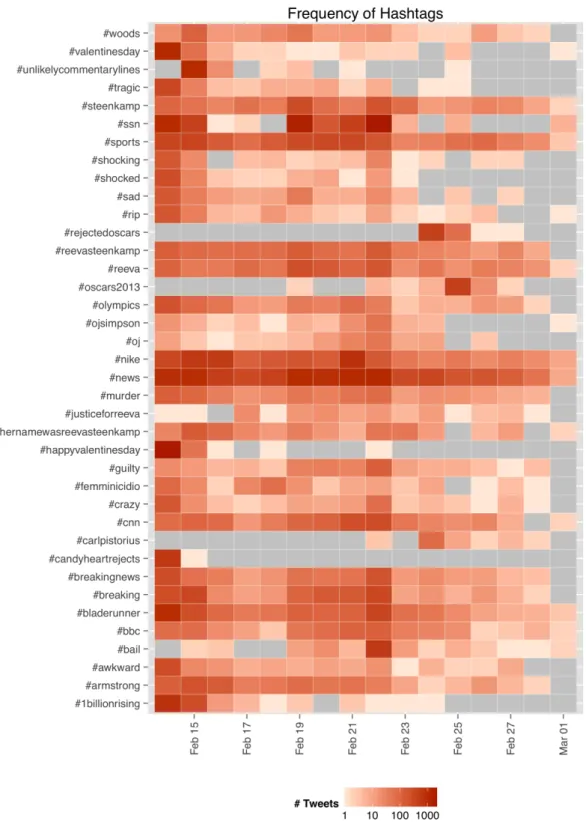
We performed a daily analysis of tweeted hashtags. A total of 32,267 unique hashtags were used, being #pistorius added to 136,895 tweets – this was the most used hashtag in our corpus. We graphically display the daily frequency of some important hashtags in Figure 2.
We observe in Figure 2 how the story was first framed as a tragedy, since hashtags such as #tragic,
#shocking, #shocked, and #sad were used more often in the beginning. Also, as the shooting occurred
on Valentine’s Day, many users made an association to the date. From the second day, Feb. 15, we observe that the association between Pistorius and other Nike athletes got stronger with specific hashtags being used such as #woods, #nike, and #armstrong. A qualitative analysis of the most tweeted messages at this particular day revealed that many messages mentioned a specific Nike advertisement where Pistorius is metaphorically called “a bullet in the chamber”. Towards the end of the analyzed period, Twitter users talked about Pistorius’ bail and, on Feb. 22, the use of the hashtag
#guilty slightly increased.
Selected Papers of Internet Research 14.0, 2013: Denver, USA
3
Figure 2: Heatmap generated with R using a selection of significant hashtags.
It is worth mentioning that Twitter users initially framed the case from Pistorius’ point of view and then slightly switched to hers in part of the messages. As we observe in Figure 3, Reeva was referred to as simply Oscar’s girlfriend at first and soon after by her name. This phenomenon is highlighted by the hashtag #hernamewasreevasteenkamp (Figure 2), one of the most tweeted hashtags on the second day – #justiceforreeva is also significant in the forth day. The increasing use of her name as opposite to “girlfriend” coincides with three special events: 1) on Feb 17, when a South African network broadcast her final appearance in a reality show; 2) on Feb 19, date of Pistorius’ bail hearing; and 3)
4
on Feb 26, when Oscar declared his intention to hold a private memorial service for Reeva.
Figure 3: Proportional occurrence of “girlfriend” and “reeva” or “steenkamp” over the days.
Figure 4 illustrates how more systemic or social frames come up over the days. In this heatmap, we list words associated with the term “gun” and their frequency. It is particularly significant how “gun” is more or less articulated in a same post with the words “violence”, “laws”, “America”, and “security”. Notoriously, Feb. 15 is not only the day when associations between Oscar and Nike are more often made, but also there is an increase in posts discussing gun violence and gun control issues in South Africa – especially, there was a comparison to America.
access africa america bullet charged control crime laws murder police safer security shooting shot tragic violence woman worse F eb 15 Feb 17 Feb 19 Feb 21 Feb 23 Feb 25 Feb 27 Mar 01 1 10 100 # Tweets
Frequency of terms in association with the word 'gun'
Selected Papers of Internet Research 14.0, 2013: Denver, USA
5
In sum, the issues being discussed over the days showcase how the attribution of responsibility changes according to possible causes wondered for the incident. The episodic frame, when only the event is reported, is characterized for a lack of particular causes and responsible agents (Iyengar, 1991) – at first, nobody knew exactly what had happened. From a tragedy for Pistorius to Reeva becoming the victim in the situation, the messages also highlight how a more personal frame focused on Oscar as the perpetrator turned up, especially from the third day on. The more systemic/social approaches emerged in the second day, notoriously because Pistorius’ life story led users to quickly look for some broader explanations for the shooting.
References
Bruns, A. (2011). Gawk scripts for Twitter processing. Mapping online publics Retrieved 14 April 2012, from http://www.mappingonlinepublics.net/resources/
Entman, R. M. (1993). Framing: toward clarification of a fractured paradigm. Journal of Communication, 43(4), 51-58.
Entman, R. M. (2004). Projections of power: framing news, public opinion, and U.S. foreign policy. Chicago: The University of Chicago Press.
Gamson, W. A., & Modigliani, A. (1989). Media discurse and public opinion on nuclear power: a construcionist approach. American Journal of Sociology, 95, 1-37.
Iyengar, S. (1991). Is anyone responsible? How television frames political issues. Illinois: University of Chicago Press.
Matthes, J., & Kohring, M. (2008). The content analysis of media frames: toward improving reliability and validity. Journal of Communication, 58(2), 258-279.
Vimieiro, A. C., & Maia, R. C. M. (2011). Indirect media frame analysis: a methodological alternative to identify cultural frames. Revista Famecos, 18(1), 235-252.