a Conference Management Process
Mirjana Ivanović, Zoran Putnik, Zoran Budimac Department of Mathematics and Informatics, Faculty of Science,
University of Novi Sad, Novi Sad, Serbia & Montenegro
Email: {mira,putnik,zjb}@im.ns.ac.yu
Abstract. In this paper, one of the most popular and reliable Workflow Man-agement Systems - Oracle Workflow System - is used for automation of a typi-cal faculty business – organization of a scientific conference. Four main branches of the organization are detached into four sub-workflows and ex-plained in details. Joined they create a structure and give a formal model able to support organization of a conference – computerized and “workflow-ized” or not.
1 Introduction
Systems for workflow management (WfMS) ensure framework for control and super-vision of intra and inter-organizational business processes. They consist of set of tools securing support for definition of a formal model of a business process, rules for its behavior, administration, and monitoring. Workflow methodology is used in almost all business areas, especially for automation of administrative issues.
WfMS are very complicated software systems. They must agree to the contempo-rary demands on questions of security, reliability, and high performance. At the same time, they must enable cooperation and coordination with other workflow systems, or software tools of other kinds.
Using workflow methodology in order to manage, control, and monitor “business” processes is a relatively new, but fast developing technique. This methodology is used to formally define:
− activities necessary for successful outcome of a certain job, − roles that participate in a job, and
− subtasks that make a complete job.
Methodology itself was first developed during ‘70s, while research was focused on procedures used to formally model office work and document management. Later during ‘80s, the technique progressed towards ‘image processing’ method, putting more emphasis on process model. Yet, the technology didn’t meet the expectations of business users. Researchers realized that the main reason was the narrow perspective to which workflow technology was limited. Therefore, they reconsidered workflow as a multidisciplinary endeavor, located at the intersection of different areas of informa-tion technology, business management, and social sciences. This much broader
per-spective contributed to the return of interest in workflow technology in the 1990s [10].
More about workflow technique in general can be found for example in [1, 6, 8], newer versions of white-paper(s) of the Workflow Management Coalition, or some other authors [3, 5]. More about practical usage of Oracle Workflow Builder – a tool that will be used in this paper for managing workflow – can be found in [7, 11].
In this paper, Oracle Workflow Builder will be employed in a practical case study, which will verify its ability to be used in a formalization of one rather typical “scien-tific business” process. The idea emerged from a paper that suggested a partial analy-sis of one of tasks that is a part of conference organization process [4]. Still, while that paper considered only “review process” - part of conference organization, here a workflow for organization in full is presented.
2 Problem
Statement
The process that has been chosen for formalization diverges almost from the start into several branches. Each of them is relatively independent, while still connected at many important points.
Analyzing the process from the top level the conference organization can be ex-plained in a few sentences. It starts by contacts with possible authors by some sort of inquiry letter. This assures rough estimation of a number of participants of a confer-ence. According to answers, several different lines of communication are started: − contact with appropriate number of possible reviewers;
− contact with a hotel, motel, or similar facility where the conference will be organ-ized;
− contact with travel agencies that are willing and able to organize transportation from different places by different means, and
− contact with prosperous publishing firms that will produce “book” of abstracts be-fore, and proceedings “book” after the conference.
At this moment, a note should be made that this is just one of possible models. Some obvious changes can be made even here, before the beginning of the confer-ence, at the “theoretical” level. For example – some conferences do not have book of abstracts, but only proceedings book – available either at the conference, or later, only for authors who presented their paper.
Contact with a hotel may be left to a travel agency. Publication of papers may be done as a part of some regular journal, in which case contact with authors, reviewers, and publisher is a well-defined process, not connected with the conference. Still, ex-perience gained during organization of several conferences suggests that the above-mentioned model is the one giving good results. Some of the more important reasons for such an opinion are the following:
− Contact with reviewers at the level of abstracts ensures the best choice of experts latter, at the level of papers;
− Direct contact with a hotel ensures that there will be a proper number of conference rooms, big enough for certain conference sections;
− Contact with “big enough” travel agencies ensures that all of the participants can be offered organization of their transportation, (almost) regardless of their choice of time schedule, place from where they travel, or way of transportation;
− Early communication with a publishing company ensures additional level of qual-ity through book of abstracts. At the same time, offer for two publishing jobs will probably result in lowering of the prices. As much as the participants are con-cerned, book of abstracts available at the conference relax the choice of interesting presentations. From the point of view of organizers separate proceedings book en-sures that only presented papers will be included in it.
Conferences with other methods are not restricted by a given organizational ap-proach.
Fig. 1. Top level organization of conference workflow
After agreeing on the model of organization, as a natural consequence four mutually connected branches of workflow are achieved. This top-level model of organization is given in figure 1.
3
More Detailed Model
In the following subsections, a more detailed explanations and an example of graphi-cal representation of one branch will be given.
3.1 Contact with Reviewers
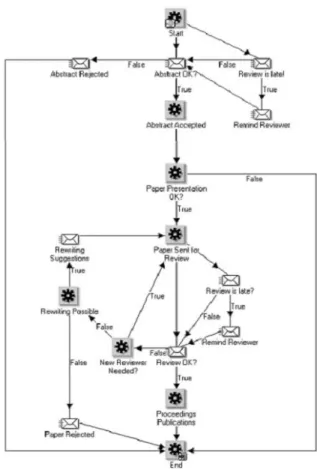
Fig. 2. Contact-with-reviewers branch
“Letter of interest” inquiry supplies a rough estimate of a needed number of review-ers. Choice of separate sending and review of abstracts and papers enables a proper choice of a number and a type of reviewers. Also, contact with the reviewers at the level of abstracts, ensures later assignment of paper to a proper expert. Shortness of abstracts makes it possible for organizing committee to reassign them on time if re-viewer decides that she/he isn’t best suited for a certain topics. At the same time, or-ganizers are through this process given a precise number of needed reviewers for all fields covered by the conference.
As a regular part of this process, organizing committee together with a program committee is given a possibility to reject abstracts that obviously are not proper for the conference.
During the abstracts review subprocess, organizing committee and expert review-ers agree on a maximal number of papreview-ers that will be sent to the expert after the con-ference. The term “maximal” is introduced because of expected situation that not all of the submitted abstracts will be presented – which usually means that submission of paper is not allowed. Also, not all of the submitted and presented abstracts will be ac-companied by the paper, as a choice of author(s).
Top sub-level of details of contact with reviewers is given in figure 2. It is obvious that some of the nodes of this workflow are again processes, not shown in details here. Also, each paper is usually sent to at least two reviewers, again not shown here. This simplification is done for the sake of clearness and simplicity of already rather complicated workflow. Still, because of excellent abilities of Oracle Workflow Builder, this workflow is not sealed forever in this form. Each node can be if neces-sary redefined as a sub-process, explained and detailed in a third level (or even deeper if needed) sub-workflow.
Roles existing in this workflow are: organizing committee, reviewers, and confer-ence participants. There are some other less important roles, such as post-office for handling a large amount of letters, or system administrator, in case of electronic let-ters.
Activity existing in a workflow is contact between committee and reviewers. This contact exists at different levels and at different times. First, before the conference (abstracts) and then after the conference (papers). During those contacts and between them there may be some sort of negotiation about future roles of reviewers and amount of reviews they are able and willing to perform.
3.2 Contact with a Hotel
This part of a conference organization process is the one that is the least connected with the assumed expert knowledge by organizers. As a consequence, this should as much as possible be left to a travel agency participating in organization. Still, there are some points that require direct contact between organizers and a hotel.
While for the travel agency only the total number of guests is relevant, organizer must take proper care about number of participants belonging to certain sections. A proper number of proper-sized conference rooms must be available at the hotel. Con-ference desk and conCon-ference-organizing office close to the conCon-ference rooms must be available as well. Some technical equipment - computer, video-beam, printer, or copy machine, for example - relaxes organization if available at the hotel. Possibility of having conference rooms as close as possible to each other enables easier contact among participants at different sections during breaks.
Direct contact with the hotel can also enable better understanding between partici-pants and organizing committee. There will always be participartici-pants who want to or-ganize transportation or staying at the hotel by themselves. At the same time, they would want to share all the benefits that other participants as a group are given by a hotel. This can be assured by understanding between hotel and organizers, for all the participants of the conference.
Naturally, this additional communication between two parties assures also better organization of things ranging from opening and closing ceremonies and conference diners, down to organization of coffee breaks or taxi calls.
Roles existing in this workflow are: organizing committee and hotel. Activities ex-isting in a workflow are: contacts between hotel and organizing committee, and be-tween participant and hotel.
Tasks/nodes of this workflow consist of numerous repetitions of contacts between hotel and organizing committee, ensuring that actual conference flow will be as needed.
3.3 Contact with a Travel Agency
There is too much of routine required during the organization of the conference for the organizing committee, regarding tourist activities. Participants will come at differ-ent time, leave on differdiffer-ent day, stay for a differdiffer-ent number of days. Some of them will connect participation at the conference with some other job or holidays, requiring either to come earlier then the conference begins or leave later. There will be a lot of different choices of means of transportation, also. Participants coming from far away, possibly from other continents, would require traveling by plane, with all needed transfers from and to the airports. Others, coming from nearer destinations, would re-quire some other mean of transportation, but still organized completely in each detail. All of the mentioned should be left to the professionals - tourist agency - as much as possible. Even direct communication between conference participant and the agency is best left open for participants with special requirements.
Our experience shows that choice between a “big” and “small” agency largely de-pends on a size of a conference and number of participants from abroad. For local or-ganization, “small” agency even has some additional advantages, for example for giv-ing special attention to the conference for a certain period of time. Still, for “abroad” organization, well-known large agency ensures better trust for participants from far away.
Things mentioned in a previous subsection concerning direct communication of organizing committee and a hotel must be known by travel agency. This will ensure that there is no misunderstanding about those very important moments and that there are no points that are double performed both by agency and committee, or worse - ne-glected by both sides. Permanent contact between agency and organizing committee must exist, if possible including face-to-face meetings on regular bases. This also helps organizing committee to keep track of actual number of participants of the con-ference.
Considering the given description of this branch, it may seem that it is a relatively simple part of a process. There are several reasons for this. First there are a lot of con-nections and activities between agency and other branches of a conference workflow, which can be shown only at the general level. Second, and more important, agency has its own workflow for organization of all contacts, transportation, transfers and similar, not mentioned here.
Roles existing in this workflow are: organizing committee, travel agency, confer-ence participants, and hotel. As noted above, other important roles like transport agencies, airports, or banks, for example - are included in agency workflow and are not presented here.
Activities existing in a workflow are: contacts between participant and organizing committee, between participant and travel agency, and between organizing committee and agency. Activities of agency concerning transportation and transfers and “regu-lar” contact with the hotel are not mentioned here, being a part of agency workflow.
Contact of agency with the hotel, organizing committee and a hotel, and organizing committee and agency mentioned in second subsection, are also not given here, being a part of a general workflow model.
Tasks/nodes of this workflow consist of numerous repetitions of contacts between agency and individual participants. These contacts are either started directly, or through organizing committee, but later, organizing committee is only informed on number of participants, while their obligations towards agency are not of interest to other parts of conference workflow.
Even though this is rather obvious, we will mention here that organizing committee must be aware that there will always be participants not connected to a given travel agency. Statistical analysis of couple of conferences can be used for this purpose, so that organizing committee can calculate more precisely actual number of participants at the conference.
3.4 Contact with a Publishing Company
This part of a conference organization model is by our opinion very well defined in advance. Potential participants send abstracts. They are reviewed and certain number is accepted for presentation. Accepted abstracts are published as a separate book of abstracts, available at the conference. Participants who presented their abstracts (and paid conference fee) are entitled to send their papers for review. Accepted papers are published as a proceedings book. Even though advantages of this or some other model of publishing can be a matter of a discussion, it doesn’t influence our sub-workflow - contact with publishing company. Each conference wanting to publish both book of abstracts and proceedings book can follow given workflow. Conference without book of abstracts can disregard just that part of a workflow. Conferences wanting book of abstracts, while papers are published as a part of some regular journal can disregard second part of workflow. Finally, conferences without book of abstracts that publish papers as a regular journal will naturally have no need for this sub-workflow as a whole.
It can be noticed that the term “publishing company” should be considered rather wide because of different possible methods of publishing. Modern means of publica-tion of proceedings, such as compact disks, or publicapublica-tion on the World Wide Web, are not excluded by a proposed model. Any form of publication of proceedings “book” asks for a help of a professional, expert company, outside of organizing com-mittee.
On the other hand different model of publishing (proceedings book available at the conference, with or without book of abstracts ...) doesn’t change this branch. The only change exists in a time schedule of a general workflow model. In the case of the latter model contact with a publishing company is finished before the conference starts.
Since actual workflow of this branch is rather straightforward and generally under-standable, no further textual nor graphical explanations will be given here.
Let us only define elements of this workflow here. Roles existing in this workflow are: organizing committee, and publishing company, (and possibly post office). This part of a general workflow is highly connected with a reviewer branch, but roles from there - reviewers, or proofreaders, are not mentioned here.
Activities in this branch are: contact with publishing company about book of ab-stracts, publishing of a book of abab-stracts, contact about proceedings book and publish-ing of it. In proposed model, those two jobs are completely separated, first is per-formed before, second after the conference. This gives probably a several months time gap between those jobs.
Tasks/nodes in the workflow are mainly part of a publishing business, but still or-ganizing committee can and should have influence and control over it. Design of books, separation of abstracts/papers into proper sections and numerous other tasks can raise or lower conference image highly.
4 Summary
Workflow management systems can be deployed in various scenarios, ranging from human-centered organizational processes to autonomous software processes, both confined to or extending beyond the boundaries of an enterprise. Each of these sce-narios utilizes the coordination functions provided by the workflow system in differ-ent ways and requires integration to a differdiffer-ent set of systems. A critical success fac-tor for current organizations is how well they use information technology to support their business processes [9].
Throughout the paper, a huge help that Oracle Workflow Builder gives in formal-ization and proper definition of this job was partly neglected. Any node of a certain workflow, if necessary, can easily be developed into a separate sub-workflow with any level of complexity. Still, proper choice of graphics presentation allows the user to see chosen level of details - from very global, non-detailed, general workflow, to sub-sub-...-sub workflow with all defined details for a given task.
Separation of conference organization into given four branches, allows us to use this workflow even for the conferences organized by some different model. This can be achieved by simple deletion of a certain branch, a part of a branch, re-arrangement of time schedule, or by addition of certain nodes, activities or roles to some part of some workflow. Workflow management as a technology brings greater flexibility into systems in which it is employed, attaining larger interest lately. The basic idea of cap-turing the formal descriptions of a certain business processes, creation of a model de-scribing it, and develops it further through the usage of information technology helps in any business – including conference organization.
In comparison to [4] where only the reviewing process as a part of the conference organization was formalized and presented, in this paper an attempt of the complete formalization and modeling is given. The advantage of this approach is wide, starting from philosophical – such a model can be checked and proved correct, ending with the practical – the completeness of a model makes it possible to use some software tool for both modeling and monitoring of a process.
An important point to make is also that the advantages resulting from the use of workflow management technology can be broadly divided into business-related and technology-related advantages. One of the key business-related is the reduction of holdup, delay time in routing work among people. This usually and almost certainly results in increased productivity and reduced costs. Concerning the technology-related
advantages, workflow management systems can be regarded as meta-programming tools that can be used to develop flexible distributed applications, where the basic in-structions used are autonomous, heterogeneous applications [2].
Naturally, complicated nature of a conference organization does not allow simple separation. Even though we gave four branches, relatively easily separable and defin-able, all of those branches are mutually connected and interrelated. More than that, on a general level, some more roles, tasks, and activities emerge, all of them aimed at better organization. Still, with an excellent tool such as Oracle Workflow Builder, ex-tensions to a workflow are easily achieved.
Another important advantage that usage of Oracle Workflow Builder brings is a possibility for using this workflow later, not just as a formal model, but also as a real-life monitoring tool. With Oracle Workflow Monitor available and installed at Oracle Database Server, any computer with the access to the World Wide Web and proper administrative rights can be used for monitoring, controlling and changing previously defined workflow. This part is also defined at the time of workflow definition - roles and access levels ranging from system administrators to guests and permissions and abilities of each role. Client computers, used for monitoring, do not require any addi-tional software, except for connection to the World Wide Web through a browser.
References
1. Terminology & Glossary, Technical Report WFMC-TC-1011, The Workflow Management Coalition, Brussels, Belgium (1996)
2. Alonso G., Mohan C.: Workflow Management Systems: the Next Generation of Distributed Processing Tools. Advanced Transaction Models and Architectures, Kluwer, (1997) 3. Becker J., zur Muehlen M., Gille M.: Workflow Application Architectures: Classification
and Characteristics of Workflow-Based Information Systems. Workflow Handbook 2002, Future Strategies, Lighthouse Point (2002)
4. Benes M.: Conference Paper Review Process: A Case Study. Proceedings ISM’01 Confer-ence, Ostrava, Czech Republic (2001)
5. Frappaolo C.: The Many Generations of Workflow. Workflow Handbook 2001, Future Strategies, Lighthouse Point (2000)
6. Hollingsworth D.: The Workflow Reference Model, Tech Report TC00-1003, The Work-flow Management Coalition, Brussels, Belgium (1994)
7. Ivanović M., Putnik Z., Budimac Z., Babjak P.: An Application of Workflow Methodology in Design of Information Systems. Proceedings Conference on Application of Informatics in Yugoslav Army, Belgrade, Yugoslavia, http://www.vj.yu/vojska_s/obrazov/savetovanje/ projis-3april/workflow.htm (2001)
8. Jablonski S., Bussler C.: Workflow Management. Modeling Concepts, Architecture and Im-plementation, International Thomson Computer Press (1996)
9. Kradofler M.: A Workflow Metamodel Supporting Dynamic, Reuse-Based Model Evolu-tion, Ph.D. Thesis, University of Zurich (2000)
10. Mahling D.E., Craven N., Croft W.B.: From Office Automation to Intelligent Workflow Systems, IEEE Expert (2000)
11. Putnik Z., Budimac Z.: An Example of Usage of Workflow Technology in Introduction of Standard ISO 9001, Proceedings YU INFO’2001, Kopaonik, Yugoslavia, CD edition, (2001)