Advanced Inverter Overview
Renewables on the Distribution Grid
Minnesota Public Utilities Commission
April 11, 2014
Lise Trudeau
Senior Engineering Specialist Minnesota Department of Commerce Division of Energy Resources
Distributed Resources Include:
•
Efficiency
,
•
Distributed Generation
(Solar PV, Combined
heat and power, Small wind),
•
Distributed Flexibility and Storage
(Demand response, Electric vehicles, Thermal
storage, Battery storage), and
•
Distributed intelligence
(Information and
control technologies that support system
integration, including advanced inverters).
2
Advanced Inverters
Examples of advanced functionality:
• Voltage and Frequency Ride through while still providing anti-islanding
• Reactive Power (var) support
• Ramping rates for normal and emergency scenarios
• Reconnection using “soft-start” capability with either ramping or random starts within
windows, in order to avoid sharp spikes when large numbers of I-DER systems reconnect to the distribution system
Impacts on Distribution Systems
Distributed Generation - Feeder Analysis
4 Evaluation Criteria include:
• Voltage
• Protection system • Power quality
• Loading • Operations
Solutions include:
• Advanced Inverters • Demand Response
• Energy Storage (thermal, batteries, Electric Vehicles)
Key Factors that Determine How Much PV a
Feeder Can Accommodate (Hosting Capacity)
5
Source: EPRI, Daniel Brooks & Jeff Smith. Presentations IEEE PES July 13, Lisbon Nov 12.
• Size of PV
• Location of PV
• Feeder characteristics • Electrical proximity to
other PV
• Unique solar resource characteristics in the area
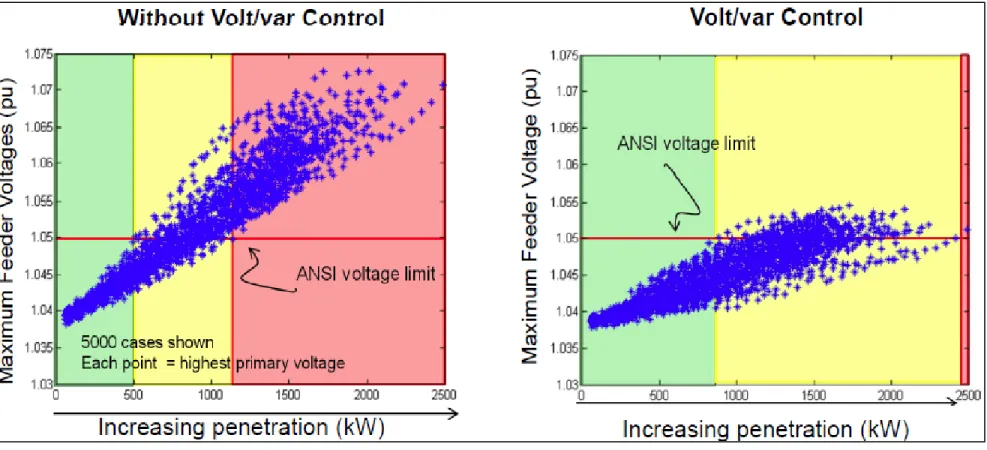
Increasing Hosting Capacity with Smart Inverters
6
Graphic Source: EPRI, Daniel Brooks & Jeff Smith. Presentations IEEE PES July 13, Lisbon Nov 12.
Advanced inverters can generally double the capacity of PV allowed on a feeder.
Technical Context – Codes & Standards
7
Technical and
jurisdictional overlap
Source: NREL Presentation at MN Commerce DG Interconnection Meeting. May 31, 2012.
CA Smart Inverter Working Group
In response to California Rule 21, the Smart Inverter Working Group (SIWG) will develop standards for certifying advanced functions. January 1, 2014 SIWG report to the CPUC*: • Background
• Recommendations
• Development framework & timelines
8
SIWG - Proposed Timeline
• Phase 1: autonomous functions
– March 2014 – UL to publish test procedures – October 2015 – commercial implementation
• Phase 2: communication functions
– June 2014 - UL to publish test procedures – January 2016 - commercial implementation
• Phase 3: additional functions
– September 2014 - UL to publish test procedures – April 2016 - commercial implementation
9
Integration with the Distribution Grid
• DG penetrations in MN are still very low; increases are coming.
• Distribution system planning occurs largely in isolation from planning for other parts of the grid – coordination is needed with other planning work; • Distribution system planning is based largely on historical peak loads –
additional drivers should be incorporated;
• Distributed generation is capable of providing active grid support but has not historically been allowed or required to do so – both will change;
• Distributed generation is often not visible to the system operators – challenging at high penetrations;
• Distribution management systems have advanced significantly including sophisticated real time functions – capabilities not yet tapped.
Future Grid
Tomorrow’s grid will:
– Be more distributed, flexible, intelligent, real-time controlled, autonomous, open and secure;
– Be cleaner and reliable;
– Operate resiliently against attack and natural disaster.
Tomorrow’s distribution system will:
– Enable a high level of integrated Distributed Resources, both supply and demand side, with active participation by consumers;
– Manage two way flows of electricity;
– Implement modern distribution management systems (DMS) including advanced control and communications.
Distribution Planning
Increasing need for:
• Transparency
• Forecasting and planning for DG, DSM,
and efficiency
• Coordination with other planning work
Distribution Planning
Utilities to watch:
• San Diego Gas and Electric
– Distribution system available capacity – Dynamic pricing
• Con Edison
– DSM and efficiency forecasting:
– Planning for Efficiency, Con Edison, August 2011, Public Utilities Fortnightly
Thank You.
MN DG Resources
Reports, presentations, data, and dockets:
http://mn.gov/commerce/energy/topics/clean-energy/distributed-generation/ or search for: “MN
distributed generation”
http://mn.gov/commerce/energy/topics/resources/ene
rgy-legislation-initiatives/ or search for: “MN Energy
Legislation Initiatives”
https://mn.gov/commerce/energy/utilities/Annual-Reporting-Utility.jsp or search for: “MN Utility Annual
Reporting”