International Journal of Research in Community
Service
Vol. 1, No. 1, pp. 7-13, 2020
Al Jazari Journal of Mechanical Engineering
ISSN: 2527-3426 Al Jazari Journal of Mechanical Engineering
ISSN: 2527-3426
Comparative Analysis of Elementary School Student Knowledge
Regarding Flood Mitigation in the Citarum Watershed
Sukono
a,*, Eman Lesmana
a, Herlina Napitupulu
aa
Department of Mathematics, Universitas Padjadjaran, Indonesia Corresponding author e-mail address: [email protected]
Abstract
Flooding is a natural event, one of which is caused by the overflow of rivers. This disaster often occurs in the Dayeuhkolot area, Bandung Regency. Geographical conditions that are close to the flow of the Citarum River and the plains that are lower than the surrounding area cause this area to be flooded especially during the rainy season. This paper aims to analyze the effectiveness of disaster training given at a young age and analyze the effectiveness of training methods provided in the form of games and PowerPoint media. This activity is aimed at grade 6th students at Bojong Asih Elementary School starting with the questionnaire I which functions as a pre-test and ends with questionnaire II which functions as a post-test. Questionnaires were given at the beginning and at the end to see the extent to which the material provided new influence and knowledge to Bojong Asih Elementary School students. The results of the questionnaire showed that before counseling about flood mitigation, samples were categorized as having a good knowledge of 91% and having poor knowledge of 9%. After counseling about flood disaster mitigation using games and PowerPoint media there was an increase in knowledge, samples that had good knowledge were 98% and those with less good knowledge were 2%. Based on the pre-test and post-test results, this activity was proven successful in increasing the knowledge of Bojong Asih Elementary School related to flood mitigation.
Keywords: Citarum River, Bandung Regency, rain, flood, mitigation.
1. Introduction
Disaster is a situation that is detrimental to many parties. Disaster is a condition that disrupts the socio-economic life of the community caused by natural phenomena or human actions (Alexandra, 2015). Disasters can occur through a long process or a certain situation in a very fast time without any signs. The impact of a disaster can varies, depending on environmental and community conditions and vulnerability. One of the most frequent disasters experienced by people in Indonesia, especially in certain areas such as Dayeuhkolot Bandung is flooding (Adi, 2013). Floods often become disasters that occur and continue
to recur (Chalkias et al., 2014; Kablan et al, 2017). Muin et al. (2015) and Bainus et al. (2020) have researched flood disaster relief.
Frequent floods that occur and provide losses so mitigation is needed to minimize losses from flooding (Tauhid et al., 2017; Bambals, 2015; Manfreda et al., 2011). Mitigation has an important role in efforts to reduce the risk of floods that often occur in the Dayeuhkolot area of Bandung. Dayeuhkolot is a flood-prone area in Bandung. Together with Baleendah, this district has become a standby area when the rainy season arrives. A study of the character of the Citarum Watershed in 2016, found that 94% (around 879.8 ha) of the Dayeuhkolot area had the potential to be flooded every year. This region includes the upper Citarum Watershed.
This understanding of mitigation is very important especially to young people who do not yet know what is needed early in the event of a disaster (Jimba et al., 2011; Pitsuwan and Caballero-Anthony, 2014). Disaster mitigation is a series of efforts to reduce disaster risks, both through physical development and awareness-raising and capacity building to face the threat of disasters (Article 1 Paragraph 6 Government Regulation of the Republic of Indonesia No. 21 of 2008 concerning Implementation of Disaster Management /Pasal 1 Ayat 6 Peraturan Pemerintah Republik Indonesia No. 21 Tahun 2008 tentang Penyelenggaraan Penanggulangan Bencana). Flood mitigation training must be carried out and given to the community, especially young people. Telling things about floods starting from what floods are, causes of floods, things to do when a flood occurs, things to do after a flood, and instilling thought about the importance of preventing floods. So that all losses caused by flooding will no longer be felt by the community (Sarminingsih et al.. 2014; Hassani, 2016)
The purpose of the research regarding the effectiveness of disaster mitigation training in Bojong Asih 01 Elementary School and Bojong Asih 02 Elementary School are
1. analyze the effectiveness of disaster training given at a young age, and
2. analyze the effectiveness of training methods provided in the form of games and PowerPoint media.
2. Research Methods
The method we use to collect data is a questionnaire in the form of pre-test and post-test. Pre-test and post-test contain questions related to flooding disaster mitigation. Another method that we use for disaster mitigation socialization is by using PowerPoint media. The method for processing our data uses Microsoft Excel 2010 software.
3. Results and Discussion
3.1.Scores Data
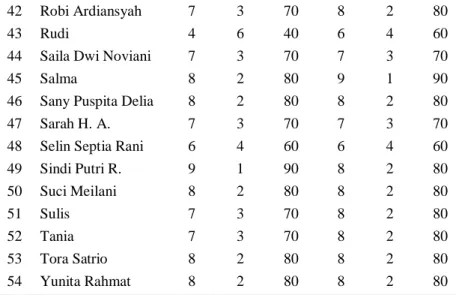
The data we use are data from the results of the pre-test scores that we provide before the socialization activities and the post-tests that we provide after the socialization activities. Scores data before and after socialization using PowerPoint media can be seen in Table 1.
Table 1: Scores data of students’ knowledges about flood disaster mitigation
No Name Pre-test Post-test
True False Score True False Score
1 Adi Hardiansah 7 3 70 7 3 70
3 Akbar Fathul Rizky 7 3 70 8 2 80
4 Alfi 6 4 60 8 2 80
5 Aliska 5 5 50 6 4 60
6 Annisa Putri M. 8 2 80 8 2 80
7 Azzrul Mardia 8 2 80 8 2 80
8 Bella Tri W. 7 3 70 8 2 80
9 Diana Lisna Dewi 7 3 70 7 3 70
10 Dirga Maulana 7 3 70 8 2 80
11 Dwi Ramayanti 7 3 70 7 3 70
12 Eka Alamsyah 9 1 90 9 1 90
13 Fahri 5 5 50 5 5 50
14 Fajar Iqbal M. 7 3 70 7 3 70
15 Farel 8 2 80 8 2 80
16 Fauzi 6 4 60 6 4 60
17 Fedli 8 2 80 8 2 80
18 Fergie 7 3 70 7 3 70
19 Fikri R. M. 8 2 80 8 2 80
20 Fitriya K. 7 3 70 8 2 80
21 Haikal 7 3 70 8 2 80
22 Ikhsan Al Rizky 7 3 70 8 2 80
23 Indah Sri Restina 8 2 80 9 1 90
24 Irpan 5 5 50 7 3 70
25 Jamius 7 3 70 7 3 70
26 Lia Ratisah Fauziah 5 5 50 7 3 70
27 M. Ridwan 7 3 70 8 2 80
28 Meilany 7 3 70 7 3 70
29 Nadiya 8 2 80 8 2 80
30 Nisa Aulia S. 8 2 80 8 2 80
31 Pahmi Wahyudin 8 2 80 9 1 90
32 Panji 8 2 80 9 1 90
33 Raja 8 2 80 8 2 80
34 Raka Agustin 7 3 70 8 2 80
35 Ramdani 8 2 80 8 2 80
36 Randi Hapid 8 2 80 8 2 80
37 Rangga 7 3 70 7 3 70
38 Rani 8 2 80 8 2 80
39 Reyhan 7 3 70 7 3 70
40 Ria Oktaviani 6 4 60 6 4 60
42 Robi Ardiansyah 7 3 70 8 2 80
43 Rudi 4 6 40 6 4 60
44 Saila Dwi Noviani 7 3 70 7 3 70
45 Salma 8 2 80 9 1 90
46 Sany Puspita Delia 8 2 80 8 2 80
47 Sarah H. A. 7 3 70 7 3 70
48 Selin Septia Rani 6 4 60 6 4 60
49 Sindi Putri R. 9 1 90 8 2 80
50 Suci Meilani 8 2 80 8 2 80
51 Sulis 7 3 70 8 2 80
52 Tania 7 3 70 8 2 80
53 Tora Satrio 8 2 80 8 2 80
54 Yunita Rahmat 8 2 80 8 2 80
3.2.Average Knowledge Score of Samples
The average score of students’ knowledges about flood disaster mitigation both before and after being given exposure using PowerPoint media can be seen in Table 2.
Table 2: Average score of students’ knowledges about flood disaster mitigation
Average
Pre-test Post-test
72 76
3.3.Knowledge Level
Scores can be categorized as good if the sample has a score greater than or equal to 60, and is not good or poor if the sample has a score of less than 60.
The frequency distribution of students’ knowledge about flood disaster mitigation both before and after being given exposure using PowerPoint media can be seen in Table 3.
Table 3: Frequency distribution of students’ knowledge about flood disaster mitigation
Knowledge Pre-test Post-test N % N %
Good 49 91% 53 98%
Not good 5 9% 1 2%
Total 54 100% 54 100%
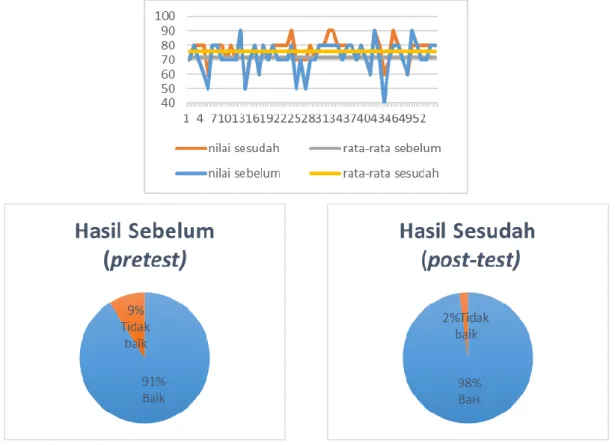
Based on the calculation of the results of the pre-test conducted, before the socialization, there were 49 students or about 91% had good knowledge and as many as 5 students or about 9% had poor knowledge and with an average score of 72. But after the socialization was done according to the calculation results from the post-test with good knowledge increased to 53 students or around 98%, while those who had poor knowledge became as much as 1 student or about 2% and with an average score of 76.
If seen from the results of the pre-test and post-test calculations, the score of student knowledge, the average score of students, and the distribution of the score of average knowledge increases. This increase can be seen from the diagram in Figure 1.
Figure 1: Diagram of students’ knowledge about flood disaster mitigation
4. Conclussion
From the results of our research and based on the background of the area used for the study, students in grade 6th at Bojong Asih 01 Elementary School and Bojong Asih 02 Elementary School in Dayeuhkolot already know a lot about disaster mitigation because almost every year floods occur in the area. But not a few also are still lacking knowledge about flood mitigation. After the socialization of disaster mitigation that we do, almost all students can understand the importance of disaster mitigation in the Citarum Watershed.
Our advice that can be done in the future are
1. conduct regular disaster mitigation socialization so that students in the Citarum Watershed understand the importance of disaster mitigation evenly, and
2. use a variety of more creative socialization media to increase student enthusiasm and to be easily understood.
Acknowledgments
Thank you to the Dean of the Faculty of Mathematics and Natural Sciences, and the Directorate of Research, Community Service, and Innovation, Universitas Padjadjaran, who have provided Community Service Grants funds with contract Number: 3453/UN6.D/PM/2019.
References
Adi, S. (2013). Characterization of flash flood disaster in Indonesia. Indonesian Journal of Science and Technology,15(1), 42-51.
Alexandra, L.A. (2015).Perception of Human Security: Indonesian View, in Human Security in Practice: East Asia Experiences JICA-RI Working Paper, No. 99. Tokyo: JICA Research Institute. Bainus, A., Yulianti, D., and Husin, L.H. (2020). Mitigating Natural Disaster in the Midst of Limitations:
Human Security Issues in Overcoming Threat of Flood in Citarum River Basin, Indonesia.
Humanities & Social Sciences Reviews, Vol 8, No 3, 2020, pp 859-867.
Bambals, R. (2015). Human security: An analytical tool for disaster perception research. Disaster Prevention and Management, 24 (2),150-65.
Chalkias , C., Ferentinou, M. & Polykretis , C., (2014). GIS-Based Landslide Susceptibility Mapping on the Peloponnese Peninsula, Greece. Geosciences, Volume 4, 176-190.
Hassani, W. (2016). Flood disaster risk analysis in Majalaya district, Bandung Regency
(Unpublished master dissertation). Department of Geography Studies, UniversitasPendidikan Indonesia.
Jimba, M., Hubbard, S., Sase, E., Suzuki, T., and Otsuka, K. (2011). Human security approaches for disaster recovery and resilience. JMAJ, 54 (5), pp. 38-341,
Kablan, M.K.A., Dongo, K., and Coulibaly, M. (2017). Assessment of Social Vulnerability to Flood in Urban Côte d’Ivoire Using the MOVE Framework. Water 2017, 9, 292; 1-19. doi:10.3390/w9040292
Manfreda, S., Sole, A. & Di Leo, M., 2011. Detection of Flood-Prone Areas Using Digital Elevation Models. Journal of Hydrologic Engineering, pp. 781-790.
Muin, S. F., Boer, R., and Suharnoto, Y. (2015). Flood modeling and analysis of losses due to flood disasters in the Upper Citarum watershed.Jurnal Tanah danIkliim, Vol 39 (2),
Pitsuwan, S. and Caballero-Anthony, M. (2014). Human Security in Southeast Asia: 20 years in Review. Asian Journal of Peacebuilding, 2(2), 199-215
Sarminingsih, A., Soekarno, I., Hadihardaja, I.K., and Syahril, S.B. (2014). Flood Vulnerability Assessment of Upper Citarum River Basin, West Java, Indonesia. International Journal of Applied Engineering Research, 9 (23). 22921-22940.
Tauhid, C.D.L., Fathani, T.F., and legono, D. (2017). Multi-Disaster Risk Analysis of Klaten Regency, Central Java, Indonesia. Journal of the Civil Engineering Forum, Vol. 3 No. 3 (September 2017), 135-148.