DE PA
O TM
ENT F THE A
R
M Y
•
•
E U
N I
T
E D
S TAT S O
A
F A
ME RI
C
R THIS W E ' LLD E FE N D
Joint Publication 3-13
Information Operations
27 November 2012
Incorporating Change 1
This publication provides joint doctrine for the planning, preparation, execution, and assessment of information operations across the range of military operations.
2. Purpose
This publication has been prepared under the direction of the Chairman of the Joint Chiefs of Staff. It sets forth joint doctrine to govern the activities and performance of the Armed Forces of the United States in joint operations and provides the doctrinal basis for US military coordination with other US Government departments and agencies during operations and for US military involvement in multinational operations. It provides military guidance for the exercise of authority by combatant commanders and other joint force commanders (JFCs) and prescribes joint doctrine for operations, education, and training. It provides military guidance for use by the Armed Forces in preparing their appropriate plans. It is not the intent of this publication to restrict the authority of the JFC from organizing the force and executing the mission in a manner the JFC deems most appropriate to ensure unity of effort in the accomplishment of the overall objective.
3. Application
a. Joint doctrine established in this publication applies to the Joint Staff, commanders of combatant commands, subunified commands, joint task forces, subordinate components of these commands, and the Services.
b. The guidance in this publication is authoritative; as such, this doctrine will be followed except when, in the judgment of the commander, exceptional circumstances dictate otherwise. If conflicts arise between the contents of this publication and the contents of Service publications, this publication will take precedence unless the Chairman of the Joint Chiefs of Staff, normally in coordination with the other members of the Joint Chiefs of Staff, has provided more current and specific guidance. Commanders of forces operating as part of a multinational (alliance or coalition) military command should follow multinational doctrine and procedures ratified by the United States. For doctrine and procedures not ratified by the United States, commanders should evaluate and follow the multinational command’s doctrine and procedures, where applicable and consistent with United States law, regulations, and doctrine.
For the Chairman of the Joint Chiefs of Staff:
CURTIS M. SCAPARROTTI Lieutenant General, U.S. Army
Preface
ii JP 3-13
• Describes techniques for assessing information related capabilities (IRC) and techniques for assessing the integration of the IRCs in support of the joint force commander’s objectives.
• Expands guidance for the 8-step assessment process.
• Provides additional information about private sector assessment techniques, including the theory of change.
• Expands discussion of sound assessment with a focused, organized approach that is being developed in conjunction with the initial operation plan.
• Emphasizes the need for assessments to be periodically adjusted to avoid becoming obsolete.
Summary of Changes
Intentionally Blank
TABLE OF CONTENTS
PAGE EXECUTIVE SUMMARY ... ix CHAPTER I
OVERVIEW
• Introduction ... I-1
• The Information Environment ... I-1
• The Information and Influence Relational Framework and the Application
of Information-Related Capabilities ... I-3 CHAPTER II
INFORMATION OPERATIONS
• Introduction ...II-1
• Terminology ...II-1
• Information Operations and the Information-Influence Relational
Framework ...II-1
• The Information Operations Staff and Information Operations Cell ...II-2
• Relationships and Integration ...II-5 CHAPTER III
AUTHORITIES, RESPONSIBILITIES, AND LEGAL CONSIDERATIONS
• Introduction ... III-1
• Authorities ... III-1
• Responsibilities ... III-1
• Legal Considerations ... III-3 CHAPTER IV
INTEGRATING INFORMATION-RELATED CAPABILITIES INTO THE JOINT OPERATION PLANNING PROCESS
• Introduction ... IV-1
• Information Operations Planning ... IV-1
• Information Operations Phasing and Synchronization ... IV-11 CHAPTER V
MULTINATIONAL INFORMATION OPERATIONS
• Introduction ... V-1
• Other Nations and Information Operations ... V-2
• Multinational Information Operations Considerations ... V-2
• Planning, Integration, and Command and Control of Information Operations
in Multinational Operations ... V-3
• Multinational Organization for Information Operations Planning ... V-5
• Multinational Policy Coordination ... V-5 CHAPTER VI
INFORMATION OPERATIONS ASSESSMENT
• Introduction ... VI-1
• Understanding Information Operations Assessment ... VI-1
• Purpose of Assessment in Information Operations ... VI-2
• Impact of the Information Environment on Assessment ... VI-2
• The Information Operations Assessment Process ... VI-3
• Barriers to Information Operations Assessment ... VI-10
• Organizing for Operation Assessment ... VI-10
• Measures and Indicators ... VI-11
• Considerations ... VI-13
• Categories of Assessment ... VI-13 APPENDIX
A References ... A-1 B Administrative Instructions ...B-1 GLOSSARY
Part I Abbreviations and Acronyms ... GL-1 Part II Terms and Definitions ... GL-3 FIGURE
I-1 The Information Environment ... I-2 I-2 Target Audiences ... I-4 I-3 Application of Means to Achieve Influence ... I-6 I-4 Application of Information-Related Capabilities to Achieve
Influence ... I-7 I-5 Influence Leads to Achievement of an End(s) ... I-8 II-1 Notional Operation Plan Phases ...II-2 II-2 Information Operations Cell Chief Functions ...II-5 II-3 Notional Information Operations Cell ...II-6 II-4 Notional Joint Interagency Coordination Group Structure ...II-8 II-5 Notional Joint Intelligence Support Element and
Joint Intelligence Operations Center ...II-11 IV-1 Information Operations Planning within the Joint Operation
Planning Process ... IV-3 IV-2 Examples of Measures of Performance Feedback ... IV-8 IV-3 Possible Sources of Measures of Effectiveness Feedback ... IV-9 V-1 Information Operations in the Multinational Environment ... V-1
Table of Contents
V-2 Notional Multinational Information Operations Coordination
Board ... V-4 VI-1 Information Operations Assessment Framework ... VI-3
EXECUTIVE SUMMARY
COMMANDER’S OVERVIEW• Provides an Overview of Information Operations (IO) and the Information Environment
• Describes IO and Its Relationships and Integration
• Addresses IO Authorities, Responsibilities, and Legal Considerations • Explains Integrating Information-Related Capabilities into the Joint
Operation Planning Process
• Covers Multinational Information Operations
Overview The ability to share information
in near real time, anonymously and/or securely, is a capability that is both an asset and a potential vulnerability to us, our allies, and our adversaries.
The instruments of national power (diplomatic, informational, military, and economic) provide leaders in the US with the means and ways of dealing with crises around the world. Employing these means in the information environment requires the ability to securely transmit, receive, store, and process information in near real time. The nation’s state and non-state adversaries are equally aware of the significance of this new technology, and will use information-related capabilities (IRCs) to gain advantages in the information environment, just as they would use more traditional military technologies to gain advantages in other operational environments. As the strategic environment continues to change, so does information operations (IO). Based on these changes, the Secretary of Defense now characterizes IO as the integrated employment, during military operations, of IRCs in concert with other lines of operation to influence, disrupt, corrupt, or usurp the decision making of adversaries and potential adversaries while protecting our own.
The Information Environment The information environment is the aggregate of individuals, organizations, and systems that collect, process, disseminate, or act on information. This environment consists of three
The joint force commander’s operational environment is the composite of the conditions, circumstances, and influences that affect employment of capabilities and bear on the decisions of the commander (encompassing physical areas and factors of the air, land, maritime, and space domains) as well as the information
environment (which includes cyberspace).
interrelated dimensions, which continuously interact with individuals, organizations, and systems. These dimensions are known as physical, informational, and cognitive. The physical dimension is composed of command and control systems, key decision makers, and supporting infrastructure that enable individuals and organizations to create effects. The informational dimension specifies where and how information is collected, processed, stored, disseminated, and protected. The cognitive dimension encompasses the minds of those who transmit, receive, and respond to or act on information.
The Information and Influence Relational Framework and the Application of Information-Related Capabilities
IRCs are the tools, techniques, or activities that affect any of the three dimensions of the information environment. The joint force (means) employs IRCs (ways) to affect the information provided to or disseminated from the target audience (TA) in the physical and informational dimensions of the information environment to affect decision making.
Information Operations
Information Operations and the Information-Influence Relational Framework
The relational framework describes the application, integration, and synchronization of IRCs to influence, disrupt, corrupt, or usurp the decision making of TAs to create a desired effect to support achievement of an objective.
The Information Operations Staff and Information Operations Cell
Joint force commanders (JFCs) may establish an IO staff to provide command-level oversight and collaborate with all staff directorates and supporting organizations on all aspects of IO. Most combatant commands (CCMDs) include an IO staff to serve as the focal point for IO. Faced with an ongoing or emerging crisis within a geographic combatant commander’s (GCC’s) area of responsibility, a JFC can establish an IO cell to provide additional expertise and coordination across the staff and interagency.
Executive Summary
Relationships and Integration IO is not about ownership of individual capabilities but rather the use of those capabilities as force multipliers to create a desired effect. There are many military capabilities that contribute to IO and should be taken into consideration during the planning process. These include: strategic communication, joint interagency coordination group, public affairs, civil-military operations, cyberspace operations (CO), information assurance, space operations, military information support operations (MISO), intelligence, military deception, operations security, special technical operations, joint electromagnetic spectrum operations, and key leader engagement.
Authorities, Responsibilities, and Legal Considerations Authorities
The authority to employ
information-related capabilities is rooted foremost in Title 10, United States Code.
Department of Defense (DOD) and Chairman of the Joint Chiefs of Staff (CJCS) directives delegate authorities to DOD components. Among these directives, Department of Defense Directive 3600.01, Information Operations, is the principal IO policy document. Its joint counterpart, Chairman of the Joint Chiefs of Staff Instruction 3210.01, Joint Information Operations Policy,
provides joint policy regarding the use of IRCs, professional qualifications for the joint IO force, as well as joint IO education and training requirements. Based upon the contents of these two documents, authority to conduct joint IO is vested in the combatant commander (CCDR), who in turn can delegate operational authority to a subordinate JFC, as appropriate.
Responsibilities Under Secretary of Defense for Policy oversees and manages DOD-level IO programs and activities.
Under Secretary of Defense for Intelligence
develops, coordinates, and oversees the implementation of DOD intelligence policy, programs, and guidance for intelligence activities supporting IO.
Joint Staff. As the Joint IO Proponent, the Deputy Director for Global Operations (J-39 DDGO) serves as the CJCS’s focal point for IO and coordinates with the Joint Staff, CCMDs, and other organizations that have direct or supporting IO responsibilities.
Joint Information Operations Warfare Center (JIOWC) is a CJCS controlled activity reporting to the operations directorate of a joint staff via J-39 DDGO. The JIOWC supports the Joint Staff by ensuring operational integration of IRCs in support of IO, improving DOD’s ability to meet CCMD IRC requirements, as well as developing and refining IRCs for use in support of IO across DOD.
Combatant Commands. The Unified Command Plan provides guidance to CCDRs, assigning them missions and force structure, as well as geographic or functional areas of responsibility. In addition to these responsibilities, the Commander, United States Special Operations Command, is also responsible for integrating and coordinating MISO. This responsibility is focused on enhancing interoperability and providing other CCDRs with MISO planning and execution capabilities. In similar fashion, the Commander, United States Strategic Command is responsible for advocating on behalf of the IRCs of electronic warfare and CO.
Service component command responsibilities include recommending to the JFC the proper employment of the Service component IRCs in support of joint IO.
Like Service component commands, functional component commands have authority over forces or in the case of IO, IRCs, as delegated by the establishing authority (normally a CCDR or JFC).
Executive Summary
reason, joint IO planners should consult their staff judge advocate or legal advisor for expert advice.
Integrating Information-Related Capabilities into the Joint Operation Planning Process
Information Operations Planning The IO cell chief is responsible to the JFC for integrating IRCs into the joint operation planning process (JOPP). Thus, the IO staff is responsible for coordinating and synchronizing IRCs to accomplish the JFC’s objectives. The IO cell chief ensures joint IO planners adequately represent the IO cell within the joint planning group and other JFC planning processes. Doing so will help ensure that IRCs are integrated with all planning efforts. As part of JOPP, designation of release and execution authorities for IRCs is required. Normally, the JFC is designated in the execution order as the execution authority. Given the fact that IRC effects are often required across multiple operational phases, each capability requires separate and distinct authorities.
Information Operations Phasing and Synchronization
Through its contributions to the GCC’s theater campaign plan, it is clear that joint IO is expected to play a major role in all phases of joint operations. This means that the GCC’s IO staff and IO cell must account for logical transitions from phase to phase, as joint IO moves from the main effort to a supporting effort.
Multinational Information Operations Other Nations and Information
Operations
Multinational partners recognize a variety of information concepts and possess sophisticated doctrine, procedures, and capabilities. Given these potentially diverse perspectives regarding IO, it is essential for the multinational force commander (MNFC) to resolve potential conflicts as soon as possible. It is vital to integrate multinational partners into IO planning as early as possible to gain agreement on an integrated and achievable IO strategy.
Multinational Organization for Information Operations Planning
When the JFC is also the MNFC, the joint force staff should be augmented by planners and subject
matter experts from the multinational force (MNF). MNF IO planners and IRC specialists should be trained on US and MNF doctrine, requirements, resources, and how the MNF is structured to integrate IRCs. IO planners should seek to accommodate the requirements of each multinational partner, within given constraints, with the goal of using all the available expertise and capabilities of the MNF.
Multinational Policy Coordination
The Joint Staff coordinates US positions on IO matters delegated to them as a matter of law or policy, and discusses them bilaterally, or in multinational organizations, to achieve interoperability and compatibility in fulfilling common requirements. Direct discussions regarding multinational IO planning in specific theaters are the responsibility of the GCC.
Information Operations Assessment
Information Operations assessment is iterative,
continuously repeating rounds of analysis within the operations cycle in order to measure the progress of information related capabilities toward achieving objectives.
Assessment of IO is a key component of the commander’s decision cycle, helping to determine the results of tactical actions in the context of overall mission objectives and providing potential recommendations for refinement of future plans. Assessments also provide opportunities to identify IRC shortfalls, changes in parameters and/or conditions in the information environment, which may cause unintended effects in the employment of IRCs, and resource issues that may be impeding joint IO effectiveness.
The Information Operations Assessment Process
A solution to these assessment requirements is the eight-step assessment process.
• Focused characterization of the information environment
• Integrate information operations assessment into plans and develop the assessment plan
• Develop information operations assessment information requirements and collection plans
• Build/modify information operations assessment baseline
Executive Summary
• Monitor and collect focused information environment data for information operations assessment
• Analyze information operations assessment data
• Report information operations assessment results and recommendations
Measures and Indicators Measures of performance (MOPs) and measures of effectiveness (MOEs) help accomplish the assessment process by qualifying or quantifying the intangible attributes of the information environment. The MOP for any one action should be whether or not the TA was exposed to the IO action or activity. MOEs should be observable, to aid with collection; quantifiable, to increase objectivity; precise, to ensure accuracy; and correlated with the progress of the operation, to attain timeliness. Indicators are crucial because they aid the joint IO planner in informing MOEs and should be identifiable across the center of gravity critical factors.
Considerations Assessment teams may not have direct access to a TA for a variety of reasons. The goal of measurement is not to achieve perfect accuracy or precision—given the ever present biases of theory and the limitations of tools that exist—but rather, to reduce uncertainty about the value being measured. CONCLUSION
This publication provides joint doctrine for the planning, preparation, execution, and assessment of information operations across the range of military operations.
I-1
CHAPTER I
OVERVIEW
1. Introduction
a. The growth of communication networks has decreased the number of isolated populations in the world. The emergence of advanced wired and wireless information technology facilitates global communication by corporations, violent extremist organizations, and individuals. The ability to share information in near real time, anonymously and/or securely, is a capability that is both an asset and a potential vulnerability to us, our allies, and our adversaries. Information is a powerful tool to influence, disrupt, corrupt, or usurp an adversary’s ability to make and share decisions.
b. The instruments of national power (diplomatic, informational, military, and economic) provide leaders in the United States with the means and ways of dealing with crises around the world. Employing these means in the information environment requires the ability to securely transmit, receive, store, and process information in near real time. The nation’s state and non-state adversaries are equally aware of the significance of this new technology, and will use information-related capabilities (IRCs) to gain advantages in the information environment, just as they would use more traditional military technologies to gain advantages in other operational environments. These realities have transformed the information environment into a battlefield, which poses both a threat to the Department of Defense (DOD), combatant commands (CCMDs), and Service components and serves as a force multiplier when leveraged effectively.
c. As the strategic environment continues to change, so does IO. Based on these changes, the Secretary of Defense now characterizes IO as the integrated employment, during military operations, of IRCs in concert with other lines of operation to influence, disrupt, corrupt, or usurp the decision making of adversaries and potential adversaries while protecting our own. This revised characterization has led to a reassessment of how essential the information environment can be and how IRCs can be effectively integrated into joint operations to create effects and operationally exploitable conditions necessary for achieving the joint force commander’s (JFC’s) objectives.
2. The Information Environment
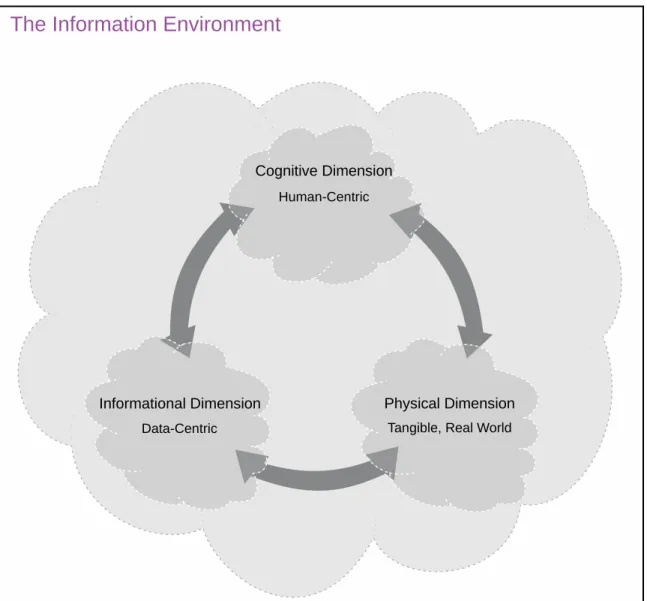
The information environment is the aggregate of individuals, organizations, and systems that collect, process, disseminate, or act on information. This environment consists of three interrelated dimensions which continuously interact with individuals, organizations, and systems. These dimensions are the physical, informational, and cognitive (see Figure I-1). The JFC’s operational environment is the composite of the conditions, circumstances, and influences that affect employment of capabilities and bear on the decisions of the commander
“The most hateful human misfortune is for a wise man to have no influence.”
(encompassing physical areas and factors of the air, land, maritime, and space domains) as well as the information environment (which includes cyberspace).
a. The Physical Dimension. The physical dimension is composed of command and control (C2) systems, key decision makers, and supporting infrastructure that enable individuals and organizations to create effects. It is the dimension where physical platforms and the communications networks that connect them reside. The physical dimension includes, but is not limited to, human beings, C2 facilities, newspapers, books, microwave towers, computer processing units, laptops, smart phones, tablet computers, or any other objects that are subject to empirical measurement. The physical dimension is not confined solely to military or even nation-based systems and processes; it is a defused network connected across national, economic, and geographical boundaries.
Figure I-1. The Information Environment
The Information Environment
Cognitive Dimension
Informational Dimension Physical Dimension
Data-Centric Tangible, Real World
Overview
I-3
b. The Informational Dimension. The informational dimension encompasses where and how information is collected, processed, stored, disseminated, and protected. It is the dimension where the C2 of military forces is exercised and where the commander’s intent is conveyed. Actions in this dimension affect the content and flow of information.
c. The Cognitive Dimension. The cognitive dimension encompasses the minds of those who transmit, receive, and respond to or act on information. It refers to individuals’ or groups’ information processing, perception, judgment, and decision making. These elements are influenced by many factors, to include individual and cultural beliefs, norms, vulnerabilities, motivations, emotions, experiences, morals, education, mental health, identities, and ideologies. Defining these influencing factors in a given environment is critical for understanding how to best influence the mind of the decision maker and create the desired effects. As such, this dimension constitutes the most important component of the information environment.
3. The Information and Influence Relational Framework and the Application of Information-Related Capabilities
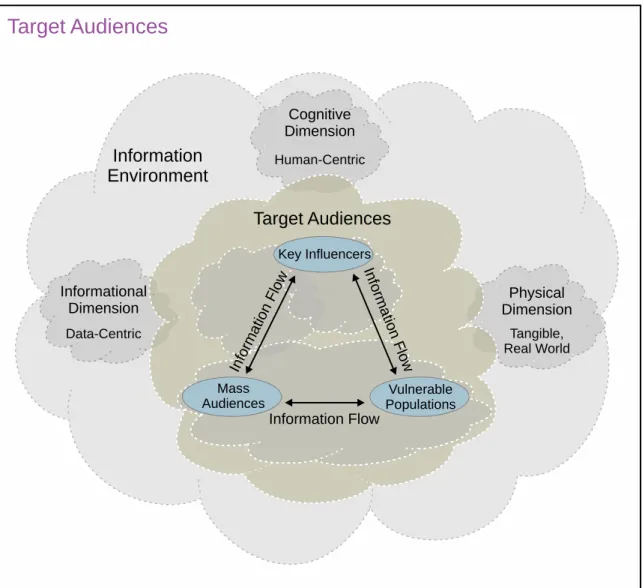
a. IRCs are the tools, techniques, or activities that affect any of the three dimensions of the information environment. They affect the ability of the target audience (TA) to collect, process, or disseminate information before and after decisions are made. The TA is the individual or group selected for influence. The joint force (means) employs IRCs (ways) to affect the information provided to or disseminated from the TA in the physical and informational dimensions of the information environment to affect decision making (see Figure I-2). The change in the TA conditions, capabilities, situational awareness, and in some cases, the inability to make and share timely and informed decisions, contributes to the desired end state. Actions or inactions in the physical dimension can be assessed for future operations. The employment of IRCs is complemented by a set of capabilities such as operations security (OPSEC), information assurance (IA), counterdeception, physical security, electronic warfare (EW) support, and electronic protection. These capabilities are critical to enabling and protecting the JFC’s C2 of forces. Key components in this process are:
(1) Information. Data in context to inform or provide meaning for action. (2) Data. Interpreted signals that can reduce uncertainty or equivocality.
(3) Knowledge. Information in context to enable direct action. Knowledge can be further broken down into the following:
(a) Explicit Knowledge. Knowledge that has been articulated through words, diagrams, formulas, computer programs, and like means.
(b) Tacit Knowledge. Knowledge that cannot be or has not been articulated through words, diagrams, formulas, computer programs, and like means.
(5) Means. The resources available to a national government, non-nation actor, or adversary in pursuit of its end(s). These resources include, but are not limited to, public- and private-sector enterprise assets or entities.
(6) Ways. How means can be applied, in order to achieve a desired end(s). They can be characterized as persuasive or coercive.
(7) Information-Related Capabilities. Tools, techniques, or activities using data, information, or knowledge to create effects and operationally desirable conditions within the physical, informational, and cognitive dimensions of the information environment.
(8) Target Audience. An individual or group selected for influence. (9) Ends. A consequence of the way of applying IRCs.
Figure I-2. Target Audiences
Target Audiences
Cognitive Dimension Human-Centric
Physical Dimension
Tangible, Real World
Information Flow
In fo
rm a
tio n
F lo
w
Info rm
atio n F
low
Target Audiences
Key Influencers
Vulnerable Populations Mass
Audiences Informational
Dimension Data-Centric
Information Environment
Overview
I-5
(10) Using the framework, the physical, informational, and cognitive dimensions of the information environment provide access points for influencing TAs (see Figure I-2).
b. The purpose of integrating the employment of IRCs is to influence a TA. While the behavior of individuals and groups, as human social entities, are principally governed by rules, norms, and beliefs, the behaviors of systems principally reside within the physical and informational dimensions and are governed only by rules. Under this construct, rules, norms, and beliefs are:
(1) Rules. Explicit regulative processes such as policies, laws, inspection routines, or incentives. Rules function as a coercive regulator of behavior and are dependent upon the imposing entity’s ability to enforce them.
(2) Norms. Regulative mechanisms accepted by the social collective. Norms are enforced by normative mechanisms within the organization and are not strictly dependent upon law or regulation.
(3) Beliefs. The collective perception of fundamental truths governing behavior. The adherence to accepted and shared beliefs by members of a social system will likely persist and be difficult to change over time. Strong beliefs about determinant factors (i.e., security, survival, or honor) are likely to cause a social entity or group to accept rules and norms.
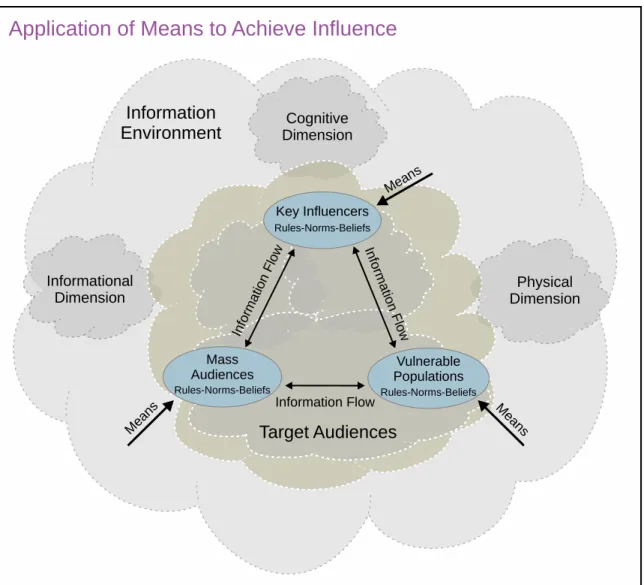
c. The first step in achieving an end(s) through use of the information-influence relational framework is to identify the TA. Once the TA has been identified, it will be necessary to develop an understanding of how that TA perceives its environment, to include analysis of TA rules, norms, and beliefs. Once this analysis is complete, the application of means available to achieve the desired end(s) must be evaluated (see Figure I-3). Such means may include (but are not limited to) diplomatic, informational, military, or economic actions, as well as academic, commercial, religious, or ethnic pronouncements. When the specific means or combinations of means are determined, the next step is to identify the specific ways to create a desired effect.
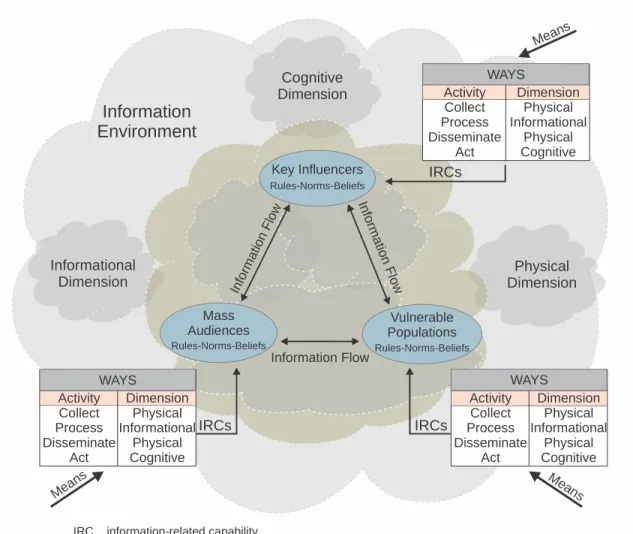
d. Influencing the behavior of TAs requires producing effects in ways that modify rules, norms, or beliefs. Effects can be created by means (e.g., governmental, academic, cultural, and private enterprise) using specific ways (i.e., IRCs) to affect how the TAs collect, process, perceive, disseminate, and act (or do not act) on information (see Figure I-4).
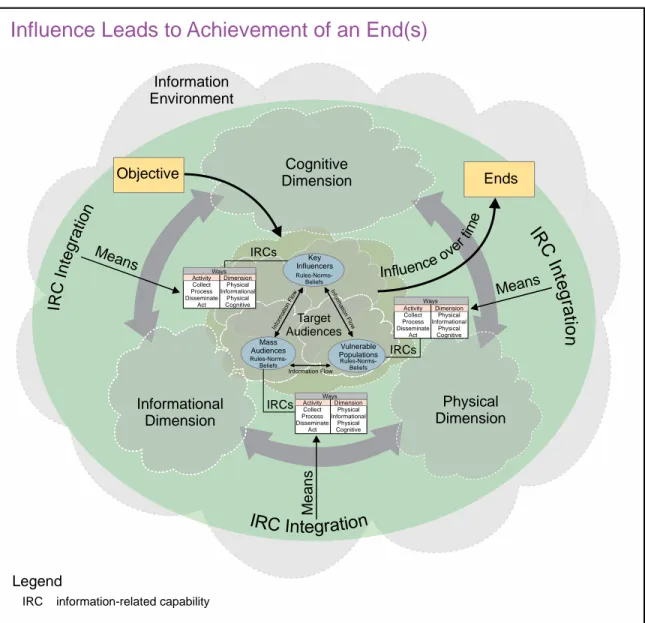
e. Upon deciding to persuade or coerce a TA, the commander must then determine what IRCs it can apply to individuals, organizations, or systems in order to produce a desired effect(s) (see Figure I-5). As stated,IRCs can be capabilities, techniques, or activities, but they do not necessarily have to be technology-based. Additionally, it is important to focus on the fact that IRCs may come from a wide variety of sources. Therefore, in IO, it is not the ownership of the capabilities and techniques that is important, but rather their integrated application in order to achieve a JFC’s end state.
Figure I-3. Application of Means to Achieve Influence
Application of Means to Achieve Influence
Cognitive Dimension
Physical Dimension
Information Flow
Info rm
atio n F
low Info rm
a tio
n F
low
Key Influencers
Vulnerable Populations Mass
Audiences Informational
Dimension
Information Environment
Target Audiences
Rules-Norms-Beliefs
Rules-Norms-Beliefs Rules-Norms-Beliefs
Mea
ns Mea
ns Mean
Overview
I-7
Figure I-4. Application of Information-Related Capabilities to Achieve Influence
Application of Information-Related Capabilities to Achieve Influence
Cognitive Dimension Physical Dimension Info rm atio n F
low Information Flow Key Influencers Vulnerable Populations Mass Audiences In fo rm a tio n F low Informational Dimension Information Environment Rules-Norms-Beliefs Rules-Norms-Beliefs Rules-Norms-Beliefs WAYS Activity Collect Process Disseminate Act Dimension Physical Informational Physical Cognitive IRCs WAYS Activity Collect Process Disseminate Act Dimension Physical Informational Physical Cognitive IRCs WAYS Activity Collect Process Disseminate Act Dimension Physical Informational Physical Cognitive IRCs Mea ns Mean s Mean s
Figure I-5. Influence Leads to Achievement of an End(s)
Influence Leads to Achievement of an End(s)
Mass Audiences Physical Dimension Information Environment Cognitive Dimension Informational Dimension IRCs IRCs IRCs Means Means M e a n s IR
C I nte
gra
tion IR
C In te g ra tio n Info rma tion Flo w Target Audiences Info rm a tion F low Information Flow Vulnerable Populations Ways Activity Collect Process Disseminate Act Dimension Physical Informational Physical Cognitive Ways Activity Collect Process Disseminate Act Dimension Physical Informational Physical Cognitive
Rules-Norms-Beliefs Rules-Norms-Beliefs Key Influencers Rules-Norms-Beliefs Ends Objective
IRC information-related capability
Legend Ways Activity Collect Process Disseminate Act Dimension Physical Informational Physical Cognitive
II-1
CHAPTER II
INFORMATION OPERATIONS
1. Introduction
This chapter addresses how the integrating and coordinating functions of IO help achieve a JFC’s objectives. Through the integrated application of IRCs, the relationships that exist between IO and the various IRCs should be understood in order to achieve an objective.
2. Terminology
a. Because IO takes place in all phases of military operations, in concert with other lines of operation and lines of effort, some clarification of the terms and their relationship to IO is in order.
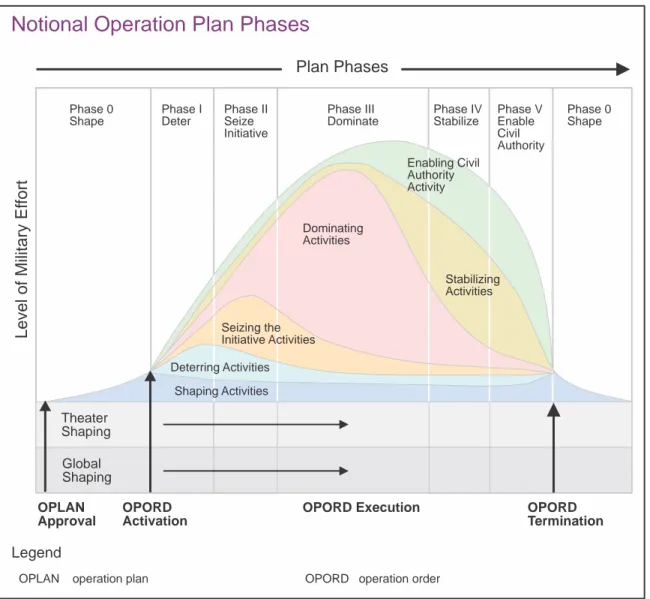
(1) Military Operations. The US military participates in a wide range of military operations, as illustrated in Figure II-1. Phase 0 (Shape) and phase I (Deter) may include defense support of civil authorities, peace operations, noncombatant evacuation, foreign humanitarian assistance, and nation-building assistance, which fall outside the realm of major combat operations represented by phases II through V.
(2) Lines of Operation and Lines of Effort. IO should support multiple lines of operation and at times may be the supported line of operation. IO may also support numerous lines of effort when positional references to an enemy or adversary have little relevance, such as in counterinsurgency or stability operations.
b. IO integrates IRCs (ways) with other lines of operation and lines of effort (means) to create a desired effect on an adversary or potential adversary to achieve an objective (ends). 3. Information Operations and the Information-Influence Relational Framework
Influence is at the heart of diplomacy and military operations, with integration of IRCs providing a powerful means for influence. The relational framework describes the application, integration, and synchronization of IRCs to influence, disrupt, corrupt, or usurp the decision making of TAs to create a desired effect to support achievement of an objective. Using this description, the following example illustrates how IRCs can be employed to create a specific effect against an adversary or potential adversary.
“There is a war out there, old friend- a World War. And it’s not about whose got the most bullets; it’s about who controls the information.”
4. The Information Operations Staff and Information Operations Cell
Within the joint community, the integration of IRCs to achieve the commander’s objectives is managed through an IO staff or IO cell. JFCs may establish an IO staff to provide command-level oversight and collaborate with all staff directorates and supporting organizations on all aspects of IO. Most CCMDs include an IO staff to serve as the focal point for IO. Faced with an ongoing or emerging crisis within a geographic combatant commander’s (GCC’s) area of responsibility (AOR), a JFC can establish an IO cell to provide additional expertise and coordination across the staff and interagency.
Figure II-1. Notional Operation Plan Phases
Notional Operation Plan Phases
Legend
OPLAN operation plan
Level of Military Ef
fort
Stabilizing Activities Seizing the
Initiative Activities Deterring Activities
Dominating Activities
Enabling Civil Authority Activity
Shaping Activities Theater
Shaping
OPLAN Approval
OPORD Termination OPORD
Activation
Global Shaping
Phase 0 Shape
Phase I Deter
Phase II Seize Initiative
Phase III Dominate
Phase IV Stabilize
Phase V Enable Civil Authority
Phase 0 Shape Plan Phases
OPORD Execution
Information Operations
II-3 APPLICATION OF INFORMATION-RELATED CAPABILITIES TO THE
INFORMATION AND INFLUENCE RELATIONAL FRAMEWORK
This example provides insight as to how information-related capabilities (IRCs) can be used to create lethal and nonlethal effects to support achievement of the objectives to reach the desired end state. The integration and synchronization of these IRCs require participation from not just information operations planners, but also organizations across multiple lines of operation and lines of effort. They may also include input from or coordination with national ministries, provincial governments, local authorities, and cultural and religious leaders to create the desired effect. Situation: An adversary is attempting to overthrow the government of Country X using both lethal and nonlethal means to demonstrate to the citizens that the government is not fit to support and protect its people. Joint Force Commander’s Objective: Protect government of Country X from being overthrown.
Desired Effects:
1. Citizens have confidence in ability of government to support and protect its people.
2. Adversary is unable to overthrow government of Country X. Potential Target Audience(s):
1. Adversary leadership (adversary).
2. Country X indigenous population (friendly, neutral, and potential adversary).
Potential Means available to achieve the commander’s objective: Diplomatic action (e.g., demarche, public diplomacy) Informational assets (e.g., strategic communication, media)
Military forces (e.g., security force assistance, combat operations, military information support operations, public affairs, military deception)
Economic resources (e.g., sanctions against the adversary, infusion of capital to Country X for nation building)
a. IO Staff
(1) In order to provide planning support, the IO staff includes IO planners and a complement of IRCs specialists to facilitate seamless integration of IRCs to support the JFC’s concept of operations (CONOPS).
(2) IRC specialists can include, but are not limited to, personnel from the EW, cyberspace operations (CO), military information support operations (MISO), civil-military operations (CMO), military deception (MILDEC), intelligence, and public affairs (PA) communities. They provide valuable linkage between the planners within an IO staff and those communities that provide IRCs to facilitate seamless integration with the JFC’s objectives.
b. IO Cell
(1) The IO cell integrates and synchronizes IRCs, to achieve national or combatant commander (CCDR) level objectives. Normally, the chief of the CCMD’s IO staff will serve as the IO cell chief; however, at the joint task force level, someone else may serve as the IO cell chief. Some of the functions of the IO cell chief are listed in Figure II-2.
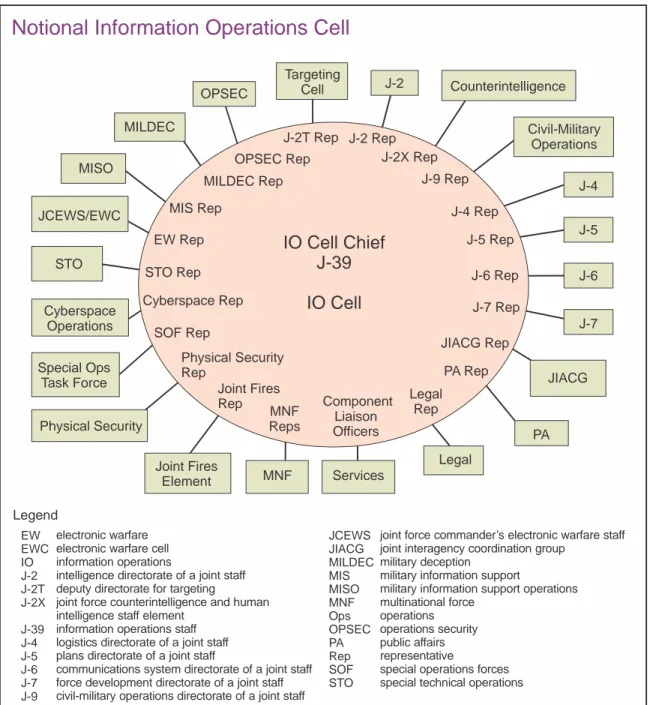
(2) The IO cell comprises representatives from a wide variety of organizations to coordinate and integrate additional activities in support of a JFC. When considering the notional example in Figure II-3, note that the specific makeup of an IO cell depends on the situation. It may include representatives from organizations outside DOD, even allied or multinational partners.
Potential Ways (persuasive communications or coercive force): Targeted radio and television broadcasts
Blockaded adversary ports
Government/commercially operated Web sites Key leadership engagement
Regardless of the means and ways employed by the players within the information environment, the reality is that the strategic advantage rests with whoever applies their means and ways most efficiently.
Information Operations
II-5
5. Relationships and Integration
a. IO is not about ownership of individual capabilities but rather the use of those capabilities as force multipliers to create a desired effect. There are many military capabilities that contribute to IO and should be taken into consideration during the planning process.
(1) Strategic Communication (SC)
(a) The SC process consists of focused United States Government (USG) efforts to create, strengthen, or preserve conditions favorable for the advancement of national interests, policies, and objectives by understanding and engaging key audiences through the use of coordinated programs, plans, themes, messages, and products synchronized with the actions of all instruments of national power. SC is a whole-of-government approach, driven by interagency processes and integration that are focused upon effectively communicating national strategy.
Figure II-2. Information Operations Cell Chief Functions
Information Operations Cell Chief Functions
Coordinate the overall information operations (IO) portion of the plan for the joint force commander (JFC).
Coordinate IO issues within the joint force staff and with counterpart IO planners on the component staffs and supporting organizations.
Coordinate employment of information-related capabilities and activities to support the JFC concept of operations.
Recommend IO priorities to accomplish planned objectives.
Determine the availability of information-related capability resources to carry out IO plans.
Request planning support from organizations that plan and execute information-related capabilities.
Serve as the primary “advocate” throughout the target nomination and review process for targets that, if engaged, will create a desired effect within the information environment.
Coordinate the planning and execution of information-related capabilities among joint organizations (including components) and agencies that support IO objectives.
Identify and coordinate intelligence and assessment requirements that support IO planning and associated activities.
Coordinate support with the Joint Information Operations Warfare Center, Joint Warfare Analysis Center, and other joint centers and agencies.
(b) The elements and organizations that implement strategic guidance, both internal and external to the joint force, must not only understand and be aware of the joint force’s IO objectives; they must also work closely with members of the interagency community, in order to ensure full coordination and synchronization of USG efforts. Hence, the JFC’s IO objectives should complement the overall objectives in accordance with strategic guidance. The joint interagency coordination group (JIACG) representative within the IO cell facilitates coordination to comply with strategic guidance and facilitate SC.
Figure II-3. Notional Information Operations Cell
Notional Information Operations Cell
Legend EW EWC IO J-2 J-2T J-2X J-39 J-4 J-5 J-6 J-7 J-9 JCEWS JIACG MILDEC MIS MISO MNF Ops OPSEC PA Rep SOF STO electronic warfare
electronic warfare cell information operations
intelligence directorate of a joint staff deputy directorate for targeting
joint force counterintelligence and human intelligence staff element
information operations staff logistics directorate of a joint staff plans directorate of a joint staff
communications system directorate of a joint staff force development directorate of a joint staff civil-military operations directorate of a joint staff
joint force commander’s electronic warfare staff joint interagency coordination group
military deception
military information support operations multinational force
operations operations security public affairs representative
special operations forces special technical operations military information support
IO Cell Chief J-39 IO Cell
J-2T Rep J-2 Rep J-2X Rep J-9 Rep J-4 Rep J-5 Rep J-6 Rep J-7 Rep JIACG Rep PA Rep Legal Rep Component Liaison Officers MNF Reps Joint Fires Rep Physical Security Rep SOF Rep Cyberspace Rep STO Rep EW Rep MIS Rep MILDEC Rep OPSEC Rep Targeting
Cell J-2 Counterintelligence OPSEC Civil-Military Operations J-4 J-5 J-6 J-7 JIACG PA Legal Services MNF Joint Fires Element Physical Security Special Ops Task Force Cyberspace Operations STO JCEWS/EWC MISO MILDEC
Information Operations
II-7
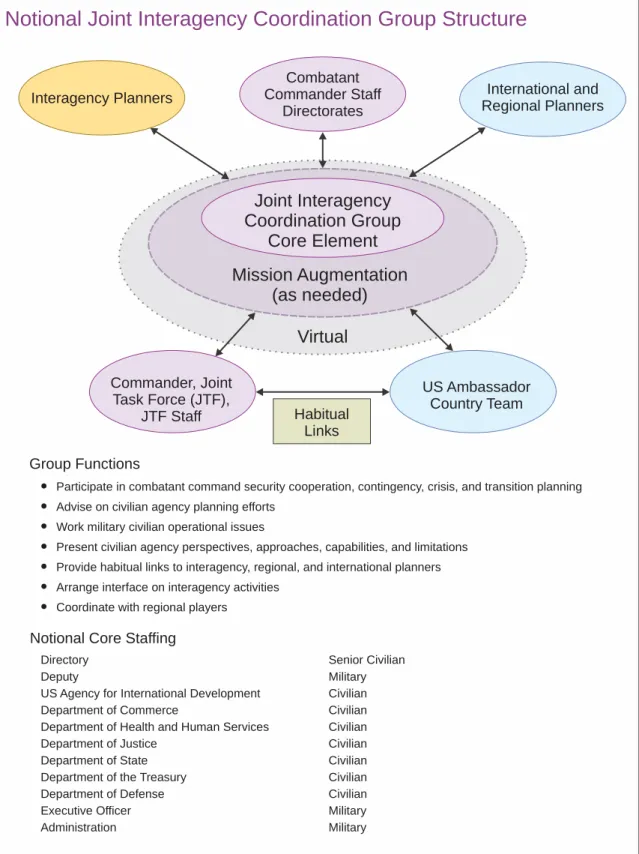
(2) Joint Interagency Coordination Group. Interagency coordination occurs between DOD and other USG departments and agencies, as well as with private-sector entities, nongovernmental organizations, and critical infrastructure activities, for the purpose of accomplishing national objectives. Many of these objectives require the combined and coordinated use of the diplomatic, informational, military, and economic instruments of national power. Due to their forward presence, the CCMDs are well situated to coordinate activities with elements of the USG, regional organizations, foreign forces, and host nations. In order to accomplish this function, the GCCs have established JIACGs as part of their normal staff structures (see Figure II-4). The JIACG is well suited to help the IO cellwith interagency coordination. Although IO is not the primary function of the JIACG, the group’s linkage to the IO cell and the rest of the interagency is an important enabler for synchronization of guidance and IO.
(3) Public Affairs
(a) PA comprises public information, command information, and public engagement activities directed toward both the internal and external publics with interest in DOD. External publics include allies, neutrals, adversaries, and potential adversaries. When addressing external publics, opportunities for overlap exist between PA and IO.
(b) By maintaining situational awareness between IO and PA the potential for information conflict can be minimized. The IO cell provides an excellent place to coordinate IO and PA activities that may affect the adversary or potential adversary. Because there will be situations, such as counterpropaganda, in which the TA for both IO and PA converge, close cooperation and deconfliction are extremely important. Such coordination and deconfliction efforts can begin in the IO cell. However, since it involves more than just IO equities, final coordination should occur within the joint planning group (JPG).
(c) While the IO cell can help synchronize and deconflict specific IO-related and PA objectives, when implementing strategic guidance that affects the adversary, care must be taken to carefully follow all legal and policy constraints in conducting the different activities. For example, see Department of Defense Directive (DODD) S-3321.1, Overt Psychological Operations Conducted by the Military Services in Peacetime and in
Contingencies Short of Declared War.
(4) Civil-Military Operations
(a) CMO is another area that can directly affect and be affected by IO. CMO activities establish, maintain, influence, or exploit relations between military forces, governmental and nongovernmental civilian organizations and authorities, and the civilian populace in a friendly, neutral, or hostile operational area in order to achieve US objectives. These activities may occur prior to, during, or subsequent to other military operations. In CMO, personnel perform functions normally provided by the local, regional, or national government, placing them into direct contact with civilian populations. This level of interaction results in CMO having a significant effect on the perceptions of the local populace. Since this populace may include potential adversaries, their perceptions are of great interest to the IO community. For this reason, CMO representation in the IO cell can
assist in identifying TAs; synchronizing communications media, assets, and messages; and
Figure II-4. Notional Joint Interagency Coordination Group Structure
Notional Joint Interagency Coordination Group Structure
CombatantCommander Staff Directorates
International and Regional Planners
US Ambassador Country Team Commander, Joint
Task Force (JTF), JTF Staff
Virtual
Mission Augmentation (as needed) Joint Interagency Coordination Group
Core Element
Habitual Links Group Functions
Participate in combatant command security cooperation, contingency, crisis, and transition planning Advise on civilian agency planning efforts
Work military civilian operational issues
Present civilian agency perspectives, approaches, capabilities, and limitations Provide habitual links to interagency, regional, and international planners Arrange interface on interagency activities
Coordinate with regional players
Notional Core Staffing
Directory Deputy
US Agency for International Development Department of Commerce
Department of Health and Human Services Department of Justice
Department of State Department of the Treasury Department of Defense Executive Officer Administration
Senior Civilian Military Civilian Civilian Civilian Civilian Civilian Civilian Civilian Military Military
Information Operations
II-9
(b) Although CMO and IO have much in common, they are distinct disciplines. The TA for much of IO is the adversary; however, the effects of IRCs often reach supporting friendly and neutral populations as well. In a similar vein, CMO seeks to affect friendly and neutral populations, although adversary and potential adversary audiences may also be affected. This being the case, effective integration of CMO with other IRCs is important, and a CMO representative on the IO staff is critical. The regular presence of a CMO representative in the IO cellwill greatly promote this level of coordination.
(5) Cyberspace Operations
(a) Cyberspace is a global domain within the information environment consisting of the interdependent network of information technology infrastructures and resident data, including the Internet, telecommunications networks, computer systems, and embedded processors and controllers. CO are the employment of cyberspace capabilities where the primary purpose is to achieve objectives in or through cyberspace. Cyberspace capabilities, when in support of IO, deny or manipulate adversary or potential adversary decision making, through targeting an information medium (such as a wireless access point in the physical dimension), the message itself (an encrypted message in the information dimension), or a cyber-persona (an online identity that facilitates communication, decision making, and the influencing of audiences in the cognitive dimension). When employed in support of IO, CO generally focus on the integration of offensive and defensive capabilities exercised in and through cyberspace, in concert with other IRCs, and coordination across multiple lines of operation and lines of effort.
(b) As a process that integrates the employment of IRCs across multiple lines of effort and lines of operation to affect an adversary or potential adversary decision maker,
IO can target either the medium (a component within the physical dimension such as a microwave tower) or the message itself (e.g., an encrypted message in the informational dimension). CO is one of several IRCs available to the commander.
For more information, see Joint Publication (JP) 3-12, Cyberspace Operations.
(6) Information Assurance. IA is necessary to gain and maintain information superiority. The JFC relies on IA to protect infrastructure to ensure its availability, to position information for influence, and for delivery of information to the adversary. Furthermore, IA and CO are interrelated and rely on each other to support IO.
(7) Space Operations. Space capabilities are a significant force multiplier when integrated with joint operations. Space operations support IO through the space force enhancement functions of intelligence, surveillance, and reconnaissance; missile warning; environmental monitoring; satellite communications; and space-based positioning, navigation, and timing. The IO cell is a key place for coordinating and deconflicting the space force enhancement functions with other IRCs.
(8) Military Information Support Operations. MISO are planned operations to convey selected information and indicators to foreign audiences to influence their emotions, motives, objective reasoning, and ultimately the behavior of foreign governments,
organizations, groups, and individuals. MISO focuses on the cognitive dimension of the information environment where its TA includes not just potential and actual adversaries, but also friendly and neutral populations. MISO are applicable to a wide range of military operations such as stability operations, security cooperation, maritime interdiction, noncombatant evacuation, foreign humanitarian operations, counterdrug, force protection, and counter-trafficking. Given the wide range of activities in which MISO are employed, the military information support representative within the IO cell should consistently interact with the PA, CMO, JIACG, and IO planners.
(9) Intelligence
(a) Intelligence is a vital military capability that supports IO. The utilization of information operations intelligence integration (IOII) greatly facilitates understanding the interrelationship between the physical, informational, and cognitive dimensions of the information environment.
(b) By providing population-centric socio-cultural intelligence and physical network lay downs, including the information transmitted via those networks, intelligence can greatly assist IRC planners and IO integrators in determining the proper effect to elicit the specific response desired. Intelligence is an integrated process, fusing collection, analysis, and dissemination to provide products that will expose a TA’s potential capabilities or vulnerabilities. Intelligence uses a variety of technical and nontechnical tools to assess the information environment, thereby providing insight into a TA.
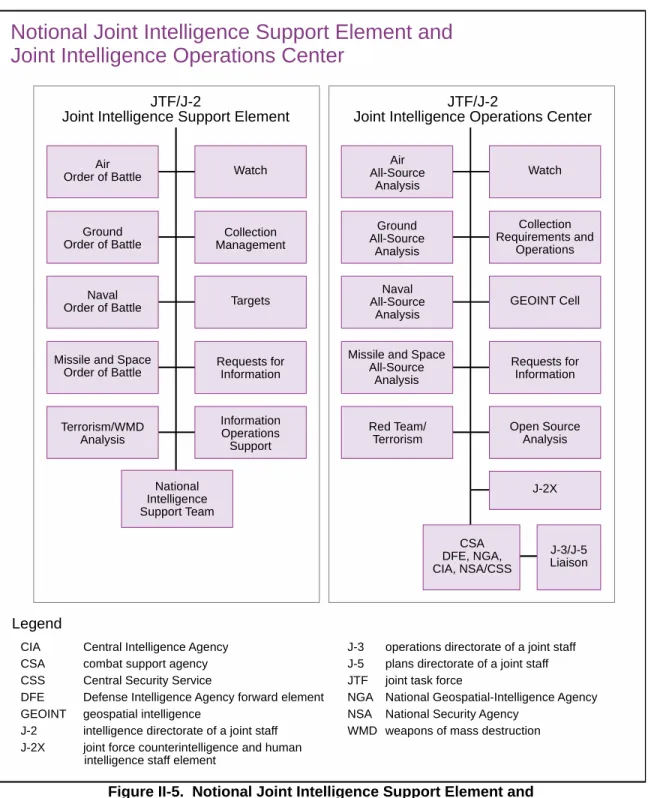
(c) A joint intelligence support element (JISE) may establish an IO support office (see Figure II-5) to provide IOII. This is due to the long lead time needed to establish information baseline characterizations, provide timely intelligence during IO planning and execution efforts, and to properly assess effects in the information environment. In addition to generating intelligence products to support the IO cell, the JISE IO support office can also work with the JISE collection management office to facilitate development of collection requirements in support of IO assessment efforts.
(10) Military Deception
(a) One of the oldest IRCs used to influence an adversary’s perceptions is MILDEC. MILDEC can be characterized as actions executed to deliberately mislead adversary decision makers, creating conditions that will contribute to the accomplishment of the friendly mission. While MILDEC requires a thorough knowledge of an adversary or potential adversary’s decision-making processes, it is important to remember that it is focused on desired behavior. It is not enough to simply mislead the adversary or potential adversary; MILDEC is designed to cause them to behave in a manner advantageous to the friendly mission, such as misallocation of resources, attacking at a time and place advantageous to friendly forces, or avoid taking action at all.
Information Operations
II-11
(b) When integrated with other IRCs, MILDEC can be a particularly powerful way to affect the decision-making processes of an adversary or potential adversary. The IO cell provides a coordinating mechanism for enabling or integrating MILDEC with other IRCs.
Figure II-5. Notional Joint Intelligence Support Element and Joint Intelligence Operations Center
Notional Joint Intelligence Support Element and
Joint Intelligence Operations Center
CIA Central Intelligence Agency
CSA combat support agency
CSS Central Security Service
DFE Defense Intelligence Agency forward element
GEOINT geospatial intelligence
J-2 intelligence directorate of a joint staff
J-2X joint force counterintelligence and human
intelligence staff element
Legend
J-3 operations directorate of a joint staff
J-5 plans directorate of a joint staff
JTF joint task force
NGA National Geospatial-Intelligence Agency NSA National Security Agency
WMD weapons of mass destruction
JTF/J-2
Joint Intelligence Support Element
Air Order of Battle
JTF/J-2
Joint Intelligence Operations Center
Watch
Ground Order of Battle
Collection Management
Naval
Order of Battle Targets
Missile and Space
Order of Battle Requests for Information
Terrorism/WMD Analysis Information Operations Support National Intelligence Support Team Air All-Source Analysis Watch Ground All-Source Analysis Collection Requirements and Operations GEOINT Cell Requests for Information Open Source Analysis Naval All-Source Analysis
Missile and Space All-Source Analysis Red Team/ Terrorism J-2X CSA DFE, NGA, CIA, NSA/CSS J-3/J-5 Liaison
(c) MILDEC differs from other IRCs in several ways. Due to the sensitive nature of MILDEC plans, goals, and objectives, a strict need-to-know should be enforced.
(11) Operations Security
(a) OPSEC is a standardized process designed to meet operational needs by mitigating risks associated with specific vulnerabilities in order to deny adversaries critical information and observable indicators. OPSEC identifies critical information and actions attendant to friendly military operations to deny observables to adversary intelligence systems. Once vulnerabilities are identified, other IRCs (e.g., MILDEC, CO) can be used to satisfy OPSEC requirements. OPSEC practices must balance the responsibility to account to the American public with the need to protect critical information. The need to practice OPSEC should not be used as an excuse to deny noncritical information to the public.
(b) The effective application, coordination, and synchronization of other IRCs are critical components in the execution of OPSEC. Because a specified IO task is “to protect our own” decision makers, OPSEC planners require complete situational awareness, regarding friendly activities to facilitate the safeguarding of critical information. This kind of situational awareness exists within the IO cell, where a wide range of planners work in concert to integrate and synchronize their actions to achieve a common IO objective.
(12) Special Technical Operations (STO). IO need to be deconflicted and synchronized with STO. Detailedinformation related to STO and its contribution to IO can be obtained from the STO planners at CCMD or Service component headquarters. IO and STO are separate, but have potential crossover, and for this reason an STO planner is a valuable member of the IO cell.
(13) Joint Electromagnetic Spectrum Operations (JEMSO)
(a) All information-related mission areas increasingly depend on the electromagnetic spectrum (EMS). JEMSO, consisting of EW and joint EMS management operations, enable EMS-dependent systems to function in their intended operational environment. EW is the mission area ultimately responsible for securing and maintaining freedom of action in the EMS for friendly forces while exploiting or denying it to adversaries. JEMSO therefore supports IO by enabling successful mission area operations.
(b) EW activities are normally planned and managed by personnel dedicated to JEMSO and members of either the joint force commander’s electronic warfare staff (JCEWS) or joint electronic warfare cell (EWC). The JCEWS or EWC integrates their efforts into the JFC’s targeting cycle and coordinates with, the JFC’s IO cell to align objective priorities and help synchronize EW employment with other IRCs.
For more information on EW, see JP 3-13.1, Electronic Warfare. For more information on
Information Operations
II-13
(14) Key Leader Engagement (KLE)
(a) KLEs are deliberate, planned engagements between US military leaders and the leaders of foreign audiences that have defined objectives, such as a change in policy or supporting the JFC’s objectives. These engagements can be used to shape and influence foreign leaders at the strategic, operational, and tactical levels, and may also be directed toward specific groups such as religious leaders, academic leaders, and tribal leaders; e.g., to solidify trust and confidence in US forces.
(b) KLEs may be applicable to a wide range of operations such as stability operations, counterinsurgency operations, noncombatant evacuation operations, security cooperation activities, and humanitarian operations. When fully integrated with other IRCs into operations, KLEs can effectively shape and influence the leaders of foreign audiences. b. The capabilities discussed above do not constitute a comprehensive list of all possible capabilities that can contribute to IO. This means that individual capability ownership will be highly diversified. The ability to access these capabilities will be directly related to how well commanders understand and appreciate the importance of IO.
III-1
CHAPTER III
AUTHORITIES, RESPONSIBILITIES, AND LEGAL CONSIDERATIONS
1. Introduction
This chapter describes the JFC’s authority for the conduct of IO; delineates various roles and responsibilities established in DODD 3600.01, Information Operations; and addresses legal considerations in the planning and execution of IO.
2. Authorities
a. The authority to employ IRCs is rooted foremost in Title 10, United States Code (USC). While Title 10, USC, does not specify IO separately, it does provide the legal basis for the roles, missions, and organization of DOD and the Services. Title 10, USC, Section 164, gives command authority over assigned forces to the CCDR, which provides that individual with the authority to organize and employ commands and forces, assign tasks, designate objectives, and provide authoritative direction over all aspects of military operations.
b. DOD and Chairman of the Joint Chiefs of Staff (CJCS) directives delegate authorities to DOD components. Among these directives, DODD 3600.01, Information Operations, is the principal IO policy document. Its joint counterpart, Chairman of the Joint Chiefs of Staff Instruction (CJCSI) 3210.01, Joint Information Operations Policy, provides joint policy regarding the use of IRCs, professional qualifications for the joint IO force, as well as joint IO education and training requirements. Based upon the contents of these two documents, authority to conduct joint IO is vested in the CCDR, who in turn can delegate operational authority to a subordinate JFC, as appropriate.
c. The nature of IO is such that the exercise of operational authority inherently requires a detailed and rigorous legal interpretation of authority and/or legality of specific actions. Legal considerations are addressed in more detail later in this chapter.
3. Responsibilities
a. Under Secretary of Defense for Policy (USD[P]). The USD(P) oversees and manages DOD-level IO programs and activities. In this capacity, USD(P) manages guidance publications (e.g., DODD 3600.01) and all IO policy on behalf of the Secretary of Defense. The office of the USD(P) coordinates IO for all DOD components in the interagency process.
“Well may the boldest fear and the wisest tremble when incurring responsibilities on which may depend our country’s peace and prosperity.”
b. Under Secretary of Defense for Intelligence (USD[I]). USD(I) develops, coordinates, and oversees the implementation of DOD intelligence policy, programs, and guidance for intelligence activities supporting IO.
c. Joint Staff. In accordance with the Secretary of Defense memorandum on Strategic
Communication and Information Operations in the DOD, dated 25 January 2011, the Joint
Staff is assigned the responsibility for joint IO proponency. CJCS responsibilities for IO are both general (such as establishing doctrine, as well as providing advice, and recommendations to the President and Secretary of Defense) and specific (e.g., joint IO policy). As the Joint IO Proponent, the Deputy Director for Global Operations (J-39 DDGO) serves as the CJCS’s focal point for IO and coordinates with the Joint Staff, CCMDs, and other organizations that have direct or supporting IO responsibilities. Joint Staff J-39 DDGO also provides IO-related advice and advocacy on behalf of the CCMDs to the CJCS and across DOD. As designated in the Secretary of Defense memorandum on SC and IO, the Joint Staff also serves as the proponent for the IRCs of MILDEC and OPSEC.
d. Joint Information Operations Warfare Center (JIOWC). The JIOWC is a CJCS-controlled activity reporting to the operations directorate of a joint staff (J-3) via J-39 DDGO. The JIOWC supports the Joint Staff by ensuring operational integration of IRCs in support of IO, improving DOD’s ability to meet CCMD IRC requirements, as well as developing and refining IRCs for use in support of IO across DOD. JIOWC’s specific organizational responsibilities include:
(1) Provide IO subject matter experts and advice to the Joint Staff and the CCMDs.
(2) Develop and maintain a joint IO assessment framework.
(3) Assist the Joint IO Proponent in advocating for and integrating CCMD IO requirements.
(4) Upon the direction of the Joint IO Proponent, provide support in coordination and integration of DOD IRCs for JFCs, Service component commanders, and DOD agencies. e. Combatant Commands. The Unified Command Plan provides guidance to CCDRs, assigning them missions and force structure, as well as geographic or functional areas of responsibility. In addition to these responsibilities, the Commander, United States Special Operations Command, is also responsible for integrating and coordinating MISO. This responsibility is focused on enhancing interoperability and providing other CCDRs with MISO planning and execution capabilities. In similar fashion, the Commander, United States Strategic Command (USSTRATCOM) is responsible for advocating on behalf of the IRCs of EW and CO. The Commander, USSTRATCOM, is also focused on enhancing interoperability and providing other CCDRs with contingency EW expertise in support of their missions. For CO, the Commander, USSTRATCOM, synchronizes CO planning. CCDRs integrate, plan, execute, and assess IO when conducting operations or campaigns. f. Service Component Commands. Service component command responsibilities are