An Efficient Solution to the Five-Point Relative Pose Problem
David Nist´er
Sarnoff Corporation
CN5300, Princeton, NJ 08530
[email protected]
Abstract
An efficient algorithmic solution to the classical five-point relative pose problem is presented. The problem is to find the possible solutions for relative camera motion between two calibrated views given five corresponding points. The algorithm consists of computing the coefficients of a tenth degree polynomial and subsequently finding its roots. It is the first algorithm well suited for numerical implementation that also corresponds to the inherent complexity of the prob-lem. The algorithm is used in a robust hypothesise-and-test framework to estimate structure and motion in real-time.
1. Introduction
Reconstruction of camera positions and scene structure based on images of scene features from multiple viewpoints has been studied for over two centuries, first by the pho-togrammetry community and more recently in computer vi-sion. In the classical setting, the intrinsic parameters of the camera, such as focal length, are assumed known a pri-ori. This calibrated setting is where the five-point prob-lem arises. Given the images of five unknown scene points from two distinct unknown viewpoints, what are the possi-ble solutions for the configuration of the points and cam-eras? Clearly, only the relative positions of the points and cameras can be recovered. Moreover, the overall scale of the configuration can never be recovered solely from im-ages. Apart from this ambiguity, the five-point problem was proven by Kruppa [14] to have at most eleven solutions. This was later improved upon [2, 3, 5, 16, 11], showing that there are at most ten solutions and that there are ten solu-tions in general (including complex ones). The ten solusolu-tions correspond to the roots of a tenth degree polynomial. How-ever, Kruppa’s method requires the non-trivial operation of finding all intersections between two sextic curves and there is no previously known practical method of deriving the coefficients of the tenth degree polynomial in the general case. A few algorithms suitable for numerical implemen-tation have also been devised. In [28] a 60×60sparse
Prepared through collaborative participation in the Robotics Consortium sponsored by the U. S. Army Research Laboratory under the Collaborative Technology Alliance Program, Cooperative Agreement DAAD19-01-2-0012. The U. S. Government is authorized to reproduce and distribute reprints for Government purposes notwithstanding any copyright notation thereon.
matrix is built, which is subsequently reduced using linear algebra to a20×20non-symmetric matrix whose eigenval-ues and eigenvectors encode the solution to the problem. In [21] an efficient derivation is given that leads to a thirteenth degree polynomial whose roots include the solutions to the five-point problem. The solution presented in this paper is a refinement of this. A better elimination that leads directly in closed form to the tenth degree polynomial is used. Thus, an efficient algorithm that corresponds exactly to the intrin-sic degree of difficulty of the problem is obtained.
For the structure and motion estimation to be robust and accurate in practice, more than five points have to be used. The classical way of making use of many points is to min-imise a least squares measure over all points, see for exam-ple [13]. Our intended application for the five-point algo-rithm is as a hypothesis generator within a random sample consensus scheme (RANSAC) [6]. Many random samples containing five point correspondences are taken. Each sam-ple yields a number of hypotheses for the relative orienta-tion that are scored by a robust statistical measure over all points in two or more views. The best hypothesis is then refined iteratively. Such a hypothesise-and-test architecture has become the standard way of dealing with mismatched point correspondences [26, 31, 10, 18] and has made auto-matic reconstructions spanning hundreds of views possible [1, 22, 19].
The requirement of prior intrinsic calibration was re-laxed in the last decade [4, 9, 10], leading to higher flexibil-ity and less complicated algorithms. So, why consider the calibrated setting? Apart from the theoretical interest, one answer to this question concerns stability and uniqueness of solutions. Enforcing the intrinsic calibration constraints often gives a crucial improvement of both the accuracy and robustness of the structure and motion estimates. Currently, the standard way of achieving this is through an initial un-calibrated estimate followed by iterative refinement to bring the estimate into agreement with the calibration constraints. When the intrinsic parameters are known a priori, the five-point algorithm is a more direct way of enforcing the cal-ibration constraints exactly and obtaining a Euclidean re-construction. The accuracy and robustness improvements gained by enforcing the calibration constraints are
particu-larly significant for planar or near planar scenes and scenes that appear planar in the imagery. The uncalibrated meth-ods fail when faced with coplanar scene points, since there is then a continuum of possible solutions. It has been pro-posed to deal with this degeneracy using model selection [27, 23], switching between a homographic model and the general uncalibrated model as appropriate. In the calibrated setting, coplanar scene points only cause at most a two-fold ambiguity [15, 17]. With a third view, the ambiguity is in general resolved. In light of this, a RANSAC scheme that uses the five-point algorithm over three or more views is proposed. It applies to general structure but also continues to operate correctly despite scene planarity, without rely-ing on or explicitly detectrely-ing the degeneracy. In essence, the calibrated model can cover both the planar and general structure cases seamlessly. This gives some hope of deal-ing with the approximately planar cases, where neither the planar nor the uncalibrated general structure model applies well.
The rest of the paper is organised as follows. Section 2 establishes some notation and describes the constraints used in the calibrated case. Section 3 presents the five-point algorithm. Section 4 discusses planar degeneracy. Section 5 outlines the RANSAC schemes for two and three views. Section 6 gives results and Section 7 concludes.
2. Preliminaries and Notation
Image points are represented by homogeneous 3-vectorsq
andq in the first and second view, respectively. World points are represented by homogeneous 4-vectorsQ. A per-spective view is represented by a3×4 camera matrixP
indicating the image projectionq∼P Q, where∼denotes equality up to scale. A view with a finite projection centre can be factored intoP = K[R|t], where K is a3 ×3 upper triangular calibration matrix holding the intrinsic pa-rameters andRis a rotation matrix. Let the camera matrices for the two views beK1[I|0]andP =K2[R|t]. Let[t]×
denote the skew symmetric matrix [t]×=
t03 −0t3 −t2t1
−t2 t1 0
(1)
so that[t]×x=t×xfor allx. Then the fundamental matrix is
F ≡K2−[t]×RK1−1. (2) The fundamental matrix encodes the well known copla-narity, or epipolar constraint
qF q= 0. (3) IfK1 andK2 are known, the cameras are said to be cali-brated. In this case, we can always assume that the image pointsqandqhave been premultiplied byK1−1andK2−1, respectively, so that the epipolar constraint simplifies to
qEq= 0, (4)
where the matrixE ≡ [t]×R is called the essential ma-trix. Any rank-2 matrix is a possible fundamental mama-trix. An essential matrix has the additional property that the two non-zero singular values are equal. This leads to the fol-lowing important cubic constraints on the essential matrix, adapted from [25, 5, 16, 21]:
Theorem 1 A real non-zero3×3matrixEis an essential matrix if and only if it satisfies the equation
EEE−1
2trace(EE)E = 0. (5) This property will help us recover the essential matrix. Once the essential matrix is known,R,t and the camera matrices can be recovered from it.
3. The Five-Point Algorithm
In this section the five-point algorithm is described, first in a straightforward manner. Recommendations for an efficient implementation are then given in Section 3.2. Each of the five point correspondences gives rise to a constraint of the form (4). This constraint can also be written as
˜
qE˜= 0, (6) where
˜
q≡q1q1 q2q1 q3q1 q1q2 q2q2 q3q2 q1q3 q2q3 q3q3(7) ˜
E≡E11 E12 E13 E21 E22 E23 E31 E32 E33 (8) By stacking the vectorsq˜for all five points, a5×9matrix is obtained. Four vectors X,˜ Y ,˜ Z,˜ W˜ that span the right nullspace of this matrix are now computed. The most com-mon way to achieve this is by singular value decomposi-tion [24], but QR-factorisadecomposi-tion as described in Secdecomposi-tion 3.2 is much more efficient. The four vectors correspond directly to four3×3matricesX, Y, Z, W and the essential matrix must be of the form
E=xX+yY +zZ+wW (9) for some scalars x, y, z, w. The four scalars are only defined up to a common scale factor and it is therefore assumed that w= 1. Note here that the algorithm can be extended to using more than 5 points in much the same way as the uncalibrated 7 and 8-point methods. In the overdetermined case, the four singular vectors
X, Y, Z, W that correspond to the four smallest singular values are used. By inserting (9) into the nine cubic constraints (5) and performing Gauss-Jordan elimina-tion with partial pivoting we obtain the equaelimina-tion system A x3 y3x2y xy2x2z y2z x2 y2xyz xy xz2xz x yz2yz y 1
(a) 1 . . . . . . . . . . . . . . . [3]
(b) 1 . . . . . . . . . . . . . . [3]
(c) 1 . . . . . . . [3]
(d) 1 . . . . . . . [3]
(e) 1 . . . . . . . [3]
(f) 1 . . . . . . . [3]
(g) 1 L . . . M N O [3] (h) 1 P Q R S . . . [3]
where . and L, . . . , S denote some scalar values and [n] denotes a polynomial of degree n in the variable z. Note that the elimination can optionally be stopped two rows early. Further, define the additional equations
(j)≡(e)−z(g) (10)
(k)≡(f)−z(h) (11)
(l)≡(d)−x(h) +P(c) +zQ(e) +R(e) +S(g) (12) (m)≡(c)−y(g) +L(d) +zM(f) +N(f) +O(h).(13) We now have the five equations
(i) = xy[1] +x[2] +y[2] + [3] = 0 (14) (j) = xy[1] +x[3] +y[3] + [4] = 0 (15) (k) = xy[1] +x[3] +y[3] + [4] = 0 (16) (l) = xy[2] +x[3] +y[3] + [4] = 0 (17) (m) = xy[2] +x[3] +y[3] + [4] = 0. (18) These equations are arranged into two 4 × 4 matrices containing polynomials inz:
B xy x y 1
(i) [1] [2] [2] [3]
(j) [1] [3] [3] [4]
(k) [1] [3] [3] [4]
(l) [2] [3] [3] [4]
C xy x y 1
(i) [1] [2] [2] [3]
(j) [1] [3] [3] [4]
(k) [1] [3] [3] [4]
(m) [2] [3] [3] [4]
Since the vector [ xy x y 1 ] is a nullvector to both these matrices, their determinant polynomials must both vanish. Let the two eleventh degree determinant polynomials be denoted by(n)and(o), respectively. The eleventh degree term is cancelled between them to yield the tenth degree polynomial
(p)≡(n)o11−(o)n11. (19) The real roots of(p)are now computed. There are various standard methods to accomplish this. A highly efficient way is to use Sturm-sequences to bracket the roots, followed by a root-polishing scheme. This is described in Section 3.2. Another method, which is easy to implement with most lin-ear algebra packages, is to eigen-decompose a companion matrix. After normalising(p)so thatp10= 1, the roots are found as the eigenvalues of the10×10companion matrix
p9 p8 · · · p0
−1 . ..
−1
. (20)
For each rootz the variablesxandy can be found using equation systemB. The last three coordinates of a nullvec-tor toBare computed, for example by evaluating the three
3×3determinants obtained from the first three rows ofB
by striking out the columns corresponding tox,yand1, re-spectively. The essential matrix is then obtained from (9). In Section 3.1 it is described how to recoverRandtfrom the essential matrix.
3.1
Recovering
R
and
t
from
E
Let
D=
−1 0 00 1 0
0 0 1
. (21)
Randtare recovered from the essential matrix on the basis of the following theorem [30, 10]:
Theorem 2 Let the singular value decomposition of the
es-sential matrix be E ∼ U diag(1,1,0)V, where U and
V are chosen such that det(U) > 0 and det(V) > 0. Thent ∼ tu ≡ u13 u23 u33 and R is equal to
Ra ≡U DVorRb≡U DV.
Any combination ofR andt according to the above pre-scription satisfies the epipolar constraint (4). To resolve the inherent ambiguities, it is assumed that the first camera ma-trix is[I|0]and thattis of unit length. There are then the following four possible solutions for the second camera ma-trix: PA ≡ [Ra |tu],PB ≡ [Ra | −tu],PC ≡ [Rb|tu],
PD ≡ [Rb| −tu]. One of the four choices corresponds to the true configuration. Another one corresponds to the twisted pair which is obtained by rotating one of the views 180 degrees around the baseline. The remaining two corre-spond to reflections of the true configuration and the twisted pair. For example,PA gives one configuration. PC corre-sponds to its twisted pair, which is obtained by applying the transformation
Ht≡ −2 I 0
v13 −2v23 −2v33 −1
. (22)
PBandPDcorrespond to the reflections obtained by apply-ingHr ≡ diag(1,1,1,−1). In order to determine which choice corresponds to the true configuration, the cheirality constraint1 is imposed. One point is sufficient to resolve the ambiguity. The point is triangulated using the view pair ([I|0], PA) to yield the space point Qand cheirality is tested. Ifc1 ≡ Q3Q4 < 0, the point is behind the first camera. Ifc2 ≡ (PAQ)3Q4 < 0, the point is behind the second camera. Ifc1 > 0 andc2 > 0,PA andQ corre-spond to the true configuration. Ifc1 <0andc2 <0, the reflectionHris applied and we getPB. If on the other hand
c1c2 < 0, the twistHtis applied and we getPC and the pointHtQ. In this case, ifQ3(HtQ)4 > 0 we are done. Otherwise, the reflectionHris applied and we getPD.
3.2
Efficiency Considerations
In summary, the main computational steps of the algorithm outlined above are as follows:
1. Extraction of the nullspace of a5×9matrix. 2. Expansion of the cubic constraints (5).
3. Gauss-Jordan elimination on the9×20matrixA. 4. Expansion of the determinant polynomials of the two
4×4polynomial matricesBandCfollowed by elim-ination to obtain the tenth degree polynomial (19). 5. Extraction of roots from the tenth degree polynomial. 6. Recovery ofR andt corresponding to each real root
and point triangulation for disambiguation.
We will discuss efficient implementation of Steps 1,5 and 6. Singular value decomposition is the gold standard for the nullspace extraction in Step 1, but a specifically tailored QR-factorisation is much more efficient. The five input vec-tors are orthogonalised first, while pivoting, to form the or-thogonal basisq˜1, . . . ,q˜5. This basis is then amended with the9×9identity matrix to form the matrix
˜
q1 · · · q˜5 | I (23) The orthogonalisation with pivoting is now continued until nine orthogonal vectors are obtained. The last four rows constitute an orthogonal basis for the nullspace.
Sturm sequences are used to bracket the roots in Step 5. The definition of a Sturm sequence, also called Sturm chain is given in Appendix A. The tenth degree polynomial has an associated Sturm sequence, which consists of eleven poly-nomials of degree zero to ten. The number of real roots in an interval can be determined by counting the number of sign changes in the Sturm sequence at the two endpoints of the interval. The Sturm sequence can be evaluated recursively with 38 floating point operations. 10 additional operations are required to count the number of sign changes. This is to be put in relation to the 20 floating point operations required to evaluate the polynomial itself. With this simple test for number of roots in an interval, it is fairly straightforward to hunt down a number of intervals, each containing one of the real roots of the polynomial. Any root polishing scheme [24] can then be used to determine the roots accurately. In our experiments we simply use 30 iterations of bisection, since this provides a guaranteed precision in fixed time and requires almost no control overhead.
Step 6 requires a singular value decomposition of the essential matrix and triangulation of one or more points. When all the other steps of the algorithm have been effi-ciently implemented, these operations can take a significant
portion of the computation time, since they have to be car-ried out for each real root. A specifically tailored singular value decomposition is given in Appendix B. Efficient tri-angulation is discussed in Appendix C. Note that a triangu-lation scheme that assumes ideal point correspondences can be used since for true solutions the recovered essential ma-trix is such that intersection is guaranteed for the five pairs of rays.
4. Planar Structure Degeneracy
The planar structure degeneracy is an interesting example of the differences between the calibrated and uncalibrated frameworks. The degrees of ambiguity that arise from a planar scene in the two frameworks are summarised in Ta-ble 1. For pose estimation with known intrinsics there is a unique solution provided that the plane is finite and that the cheirality constraint is taken into account2. In theory, focal length can also be determined if the principal direction does not coincide with the plane normal. Without knowledge of the intrinsics however, there is a three degree of freedom ambiguity that can be thought of as parameterised by the position of the camera centre. For any camera centre, ap-propriate choices for the calibration matrixKand rotation matrixR can together produce any homography between the plane and the image. With known intrinsics and two views of an unknown plane, there are two solutions for the essential matrix [15, 17], unless the baseline is perpendic-ular to the plane in which case there is a unique solution. The cheirality constraint resolves the ambiguity unless all visible points are closer to one viewpoint than the other [15]. If all visible points are closer to one viewpoint, the dual solution is obtained from the true one by reflecting that view across the plane and then taking the twisted pair of the resulting configuration. Any attempts to recover intrin-sic parameters from two views of a planar surface are futile according to the following theorem, adapted from [16]:
Theorem 3 For any choice of intrinsic parameters, any
ho-mography can be realised between two views by some posi-tioning of the two views and a plane.
If the calibration matrices are completely unknown, there is a two degree of freedom ambiguity, that can be thought of as parameterised by the epipole in one of the images, i.e. for any choice of epipole in the first image, there is a unique valid solution. Once the epipole is specified in the first im-age, the problem of solving for the remaining parameters of the fundamental matrix is algebraically equivalent to solv-ing for the projective pose of a one-dimensional camera in a two-dimensional world, where the projection centre of the
2If the plane is the plane at infinity it is impossible to determine the
camera position and without the cheirality constraint the reflection across the plane constitutes a second solution.
1View Known Structure
2 Views Un-known Struc-ture
n > 2 Views Unknown Structure Known
intrin-sics
Unique Two-fold or unique
Unique
Unknown fixed focal length
Unique in gen-eral
1 d.o.f. Unique in gen-eral
Unknown vari-able intrinsics
3 d.o.f. 2 d.o.f. 3n-4 d.o.f.
Table 1:The degrees of ambiguity in the face of planar degener-acy for pose estimation and structure and motion estimation. The motion is assumed to be general and the structure is assumed to be dense in the plane. See the text for further explanation.
1-D camera corresponds to the epipole in the second image, the orientation corresponds to the epipolar line homogra-phy and the points in the second image correspond to world points in the 2-D space. The problem according to Chasles’ Theorem [10] has a unique solution unless all the points and the epipole in the second image lie on a conic, which is not the case since we are assuming that the structure is dense in the plane. For three views with known intrinsics there is a unique solution. If the views are in general posi-tion a common unknown focal length can also be recovered, but this requires rotation and suffers from additional critical configurations. With unknown variable intrinsics there are 3 additional degrees of freedom for each view above two.
5. Applying the Algorithm Together
with Random Sample Consensus
We use the algorithm in conjunction with random sampling consensus in two or three views. A number of random sam-ples are taken, each containing five point-tracks. The five-point algorithm is applied to each sample and thus a number of hypotheses are generated. In the two-view case, the hy-potheses are scored by a robust measure over all the point pairs and the hypothesis with the best score is retained. Fi-nally, the best hypothesis can be polished by iterative refine-ment [29]. When three or more views are available, we pre-fer to disambiguate and score the hypotheses utilising three views. A unique solution can then be obtained from each sample of five tracks and this continues to hold true even if the scene points are all perfectly coplanar. For each sam-ple of five point-tracks, the points in the first and last view are used in the five-point algorithm to determine a number of possible camera matrices for the first and last view. For each case, the five points are triangulated3. The remaining view can now be determined by any 3-point calibrated per-spective pose algorithm, see [8] for a review and additional references. Up to four solutions are obtained and disam-biguated by the additional two points. The reprojection er-rors of the five points in all of the views are now enough to single out one hypothesis per sample. Finally, the solutions from all samples are scored by a robust measure using all available point tracks.3See Appendix C.
6. Results
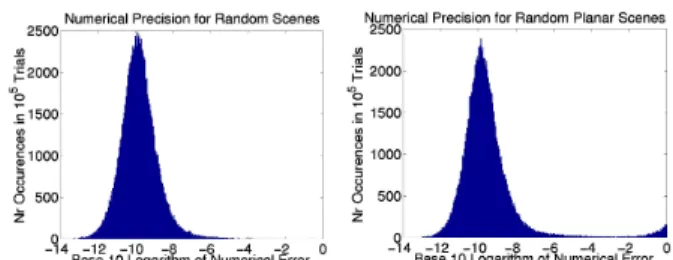
For a minimal solution such as the five-point method the two main requirements are precision and speed. Observe that the effects of noise will be the same for any five-point solution method. The numerical precision of our fast imple-mentation is investigated in Figure 1. Note that the typical errors are insignificant in comparison to realistic noise lev-els.
The computation time is partially dependent on the num-ber of real solutions. The distribution of the numnum-ber of so-lutions is given in Table 2. We have also verified experi-mentally that five points in three views in general yield a unique solution, with or without planar structure and an un-known focal length common to the three views. Timing in-formation for our efficient implementation of the five-point algorithm is given in Table 3.
The algorithm is used as a part of a system that recon-structs structure and motion from video in real-time. Sys-tem timing information is given in Table 4. Some results from the reconstruction system are given in Figures 2-6. See the figure captions for details.
Figure 1: Distribution of the numerical error in the computed essential matrixEˆbased on105 random tests with generic (left) and planar (right) scenes. Since the matrix is up to scale and there are multiple solutionsEˆi, the minimum residual
min
i min(
ˆ
Ei
Eˆi−
E
E , EE+ ˆ
Ei
Eˆi )from each problem
instance is used. The median error is 1.39·10−10 for generic scenes and1.76·10−10for planar scenes. All computations were performed in double precision.
7. Summary and Conclusions
An efficient algorithm for solving the five-point relative pose problem was presented. The algorithm was used in conjunction with random sampling consensus to solve for unknown structure and motion over two, three or more views. The efficiency of the algorithm is very impor-tant since it will typically be applied within this kind of hypothesise-and-test architecture, where the algorithm is executed for hundreds of different five-point samples. Prac-tical real-time reconstruction results were given and it was shown that the calibrated framework can continue to oper-ate correctly despite scene planarity.
Nr Hyp 0 1 2 3 4 5 6 7 8 9 10 Step 5 0 . 0.12 . 0.50 . 0.36 . 0.15 . 4.9e
−4 Step 6 4.2e
−6 0.17 0.28 0.29 0.17 5−.82e 2−.52e 1−.53e 6−.64e 1−.56e 2−e7
Table 2:The distribution of the number of hypotheses that result from computational steps 5 and 6 (as numbered in Section 3.2). The second row shows the distribution of the number of real roots of the tenth degree polynomial(p)in Equation (19), based on105 random point and view configurations. The average is 4.55 roots. The third row shows the distribution of the number of hypothe-ses once the cheirality constraint has been enforced, based on107 random point and view configurations. The average number of hy-potheses is 2.74. Both rows show fractions of the total number of trials. Our current randomization leads to two cases in107with ten distinct physically valid solutions. We have verified that there are such cases with ten well separated solutions that are not caused by numerical inaccuracies.
Step 1 2 3 4 5 6 Three-Point Pose
Mean Two Views
Mean Three Views µs 8 12 23 14 6/root 8/root 5/root 121 134
Table 3: Approximate timings for the algorithm steps (as num-bered in Section 3.2) on a modest 550MHz machine with highly optimised but platform-independent code. Including all overhead, the two and three view functions typically take 110-140µs and 120-180µs, respectively. For RANSAC processes with 500 sam-ples the total hypothesis generation times are around 60msand 67ms, respectively.
Appendixes
A
Definition of Sturm Chain
Letp(z)be a general polynomial of degreen >= 2. Here, the significance of general is that we ignore special cases for the sake of brevity. For example,p(z)is assumed to have no multiple roots. Moreover, the polynomial divisions carried out below are assumed to have a non-zero remainder. Under these assumptions, the Sturm chain is a sequence of poly-nomialsf0, . . . , fn of degrees0, . . . , n, respectively. fnis the polynomial itself andfn−1is its derivative:
fn(z) ≡ p(z) (24)
fn−1(z) ≡ p(z). (25) For i = n, . . . ,2 we carry out the polynomial division
fi/fi−1. Let the quotient of this division be qi(z) = kiz +mi and let the remainder be ri(z), i.e. fi(z) = qi(z)fi−1(z) +ri(z). Then definefi−2(z) ≡ −ri(z). Fi-nally, define the coefficientsm0, m1andk1such that
f0(z) =m0 (26)
f1(z) =k1z+m1. (27) Once the scalar coefficients k1, . . . , kn and m0, . . . , mn
have been derived, the Sturm chain can be evaluated at any
Feature Detection 30ms
Matching with Disparity Range
3% 5% 10%
34ms 45ms 160ms
SaM 50ms Table 4: Approximate average timings per 720x240 frame of video for the system components on a modest 550MHz machine. MMX code was used for the crucial parts of the feature detection and feature matching. Disparity range for the matching is given in percent of the image dimensions. In the structure and motion component (SaM), one-view and three-view estimations are com-bined to incrementally build the reconstruction with low latency. The whole system including all overhead currently operates at 26 frames per second on average on a 2.4GHz machine when using a 3% disparity range. The latency is also small, since there is no self-calibration and only very local iterative refinements.
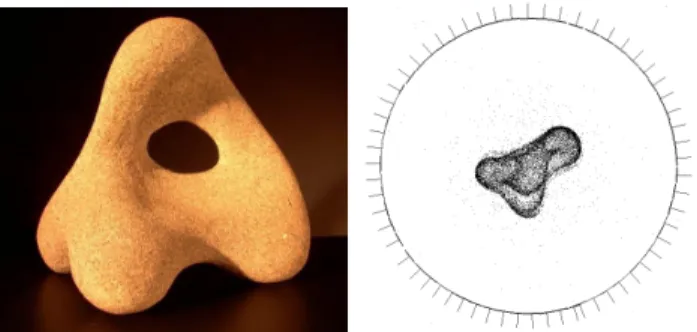
Figure 2: Reconstruction from the turntable sequence ’Stone’. No prior knowledge about the motion or the fact that it closes on itself was used in the estimation. The circular shape of the es-timated trajectory is a verification of the correctness of the result. This result was obtained without any global bundle adjustment and exhibits a regularity and accuracy that is typically not obtained with an uncalibrated method until the calibration constraints have been enforced through bundle adjustment.
pointzthrough Equations (26, 27) and the recursion
fi(z) = (kiz+mi)fi−1(z)−fi−2(z) i= 2, . . . , n(28) Let the number of sign changes in the chain bes(z). The number of real roots in an interval[a, b]is thens(a)−s(b). Unbounded intervals such as for example [0,∞) can be treated by looking atm0andk0, . . . , knin order to calculate limz→∞s(z). For more details, see for example [7, 12].
B
Efficient Singular Value
Decompo-sition of the Essential Matrix
An efficient singular value decomposition according to the conditions of Theorem 2 is given. Let the essential matrix be E = ea eb ec , whereea, eb, ec are column-vectors. It is assumed that it is a true essential matrix, i.e. that it has rank two and two equal non-zero singular values. First, all the vector productsea×eb,ea×ecandeb×ecare computed and the one with the largest magnitude chosen.
Figure 3: Reconstructions obtained from the ’Stone’ sequence by setting the focal length to incorrect values. The focal lengths used were 0.05, 0.3, 0.5, 0.7, 1.3, 1.5, 2.0 and 3.0 times the value obtained from calibration. For too small focal lengths, the recon-struction ’unfolds’ and vice versa.
Figure 4:Reconstruction from the sequence ’Farmhouse’, which contains long portions where a single plane fills the field of view. The successful reconstruction is a strong practical proof of the fact that the calibrated framework can overcome planar structure de-generacy without relying on the dede-generacy or trying to detect it. This is especially important for near-planar scenes, where neither the planar nor the uncalibrated model applies well. Only approx-imate intrinsic parameters were used and no global bundle adjust-ment was performed.
Assume without loss of generality thatea×ebhas the largest magnitude. Definevc≡(ea×eb)/|ea×eb|,va ≡ea/|ea|,
vb ≡ vc ×va,ua ≡ Eva/|Eva|,ub ≡ Evb/|Evb|and
uc ≡ ua×ub. Then the singular value decomposition is given byV = va vb vc andU = ua ub uc .
C
Efficient Triangulation of an Ideal
Point Correspondence
In the situation encountered in the five-point algorithm where triangulation is needed, a hypothesis for the essen-tial matrixE has been recovered and along with it the two camera matrices[I|0]andP. No error metric has to be minimised, since for the true solution the rays backpro-jected from the image correspondenceq↔q are guaran-teed to meet. For non-ideal point correspondences, prior correction to guarantee ray-intersection while minimising a good error metric is recommended. Global minimisation of . 2-norm in two views requires solving a sixth degree
Figure 5: Reconstruction from the sequence ’Girlsstatue’ that was acquired with a handheld camera. Only approximate intrin-sic parameters were used and no global bundle adjustment was performed.
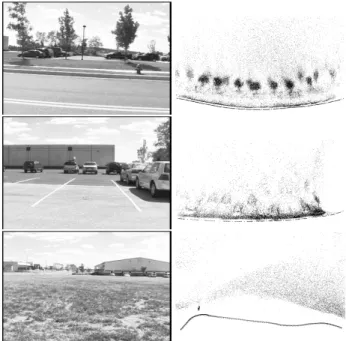
Figure 6:Reconstruction from vehicle sequences ’Road’, ’Park-ing Lot’ and ’Turn’, with 360, 330 and 130 frames, respectively. Only approximate intrinsic parameters were used and no global bundle adjustment was performed.
polynomial, see [10]. Minimisation of . ∞-norm [19], or directional error [20], also yields good results in prac-tice and can be achieved in closed form an order of mag-nitude faster. In the ideal situation, triangulation can be accomplished very efficiently by intersecting three planes that are back-projected from image lines. The image lines chosen to generate the three planes are the epipolar line
a corresponding to q, the line b through q that is per-pendicular to a and the line c through q that is perpen-dicular toEq. For non-ideal point correspondences, this scheme finds the world point on the ray backprojected from
q that minimises the reprojection error in the first image. It triangulates world points at infinity correctly and is in-variant to projective transformations of the world space. Observe that a = Eq, b = q×(diag(1,1,0)a) and
is the plane backprojected froma,B ≡[ b 0 ] is the plane backprojected frombandC≡Pcis the plane back-projected fromc. The intersection between the three planes
A,BandCis now sought. Formally, the intersection is the contractionQl ≡7ijklAiBjCk between the epsilon tensor
7ijkl 4 and the three planes. More concretely,d ≡ a×b is the direction of the ray backprojected from the intersec-tion betweenaandb. The space point is the intersection between this ray and the planeC:
Q∼ dC4 −(d1C1+d2C2+d3C3) . (29) Finally, it is observed that in the particular case of an ideal point correspondence we haved=q, so that computinga, b
andA, Bcan be avoided altogether.
References
[1] P. Beardsley, A. Zisserman and D. Murray, Sequential updat-ing of projective and affine structure from motion,
Interna-tional Journal of Computer Vision, 23(3): 235-259, 1997.
[2] M. Demazure, Sur Deux Problemes de Reconstruction,
Tech-nical Report No 882, INRIA, Rocquencourt, France, 1988.
[3] O. Faugeras and S. Maybank, Motion from Point Matches: Multiplicity of Solutions, International Journal of Computer
Vision, 4(3):225-246, 1990.
[4] O. Faugeras, What Can be Seen in Three Dimensions with an Uncalibrated Stereo Rig?, Proc. European Conference on
Computer Vision, pp. 563-578, 1992.
[5] O. Faugeras, Three-Dimensional Computer Vision: a
Geo-metric Viewpoint, MIT Press, ISBN 0-262-06158-9, 1993.
[6] M. Fischler and R. Bolles, Random Sample Consensus: a Paradigm for Model Fitting with Application to Image Anal-ysis and Automated Cartography, Commun. Assoc. Comp.
Mach., 24:381-395, 1981.
[7] W. Gellert, K. K¨ustner, M. Hellwich and H. K¨astner, The VNR
Concise Encyclopedia of Mathematics, Van Nostrand
Rein-hold Company, ISBN 0-442-22646-2, 1975.
[8] R. Haralick, C. Lee, K. Ottenberg and M. N¨olle, Review and Analysis of Solutions of the Three Point Perspective Pose Es-timation Problem, International Journal of Computer Vision, 13(3):331-356, 1994.
[9] R. Hartley, Estimation of Relative Camera Positions for Un-calibrated Cameras, Proc. European Conference on Computer
Vision, pp. 579-587, 1992.
[10] R. Hartley and A. Zisserman, Multiple View Geometry in
Computer Vision, Cambridge University Press, ISBN
0-521-62304-9, 2000.
[11] A. Heyden and G. Sparr, Reconstruction from Calibrated Cameras - a New Proof of the Kruppa-Demazure Theorem,
Journal of Mathematical Imaging & Vision, 10:1-20, 1999.
[12] D. Hook and P. McAree, Using Sturm Sequences To Bracket Real Roots of Polynomial Equations, Graphic Gems I, Aca-demic Press, ISBN 0-122-86166-3, pp. 416-423, 1990. [13] B. Horn, Relative Orientation, International Journal of
Com-puter Vision, 4:59-78, 1990.
4The epsilon tensor
ijklis the tensor such thatijklAiBjCkDl= det([ A B C D ]).
[14] E. Kruppa, Zur Ermittlung eines Objektes aus zwei Perspek-tiven mit Innerer Orientierung, Sitz.-Ber. Akad. Wiss., Wien,
Math. Naturw. Kl., Abt. IIa., 122:1939-1948, 1913.
[15] H. Longuet-Higgins, The Reconstruction of a Plane Surface from Two Perspective Projections, Proc. R. Soc. Lond. B, 277:399-410, 1986.
[16] S. Maybank, Theory of Reconstruction from Image Motion, Springer-Verlag, ISBN 3-540-55537-4, 1993.
[17] S. Negahdaripour, Closed-Form Relationship Between the Two Interpretations of a Moving Plane, J. Optical Society of
America, 7(2):279-285, 1990.
[18] D. Nist´er. Reconstruction From Uncalibrated Sequences with a Hierarchy of Trifocal Tensors, Proc. European
Con-ference on Computer Vision, Volume 1, pp. 649-663, 2000.
[19] D. Nist´er. Automatic dense reconstruction from uncalibrated
video sequences, PhD Thesis, Royal Institute of Technology
KTH, ISBN 91-7283-053-0, March 2001.
[20] J. Oliensis and Y. Genc, New Algorithms for Two-Frame Structure from Motion, Proc. International Conference on
Computer Vision, pp. 737-744 ,1999.
[21] J. Philip, A Non-Iterative Algorithm for Determining all Essential Matrices Corresponding to Five Point Pairs,
Pho-togrammetric Record, 15(88):589-599, October 1996.
[22] M. Pollefeys, R. Koch and L. Van Gool, Self-Calibration and Metric Reconstruction in spite of Varying and Unknown In-ternal Camera Parameters, International Journal of Computer
Vision, 32(1):7-25, 1999.
[23] M. Pollefeys, F. Verbiest and L. Van Gool, Surviving Dom-inant Planes in Uncalibrated Structure and Motion Recovery,
Proc. European Conference on Computer Vision, Volume 2,
pp. 837-851, 2002.
[24] W. Press, S. Teukolsky, W. Vetterling and B. Flannery,
Nu-merical recipes in C, Cambridge University Press, ISBN
0-521-43108-5, 1988.
[25] P. Stefanovic, Relative Orientation - a New Approach, I. T.
C. Journal, 1973-3:417-448, 1973.
[26] P. Torr and D. Murray, The Development and Comparison of Robust Methods for Estimating the Fundamental Matrix,
In-ternational Journal of Computer Vision, 24(3):271-300, 1997.
[27] P. Torr, A. Fitzgibbon and A. Zisserman, The Problem of Degeneracy in Structure and Motion Recovery from Uncali-brated Image Sequences, International Journal of Computer
Vision, 32(1):27-44, August 1999.
[28] B. Triggs, Routines for Relative Pose of Two Cal-ibrated Cameras from 5 Points, Technical Report, http://www.inrialpes.fr/movi/people/Triggs INRIA, France,
2000.
[29] B. Triggs, P. McLauchlan, R. Hartley and A. Fitzgibbon, Bundle Adjustment - a Modern Synthesis, Springer Lecture
Notes on Computer Science, Springer Verlag, 1883:298-375,
2000.
[30] R. Tsai and T. Huang, Uniqueness and Estimation of Three-Dimensional Motion Parameters of Rigid Objects with Curved Surfaces, IEEE Transactions on Pattern Analysis and
Machine Intelligence, 6(1):13-27, 1984.
[31] Z. Zhang, Determining the Epipolar Geometry and its Uncer-tainty: a Review, International Journal of Computer Vision, 27(2):161-195, 1998.
The views and conclusions contained in this document are those of the authors and should not be interpreted as representing the official policies, either expressed or implied, of the Army Research Laboratory or the U. S. Govern-ment.