DeepFace: Closing the Gap to Human-Level Performance in Face Verification
Yaniv Taigman
Ming Yang
Marc’Aurelio Ranzato
Facebook AI Research
Menlo Park, CA, USA
{yaniv, mingyang, ranzato}@fb.com
Lior Wolf
Tel Aviv University
Tel Aviv, Israel
[email protected]Abstract
In modern face recognition, the conventional pipeline consists of four stages: detect⇒align⇒represent⇒ clas-sify. We revisit both the alignment step and the representa-tion step by employing explicit 3D face modeling in order to apply a piecewise affine transformation, and derive a face representation from a nine-layer deep neural network. This deep network involves more than 120 million parameters using several locally connected layers without weight shar-ing, rather than the standard convolutional layers. Thus we trained it on the largest facial dataset to-date, an iden-tity labeled dataset of four million facial images belong-ing to more than 4,000 identities. The learned representa-tions coupling the accurate model-based alignment with the large facial database generalize remarkably well to faces in unconstrained environments, even with a simple classifier. Our method reaches an accuracy of 97.35% on the Labeled Faces in the Wild (LFW) dataset, reducing the error of the current state of the art by more than 27%, closely approach-ing human-level performance.
1. Introduction
Face recognition in unconstrained images is at the fore-front of the algorithmic perception revolution. The social and cultural implications of face recognition technologies are far reaching, yet the current performance gap in this do-main between machines and the human visual system serves as a buffer from having to deal with these implications.
We present a system (DeepFace) that has closed the ma-jority of the remaining gap in the most popular benchmark in unconstrained face recognition, and is now at the brink of human level accuracy. It is trained on a large dataset of faces acquired from a population vastly different than the one used to construct the evaluation benchmarks, and it is able to outperform existing systems with only very minimal adaptation. Moreover, the system produces an extremely compact face representation, in sheer contrast to the shift
toward tens of thousands of appearance features in other re-cent systems [5,7,2].
The proposed system differs from the majority of con-tributions in the field in that it uses the deep learning (DL) framework [3,21] in lieu of well engineered features. DL is especially suitable for dealing with large training sets, with many recent successes in diverse domains such as vision, speech and language modeling. Specifically with faces, the success of the learned net in capturing facial appearance in a robust manner is highly dependent on a very rapid 3D alignment step. The network architecture is based on the assumption that once the alignment is completed, the loca-tion of each facial region is fixed at the pixel level. It is therefore possible to learn from the raw pixel RGB values, without any need to apply several layers of convolutions as is done in many other networks [19,21].
In summary, we make the following contributions : (i) The development of an effective deep neural net (DNN) ar-chitecture and learning method that leverage a very large labeled dataset of faces in order to obtain a face representa-tion that generalizes well to other datasets; (ii) An effective facial alignment system based on explicit 3D modeling of faces; and (iii) Advance the state of the art significantly in (1) the Labeled Faces in the Wild benchmark (LFW) [18], reaching near human-performance; and (2) the YouTube Faces dataset (YTF) [30], decreasing the error rate there by more than 50%.
1.1. Related Work
Big data and deep learning In recent years, a large num-ber of photos have been crawled by search engines, and up-loaded to social networks, which include a variety of un-constrained material, such as objects, faces and scenes.
This large volume of data and the increase in compu-tational resources have enabled the use of more powerful statistical models. These models have drastically improved the robustness of vision systems to several important vari-ations, such as non-rigid deformvari-ations, clutter, occlusion and illumination, all problems that are at the core of many computer vision applications. While conventional machine
learning methods such as Support Vector Machines, Prin-cipal Component Analysis and Linear Discriminant Analy-sis, have limited capacity to leverage large volumes of data, deep neural networks have shown better scaling properties. Recently, there has been a surge of interest in neu-ral networks [19, 21]. In particular, deep and large net-works have exhibited impressive results once: (1) they have been applied to large amounts of training data and (2) scalable computation resources such as thousands of CPU cores [11] and/or GPU’s [19] have become available. Most notably, Krizhevsky et al. [19] showed that very large and deep convolutional networks [21] trained by standard back-propagation [25] can achieve excellent recognition accuracy when trained on a large dataset.
Face recognition state of the artFace recognition er-ror rates have decreased over the last twenty years by three orders of magnitude [12] when recognizing frontal faces in still images taken in consistently controlled (constrained) environments. Many vendors deploy sophisticated systems for the application of border-control and smart biometric identification. However, these systems have shown to be sensitive to various factors, such as lighting, expression, oc-clusion and aging, that substantially deteriorate their perfor-mance in recognizing people in such unconstrained settings. Most current face verification methods use hand-crafted features. Moreover, these features are often combined to improve performance, even in the earliest LFW con-tributions. The systems that currently lead the perfor-mance charts employ tens of thousands of image descrip-tors [5,7, 2]. In contrast, our method is applied directly to RGB pixel values, producing a very compact yet sparse descriptor.
Deep neural nets have also been applied in the past to face detection [24], face alignment [27] and face verifica-tion [8,16]. In the unconstrained domain, Huang et al. [16] used as input LBP features and they showed improvement when combining with traditional methods. In our method we use raw images as our underlying representation, and to emphasize the contribution of our work, we avoid com-bining our features with engineered descriptors. We also provide a new architecture, that pushes further the limit of what is achievable with these networks by incorporating 3D alignment, customizing the architecture for aligned inputs, scaling the network by almost two order of magnitudes and demonstrating a simple knowledge transfer method once the network has been trained on a very large labeled dataset.
Metric learning methods are used heavily in face ver-ification, often coupled with task-specific objectives [26, 29,6]. Currently, the most successful system that uses a large data set of labeled faces [5] employs a clever transfer learning technique which adapts a Joint Bayesian model [6] learned on a dataset containing 99,773 images from 2,995 different subjects, to theLFWimage domain. Here, in order
(a) (b) (c) (d)
(e) (f) (g) (h)
Figure 1.Alignment pipeline.(a) The detected face, with 6 initial fidu-cial points. (b) The induced 2D-aligned crop. (c) 67 fidufidu-cial points on the 2D-aligned crop with their corresponding Delaunay triangulation, we added triangles on the contour to avoid discontinuities. (d) The reference 3D shape transformed to the 2D-aligned crop image-plane. (e) Triangle visibility w.r.t. to the fitted 3D-2D camera; darker triangles are less visible. (f) The 67 fiducial points induced by the 3D model that are used to direct the piece-wise affine warpping. (g) The final frontalized crop. (h) A new view generated by the 3D model (not used in this paper).
to demonstrate the effectiveness of the features, we keep the distance learning step trivial.
2. Face Alignment
Existing aligned versions of several face databases (e.g. LFW-a [29]) help to improve recognition algorithms by pro-viding a normalized input [26]. However, aligning faces in the unconstrained scenario is still considered a difficult problem that has to account for many factors such as pose (due to the non-planarity of the face) and non-rigid expres-sions, which are hard to decouple from the identity-bearing facial morphology. Recent methods have shown successful ways that compensate for these difficulties by using sophis-ticated alignment techniques. These methods can use one or more from the following: (1) employing an analytical 3D model of the face [28,32,14], (2) searching for sim-ilar fiducial-points configurations from an external dataset to infer from [4], and (3) unsupervised methods that find a similarity transformation for the pixels [17,15].
While alignment is widely employed, no complete phys-ically correct solution is currently present in the context of unconstrained face verification. 3D models have fallen out of favor in recent years, especially in unconstrained envi-ronments. However, since faces are 3D objects, done cor-rectly, we believe that it is the right way. In this paper, we describe a system that includes analytical 3D modeling of the face based on fiducial points, that is used to warp a de-tected facial crop to a 3D frontal mode (frontalization).
Similar to much of the recent alignment literature, our alignment is based on using fiducial point detectors to direct the alignment process. We use a relatively simple fiducial
point detector, but apply it in several iterations to refine its output. At each iteration, fiducial points are extracted by a Support Vector Regressor (SVR) trained to predict point configurations from an image descriptor. Our image de-scriptor is based on LBP Histograms [1], but other features can also be considered. By transforming the image using the induced similarity matrix T to a new image, we can run the fiducial detector again on a new feature space and refine the localization.
2D Alignment We start our alignment process by de-tecting 6 fiducial points inside the detection crop, centered at the center of the eyes, tip of the nose and mouth loca-tions as illustrated in Fig.1(a). They are used to approxi-mately scale, rotate and translate the image into six anchor locations by fittingTi
2d := (si, Ri, ti)where: x j
anchor := si[Ri|ti]∗xjsourcefor pointsj= 1..6and iterate on the new
warped image until there is no substantial change, even-tually composing the final 2D similarity transformation:
T2d := T21d ∗ ...∗ T k
2d. This aggregated transformation
generates a 2D aligned crop, as shown in Fig.1(b). This alignment method is similar to the one employed in LFW-a, which has been used frequently to boost recognition accu-racy. However, similarity transformation fails to compen-sate for out-of-plane rotation, which is particularly impor-tant in unconstrained conditions.
3D AlignmentIn order to align faces undergoing out-of-plane rotations, we use a generic 3D shape model and register a 3D affine camera, which are used to warp the 2D-aligned crop to the image plane of the 3D shape. This gen-erates the 3D-aligned version of the crop as illustrated in Fig.1(g). This is achieved by localizing additional 67 fidu-cial pointsx2din the 2D-aligned crop (see Fig.1(c)), using
a second SVR. As a 3D generic shape model, we simply take the average of the 3D scans from the USF Human-ID database, which were post-processed to be represented as aligned verticesvi = (xi, yi, zi)n
i=1. We manually place
67 anchor points on the 3D shape, and in this way achieve full correspondence between the 67 detected fiducial points and their 3D references. An affine 3D-to-2D camera P
is then fitted using the generalized least squares solution to the linear system x2d = X3dP~ with a known
covari-ance matrixΣ, that is,P~ that minimizes the following loss:
loss(P~) =rTΣ−1rwherer= (x
2d−X3dP~)is the
resid-ual vector andX3d is a(67∗2)×8matrix composed by
stacking the (2×8) matrices[x>3d(i),1, ~0;~0, x>3d(i),1], with
~0 denoting a row vector of four zeros, for each reference
fiducial pointx3d(i). The affine cameraP of size2×4 is
represented by the vector of 8 unknownsP~. The loss can be minimized using the Cholesky decomposition ofΣ, that transforms the problem into ordinary least squares. Since, for example, detected points on the contour of the face tend to be more noisy, as their estimated location is largely in-fluenced by the depth with respect to the camera angle, we
use a(67∗2)×(67∗2)covariance matrixΣgiven by the estimated covariances of the fiducial point errors.
Frontalization Since full perspective projections and non-rigid deformations are not modeled, the fitted camera
P is only an approximation. In order to reduce the corrup-tion of such important identity-bearing factors to the final warping, we add the corresponding residuals inrto the x-y components of each reference fiducial pointx3d, we denote
this asxf3d. Such a relaxation is plausible for the purpose of
warping the 2D image with smaller distortions to the iden-tity. Without it, faces would have been warped into the same shape in 3D, losing important discriminative factors. Fi-nally, the frontalization is achieved by a piece-wise affine transformationTfromx2d(source) toxf3d(target), directed
by the Delaunay triangulation derived from the 67 fiducial points1. Also, invisible triangles w.r.t. to cameraP, can be replaced using image blending with their symmetrical coun-terparts.
3. Representation
In recent years, the computer vision literature has at-tracted many research efforts in descriptor engineering. Such descriptors when applied to face-recognition, mostly use the same operator to all locations in the facial im-age. Recently, as more data has become available, learning-based methods have started to outperform engineered fea-tures, because they can discover and optimize features for the specific task at hand [19]. Here, we learn a generic rep-resentation of facial images through a large deep network.
DNN Architecture and Training We train our DNN on a multi-class face recognition task, namely to classify the identity of a face image. The overall architecture is shown in Fig.2. A 3D-aligned 3-channels (RGB) face im-age of size 152 by 152 pixels is given to a convolutional layer (C1) with 32 filters of size 11x11x3 (we denote this by 32x11x11x3@152x152). The resulting 32 feature maps are then fed to a max-pooling layer (M2) which takes the max over 3x3 spatial neighborhoods with a stride of 2, sep-arately for each channel. This is followed by another con-volutional layer (C3) that has 16 filters of size 9x9x16. The purpose of these three layers is to extract low-level features, like simple edges and texture. Max-pooling layers make the output of convolution networks more robust to local trans-lations. When applied to aligned facial images, they make the network more robust to small registration errors. How-ever, several levels of pooling would cause the network to lose information about the precise position of detailed facial structure and micro-textures. Hence, we apply max-pooling only to the first convolutional layer. We interpret these first layers as a front-end adaptive pre-processing stage. While they are responsible for most of the computation, they hold
1T2
Figure 2.Outline of theDeepFacearchitecture. A front-end of a single convolution-pooling-convolution filtering on the rectified input, followed by three locally-connected layers and two fully-connected layers. Colors illustrate feature maps produced at each layer. The net includes more than 120 million parameters, where more than 95% come from the local and fully connected layers.
very few parameters. These layers merely expand the input into a set of simple local features.
The subsequent layers (L4, L5 and L6) are instead lo-cally connected [13,16], like a convolutional layer they ap-ply a filter bank, but every location in the feature map learns a different set of filters. Since different regions of an aligned image have different local statistics, the spatial stationarity assumption of convolution cannot hold. For example, ar-eas between the eyes and the eyebrows exhibit very differ-ent appearance and have much higher discrimination ability compared to areas between the nose and the mouth. In other words, we customize the architecture of the DNN by lever-aging the fact that our input images are aligned. The use of local layers does not affect the computational burden of feature extraction, but does affect the number of parameters subject to training. Only because we have a large labeled dataset, we can afford three large locally connected layers. The use of locally connected layers (without weight shar-ing) can also be justified by the fact that each output unit of a locally connected layer is affected by a very large patch of the input. For instance, the output of L6 is influenced by a 74x74x3 patch at the input, and there is hardly any statisti-cal sharing between such large patches inalignedfaces.
Finally, the top two layers (F7 and F8) are fully con-nected: each output unit is connected to all inputs. These layers are able to capture correlations between features cap-tured in distant parts of the face images,e.g., position and shape of eyes and position and shape of mouth. The output of the first fully connected layer (F7) in the network will be used as our raw face representation feature vector through-out this paper. In terms of representation, this is in con-trast to the existing LBP-based representations proposed in the literature, that normally pool very local descriptors (by computing histograms) and use this as input to a classifier.
The output of the last fully-connected layer is fed to a K-way softmax (where K is the number of classes) which produces a distribution over the class labels. If we denote byok thek-th output of the network on a given input, the
probability assigned to the k-th class is the output of the softmax function:pk = exp(ok)/P
hexp(oh).
The goal of training is to maximize the probability of the correct class (face id). We achieve this by minimiz-ing the cross-entropy loss for each trainminimiz-ing sample. If k
is the index of the true label for a given input, the loss is:
L = −logpk. The loss is minimized over the parameters by computing the gradient of L w.r.t. the parameters and by updating the parameters using stochastic gradient de-scent (SGD). The gradients are computed by standard back-propagation of the error [25,21]. One interesting property of the features produced by this network is that they are very sparse. On average, 75% of the feature components in the topmost layers are exactly zero. This is mainly due to the use of the ReLU [10] activation function: max(0, x). This soft-thresholding non-linearity is applied after every con-volution, locally connected and fully connected layer (ex-cept the last one), making the whole cascade produce highly non-linear and sparse features. Sparsity is also encouraged by the use of a regularization method called dropout [19] which sets random feature components to 0 during training. We have applied dropout only to the first fully-connected layer. Due to the large training set, we did not observe sig-nificant overfitting during training2.
Given an imageI, the representationG(I)is then com-puted using the described forward network. Any feed-forward neural network withLlayers, can be seen as a com-position of functionsgl
φ. In our case, the representation is: G(I) = gF7
φ (g L6 φ (...g
C1
φ (T(I, θT))...))with the net’s
pa-rameters φ = {C1, ..., F7} andθT = {x2d, ~P , ~r} as
de-scribed in Section 2.
Normaliaztion As a final stage we normalize the fea-tures to be between zero and one in order to reduce the sen-sitivity to illumination changes: Each component of the fea-ture vector is divided by its largest value across the training set. This is then followed by L2-normalization: f(I) :=
¯
G(I)/||G(I)¯ ||2 where G(I)¯ i = G(I)i/max(Gi, ) 3.
Since we employ ReLU activations, our system is not in-variant to re-scaling of the image intensities. Without
bi-2See thesupplementarymaterial for more details. 3= 0.05in order to avoid division by a small number.
ases in the DNN, perfect equivariance would have been achieved.
4. Verification Metric
Verifying whether two input instances belong to the same class (identity) or not has been extensively researched in the domain of unconstrained face-recognition, with supervised methods showing a clear performance advantage over unsu-pervised ones. By training on the target-domain’s training set, one is able to fine-tune a feature vector (or classifier) to perform better within the particular distribution of the dataset. For instance,LFW has about 75% males, celebri-ties that were photographed by mostly professional photog-raphers. As demonstrated in [5], training and testing within different domain distributions hurt performance consider-ably and requires further tuning to the representation (or classifier) in order to improve their generalization and per-formance. However, fitting a model to a relatively small dataset reduces its generalization to other datasets. In this work, we aim at learning an unsupervised metric that gener-alizes well to several datasets. Our unsupervised similarity is simply the inner product between the two normalized fea-ture vectors. We have also experimented with a supervised metric, theχ2similarity and the Siamese network.
4.1. Weighted
χ2distance
The normalizedDeepFacefeature vector in our method contains several similarities to histogram-based features, such as LBP [1] : (1) It contains non-negative values, (2) it is very sparse, and (3) its values are between [0, 1]. Hence, similarly to [1], we use the weighted-χ2similarity: χ2(f1, f2) = Piwi(f1[i]−f2[i])2/(f1[i] +f2[i])where f1 andf2 are the DeepFacerepresentations. The weight
parameters are learned using a linear SVM, applied to vec-tors of the elements(f1[i]−f2[i])2/(f1[i] +f2[i]).
4.2. Siamese network
We have also tested an end-to-end metric learning ap-proach, known as Siamese network [8]: once learned, the face recognition network (without the top layer) is repli-cated twice (one for each input image) and the features are used to directly predict whether the two input images be-long to the same person. This is accomplished by: a) taking the absolute difference between the features, followed by b) a top fully connected layer that maps into a single logistic unit (same/not same). The network has roughly the same number of parameters as the original one, since much of it is shared between the two replicas, but requires twice the computation. Notice that in order to prevent overfitting on the face verification task, we enable training for only the two topmost layers. The Siamese network’s induced dis-tance is: d(f1, f2) = Piαi|f1[i]−f2[i]|, where αi are
Figure 3.The ROC curves on theLFWdataset. Best viewed in color.
trainable parameters. The parameters of the Siamese net-work are trained by standard cross entropy loss and back-propagation of the error.
5. Experiments
We evaluate the proposedDeepFacesystem, by learning the face representation on a very large-scale labeled face dataset collected online. In this section, we first introduce the datasets used in the experiments, then present the de-tailed evaluation and comparison with the state-of-the-art, as well as some insights and findings about learning and transferring the deep face representations.
5.1. Datasets
The proposed face representation is learned from a large collection of photos fromFacebook, referred to as the So-cial Face Classification (SFC) dataset. The representa-tions are then applied to the Labeled Faces in the Wild database (LFW), which is thede facto benchmark dataset for face verification in unconstrained environments, and the YouTube Faces (YTF) dataset, which is modeled similarly to theLFWbut focuses on video clips.
TheSFCdatasetincludes 4.4 million labeled faces from 4,030 people each with 800 to 1200 faces, where the most recent 5% of face images of each identity are left out for testing. This is done according to the images’ time-stamp in order to simulate continuous identification through aging. The large number of images per person provides a unique opportunity for learning the invariance needed for the core problem of face recognition. We have validated using sev-eral automatic methods, that the identities used for train-ing do not intersect with any of the identities in the below-mentioned datasets, by checking their name labels.
TheLFWdataset[18] consists of 13,323 web photos of 5,749 celebrities which are divided into 6,000 face pairs in 10 splits. Performance is measured by mean recognition ac-curacy using A) therestrictedprotocol, in which only same and not same labels are available in training; B) the unre-strictedprotocol, where additional training pairs are acces-sible in training; and C) anunsupervisedsetting in which no training whatsoever is performed on LFW images.
The YTF dataset[30] collects 3,425 YouTube videos of 1,595 subjects (a subset of the celebrities in theLFW). These videos are divided into 5,000 video pairs and 10 splits and used to evaluate the video-level face verification.
The face identities in SFC were labeled by humans, which typically incorporate about 3% errors. Social face photos have even larger variations in image quality, light-ing, and expressions than the web images of celebrities in the LFW andYTF which were normally taken by profes-sional photographers rather than smartphones4.
5.2. Training on the
SFCWe first train the deep neural network on theSFCas a multi-class classification problem using a GPU-based en-gine, implementing the standard back-propagation on feed-forward nets by stochastic gradient descent (SGD) with mo-mentum (set to 0.9). Our mini-batch size is 128, and we have set an equal learning rate for all trainable layers to 0.01, which was manually decreased, each time by an or-der of magnitude once the validation error stopped decreas-ing, to a final rate of 0.0001. We initialized the weights in each layer from a zero-mean Gaussian distribution with
σ= 0.01, and biases are set to 0.5. We trained the network for roughly 15 sweeps (epochs) over the whole data which took 3 days. As described in Sec. 3, the responses of the fully connected layer F7 are extracted to serve as the face representation.
We evaluated different design choices of DNN in terms of the classification error on 5% data of SFC as the test set. This validated the necessity of using a large-scale face dataset and a deep architecture. First, we vary the train/test dataset size by using a subset of the persons in the SFC. Subsets of sizes 1.5K, 3K and 4K persons (1.5M, 3.3M, and 4.4M faces, respectively) are used. Using the architecture in Fig.2, we trained three networks, denoted byDF-1.5K, DF-3.3K, andDF-4.4K. Table1 (left column) shows that the classification error grows only modestly from7.0%on 1.5K persons to7.2%when classifying 3K persons, which indicates that the capacity of the network can well accom-modate the scale of 3M training images. The error rate rises to8.7%for 4K persons with 4.4M images, showing the net-work scales comfortably to more persons. We’ve also varied the global number of samples in SFCto10%,20%,50%,
4See thesupplementarymaterial for more details aboutSFC.
leaving the number of identities in place, denoted by DF-10%,DF-20%,DF-50%in the middle column of Table1. We observed the test errors rise up to20.7%, because of overfitting on the reduced training set. Since performance does not saturate at 4M images, this shows that the network would benefit from even larger datasets.
We also vary the depth of the networks by chopping off the C3 layer, the two local L4 and L5 layers, or all these 3 layers, referred respectively asDF-sub1,DF-sub2, and DF-sub3. For example, only four trainable layers remain in DF-sub3which is a considerably shallower structure compared to the 9 layers of the proposed network in Fig.2. In training such networks with 4.4M faces, the classification errors stop decreasing after a few epochs and remains at a level higher than that of the deep network, as can be seen in Table 1
(right column). This verifies the necessity of network depth when training on a large face dataset.
5.3. Results on the
LFWdataset
The vision community has made significant progress on face verification in unconstrained environments in re-cent years. The mean recognition accuracy onLFW [18] marches steadily towards the human performance of over
97.5%[20]. Given some very hard cases due to aging ef-fects, large lighting and face pose variations inLFW, any improvement over the state-of-the-art is very remarkable and the system has to be composed by highly optimized modules. There is a strong diminishing return effect and any progress now requires a substantial effort to reduce the num-ber of errors of state-of-the-art methods.DeepFacecouples large feedforward-based models with fine 3D alignment. Regarding the importance of each component: 1) Without frontalization: when using only the 2D alignment, the ob-tained accuracy is “only”94.3%. Without alignment at all, i.e., using the center crop of face detection, the accuracy is
87.9%as parts of the facial region may fall out of the crop. 2) Without learning: when using frontalization only, and a naive LBP/SVM combination, the accuracy is91.4%which is already notable given the simplicity of such a classifier.
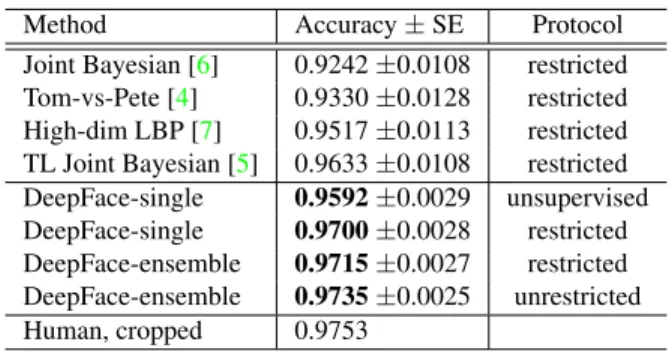
All theLFW images are processed in the same pipeline that was used to train on the SFC dataset, denoted as DeepFace-single. To evaluate the discriminative capability of the face representation in isolation, we follow the unsu-pervisedsetting to directly compare the inner product of a pair of normalized features. Quite remarkably, this achieves a mean accuracy of 95.92% which is almost on par with the best performance to date, achieved by supervised trans-fer learning [5]. Next, we learn a kernel SVM (with C=1) on top of the χ2-distance vector (Sec. 4.1) following the
restricted protocol,i.e., where only the 5,400 pair labels per split are available for the SVM training. This achieves an accuracy97.00%, reducing significantly the error of the state-of-the-art [7,5], see Table3.
Network Error Network Error Network Error
DF-1.5K 7.00% DF-10% 20.7% DF-sub1 11.2%
DF-3.3K 7.22% DF-20% 15.1% DF-sub2 12.6%
DF-4.4K 8.74% DF-50% 10.9% DF-sub3 13.5%
Table 1. Comparison of the classification errors on theSFC w.r.t.
training dataset size and network depth. See Sec.5.2for details.
Network Error (SFC) Accuracy±SE (LFW)
DeepFace-align2D 9.5% 0.9430±0.0043
DeepFace-gradient 8.9% 0.9582±0.0037
DeepFace-Siamese NA 0.9617±0.0038
Table 2. The performance of various individual DeepFace net-works and the Siamese network.
Ensembles of DNNs Next, we combine multiple net-works trained by feeding different types of inputs to the DNN: 1) The network DeepFace-single described above based on 3D aligned RGB inputs; 2) The gray-level im-age plus imim-age gradient magnitude and orientation; and 3) the 2D-aligned RGB images. We combine those distances using a non-linear SVM (with C=1) with a simple sum of power CPD-kernels: KCombined := Ksingle+Kgradient+
Kalign2d, whereK(x, y) := −||x−y||2, and following the
restricted protocol, achieve an accuracy97.15%.
The unrestricted protocol provides the operator with knowledge about the identities in the training sets, hence enabling the generation of many more training pairs to be added to the training set. We further experiment with train-ing a Siamese Network (Sec.4.2) to learn a verification met-ric by fine-tuning the Siamese’s (shared) pre-trained feature extractor. Following this procedure, we have observed sub-stantial overfitting to the training data. The training pairs generated using the LFW training data are redundant as they are generated out of roughly 9K photos, which are insufficient to reliably estimate more than 120M parame-ters. To address these issues, we have collected an ad-ditional dataset following the same procedure as with the SFC, containing an additional new 100K identities, each with only 30 samples to generate same and not-same pairs from. We then trained the Siamese Network on it followed by 2 training epochs on the LFW unrestricted training splits to correct for some of the data set dependent biases. The slightly-refined representation is handled similarly as be-fore. Combining it into the above-mentioned ensemble, i.e.,KCombined+=KSiamese, yields the accuracy97.25%, un-der the unrestricted protocol. By adding four additional DeepFace-single networks to the ensemble, each trained from scratch with different random seeds,i.e.,KCombined+= P
KDeepFace-Single, the obtained accuracy is 97.35%. The performances of the individual networks, before combina-tion, are presented in Table2.
The comparisons with the recent state-of-the-art
meth-Method Accuracy±SE Protocol Joint Bayesian [6] 0.9242±0.0108 restricted Tom-vs-Pete [4] 0.9330±0.0128 restricted High-dim LBP [7] 0.9517±0.0113 restricted TL Joint Bayesian [5] 0.9633±0.0108 restricted DeepFace-single 0.9592±0.0029 unsupervised DeepFace-single 0.9700±0.0028 restricted DeepFace-ensemble 0.9715±0.0027 restricted DeepFace-ensemble 0.9735±0.0025 unrestricted Human, cropped 0.9753
Table 3. Comparison with the state-of-the-art on theLFWdataset.
Method Accuracy (%) AUC EER MBGS+SVM- [31] 78.9±1.9 86.9 21.2 APEM+FUSION [22] 79.1±1.5 86.6 21.4 STFRD+PMML [9] 79.5±2.5 88.6 19.9 VSOF+OSS [23] 79.7±1.8 89.4 20.0 DeepFace-single 91.4±1.1 96.3 8.6 Table 4. Comparison with the state-of-the-art on theYTFdataset.
ods in terms of the mean accuracy and ROC curves are pre-sented in Table3and Fig.3, including human performance on the cropped faces. The proposedDeepFacemethod ad-vances the state-of-the-art, closely approaching human per-formance in face verification.
5.4. Results on the
YTFdataset
We further validateDeepFaceon the recent video-level face verification dataset. The image quality of YouTube video frames is generally worse than that of web photos, mainly due to motion blur or viewing distance. We em-ploy theDeepFace-singlerepresentation directly by creat-ing, for every pair of training videos, 50 pairs of frames, one from each video, and label these as same or not-same in accordance with the video training pair. Then a weighted
χ2 model is learned as in Sec.4.1. Given a test-pair, we
sample 100 random pairs of frames, one from each video, and use the mean value of the learned weighed similarity.
The comparison with recent methods is shown in Ta-ble 4and Fig. 4. We report an accuracy of91.4%which reduces the error of the previous best methods by more than
50%. Note that there are about 100 wrong labels for video pairs, recently updated to theYTFwebpage. After these are corrected, DeepFace-singleactually reaches92.5%. This experiment verifies again that theDeepFacemethod easily generalizes to a new target domain.
5.5. Computational efficiency
We have efficiently implemented a CPU-based feedfor-ward operator, which exploits both the CPU’s Single In-struction Multiple Data (SIMD) inIn-structions and its cache by leveraging the locality of floating-point computations
Figure 4.The ROC curves on theYTFdataset. Best viewed in color.
across the kernels and the image. Using a single core In-tel 2.2GHz CPU, the operator takes 0.18 seconds to extract features from the raw input pixels. Efficient warping tech-niques were implemented for alignment; alignment alone takes about 0.05 seconds. Overall, the DeepFaceruns at 0.33 seconds per image, accounting for image decoding, face detection and alignment, the feedforward network, and the final classification output.
6. Conclusion
An ideal face classifier would recognize faces in accu-racy that is only matched by humans. The underlying face descriptor would need to be invariant to pose, illumination, expression, and image quality. It should also be general, in the sense that it could be applied to various populations with little modifications, if any at all. In addition, short descrip-tors are preferable, and if possible, sparse features. Cer-tainly, rapid computation time is also a concern. We believe that this work, which departs from the recent trend of using more features and employing a more powerful metric learn-ing technique, has addressed this challenge, closlearn-ing the vast majority of this performance gap. Our work demonstrates that coupling a 3D model-based alignment with large capac-ity feedforward models can effectively learn from many ex-amples to overcome the drawbacks and limitations of previ-ous methods. The ability to present a marked improvement in face recognition, attests to the potential of such coupling to become significant in other vision domains as well.
References
[1] T. Ahonen, A. Hadid, and M. Pietik¨ainen. Face description with local binary patterns: Application to face recognition.PAMI, 2006.3,5
[2] O. Barkan, J. Weill, L. Wolf, and H. Aronowitz. Fast high dimen-sional vector multiplication face recognition. InICCV, 2013.1,2
[3] Y. Bengio. Learning deep architectures for AI. Foundations and Trends in Machine Learning, 2009.1
[4] T. Berg and P. N. Belhumeur. Tom-vs-pete classifiers and identity-preserving alignment for face verification. InBMVC, 2012.2,7
[5] X. Cao, D. Wipf, F. Wen, G. Duan, and J. Sun. A practical transfer learning algorithm for face verification. InICCV, 2013.1,2,5,6,7
[6] D. Chen, X. Cao, L. Wang, F. Wen, and J. Sun. Bayesian face revis-ited: A joint formulation. InECCV, 2012.2,7
[7] D. Chen, X. Cao, F. Wen, and J. Sun. Blessing of dimensionality: High-dimensional feature and its efficient compression for face veri-fication. InCVPR, 2013.1,2,6,7
[8] S. Chopra, R. Hadsell, and Y. LeCun. Learning a similarity met-ric discriminatively, with application to face verification. InCVPR, 2005.2,5
[9] Z. Cui, W. Li, D. Xu, S. Shan, and X. Chen. Fusing robust face region descriptors via multiple metric learning for face recognition in the wild. InCVPR, 2013.7
[10] G. E. Dahl, T. N. Sainath, and G. E. Hinton. Improving deep neu-ral networks for LVCSR using rectified linear units and dropout. In
ICASSP, 2013.4
[11] J. Dean, G. Corrado, R. Monga, K. Chen, M. Devin, Q. Le, M. Mao, M. Ranzato, A. Senior, P. Tucker, K. Yang, and A. Ng. Large scale distributed deep networks. InNIPS, 2012.2
[12] P. J. P. et al. An introduction to the good, the bad, & the ugly face recognition challenge problem. InFG, 2011.2
[13] K. Gregor and Y. LeCun. Emergence of complex-like cells in a tem-poral product network with local receptive fields. arXiv:1006.0448, 2010.4
[14] T. Hassner. Viewing real-world faces in 3D. InInternational Con-ference on Computer Vision (ICCV), Dec. 2013.2
[15] G. B. Huang, V. Jain, and E. G. Learned-Miller. Unsupervised joint alignment of complex images. InICCV, 2007.2
[16] G. B. Huang, H. Lee, and E. Learned-Miller. Learning hierarchical representations for face verification with convolutional deep belief networks. InCVPR, 2012.2,4
[17] G. B. Huang, M. A. Mattar, H. Lee, and E. G. Learned-Miller. Learn-ing to align from scratch. InNIPS, pages 773–781, 2012.2
[18] G. B. Huang, M. Ramesh, T. Berg, and E. Learned-miller. Labeled faces in the wild: A database for studying face recognition in un-constrained environments. InECCV Workshop on Faces in Real-life Images, 2008.1,6
[19] A. Krizhevsky, I. Sutskever, and G. Hinton. ImageNet classification with deep convolutional neural networks. InANIPS, 2012.1,2,3,4
[20] N. Kumar, A. C. Berg, P. N. Belhumeur, and S. K. Nayar. Attribute and simile classifiers for face verification. InICCV, 2009.6
[21] Y. LeCun, L. Bottou, Y. Bengio, and P. Haffner. Gradient based learning applied to document recognition.Proc. IEEE, 1998.1,2,4
[22] H. Li, G. Hua, Z. Lin, J. Brandt, and J. Yang. Probabilistic elastic matching for pose variant face verification. InCVPR, 2013.7
[23] H. Mendez-Vazquez, Y. Martinez-Diaz, and Z. Chai. Volume struc-tured ordinal features with background similarity measure for video face recognition. InInt’l Conf. on Biometrics, 2013.7
[24] M. Osadchy, Y. LeCun, and M. Miller. Synergistic face detection and pose estimation with energy-based models.JMLR, 2007.2
[25] D. Rumelhart, G. Hinton, and R. Williams. Learning representations by back-propagating errors.Nature, 1986.2,4
[26] K. Simonyan, O. M. Parkhi, A. Vedaldi, and A. Zisserman. Fisher vector faces in the wild. InBMVC, 2013.2
[27] Y. Sun, X. Wang, and X. Tang. Deep convolutional network cascade for facial point detection. InCVPR, 2013.2
[28] Y. Taigman and L. Wolf. Leveraging billions of faces to overcome performance barriers in unconstrained face recognition. arXiv:1108.1122, 2011.2
[29] Y. Taigman, L. Wolf, and T. Hassner. Multiple one-shots for utilizing class label information. InBMVC, 2009.2
[30] L. Wolf, T. Hassner, and I. Maoz. Face recognition in unconstrained videos with matched background similarity. InCVPR, 2011.1,6
[31] L. Wolf and N. Levy. The SVM-minus similarity score for video face recognition. InCVPR, 2013.7
[32] D. Yi, Z. Lei, and S. Z. Li. Towards pose robust face recognition. In