Compositional May-Must Program Analysis:
Unleashing the Power of Alternation
Patrice Godefroid
Microsoft Research Redmond [email protected]
Aditya V. Nori
Microsoft Research IndiaSriram K. Rajamani
Microsoft Research India [email protected]Sai Deep Tetali
∗ UC Los Angeles [email protected]Abstract
Program analysis tools typically compute two types of informa-tion: (1)mayinformation that is true ofallprogram executions and is used to prove the absence of bugs in the program, and (2)must
information that is true ofsomeprogram executions and is used to prove the existence of bugs in the program. In this paper, we pro-pose a new algorithm, dubbed SMASH, which computes both may and must informationcompositionally. At each procedure bound-ary, may and must information is represented and stored as may and must summaries, respectively. Those summaries are computed in a demand-driven manner and possibly using summaries of the oppo-site type. We have implemented SMASHusing predicate abstraction (as in SLAM) for the may part and using dynamic test generation (as in DART) for the must part. Results of experiments with 69 Microsoft Windows 7device drivers show that SMASHcan sig-nificantly outperform may-only, must-only and non-compositional may-must algorithms. Indeed, our empirical results indicate that most complex code fragments in large programs are actually often either easy to prove irrelevant to the specific property of interest using may analysisoreasy to traverse using directed testing. The fine-grained coupling andalternationof may (universal) and must (existential) summaries allows SMASHto easily navigate through these code fragments while traditional may-only, must-only or non-compositional may-must algorithms are stuck in their specific anal-yses.
Categories and Subject Descriptors D.2.4 [Software Engineer-ing]: Software/Program Verification; D.2.5 [Software Engineer-ing]: Testing and Debugging; F.3.1 [Logics and Meanings of Pro-grams]: Specifying and Verifying and Reasoning about Programs
General Terms Testing, Verification
∗This author performed the work reported here as a research software
developer at Microsoft Research India.
Permission to make digital or hard copies of all or part of this work for personal or classroom use is granted without fee provided that copies are not made or distributed for profit or commercial advantage and that copies bear this notice and the full citation on the first page. To copy otherwise, to republish, to post on servers or to redistribute to lists, requires prior specific permission and/or a fee.
POPL’10, January 17–23, 2010, Madrid, Spain.
Copyright c2010 ACM 978-1-60558-479-9/10/01. . . $10.00
Keywords Abstraction refinement; Directed testing; Software model checking
1.
Introduction
The use of static analysis and dynamic analysis to find bugs and prove properties of programs has received a lot of attention in the past decade. Tools that came out of research in this area [4, 7, 11, 16, 18, 23] are now routinely used for ensuring quality control in industrial-strength software development projects.
Program analysis tools typically compute two types of informa-tion. May information captures facts that are true aboutall execu-tionsof the program. For example, static whole-program may-alias analysis is used to bound all possible pointer aliases that can occur during a program execution. For efficiency and scalability reasons, the may information computed is typically over-approximate. Thus, if a may-alias analysis says that pointerpmay alias pointerq, it is possible that no execution exists wherepandqactually alias. Be-cause it is over-approximate, may information can be used to prove properties of programs. For example, consider the following code snippet that is a part of some larger program:
1: *p = 4; 2: *q = 5;
3: assert(*p == 4);
If the may-alias set of pointerpdoesnotinclude pointerq, then we know for sure thatpand qnever alias, and we can use this information to prove that the assertion in line3always holds.
Dually, must information captures facts that are guaranteed to hold onparticular executions of the program. For example, dy-namic must-alias analysis can detect aliases that occur during spe-cific executions of the program. For large programs, the must formation computed is typically under-approximate, since it is in-feasible to cover all executions. Thus, in the previous example, if a must-alias analysis determines thatpandqmust alias in some exe-cution, then we can use this information to prove that the assertion
assert(*p == 4)can be violated.
In this paper, we focus on the problem of checking whether a sequential programPsatisfies an assertionϕ, called the property checking problem. May and must analyses offer complementary approaches to solve this problem. A may analysis can be used to prove that all executions of the program satisfy assertionϕ, while a must analysis can be used to prove the existence of some program execution that violates the assertionϕ.
Compositional approaches to property checking involve decom-posing the whole-program analysis into several sub-analyses of individual components (such as program blocks or procedures), summarizing the results of these sub-analyses, and memoizing (caching) those summaries for possible later re-use in other calling contexts. Summarizing at procedure boundaries is indispensable for scalability. A may summary of a procedureP is of the form
hϕ1 may
=⇒P ϕ2i, where ϕ1 and ϕ2 are predicates over program
states. The may summaryhϕ1 may
=⇒P ϕ2imeans that, if we invoke
procedureP from any state satisfyingϕ1, the set of all possible
states of the program on termination ofPis over-approximated by the set of statesϕ2. This implies that no states satisfying¬ϕ2are
reachable from states satisfyingϕ1by executingP. Dually, a must
summary of a procedureP is of the formhϕ1 must
=⇒P ϕ2i, which
means that, if we invoke procedurePfrom any state satisfyingϕ1,
the set of all possible states of the program on termination ofP is under-approximated by the set of statesϕ2. This implies that any
state satisfyingϕ2 is guaranteed to be reachable from some state
satisfyingϕ1by executingP.
Intuitively, a may summary of a procedure represents a property that is guaranteed to be true about all executions of the procedure, and a must summary of a procedure represents witness executions of the procedure that are guaranteed to exist. May summaries pro-vide obvious benefits to improving the efficiency of may analy-sis: when a compositional may analysis requires a sub-query for a procedureP, a previously-computed may summary forPcan po-tentially be re-used to answer that query without re-analyzing the procedure. Similarly, must summaries can also considerably speed-up must analysis: when a compositional must analysis requires a sub-query for a procedureP, an existing must summary forPcan potentially be re-used to answer that query.
In this paper, we present a new algorithm, named SMASH, that performs both may analysis and must analysissimultaneously, and uses both may summaries and must summaries to improve the ef-fectivenessas well as theefficiencyof the analysis. The key novel feature of SMASHis its inherent use of alternation:bothmay anal-ysis and must analanal-ysis in SMASHuse bothmay summaries and must summaries. Surprisingly, this feature of the algorithm enables SMASHto often significantly outperform compositional may-only, compositional must-only and non-compositional may-must algo-rithms, and hence to handle larger as well as complex programs. From our experiments, we observed that the gain in efficiency is due to alternation in may-must reasoning in SMASHand can be ex-plained as follows: most complex code fragments in large programs are actually often either easy to prove irrelevant to the specific property of interest using may analysisoreasy to traverse using directed testing. Those fragments that are easy to prove irrelevant can often cause a must analysis to needlessly explore a large num-ber of paths searching for a path that violates the property, whereas a may analysis can inexpensively conclude that no such path ex-ists. Dually, those fragments that are easy to traverse using directed testing often cause may analyses to needlessly refine program may-abstractions and get stuck while trying to discover complex loop in-variants. This fined-grained coupling andalternationof may (uni-versal) and must (existential) summaries allow SMASH to easily navigate through these code fragments while traditional may-only, must-only or non-compositional may-must algorithms are stuck in their specific analyses.
We support the above intuition with significant empirical evi-dence from checking 85 properties on 69Windows 7drivers. With a non-compositional may-must analysis, all these checks take 117 hours (these include 61 checks timing out after 30 minutes). With SMASH, the same checks take only 44 hours, with only 9 time-outs. To drill down into the gains, we also implemented compositional may-only and compositional must-only algorithms, and compare
them with SMASHin detail. Our data clearly indicates and quan-tifies the gains due to theinterplaybetween may summaries and must summaries in SMASH.
Though the main goal of this paper is to describe the design, implementation and evaluation of SMASH, we have another aux-iliary goal of placing SMASH in the context of the large and di-verse amount of existing work in this area. Over the past 10 years, there have been a variety of analysis techniques proposed to per-form may analysis, such as SLAM[4], BLAST[24] and ESP [11], and a variety of analysis techniques to perform must analysis, such as DART[16], EXE[8] and SMART[14], and some combinations of the two, such as SYNERGY [19] and DASH [5]. Even if the reader is unfamiliar with this prior work, this paper includes a de-tailed overview of the entire landscape of such analyses, and places SMASHin the context of all these analyses in a very precise manner. We consider this unified framework another valuable contribution of this paper, given the breadth and depth of these tools.
The remainder of the paper is organized as follows. Section 2 motivates and explains the SMASHalgorithm using examples. Sec-tion 3 reviews may-must analysis for single-procedure programs. Section 4 presents the SMASHalgorithm formally as a set of declar-ative rules. Section 5 describes our implementation of SMASHand empirical results from running SMASHon several examples. Sec-tion 6 surveys related work.
2.
Overview
We illustrate using examples the benefit of may summaries, must summaries, and the interplay between may and must summaries in the SMASHalgorithm.
The input to SMASHis a sequential programP and an asser-tion inP. The goal of SMASH is either to prove that the asser-tion holds for all execuasser-tions ofP, or to find an execution ofP that violates the assertion. The verification question “do all pro-gram executions satisfy the assertion?” is reduced to a dual reach-ability question, orquery, “can some program execution lead to an assertion violation?”. SMASHperforms a modular interprocedural analysis and incrementally decomposes this reachability query into several sub-queries that are generated in a demand-driven manner. Each sub-query is of the form ofhϕ1
?
=⇒f ϕ2i, whereϕ1andϕ2
are state predicates representing respectively a precondition (call-ing context) and postcondition (return context) for a proceduref (or block) inP. The answer to such a query is “yes” if there exists an execution off starting in some stateσ1 ∈ ϕ1 and
terminat-ing in some stateσ2 ∈ ϕ2, “no” if such an execution does not
exist, and “unknown” (“maybe”) if the algorithm is unable to deci-sively conclude either way (the last option is needed since program verification is undecidable in general). SMASHuses may and must summaries to answer queries.
A may summary hψ1 may
=⇒f ψ2i implies that, for any state x ∈ ψ1, for any stateysuch that the execution off starting in
statexterminates in statey, we havey∈ψ2. For technical
conve-nience (explained in Section 3.1), SMASHmaintains negated may summaries, callednot-maysummaries, where the postcondition is complemented. Thus, a not-may summaryhψ1
¬may
=⇒f ψ2iimplies
that for any statex ∈ ψ1, there does not exist a state y ∈ ψ2
such that the execution offstarting in statexterminates in statey. Clearly, a not-may summaryhψ1
¬may
=⇒fψ2ican be used to give a
“no” answer to a queryhϕ1 ?
=⇒f ϕ2iforfprovided thatϕ1⊆ψ1
andϕ2⊆ψ2.
A must summaryhψ1 must
=⇒f ψ2iimplies that, for every state y ∈ ψ2, there exists a statex ∈ ψ1 such that the execution of f starting in state x ∈ ψ1 terminates in state y ∈ ψ2 (this is
void main(int i1,i2,i3) {
0: int x1,x2,x3; 1: x1 = g(i1); 2: x2 = g(i2); 3: x3 = g(i3);
4: if ((x1 < 0)||(x2 < 0)||(x3 < 0)) 5: assert(false);
}
int g(int i) {
11: if (i > 0) 12: return i; 13: else 14: return -i; }
Figure 1. Example to illustrate benefits of not-may summaries.
void main(int i1,i2,i3) {
0: int x1,x2,x3; 1: x1 = f(i1); 2: x2 = f(i2); 3: x3 = f(i3); 4: if (x1 > 0) 5: if (x2 > 0) 6: if (x3 > 0) 7: assert(false); }
int f(int i) {
11: if (i > 0) 12: return i;
else
13: return h(i);
// h(i) is a complex function // such as a hash function }
Figure 2. Example to illustrate benefits of must summaries.
hψ1 must
=⇒f ψ2i can be used to give a “yes” answer to a query
hϕ1 ?
=⇒f ϕ2iprovided thatψ1⊆ϕ1andψ2∩ϕ26={}.
SMASH computes not-may summaries on abstract state sets, called regions, using predicate abstraction and automatic parti-tion refinement (as in SLAM [4]), and it computes must sum-maries using symbolic execution along whole-program paths (as in DART[16]). SMASHstarts with an empty set of summaries for each function. As the SMASHalgorithm proceeds, it progressively refines the not-may summaries and must summaries of each func-tion on demand, in order to prove that the asserfunc-tion is never vio-lated, or to find an execution that violates the assertion. The exact algorithm is described using declarative rules in Section 4. Here, we illustrate SMASHusing small examples.
Example 1.Consider the example in Figure 1. The inputs of this program are the arguments passed to the function main. Since functiongalways returns non-negative values, the assertion at line
5 of function main can never be reached. This can be proved using a not-may summary for the functiong. Given the assertion in line5of functionmainas a goal, SMASHfirst tries to find an execution along the path1, 2, 3, 4, 5. After some analysis, SMASHgenerates the queryhtrue=⇒? g(retval <0)i. Since all paths ingresult in a return value greater than or equal to 0, this result is encoded as a not-may summaryhtrue¬=may⇒g(retval < 0)i. Once this not-may summary is computed, it can be used at all the call-sites ofgin functionmain(at lines1,2and3) to show that the assertion failure in line5can never be reached.
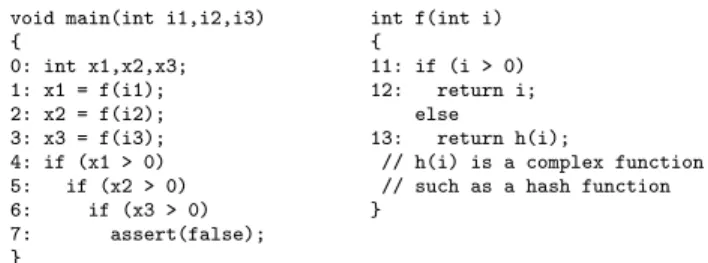
Example 2.Consider the example program in Figure 2. Functionf
has two branches, one of which (the else branch) is hard to analyze since it invokes a complicated or even unknown hash functionh. As before, SMASHfirst tries to find an execution along the path
1, 2, 3, 4, 5, 6, 7. From the conditions in lines4,5and6, it incrementally collects the constraints x1 > 0, x2 > 0, and x3 > 0, and generates a queryhtrue=?⇒f(retval > 0)i for functionfwhereretvaldenotes the return value of that function. SMASH now searches for an execution path in f that satisfies the postcondition(retval>0)and computes the must summary
h(i > 0)must=⇒f(retval >0)iby exploring only the “if” branch of the conditional at line11and avoiding the exploration of the complex functionhin the “else” branch. Once this must summary is computed for f, a symbolic execution along the path 1, 2,
void main(int j) {
1: int i = 0; 2: x = foo(i,j); 3: if (x == 1) 4: assert(false); }
int foo(int i,j) {
11: if (j > 0) 12: return bar(i)+1; 13: else
14: return i+1; }
Figure 3. Example of must summary benefiting from not-may summary.
void main(int i,j) {
0: int x;
1: if (i > 2 && j > 2) { 2: x = foo(i,j); 3: if (x < 0) 4: assert(false);
} }
int g(int j) {
20: if (j > 0) 21: return j; 22: else 23: return -j; }
int foo(int i,j) {
10: int r,y; 11: y = bar(i); 12: if (y > 10) 13: r = g(j); 14: else 15: r = y; 16: return r; }
Figure 4. Example of not-may summary benefiting from must summary.
3, 4, 5, 6, 7can reuse this summary (as in SMART [1, 14]) at the call sites at lines1,2and3without descending intofany further. Next, SMASHgenerates a test input formainsatisfying the constraintsi1>0∧i2>0∧i3>0to prove that the assertion violation in line7can be reached.
Next, we illustrate the interplay between not-may summaries and must summaries in Example 3 and Example 4.
Example 3.Consider the example in Figure 3. In this example, supposebaris a complex function with nested function calls and a large number of paths, but one which already has a not-may summaryh(i = 0)¬=may⇒bar (retval = 0)i. We show how this not-may summary can help with computing a must summary of
foo.
During the analysis ofmain, SMASH tries to generate an ex-ecution that goes along the path1,2,3,4in functionmain. This results in the queryh(i = 0)=?⇒foo (retval = 1)i. This query results in SMASHsearching through paths infoofor an execution satisfying the query. However, due to the not-may summaryh(i= 0)¬=may⇒bar(retval= 0)i, SMASHis immediately able to conclude that none of the paths throughbarcan result in the desired post-condition(retval = 1)forfoogiven thati=0. Thus, it explores only the “else” branch of theifstatement in line11and generates the must summaryh(i= 0∧j≤0)must=⇒foo(retval = 1)i. Note that while computing such a must summary, the SMASHalgorithm uses the not-may summary ofbarto conclude that no path through
barwould result in the desired post condition, hence avoiding a wasteful search through the large number of paths inbar. Once the must summary forh(i = 0∧j ≤ 0)must=⇒foo (retval = 1)iis computed, SMASHuses it to analyzemainand establish that any test casej≤0violates the assertion in line4.
Example 4.Consider the example in Figure 4. In this example, sup-posebaris a complex function (with loops etc.) whose set of possi-ble return values is hard to characterize precisely (perhaps because the integers returned are prime numbers). Assume that a prior
anal-ysis ofbarresults in the must summariesh(i >5)must=⇒bar(20< retval < 25)iandh(i = 5)must=⇒bar (0 < retval < 5)i, ob-tained by symbolically executing specific paths (tests) inbar, as well as the not-may summaryh(true)¬=may⇒bar(retval <0)i. We now show how SMASHuses these must and not-may summaries for
barin order to compute a not-may summary forfooproving that the assertion in line4ofmaincan never be reached.
SMASHfirst tries to find an execution along the path0,1,2,3,4
inmain. In order to do this, it generates a queryh(i >2∧j >
2) =?⇒foo (retval < 0)i which leads to an analysis of foo.
While analyzingfoo, SMASHuses the available must-summaries
h(i >5)must=⇒bar(20<retval<25)iandh(i= 5) must
=⇒bar(0< retval<5)iin order to prove that lines13and15, respectively, are reachable (and therefore prevent a possibly expensive and hopeless not-may proof that one of those two branches is not feasible). Next, SMASH generates a queryh(j > 2)=?⇒g(retval < 0)i. While analyzing the body ofgwith preconditionj >2, SMASH
concludes that the return valueretvalofgis always greater than0, thus generating the not-may summaryh(j >2)¬=may⇒g(retval < 0)i. Subsequently, while analyzing the path10,11,12,14,15,16, SMASHgenerates the queryh(i > 2)=?⇒bar(retval < 0)iand uses the not-may summary h(true) ¬=may⇒bar (retval < 0)i to answer this query. This results in the not-may summary h(i > 2∧j > 2)¬=may⇒foo (retval < 0)iforfoo. Using this not-may summary forfoo, SMASHis able to prove that the assertion in line
4ofmaincannot be reached.
While it is intuitive that building not-may summaries improves may analysis, and must summaries improve must-analysis, our empirical results (see Section 5) revealed that using both not-may and must summaries together scaled better than just using may summaries or must summaries individually. We discovered the power of alternation in the process of understanding these empirical results. In Example 3, a not-may summary of barwas used to compute a must-summary offoo. In Example 4, a must-summary ofbarwas used to avoid a may-analysis over the return value of
barwhile still being able to build a not-may analysis offoo. Even though these examples are simple, they illustrate common patterns exhibited in large programs (see Section 5): some parts of large programs are more amenable to may analysis while other parts are more amenable to must analysis. In particular, for functions with many paths due to nested calls, conditionals and loops, but simple postconditions established in a post-dominator of all paths (such as the last statement before return), not-may summaries can be easy to compute. Such not-may summaries can be used to avoid an expensive search of (possibly infinitely many) explicit paths during must analysis, as we saw in Example 3. On the other hand, if a function has complex loops with complex loop invariants, a may analysis tends not to converge, while a must analysis of the same code can easily identify be a few feasible paths that traverse entirely the function and generate usable must summaries for those paths. Such must summaries can be used to avoid an expensive search for proofs in these parts of the code, as illustrated in Example 4. The tight integration between may and must summaries allows SMASHto alternate between both in a flexible and unprecedented manner. Further, our empirical results (see Figure 12 in Section 5) even quantify the amount of interaction between may analysis and must-analysis for our data set. On an average (1) to generate a proof,68%of summaries used were not-may summaries and32% of the summaries used were must summaries, and (2) to identify a bug,64%of summaries used were must summaries and36%of the summaries used were not-may summaries.
Note that must summaries are existential while not-may sum-maries are universal. Higher-level sumsum-maries of one type
(existen-tial or universal) are built up from lower-level summaries of the same type. The role played by lower-level summaries of one type when computing higher-level summaries of the other type is “only” to prove the non-existence of lower-level summaries of that other type, since any query cannot simultaneously have both a match-ing must-summary and a matchmatch-ing not-may summary. For instance, lower-level existential summaries help prove the non-existence of matching not-may lower-level summaries, hence avoiding unnec-essary not-may analyses, and vice versa. With this in mind, using
must−(backward) ormust (forward) summaries does not make much difference, as both summaries imply the non-existence of a matching not-may summary. In this paper, we usemust− sum-maries for technical convenience. These considerations are formal-ized and discussed in detail in Section 4.
3.
Single-Procedure Programs and May-Must
Analysis
A programPhas a finite set of variablesVP. Each of these vari-ables take values from an infinite domainD(such as integers or pointers). Informally, a program is specified by its variables and its control flow graph, which may contain cycles representing program loops. Each edge of the control flow graph maps to a statement. Ini-tially, we consider only two types of statements: assignments and assume statements. Later we will add procedure calls and returns, when we consider multi-procedure programs.
Formally, a sequential program P is defined as a 6-tuple
hVP, NP, EP, n0P, nxP, λPiwhere
1.VPis a finite set of variables that the program manipulates (each variable takes values from an infinite domainD),
2.NPis a finite set of nodes (or program locations), 3.EP⊆NP×NPis a finite set of edges, 4.n0
P ∈NPis a distinguished entry node, 5.nx
P ∈NPis a distinguished exit node,
6.λP : EP → Stmts, maps each edge to a statement in the program,
We consider two types of statements: (1)assignmentstatements are of the formx := ewherexis a variable andeis a side-effect free expression over variables and constants, and (2)assume(or conditional) statements are of the formassume(e), whereeis a side-effect free expression. A configuration of a programP is a pairhn, σiwheren∈NPandσis astate, defined below. A state of a programPis a valuation to the program variablesVP. The set of all states ofPis denoted byΣP.
An assignment statement is a functionΣP→ΣPsince it maps every stateσto a state obtained by executing the assignment. An assume statementassume(e)is a partial function overΣP. Ife evaluates to true in a stateσ, then the function mapsσ to itself. Otherwise, it is undefined overσ.
Thus, every edge e ∈ EP can be thought of as a relation
Γe ⊆ ΣP ×ΣP. So far,Γe is actually a partial function, but it
is convenient to think of it as a relation and the generality will help when we consider multi-procedure programs.
Note that though each statement of the program is deterministic (i.e,Γeis a partial function), the programPhas control
nondeter-minism, since nodes inNP can have multiple outgoing edges in EP.
The initial configurations of a programPare given by the set
{hn0
P, σi |σ∈ΣP}. That is, the noden0Pis the entry node of the program, and the stateσis any possible state where variables can take any values. From any configurationhn, σi, the program can execute astepby taking any outgoing edge ofe =hn, n0iout of
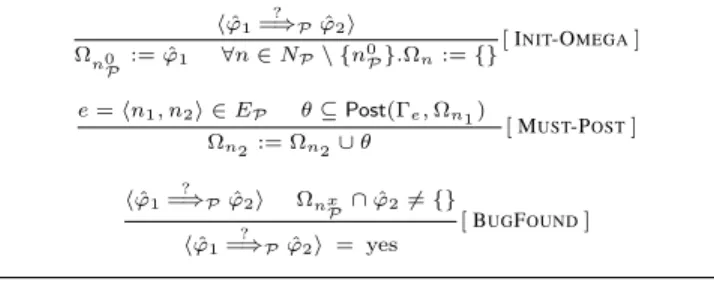
hϕˆ1 ?
=⇒Pϕˆ2i
Ωn0
P := ˆϕ1 ∀n∈NP\ {n
0
P}.Ωn:={}
[INIT-OMEGA]
e=hn1, n2i ∈EP θ⊆Post(Γe,Ωn1)
Ωn2:= Ωn2∪θ
[MUST-POST]
hϕˆ1 ?
=⇒Pϕˆ2i ΩnxP∩ϕˆ26={}
hϕˆ1=?⇒Pϕˆ2i = yes
[BUGFOUND]
Figure 6. Must analysis.
nand transitioning to a state obtained by computing the image of the relationΓewith respect to the stateσ. That is, if there existsσ0
such thatΓe(σ, σ0), then the program can transition to the
config-urationhn0, σ0i. Starting from an initial configuration, a program can execute several steps producing several configurations.
A verification question for programPis formalized as a reach-ability query of the formhϕ1
?
=⇒Pϕ2i, whereϕ1represents a set
of initial states at entry noden0P, andϕ2represents a set of states at
the exit nodenxP. The reachability query evaluates to “yes” (mean-ing the program is incorrect) if there exists an execution which starts at a configurationhn0P, σ1iwithσ1∈ϕ1and ends at a
con-figurationhnxP, σ2iwithσ2 ∈ ϕ2, it evaluates to “no” if such an
execution provably does not exist, or it evaluates to “unknown” oth-erwise. Indeed, the verification question is undecidable in general, particularly if the domainDof values taken by variables is infi-nite. Even ifDis finite, the number of configurations is exponen-tial in the number of variablesVP making an exact answer to this question computationally difficult to ascertain. Thus, in practice, approximate methods are used to answer the verification question.
Note that specifications in the style of Hoare triples such as
{ϕ1}P {ϕ2}, where we want all executions starting from states
inϕ1 to end in states fromϕ2, can be expressed in our notation
as the queryhϕ1 ?
=⇒P ¬ϕ2i. Assertions in the form used in the
example programs from Section 2 can also be expressed in this form by adding a special boolean variableerror which is set to
falseinitially and set totrueif an assertion fails, enabling us to state an equivalent specificationhΣP=?⇒Perrori.
We recall the formal definitions of the preimagePreand post-conditionPostoperators that will be used later. Suppose Γe ⊆
ΣP×ΣP, andϕ ⊆ ΣP. Thepreconditionofϕwith respect to
Γe(denotedPre(Γe, ϕ)) is the set of all predecessors of states inϕ
given by
Pre(Γe, ϕ)
def
={σ∈ΣP | ∃σ0∈ϕ.Γe(σ, σ
0
)}
In a dual way, the postcondition ofϕwith respect toΓe(denoted
Post(Γe, ϕ)) is given by
Post(Γe, ϕ)
def
={σ∈ΣP| ∃σ0∈ϕ.Γe(σ0, σ)}
3.1 May Analysis
Amay analysisof a program is used to prove that the program never reaches an error node during any execution. Formally, amay analysisof a programPassociates every nodeninNPwith a finite partitionΠnofΣP, and every edgee=hn1, n2i ∈EPwith a set of edgesΠe ⊆Πn1×Πn2, such that, for any regionπ1inΠn1,
and any regionπ2inΠn2, if∃σ1∈π1.∃σ2 ∈π2.Γe(σ1, σ2)then
hπ1, π2i ∈Πe.
By construction, the edgesΠeover-approximatethe transition
relation of the program, and are calledmayedges or transitions. A partitionΠnfor a nodenis defined as a set of regions. Associated
with every program edgee = hn1, n2i, initially there is a may
edge from every region of the partitionΠn1 to every region of
the partitionΠn2. As the algorithm proceeds, partitions get refined
and may edges get deleted. Instead of deleting edges, we find it notationally convenient to maintain the complement of may edges, calledNeedges below. The set ofNeedges grows monotonically
as the algorithm proceeds. In response to a queryhϕˆ1
?
=⇒Pϕˆ2i, if there is no path through
the edgesΠefrom every regionϕ1associated program’s entry node n0Psuch thatϕ1∩ϕˆ16={}to every regionϕˆ2associated with the
exit nodenx
Psuch thatϕ2∩ϕˆ26={}, then the may analysis proves
that none of the states inϕˆ2can be reached at the exit node ofP
by starting the program with states fromϕˆ1. Figure 5 gives a set
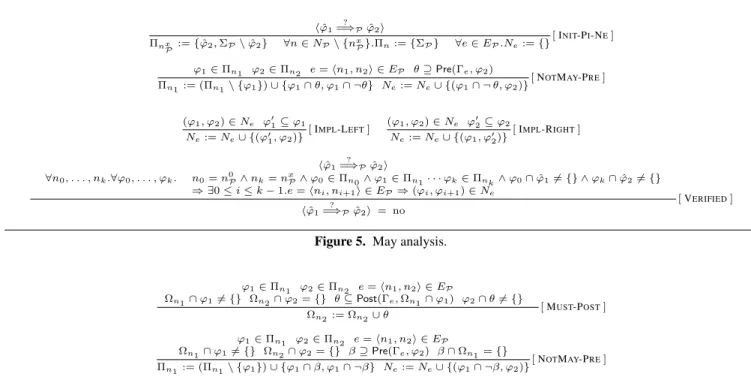
of declarative rules to perform a may analysis which automatically refines partitions in a demand-driven manner.
In response to a query hϕˆ1 ?
=⇒P ϕˆ2i, the rule INIT-PI-NE
initializes the exit node nx
P with a partition consisting of two regionsϕˆ2andΣP\ϕˆ2. All other nodes are initialized to have a
single partition with all possible statesΣP. The current set of rules performsbackwardmay analysis, using thePreoperator. Thus, to allow maximum flexibility, we do not partition the initial node with the preconditionϕˆ1from the query. The preconditionϕˆ1is used in
the last rule VERIFIEDdescribed below. The rule also initializes an empty relationNe associated with each program edgee. Relation
Neis the complement ofΠeand is used to keep track of may edges
that we know for sure donotexist.
Abstract partition refinement is performed using the rule NOTMAY -PRE. The rule NOTMAY-PREchooses two nodesn1andn2, a
re-gionϕ1in the partitionΠn1ofn1, and a regionϕ2in the partition
Πn2ofn2, and thensplitsϕ1using the preconditionθofϕ2with
respect to the transition relation on the edgee=hn1, n2i. We
de-note splitting the regionϕ1 in partitionΠn1 into two sub-regions
ϕ1∩θandϕ1∩ ¬θbyΠn1 := (Πn1\ {ϕ1})∪ {ϕ1∩θ, ϕ1∩ ¬θ}.
After the split, we know by construction and the definition ofPre that any state in the new regionϕ1∩ ¬θcannotpossibly lead to a
state in regionϕ2, and we record this in relationNeaccordingly.
Note that a superset of the precondition can be used as valid ap-proximations to do splits. Such apap-proximations are necessary in practice wheneverPrecannot be computed precisely.
A dual rule NOTMAY-POSTfor splitting regions using the op-eratorPostin the forward direction exists but is omitted here.
The IMPL-RIGHTrule allowsNeedges of the form(ϕ1, ϕ2)to
be maintained as the post-regionsϕ2get refined. The rules IMPL -LEFTrule allowsNeedges of the form(ϕ1, ϕ2)to be maintained
as the pre-regionsϕ1get refined.
The VERIFIEDrule says that as soon asallpaths from the entry node regions that intersect with the precondition of the queryϕˆ1
to the exit node region that intersects with the postcondition of the queryϕˆ2have at least one step where the may analysis shows that
the edge doesnotexist, then we have verified that the answer to the queryhϕˆ1
?
=⇒Pϕˆ2iis “no” and hence that the program is correct.
It is easy to show that, at every refinement step, the transition system defined over the partitioned regions simulates the program
P. Thus, the incremental inference of relation Ne made by the
may analysis is always guaranteed to be sound with respect toP. However, there is no guarantee that, if the program is correct, the refinement process will ever converge to such an answer. For finite-state programs, the process is guaranteed to terminate.
The partition splits specified in the rules of Figure 5 are nonde-terministic. Specific abstraction-refinement tools such as SLAM[4] can be viewed as instantiating this framework by refining regions only along abstract counterexamples that lead from the starting node to the error node.
hϕˆ1 ?
=⇒Pϕˆ2i
ΠnxP :={ϕˆ2,ΣP\ϕˆ2} ∀n∈NP\ {nxP}.Πn:={ΣP} ∀e∈EP.Ne:={}
[INIT-PI-NE]
ϕ1∈Πn1 ϕ2∈Πn2 e=hn1, n2i ∈EP θ⊇Pre(Γe, ϕ2)
Πn1:= (Πn1\ {ϕ1})∪ {ϕ1∩θ, ϕ1∩ ¬θ} Ne:=Ne∪ {(ϕ1∩ ¬θ, ϕ2)}
[NOTMAY-PRE]
(ϕ1, ϕ2)∈Ne ϕ01⊆ϕ1
Ne:=Ne∪ {(ϕ0
1, ϕ2)}
[IMPL-LEFT] (ϕ1, ϕ2)∈Ne ϕ
0
2⊆ϕ2
Ne:=Ne∪ {(ϕ1, ϕ02)}
[IMPL-RIGHT]
hϕˆ1=?⇒Pϕˆ2i
∀n0, . . . , nk.∀ϕ0, . . . , ϕk. n0=n0P∧nk=nxP∧ϕ0∈Πn0∧ϕ1∈Πn1· · ·ϕk∈Πnk∧ϕ0∩ϕˆ16={} ∧ϕk∩ϕˆ26={}
⇒ ∃0≤i≤k−1.e=hni, ni+1i ∈EP ⇒(ϕi, ϕi+1)∈Ne
hϕˆ1 ?
=⇒Pϕˆ2i = no
[VERIFIED]
Figure 5. May analysis.
ϕ1∈Πn1 ϕ2∈Πn2 e=hn1, n2i ∈EP
Ωn1∩ϕ16={} Ωn2∩ϕ2={} θ⊆Post(Γe,Ωn1∩ϕ1) ϕ2∩θ6={}
Ωn2:= Ωn2∪θ
[MUST-POST]
ϕ1∈Πn1 ϕ2∈Πn2 e=hn1, n2i ∈EP
Ωn1∩ϕ16={} Ωn2∩ϕ2={} β⊇Pre(Γe, ϕ2) β∩Ωn1={}
Πn1:= (Πn1\ {ϕ1})∪ {ϕ1∩β, ϕ1∩ ¬β} Ne:=Ne∪ {(ϕ1∩ ¬β, ϕ2)}
[NOTMAY-PRE]
Figure 7. May-Must analysis. Rules INIT-PI-NE, IMPL-LEFT, IMPL-RIGHTand VERIFIEDare assumed to be included from Figure 5, and rules INIT-OMEGAand BUGFOUNDare assumed to be included from Figure 6.
3.2 Must Analysis
Amust analysisof a program is used to prove that the program reaches a given set of states during some execution. While a may analysis over-approximates reachability information in order to prove the absence of errors, a must analysis under-approximates reachability information in order to prove the existence of execu-tion paths leading to an error. A must analysis based on succes-sive partition refinements can be defined by dualizing the rules pre-sented in the previous section. However, splitting must partitions is no longer guaranteed to preserve previously-computed must transi-tions and other techniques (such as hyper-must transitransi-tions or carte-sian abstraction) are needed to restore the monotonicity of must-partition refinement [15].
In this paper, we consider a specific type of must abstractions which avoid the issues above. Specifically, a must analysisof a programPassociates every nodeninNPwith a setΩnof states
that are all guaranteed to be reachable from the initial state of the program. The setΩnof states associated with a nodenincreases
monotonically during the must analysis and is never partitioned. Figure 6 gives a set of declarative rules to perform a must analysis using setsΩn.
In response to a queryhϕˆ1 ?
=⇒P ϕˆ2i, we initializeΩn0
P with
ˆ
ϕ1and for all other nodesnwe initializeΩnto be the empty set
(rule INIT-OMEGA).
The rule MUST-POSTspecifies how to perform a forward must-analysis using the postcondition operatorPost: the postcondition θofΩn1 with respect to the transition relation associated with an
edgeefrom noden1to noden2can be safely added toΩn2. If the
postconditionPostcannot be computed precisely, any subset is a valid approximation. This formalization includes as a specific case DART[16], where complex constraints are simplified by substitut-ing symbolic expressions with concrete values observed dynami-cally during testing.
A rule MUST-PRE for backward must-analysis using the pre-condition operatorPrecan be written as the dual of rule MUST -POST, but is omitted here.
During the analysis of a query hϕˆ1 ?
=⇒P ϕˆ2i, if Ωnx
P ever
intersects withϕˆ2, then we can conclude that the answer to the
query is “yes” (rule BUGFOUND). 3.3 May-Must Analysis
May and must analysis have complementary properties – the for-mer is used for verification and the latter for bug finding. Figure 7 shows a set of rules that combine may and must rules in order to perform both a may and a must analysis simultaneously. The rules INIT-PI-NE, IMPL-LEFT, IMPL-RIGHT and VERIFIED are included “as is” from Figure 5, and rules INIT-OMEGAand BUG -FOUNDare included “as is” from Figure 6, so we do not repeat them here.
The interesting rules are MUST-POSTand NOTMAY-PRE. Sup-pose edgee = hn1, n2iis such thatϕ1 ∈ Πn1 andϕ2 ∈ Πn2.
Furthermore, suppose thatϕ1∩Ωn1 6={}, andϕ2∩Ωn2 ={}.
This means that we know that the partitionϕ1 ∈ Πn1 is indeed
reachable (since it intersects with the regionΩn1), and we do not
know ifϕ2 ∈ Πn2 is reachable (since it does not intersect with
the region Ωn2). If we can compute a subset of the
postcondi-tionθ ⊆Post(Γe, ϕ1∩Ωn1)such thatθintersects withϕ2, then
we simply augmentΩn2 withθ, as specified in the rule MUST
-POST. Dually, if we can compute a superset of the precondition β ⊃ Pre(Γe, ϕ2)such thatβdoes not intersect withΩn1, then
we split the regionϕ1 ∈ Πn1 usingβand we know that region
ϕ2is not reachable from regionϕ1∩ ¬β, as specified in the rule
NOTMAY-PRE. Note that any interpolant (see [27]) between the setsPre(Γe, ϕ2)andΩn1 satisfies the conditions to be used asβ,
and can be used to split the regionϕ1.
These rules can be instantiated to obtain the SYNERGY[19] and DASH[5] algorithms. These algorithms have the specific property that, whenever one can compute preciselyPost, equivalentlyPre, then either rule MUST-POSTor rule NOTMAY-PRE must be
en-abled, and a single call to a theorem prover to computePost/Pre is then sufficient to refine either the current must or may (respec-tively) program abstraction.
4.
Multi-Procedure Programs and Compositional
May-Must Analysis
In programs with multiple procedures, compositional analyses, which analyze one procedure at a time and build summaries for each procedure for possible re-use in other calling contexts, are de-sired for scalability. We describe how to do compositional analysis with may abstractions, must abstractions and by combining may-must abstractions. First, we extend our program notation to allow programs with multiple procedures.
A multi-procedure programPis a set of single-procedure pro-grams{P0,P1, . . . ,Pn}. Each of the single-procedure programs
follows the notation described earlier, with the following modi-fications. There areglobal variables common to all procedures, andlocal variablesprivate to each procedure (more precisely, pri-vate to each invocation of a procedure). Thus, for any single-procedure programPi (also called procedure Pi), we have that
Pi = hVPi, NPi, EPi, n 0
Pi, n
x
Pi, λPiiwhereVPi is the disjoint
union of global variablesVGand local variablesVPLi. Parameters and return values can be simulated using global variables, so we do not explicitly model these. Without loss of generality, we assume each procedure has a single entry noden0Piand a single exit node nxPi. For any two distinct proceduresPiandPj, we assume that
NPi andNPj are disjoint. Thus a node unambiguously identifies
which procedure it is in. We useΣPito denote the set of all
possi-ble valuations toVPi.
In addition to the assignment and assume statements, we add a new statementcall pwherepis the name of the procedure being called. ProcedureP0is the “main” procedure where the program
starts executing. As before, all global variables initialize nonde-terministically to any value in the initial configuration. Whenever a procedure is entered, its local variables are initialized nondeter-ministically. Unlike local variables, global variables get initialized only once at the beginning of execution, and can be used for com-munication between procedures.
We use the query notation to specify verification questions for procedure programs as well. In particular, for multi-procedure programs, we assume that the query is asked in terms of the main procedureP0, and is of the formhϕ1
?
=⇒P0ϕ2i. Our
compositional analyses solve the verification question by formu-lating various sub-queries to procedures that are called fromP0,
and then sub-queries to procedures called by those procedures and so on. Each sub-query is defined in the context of a particular pro-cedure, and is solved by analyzing the code of that procedure in combination with summaries for other called procedures.
We have presented the rules in Section 3 in such a way that they can easily be extended to work with summaries. In particular, the edgesNefrom Figure 5 can be used to build not-may summaries,
and the setsΩnfrom Figure 6 can be used to build must summaries.
Given a setS⊆ΣPi, we use∃VPLi.Sto denote the set of global states obtained by considering only the values of global variables of each state inS.
4.1 Compositional May Analysis
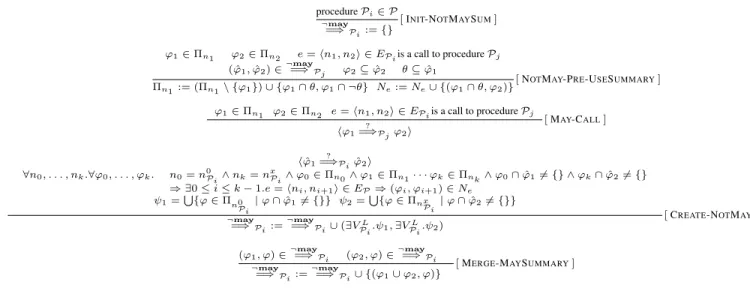
Figure 8 gives the rules for compositional may analysis. The rules for intraprocedural may analysis from Figure 5 are assumed to be included and are not repeated.
The rules maintain a set ¬=may⇒Pi of not-may summaries for each procedurePi. The rule INIT-NOTMAYSUMinitializes the set
of not-may summaries of all procedures to empty sets. The rule NOTMAY-PRE-USESUMMARYuses an existing not-may summary
to split a regionϕ∈Πn1along the lines of the NOTMAY-PRErule.
Recall that ifhϕˆ1
¬may
=⇒Piϕˆ2iis a not-may summary, then there is
no transition from any state inϕˆ1to any state inϕˆ2. Thus, for any
subsetθofϕˆ1there exists no transition from any state inθto any
state inϕ2⊆ϕˆ2. This justifies theNeedge{(ϕ1∩θ, ϕ2)}in the
consequent of the rule.
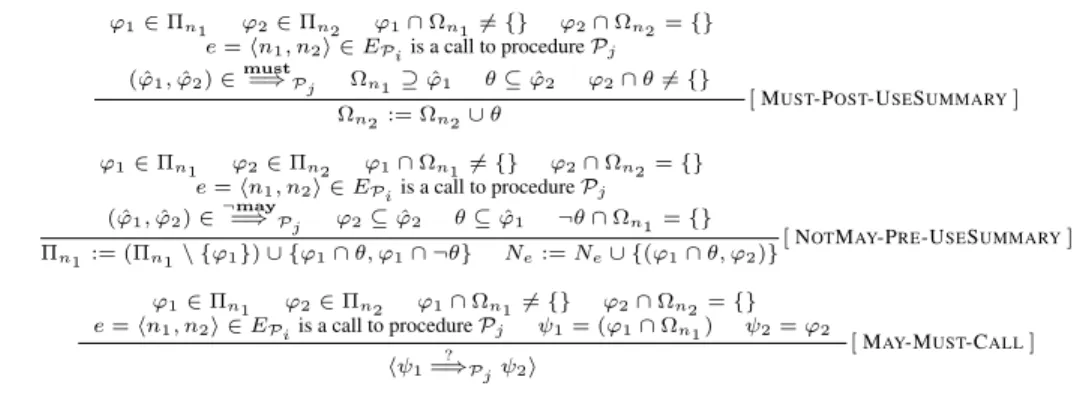
The rule MAY-CALL generates a query in the context of a called procedure. For notational convenience, we assume that the partitionsΠn for each noden and the edgesNe are computed
afresh for each invocation of a query. (Note that intraprocedural inference steps could themselves be summarized and re-used across multiple query invocations.)
The rule CREATE-NOTMAYSUMMARY is used to generate a not-may summary fromNe edges. If all paths from every region
ϕ0 in Πn0
Pi (which overlaps with the query states ϕˆ1) to every
regionϕkinΠnx
Pi (which overlaps with the query statesϕˆ2) pass
through at least oneNe edge, we can conclude that there are no
paths from states inϕ0to states inϕk. Thus, we can add a not-may
summary between these two sets of states after quantifying out the local variables that are irrelevant to the calling contexts.
The rule MERGE-MAYSUMMARYallows not-may summaries to be merged. The correctness of this rule follows from the defini-tion of not-may summaries. If there are no paths from states inϕ1
to states inϕ, and there are no paths from states inϕ2 to states in ϕ, we can conclude that there are no paths from states inϕ1∪ϕ2to
states inϕ. Merged summaries can contribute to larger setsθused to split regions in the NOTMAY-PRE-USESUMMARYrule. 4.2 Compositional Must Analysis
The rules in Figure 9 along with the intraprocedural rules described in Figure 6 define compositional must analysis.
The set of must-summaries for each procedurePi is denoted
by must=⇒Pi. This set is initialized to the empty set in the rule
INIT-NOTMAYSUM, and it monotonically increases as the analysis proceeds.
The rule MUST-POST-USESUMMARYis very similar to the rule MUST-POSTin the intraprocedural must analysis. The only differ-ence here is that the noden1 is a call node, representing a call to
another procedurePj. If a suitable must summary(ϕ1, ϕ2)exists,
the rule uses the must summary to compute an underapproximation to the postcondition.
The rule MUST-CALL creates a new sub-query for a called procedurePj, which can result in new summaries created forPj.
As in the compositional may analysis case, we assume again for notational simplicity that the setsΩnfor each nodenare computed
afresh for each query.
The rule CREATE-MUSTSUMMARY creates must summaries in the context of the current query for the procedure. Suppose
hϕˆ1 ?
=⇒Piϕˆ2iis the current query for the procedurePi. Suppose θ=∃VPLi.Ωnx
Pirepresents the global state reached at the exit point
of the procedurePiby using must analysis. Further suppose thatθ
intersects with the post-state of the queryϕ2. Then, we add the
must summary{( ˆϕ1, θ)}since every state inθcan be obtained by
executing the procedure starting at some state inϕ1.
Finally the rule MERGE-MUSTSUMMARY allows merging must summaries. The correctness of this rule follows from the definition of must summaries. If every state inϕ1 can be reached
from some state inϕ, and every state inϕ2can be reached from
some state inϕ, it follows that every state inϕ1∪ϕ2can be reached
from some state inϕ.
These sets of rules can be instantiated to obtain a variant of the SMART algorithm [14], a compositional version of the DART al-gorithm. Indeed, our rules compute summaries for specific calling contexts (seeθ in rule MUST-CALL) and record those in the
pre-procedurePi∈ P
¬may
=⇒Pi:={}
[INIT-NOTMAYSUM]
ϕ1∈Πn1 ϕ2∈Πn2 e=hn1, n2i ∈EPiis a call to procedurePj ( ˆϕ1,ϕˆ2)∈
¬may
=⇒Pj ϕ2⊆ϕˆ2 θ⊆ϕˆ1
Πn1:= (Πn1\ {ϕ1})∪ {ϕ1∩θ, ϕ1∩ ¬θ} Ne:=Ne∪ {(ϕ1∩θ, ϕ2)}
[NOTMAY-PRE-USESUMMARY]
ϕ1∈Πn1 ϕ2∈Πn2 e=hn1, n2i ∈EPiis a call to procedurePj
hϕ1=?⇒Pjϕ2i
[MAY-CALL]
hϕˆ1=?⇒Piϕˆ2i
∀n0, . . . , nk.∀ϕ0, . . . , ϕk. n0=n0Pi∧nk=n x
Pi∧ϕ0∈Πn0∧ϕ1∈Πn1· · ·ϕk∈Πnk∧ϕ0∩ϕˆ16={} ∧ϕk∩ϕˆ26={}
⇒ ∃0≤i≤k−1.e=hni, ni+1i ∈EP⇒(ϕi, ϕi+1)∈Ne
ψ1=S{ϕ∈Πn0
Pi|ϕ∩ϕˆ16={}} ψ2=
S{ϕ∈Π
nxP i
|ϕ∩ϕˆ26={}}
¬may
=⇒Pi:= ¬may
=⇒Pi∪(∃VPLi.ψ1,∃VPLi.ψ2)
[CREATE-NOTMAYSUMMARY]
(ϕ1, ϕ)∈
¬may
=⇒Pi (ϕ2, ϕ)∈
¬may
=⇒Pi ¬may
=⇒Pi:= ¬may
=⇒Pi∪ {(ϕ1∪ϕ2, ϕ)}
[MERGE-MAYSUMMARY]
Figure 8. Compositional May analysis. Rules from Figure 5 are assumed to be included, but not shown.
procedurePi∈ P must
=⇒Pi:={}
[INIT-MUSTSUMMARY]
e=hn1, n2i ∈EPi is a call to procedurePj (ϕ1, ϕ2)∈must=⇒Pj Ωn1⊇ϕ1 θ⊆ϕ2
Ωn2:= Ωn2∪θ
[MUST-POST-USESUMMARY]
e=hn1, n2i ∈EPi is a call to procedurePj
hΩn1 ?
=⇒PjΣPi
[MUST-CALL]
hϕˆ1 ?
=⇒Piϕˆ2i θ=∃VPLi.ΩnxP i
θ∩ϕˆ26={}
must
=⇒Pi:=must=⇒Pi∪ {( ˆϕ1, θ)}
[CREATE-MUSTSUMMARY]
(ϕ, ϕ1)∈
must
=⇒Pi (ϕ, ϕ2)∈
must
=⇒Pi
must
=⇒Pi:=must=⇒Pi∪ {(ϕ, ϕ1∪ϕ2)}
[MERGE-MUSTSUMMARY]
Figure 9. Compositional Must analysis. Rules from Figure 6 are assumed to be included, but not shown.
conditions of summaries. In contrast, preconditions of summaries in SMARTare expressed exclusively in terms of the procedure’s in-put variables and calling contexts themselves are not recorded. The summaries of SMARTcan therefore be more general (hence more re-usable), while our summaries record must-reachability informa-tion more precisely, which in turns simplifies the formalizainforma-tion and the combination with not-may summaries, as is discussed next. 4.3 SMASH: Compositional May-Must Analysis
The rules for compositional may-must analysis combine the may rules and the must rules in the same way as in the single proce-dure case. The set of rules is shown in Figure 10. All rules from compositional may analysis (Figure 8), compositional must analy-sis (Figure 9), and intraprocedural may-must analyanaly-sis (Figure 7) are included but not shown, except the rules MAY-CALLand MUST -CALLwhich are replaced by the new rule MAYMUST-CALL, and except the rules MUST-POST-USESUMMARYand NOTMAY-PRE -USESUMMARYwhich are modified as shown in Figure 10.
The succinctness of these rules hides how not-may summaries and must summaries interact, so we explain this in more detail. Each query made to SMASHcan be answered with either a not-may summary or a must summary, but not both. Whenever SMASH
ana-lyzes a procedurePiand encounters an edgeeinPicalling another
procedurePj, SMASHcan either use an existing must summary for procedurePj(using the rule MUST-POST-USESUMMARY), or an existing not-may summary forPj (using the rule NOTMAY -PRE-USESUMMARY), or initiate a fresh query to Pj (using the
rule MAY-MUST-CALL). Note that when the rule MAY-MUST -CALLgenerates a query for the called procedurePj, we do not
know if the query will result in creating not-may summaries or must summaries. If the body ofPjcalls another procedurePk,
an-other query can be potentially generated for that procedure as well. Eventually, some of the calls could be handled using must sum-maries (using the rule MUST-POST-USESUMMARY), and some of the calls using not-may summaries (using the rule NOTMAY-PRE -USESUMMARY). Thus, not-may summaries can be used to create must summaries and vice versa, as illustrated in Section 2 with Ex-amples 3 and 4.
The rule MUST-POST-USESUMMARY is similar to the rule MUST-POSTin Figure 7. The main difference is that the edgeeis a call to another procedurePj. Assuming a suitable must summary
exists, the rule uses the must summary as the transition relation of the procedure call in order to perform the equivalent of aPost computation. Suppose edgee =hn1, n2iis such thatϕ1 ∈Πn1
ϕ1∈Πn1 ϕ2∈Πn2 ϕ1∩Ωn16={} ϕ2∩Ωn2={}
e=hn1, n2i ∈EPiis a call to procedurePj ( ˆϕ1,ϕˆ2)∈
must
=⇒Pj Ωn1⊇ϕˆ1 θ⊆ϕˆ2 ϕ2∩θ6={}
Ωn2:= Ωn2∪θ
[MUST-POST-USESUMMARY]
ϕ1∈Πn1 ϕ2∈Πn2 ϕ1∩Ωn16={} ϕ2∩Ωn2={}
e=hn1, n2i ∈EPiis a call to procedurePj ( ˆϕ1,ϕˆ2)∈
¬may
=⇒Pj ϕ2⊆ϕˆ2 θ⊆ϕˆ1 ¬θ∩Ωn1={}
Πn1:= (Πn1\ {ϕ1})∪ {ϕ1∩θ, ϕ1∩ ¬θ} Ne:=Ne∪ {(ϕ1∩θ, ϕ2)}
[NOTMAY-PRE-USESUMMARY]
ϕ1∈Πn1 ϕ2∈Πn2 ϕ1∩Ωn16={} ϕ2∩Ωn2={}
e=hn1, n2i ∈EPiis a call to procedurePj ψ1= (ϕ1∩Ωn1) ψ2=ϕ2
hψ1=?⇒Pjψ2i
[MAY-MUST-CALL]
Figure 10. SMASH: Compositional May-Must analysis. All rules from compositional may analysis (Figure 8), compositional must analysis (Figure 9), and intraprocedural may-must analysis (Figure 7) are included but not shown, except the rules MAY-CALL and MUST -CALL which are replaced by the new rule MAYMUST-CALL, and except the rules MUST-POST-USESUMMARY and NOTMAY-PRE -USESUMMARYwhich are modified as shown above.
and ϕ2 ∈ Πn2. Furthermore, suppose that ϕ1 ∩Ωn1 6= {},
ϕ2 ∩Ωn2 = {}, and( ˆϕ1,ϕˆ2) is a must-summary forPj, with
Ωn1 ⊇ ϕˆ1. Since( ˆϕ1,ϕˆ2)is a must-summary, we know that all
the states inϕˆ2are reachable by executions ofPjfrom states in
ˆ
ϕ1. SinceΩn1 ⊇ϕˆ1, this implies that any subsetθ ⊆ϕˆ2can be
reached from the set of satesΩn1by executing the procedurePj.
Thus, we can addθto the set of statesΩn2, which are the set of
states that are guaranteed to be reachable at noden2 during this
execution of procedurePj.
Similarly, the rule NOTMAY-PRE-USESUMMARY is like the rule NOTMAY-PREin Figure 7. The main difference is again that the edgeeis a call to another procedurePj. Assuming a suitable
not-may summary exists, the rule uses the not-may summary as the transition relation of the procedure call to perform the equivalent of a Pre computation. Suppose e, ϕ1 and ϕ2 satisfy the same
assumptions as above, and there is a not-may summary( ˆϕ1,ϕˆ2)
withϕ2⊆ϕˆ2. Since( ˆϕ1,ϕˆ2)is a not-may summary, we know that
there are no executions of the procedurePjstarting at any subset
θ⊆ϕˆ1resulting in states inϕˆ2. Thus, we can partition the region ϕ1 ∈ Πn1 with the guarantee that there are no transitions from
ϕ1∩θtoϕ2, and hence we can add(ϕ1∩θ, ϕ2)toNe. We can use
interpolants (as discussed in Section 3.3) to choose possible values forθ.
Given e, ϕ1, ϕ2,Ωn1, we can show that both rules MUST
-POST-SUMMARY and NOTMAY-PRE-USESUMMARY can never be simultaneously enabled since, by construction, it is not possible to both have a must summary( ˆϕ1,ϕˆ2) and a not-may summary (ψ1, ψ2)for a procedure such thatψ1⊇ϕˆ1andψ2⊇ϕˆ2.
Recursion.To avoid clutter, the rules for our compositional algo-rithms (Figures 8, 9 and 10) have been written for non-recursive programs. To handle recursive programs, we need to keep track for each function which queries are in progress, and also constrain the order in which rules are applied. When a queryhϕˆ1
?
=⇒P ϕˆ2iis
made, in addition to checking whether existing not-may or must summaries can be used to answer the queries (using rules MUST -POST-SUMMARY and NOTMAY-PRE-USESUMMARY), we need to also check if this query can be answered by another “in-progress” queryhϕ1
?
=⇒Pϕ2i, and start computations for the current query
only if no such in-progress query exists. Such a check would guar-antee termination of the SMASHalgorithm for recursive programs where data types are over a finite domain and no dynamic alloca-tion is allowed (for instance, as in boolean programs [3]). However, if data types are unbounded or if dynamic allocation is allowed, checking a query is undecidable and SMASHis not guaranteed to terminate.
Soundness.To establish soundness, we assert the following five invariants over the data structures of the SMASHalgorithm: I1. For every noden∈NPi,Πnis a partition ofΣPi.
I2. For every noden∈NPiand every stateσ∈Ωn,σis reachable
by some program execution at nodenstarting from initial state of the program.
I3. For every(ϕ1, ϕ2)∈Ne, and anyσ1∈ϕ1, it is not possible to
execute the statement at edgeestarting from stateσ1and reach
a stateσ2∈ϕ2.
I4. For every(ϕ1, ϕ2)∈
¬may
=⇒Pi, for any stateσ1 ∈ϕ1, it is not
possible to execute procedurePistarting at stateσ1and reach
a stateσ2∈ϕ2after completing the execution ofPi.
I5. For every (ϕ1, ϕ2) ∈ must
=⇒Pi, for any stateσ2 ∈ ϕ2, there
exists a stateσ1 ∈ ϕ1 such that executing the procedurePi
starting at stateσ1leads to the stateσ2.
The correctness of these invariants is established by induction over each of the rules of the SMASHalgorithm. As an example, we show the induction step for the rule NOTMAY-PRE-USESUMMARYfrom Figure 10. We need to establish that the refinement toΠn1respects
invariantI1, and the new edge added toNerespects the invariant
I3. Due to the induction hypothesis, we can assume thatΠn1before
execution of the rule is a partition. For anyϕ1 ∈ Πn1, and any
value ofθ, sinceΠn1is a partition, we have that(Πn1\ {ϕ1})∪
{ϕ1 ∩θ, ϕ1∩ ¬θ}is a partition, hence preserving invariantI1.
Next, consider the edge(ϕ1 ∩θ, ϕ2) that is added to Ne. Due
to the antecedent of the rule, since( ˆϕ1,ϕˆ2) ∈
¬may
=⇒Pj, due to
induction hypothesisI4we know that no state inϕˆ1can reach any
state inϕˆ2by executing procedurePj. Sinceθ⊆ϕˆ1, we have that ϕ1∩θ ⊆ϕˆ1. Consequently, we have that no state inϕ1∩θcan
reach any state inϕ2 ⊆ ϕˆ2by executingPj, and it follows that
the updatedNesatisfies the invariantI3. The soundness of all the
other rules is proved in a similar way.
5.
Evaluation
In this section, we describe our implementation of SMASH and present results of experiments with severalMicrosoft Windows 7 device drivers.
5.1 Implementation
Our tool SMASHis a deterministic implementation of the declara-tive rules of Figure 10, developed in theF#programming language and using the Z3 theorem prover [12] . Recall that every
reachabil-Statistics DASH (Figure 7)
SMASH (Figure 10) Average
Not-May Summaries/driver 0 39 Average
Must Summaries/driver 0 12
Number of proofs 2176 2228
Number of bugs 64 64
Time-outs 61 9
Time (hours) 117 44
Table 1. SMASHvs. DASHon 69 drivers (342000LOC) and 85 properties.
ity queryhϕ1 ?
=⇒Piϕ2ifor a procedurePican be answered
exclu-sivelyby either a must summary or a not-may summary. Therefore, the SMASHimplementation makes the rules given in Figure 10 de-terministic as shown below:
1. If some previously computed must summaryhϕˆ1 must
=⇒Pi ϕˆ2i
is applicable, return “yes”.
2. If some previously computed not-may summaryhϕˆ1
¬may =⇒Piϕˆ2i
is applicable, return “no”.
3. Otherwise, analyze the procedure Pi using the rule MAY -MUST-CALL. The result of this analysis could be itself ei-ther a “yes” (computation of a must summary for Pi given
by the rule CREATE-MUSTSUMMARY) or a “no” (computa-tion of a not-may summary forPigiven by the rule CREATE
-MAYSUMMARY).
SMASH’s intraprocedural analysis implements the DASH algo-rithm [5] which is an instance of the may-must analysis shown in Figure 7. We have implemented SMASH using the YOGI frame-work [29] which handlesC programs with primitive data types, structs, pointers, function pointers and procedures. Pointer arith-metic is not handled—*(p+i)is treated as*p, similar to SLAM[4] and BLAST[24]. All predicates used to build may and must pro-gram abstractions are propositional logic formulas defined over lin-ear arithmetic and uninterpreted functions stored in Z3’s internal representation. With these assumptions, the logic is decidable and therefore every satisfiability/validity query to the theorem prover results in either a “yes” or “no” answer.
5.2 Experiments
We evaluated SMASHon 69Microsoft Windows 7device drivers and 85 properties. We performed our experiments using a system with a 2.66 GHz Intel Xeon quad core processor with 4GB RAM runningMicrosoft Windows Server 2003.
Overall comparison.A comparison of SMASH with DASH [5] (this is the non-compositional may-must analysis described in Fig-ure 7) on all 69 device drivers and 85 properties is shown in Ta-ble 1. The total number of lines of code analyzed is 342000 lines of code. The total number of checks (we will refer to every verification question involving a driver and a property1 as acheck) performed by both analyses is 2301 (the rest correspond to checks where the property is not applicable to the driver). The average number of not-may summaries per driver used by SMASHis 39 and the aver-age number of must summaries per driver equals 12. With a time-out limit of 30 minutes, there are 61 checks where DASHtimes out while SMASHtimes out only on 9 checks. The total time taken for the analysis by DASHis117 hourswhile SMASHtakes only44 hours, including time-outs. It is worth emphasizing that our
non-1Properties are typestate properties for device drivers as described inhttp: //msdn.microsoft.com/en-us/library/aa469136.aspx.
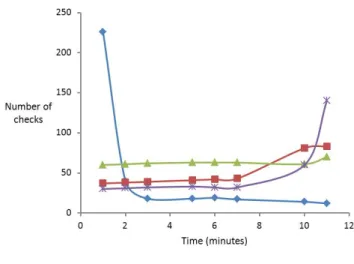
Figure 11. Comparison of SMASHwith COMPOSITIONAL-MAY -DASH, COMPOSITIONAL-MUST-DASHand DASHon 303 checks. compositional analysis baseline DASHis already an improvement over SLAM[4] (see [5]).
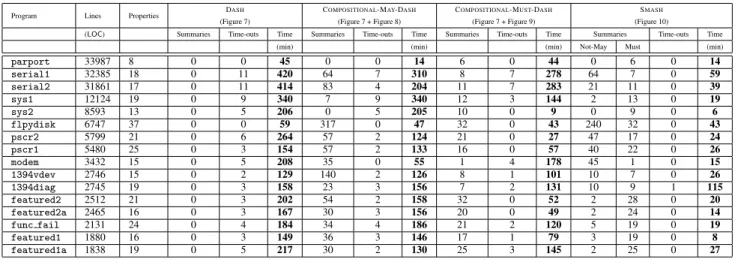
Detailed comparison on 16 drivers.To understand the effective-ness of SMASH, we drill down into empirical data for 16 drivers (arbitrarily picked from the 69 drivers) in Table 2. Every row of this table shows a driver along with its number of lines of code and the number of properties checked. We compare SMASHagainst DASH, DASHwith compositional may analysis (rules of Figures 7 and 8, denoted by COMPOSITIONAL-MAY-DASH), and DASHwith compositional must analysis (rules of Figures 7 and 9, denoted by COMPOSITIONAL-MUST-DASH). The total time taken by each analysis is reported in minutes. We also report the average number of not-may/must summaries used by each analysis for each driver. It is clear from Table 2 that SMASHoutperforms COMPOSITIONAL -MAY-DASH, COMPOSITIONAL-MUST-DASHand DASHon all 16 drivers. This is further elucidated in Figure 11 where each point
(x, y)in the graph denotes the fact that there areychecks that take an average time ofxminutes. As indicated by the curve for SMASH, a large number of checks take a relatively short amount of time with SMASH. In contrast, with DASH, a large number of checks take a large amount of time. The curves for COMPOSITIONAL -MAY-DASH and COMPOSITIONAL-MUST-DASH are better than DASH, but are outperformed by SMASH. This data indicates that in addition to gains obtained by COMPOSITIONAL-MAY-DASHand COMPOSITIONAL-MUST-DASHanalyses, extra gains are obtained in SMASHdue to the interplay between may analysis and must anal-ysis.
There are a number of checks where DASH, COMPOSITIONAL -MAY-DASH and COMPOSITIONAL-MUST-DASHtime out while SMASH does not. These correspond to patterns like those out-lined in Figures 3 and 4, which illustrate how the intricate inter-play between not-may summaries and must summaries can prevent SMASHfrom getting “stuck”. However, SMASHdoes timeout on 1 check for the driver1394diagand the reason for this (as well as all the 9 time-outs in Table 1) is that it is unable to discover the right invariant to prove the property.
Table 2 also shows that the total number of summaries used by SMASH is less than the total number of summaries used by COMPOSITIONAL-MAY-DASH and COMPOSITIONAL-MUST -DASHput together. Since the number of summaries is related to the number of queries (every distinct query that cannot be answered
us-Program Lines Properties DASH (Figure 7)
COMPOSITIONAL-MAY-DASH (Figure 7 + Figure 8)
COMPOSITIONAL-MUST-DASH (Figure 7 + Figure 9)
SMASH (Figure 10)
(LOC) Summaries Time-outs Time Summaries Time-outs Time Summaries Time-outs Time Summaries Time-outs Time
(min) (min) (min) Not-May Must (min)
parport 33987 8 0 0 45 0 0 14 6 0 44 0 6 0 14
serial1 32385 18 0 11 420 64 7 310 8 7 278 64 7 0 59
serial2 31861 17 0 11 414 83 4 204 11 7 283 21 11 0 39
sys1 12124 19 0 9 340 7 9 340 12 3 144 2 13 0 19
sys2 8593 13 0 5 206 0 5 205 10 0 9 0 9 0 6
flpydisk 6747 37 0 0 59 317 0 47 32 0 43 240 32 0 43
pscr2 5799 21 0 6 264 57 2 124 21 0 27 47 17 0 24
pscr1 5480 25 0 3 154 57 2 133 16 0 57 40 22 0 26
modem 3432 15 0 5 208 35 0 55 1 4 178 45 1 0 15
1394vdev 2746 15 0 2 129 140 2 126 8 1 101 10 7 0 26
1394diag 2745 19 0 3 158 23 3 156 7 2 131 10 9 1 115
featured2 2512 21 0 3 202 54 2 158 32 0 52 2 28 0 20
featured2a 2465 16 0 3 167 30 3 156 20 0 49 2 24 0 14
func fail 2131 24 0 4 184 34 4 186 21 2 120 5 19 0 19
featured1 1880 16 0 3 149 36 3 146 17 1 79 3 19 0 8
featured1a 1838 19 0 5 217 30 2 130 25 3 145 2 25 0 27
Table 2. Empirical evaluation of SMASHon 16 device drivers.
Figure 12. Average summary population for SMASH.
ing an existing summary results in a new summary), this data points to reduced number of queries in SMASH, indicating that a combi-nation of may and must analyses can drastically reduce the number of queries in the analysis.
Interplay between not-may and must summaries. Finally, to quantify the interplay between not-may and must summaries in SMASH, we examine the average summary population for top-level queries/checks (those that result in proofs or bugs) for all the 16 drivers in Table 2. This data is presented in Figure 12— the first column in this figure represents the average number of not-may summaries and must summaries used to answer queries that re-sulted in a “no” answer (a proof/not-may answer), while the sec-ond column represents the average number of not-may summaries and must summaries used to answer queries that resulted in a “yes” (a bug/must answer). On an average, to generate a proof,68%of summaries used were not-may summaries and32% of the sum-maries used were must sumsum-maries. On an average, to identify a bug, 64%of summaries used were must summaries and36%of the sum-maries used were not-may sumsum-maries. Indeed, it is this fine-grained coupling and alternation of not-may and must summary applica-tions that allows SMASHto easily navigate through code fragments that are typically hard to analyze using COMPOSITIONAL-MAY -DASH, COMPOSITIONAL-MUST-DASHand DASH.
The experiments reported here were performed in an experi-mental setup similar to the one used in [5]: (1) environment mod-els/code are used to simulate the effects of the operating system
visible to the device drivers considered, and (2) “concrete” execu-tions of the drivers (and of the environment code) are simulated by an interpreter. Note that assumption (1) is an inherent limita-tion to all may static program analysis: the impact of the exter-nal environment must be modeled abstractly somehow. In contrast, testing-based approaches [16] can simply run the actual environ-ment code (assuming it is available) as a blackbox, although this typically makes the analysis incomplete, i.e., the analysis may miss bugs. Because of assumption (2), the level of precision when com-puting preconditionsPreand postconditionsPostin the rules of Figure 7 is always the same, and one of the two rules MUST-POST
or NOTMAY-PREis always guaranteed to be applicable.
6.
Related Work
As mentioned earlier, the SMASH algorithm generalizes and ex-tends several existing algorithms.2SLAM[4] performs a composi-tional may analysis using predicate abstraction and partition refine-ment, but does not perform a must analysis. SMART[14] performs a compositional must analysis, extending the non-compositional must analysis of DART [16], but does not perform a may analy-sis. SYNERGY[19] combines SLAMand DARTfor intraprocedu-ral analysis only. DASH[5] performs an interprocedural may-must analysis, extending the intraprocedural SYNERGYalgorithm [19], but is non-compositional, i.e., it does not memoize (cache) interme-diate results in the form of reusable summaries. Also, the formal-ization of the DASHalgorithm in [5] does not account for impreci-sion in symbolic execution and constraint solving while computing preconditionsPreor postconditionsPost.
To the best of our knowledge, SMASHis the first 3-valued com-positional may-must analysis algorithm. Its key novel feature is its fined-grained coupling between may and must summaries, which allows using either type of summaries in a flexible and demand-driven manner. As shown in the experiments of the previous sec-tion, this alternation is the key feature that allows SMASHto out-perform previous algorithms.
Several other algorithms and tools combine static and dy-namic program analyses for property checking and test generation, e.g., [6, 10, 28, 32]. Most of these looser combinations perform a static analysis before a dynamic analysis, while some [6] al-low for some feedback to fal-low between both. But none support