1 of 7
Who should read this fact sheet?
The information in this fact sheet applies to most Defined
Contribution (accumulation) members of Energy Super.
It also has relevance for the Defined Benefit section of the Fund. It is not relevant to former SPEC Super
members (who became Energy Super members as
a result of SPEC Super merging with ESI Super on 1 April 2011). These members should refer to their
Death and TPD Insurance Guide.
What insurance cover does Energy
Super offer?
Energy Super offers three types of insurance cover:
• Death Only (detailed in this fact sheet)
• Death and Total and Permanent Disablement (TPD) (detailed in this fact sheet), and
• Income Protection (detailed in a separate fact sheet). All these insurances are offered to you at competitive group rates. You are generally covered worldwide 24 hours a day, seven days a week, whether you are at work, at home or on holiday.
What level of cover am I eligible to
receive when I join?
The insurance cover you are initially eligible to
receive is determined by how you join Energy Super,
either through an Energy Super employer or
by direct application.
Joining through an Energy Super employer
You are eligible to receive a number of units of
automatic cover, either:
• the default age-based number of units with an automatic life-stage increases feature (see over), or
• a set number of units of automatic cover nominated
by your employer.
Joining by direct application
You do not receive an automatic level of cover nor do you have automatic acceptance conditions for your Death and TPD cover. This means, if you apply for Death and TPD cover when you first join or any time thereafter, your application will be subject to acceptance
by the Insurer.
What is an Automatic Acceptance
Limit of cover?
An Automatic Acceptance Limit (AAL) applies only
when you first join Energy Super through an Energy
Super employer. An AAL is a group life insurance term which means the maximum amount of insurance cover
you can get without having to provide the Insurer with evidence of your good health. The AAL for Energy Super’s Death and TPD cover is 6 units.
You can get up to 6 units of cover under AAL, if:
• you are less than age 65 and you apply for cover within 60 days of joining Energy Super.
How is Death and TPD cover offered
by Energy Super?
You can purchase Death Only cover or Death and TPD cover through Energy Super. You cannot select TPD cover only. This cover is structured to give you a choice
of two alternative ways to set up your personal insurance
cover for your circumstances, either:
• unit-based cover is where the cost per unit remains
the same over time and the benefit value per unit decreases with age
• fixed-dollar cover is where the amount of your cover
remains the same over time and you pay a cost per $1,000 of cover which increases with age.
Please note: Unit-based cover is the default for Energy
Super. If you choose fixed-dollar cover, the fixed-dollar
cover will replace any units of Death and TPD cover you may have.
What are the features of each
type of cover?
Unit-based cover
• insurance cover is based on multiples of units
• the benefit amount of each unit decreases with age
• the cost per unit remains the same.
Fixed-dollar cover
• insurance is based on a fixed-dollar amount of cover nominated by you
• the cost increases annually with your age
• the benefit amount remains the same
• fixed-cover replaces any unit-based cover you
may have.
Death and Total and
Permanent Disablement
(TPD) Cover Fact Sheet
Continued over page >
Death and Total and Permanent Disablement (TPD) Cover Fact Sheet
What is the automatic life-stage
increases feature?
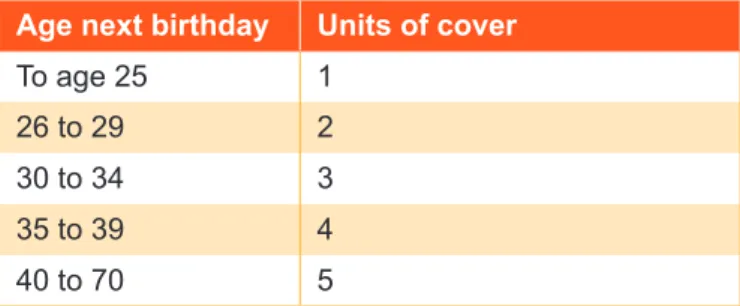
The automatic life-stage increases feature automatically
increases your units of cover when you move from one
age bracket to another.
Table of age brackets for the automatic life-stage increases
Age next birthday Units of cover
To age 25 1
26 to 29 2
30 to 34 3
35 to 39 4
40 to 70 5
The automatic life-stage feature means that the dollar
amount of cover you have will automatically increase
at a time when you are most likely to need it because of your greater commitment to work and family. This is demonstrated visually in the graph below.
Who is eligible to receive the automatic
life-stage increases feature?
The automatic life-stage increases feature is the default cover if you join through an Energy Super employer
unless your employer has nominated and pays for a set number of default units for you.
If you join Energy Super by direct application you are able to select the automatic life-stage increases feature when you apply for Death and TPD
insurance cover.
Please note: As your age-based units automatically increase your sum insured initially increases but then reduces
in line with the age based benefit table on page 25. The trend line from age 39 to 70 represents the value of 5 units of cover diminishing each year to age 70.
Continued over page > Life-stage cover with automatically increasing units
Age
15 17 19 21 23 25 27 29 31 33 35 37 39 42 44 46 48 50 52 54 56 58 60 62 64 66 68 70 450,000
400,000 350,000 300,000 250,000 200,000 150,000 100,000 50,000
3 of 7
How much does cover cost and what
level of cover can I get?
The cost of your Death and TPD insurance cover depends on the amount of cover you choose and
whether it is unit-based or fixed-dollar cover.
You may be eligible for a discounted rate for your insurance if your occupation is within the definition of White collar/ Professional (the discount applies to both the unit-based and fixed-dollar cover). See the definition below.
Unit-based cover
Death & TPD:
• Standard cost: $1.10 per unit per week
• Discounted cost: $0.90 per unit per week
Death Only:
• Standard cost: $0.66 per unit per week
• Discounted cost: $0.61 per unit per week For example: If you have 5 units of Death and TPD insurance at the standard cost, the annual cost for your units can be calculated as follows:
5 units of cover X $1.10 X 52 = $286.00
The cost of your insurance cover is deducted monthly
from your Energy Super account.
Definition:
‘White Collar/Professional’ means a member who is engaged in an occupation with minimal manual duties or very light-skilled duties.
These members have no exposure to unusual
occupational hazards and spends at least 90% of their working hours in an office environment. Employees with technical skills expertise who may be required to use their skills and judgement in a variety of tasks outside of the office environment. These members may have some exposure to unusual occupational hazards.
Benefit payment amount (sum insured)
Each unit of your Death and TPD has a benefit value based on your age next birthday if you die or become totally and permanently disabled (see the age-based benefit table right).
For example: If you have 10 units of Death and TPD insurance and you were declared TPD when you were age 44 (age 45 next birthday), the benefit payment would be $310,000.
10 units x $31,000 (age 45 next birthday) = $310,000.
Please note: Your benefit will generally be paid as a
lump sum.
Please note: Some members may have a different
‘Age based benefit per unit of cover’ table that applies to
them. This will appear in their Part Two - Energy Super Other Information (if applicable).
Age based benefit per unit of cover
Age next birthday Amount of cover per unit ($) Up to age 30 108,600
31 103,400
32 98,400
33 97,300
34 97,300
35 83,000
36 77,400
37 71,700
38 66,400
39 60,800
40 55,400
41 49,400
42 44,000
43 39,200
44 34,800
45 31,000
46 27,300
47 24,000
48 21,200
49 18,600
50 16,300
51 14,100
52 12,300
53 10,700
54 9,300
55 8,000
56 7,000
57 6,300
58 5,400
59 4,800
60 4,300
61 4,000
62 3,400
63 3,200
64 3,000
65 2,700
66 2,400
67 2,100
68 2,000
69 1,900
70 1,700
Continued over page >
Death and Total and Permanent Disablement (TPD) Cover Fact Sheet
Fixed-dollar cover
If you choose to have fixed-dollar cover the cost of this insurance cover is calculated by dividing your fixed amount of cover by 1,000 and multiplying the answer by the cost per $1,000 of cover for your age next birthday (see table to the right).
Cost of fixed-dollar cover
If you have $500,000 of fixed-dollar Death and TPD cover the annual cost will depend on your age next birthday. For example:
• If you are currently age 34 the annual cost will be
500,000/1,000 X 0.70 = $350.00
• If you are currently age 44 the annual cost will be
500,000/1,000 X 1.89 = $945.00
TPD cover reduces after age 61
A tapering benefit applies to your fixed-dollar TPD cover after you reach age 61, and continues to reduce through to age 70 when cover stops. The age-based taper is a percentage of your insured
amount as follows:
Age next birthday % of fixed cover
62 90%
63 80%
64 70%
65 60%
66 50%
67 40%
68 30%
69 20%
70 10%
Please note: Your benefit will generally be paid as a
lump sum.
Cost of Death and TPD cover
(annual cost per $1,000 sum insured)
STANDARD COST DISCOUNTED COST Age
next birthday
Death & TPD ($)
Death Only
Age next birthday
Death & TPD ($)
Death Only Up to 30 0.54 0.37 Up to 30 0.43 0.33
31 0.56 0.39 31 0.45 0.35
32 0.59 0.41 32 0.48 0.36
33 0.60 0.42 33 0.48 0.37
34 0.60 0.42 34 0.48 0.37
35 0.70 0.49 35 0.56 0.43
36 0.75 0.52 36 0.60 0.46
37 0.81 0.56 37 0.65 0.50
38 0.88 0.61 38 0.70 0.54
39 0.96 0.67 39 0.77 0.59
40 1.05 0.73 40 0.84 0.65
41 1.18 0.82 41 0.94 0.72
42 1.33 0.92 42 1.06 0.81
43 1.49 1.03 43 1.19 0.91
44 1.68 1.16 44 1.34 1.03
45 1.89 1.31 45 1.51 1.16
46 2.14 1.48 46 1.71 1.31
47 2.43 1.69 47 1.95 1.49
48 2.76 1.91 48 2.20 1.69
49 3.15 2.19 49 2.52 1.93
50 3.59 2.49 50 2.87 2.20
51 4.13 2.87 51 3.31 2.54
52 4.76 3.30 52 3.81 2.92
53 5.48 3.80 53 4.38 3.36
54 6.26 4.34 54 5.01 3.84
55 7.30 5.06 55 5.84 4.48
56 8.27 5.73 56 6.61 5.07
57 9.32 6.46 57 7.46 5.72
58 10.69 7.41 58 8.55 6.56
59 12.17 8.44 59 9.74 7.47
60 13.69 9.49 60 10.96 8.40
61 14.61 10.13 61 11.69 8.96
62 16.85 11.69 62 13.48 10.34
63 18.26 12.66 63 14.61 11.20
64 19.92 13.81 64 15.93 12.22
65 21.91 15.19 65 17.53 13.44
66 24.10 16.71 66 19.28 14.79
67 26.52 18.38 67 21.21 16.26
68 29.17 20.22 68 23.34 17.89
69 32.09 22.24 69 25.67 19.67
70 35.30 24.46 70 28.25 21.64
5 of 7
What happens if I have a terminal
illness?
Under certain circumstances a member may be declared terminally ill. If this was to apply to you, you will not have to serve any waiting period to become eligible to receive a terminal illness benefit.
The definition of terminal illness is:
• you suffer from an illness or, you have incurred an injury, that two registered medical practitioners have certified, jointly or separately, is likely to result in your death within a period (the certification period) that ends not more than 12 months after the date of the certification
• at least one of the registered medical practitioners is a specialist practicing in an area related to your illness or injury, and
• for each of the certificates, the certification period has not ended.
The reduced life expectancy must occur while you are a
member of Energy Super.
The maximum benefit payable on being diagnosed as terminally ill is $3 million. If your death cover is higher than $3 million, the benefit paid on your death will be reduced by the amount of the terminal illness benefit paid.
What is the maximum
amount of cover?
You can apply for cover up to the maximum benefit limits of $10 million for Death and $3 million for TPD. You should note however, that for cover over $1 million, you will be required to complete a Personal Statement
and undergo other tests as required by the Insurer.
Can I transfer existing cover from
another fund?
If you are rolling over your super from another fund, where you also have insurance arrangements, you may be able to transfer the same level of cover under ‘take
over’ terms in Energy Super. This means you can get a similar amount of cover without having to complete
questionnaires and undergo medical tests. If you wish to take up this option contact us on
1300 4 ENERGY (1300 436 374).
When does cover commence?
If you:
• Joined Energy Super through an Energy Super employer – your automatic cover or cover up to
the AAL starts on the first day of your employment, provided you are at work on that day. If you are not ‘At Work’ on your first day of employment, limited cover will apply (see below). You will need to be at work for 30 consecutive days before your full cover applies. Any additional cover you take out, above the AAL, will commence on the day the Insurer accepts
your application in writing.
• Joined Energy Super by direct application
– any optional cover you take out will commence on the day the Insurer accepts your application
in writing.
What is limited cover?
Limited cover means you are covered only for claims arising from an illness that first became apparent, or an injury which first occurred on or after the date that you first became eligible for cover.
Can I increase, reduce or
cancel cover?
You can apply to increase your Death and TPD cover
at any time by completing a Change of Insurance Form.
However, if you apply to increase your cover it must be
within the maximum allowable limits.
You can reduce or cancel your cover at any time by
completing a Change of Insurance Form. However if, at a later date you want to reinstate your cover you will need to complete a Personal Statement and may have to undergo medical tests as required by
the Insurer.
The Change of Insurance Form can be found at the back of the Energy SuperMember Guide or you can
download it from our website.
Please note: If your employer pays for some units of
cover for you, you will not be able to reduce or cancel
this cover.
Continued over page >
Death and Total and Permanent Disablement (TPD) Cover Fact Sheet
Continued over page >
Life changing events
If you have a life changing event such as:
• getting married, or
• taking out a mortgage, or
• the birth of or adoption of a child, or
• getting a divorce, or
• 10 years of Energy Super membership.
You are able to increase your Death and TPD cover by up to 2 units, for each event, without having to provide any further health evidence as long as you are ‘at work’ at the time of your application. You must provide relevant evidence to the Insurer within 90 days of the event occurring. Proof of the event must be accepted by the Insurer before your cover is increased.
This benefit is limited to a maximum of 4 units per insured member and is subject to the maximum benefit limits.
Will cover continue after I leave my
employer?
Yes, subject to your account having sufficient funds to cover the deduction of insurance premiums.
Will cover continue after I leave
Energy Super?
No. However if you leave Energy Super, you can apply to continue your insurance with the Fund’s Insurer. You must be under age 60 and submit the application within 60 days of leaving the Fund. You will be applying for an individual policy under retail conditions, which is guaranteed to be renewed annually.
Who will receive my Death benefit?
You have the choice of making a binding or non-binding
nomination for the beneficiaries of your death benefit. If your death benefit nomination is non-binding, the Trustee has the discretion to decide who will receive your death benefit if you die while you are a member. However, it will take your nomination into account when making its decision. This is why it is important that you specify who you would like to receive your super benefit.
A binding death benefit nomination binds the Trustee to pay the death benefit to your nominated dependants. Binding nominations are valid for three years. Every year, we will notify you of the details of your binding nomination and its expiry date.
To let the Trustee know your wishes, complete the
Non-binding Death Benefit Nomination Form, or if you would like to make a binding nomination, complete a
Binding Death Benefit Nomination Form. Both forms can be downloaded from our website – energysuper.com.au
or call us and we will send it to you.
Be sure to update your nominations by completing
a new form if your circumstances change.
How is a Death benefit claimed?
The claim must be made as soon as possible. The process of claiming a death benefit can be a long one, because the Trustee must be sure that the dependants claiming the benefit are entitled to it. There may also be delays if there is any dispute as to who is entitled to the death benefit.
The key to the process is getting started early and providing as much information as possible to
the Trustee.
How do I claim a TPD benefit?
You should notify us as soon as reasonably practical if you think you may be eligible to make a claim. You will be required to provide medical information and the process can be lengthy.
Qualifying for a TPD benefit
The definition of TPD is made up of four parts – A, B, C and D (see next page). The part that will apply to you will depend on your age and the hours you worked in the six month period prior to you becoming disabled,
as follows:
If at the time of becoming TPD you are:
Parts*
A B C D
Less than age 65 and employed
for at least 15 hours per week. n/a
Less than age 65 and employed for less than 15 hours per week or your occupation is classified
as ‘Home Duties’.
n/a
Aged 65 years or more. n/a n/a
* You may be declared TPD if you meet any of the four parts of the
7 of 7 PART A: Own / similar occupation definition
You have been absent from your occupation
solely through injury or illness for a period of six consecutive months and are incapacitated to such an extent that, in the Trustee’s opinion, after consideration of medical and other relevant evidence, you were, at the end of the period of six consecutive months absence from employment, unlikely to ever engage in or work for reward in your own occupation and any similar occupation for which you are reasonably suited by education,
training or experience.
PART B: Specific loss
You suffer the permanent loss of use of two limbs or the sight of both eyes; or the permanent
loss of use of one limb and the sight of one eye (where limb is defined as whole hand or the whole
foot) in circumstances where the loss will never
be regained.
PART C: Activities of daily living
You are incapacitated to such an extent that, in the Trustee’s opinion, after consideration of medical and other relevant evidence, you are unlikely to
ever be able to perform at least two ‘activities of
daily living’ without the physical help of someone else. For the purpose of this definition, ‘activities of daily living’ means:
1. bathing and/or showering, or
2. dressing, or
3. moving from place-to-place including in and out of bed and in and out of a chair, or
4. eating or drinking, or 5. using the toilet.
How do I get more information?
If you would like more information about death and total and permanent disablement insurance please read the Energy Super Member Guide or check the
insurance information on our website.
PART D: Home Duties
Where your occupation is classified as ‘home duties’, you have been absent from your occupation solely through injury or illness for a period of six consecutive months and you are incapacitated to such an extent that, in the Trustee’s opinion, after consideration of medical and other relevant evidence you were, at the end of the period of six consecutive months absence from employment, unlikely to ever again attend to at least two normal physical domestic household duties. For the purpose of this definition, ‘normal physical domestic household duties’ means:
1. cleaning the family home, or
2. shopping for food and household items, or
3. meal preparation and laundry services, or
4. leaving the house without the assistance of
another person, or
5. looking after dependent child/children under 16 years of age or in full time secondary education, where applicable, or
6. providing full time care for a disabled
person(s) who is a member of your
immediate family, where applicable.
If you are able to perform the normal physical
domestic household duties with the assistance
of another person or with the use of assistive
devices, you are deemed to be able to perform these duties. You must be under the regular care and attention and following the advice of a doctor for that injury or illness. Evidence that you carried out the duties on a daily basis prior to your period of disability will be required.
FAC 012 0311 Death and Total and Permanent Disablement (TPD) Cover Fact Sheet
More information – Call 1300 4 ENERGY (1300 436 374)
Email [email protected] or visit energysuper.com.au
This document provides general financial product advice only and should not be relied on as legal or taxation advice, nor does it take the place of such advice. It has been prepared for the general information of members of Energy Super. It does not take into account any member’s individual financial objectives, financial situation or needs. Any statements of law or proposals are based on our interpretation of the law or proposals as at 1 April 2011. We recommend that you seek help from a licensed financial adviser before acting on any information in this fact sheet or making any decision about your superannuation benefit. You should obtain a Product Disclosure Statement (PDS) and consider the PDS before making any decision. While all due care and diligence has been taken in the preparation of this document, the Trustee reserves the right to correct errors or omissions. If there are inconsistencies between the terms of Energy Super’s Trust Deed and this document, the terms of the Trust Deed prevail.
Any information or advice included in this Fact Sheet is provided by ESI Financial Services Pty Ltd (ABN 93 101 428 782 AFSL 224952). Electricity Supply Industry Superannuation (Qld) Ltd (ABN 30 069 634 439 AFSL 336567) is the Trustee for Energy Super (ABN 33 761 363 685).