TaqMan
Copy Number Assays
Protocol
this document.
APPLIED BIOSYSTEMS DISCLAIMS ALL WARRANTIES WITH RESPECT TO THIS DOCUMENT, EXPRESSED OR IMPLIED, INCLUDING BUT NOT LIMITED TO THOSE OF MERCHANTABILITY OR FITNESS FOR A PARTICULAR PURPOSE. IN NO EVENT SHALL APPLIED BIOSYSTEMS BE LIABLE, WHETHER IN CONTRACT, TORT, WARRANTY, OR UNDER ANY STATUTE OR ON ANY OTHER BASIS FOR SPECIAL, INCIDENTAL, INDIRECT, PUNITIVE, MULTIPLE OR CONSEQUENTIAL DAMAGES IN CONNECTION WITH OR ARISING FROM THIS DOCUMENT, INCLUDING BUT NOT LIMITED TO THE USE THEREOF.
NOTICE TO PURCHASER: LIMITED LICENSE
A license to perform the patented 5' Nuclease Process for research is obtained by the purchase of (i) both Authorized 5' Nuclease Core Kit and Licensed Probe, (ii) a Licensed 5' Nuclease Kit, or (iii) license rights from Applied Biosystems.
This product is an Authorized 5' Nuclease Core Kit. Use of this product is covered by US patents claims and patent claims outside the US. The purchase of this product includes a limited, non-transferable immunity from suit under the foregoing patent claims for using only this amount of product for the purchaser's own internal research. Separate purchase of a Licensed Probe would convey additional rights under the applicable claims of US patent claims and corresponding claims outside the United States. No right under any other patent claim and no right to perform commercial services of any kind, including without limitation reporting the results of purchaser's activities for a fee or other commercial consideration, is conveyed expressly, by implication, or by estoppel. This product is for research use only. Diagnostic uses under Roche patents require a separate license from Roche. Further information on purchasing licenses may be obtained from the Director of Licensing, Applied Biosystems, 850 Lincoln Centre Drive, Foster City, California 94404, USA.
Trademarks:
The trademarks mentioned herein are the property of Life Technologies Corporation or their respective owners. AmpErase, AmpliTaq Gold, and TaqMan are registered trademarks of Roche Molecular Systems, Inc.
© Copyright 2010, Life Technologies Corporation. All rights reserved. Part Number 4397425 Rev. D
Preface . . . 5
Safety . . . 5
How to obtain more information . . . 6
How to obtain support . . . 7
TaqMan
®Copy Number Assays . . . 9
Product overview . . . 9
Materials and equipment . . . 11
TaqMan® Copy Number Assays workflow . . . 16
Prepare the genomic DNA samples . . . 17
Design the experiment . . . 18
Set up the instrument software . . . 18
Prepare the reactions . . . 21
Run the reactions . . . 24
Analyze and export the results . . . 25
Appendix A
Troubleshooting . . . 27
Troubleshooting real-time PCR data . . . 27
Appendix B
Good PCR Practices . . . 33
Prevent contamination and nonspecific amplification . . . 33
Appendix C
TaqMan
®Chemistry . . . 35
TaqMan® Copy Number Assays . . . 35
Appendix D
The Information CD . . . 37
About the Information CD files . . . 37
Appendix E
Safety . . . 39
Chemical safety . . . 40
Safety
Safety alert
words
Four safety alert words appear in Applied Biosystems user documentation at points in the document where you need to be aware of relevant hazards. Each alert
word—IMPORTANT, CAUTION, WARNING, DANGER—implies a particular level of observation or action, as defined below.
Definitions
IMPORTANT! – Indicates information that is necessary for proper instrument
operation, accurate chemistry kit use, or safe use of a chemical.
CAUTION! – Indicates a potentially hazardous situation that, if not avoided,
may result in minor or moderate injury. It may also be used to alert against unsafe practices.
WARNING! – Indicates a potentially hazardous situation that, if not avoided,
could result in death or serious injury.
DANGER! – Indicates an imminently hazardous situation that, if not avoided,
will result in death or serious injury. This signal word is to be limited to the most extreme situations.
Chemical hazard warning
WARNING! CHEMICAL HAZARD. Some of the chemicals used with
Applied Biosystems instruments and protocols are potentially hazardous and can cause injury, illness, or death. For all chemicals, read the Safety Data Sheet (SDS) and follow the handling instructions. Wear appropriate protective eyewear, clothing, and gloves.
How to obtain more information
Related
documentation
You can download the following documents from:
http://docs.appliedbiosystems.com.
Send us your
comments
Applied Biosystems welcomes your comments and suggestions for improving its user documents. You can e-mail your comments to:
The e-mail address above is only for submitting comments and suggestions relating to documentation. To order documents, download PDF files, or for help with a technical question, go to http://www.appliedbiosystems.com, then click the link for Support. (See “How to obtain support” below.)
Software or Real-Time PCR
System Document Part number
CopyCaller™ Software Applied Biosystems CopyCaller™ Software User Guide 4400042
Applied Biosystems CopyCaller™ Software Quick Reference Card 4400043
7900HT Fast and 7300/7500 Systems
Applied Biosystems 7900HT Fast Real-Time PCR System and 7300/7500 Real-Time PCR System Chemistry Guide
4348358
7300, 7500, and 7500 Fast Systems
Applied Biosystems 7300/7500/7500 Fast Real-Time PCR System Relative Quantification Getting Started Guide
4347824
Applied Biosystems 7300/7500/7500 Fast Real-Time PCR System Absolute Quantification Getting Started Guide
4347825
7900HT Fast System Applied Biosystems 7900HT Fast Real-Time PCR System and SDS
Enterprise Database User Guide
4347825
Applied Biosystems 7900HT Fast Real-Time PCR System Absolute Quantitation Using Standard Curve Getting Started Guide
4364014
Applied Biosystems 7900HT Fast Real-Time PCR System Relative Quantitation Using Comparative CT Getting Started Guide
4364016
StepOnePlus™ Systems Applied Biosystems StepOne™ and StepOnePlus™ Real-Time
PCR Systems Getting Started Guide for Relative Standard Curve and Comparative CT Experiments
4376785
Applied Biosystems StepOne™ and StepOnePlus™ Real-Time PCR Systems Getting Started Guide for Standard Curve Experiments
4376784
Applied Biosystems StepOne™ and StepOnePlus™ Real-Time PCR Systems Reagent Guide
4379704
ViiA™ 7 Real-Time PCR
System
How to obtain support
For the latest services and support information for all locations, go to
http://www.appliedbiosystems.com, then click the link for Support.
At the Support page, you can:
• Search through frequently asked questions (FAQs) • Submit a question directly to Technical Support
• Order Applied Biosystems user documents, Safety Data Sheets (SDS), and other related documents
• Download PDF documents
• Obtain information about customer training • Download software updates and patches
In addition, the Support page provides access to worldwide telephone and fax numbers to contact Applied Biosystems Technical Support and Sales facilities.
TaqMan
Copy Number Assays
Product overview
About this
protocol
The TaqMan® Copy Number Assays Protocol provides step-by-step instructions for performing and analyzing copy number variation quantitation experiments using TaqMan® Copy Number Assays and TaqMan® Copy Number Reference Assays.
Purpose of the
assay
TaqMan® Copy Number Assays are designed to detect and measure copy number variation within the human and mouse genomes. Copy number variation is an important polymorphism associated with genetic diseases such as cancer, immune diseases, and neurological disorders.
Pre-designed,
Custom Plus, and
Custom assays
available
An extensive collection of pre-designed TaqMan® Copy Number Assays is available for genes and known copy number variation regions in the human and mouse genomes. Pre-designed assays to common vector marker and reporter genes are also available for study of transfected cells and organisms. For human or mouse targets not represented by pre-designed assays, Custom Plus TaqMan® Copy Number Assays can be made by a proprietary design pipeline that performs bioinformatics analysis on target and assay sequences, ensuring the best possible assay design. Standard Custom TaqMan® Copy Number Assays (no bioinformatics analysis) can be designed for other targets of interest.
Reference assays
available
TaqMan® Copy Number Reference Assays are designed to unique human and mouse genomic sequences, and they are required for relative quantitation of copy number targets.
Where to find
assays
To view and order TaqMan® Copy Number Assays, Custom TaqMan® Copy Number Assays, and TaqMan® Copy Number Reference Assays, refer to the product pages at
How the assays
work
TaqMan® Copy Number Assays are run simultaneously with a TaqMan® Copy Number Reference Assay in a duplex real-time polymerase chain reaction (PCR). The Copy Number Assay detects the target gene or genomic sequence of interest, and the Reference Assay detects a sequence that is known to exist in two copies in a diploid genome (for example, the human RNase P H1 RNA gene).
The number of copies of the target sequence in each test sample is determined by relative quantitation (RQ) using the comparative CT (ΔΔCT) method. This method measures the CT difference (ΔCT) between target and reference sequences, then compares the ΔCT values of test samples to a calibrator sample(s) known to have two copies of the target sequence. The copy number of the target is calculated to be two times the relative quantity.
In a copy number quantitation reaction, purified genomic DNA is combined with: • The TaqMan® Copy Number Assay, containing two primers and a FAM™
dye-labeled MGB probe to detect the genomic DNA target sequence.
• The TaqMan® Copy Number Reference Assay, containing two primers and a VIC® dye-labeled TAMRA™ probe to detect the genomic DNA reference sequence.
• The TaqMan® Genotyping Master Mix, containing AmpliTaq Gold® DNA Polymerase, UP (Ultra Pure) and dNTPs required for the PCR reactions. The real-time PCR reaction occurs in a single tube or well, and it uses universal PCR cycling conditions. Reactions are run on an Applied Biosystems Real-Time PCR System. After amplification, data files containing the sample replicate CT values for each reporter dye can be exported from the real-time PCR instrument software and imported into a software analysis tool. Applied Biosystems CopyCaller™ Software is recommended for post-PCR data analysis of copy number quantitation experiments. For details of the assay chemistry, see Appendix C, TaqMan® Chemistry on page 35.
Materials and equipment
TaqMan
®Copy
Number Assay
contents
Each TaqMan® Copy Number Assay shipment contains:
• One tube of TaqMan® Copy Number Assay Mix, for each assay ordered – Target-specific forward and reverse primers
– FAM™ dye-labeled MGB probe • One Information CD containing:
– The Assay Information File (AIF)
– A PDF file of the TaqMan® Copy Number Assays Protocol (PN 4397425)
– A PDF file of the TaqMan® Copy Number Assays Quick Reference Card (PN 4397424)
– A PDF file of the CopyCaller™ Software User Guide (PN 44000042)
– A PDF file of the CopyCaller™ Software Quick Reference Card (PN 44000043)
– A PDF file of the Product Insert – A PDF file of the Data Sheet – A PDF file of Safety Data Sheet(s)
– A PDF file of the Understanding Your Shipment document • A printed Data Sheet describing the assay
Available
quantities
TaqMan® Copy Number Assays, Custom Plus TaqMan® Copy Number Assays, and Custom TaqMan® Copy Number Assays are made to order (not inventoried). They are available in 20✕ and 60✕ concentrations in the following quantities:
TaqMan
®Copy
Number
Reference Assay
contents
TaqMan® Copy Number Reference Assays must be ordered separately. There are two human and two mouse assays, each of which detects a single-copy gene in its respective reference genome assembly.
The human assays are:
• TaqMan® Copy Number Reference Assay RNase P – recommended as the standard reference assay for human gDNA copy number quantitation
experiments. This assay detects the Ribonuclease P RNA component H1 (H1RNA) gene (RPPH1) on chromosome 14, cytoband 14q11.2.
• TaqMan® Copy Number Reference Assay TERT – recommended as an alternative reference assay for human gDNAs. This assay targets the telomerase reverse transcriptase (TERT) gene located on chromosome 5, cytoband 5p15.33.
Scale Concentration
Number of reactions Part number 384-well, 10 µL 96-well, 20 µL Pre-designed assays Custom Plus assays Custom assays
Small 20✕ 720 360 4400291 4442487 4400294
Medium 20✕ 1500 750 4400292 4442520 4400295
The mouse assays are:
• TaqMan® Copy Number Reference Assay, Mouse, Tfrc – recommended as the standard reference assay for mouse gDNA copy number quantitation experiments. This assay detects the transferrin receptor gene (Tfrc) on chromosome 16, cytoband 16qB3.
• TaqMan® Copy Number Reference Assay, Mouse, Tert – recommended as
an alternative reference assay for mouse gDNA. This assay targets the telomerase reverse transcriptase (Tert) gene located on chromosome 13, cytoband 13qC1.
Each TaqMan® Copy Number Reference Assay shipment contains one tube with: • Reference sequence-specific forward and reverse primers
• VIC® dye-labeled TAMRA™ probe
Available
quantities
TaqMan® Copy Number Reference Assays are inventoried and are available in
two scales.
Product Concentration
Number of reactions
Part number 384-well,
10 µL
96-well, 20 µL
Human Assays
TaqMan® Copy Number Reference Assay
RNase P, 750 Reactions
1 tube, 20✕ 1500 750 4403326
TaqMan® Copy Number Reference Assay
RNase P, 3000 Reactions
4 tubes, 20✕ 6000 3000 4403328
TaqMan® Copy Number Reference Assay
TERT, 750 Reactions
1 tube, 20✕ 1500 750 4403316
TaqMan® Copy Number Reference Assay
TERT, 3000 Reactions
4 tubes, 20✕ 6000 3000 4403315
Mouse Assays
TaqMan® Copy Number Reference Assay,
Mouse, Tfrc, 750 Reactions
1 tube, 20X 1500 750 4458366
TaqMan® Copy Number Reference Assay,
Mouse, Tfrc, 3000 Reactions
4 tubes, 20X 6000 3000 4458367
TaqMan® Copy Number Reference Assay,
Mouse, Tert, 750 Reactions
1 tube, 20X 1500 750 4458368
TaqMan® Copy Number Reference Assay,
Mouse, Tert, 3000 Reactions
Order your
assays
For details on how to order your pre-designed, Custom Plus, or Custom Assays, refer to the TaqMan® Copy Number Assays product page at
www.appliedbiosystems.com.
Store your assays
Applied Biosystems recommends that you:• Store assays at –15 to –25 °C and protect them from light.
• To minimize freeze-thaw cycles, consider diluting 60✕ assays to a 20✕ working stock and aliquoting the solution into smaller volumes.
Recommended
master mix
TaqMan® Genotyping Master Mix is recommended for use with the TaqMan® Copy Number Assays for optimal performance.
Note: TaqMan® Copy Number Assays can also be used with TaqMan® Gene
Expression Master Mix or TaqMan® Universal PCR Master Mixes (with or without AmpErase® UNG).
Note: TaqMan® Fast Universal PCR Master Mix is not recommended for use with
TaqMan® Copy Number Assays.
CopyCaller
™Software
Applied Biosystems recommends CopyCaller™ Software (PN 4412907) to analyze your copy number experiments. The software is free and available by download or on CD. Refer to www.appliedbiosystems.com for details.
Available volumes for TaqMan® Genotyping
Master Mix (2✕) Part number
1-Pack; one 10-mL bottle 4371355
2-Pack; two 10-mL bottles 4381656
Single Bulk Pack; one 50-mL bottle 4371357
Materials and
equipment
purchased
separately
Reaction plates and accessories
Use reaction plates and accessories appropriate for your Real-Time PCR System.
Other materials and equipment
For more product recommendations, visit www.appliedbiosystems.com.
Real-Time PCR
System Reaction plates and accessories
7300 System 7500 System 7900HT System (96-Well Block)
• MicroAmp® Optical 96-Well Reaction Plate with Barcode:
– 500 plates (PN 4326659) – 20 plates (PN 4306737)
• MicroAmp® Optical 96-Well Reaction Plate:
– 500 plates (PN 4316813) – 10 plates (PN N8010560)
• MicroAmp® Optical Adhesive Film (PN 4311971)
• MicroAmp® Snap-On Optical Film Compression Pad
(PN 4333292)
• MicroAmp® Optical Tube without Cap (0.2-mL)
(PN N8010933)
• MicroAmp® Optical 8-Cap Strip (PN 4323032)
7500 Fast System
StepOnePlus™ System
• MicroAmp®Fast Optical 96-Well Reaction Plate with
Barcode:
– 200 plates (PN 4366932) – 20 plates (PN 4346906)
• MicroAmp®Fast Optical 96-Well Reaction Plate (10 plates)
(PN 4346907)
• MicroAmp® Optical Adhesive Film (PN 4311971)
7900HT System (384-Well Block)
or
7900HT Fast System (384-Well Block)
or
ViiA™ 7 Real-Time PCR
System
• MicroAmp® Optical 384-Well Reaction Plate with Barcode:
– 1000 plates (PN 4343814) – 500 plates (PN 4326270) – 50 plates (PN 4309849)
• MicroAmp® Optical 384-Well Reaction Plate (1000 plates)
(PN 4343370)
• MicroAmp® Optical Adhesive Film (PN 4311971)
Item Source
Nuclease-free water (500 mL) Applied Biosystems
(PN AM9930)
Pipette tips, with filter plugs Major laboratory supplier
(MLS)
Polypropylene tubes MLS
Centrifuge with plate adapter MLS
Microcentrifuge MLS
Pipettors, positive-displacement or air-displacement MLS
Tris-EDTA (TE) buffer, pH 8.0 Applied Biosystems
(PN AM9849)
Vortexer MLS
TaqMan
®
Copy Number Assays workflow
Prepare the gDNA samples
Perform PCR amplification
Design the experiment
Set up the instrument software
Prepare the reactions
Run the real-time reactions
Prepare the genomic DNA samples
Extract the DNA
The target template for TaqMan® Copy Number Assays is purified genomic DNA (gDNA).Applied Biosystems recommends using commercially available gDNA extraction and purification kits.
Quantify the DNA
Applied Biosystems strongly recommends that you quantify the gDNA using one of the following methods:• The TaqMan® RNase P Detection Reagents (PN 4316831) for human gDNAs. You can use your own human DNA samples or the TaqMan® DNA Template Reagents (PN 401970) to create a standard curve.
Refer to Creating Standard Curves with Genomic DNA or Plasmid DNA Templates for Use in Quantitative PCR (PN 4371090). You can download the document from www.appliedbiosystems.com.
or
• UV absorbance (A260/A280) measurements. Ensure that the human or mouse gDNA that you use has an A260/A280 ratio greater than 1.7.
Note: The TaqMan® Copy Number Reference Assay RNase P method is preferred
because it is more accurate than UV absorbance, and it assesses sample quality.
Dilute the DNA
and prepare the
plates
Follow the instructions for the type of gDNA you are using:
• For liquid gDNA – Dilute each sample to 5 ng/µL using either nuclease-free water or 1✕ TE buffer, pH 8.0 to make a 5✕ stock solution.
• For dried gDNA – You do not need to dilute all the DNA samples to the same working stock concentration. However, you must load the same amount of gDNA in each well of the plate. See the example in the chart below.
IMPORTANT! You must use the same amount of gDNA for each sample and for each
sample replicate that is run with the same assay.
For a...
Your final reaction volume is...
The amount of gDNA required per
well is...
The volume of 5 ng/µL (5✕) gDNA stock per
well is...
384-well plate 10 µL 10 ng 2 µL
Design the experiment
Determine the
number of
sample types
Applied Biosystems recommends running the following samples on each plate: • Samples or Unknowns – gDNA samples in which the copy number of the
target is unknown.
• No Template Controls (NTC) – A sample that does not contain a DNA template. It shows the background fluorescence and allows for the detection of contamination.
• Calibrator sample – A DNA sample with a known copy number for the target of interest. Also known as the reference sample.
Determine the
number of
sample replicates
To generate the reliable copy number calls, Applied Biosystems strongly recommends using four replicates for each gDNA sample, on the plate, in order.
Set up the instrument software
Real-time
instruments
For a complete list of Applied Biosystems Real-Time PCR Systems, see “Materials
and equipment purchased separately” on page 14.
Create the plate
document/
experiment
Use the selected Real-Time PCR System software to set up the experiment. The Absolute Quantitation method or Quantitation – Standard Curve Setup is required to capture the cycle threshold (CT) data from the duplex PCR run. The real-time PCR CT data are subsequently used by Applied Biosystems CopyCaller™ Software to calculate sample copy number values by relative quantitation. Specific information is required in the experiment setup for data analysis (see below).
1. Create a plate document/experiment for the run using the parameters in the following table:
System Run Reaction plate Ramp
speed/model
Sample volume
ViiA™ 7 Real-Time PCR System (ViiA™ 7
Software v1.X; 7500 Software v2.0 or later)
Standard 96-well standard Standard 20 µL
96-well Fast
384-well standard 10 µL
7900HT/7900HT Fast (SDS Software v2.1 or later)
Standard 96-well standard 9600 emulation 20 µL
96-well Fast (for 7900HT) 384-well standard (for 7900HT)
10 µL
7500/7500 Fast (SDS Software v1.3 or later) Standard 96-well standard 9600 emulation 20 µL
2. In the plate document, identify the samples in each well of the reaction plate: • Select the wells containing gDNA and the no template controls (NTCs). • Apply to each well of the plate that contains a reaction: a sample name and
a detector/target that includes dye information (reporter and quencher). • Create unique assay sample names so that the CopyCaller™ Software
analyzes each sample separately.
• Apply the same sample name to the wells of each technical replicate group. The CopyCaller™ Software combines data of replicate wells only if they share the same sample name. If the replicate wells are named differently (for example, smpl012a and smpl012b), the software analyzes the wells as different samples.
• Apply unique detector/target names to the wells of plates that contain multiple TaqMan® Copy Number Assays or Reference Assays (optional). When a plate contains more than one kind of copy number assay or reference assay, label the wells according to the assay(s) that they contain. The CopyCaller™ Software can separate the data from multiple assays only if the associated wells are labeled with unique assay names.
• Apply the setup data shown in the table below for your Real-Time PCR System to each TaqMan® Copy Number experiment. The CopyCaller™ Software requires that exported data files contain reporter and quencher dye information.
Note: If you use SDS Software v1.X, you must specify “FAM” and “VIC”
as the detector names for the copy number and reference assays
respectively. SDS Software v1.X does not export dye information, so you must specify the reporter dye(s) in the detector name.
IMPORTANT! The shaded cells in the table below indicate that you must
enter the specified values exactly as shown.
7500/7500 Fast (7500 Software v2.0 or later) Standard 96-well standard Standard 20 µL
96-well Fast
7300 (SDS Software v1.3 or later) Standard 96-well standard 9600 emulation 20 µL
StepOnePlus™ (StepOne™ Software v2.0 or
later)
Standard 96-well Fast Standard 20 µL
System Run Reaction plate Ramp
speed/model
Sample volume
For more
information
Refer to the User Guide or Getting Started Guides for your Real-Time PCR System for instructions on how to create a plate document and how to run a quantitation experiment. See “Related documentation” on page 6 for a list of documents for your instrument.
Required setup information for a TaqMan® Copy Number Assay
Assay Detector name Target name Reporter Quencher 7900HT Fast System (SDS Software v2.X) – Absolute quantitation plate document‡
‡ If you run more than one TaqMan® Copy Number or Reference Assay on a plate, you can enter the names of the assays in the
Detector/Target Name fields so that the CopyCaller™ Software analyzes the data from each assay separately.
TaqMan® Copy Number Assay User-defined N/A FAM Nonfluorescent
TaqMan® Copy Number Reference Assay User-defined N/A VIC TAMRA
7300/7500/7500 Fast System (SDS Software v1.X) – Absolute quantitation plate document
TaqMan® Copy Number Assay FAM§
§ If you use SDS Software v1.X, you must specify “FAM” and “VIC” as the detector names for the Copy Number and Reference Assays respectively. SDS Software v1.X does not export dye information, so you must specify the reporter dye(s) in the detector name.
N/A FAM (none)
TaqMan® Copy Number Reference Assay VIC§ N/A VIC TAMRA
7500/7500 Fast System (7500 Software v2.X) or ViiA™ 7 Software v1.X
or StepOnePlus™ System (StepOne Software v2.X) – Advanced Setup/Quantitation-Standard Curve experiment‡
TaqMan® Copy Number Assay N/A User-defined FAM NFQ-MGB
Prepare the reactions
Use liquid or
dried genomic
DNA
Decide which form of gDNA to use for your experiment–liquid or dried–and follow the appropriate instructions below. For both forms of gDNA and for both 96- and 384-well plates, the recommended final reaction concentration of gDNA is 1 ng/µL (see the chart in “Dilute the DNA and prepare the plates” on page 17).
Using liquid gDNA template:
Dilute each sample to 5 ng/µL using either nuclease-free water or 1✕ TE buffer, pH 8, to make a 5✕ stock solution. Obtain a 384- or 96-well MicroAmp® Optical Reaction Plate, then go to “Prepare the reactions for liquid gDNA” on page 21.
Using dried gDNA template:
1. Transfer the gDNA into each well of a MicroAmp® Optical Reaction Plate: • For a 384-well plate – pipette 10 ng
• For a 96-well plate – pipette 20 ng
2. Allow the sample to dry at room temperature in an amplicon-free location. 3. Go to “Prepare the reactions for dried gDNA” on page 23.
Prepare the
reactions for
liquid gDNA
1. Calculate the volumes of components that you need, based on the reaction volume and the number of reactions. Include excess volume in your calculations to provide for the loss that occurs during reagent transfers.
Note: Applied Biosystems recommends using four replicates of each sample.
2. Completely thaw the TaqMan® Copy Number Assays and the TaqMan® Copy
Number Reference Assays. Gently vortex the assays to mix them, then centrifuge the tubes briefly to bring contents to the bottom of the tube. 3. Swirl to thoroughly mix the TaqMan® Genotyping Master Mix.
Reaction mixture component
Volume per well (µL) 384-well
plate
96-well plate
2✕ TaqMan® Genotyping Master Mix‡
‡ TaqMan® Gene Expression or TaqMan® Universal Master Mixes can also be used, but do
not use TaqMan® Fast Universal Master Mix.
5.0 10.0
TaqMan® Copy Number Assay, 20✕ working
stock§
§ If you use large-scale assays (60✕), dilute the assays to a 20✕ working stock.
0.5 1.0
TaqMan® Copy Number Reference Assay, 20✕ 0.5 1.0
Nuclease-free water 2.0 4.0
4. Combine the required volumes of reaction components in microcentrifuge tubes.
5. Invert or flick the tubes to mix the contents thoroughly, then centrifuge the tubes briefly.
6. Pipette the reaction mixture into the wells of the reaction plate that you prepared.
• For 384-well plates – pipette 8 µL per well. • For 96-well plates – pipette 16 µL per well.
7. Vortex the gDNA samples that you prepared and diluted. 8. Add the gDNA to the wells containing the reaction mixture:
• For 384-well plates – pipette 2 µL of gDNA (5 ng/µL) per well. • For 96-well plates – pipette 4 µL of gDNA (5 ng/µL) per well.
Alternatively, you can add the gDNA to the plate first, then add the reaction mixture.
9. Mix the reaction mixture with the gDNA by pipetting up and down several times.
10. Seal the reaction plate with optical adhesive film (or optical caps), then centrifuge the reaction plate briefly.
11. Inspect all the wells to ensure a uniform volume. 12. Go to “Run the reactions” on page 24.
Prepare the
reactions for
dried gDNA
1. Calculate the volumes of components that you need, based on the reaction volume and the number of reactions. Include excess volume in your calculations to provide for the loss that occurs during reagent transfers.
Note: Applied Biosystems recommends using four replicates of each sample.
2. Completely thaw the TaqMan® Copy Number Assays and the TaqMan® Copy
Number Reference Assays. Gently vortex the assays to mix them, then centrifuge the tubes briefly to bring contents to the bottom of the tube. 3. Swirl to thoroughly mix the TaqMan® Genotyping Master Mix.
4. Combine the required volumes of reaction components in microcentrifuge tubes.
5. Invert or flick the tubes to mix the contents thoroughly, then centrifuge the tubes briefly.
6. Obtain the reaction plate containing the dried gDNA.
7. Pipette the reaction mixture into each of the wells of the reaction plate. • For 384-well plates – pipette 10 µL per well.
• For 96-well plates – pipette 20 µL per well.
8. Mix the reaction mixture with the gDNA by pipetting up and down several times.
9. Seal the reaction plate with optical adhesive film (or optical caps), then centrifuge the reaction plate briefly.
10. Inspect all the wells to ensure a uniform volume. 11. Go to “Run the reactions” on page 24.
Reaction mixture component
Volume per well (µL) 384-well
plate
96-well plate
2✕ TaqMan® Genotyping Master Mix‡
‡ TaqMan® Gene Expression or TaqMan® Universal Master Mixes can also be used, but do
not use TaqMan® Fast Universal Master Mix.
5.0 10.0
TaqMan® Copy Number Assay, 20✕ working
stock§
§ If you use large-scale assays (60✕), dilute the assays to a 20✕ working stock.
0.5 1.0
TaqMan® Copy Number Reference Assay, 20✕ 0.5 1.0
Nuclease-free water 4.0 8.0
Run the reactions
Run the plate
1. Load the reaction plate into a real-time PCR instrument. 2. Run the plate using the parameters below:3. Unload the reaction plate after the run is complete.
For more
information
Refer to the User Guide or Getting Started Guides for your Real-Time PCR System for more information about running a quantitation experiment. See “Related
documentation” on page 6 for a list of documents for your instrument.
Stage Temperature Time
Hold 95 °C 10 min
Cycle (40 Cycles)
95 °C 15 sec
Analyze and export the results
Analyze the
results
1. In the real-time PCR Instrument software, open the Analysis Settings window and set the following:
• Manual CT threshold – 0.2 • Autobaseline – On
2. Apply the settings, then close the window. 3. Analyze the experiment.
4. Review the analyzed data and troubleshoot any flags or problematic data. Verify that the amplification curves for the:
• Reference Assay (VIC® dye signal) in all samples have a distinct, linear amplification phase.
• Copy Number Assay (FAM™ dye signal) in most wells have a distinct, linear amplification phase.
Note: Samples that contain zero copies of the target of interest do not
amplify well, if at all, with the copy number assay. Such samples have high or undetermined FAM™ C
Ts.
• Review any displayed quality check (QC) flags, then review the real-time data of the associated samples.
For information on troubleshooting problematic real-time data, see
“Troubleshooting real-time PCR data” on page 27 or refer to the User Guide or
Getting Started Guides for your Real-Time PCR System.
Note: See “Related documentation” on page 6 for a list of documents for your
instrument.
Export the results
After you use the Real-Time PCR System software to analyze each TaqMan® Copy Number Assay experiment, export each experiment results or results table to one or more exported real-time PCR files.Note: If using the ViiA™ 7 Software v1.0 and CopyCaller™ Software v1.0 for copy
number data analysis, export results using the 7900 Format option. CopyCaller™ Software cannot open ViiA™ 7 Software v1.0 export files in other formats.
IMPORTANT! Do not modify the exported data files. The CopyCaller™ Software
In the Real-Time PCR Instrument software
IMPORTANT! If you run multiple TaqMan® Copy Number or Reference Assays on
each plate, make sure to apply distinct assay detector/target names to the document as described in “Set up the instrument software” on page 18. User-defined
target/detector names allow the CopyCaller™ Software to arrange and analyze data independently for each assay in a single exported file.
IMPORTANT! If you use a 7300/7500/7500 Fast system running SDS Software v1.X,
you must specify “FAM” and “VIC” as the detector names for the Copy Number and Reference assays, respectively. SDS Software v1.X does not export dye information, so you must specify the reporter dye(s) in the detector name.
In the CopyCaller™ Software
1. Import the exported real-time PCR file into the CopyCaller™ Software. 2. Run the analysis to determine the copy number for your target in each sample. For more information, refer to the Applied Biosystems CopyCaller™ Software User Guide.
Assays per plate
Did you specify the placement of the assay(s) using separate
targets/detectors?
Procedure
One Not applicable Export the real-time PCR results to a tab-delimited
text (.txt) or comma-separated values (.csv) exported file.
More than one
Yes Export the real-time PCR results to a single
exported file (.csv or .txt) that includes all wells of
the plate. The CopyCaller™ Software uses the
target/detector names to distinguish the data from the different assays.
No Export the real-time PCR results of each assay to
a separate exported file.
1. Select the wells of the plate that contain the
data from one of the TaqMan® Copy Number
Assays.
2. Select FileExport, then export the data from
the selected wells to a data file.
3. Repeat steps 1 and 2 to export the data from
the other assays present on the plate.
Note: To help with organization, name each
exported file according to the assay data it contains.
A
Troubleshooting
Troubleshooting real-time PCR data
This section contains information for troubleshooting TaqMan® Copy Number Assay experiments using the Applied Biosystems real-time PCR system software (such as the SDS software or the StepOne™ software).
Overview
The table below summarizes the observations that are covered in this section, and indicates the relevant troubleshooting pages. The table organizes the information by the interface elements (plots) in which the observations are made.Plot Observation See
page
Amplification Plot:
Rn vs. Cycle
Rn value in the Rn versus Cycle plot is very high. 32 Rn value shifts during the early cycles of the PCR
(cycles 0 to 5).
32
ΔRn is small. 32
Amplification Plot:
ΔRn vs. Cycle
Amplification curve shows abnormal plot and/or low ΔRn values.
28 Amplification curve shows a rising baseline. 28 Amplification curve shows weak amplification. 29 Amplification curve shows samples within the same assay that have differently shaped curves.
29 Amplification curve shows no amplification of the sample (CT is undetermined).
30 No template control (NTC) shows amplification. 31 High level of variation exists between replicates
(inconsistent data, CT value varies).
31
Signal above the threshold is noisy. 32
Multicomponent Plot
ROX™ dye fluorescence (passive reference dye) is low. 31
Fluorescence from both the passive reference (ROX™) dye
and the reporter dye(s) increase simultaneously.
31 Multicomponent signal for ROX™ dye is not linear. 32
Other Reference assay (VIC® dye) C
Observation Possible cause Recommended action
Amplification curve shows
abnormal plot and/or low ΔRn
values. Linear view:
Log view:
Baseline set incorrectly (some
samples have CT values lower
than the baseline stop value)
Enable automatic baselining, or manually move the
baseline stop value to a lower CT (2 cycles before the
point at which the amplification curve for the sample crosses the threshold).
Note: Refer to your real-time PCR system user
guide for procedures on setting the baseline. Corrected log view:
Amplification detected in the early cycles of the PCR (prevents the software from setting the baseline automatically)
• Verify that the concentration of the sample is within the recommended range.
• Dilute the sample to increase the CT value.
Amplification curve shows a rising baseline.
Linear view:
Log view:
• Primer and probe interaction • Bubble in a well
• Adjust the threshold and/or baseline manually. • Select another assay from the same genomic
region.
Before thermocycling, verify that the reaction plate does not contain bubbles.
1.000
5.000 E1 1.500 2.000 2.500
0 5 10 15 20 25 30 35 40
Cycle Amplification Plot Rn 1.000 E-3 1.000 E-4 1.000 E-5 1.000 E-2 1.000 E-1 1.000 1.000 E+1
0 5 10 15 20 25 30 35 40
Cycle Amplification Plot Rn 1.000 E-3 1.000 E-4 1.000 E-5 1.000 E-2 1.000 E-1 1.000 1.000 E+1
0 5 10 15 20 25 30 35 40
Cycle Amplification Plot Rn 1.000 1.000 1.000 1.000 1.000 1.000
0 5 10 15 20 25 30 35 40
Cycle Amplification Plot Rn 1.000 E-3 1.000 E-2 1.000 E-1 1.000 1.000 E+1
0 5 10 15 20 25 30 35 40
Cycle Amplification Plot
Amplification curve shows weak amplification.
Sequence mismatch between target region and the Copy Number Assay
• Perform bioinformatics. For example, verify the presence of SNPs in the target region.
• Select another assay from the same genomic region.
Degraded reagents and/or assays
• Verify that the reagents have not expired. • Follow the correct handling and storage
conditions.
• Avoid excessive freeze-thaw cycles. Consider
diluting the 60✕ TaqMan® Copy Number Assay to
a 20✕ working stock.
Degraded or contaminated template
• Improve sample integrity (extraction methods). • Verify each template preparation by agarose gel
electrophoresis or bioanalyzer to determine the: – Purity
– Level of degradation
• Use DNase-free, sterile, filtered water. Inhibitors present in the
reaction
Verify the presence of an inhibitor: 1. Create a serial dilution of your sample. 2. Run the serial dilution with an assay known to
detect a target in the sample (for example, the reference assay). If a PCR inhibitor is present, dilute DNA samples yield higher-than-expected
CT values in comparison to higher-concentration
samples.
3. Rerun the assay with repurified template. Amplification curve shows
samples within the same assay that have differently shaped curves.
Poor sample quality 1. Verify the quality of the sample.
2. If necessary, reextract the sample. Imprecise pipetting
(different concentrations)
Follow accurate pipetting practices.
Contamination Verify that your workspace and equipment are
cleaned correctly.
Precipitation in the TaqMan®
buffer
Perform the copy number experiments using
TaqMan® Genotyping Master Mix. Make sure that
you mix the solution thoroughly to produce a homogenous solution.
Note: TaqMan® Gene Expression Master Mix or
TaqMan® Universal Master Mix are acceptable
alternatives. Incorrect baseline and/or
threshold setting
Refer to your real-time PCR system user guide for procedures on setting the baseline:
• Change the method used to set the baseline or threshold. If you set them:
– Manually, enable automatic baselining and/or thresholding.
– Automatically, set the baseline and/or threshold manually.
• Increase the upper or lower value of the baseline range.
Amplification curve shows no amplification of the sample
(CT is undetermined).
Copy Number sequence not present in the test sample(s) (for example, the copy number variation region is deleted)
• Verify that the reference assay (VIC® dye) C
T
values are normal in samples lacking the Copy
Number Assay (FAM® dye) signal.
• Verify the result by:
– Rerunning the sample using the same assay. – Running the sample using an alternative assay
in the same genomic region.
• Verify the known copy number variation of the target genomic region.
Assay/target sequence mismatch
• For custom assays, perform bioinformatics. For example, verify that the sequence submitted to assay design contains the correct target sequence.
• Select an alternative target region for assay design or select another assay from the same genomic region.
Missing PCR component(s) Verify that gDNA, TaqMan® Copy Number Assay,
TaqMan® Copy Number Reference Assay, and
TaqMan® Master Mix were added to the reaction
plate.
Note: If the Master Mix was not added to the
reaction, the passive reference also fails. Dye components specified
incorrectly
Verify the dye components settings (reporter, quencher, and passive reference dyes). Annealing temperature too
high for the primers and/or probes
Verify that the thermal cycler is set to the correct annealing and extension temperatures. Ensure that the thermal cycler is calibrated and maintained regularly.
Degraded template • Determine the quality of the template.
• Rerun the assay with fresh template. • Use DNase-free, sterile, filtered water.
Inhibitors present Verify the presence of an inhibitor:
1. Create a serial dilution of your sample. 2. Run the serial dilution with an assay known to
detect a target in the sample (for example, the reference assay). If a PCR inhibitor is present, dilute DNA samples yield higher-than-expected
CT values in comparison to higher-concentration
samples.
3. Rerun the assay with purified template. Incorrect baseline and/or
threshold setting
• Change the method used to set the baseline or threshold. If you set them:
– Manually, enable automatic baselining and/or thresholding.
– Automatically, set the baseline and/or threshold manually.
• Lower the threshold value to within the appropriate range.
Note: Refer to your real-time PCR system user
documentation for information on setting the baseline and threshold.
No template control (NTC) shows amplification.
Reagent contamination (gDNA, amplicon, or plasmid clones)
• Rerun the assay using new reagents.
• Make sure that your workspace and equipment are cleaned correctly.
• Use AmpErase® UNG (in TaqMan® Gene
Expression or Universal Master Mixes) and adjust the protocol to include the UNG activation step (50 °C/10 min HOLD before the standard PCR protocol steps).
Template or amplicon contamination
Follow good laboratory practices for preventing PCR contamination.
Reference assay (VIC® dye)
CT values vary.
Reference sequence not present or contains polymorphisms in test sample(s)
Use an alternate TaqMan® Copy Number Reference
Assay.
High variation in sample concentrations
Quantitate and normalize samples before running them.
Note: In general, the calculation of sample-level ΔCT accounts for variability in sample concentration.
Pipetting inaccuracy Verify that your pipettors and/or liquid transfer
robot(s) are calibrated and working correctly. High level of variation exists
between replicates
(inconsistent data, CT value
varies).
Insufficient mixing • Increase the time spent mixing the reagents.
• Validate your mixing process by running a replicate plate.
Pipetting inaccuracy Verify that your pipettors and/or liquid transfer
robot(s) are calibrated and working correctly.
Incorrect threshold setting Using your real-time PCR system software, set the
threshold above the noise and within the region where the amplification curves for the technical replicates are clustered tightly.
Note: Refer to your real-time PCR system user
documentation for information on setting the threshold.
Low concentration of one or more reaction components
Verify that correct amounts of Copy Number Assay, Reference Assay, and Master Mix were added to the reaction plate.
Low target concentration Rerun the reaction using more sample.
High sample concentration • Reduce the amount of sample.
• Quantitate and normalize the sample. Template or amplicon
contamination
Follow good laboratory practices for preventing PCR contamination.
ROX™ dye fluorescence
(passive reference dye) is low.
Degraded TaqMan® buffers Verify that the assays have not expired and that they
have been stored according to the instructions on the packaging.
Pipetting inaccuracy (insufficient master mix)
Follow accurate pipetting practices. Fluorescence from both the
passive reference (ROX™)
dye and the reporter dye(s) increase simultaneously.
Evaporation Verify that the seal of the optical adhesive cover is
intact (no leaks).
Multicomponent signal for
ROX™ dye is not linear.
Incorrect pure dye components spectra
Perform a pure dye calibration, then reanalyze the plate document/experiment using the new dye spectra.
Dye components specified incorrectly
Select the correct dyes for the plate document/experiment.
Rn value in the Rn versus
Cycle plot is very high.
Incorrect passive reference setting
Select the ROX™ dye as the passive reference for the
plate document/experiment.
Rn value shifts during the
early cycles of the PCR (cycles 0 to 5).
Note: This condition does
not affect PCR or the results.
Fluorescence did not stabilize to the buffer conditions of the reaction mix
• Manually set the lower value of the baseline range.
or
• Enable automatic baselining.
ΔRn is small. Poor PCR efficiency Verify that the concentrations of reagents and assay
are correct.
Low copy number of target Increase the quantity of the sample.
Signal above the threshold is noisy.
Evaporation Verify the seal of the optical adhesive cover (no
leaks). Empty well
(pipetting inaccuracy)
Verify that your pipettors and/or liquid transfer robot(s) are calibrated and working correctly. Detector/target incorrectly
applied to an empty well (The empty well is labeled with a detector in the plate document/experiment.)
1. Verify that the detector/target settings for the well in the plate document/experiment are correct. 2. Exclude the well, then reanalyze the data.
B
Good PCR Practices
Prevent contamination and nonspecific amplification
PCR assays require special laboratory practices to avoid false positiveamplifications. The high throughput and repetition of these assays can lead to amplification of one DNA molecule.
PCR good
laboratory
practices
When preparing samples for PCR amplification:
• Use a positive-displacement pipette or aerosol-resistant pipette tips. • Follow proper pipette-dispensing techniques to prevent aerosols.
• Wear clean gloves and a clean lab coat (not previously worn while handling amplified PCR products or used during sample preparation).
• Change gloves whenever you suspect that they are contaminated. • Maintain separate areas and dedicated equipment and supplies for:
– Sample preparation – PCR setup
– PCR amplification – Analysis of PCR products
• Never bring amplified PCR products into the PCR setup area.
• Open and close all sample tubes carefully. Centrifuge tubes before opening. Avoid splashing or spraying PCR samples.
• Keep reactions and components capped as much as possible.
• Clean lab benches and equipment periodically with 10% bleach solution. Use DNAZap™ Solution (PN AM9890).
C
TaqMan
®
Chemistry
TaqMan
®
Copy Number Assays
A duplex reaction
In a copy number quantitation experiment, TaqMan® Copy Number Assays are run together with a TaqMan® Copy Number Reference Assay in a duplex real-time Polymerase Chain Reaction (PCR). The Copy Number Assay detects the target gene or genomic sequence of interest and the Reference Assay detects a sequence that is known to be present in two copies in a diploid genome. This method of relative quantitation is used to determine the relative copy number of the target of interest in a gDNA sample, normalized to the known copy number of the reference sequence.About the
reaction
components
In a copy number quantitation experiment, there are four reaction components: 1. TaqMan® Copy Number Assay (see below)
2. TaqMan® Copy Number Reference Assay (see below)
3. TaqMan® Genotyping Master Mix, containing AmpliTaq Gold® DNA Polymerase, UP (Ultra Pure), and dNTPs required for the PCR reactions 4. Purified genomic DNA (gDNA) sample
Components of TaqMan® Copy Number Assays
Each TaqMan® Copy Number Assay contains:
• Two unlabeled primers for amplifying the target sequence of interest. • One TaqMan® MGB probe for detecting the target sequence of interest. The
probe includes:
– FAM™ reporter dye, attached to the 5′ end.
– A nonfluorescent quencher (NFQ) and a Minor Groove Binder (MGB), attached to the 3′ end.
MGBs increase the melting temperature (Tm) without increasing probe length. They allow for the design of shorter probes.
Components of TaqMan® Copy Number Reference Assays
Each TaqMan® Copy Number Reference Assay contains:
• Two unlabeled primers for amplifying the reference sequence.
• One TaqMan® TAMRA™ probe for detecting the reference sequence. The probe includes:
– VIC® reporter dye, attached to the 5′ end. – TAMRA™ quencher, attached to the 3′ end.
5
′
nuclease assay
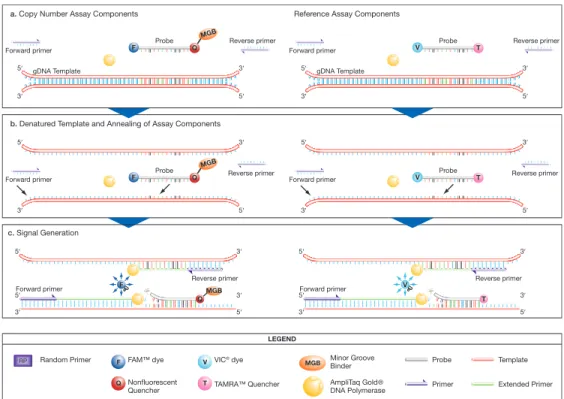
Figure 1 shows the steps in a duplex PCR reaction containing copy number target and reference assays, both of which are 5′ nuclease assays.During PCR:
• A TaqMan® Copy Number Assay, a TaqMan® Copy Number Reference Assay, TaqMan® Genotyping Master Mix, and a gDNA sample are mixed together in a single well or tube.
• The gDNA template is denatured and each set of assay primers anneals to its specific target sequences. Each TaqMan® probe anneals specifically to its complementary sequence between forward and reverse primer binding sites. • When each oligonucleotide probe is intact, the proximity of the quencher dye to
the reporter dye causes the reporter dye signal to be quenched. • During each round of PCR, the target and reference sequences are
simultaneously amplified by AmpliTaq® Gold DNA Polymerase. This enzyme has a 5′ nuclease activity that cleaves probes that are hybridized to each amplicon sequence.
• When an oligonucleotide probe is cleaved by the AmpliTaq Gold DNA
Polymerase 5′ nuclease activity, the quencher is separated from the reporter dye increasing the fluorescence of the reporter. Accumulation of PCRS products can be detected in real time by monitoring the increase in fluorescence of each reporter dye at each PCR cycle.
Figure 1 PCR and detection of target and reference gDNA sequences in a
duplex reaction
b. Denatured Template and Annealing of Assay Components
Forward primer Reverse primer
T
MGB V
LEGEND
Random Primer
RP
5′
3′
a. Copy Number Assay Components
gDNA Template Forward primer
Reverse primer Probe
Q
MGB
F
Probe
Q
MGB
F 5′ 3′ 3′ 5′ 3′ 5′
c.Signal Generation
Reverse primer
F Forward primer 5′ 3′ 3′ 5′ 3′ 5′
MGB Q
Forward primer Reverse primer
5′
3′
Reference Assay Components
gDNA Template Forward primer
Reverse primer Probe T V Probe T V 5′ 3′ 3′ 5′ 3′ 5′
Reverse primer
V Forward primer 5′ 3′ 3′ 5′ 3′ 5′ T
Minor Groove Binder AmpliTaqGold®
DNA Polymerase Nonfluorescent
Quencher
Probe Primer VIC® dye
TAMRA™ Quencher
Q
F FAM™ dye Template Extended Primer
D
The Information CD
About the Information CD files
When you order TaqMan® Copy Number Assays, you receive an Information CD with your order. The CD contains:
• The Assay Information File (AIF)
• A PDF file of the TaqMan® Copy Number Assays Protocol (PN 4397425) • A PDF file of the TaqMan® Copy Number Assays Quick Reference Card
(PN 4397424)
• A PDF file of the CopyCaller™ Software User Guide (PN 44000042)
• A PDF file of the CopyCaller™ Software Quick Reference Card (PN 44000043)
• A PDF file of the Product Insert • A PDF file of the Data Sheet • A PDF file of Safety Data Sheet(s)
• A PDF file of the Understanding Your Shipment document
About the Assay
Information File
(AIF)
The Assay Information File (AIF) contains reference information about your order and technical details for all of the TaqMan® Copy Number Assays in your shipment. The AIF is provided in .txt, .xml, and .html formats. The .html-format AIF is provided as a reference to users; open it in a web browser. The .xml- and .txt-format AIFs are provided primarily for importing and manipulating data electronically. You can use the AIF to:
• Upload Assay IDs into Real-Time PCR instrument software
• View genomic information about pre-designed or Custom Plus assays, including:
– Gene location
– Copy number variant location – Genome location
– Context sequence
• View assay sequence information for Custom assays (not available for pre-designed or Custom Plus assays)
E
Safety
This appendix covers:
Chemical safety . . . 40
General chemical safety . . . 40
SDSs . . . 41
Chemical waste safety . . . 41
Biological hazard safety . . . 42
Safety alerts . . . 44
Chemical safety
General chemical
safety
Chemical hazard warning
WARNING! CHEMICAL HAZARD. Before handling any chemicals, refer
to the Safety Data Sheet (SDS) provided by the manufacturer, and observe all relevant precautions.
WARNING! CHEMICAL HAZARD. All chemicals in the instrument,
including liquid in the lines, are potentially hazardous. Always determine what chemicals have been used in the instrument before changing reagents or instrument components. Wear appropriate eyewear, protective clothing, and gloves when working on the instrument.
WARNING! CHEMICAL HAZARD. Four-liter reagent and waste bottles can
crack and leak. Each 4-liter bottle should be secured in a low-density polyethylene safety container with the cover fastened and the handles locked in the upright position. Wear appropriate eyewear, clothing, and gloves when handling reagent and waste bottles.
WARNING! CHEMICAL STORAGE HAZARD. Never collect or store
waste in a glass container because of the risk of breaking or shattering. Reagent and waste bottles can crack and leak. Each waste bottle should be secured in a low-density polyethylene safety container with the cover fastened and the handles locked in the upright position. Wear appropriate eyewear, clothing, and gloves when handling reagent and waste bottles.
Chemical safety guidelines
To minimize the hazards of chemicals:
• Read and understand the Safety Data Sheets (SDSs) provided by the chemical manufacturer before you store, handle, or work with any chemicals or hazardous materials. (See “About SDSs” on page 41.)
• Minimize contact with chemicals. Wear appropriate personal protective equipment when handling chemicals (for example, safety glasses, gloves, or protective clothing). For additional safety guidelines, consult the SDS.
• Minimize the inhalation of chemicals. Do not leave chemical containers open. Use only with adequate ventilation (for example, fume hood). For additional safety guidelines, consult the SDS.
• Check regularly for chemical leaks or spills. If a leak or spill occurs, follow the manufacturer’s cleanup procedures as recommended in the SDS.
• Comply with all local, state/provincial, or national laws and regulations related to chemical storage, handling, and disposal.
SDSs
About SDSsChemical manufacturers supply current Safety Data Sheets (SDSs) with shipments of hazardous chemicals to new customers. They also provide SDSs with the first shipment of a hazardous chemical to a customer after an SDS has been updated. SDSs provide the safety information you need to store, handle, transport, and dispose of the chemicals safely.
Each time you receive a new SDS packaged with a hazardous chemical, be sure to replace the appropriate SDS in your files.
Obtaining SDSs
The SDS for any chemical supplied by Applied Biosystems is available to you free 24 hours a day. To obtain SDSs:
1. Go to www.appliedbiosystems.com, click Support, then select SDS.
2. In the Keyword Search field, enter the chemical name, product name, SDS part number, or other information that appears in the SDS of interest. Select the language of your choice, then click Search.
3. Find the document of interest, right-click the document title, then select any of the following:
• Open – To view the document • Print Target – To print the document
• Save Target As – To download a PDF version of the document to a destination that you choose
Note: For the SDSs of chemicals not distributed by Applied Biosystems, contact the
chemical manufacturer.
Chemical waste
safety
Chemical waste hazards
CAUTION! HAZARDOUS WASTE. Refer to Safety Data Sheets and local
regulations for handling and disposal.
WARNING! CHEMICAL WASTE HAZARD. Wastes produced by
Applied Biosystems instruments are potentially hazardous and can cause injury, illness, or death.
WARNING! CHEMICAL STORAGE HAZARD. Never collect or store
waste in a glass container because of the risk of breaking or shattering. Reagent and waste bottles can crack and leak. Each waste bottle should be secured in a low-density polyethylene safety container with the cover fastened and the handles locked in the upright position. Wear appropriate eyewear, clothing, and gloves when handling reagent and waste bottles.
Chemical waste safety guidelines
To minimize the hazards of chemical waste:
• Read and understand the Safety Data Sheets (SDSs) provided by the
manufacturers of the chemicals in the waste container before you store, handle, or dispose of chemical waste.
• Provide primary and secondary waste containers. (A primary waste container holds the immediate waste. A secondary container contains spills or leaks from the primary container. Both containers must be compatible with the waste material and meet federal, state, and local requirements for container storage.) • Minimize contact with chemicals. Wear appropriate personal protective
equipment when handling chemicals (for example, safety glasses, gloves, or protective clothing). For additional safety guidelines, consult the SDS.
• Minimize the inhalation of chemicals. Do not leave chemical containers open. Use only with adequate ventilation (for example, fume hood). For additional safety guidelines, consult the SDS.
• Handle chemical wastes in a fume hood.
• After emptying a waste container, seal it with the cap provided.
• Dispose of the contents of the waste tray and waste bottle in accordance with good laboratory practices and local, state/provincial, or national environmental and health regulations.
Waste disposal
If potentially hazardous waste is generated when you operate the instrument, you must:
• Characterize (by analysis if necessary) the waste generated by the particular applications, reagents, and substrates used in your laboratory.
• Ensure the health and safety of all personnel in your laboratory.
• Ensure that the instrument waste is stored, transferred, transported, and disposed of according to all local, state/provincial, and/or national regulations.
IMPORTANT! Radioactive or biohazardous materials may require special
handling, and disposal limitations may apply.
Biological hazard
safety
General biohazard
WARNING! BIOHAZARD. Biological samples such as tissues, body fluids,
infectious agents, and blood of humans and other animals have the potential to transmit infectious diseases. Follow all applicable local, state/provincial, and/or national regulations. Wear appropriate protective equipment, which includes but is not limited to: protective eyewear, face shield, clothing/lab coat, and gloves. All work should be conducted in properly equipped facilities using the appropriate safety equipment (for example, physical containment devices). Individuals should be trained according to applicable regulatory and company/institution requirements before working with potentially infectious materials. Read and follow the applicable guidelines and/or regulatory requirements in the following:
• U.S. Department of Health and Human Services guidelines published in
Biosafety in Microbiological and Biomedical Laboratories found at:
• Occupational Safety and Health Standards, Bloodborne Pathogens (29 CFR§1910.1030; www.access.gpo.gov/
nara/cfr/waisidx_01/29cfr1910a_01.html).
• Your company’s/institution’s Biosafety Program protocols for working with/handling potentially infectious materials.
Additional information about biohazard guidelines is available at:
Safety alerts
General alerts for
all chemicals
For all chemicals, read the Safety Data Sheet (SDS) and follow the handling instructions. Wear appropriate protective eyewear, clothing, and gloves.
Part Number 4397425 Rev. D 09/2010
Technical Resources and Support
For the latest technical resources and support information
Headquarters