MIGRATION
FOR DEVELOPMENT:
A BOTTOM-UP APPROACH
J o i n t M i g r a t i o n a n d D e v e l o p m e n t I n i t i a t i v e
A HANDBOOK
FOR PRACTITIONERS
AND POLICYMAKERS
Jamaica
Ecuador
Cape Verde Senegal
Nigeria
Sri Lanka Mali
Morocco Portugal Spain
France
BelgiumNetherlandsGermany
Georgia Moldova
Bangladesh United Kingdom
Algeria
Egypt
Ethiopia Ghana
Greece
Cyprus
Philippines Austria
Italy
Jamaica
Ecuador
Cape Verde Senegal
Nigeria
Sri Lanka Mali
Morocco Portugal Spain
France
BelgiumNetherlandsGermany
Georgia Moldova
Bangladesh United Kingdom
Algeria
Egypt
Ethiopia Ghana
Greece
Cyprus
Philippines Austria
Italy
Joint Migration and
Development Initiative
Migration for Development:
a Bottom-Up Approach
A Handbook for Practitioners
and Policymakers.
Foreword – European Commission 13
Foreword – United Nations 14
Introduction 15
Background to this Handbook 17
How to use this Handbook 19
PART I: WHO? 21
Chapter 1 A bottom-up approach to migration and development 21
1 1 Migration-development and migrant contributions 23
1 2 Decentralised cooperation, migration and small-scale actors 27
Conclusion 30
PART II ACTIONS: MIGRATION AND DEVELOPMENT IN PRACTICE 31
Chapter 2 Migrant Communities 33
2 1 Network building 34
2 2 Empowering migrant networks 38
2 3 Building on networks for local development 41
Recommendations 45
Chapter 3 Migrant Remittances 47
3 1 Improving financial tools and migrants’ financial capacity 48
3 2 Facilitating collective investment 54
3 3 Supporting individual migrants’ businesses 60
Recommendations 65
Chapter 4 Migrant Capacities 67
4 1 Mapping migrant skills and local needs 68
4 2 Matching skills through transnational engagement 70
4 3 Matching skills through long-term return 75
Recommendations 79
Chapter 5 Migrant Rights 81
5 1 Awareness raising 82
5 2 Assisting vulnerable migrants 88
Recommendations 93
PART III ALLIANCES: TRANSNATIONAL COLLABORATION 95
Chapter 6 Partnerships in M&D 97
6 1 M&D partnership essentials 98
6 2 Complementarities in M&D partnerships 101
6 3 Capacity transfer in M&D partnerships 107
6 4 Threats and solutions 111
Recommendations 117
Chapter 7 Stakeholder engagement in M&D 119
7 1 Identifying stakeholders 120
7 2 Benefits of stakeholder engagement 122
7 3 Forms of collaboration with stakeholders 129
Recommendations 131
Chapter 8 Strategic alliances in M&D 133
8 1 Identifying strategic allies 134
8 2 Benefits of involving strategic allies 137
8 3 Forms of collaboration with strategic allies 143
Recommendations 147
Final recommendations 149
References 153
1 Project Cape Verde-7: “Cape Verde multimedia centre ” 35 2 Project Jamaica-22: “Knowledge networks for connecting Jamaica
and its diaspora ” 37 3 Project Georgia-17: “Promoting cooperation among migrant
communities and local governments for local development ” 40 4 Project Philippines-43: “Maria for the MDGs: harnessing the diaspora,
local women’s groups, rural banks and local governments for rural development ” 43 5 Project Moldova-27: “DEVINPRO Moldova 2009/2010: Strengthening the
link between migration and development through developing and testing replicable migration-related products and services for migrants and their communities ” 50 6 Project Ecuador-9: “Strengthening the productive chain of organic
coffee in the province of Loja, Ecuador ” 55 7 Project Philippines-41: “Enhancing the capacity of migrants as partners
in economic development ” 56 8 Project Senegal-47: “Migrants’ Supporting Tools for Economic Projects:
S T E P ” 61 9 Project Egypt-13: “Entrepreneurial ‘knowledge’: towards Arab
German-Egyptian women development experience ” 73 10 Project Egypt-11: “Migrants skills transfer in aquaculture and fisheries:
the case of Greece and Egypt ” 77 11 Project Moldova-28: “Support for children and parents in migration ” 83 12 Project Algeria-2: “For most of it I have no words: irregular migration
routes and communication ” 84 13 Project Nigeria-39: “Migrant rights: Nigerian-Polish initiative ” 89 14 Project Mali-24: “Improving access to mental health services for forced
return migrants in Mali ” 91 15 Project Nigeria-40: “Sickle cell cohort study: a sustainable pilot
scheme ” 103 16 Project Moldova-30: “Migrants’ capacities for the Moldovan health
system development - a brain gain project ” 104 17 Project Tunisia-51: “Migrants’ information and training ” 108 18 Project Morocco-35: “Migrant rights and cultural otherness ” 123 19 Project Jamaica-21: “Mitigating the negative impact of migration on
the multi-generational household (MGH) in Jamaica ” 127
20 Project Sri Lanka-49: “Leveraging remittances for socioeconomic
development in Sri Lanka ” 135 21 JMDI Knowledge Fair 139 22 Project Morocco-36: “Mutualising migrants’ competences for solidarity
and economic development of Morocco ” 140 23 Project Georgia-15: “Integration of Georgian migrants into the labour
market ”
Fig 1 Different migrant capitals can be exploited in the same
M&D action 32
Fig 2 Actions harnessing the development potential of networks across communities 33
Fig 3 Network building 39
Fig 4 Network empowerment 42
Fig 5 Building on networks for local development 44
Fig 6 Actions enhancing remittances as development tools 47
Fig 7 Improving financial tools and migrants’ financial capacity 54
Fig 8 Facilitating collective investment 60
Fig 9 Supporting the creation and expansion of migrant enterprises 64
Fig 10 Actions enhancing the transfer of knowledge and skills 67
Fig 11 Mapping migrant skills and local needs 71
Fig 12 Matching skills through transnational engagement 74
Fig 13 Matching skills through long-term return: an overview 78
Fig 14 Actions enhancing cultural capital and human rights for development 81
Fig 15 Increasing awareness of migrant rights 87
Fig 16 Providing assistance to vulnerable migrants and their families 92
Fig 17 Alliances in small-scale M&D interventions 95
Fig 18 Partnerships in small-scale M&D projects 97
Fig 19 Binding forces in small-scale M&D partnerships 98
Fig 20 M&D partnerships’ essential elements 101
Fig 21 Complementarities between small-scale actors in a partnership 106
Fig 22 Capacity transfer in small-scale M&D partnerships 110
Fig 23 Threats in small-scale actors’ M&D partnerships 116
Fig 24 Stakeholder engagement in small-scale M&D projects 119
Fig 25 Identifying stakeholders for small-scale M&D projects 121
Fig 26 Benefits of stakeholder engagement in M&D projects 128
Fig 27 Types of collaboration with stakeholders in M&D projects 130
Fig 28 Strategic alliances in small-scale M&D projects 133
Fig 29 Identification of strategic allies in small-scale M&D projects 136
Fig 30 Benefits of strategic ally involvement in small-scale M&D projects 142 Fig 31 Forms of strategic ally involvement 145
ACF Aquaculture and fisheries ACP Africa, Caribbean and Pacific
CeSPI Centro Studi di Politica Internazionale, Italy
COMPAS Centre on Migration, Policy and Society, United Kingdom CoP Community of Practice
CSO Civil Society Organization EC European Commission
EUNOMAD European Network on Migrations and Development FES-ILDIS Friedrich Ebert Stiftung - Instituto Latinoamericano de
Investigaciones Sociales, Bolivia
GFMD Global Forum on Migration and Development GMG Global Migration Group
GTZ Deutsche Gesellschaft für Technische Zusammenarbeit (now Deutsche Gesellschaft für Internationale Zusammenarbeit, GIZ), Germany
ICT Information and Communication Technology IDP Internally Displaced Population
ILO International Labour Organization
IMI International Migration Institute, United Kingdom IOM International Organization for Migration
ISS Institute for Security Studies, South Africa IT Information Technology
JMDI Joint Migration and Development Initiative LA Local Authority
M4D Net Migration4Development Network MA Master of Arts
M&D Migration and Development MDGs Millennium Development Goals MGH Multi-Generational Household
MPI Migration Policy Institute, United States of America NGO Non-Governmental Organization
OECD Organization for Economic Co-operation and Development PhD Doctor of philosophy
PRIO Peace Research Institute Oslo, Norway SCD Sickle cell disease
SIG Savings and Investment Group
SOPEMI Système d’Observation Permanente sur les Migrations UK United Kingdom
UN United Nations
UNDP United Nations Development Programme UNFPA United Nations Population Fund
UNHCR United Nations High Commissioner for Refugees US United States of America
USD United States Dollar WB World Bank
Over the last decade, the European Union has been paying increased attention to the nexus between migration and development The high number of Communica-tions and Council Conclusions addressing this issue clearly demonstrates its high importance on the European and international policy agenda
A huge number of actors worldwide are looking for ways to make migration con-tribute efficiently to development, and at the European Union level this has been translated into an increased embedding of migration in EU development policies, with increasing awareness of the importance of migration as a key development factor The EC-UN Joint Migration and Development Initiative, implemented by UNDP in partnership with IOM, ILO, UNFPA and UNHCR and entirely funded by the European Commission through the thematic programme for cooperation with third countries in the areas of migration and asylum has been in the last years one of the main operational tools for the implementation of this vision This handbook, produced in the framework of such joint initiative, is the result of a deep learning process which included a wide range of actors actively involved in this field, and it provides all the practitioners with very useful and practical skills development tools
I therefore hope that this handbook will become an indispensable support to all the practitioners who have understood that the “human mobility” factor can and must play a fundamental role not only in the development of the migrants’ coun-tries of destination but also their councoun-tries of origin
Fokion FOTIADIS Director General
Directorate General for Development and Cooperation - EuropeAid
European Commission
The need for an evidence-based approach in the field of migration and development has been a recurring theme at the Global Forum on Migration and Development This handbook responds to that need A driving ambition of the EC-UN Joint Migration and Development Initiative (JMDI) has been its commitment to com-pile best practice both from the global community of practice it has created, the Migration4Development Network (www migration4development org), and from the organizations that have implemented JMDI projects This rich body of empiri-cal knowledge has been compiled into this handbook
Viewing migration and development through a human development lens empha-sises a decentralised, bottom-up approach, with organizations at the local and grass root level offering particular potential as actors and partners in migration and development initiatives This handbook – together with the forthcoming IOM/ MPI handbook on engaging diaspora in development, produced in the framework of the Global Forum on Migration and Development (GFMD) Platform for Partner-ships – offers straightforward advice to put this theory into practice
At the 2010 GFMD Peter Sutherland, Special Representative of the UN Secretary-General for Migration and Development, remarked that the JMDI “serves as an outstanding example of how international organizations, national and local gov-ernments, and civil society can work together to amplify the development benefits of migration” In this respect, we are grateful to all those organizations that worked on JMDI projects and whose experiences and achievements have made this handbook possible We are also grateful to the sustained and generous support of the European Union in this area and look forward to our ongoing collaboration
Foreword – United Nations
Mr Antonio Vigilante Director, UN/UNDP Brussels Office
Mr Rudi Delarue Director, ILO Brussels Mr Bernd Hemingway
Director, Regional Office, IOM Brussels Brussels Office
This handbook is produced in the frame-work of the European Commission-United Nations Joint Migration and Development Initiative (JMDI) It is a four-year, 15 million euro programme supporting small-scale organizations in their concrete efforts towards linking migration and development The JMDI reflects the acceptance of and growing interest in the strong links between migration and development The UN High Level Dialogue on Migration and Development in 2006 and the subse-quent Global Fora on Migration and Development underscored international migrants’ contribution to origin and destination countries
Funded by the European Union and implemented by UNDP, the programme represents a major innovation as far as inter-agency collaboration is concerned Four other agencies - UNHCR, UNFPA, ILO and IOM - are also engaged in the management and direction of the pro-gramme and contribute their institu-tional knowledge, expertise and exten-sive networks to ensure its success The JMDI’s Migrant Advisory Board, composed of six experts with recognised academic and hands-on expertise in the field of migration and development, pro-vides further substantive advice to the programme
The overall objective of the JMDI is to provide support to a range of organi-zations who are actively engaged in linking migration and development at the local level The JMDI aims to 1) set up and reinforce networks of actors working on migration and development; 2) identify good practices and share information on what works at the local and international level and; 3) feed this knowledge into policymaking on migra-tion and development
The JMDI issued a Call for Proposals providing approximately 10 million Euro in funding to support projects implemented through partnerships link-ing civil society groups, local authorities and other small-scale actors from Euro-pean Union Member States and their counterparts in sixteen target countries (Algeria, Cape Verde, Ecuador, Egypt, Ethiopia, Georgia, Ghana, Jamaica, Mali, Moldova, Morocco, Nigeria, Philip-pines, Senegal, Sri Lanka and Tunisia) Applications under the Call for Propos-als were made according to predefined thematic areas: migrant communities; migrant remittances; migrant capaci-ties; and migrant rights You will see that this handbook maintains this ter-minology
This handbook reflects the spirit of the JMDI – it is informed by the experiences of those who implemented projects fund-ed by the programme and in turn aims to support civil society organizations, local authorities and other small-scale actors in the future who wish to develop their own migration and development initiative Simultaneously, the hand-book supports policymakers who wish to learn from the experiences of actors which have taken a bottom up approach to migration and development
Since its inception, the JMDI has sought to close the gap between migration and development practitioners and policy-makers The Migration4Development Network (M4D Net) is an online commu-nity of practice with over 2,000 members worldwide It offers the opportunity for practitioners and policymakers to meet virtually to share experiences and good practices In this way, the exchanges that have taken place across M4D Net have also directly informed the content of this handbook
To become a member of M4D Net, go to www migration4development org With over 5,000 visitors each month, this website has become the go-to migration and development online resource centre As well as supporting the M4D Network, it offers the opportunity for visitors to browse a wide variety of migration and development related information includ-ing news, jobs, events and a dedicated migration and development library Members of the M4D Net are able to upload information to the website mean-ing it is truly a website for migration and development practitioners by migra-tion and development practimigra-tioners To further support the needs of small-scale actors, the JMDI has developed an e-learning course - “Running your M&D Project Successfully” You can also find a CD-ROM containing the e-learning course in this handbook It can also be accessed online at www migration4de-velopment org
The course complements this handbook because it offers practical advice on run-ning your Migration & Development (M&D) action From reading this hand-book we hope you will develop a clear idea of the kind of actions and the types of alliances you would like your migra-tion & development initiative to include We then encourage you to turn to the e-learning course which will provide you
with the necessary tools and advice to begin implementing your project! Just as this handbook has been informed by the experiences of those who have implemented JMDI-funded projects, so too has this e-learning course The course is illustrated throughout with photos and examples from JMDI pro-jects
A range of handbooks and other publica-tions have recently been produced to pro-vide tools, advice and recommendations to practitioners and policymakers engag-ing in the field of migration and devel-opment (EUNOMAD 2010; GMG 2010; GTZ 2009; Horst et al 2010; IOM 2010; MPI/IOM forthcoming) This handbook adds to this literature by introducing a specific focus on the role and contri-butions that can be brought by small-scale projects. These are implemented by a range of organizations from civil society, the public and the private sec-tor, including NGOs, migrant organiza-tions, grassroots organizaorganiza-tions, local authorities, universities, research and training institutes, micro-finance institutions, employer associations, trade unions, etc. Owing to the local scale of these actors’ interventions, this handbook generically refers to them as ‘small-scale actors’. Although their organizational size may vary from
small to medium scale, what these actors all have in common is that they enjoy close relations with the local contexts in which they operate This is a key feature in shaping the specific advantages that characterise their engagement in migra-tion and development, which is the topic at the core of this handbook
The handbook is the outcome of exten-sive research that was conducted among actors receiving support from the JMDI during a 12-month ‘Codification’ exer-cise The Codification aimed to under-stand how grantee organizations receiv-ing support for the implementation of their migration and development pro-jects perceived they had benefitted from participation in the JMDI, to analyse the processes and dynamics at play within their projects, and to extract the main lessons learned for the advantage also of others This exercise should not be confused with an ‘Evaluation’, which
requires the independent analysis of immediate project results and an assess-ment of their longer-term impact and sustainability The Codification, instead, was based on a self-evaluation on behalf of JMDI grantees, who were given the opportunity to define what is important for them This was grounded in the systematic collection and analysis of
information in two data-sets The first is a database comprising 121 question-naires compiled by JMDI grantees (58 of which based in countries of the glob-al North, 59 in countries of the globglob-al South); the second is a data-set inclusive of 66 qualitative documents (the tran-scriptions of 13 interviews with JMDI grantees and staff, and 53 reports from JMDI monitoring missions) Both data-sets were integrated with the systematic
analysis of additional documents such as programme documentation, project and partner level progress reports, pro-ject outputs (i e publications, leaflets, websites, etc ) While presenting specific advantages and limitations, this diversi-fied data offered insight into grantees’ own perspectives of their experiences The handbook shares the main lessons learned through the Codification for the benefit of small-scale actors wishing to engage in migration and develop-ment initiatives It is equally of inter-est for other practitioners, as well as for policymakers (in state institutions, international and intergovernmental organizations) in the same field Small-scale actors are always embed-ded in larger political, economic, social, and cultural contexts: migration and development projects may influence the context around them, but they are also constrained by it In line with the focus of the Codification, under each section the handbook does not give small-scale actors instructions on ‘what are the best actions’ and ‘how it is best to do things’ This is highly context-specific and depends on the nature of the inter-vention, the partners involved, the con-straints and opportunities posed by the countries concerned, etc Drawing on the experience of JMDI grantee organi-zations, instead, this handbook testi-fies to the extreme diversity of actions that can be undertaken and of ways in which small-scale actors can interact in
doing so. This is enriched by references throughout the handbook to the con-crete experiences of projects funded by the JMDI. A complete list of these is vided in the final annex, and some pro-jects are presented in greater detail in text boxes that support issues discussed in the text. Quotations from grantees also illustrate some of the concepts and ideas contained in the handbook and are highlight-brackets in the text. Graphics further assist the reader by providing a visual summary of key issues. The
This handbook has been designed as a “toolbox” for practitioners and policy-makers alike.
We invite you to either read the hand-book in full, or refer to specific chapters which might be of particular interest. You will see that the handbook is organised in three main sections, each responding to a key question:
• Who? PART I: After reviewing the links that exist between migration and development, in Chapter 1 the handbook discusses the importance of adopting a bottom-up approach in this field and explores the reasons underlying such an approach.
• What? PART II: Chapters 2-5 makes sense of the diversity of activities that small-scale actors can undertake when implementing migration and develop-ment projects.
• How? PART III: Chapters 6-8 are dedi -cated to exploring the ways in which small-scale actors collaborate between each other and with other actors in the implementation of their projects. PARTS II and III are intended as prac -tical, hands-on sections. Each chap-ter therefore illustrates alchap-ternative or complementary options that actors can choose from when setting up their own migration and development projects. These options are summarised at the
How to use this Handbook
handbook has been written so that it can either be read from beginning to end, or by selecting specific chapters or sections that can be consulted independently. The authors acknowledge the pre-cious feedback and comments received by all the actors involved in the JMDI throughout the research for and writing of this handbook. They are particularly grateful to grantees for sharing with passion and honesty their views and experiences.
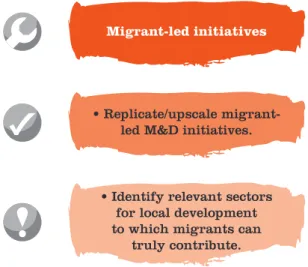
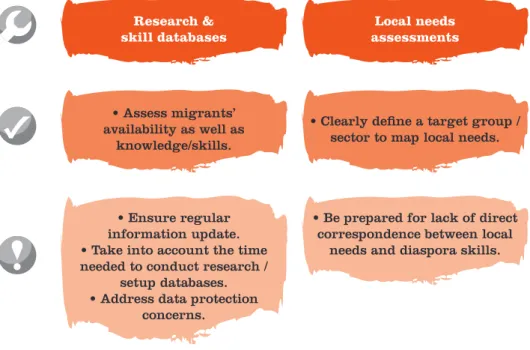
end of each sub-chapter in the form of a diagram which also emphasise key action points and issues to be aware of in relation to the options discussed. Here is an example:
Concrete experiences of projects funded by the JMDI are provided throughout the handbook. Projects are referred to by codes (e.g. Algeria-1). You can then eas-ily refer to the project in the final annex and find the full details of the project referred to. In addition, some projects are presented in greater detail in Text Boxes that support issues discussed in the text. We hope that these examples of JMDI projects will give you ideas for your own M&D initiatives!
Virtual networking spaces Networking events
• Reach out virtually to significant numbers
of actors. • Bring together a limited
number of actors in face-to-face contact.
• Identify modes of update and maintenance. • Be aware of abilities
/ limits in identifying participants.
Finally, look out for the practical recom-mendations at the end of each chapter. At the end of the handbook, overall rec-ommendations for small-scale actors are matched with parallel recommendations for policymakers wishing to support their actions.
This handbook is concerned with two main issues: it explores the topic of migration and development, and it looks more specifically at how small-scale actors can contribute in this field This chapter introduces the reader to both these issues: in this introduction a brief overview is offered on why migration and development are linked and how small-scale actors fit into the picture Both these points are then further elabo-rated in the next two sections Section 1 1 illustrates the different resources that migrants can contribute towards development in their countries of ori-gin Section 1 2 explores the underlying reasons justifying the importance of a small-scale approach to migration and development (hereafter M&D)
Migration is a complex phenomenon For decades experts have been ask-ing themselves whether and how the resources generated through human mobility affect development Approaches to M&D have been influenced by the alternation of optimistic and pessimis-tic discourses Whereas in the 1960s migration was thought to contribute with financial remittances and knowl-edge to the ‘modernisation’ of sending regions, in the 1970s it was blamed for nurturing global inequalities through
the transfer of cheap labour to devel-oped regions Throughout the 1980s and 1990s, research demonstrated that migration and its consequences are not influenced by economic forces alone This acknowledgement that migrants and the broader structures in which
they are embedded affect each other has led to the emergence of M&D as a field that considers migration an integral part of development Larger global and national development contexts deter-mine local development contexts, which in turn affect peoples’ aspirations and opportunities to migrate At the same time, peoples’ aspirations and the oppor-tunities available in the local contexts where they live determine how they can use the resources resulting from mobility for their own wellbeing, and for that of their communities and nations (de Haas 2010)
PART I: WHO?
Chapter 1. A bottom-up approach to
migration and development
A bottom-up approach to migration and development
This reciprocal relationship between M&D is aligned with the capabil-ity approach to human development (Alkire 2009; Nussbaum 2011) Inspired by the work of Amartya Sen (1999), this approach understands development as the enlargement of people’s ‘capabili-ties’, defined as what they are able to do and be in life1 Because people are
seen as holding the power to shape their lives, development cannot be achieved for them, but only by them People are their own providers of aid: they are the beneficiaries, as well as the architects of economic and social progress The goals and the means of development are, therefore, to enhance peoples’ intrinsic capacities (e g knowledge, health, self-respect), as well as the opportunities (e g access to education, employment, or decision-making processes) that make them ‘capable’ of shaping their own destiny
In line with this approach, in the M&D field the role of migrants (Faist and Fauser 2011) as well as that of other small-scale actors has been revisited Individual migrants and their associa-tions, local authorities, civil society, NGOs, the private sector, the academic
sector, etc have become key actors in development cooperation The inter-national community has increasingly supported the creation of synergies with and between these small-scale actors, who have the potential to better link the migration and development dimensions of interventions in countries of origin, transit or destination Policymakers have sought to create opportunities to involve small-scale actors in M&D (e g the JMDI is a concrete example of poli-cymakers’ efforts to harness the role of small-scale actors in M&D processes) Following the human development approach, small-scale actors’ capacities and capabilities need to be enhanced, and adequate opportunities must be in place to support their active engage-ment Among these small-scale actors, policymakers have dedicated special attention to the role played by migrants themselves They have insisted on the protection of migrants’ rights2, the
crea-tion of more avenues for legal migra-tion, and migrants’ full participation in the societies of origin and residence3,
all of which are thought to influence their engagement in development The human development approach has also influenced the way in which migrants’
1 In what has become known as the ‘capabilities approach’ (1999), Sen suggests that development is concerned both with the processes through which a given state of wellbeing can be achieved and with the results achieved, or outcomes
2 See: International Convention on the Protection of the Rights of All Migrant Workers and Members of their Families (1990)
3 UNDP suggests six major directions of reform to enhance migration’s positive effects on human development: “Opening up existing [temporary] entry channels so that more workers can emigrate, ensuring basic rights for migrants, lowering the transaction costs of migration, finding solutions that benefit both destination communities and the migrants they receive, making it easier for people to move within their own countries, and mainstreaming migration into national development strategies” (UNDP 2009: 4)
contributions to development are per-ceived: as discussed in the next section, not only financial remittances, but also social remittances such as networks and relations, skills and knowledge, ideas and values (Levitt 1998) embed developmental potential
In sum, there is a growing recogni-tion of the reciprocal relarecogni-tionship between human mobility and devel-opment This acknowledgement goes along with efforts, on behalf of policy-makers, to make room for small-scale actors to contribute actively to M&D interventions The resources generated through migration as well as the ways in which small-scale actors can help channel them for development are fur-ther discussed in the next sections of this chapter
1.1 Migration-development
and migrant contributions
Human mobility generates a num-ber of ‘capitals’ These are the main resources, or assets, that migrants contribute in M&D: social, financial, human and cultural capital For each of these assets, this section provides a definition and illustrates why it is important Although it is essential to acknowledge that migrants can (and do) contribute significantly also to their host countries, this handbook focuses on the ways in which different migrant capitals can positively affect the devel-opment of home countriesSocial capital. Migrants develop and maintain social ties across different loca-tions The potential embedded in these social relations to yield other resources is known as social capital This is what allows the creation of networks that facilitate the flow of information, skills, financial resources, values, ideas, etc Social capital can link different groups from migrant families, to diaspora asso-ciations, to professional and business networks, or even religious congrega-tions (Faist and Fauser 2011: 16) M&D practitioners are increasingly interested in mobilising migrants’ social capital for development It is assumed that owing to their transnational belonging migrants possess context-related knowledge, emotional ties, legiti-macy vis-à-vis local populations and insight into the diverse local realities in which they participate (de Haas 2006) Migrants are therefore accredited with a unique potential to bridge the vari-ous contexts in which they simultane-ously invest, and to engage in long-term philanthropic activities Many think that these ties are bound to weaken as migrants integrate in the areas of settlement However, most migrants hold ‘transnational livelihoods’ and, thanks to the expansion of informa-tion and communicainforma-tion technologies (ICTs) and increasing mobility, most migrants are capable of maintaining these ties over time They can therefore leverage on these ties to engage in
opment actions on their own, or provide first-hand information to policymak-ers This potential should nonetheless not be overestimated Migrants are not always sufficiently integrated in those trans-local realities, politically aware of, or concerned with, development issues Diasporas can be divided, migrant net-works are sometimes not in place, or they might be dispersed This hampers the mobilisation of their social capital
To overcome such constraints M&D practitioners embark in activities aimed at better knowing diasporas, enhancing their networks, and engaging in trust-building processes, or having migrants engage directly as partners in develop-ment cooperation (see Chapter 2) Financial capital. Migrants’ financial capital has received utmost attention in particular over the last decade, part-ly because of the size of remittances received by developing countries (USD 315 billion in 2010; WB 2010), and the potential embedded in diaspora savings (USD 400 billion; WB 2011) for financial
markets M&D practitioners are inter-ested in channelling these resources for development Remittances are pri-vate funds or in-kind transfers made by migrants to their non-migrant relatives Together with the cost, speed, accessibil-ity and reliabilaccessibil-ity of transfer services, the level of information and financial lit-eracy of senders and recipients influence their choice of a transfer channel (Pieke et al 2005) While informal services comply with many basic requirements, the cost of formal services in most regions remains high, as it is largely determined by financial regulations and infrastructure (Ratha and Riedberg 2005; Ratha 2007) The use of recorded services is important for governments mainly for two reasons First, officially recorded remittances are a source of foreign exchange that contributes to recipient countries’ macroeconomic sta-bility Second, informality is (sometimes misguidedly) associated with security concerns, such as financing terrorism or money laundering (Pérouse de Montclos 2005) These issues add to an interest for remittances’ developmental effects Remittances constitute a supplemen-tary source of household income that allows basic necessities to be afforded, and customary events to be enjoyed (i e religious festivals, town celebrations, anniversaries and other family related occasions) Because they stimulate con-sumption, remittances could have multi-plier effects in local economies However, it has also been argued that not all the
members of a household benefit equally from remittances Remittances could lead to dependency relations between senders and recipients, produce income inequalities between migrant and non-migrant households, or even destabilise fragile economies
Because remittances are private funds, influencing the choices of senders and recipients regarding transfer channels and remittances’ utilisation is challeng-ing M&D interventions thus focus on improving remittance legislative frame-works and strengthening the financial sector to foster competition among ser-vice providers and reduce transfer costs Efforts are also directed towards the development of financial products for migrants and their families, improv-ing financial literacy, and facilitatimprov-ing investment in countries of origin (see Chapter 3)
Human capital. Migrants’ skills and knowledge, or human capital, consti-tute another asset for development Beyond qualifications, human capital can include the occupation, interper-sonal skills and self-confidence of the individual (Wescott et al 2006: 15) Because skilled persons are thought to embody highly valued human capi-tal, their mobility has generated vivid debate regarding the costs and bene-fits of migration For example, ‘brain drain’ is a form of skilled migration whereby returns of investments in
edu-cation made by sending countries are thought to be lost When highly skilled migrants are hired to do jobs for which they are overqualified, the situation is called ‘brain waste’ It has been recog-nised, however, that knowledge benefits tend to be shared between sending and receiving countries (Wickramasekara 2002: 6) For example, skilled migrants are expected to enhance their capacities and earn higher wages abroad This could translate into remittances, tech-nology transfers, links to professional networks, investment and – arguably – a better integration of origin countries into the global markets This is known as ‘brain gain’ The ‘brain drain’, ‘brain waste’ and ‘brain gain’ debates largely refer to highly skilled or skilled persons (i e higher education students, profes-sionals, people employed in high-tech and high-productivity sectors) Skills and knowledge, however, may also be transferred by people of lesser educa-tional and professional standing, which is better understood by adopting the idea of ‘circulation’ Awareness of migrants’ transnational livelihoods has recently led to promote ‘circulation’ as an alterna-tive to share the gains of skill mobility (Wickramasekara 2002), for instance through the geographic movement of migrant workers or through business networks (Faist 2008) Networks, in fact, need not be diaspora-specific in order to play a role in fostering knowl-edge transfer/exchange (Wescott et al 2006: 16) At the policy level, three
major approaches have been reflected to address the mobility of skills: retention (through incentives), return (permanent or temporary) and circulation of skills In a similar vein, M&D interventions adopt different strategies to map and match skills for the benefit of develop-ment (see Chapter 4)
Cultural capital. Migrants’ contribu-tions to development depend upon the realisation of their capabilities and rights Human mobility is fundamen-tally an issue of choice and freedom of all people The movement of people is most successful when individuals are in a position to make the most out of their migration (UNDP 2009: 15) Not everyone, however, has the opportunity to move freely and under dignified con-ditions Constraints to migration vary and can have different consequences on migrants’ wellbeing (de Haas et al 2009) Lack of economic resources, social capital and legal restrictions to migration are examples of different lev-els of constraints to migration Among possible positive outcomes of mobil-ity, migrants’ wellbeing can improve through the acquisition of new values and ideas (i e democracy, equity, etc ), known as ‘cultural capital’ Migrants may tap into this cultural capital, for instance by contributing to peace build-ing and conflict resolution in countries of origin Mobility may also increase access to social, economic and politi-cal freedoms, or it “may also imply
a decrease in wealth and wellbeing, especially if such decisions are taken in highly constrained environments” (de Haas et al 2009: 22-23) This could be the case of human trafficking, forced migration or involuntary resettling both in the case of international and inter-nal migration Thus, migrants need to weigh the benefits of migration in terms of wellbeing against the potential social, political and physiological costs it also entails This is why on the one hand M&D interventions focus on enhancing migrants’ capabilities through the provi-sion of pre-departure and post-arrival information and assistance; encour-aging ethical recruitment; improving migrants’ integration in destination areas and lobbying at political level for migrants’ rights On the other hand, practitioners are working to increase the capabilities also of migrant house-holds by ensuring access to services and support for them to cope with the social costs of migration (see Chapter 5) Migrants’ engagement in M&D. Final-ly, it is worth mentioning that migrants’ engagement in M&D can take many forms For example, they can individu-ally send remittances to their relatives, or they can engage collectively, through their associations, in advocacy cam-paigns or in the improvement of local services and infrastructures Migrants can initiate their own projects or sup-port other practitioners to implement projects on their behalf Migrants can
return (permanently or temporarily) to their regions of origin or engage in development processes at a distance (i e participating in virtual conferences) Migrants can act out of altruism or pri-vate interest, and their engagement may be voluntary-based or professional, cost-free or subject to compensation These different forms of participation point to the need for measures that can encour-age their involvement in M&D Political frameworks that recognise migrants’ transnational engagement, multiple obligations and loyalties are likely to succeed incentivising their engagement in development processes This includes promoting migrants’ socio-economic and civil-political integration in destina-tion and origin societies
After having reviewed in this section the different ‘capitals’ that migrants can contribute to development, the next section discusses the issue of partici-pation of small-scale actors, including migrants, in M&D
1.2 Decentralised cooperation,
migration and small-scale actors
The adoption of a capability approach to human development mentioned in the introduction to this chapter is in line with two parallel trends that have emerged in the development field over the last decades The first is concerned with the increasing importance attrib-uted to processes of decentralisation (i e the transfer of decision-makingprocesses and cooperation efforts at the local level, closer to the people who are directly affected), and the second with the role that can be played in devel-opment by civil society (Faist 2008) In combination, these trends have cre-ated greater room for small-scale actors’ involvement in local development pro-cesses In M&D, this has transformed the position of small-scale actors, who are viewed as ‘allies’ who can make important contributions, especially at the local level
Decentralisation and civil society participation. Decentralised coopera-tion, just like the human approach to development, puts people at the core of decision-making processes Participa-tion is a means and a goal of decentrali-sation: it calls for greater cooperation at all administrative levels, including the sharing of responsibility between central authorities, local authorities and civil society While local authorities have had a key role in decentralisation and local development, cooperation has been opened up to almost all forms of organ-ised participation, from NGOs and CSOs, to grassroots associations, migrant associations, voluntary-based organi-zations, professional bodies, religious and community leaders, and the private and the academic sector, etc Cooperation between small-scale actors and policy-makers is based on the assumption that the former can actively contribute to achieving development, especially when
their actions are aligned with broader local and national development goals This approach is in line with calls for greater synergies and coherence in M&D and multilateral, bilateral and local cooperation4, as well as the
prin-ciple of ‘shared responsibility’ between governments and the civil society on migration and human development as stated at the 2010 Global Forum on Migration and Development (GFMD)5
The value added of building alliances at different levels of M&D cooperation was explored at the Forum, both as a means to share responsibility between governmental and non-governmental actors, as well as to advance the M&D international agenda
Sharing responsibility in M&D between small-scale actors and policymakers is first and foremost an issue of ‘par-ticipation’ To encourage small-scale actors’ engagement in M&D policymak-ers undertake several actions that are participatory in nature (consultation processes, networking, providing or matching funds to support small-scale M&D interventions, etc) These activities require diverse degrees of involvement and confer various levels of ownership over M&D processes to small-scale
actors This is true also in the case of migrants, whose participation in M&D can take various forms: migrants can initiate a M&D project independently; they can contribute with specific input during a consultation; or they can sim-ply be the beneficiaries of interventions designed without their involvement Each case provides an example of dif-ferent levels of participation and owner-ship, which determine the overall posi-tion that migrants can hold in M&D interventions: as partners, stakeholders or beneficiaries
Added value of a bottom-up approach. Small-scale actor involvement in M&D has many advantages Besides possess-ing specific technical expertise, they can contribute context-specific knowledge (i e on local needs, representation, social tensions, community participation, etc ) and trust vis-à-vis local populations, and access areas difficult to reach for others They can possess insight into specific issues that might escape larger development actors, provide services to underserved populations, build local capacity and match the larger efforts of policymakers in many ways For exam-ple, they can provide evidence about the realities where they operate to inform development and migration policies
4 UN High Level Dialogue on Migration and Development held in 2006; Council of the European Union (2006); European Commission (2006); European Commission communication on local authorities (2008)
5 Global Forum on Migration and Development (GFMD) 2010 http://www gfmd org/en/gfmd-meetings/mexico-2010 html; civil society http://www gfmd org/en/process/civil-society html (accessed 8/06/2011) Moreover, a new facility, the Platform for Partnerships, was presented and discussed at the GFMD 2010, visit: http://www gfmd org/en/pfp html (accessed 08/06/2011)
Moreover, small-scale actors could be attractive in the eyes of other develop-ment actors thanks to the fact that they have lighter management structures and are closer to the field, thus enjoying greater legitimacy at the local level For small-scale actors, engaging in M&D can open up opportunities to enlarge their networks, access new contexts of intervention, enhance their capacities, and build a track record to strengthen their role as key players in the M&D arena A romantic view of small-scale actors may however blur other reali-ties, such as the influence of the con-text in which these actors emerge Some organizations, for instance, may be the product or the object of politi-cal instrumentalisation, while others may be the outcome of genuine local demands (Beauchemin and Schoumaker 2009; Bergh 2010) The size and nature (voluntary vs professional) of small-scale actors, their organizational cul-ture and level of financial autonomy clearly affect how they engage in M&D and what they can accomplish Not all small-scale actors are necessarily natu-rally born practitioners in the field of M&D Sharing responsibility with them is therefore favoured not only when there is political will, but when adequate structures of financial and technical support also exist
Sharing the responsibility in M&D implies also understanding the dif-ferent forms in which policymakers
and small-scale actors can interact and cooperate To engage in transnational M&D projects small-scale actors may approach donors and central authori-ties, familiarise with civil society struc-tures and policy frameworks that regu-late their action in the contexts where they intervene In the case of migrants and their associations, the level of socio-economic and political integra-tion in both areas clearly affects – and is affected by – those processes Some-times small-scale actors cannot access mainstream funding and therefore partner with larger actors to secure financial resources for their interven-tions Moreover, different small-scale actors across different countries can join forces and establish partnerships to implement M&D projects (see Chap-ter 6), and they can collaborate with a wide range of local stakeholders in the contexts of intervention (see Chapter 7) It is likely that small-scale actors also seek to access the public sphere to advocate for their cause and lobby policymakers, share information to feed their practice, or turn to them for help (see Chapter 8) Differences in organi-zational culture, mandates, resourc-es, and objectives of the wide range of small-scale actors involved in M&D (together with the diversity of the con-texts in which they operate and of the actions they undertake) accounts for an extreme variation in the forms and the results of collaboration A small-scale approach to M&D therefore calls
for flexibility that can accommodate the diversity of small-scale actors As has been aptly summarised: “[t]he chal-lenge for development actors is not to make diaspora organizations [and other small-scale actors] more like them, but to build on their unique strengths” (de Haas 2006: iii)
Recognising different forms of engage-ment and levels of participation is vital to clearly define the prospects between decentralised cooperation, migration and human development, and to estab-lish more transparent forms of coopera-tion between policymakers, migrants and other small-scale actors Taking into consideration the advantages and difficulties mentioned above, it would be wise to conciliate the ambitions of poli-cymakers and small-scale actors before jointly undertaking M&D interven-tions, as different requirements need to be satisfied before small-scale actors can become development practitioners and collaborate effectively with other established actors in this field Finally, there is a need to further integrate migration and development policies and achieve more coherence between the two (see GFMD 2007; GFMD 2009)
Conclusion
This chapter has introduced the reader to M&D, and to why and how ‘migration’ and ‘development’ are linked It has also justified the importance of a bottom-up approach to M&D
Increased awareness of the strong rela-tionship that exists between migration and development justifies the attention that M&D has attracted over the last decades The growing importance of M&D as a field has been accompanied by greater opportunities for the active participation through concrete interven-tions of migrants, civil society and, more broadly, of small-scale actors Current dominant approaches to human devel-opment and cooperation recognise the potential of small-scale organizations as ‘actors’ and ‘partners’ in development cooperation The advantages of working with small-scale actors are emphasised, particularly at the local dimension Cer-tainly, a small-scale approach to M&D has many benefits in terms of greater participation of small-scale actors in development processes, as well as in terms of cost-benefit calculations for policymakers who decide to support small-scale interventions in M&D Having read this chapter, the reader should possess the necessary knowl-edge and understanding that will allow them to make full use of the chapters in the two sections that follow The next chapters provide practical tools that small-scale actors can use to facilitate the channelling of migrant capitals for homeland development, and sug-gest how small-scale actors (including migrants) can better organise them-selves and interact with others to achieve this goal
PART II. ACTIONS
MIGRATION AND DEVELOPMENT
IN PRACTICE
After having introduced the debate on M&D and the specific contributions that can be made by migrants through their transnational engagements (see Section 1 1), this part of the handbook discusses a range of different activities that small-scale actors may undertake to enhance the transfer of different forms of ‘capital’ between countries
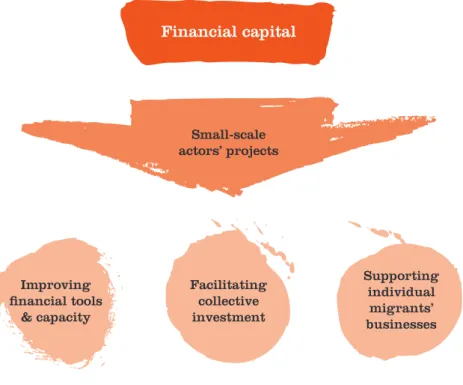
The four chapters that follow are dedi-cated respectively to detailing the ways in which: social capital generates net-works between migrants’ sending and receiving countries and can be exploit-ed for development (Chapter 2), finan-cial capital can be directed towards enhanced savings and productive invest-ment (Chapter 3), human capital allows the transfer of skills and capacities to the benefit of sending countries (Chapter 4), cultural capital makes migrants and their communities more aware of their rights and favours the transfer of ideas and values (Chapter 5)
A variety of ways are available for small-scale actors to enhance the develop-ment potential of each of these forms of migrant capital The handbook tries to make sense of this variety by providing examples of different sets of activities through which this can be done in prac-tice, offering an overview of different
‘building blocks’ that small-scale actors may choose from when assembling their own M&D intervention For each form of migrant capital, the handbook does not aim at suggesting the ‘best actions’, as this is highly dependent upon the specificities of the migrant group at stake, the countries involved, and the
nature of the project partners Instead, the handbook provides examples that illustrate the diversity of ways in which things can be done and for each case it discusses the strengths and weak-nesses In real life, M&D projects rarely address exclusively one form of capital and they more often combine activities that simultaneously target the multiple contributions that migrants can bring to local development
Overlap is in fact beneficial to the final outcome of an intervention: remittances or capacities, for instance, are better
PART II. ACTIONS: MIGRATION AND
DEVELOPMENT IN PRACTICE
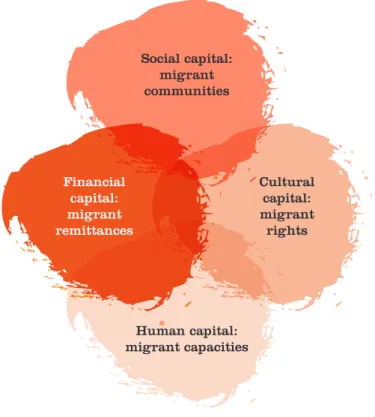
Figure 1: Different migrant capitals can be exploited in the same M&D action
channelled when the bonds within a community are also reinforced The reader seeking inspiration to set up a M&D project should therefore use each chapter as a sort of toolbox, in which the different activities illustrated can be variously combined to create a unique M&D action
Social capital: migrant communities
Financial capital: migrant remittances
Cultural capital: migrant
rights
Human capital: migrant capacities
Figure 2:
Actions harnessing the development potential of networks across communities
Chapter 2. Migrant Communities
In today’s age of global connections and transnational flows migrants increas-ingly maintain and develop social rela-tions across distant locarela-tions, invest-ing simultaneously in home and host countries (Castles and Miller, 2009) These border-crossing social relations favour the establishment of transnation-al networks that transnation-allow engagement in “occupations and activities that require regular and sustained social contacts over time across national borders for
their implementation” (Portes et al , 1999: 219) Social capital is the basic element on which any M&D project can be constructed; it is through these net-works that the flow of other resources (human, financial and cultural capital) is made possible Small-scale actors can engage in different initiatives that har-ness transnational linkages and exploit their potential for local development These are summarised in the follow-ing figure
Small-scale actors’ projects
Social capital
Building on networks
for local development Empowering
migrant networks Network
building
Network-building actions aim at strengthening ties within and across communities (Section 2 1); empower-ing efforts increase actors’ knowledge about how they can favour development processes and provide them with the necessary skills to do so (Section 2 2); and setting up projects that are rooted in established networks allows migrants to contribute directly to local develop-ment (Section 2 3)
2.1 Network building
Although it is widely accepted that migrants maintain strong links with their communities of origin, the rel-evance of these connections for M&D should not be taken for granted Migrants, in fact, may uphold strong contacts primarily at the level of house-holds or among close social relations in their communities of origin, and it may be beneficial to reach out also to other key players Small-scale organizations can help establish contact between dif-ferent actors that will favour opportuni-ties for exchange that is meaningful for local development Interventions of this kind are defined as network-building; they attempt to harness the networks that link migrants and their home com-munities to each other and/or to other relevant actors elsewhere
Before further illustrating some specific tools through which networks can be built it is useful to highlight that net-work-building interventions differ
sig-nificantly on the basis of the nature of the actors they bring together: they may leverage South-North, South-South or North-North links and they may connect migrants to their families, or to actors such as local authorities, civil society groups, other migrant organizations In addition, the nature of the elements binding a network are equally variable: networks may be based on geographic links connecting migrant sending and receiving locations in different coun-tries, but they may also leverage on other elements of common identifica-tion, such as generation (see Text box 1), gender (see Text box 4), profession, a sense of belonging to a broader diaspora community, or even a combination of these elements (see Text box 9)
Variation in the nature of the actors within a network and of the contents of the bonds linking them influences the form of network-building activities that small-scale actors might choose Network-building, for instance, can be achieved through the organization of one-off networking events and/or through the establishment of more dura-ble opportunities for exchange, such as internet platforms
Networking events. Small-scale actors can promote one-off events bringing together different sets of actors, with the aim of better knowing each other and setting the grounds for further col-laboration A number of JMDI projects
Project: Cape Verde-7
Title: “Cape Verde multimedia center”
Partners: Associação Jovens Solidarios, Associazione di Promozione Sociale Lunaria, Associazione Donne Capoverdiane in Italia, Binario Etico
Countries: Cape Verde and Italy
The project aimed to promote access to Information and Communication Technologies (ICTs) in the island of Saõ Nicolau, Cape Verde, as a way to enhance social inclusion and to facilitate communication between the local community and overseas migrants
A multimedia centre was set up in Saõ Nicolau by using recycled material collected in Italy and freeware software Training courses on ICT were offered both to local youth and to young second-generation migrants of Cape Verdean origin in Italy Enhanced IT capacity of both these groups and access to the internet in Cape Verde allowed the project to support the creation and strengthening of transnational diaspora networks linking communities across the world with this island The project generated great enthusiasm, particularly among second-generation Cape Verdean youths in Rome, who were actively involved in the activities of the online network set up to bring them together with AJS members in Cape Verde In addition to relying importantly on ICTs, ‘study trips’ were planned in Rome and Saõ Nicolau to facilitate face-to-face meetings, and encourage further exchange and collaboration between the concerned youths The project, moreover, succeeded in reaching out to members of the Cape Verdean diaspora worldwide who contacted project partners through the established web portal and online radio This project is also exemplary of capacity building within the partner organizations In particular, AJS benefitted from peer-to-peer support, including quarterly visits from the overall project coordinator and targeted assistance in project management (i e accounting support, the translation of project implementation guidelines into Portuguese and reporting) Besides capacity transfer, the implementation of project activities was facilitated by bringing together partner organizations with differ-ent but complemdiffer-entary technical and social competences (ICT capacity, experience handling international projects, strong community links in Italy and Cape Verde) Overall, this project offers an interesting example of how community networks linking migrants’ home and host communities need not necessarily rely only on the relevance of geographic links between localities Youth proved to be a powerful element to establish linkages between the island of Saõ Nicolau and the broader Cape Verdean diaspora Today, it is expected that the transnational networks established within this project can form the basis for the transfer of material, human, and cul-tural capital that can have further impact on local development
Migrant Communities
Text box 1
did so by hosting conferences, fairs, fora, seminars and workshops, in which migrant associations were invited and put in touch with local actors in their countries of origin, thereby potentially contributing to the establishment of partnerships and the rolling out of new initiatives These events have the advan-tage of promoting face-to-face contact between actors, giving them the power to define autonomously the contents of further exchange These events are how-ever unique and non-replicable They also target limited numbers of people, making their success highly depend-ent upon the organisers’ capacity of identifying participants Lessons from the JMDI show that networking events of this kind are most effective when they act at the transnational scale (i e when they involve actors from different countries that are connected through
migration) and when they bring togeth-er actors who did not already know each other This requires relying either on extensive mapping exercises to identify pertinent actors in different locations, or on complementary pre-existing contacts of various event promoters (e g the joint ability to mobilise diaspora associations abroad and local actors in countries of origin) The choice of the channels used to communicate with target groups (e g one-to-one contact, media, web, etc ) also strongly conditions opportunities among them to access these events
Virtual networking spaces. Some of the limitations faced by one-off network-building events are overcome by invest-ing in broader structures that allow actors to establish contact and access information about each other JMDI pro-jects relied heavily on Information and Communication Technologies (ICTs) to set up internet portals, communicate Networking events:
“We used the international event as an opportunity
to get those invited to engage actively We used a participatory approach, with
facilitators encouraging participants to present and
discuss their projects in focus groups We also invited
them to sign charters in which they pledged to engage
in further migration and development actions”
Virtual networks: “We established a web portal on ‘partnership for development’ where there is a lot of information, but also fora so that each migrant can open a discussion and take part in discussions Even we
did not expect such active involvement of migrants:
there are 1,600 entries registered there each month”
Project: Jamaica-22
Title: “Knowledge networks for connecting Jamaica and its diaspora”
Partners: Mona School of Business, KAJAN’s Women’s Enterprise
Countries: Jamaica and UK
The project aimed to create networks among migrant communities for development, bringing actors together in an online environment that could promote the dias-pora’s structured and sustained engagement in poli-cymaking, development planning and implementation of projects in Jamaica
The project set out to achieve these goals by setting up the web portal http://jamaicadiasporaconnect com In Jamaica, the needs of local communities and institu-tions were mapped and community-based organizainstitu-tions were included in a database showcasing projects that could benefit from the support of the Jamaican diaspora An inventory of research on diaspora issues was also made accessible via the portal In the UK, through the involvement of a stakeholder NGO with close links to the Jamaican High Commission in London, the project reached out to individual Jamaican migrants, encouraging them to register with the portal and to make their own skills known in Jamaica for voluntary or consultancy services In addition, the project mapped and categorised different Jamaican diaspora groups on the basis of their primary interests or sectors of intervention (education, social services, healthcare, business, etc ) Databases and web portals can pose a serious challenge for small-scale actors, particularly in terms of future maintenance In the case of this project, this was assured by the Jamaican Diaspora Institute Moreover, the project enjoyed the support of central authorities (Jamaica’s Ministry of Foreign Affairs and the Tourist Board), whose efforts to connect with the Jamaican diaspora were matched by the project’s virtual network
This project proves that ICTs can effectively enhance the linkages between a home country and the distant places in which its diaspora is located This technologi-cal choice, however, led to some implementation challenges The project primarily targeted the UK-based Jamaican diaspora, made up of significant numbers of older migrants who are less technologically savvy In addition, initial attempts to reach out to Jamaican migrants individually resulted in low registration Hence, more friendly tools were developed and more effective strategies to reach out to the Jamai-can diaspora collectively were adopted
The creation of a web portal is an innovative attempt to bring together various diaspora groups and organizations under an umbrella structure In addition to establishing linkages with the Jamaican diaspora that can be exploited in favour of local development processes, this project generated the unexpected outcome of enhancing contact among community-based actors in Jamaica This approach could be replicated in other contexts and, indeed, project partners aim to broaden the portal to the Jamaican diaspora in other countries of destination
Migrant Communities
Text box 2
via online radio channels, promote dias-pora magazines or web blogs A signifi-cant example comes from a project with activities in Jamaica and in the United Kingdom (UK), which established a web portal bringing together migrants and Jamaican diaspora organizations with community-based organizations active on the development scene in Jamaica By providing information about mutual needs and expertise, the portal aimed at encouraging linkages between migrants and actors in the home country that could lead to exchange and collabora-tion (see Text box 2)
While offering various advantages, the use of ICTs as tools to facilitate network-ing require greater efforts to enhance ownership among users Measures must be devised to ensure that targeted actors appropriate these means, feel them as ‘theirs’ and make active use of them, as well as to ensure sustainability over time Compared to one-off events bring-ing actors physically together, none-theless, relying on virtual networking spaces helps reaching out to
signifi-cant numbers of actors across different locations and over time Some projects, however, came to recognise that the inti-macy of face-to-face interaction is impor-tant for contacts to further develop into concrete and durable interactions The “Cape Verde multimedia centre” project, for instance, generated initial interest among diaspora youths and later offered opportunities for them to meet with peers living in Cape Verde (see Text box 1) While gathering resources that remain available to potential users over time, the information contained in web-related structures also demands upkeep and updating
In sum, network building can be achieved through different activities These are summarised in figure 3, which outlines some factors that should be taken into account when planning and implement-ing activities of this kind
2.2 Empowering migrant
networks
A variety of actors with a potential to engage in M&D may not do so because of a lack of relevant networks, but also because of their oftentimes lim-ited capacity or know-how Small-scale actors can empower communities and their members to engage concretely in M&D by increasing awareness among different target groups about how they can favour local development dissemi-nating best practices, and providing them with capacity building training