Andrew Smith
Activity 5.6 Physical Property Analysis
Introduction
What do you need to know about a product before it is built? Would you need to know its volume, surface area, or weight? Would the product weigh less if it were made of aluminum or mild steel? What about copper, brass, or cast iron? How could this information impact the product design?
How can you find the properties of a product before it is built? You can calculate them mathematically, providing you have the material specifications, but it will take time. In today’s busy, fast-paced world, engineers use solid modeling software programs to speed up the calculating process. However, the user of the software must understand what the software is doing in order to estimate the answers and to be able to recognize a possible error.
Equipment
Engineering notebook
Pencil
Computer with 3D CAD solid modeling software
Calculator
Procedure
In this activity you will calculate the volume of a part and the surface area; you will look up the density of the material and then calculate the mass. Next, you will check your work using a 3D solid modeling software program. After you have learned how to calculate the physical properties of the example parts provided, you will then do an analysis on a puzzle cube piece and parts of your Automoblox vehicle or other consumer product.
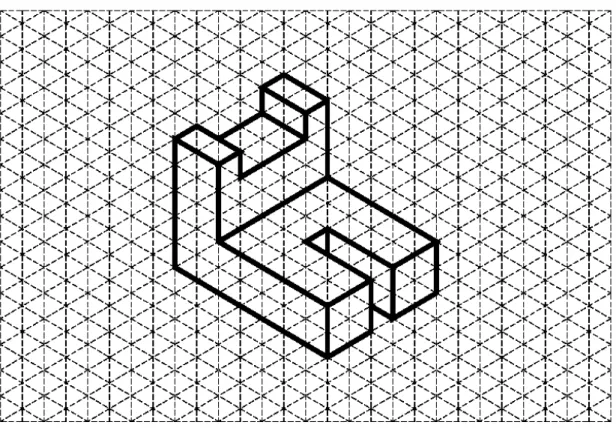
The aluminum example is provided as an isometric drawing that will need to be created as a solid model. The grid spacing for the object shown is 0.25 inch. Using the grid, determine the measurements for each facet of the part. Recreate the isometric sketch and record each facet’s dimensions in your engineering notebook. Then calculate the volume and surface area of the object. Show your work in your engineering notebook. Next, create a model of the object with the required geometry using the 3D solid modeling software. You will assign aluminum as the object’s material and perform a physical property analysis to determine the answers to the questions. Print a copy of the CAD Physical property values and insert into your engineering notebook. When you have completed the physical property analysis, answer the questions below.
You may need to review your notes and the Physical Properties PowerPoint to recall how to generate the physical properties of a part.
Andrew Smith
Questions for Aluminum Object One
Directions: Complete the calculation by hand. Show all work below and select the
appropriate answer based on your calculations. Check your work using the 3D modeling software. If your answers differ, explain why you think they are different where appropriate.
1. What is the volume of the part? A. 1.875 in.³
B. 1.125 in.³
C. 1.375 in.³ THIS ONE D. 2.125 in.³
SHOW WORK:
I cannot if I want to save as an IPT! Answers would not appear on camera, either.
2. What is the density of aluminum in grams per cubic centimeter? (This may require research. Be sure to document your source.)
All of these answers were helped with aqua-calc.com 2.69 (up) g/cm3
3. What is the density of aluminum in pounds per cubic inch? Show your work including all conversion factors.
.0975 lb/in3
4. Find the mass of the object (in pounds-mass) if it is made of aluminum. A. 0.125 lbm
B. 0.135 lbm THIS ONE
C. 0.257 lbm
D. 0.312 lbm
SHOW WORK: #1
5. What is the surface area of the part? A. 7.250 in.²
B. 8.250 in.² C. 9.250 in.²
#1
6. What are the physical properties presented in the CAD software? Include units. A. Density __2.7 g/cm3_____________
B. Mass __.134 lb_________mass____
C. Surface Area _10.25 in2______________
D. Volume _____1.375 in3__________
If physical properties are different from hand calculated values, explain why you think they differ.
Human error!
7. If one quart of cleaning solution will clean 14400 in.2, how many quarts will be
required to clean 3000 parts? Use 3D software physical properties. A. 2.000
B. 1.500
C. 2.135 This one D. 2.145
SHOW WORK: #1
Brass Object Example 2
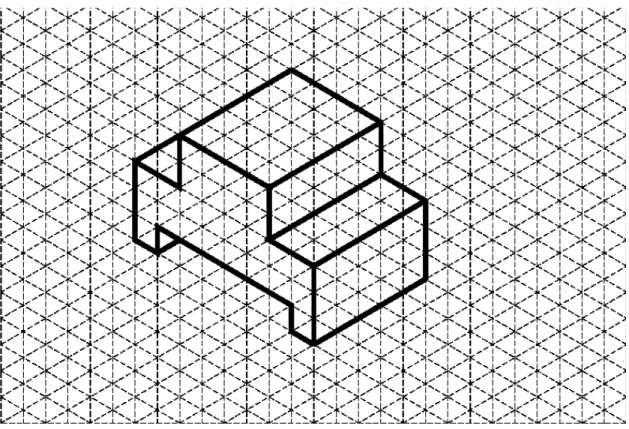
An isometric drawing of a brass part is provided. The grid spacing for the object shown is 0.25 inch. Using the grid, determine the measurements for each facet of the part. Recreate the isometric sketch and record each facet’s dimensions in your engineering notebook. Calculate the volume, mass, and surface area of the object and record below. Next, create a model of the object with the required geometry using the 3D solid modeling software. You will assign brass as the object’s material and perform a physical property analysis to determine the answers to the questions. Print a copy of the CAD physical property values and insert into your engineering
Andrew Smith
notebook. When you have completed the physical property analysis, answer the questions below.
Figure 2: Isometric drawing of Brass Object One with 0.25” grid
Questions for Brass Object One
Directions: Complete the calculation by hand. Show all work below and select the
appropriate answer based on your calculations. Check your work using the 3D modeling software. If your answers differ, explain why you think they are different where appropriate.
1. What is the volume of the part? A. 2.375 in.³
B. 3.125 in.³
C. 2.031 in.³ This one D. 4.125 in.³
SHOW WORK:
#1
8. What is the density of brass in grams per cubic inch?
all conversion factors.
Varies-is alloy.
(Answers gotten from Inventor)
10.Find the mass of the object if it is made of brass. A. 0.621 lbm This one
B. 0.547 lbm
C. 0.257 lbm
D. 0.312 lbm
SHOW WORK: #1
11. What is the surface area of the part? A. 6.000 in.²
B. 8.000 in.² C. 0.250 in.²
D. 12.000 in.² This one SHOW WORK:
#1
12.What are the physical properties presented in the CAD software? Include units. a. Density _8.47 g/cm3______________
b. Mass ____________.622 lb mass_______
c. Surface Area ______12 in2_____________
d. Volume ___2.031 in3________________
If physical properties are different from hand-calculated values, explain why you think they differ.
Andrew Smith
13.What will be the total cost to ship 100 brass parts if the shipping rate is $4.25 per pound? Use the physical properties from the CAD analysis. SHOW WORK. $14.64
Cannot show work-#1
High Density Polyethylene Example 3
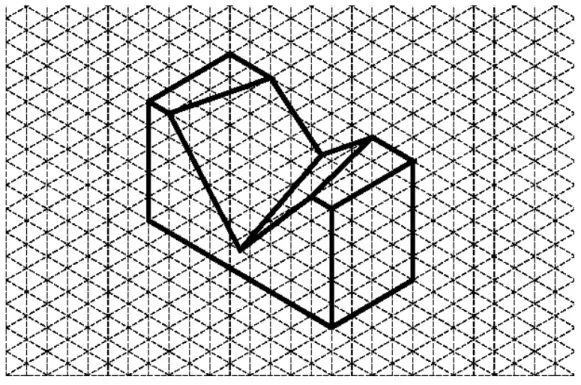
You will begin by using Figure 2 isometric drawing to create a solid model. The grid
spacing for the object shown is 1 cm. Note that this part has different dimensions
(using metric units) than the similar part you created in Activity 5.5b CAD Modeling Skills Part 2. Recreate the isometric sketch and record each facet’s dimensions in your engineering notebook. Next, create a model of the object with the required geometry using the 3D solid modeling software. (Hint: Use subtractive modeling by creating a rectangular solid, and then use the Loft tool to cut the V-notch.)
Remember to use a metric part file template. Assign high density polyethylene as the object’s material and perform a physical property analysis. Insert a copy of the CAD physical property values into your engineering notebook adjacent to the sketch. When you have completed the physical property analysis, answer the questions below.
Figure 3: Isometric drawing of High Density Polyethylene Object using a 1 cm grid 1. What are the physical properties presented in the CAD software? Include units. A. Density ______________.952 g/cm3_____
B. Mass _______________.136 kg mass____
C. Surface Area _____________19419.4 (repeat)______ D. Volume _________143333.3 (repeat) ________
Andrew Smith
14.What is the surface area in square centimeters? SHOW WORK. 194.19 cm2
15.What is the volume in cubic centimeters? SHOW WORK.
143.3 (repeat)
16.What is the weight of the high density polyethylene part in pounds? Show your work and include all conversion factors.
.3 lbs
17.How many parts can be made from 152 pounds of high density polyethylene? SHOW WORK.
506, actual number is 506.6 (repeat)
Conclusion
1. What do you need to know in order to perform a physical property analysis?
You need to know the dimensions and material of an object
2. Why is it important to understand the mathematics used in physical property analysis?
It can affect shipment and production and use of an object
3. Why is it important to perform a physical property analysis prior to producing a part?
from polycarbonate. Do you think that the connector pieces are also manufactured from polycarbonate? Justify your answer.