On the Practical Exploitability of Dual EC in TLS Implementations
Stephen Checkoway
1, Matthew Fredrikson
2, Ruben Niederhagen
3, Adam Everspaugh
2,
Matthew Green
1, Tanja Lange
3, Thomas Ristenpart
2,
Daniel J. Bernstein
3,4,
Jake Maskiewicz
5, and Hovav Shacham
51
Johns Hopkins University,
2University of Wisconsin,
3Technische Universiteit Eindhoven,
4University of Illinois at Chicago,
5UC San Diego
Abstract
This paper analyzes the actual cost of attacking TLS im-plementations that use NIST’s Dual EC pseudorandom number generator, assuming that the attacker generated the constants used in Dual EC. It has been known for several years that an attacker generating these constants and seeing a long enough stretch of Dual EC output bits can predict all future outputs; but TLS does not natu-rally provide a long enough stretch of output bits, and the cost of an attack turns out to depend heavily on choices made in implementing the RNG and on choices made in implementing other parts of TLS.
Specifically, this paper investigates OpenSSL-FIPS, Windows’ SChannel, and the C/C++and Java versions of the RSA BSAFE library. This paper shows that Dual EC exploitability is fragile, and in particular is stopped by an outright bug in the certified Dual EC implementation in OpenSSL. On the other hand, this paper also shows that Dual EC exploitability benefits from a modification made to the Dual EC standard in 2007; from several attack op-timizations introduced here; and from various proposed TLS extensions, one of which is implemented in BSAFE, though disabled in the version we obtained and stud-ied. The paper’s attacks are implemented; benchmarked; tested against libraries modified to use new Dual EC con-stants; and verified to successfully recover TLS plaintext.
1
Introduction
On September 5, 2013, the New York Times [23], the Guardian [3] and ProPublica [16] reported the existence of a secret National Security Agency SIGINT Enabling Project with the mission to “actively [engage] the US and foreign IT industries to covertly influence and/or overtly leverage their commercial products’ designs.” The re-vealed source documents describe a US $250 million/year program designed to “make [systems] exploitable through SIGINT collection” by inserting vulnerabilities, collect-ing target network data, and influenccollect-ing policies, stan-dards and specifications for commercial public key tech-nologies. Named targets include protocols for “TLS/SSL, https (e.g. webmail), SSH, encrypted chat, VPNs and encrypted VOIP.”
*Date of this document: 2014.06.06.
The documents also make specific reference to a set of pseudorandom number generator (PRNG) algo-rithms adopted as part of the National Institute of Stan-dards and Technology (NIST) Special Publication 800-90 [21] in 2006, and also standardized as part of ISO 18031 [15]. These standards include an algorithm called the Dual Elliptic Curve Deterministic Random Bit Gen-erator (Dual EC). As a result of these revelations, NIST reopened the public comment period for SP 800-90.
Known weaknesses in Dual EC. Long before 2013, Dual EC had been identified by the security community as biased [8, 27], extremely slow, and backdoorable.
SP 800-90 had already noted that “elliptic curve arith-metic” makes Dual EC generate “pseudorandom bits more slowly than the other DRBG mechanisms in this Recom-mendation” [21, p. 177] but had claimed that the Dual EC design “allows for certain performance-enhancing possi-bilities.” In fact, Dual EC with all known optimizations is two orders of magnitude slower than the other PRNGs, because it uses scalar multiplications on an elliptic curve where the other PRNGs use a hash function or cipher call.
The back door is a less obvious issue, first brought to public attention by Shumow and Ferguson [28] in 2007. What Shumow and Ferguson showed was that an attacker specifying Dual EC, and inspecting some Dual EC output bits from an unknown seed, had the power to predict all subsequent output bits.
Specifically, the description of Dual EC standardizes three parameter sets, each specifying an elliptic curveE
over a finite fieldFp, together with pointsPandQonE. The back door is knowledge ofd=logQP, the discrete logarithm ofPto the baseQ; an attacker creatingPand
Qcan be assumed to knowd. Shumow and Ferguson
showed that knowledge ofd, together with about log2p
consecutive output bits,1makes it feasible to predict all subsequent Dual EC output.
Shumow and Ferguson suggested as countermeasures to varyPandQand to reduce the number of output bits per iteration of the PRNG. However, SP 800-90 requires a particular number of bits per iteration, and states that the standardPandQ“shall be used in applications
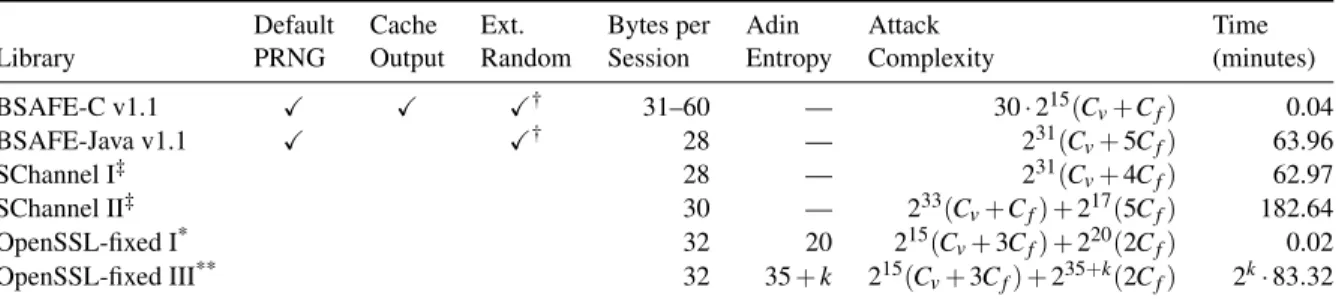
Table 1:Summary of our results for Dual EC using NIST P-256.
Default Cache Ext. Bytes per Adin Attack Time Library PRNG Output Random Session Entropy Complexity (minutes) BSAFE-C v1.1 X X X† 31–60 — 30·215(Cv+Cf) 0.04 BSAFE-Java v1.1 X X† 28 — 231(Cv+5Cf) 63.96
SChannel I‡ 28 — 231(Cv+4Cf) 62.97
SChannel II‡ 30 — 233(Cv+Cf) +217(5Cf) 182.64
OpenSSL-fixed I* 32 20 215(C
v+3Cf) +220(2Cf) 0.02 OpenSSL-fixed III** 32 35+k 215(C
v+3Cf) +235+k(2Cf) 2k·83.32 *Assuming process ID and counter known. **Assuming 15 bits of entropy in process ID, maximum counter of 2k. See Section 4.3. †With a library–compile-time flag. ‡Versions tested: Windows 7 64-bit Service Pack 1 and Windows Server 2010 R2.
The entries in the table are for normal TLS connections. In particular, we exclude all forms of session resumption. AXin the Default PRNG column indicates whether Dual EC is the default PRNG used by the library. AXin the Cache Output column indicates that the unused Dual EC output is cached for use in a subsequent call. AXin the Ext. Random column indicates that the proposed TLS extension Extended Random [25] is supported in some configuration. Reported attack times do not rely on use of Extended Random. Bytes per Session indicates how many contiguous, useful output bytes from Dual EC a TLS server’s handshake message reveals. For SChannel II this is an average value of useful bits, see Section 4.2. Adin Entropy indicates how many bits of unknown input are added to each Dual EC generate call. The Attack Complexity is the computational cost in terms of the cost of a scalar multiplication with a variable base point,Cv, and a fixed base point,Cf, in the worst case. With our optimizations (see Section 5),Cf is roughly 20 times faster thanCv; the exact speedup depends on context. The Time column gives our measured worst-case time for the attack on a four-node, quad-socket AMD Opteron 6276 cluster; the time for OpenSSL-fixed III is measured usingk=0.
quiring certification under FIPS 140-2”; this stops use of alternative points in certified implementations.
Risk assessment for this back door depends on the prob-ability that the creator ofPandQis an attacker. Shumow and Ferguson wrote “WHAT WE ARE NOT SAYING: NIST intentionally put a back door in this PRNG”; but the September 2013 news indicates that NSA may have deliberately engineered Dual EC with a back door. Our concern in this paper is not with this probability assess-ment, but rather with impact assessassess-ment, especially for the use of Dual EC in TLS.
Use of Dual EC in products. Despite the known weak-nesses in Dual EC, several vendors have implemented Dual EC in their products [22]. For example, OpenSSL-FIPS v2 and Microsoft’s SChannel include Dual EC, and RSA’s crypto libraries use Dual EC by default. RSA Ex-ecutive Chairman Art Coviello, responding to news that NSA had paid RSA to use Dual EC [18], stated during the opening speech of RSA Conference 2014: “Given that RSA’s market for encryption tools was increasingly limited to the US Federal government and organizations selling applications to the federal government, use of this algorithm as a default in many of our toolkits allowed us to meet government certification requirements” [5].
Practical attacks on TLS using Dual EC. This paper studies to which extentdeployedcryptographic systems that use Dual EC are vulnerable to the back door, assum-ing that an attacker knowsd=logQP. Specifically, we perform a case study of Dual EC use in TLS, arguably the most important potential target for attacks. The basic attack described by Shumow and Ferguson [28] (and
in-dependently, quietly, by Brown and Vanstone in a patent application [4]) turns out to be highly oversimplified: it does not consider critical limitations and variations in the amount of PRNG output actually exposed in TLS, additional inputs to the PRNG, PRNG reseeding, align-ment of PRNG outputs, and outright bugs in Dual EC implementations.
We present not just a theoretical evaluation of TLS vulnerability but an in-depth analysis of Dual EC in four recent implementations of TLS: RSA BSAFE Share for
C/C++(henceforth BSAFE-C), RSA BSAFE Share for
Java (henceforth BSAFE-Java), Windows SChannel, and OpenSSL. The Network Security Services (NSS) libraries, e.g., used by Mozilla Firefox, and the TLS implementa-tion of BlackBerry do not offer a Dual EC implementaimplementa-tion and thus are not discussed here.
To experimentally verify the actual performance of our attacks, we replace the NIST-specified constants with ones we generate; for BSAFE and Windows this required exten-sive reverse-engineering of binaries to find not justPand
Qbut many implementation-specific constants and run-time test vectors derived fromPandQ(see Section 4.4). Our major findings are as follows:
• The BSAFE implementations of TLS make the
Dual EC back door particularly easy to exploit in two ways. The Java version of BSAFE includes finger-prints in connections, making them easy to identify. The C version of BSAFE allows a drastic speedup in the attack by broadcasting longer contiguous strings of random bits than one would at first imagine to be possible given the TLS standards.
• Windows SChannel does not implement the current Dual EC standard: it omits an important computation. We show that this does not prevent attacks; in fact, it allows slightly faster attacks.
• We discovered in OpenSSL a previously unknown
bug that prevented the library from running when Dual EC is enabled. It is still conceivable that someone is using Dual EC in OpenSSL, since the bug has an obvious and very easy fix, so we ap-plied this fix and evaluated the resulting version of OpenSSL, which we call fixed. OpenSSL-fixed turns out to use additional inputs in a way that under some circumstances makes attacks sig-nificantly more expensive than for the other li-braries.
When a TLS server uses DSA or ECDSA to sign its DH/ECDH public key, a single known nonce reveals the long-lived signing key which enables future active attacks. Our attacks reveal the inner state of Dual EC which gen-erates the nonces and we have successfully recovered the long-term signing keys.
We also perform a brief measurement study of the IPv4 address space to assess the prevalence of these libraries on the Internet.
We summarize our results in Table 1. The BSAFE-C attack is practically instantaneous, even on an old laptop. The BSAFE-Java and SChannel attacks require more pro-cessing power to recover missing bits of Dual EC output. The OpenSSL-fixed attack cost depends fundamentally on how much information on the additional input is available. All of these attacks are practical for a motivated attacker, even when the attacks are repeated against a large number of targets.
2
Dual EC attack theory
Review of Dual EC. We focus on Dual EC using the NIST P-256 elliptic curve. For the curve equation and the standardized base pointsPandQsee [21, Appendix A.1]. The state of Dual EC is a 32-byte strings, which the user initializes as a secret random seed. The user then calls Dual EC any number of times; each call implicitly reads and writes the state, optionally reads additional input
from the user, and produces any number of random bytes requested by the user.
Internally, each call works as follows. Additional in-put, if provided, is hashed and xored into the state. The state is then updated as follows: computesPand then overwriteswith thex-coordinatex(sP). A 30-byte block of output is then generated as follows: computesQ, take thex-coordinatex(sQ), and discard the most significant 2 bytes. The resulting 30 bytes are used as output. If more random bytes were requested, the state is updated again and another 30-byte block of output is generated; this repeats until enough blocks have been generated.
Any excess bytes in the final block are discarded. The state is updated one final time in preparation for the next call, and the generator returns the requested number of bytes.
Review of the basic attack. The attack from Shumow and Ferguson works as follows. The attacker is assumed to control the initial standardization ofP. The attacker takes advantage of this by generating a random secret integerd and generatingPasdQ. Alternatively, if the attacker controls the initial standardization ofQrather thanP, the attacker generatesQas(1/d)P. Either way
P=dQ, withdsecretly known to the attacker.
The idea of the attack is to reconstruct sQfrom an output block (see the next paragraph) and then multiply byd, obtainingdsQ, i.e.,sP. Thex-coordinatex(sP)is the user’s next PRNG state. The attacker then computes all subsequent outputs the same way that the user does.
Recall that an output block reveals 30 out of the 32 bytes of thex-coordinate ofsQ. The attacker tries all pos-sibilities for the 2 missing bytes, obtaining 216 possibili-ties for thex-coordinate, and then for eachx-coordinate uses the curve equation to reconstruct at most 2 possi-bilities for they-coordinate, for a total of at most 217 possibilities forsQ. About half of thex-coordinates will not have any correspondingy-coordinate, and the other half will produce two points(x,y)and(x,−y)that behave identically for the attack, becausex(s(x,y)) =x(s(x,−y)), so the attacker keeps only one of those points and ends up with about 215possibilities forsQ. For each of these possibilities, the attacker computes the corresponding possibility fordsQ=sPand for the next Dual EC output. The attacker pinpoints the correct guess by checking the next actual Dual EC output.
Attacks with additional input. Shumow and Ferguson did not analyze the case where a user provides additional input to a Dual EC call. We point out that the analysis of this case depends heavily on whether one considers Dual EC in the June 2006 version of SP 800-90, which we call Dual EC 2006, or Dual EC in the March 2007 version of SP 800-90, which we call Dual EC 2007.
Additional input is only used once at the beginning of a call and therefore does not stop the attacker from using the first 30 bytes of output from a call to predict subse-quent output bytes from the same call. The remaining question is whether the attacker can predict the first 30 bytes from a call given the last 30 bytes from the previous call. This issue would be relatively minor if applications were generating many kilobytes of Dual EC output from each call; but the applications we have studied normally generate only one or two blocks from each call, so the predictability of the first 30-byte block is an important question.
If the additional input has enough entropy unknown to the attacker then the answer is no: the first 30 bytes are unpredictable. However, in the applications that we have studied, additional input is either nonexistent or potentially guessable. This is where Dual EC 2006 and Dual EC 2007 produce different answers.
What we have described so far is Dual EC 2007. The previous call returned up to 30 bytes ofsQand produced
s0=x(sP)as the new state. Assume that the attacker has reconstructedsQ. This call updatess0tos00=x((s0⊕
H(adin))P), where H is a hash function, and then returns up to 30 bytes ofx(s00Q). GivensQthe attacker computes
dsQ=sP, computess0, and then for each possibleadin computess00ands00Q.
The 2006 version of Dual EC differs slightly from the 2007 version: Dual EC 2006 is missing the final step which updates the seeds at the end of each call. The previous call returned most of sQ but left s un-touched. If there were no additional input, then this call would update s to s0=x(sP)and return most of
x(s0Q). GivensQ, the attacker computessP=dsQ,s0, and s0Q. However, with additional input, the state s
is updated tos0=x((s⊕H(adin))P)and then most of
x(s0Q)is returned. GivensQ, the attacker can compute
sP=dsQandx(sP)as before but there is no obvious way to obtain(s⊕H(adin))PfromsP, even whenadinis known.
The addition of the final update step in Dual EC 2007 has the effect of making the basic attack possible when (1) the attacker has enough bytes from two consecutive calls; (2) the first call produces at most 30 bytes; and (3) additional input is used and guessable. In this case, the Dual EC 2007 state can be recovered while this is not possible for Dual EC 2006 due to the lack of an additional state update between the first and second call. In other cases, the extra state update means that attacking Dual EC 2007 is slightly slower than attacking Dual EC 2006.
Open questions. This theoretical analysis of Dual EC exploitability leaves open several obvious questions re-garding the practical exploitability of Dual EC by network attackers who know the secretd. Do implementations of cryptographic protocols such as TLS actually expose enough Dual EC output to carry out the basic attack? How expensive are the computations required to compensate for missing output, and can these computations be made less expensive? Is additional input actually used, and if so is it hard to guess? Are certified implementations of Dual EC in fact implementing Dual EC 2006, Dual EC 2007, or something different?
The answers turn out to include several surprises, and in particular to rely on several implementation details and protocol details that have not been previously ob-served to be related to Dual EC. For example, the certified OpenSSL-FIPS implementation of Dual EC is actually
Client Server
Generate client random (≥28 bytes)
Generate session ID, server random (≤32 + 28 bytes) client random
Generate PMS (46 bytes)
server random, session ID,cert(pk) Enc(pk, PMS), Finished
Finished
MS = PRF(PMS, ”master secret”, client random || server random)
(a)TLS with RSA key transport.
Client Server
Generate client random (≥28 bytes)
Generate session ID, server random,a, signature nonce (≤32 + 28 + 32 + 32 bytes) client random
Generateb
(46 bytes)
server random,session ID,
cert(pk),aP, sig
bP, Finished Finished
MS = PRF(x(abP), ”master secret”, client random || server random)
(b)TLS with ECDHE exchange and ECDSA signature (P-256).
Figure 1:Simplified view of TLS handshakes.
non-functional, as mentioned earlier. As another example, although none of the attacks we implemented are in the case described above where exploitability relies on the difference between Dual EC 2006 and Dual EC 2007, the OpenSSL-fixed attacks are very close to this case: they avoid it solely because at one point OpenSSL-fixed calls Dual EC for 32 bytes made public through the TLS session ID, and 32 is larger than 30.
Our analysis strongly suggests that, from an attacker’s perspective, backdooring a PRNG should be combined not merely with influencing implementations to use the PRNG but also with influencing other details that secretly improve the exploitability of the PRNG. This paper does not attempt to determine whether this is what happened with Dual EC, and does not explore the difficult topic of defending against such attacks, beyond the obvious advice of not using Dual EC.
3
Attack target: TLS
TLS is the most widely used protocol for securing In-ternet communications [6]. TLS consists of several sub-protocols, including arecord protocol andhandshake
protocol. The handshake protocol is most relevant to the attacks discussed in this paper, so for simplicity we will describe only the relevant aspects of the handshake sub-protocol used in TLS version 1.2; further details are available in the RFC [6].
The handshake sub-protocol produces a fresh set of ses-sion keys with which application-layer data is encrypted and authenticated using the record protocol. Figure 1
de-picts (simplified versions of) the two main handshakes for TLS: RSA key transport and ephemeral Diffie-Hellman key exchange (DHE). Ephemeral DHE uses either ellip-tic curve groups (ECDHE) or another suitable group. In either handshake, the client initiates a connection by send-ing a ClientHello message that includes a client nonce and a list of supported cipher suites. The server replies with a server nonce, a session ID, a certificate, an ephemeral DHE public key (for DHE), and a signature over the ran-dom nonces and public key. Signatures are either RSA or DSA. The specification mandates 32-byte client and server nonces, each consisting of 28 random bytes and a 4-byte timestamp. The construction of a session ID is arbitrary (i.e., up to the server implementation), though as we will see many implementations use the same PRNG that generates the ServerHello nonce and other crypto-graphic secrets. The client’s next flow includes a client ephemeral DH public key (for DHE) or an RSA PKCS #1.5 encryption of a premaster secret (for RSA key trans-port). The premaster secret consists of either a 2-byte version number followed by a 46 byte random value (for RSA key transport), or the DHE secret defined by the DH public keys. Session keys are derived from the pre-master secret and other values sent in the clear during the handshake, so learning the premaster secret is suf-ficient to break all subsequent encryption for a given session.
TLS extensions. There are many extensions to TLS, but we draw attention to four particular proposed — but not standardized — extensions. Each of these extensions has the side effect of removing the most obvious difficulty in exploiting Dual EC in TLS, namely the limited amount of randomness broadcast to the attacker. One might guess that these extensions make P-256 less expensive to exploit in TLS by a factor of 65,536 (and make P-384 and P-521 feasible to exploit), if they are actually implemented; our analysis in Section 4.1 shows that one of these extensions is in fact implemented in BSAFE, although the actual ef-fect on exploitability is more complicated. None of these extensions have been previously described in connection with Dual EC.
One proposed extension, authored by Rescorla and Salter [25] in 2008, supports “Extended Random” client and server nonces. This extension is negotiable using the normal ClientHello extension mechanism, and includes up to 216−1 bytes of data from a suitable PRNG. The
server replies with its own Extended Random data that must be of the same length as the client’s Extended Ran-dom data. The document states that this extension was requested by the United States Department of Defense with the claim that nonces “should be at least twice as long as the security level” (e.g., 256-bit nonces for 128-bit security).
Another proposed extension, “Opaque PRF” proposed by the same authors [24] in 2006, is nearly identical to Extended Random but does not require the data to be random. A third proposed extension, “Additional Ran-dom” by Hoffman [12] in 2010, is essentially the same as “Extended Random.” After the initial announcement of our paper, Bodo Möller pointed out yet another simi-lar extension, “Additional PRF Inputs” by Hoffman and Solinas [14] in 2009.
The “Internet-Drafts” describing these four extensions all expired without producing RFCs, although a generic framework [13] for such extensions was published as an Experimental RFC by Hoffman in 2012. IETF has not standardized any of these extensions.
Attack goals. We assume that the adversary’s goal is to decrypt TLS packets to learn confidential material, or to steal long-lived secret keys. In the second case the secret keys need not be generated with Dual EC. We consider both small-scaletargetedattacks and larger-scaledragnet surveillanceattacks across broad swaths of the Internet.
Attack resources. Most of the attacks that we analyze are purely passive, relying solely on interception of TLS traffic sent through the network by the client and by the server. Usually seeing only one direction of TLS traffic is enough, and the attack can be mounted long after the fact using recorded connections. Occasionally an active attack is more powerful: for example, the range ofµsecs in Section 4.3 becomes narrower if the attacker uses care-fully timed connections (as in [29]) to more precisely pin down the server’s clock.
The attacker is assumed to know the Dual EC back door d with P=dQ. All of the attacks rely on the client or server using Dual EC, but this is not an as-sumption; rather, it is something that we evaluate, by reverse-engineering several TLS implementations and also experimentally assessing the deployment of those implementations.
Our measurements of attack cost assume that the at-tacker knows the TLS software in use; otherwise the attacker has to try several of the attacks, increasing cost somewhat. See Section 6 for fingerprinting mechanisms.
The computer power required for attacking one
Dual EC instance is very small by cryptanalytic standards: our optimized attacks (see Section 5) typically consume between $0.00001 and $1 of electricity, depending on the TLS implementation being attacked. (The exception to “typical” is OpenSSL; see Sections 4.3 and 5.2.) However, presumably the attacker’s actual goal is to repeat the at-tackmanytimes, especially in the dragnet-surveillance scenario. Our measurements allow straightforward extrap-olations of the computer resources required for large-scale attacks.
4
Exploiting Dual EC in implementations
To attack each of the implementations discussed below, the attacker follows three basic steps: (1) recover Dual EC state from the session ID and/or server random fields in the TLS handshake; (2) compute the DHE or ECDHE shared secret which enables computing the 48-byte “mas-ter secret” from which all session keys are derived; and optionally (3) recover the long-lived DSA or ECDSA signing key used to sign the server’s DHE or ECDHE public key.
Step (1) is an application of the basic attack which com-bines information exchanged in the handshake protocol messages to determine the correct Dual EC state from candidate states. Step (2) requires generating the DHE or ECDHE secret key by following the exact generation process used by the TLS implementation. Like Step (2), Step (3) duplicates the implementation’s process for gen-erating the nonce used in the signature of the public key. From the nonce, the signature, and the public key, it is straightforward to recover the signing key.
It is important to note that when a server uses DSA or ECDSA signatures, asinglebroken connection by a passive adversary is sufficient to recover the long-lived signing key which is used to authenticate the server’s (EC)DHE public key. In contrast to RSA long-lived keys, recovering a server’s (EC)DSA signing key does not en-able future passive eavesdropping; it does allow imper-sonation of the server under active attack.
4.1
RSA BSAFE
Description. RSA’s BSAFE family includes four li-braries: Share for Java, Share for C and C++, Micro Edition Suite, and Crypto-J/SSL-J. We examined Share for Java and Share for C and C++. Although the two ver-sions share a somewhat similar API, the implementation details differ, leading to different attacks.
The BSAFE family of libraries contains a number of options which can be configured at runtime. In order to avoid a combinatorial explosion in the number of config-urations to test and attack, we focus our attention on the default configurations and the most secure cipher suites that lead to the use of the P-256 curve in Dual EC and,
where applicable, ECDHE and ECDSA.2
Both BSAFE libraries we examined support both pre-diction resistance whereby the generator is reseeded on each call and output caching so that unused bytes from one call to generate can be used in subsequent calls rather than discarded. By default, neither option is enabled.
BSAFE-C. We examined the RSA BSAFE Share for C and C++library (BSAFE-C) version 1.1 for Microsoft Windows. The library actually consists of two libraries:
2Share for Java additionally supports P-384 and P-521 for Dual EC, ECDHE, and ECDSA.
sharecrypto.lib implements the core cryptographic primi-tives, including Dual EC, and sharesslpki.lib implements TLS. Unlike the Micro Edition Suite, BSAFE-C is dis-tributed only as static libraries with associated header files. This necessitated a minor reverse engineering ef-fort to discover how BSAFE-C uses Dual EC in its TLS implementation.
Unlike the other TLS implementations we examined, BSAFE-C v. 1.1 does not support TLS 1.2. As a result, it does not support elliptic curve cryptography for either key exchange or digital signatures. By default, the preferred
cipher suites areTLS_DHE_DSS_WITH_AES_128_CBC_
SHA and TLS_DHE_RSA_WITH_AES_128_CBC_SHA so we focused our efforts on these two.
A TLS server implemented using BSAFE-C generates several pseudorandom values used during the TLS hand-shake to establish session keys. In order, it generates (1) a 32-byte session identifier, (2) 28 bytes for the server random, (3) a 20-byte ephemeral Diffie–Hellman (DH) secret key, and, when using DSA, (4) a 20-byte nonce. The DH parameters and the server’s public key are signed with the server’s RSA or DSA certificate and the session ID, server random, public key, and signature are sent in the server’s first flight of messages to the client during the handshake.
Although BSAFE-C’s Dual EC interface does not cache unused output bytes by default, a separate, internal inter-face to produce pseudorandom values wraps Dual EC and provides its own layer of caching by only requesting multiples of 30 bytes from the Dual EC interface. This internal interface is used by all of the higher-level func-tionality, such as generating a DH secret key and a DSA nonce. Due to a quirk of the implementation, if a request to generaten bytes of output cannot be satisfied com-pletely from the cached bytes,b(n+29)/30c ·30 bytes are generated in a single call to Dual EC, even if most of thenbytes will be taken from the cached bytes.
Caching output bytes means that when a new TLS ses-sion is started, an attacker who has not seen all prior connections has no way of knowing if the first value gen-erated by the server — the session id — begins with a full output block or if it contains bytes cached from a previous call to Dual EC. However, due to the use of the requested number of bytes rather than the number of remaining bytes after pulling from the cache, the concatenation of the 32-byte session ID and the 28 pseudorandom bytes in the server random always contains a full 30-byte output block and between one and 30 bytes of a subsequent block where both blocks are generated in the call to Dual EC for 60 bytes made while generating the session ID.
A passive network attacker can easily recover the ses-sion keys and the server’s long-lived DSA secret key used to sign the ephemeral DH parameters and public key. The attacker uses the publicly exchanged values in the
connection through the ClientKeyExchange handshake message. At this point, the attacker knows the session ID, the client and server randoms, the DH parameters and client and server public keys, and the signature. This contains everything needed for the attack. The session keys are computed from the public values and the DH shared secret.
To recover the inner state of Dual EC a long string of consecutive output bytes is required. First, the session ID and the pseudorandom 28 bytes of the server random are concatenated into a 60-byte valueB. Since up to 29 bytes
of Bcan come from a previous call to Dual EC, one
ofB[0..29],B[1..30], . . . ,B[29..58]must be a full output block. The basic attack is run on each in turn until the Dual EC state for the next output block is recovered. The attacker knows that the correct state has been found by (1) generating the next output block and comparing the corresponding bytes with the remaining bytes inBand then (2) generating more bytes as needed to produce a DH secret key and comparing the corresponding public key to the server’s public key. If the public keys agree, then the DH shared secret can be computed hence the session keys can be computed.
Once the session keys for a single session have been recovered, more bytes can be generated to produce the DSA nonce. The DSA secret keyacan be computed from the noncek, public key(p,q,g,y), and the signature(R,S)
of the messagemasa=R−1· S·k−H(m)modq. Recovering the Dual EC internal state requires perform-ing approximately 30·215 scalar multiplications with a variable base point and an equal number with the fixed pointQ, in the worst case. The total attack has a cost of 30·215(Cv+Cf)whereCv (resp.Cf) is the cost of
performing a single scalar multiplication with a variable (resp. fixed) base point. To generate the DH key, between 3Cf and 5Cf are needed to produce enough Dual EC
out-put bytes; 1Cf is needed to compute server’s DH public
key; and, finally 1Cvis needed to compute the shared DH
secret (using the client’s DH input). Finally, to generate the nonce, at most one more Dual EC output is needed, using 3Cf.
BSAFE-Java. We examined the RSA BSAFE Share for Java library version 1.1 (BSAFE-Java) and focused on
connections using theTLS_ECDHE_ECDSA_WITH_AES_
128_GCM_SHA256cipher suite.
Unlike BSAFE-C, the output from Dual EC is not cached so each generated output value is aligned with a block of generator output. Unfortunately (for the at-tacker), the session ID value produced by the server is not a 32-byte pseudorandom value. Instead, the attacker is forced to rely on the server random.
The values generated by Dual EC are, in order, (1) 28 bytes for server random; (2) 32 bytes for an ECDHE secret key; and (3) 32 bytes for an ECDSA nonce.
As before, a passive network attacker waits until she sees the ClientKeyExchange handshake message. At this point she has all of the information she needs to mount the following, simple attack. The 28 bytes from the server random are treated as bytes 2 through 29 of the 32-byte x-coordinate. She then mounts the basic attack by guessing the remaining most significant 16-bits and least signifi-cant 16-bits of the x-coordinate. A guess is checked by generating a 32-byte ECDH secret key, computing the corresponding public key, and comparing to the server’s public key.
Once a match is found, the inner state of Dual EC is known. The session keys can be derived from the ECDH shared secret and the other values sent in the clear. Similarly, the ECDSA nonce can be found by generating another 32-byte value. As with the non-elliptic-curve DSA, the server’s private key can be recovered from the nonce and the signature.
In the worst case, recovering the generator state re-quires approximately 231 scalar multiplications with a variable base point and five times that number with a fixed base point to generate candidate ECDH secret keys and corresponding public keys. In total, the attack takes 231(Cv+5Cf)work.
BSAFE connection watermarks and Extended
Ran-dom. The documentation for C and
BSAFE-Java indicate that they support connection watermarking and the TLS Extended Random extension described in Section 3.
In our experiments, BSAFE-Java has watermarks enabled by default. The watermark works by setting the first 20 bytes of the session ID to be the first 20 bytes of the server random and the last 12 bytes
are set to the string “RSA SSLJ .” This
wa-termark can only be disabled by setting the property com.rsa.ssl.server.watermark=disabled in the Java security properties file [26].
We performed an Internet-wide scan of port 443 and found very few servers on this default port that exhibited this 32-byte watermark: only 386 of 8 million servers contacted. Details on this scan are included in section 6. From reverse engineering the BSAFE-Java share-Crypto.jar library, we determined that it contained code to support or require the proposed TLS Extended Random extension; however, this code was disabled by means of a single static final boolean variable. We surmise that this code is not “dead” in the traditional sense, but rather the value of the variable can be changed to produce versions of the library with different features.
By changing the value of this variable, we were able to verify that the Extended Random extension is supported by the server.3When enabled and an Extended Random
extension is received from the client, the server generates an equal length Extended Random response consisting of bytes generated by Dual EC concatenated with the same 12-byte watermark. The client Extended Random is 32-bytes by default. Interestingly, the 28 bytes for the server random and the Dual EC generated bytes for the Extended Random are generated together in a single call to Dual EC. As a consequence, any BSAFE-Java server which supports Extended Random exposes a sufficient quantity of contiguous output bytes to enable quick re-covery of the session keys. There does not appear to be a mechanism for disabling the watermark in the Extended Random extension.
The BSAFE-C library documentation indicates that both watermarking and Extended Random are supported in some versions of the library; however, the version we have appears to have been compiled without this support.4
For both the Java and C versions of BSAFE, we have no evidence that versions of the libraries supporting Ex-tended Random ever shipped. On the other hand, an earlier survey [1] found that Extended Random was occa-sionally requested by clients (about once in every 77000 connections). Our implemented attacks do not rely on Extended Random in any way.
4.2
Windows SChannel
SChannel (“Secure Channel”) is a security component in the Windows operating system (introduced in Win-dows 2000) that provides authentication and confiden-tiality for socket-based communications. Although it supports several protocols, it is most commonly used for SSL/TLS, including by Microsoft’s Internet Information Services (IIS) server and Internet Explorer (IE). We focus on ECDHE/ECDSA handshakes that use P-256 (which in turn cause Dual EC to also use this curve), as used by the version of IIS distributed with Windows 7 64-bit Service Pack 1 and Windows Server 2010 R2. All infor-mation about the internal workings of SChannel and its implementation of Dual EC discussed in the following was obtained via reverse-engineering.
Description. SChannel uses Microsoft’s FIPS 140-2 validated Cryptography Next Generation (CNG) API, which includes an implementation of Dual EC. CNG is implemented in two modules, one for user-mode callers (bcryptprimitives.dll) and one for kernel mode (cng.sys). Dual EC is used to generate pseudorandom bytes when theBCryptGenRandomfunction is explicitly directed to use it via a function argument or when it is selected as the system-wide default. When using Dual EC,
BCryptGenRandomgenerates enough fresh blocks to
sat-4The header files for the version of BSAFE-C we have show that the library was compiled with the command line flags -DNO_TLS_EXT_RAND -DNO_RSA_WATERMARK.
isfy the request, and discards any remaining bytes (i.e., there is no caching between requests).
Whenever SChannel requests random bytes, it calls
BCryptGenRandomusing the system-wide default. Our reverse-engineering efforts and experiments indicate that additional input is not provided by SChannel for TLS connections. TLS handshakes are performed by a separate process (lsass.exe) on behalf of IIS, which dispatches one of several worker threads to handle each request. Dual EC in CNG maintains separate state for each thread, so a successful attack on the state of one thread will not carry over to the others. Importantly, SChannel caches ephemeral keys for two hours (this timeout is hard-coded in the configurations we examined), and the cached keys are shared among all worker threads until the timeout expires.
When performing an ECDHE handshake, SChannel requests random bytes in a different order than OpenSSL and BSAFE (the number of bytes given in the following are specific to P-256 and some of them differ for other curves): (1) 32 bytes for session ID, (2) 40 bytes for ephemeral private key, (3) 32 bytes (not relevant to the at-tack), (4) 28 bytes for ServerHello nonce, and (5) 32 bytes for the signature (if using ECDSA). Notice the 40-byte request for the private key, even though a P-256 private key is only 32 bytes; this is because SChannel uses FIPS 186-3 B.4.1 (Key Pair Generation Using Extra Random Bits) to generate ECDHE key pairs, which specifies 8 additional bytes to reduce bias from a modulo operation. More importantly, SChannel requests bytes for the private keybeforethe ServerHello random field. This means that any attempt to infer the private key must use the session ID, or random fields from previous handshakes.
Deviation from SP-800-90A. The implementation of Dual EC in CNG differs from the current SP-800-90A specification in one noteworthy way. The code in bcrypt-primitives.dll that implements Dual EC (a function called
MSCryptDualEcGen) seems to include the final update step at the end of each call — performing a point multipli-cation and projection on thex-coordinate after generating the necessary blocks. However, our reverse engineering efforts, as well as our experiments, indicate that the result is not copied into the seed state, and thus not used in subsequent calls to Dual EC. In short, although the CNG Dual EC implementation appears to contain code that implements the full current specification, it effectively implements Dual EC 2006 by ignoring the result of the final update step in future calls to generate. This appears to be a bug.
Fingerprint in the session ID. When an SChannel server generates a new session ID, it requests 32 bytes,
S[0, . . . ,31]fromBCryptGenRandom, and interprets the first four bytesS[0, . . . ,3]as an unsigned integerv. It then
computesv0=vmodCACHE_LEN, and constructs the fi-nal session ID by concatenating these values,session_id=
v0[0, . . . ,3]kS[4, . . . ,31]. CACHE_LEN is the maximum number of entries allowed in SChannel’s session cache, which was hard-coded to 20,000 on the systems we tested. Thus, the presence of zeros in the third and fourth bytes of the session ID is a likely (although imperfect) fingerprint for SChannel implementations.
Attack 1: Using the server’s random nonce. With Dual EC enabled, it is possible to use the 28-byte Server-Hello nonce to learn the server’s ECDHE private key, which will allow decryption of all ECDHE sessions within the two-hour window before the private key is refreshed. As previously discussed, these bytes are requested after the private key is generated, so in order to use them for the attack, we must look at previous handshake messages sent from the server. The fact that SChannel uses multi-ple threads to perform handshakes complicates the attack, as we cannot know which thread was used for a partic-ular handshake unless we have learned the state of all threads and updated them as new handshakes were per-formed. On observing a handshake with the new server public ephemeral key, denotedh, the attacker works back-wards through previous handshakes, using the random field in each ServerHello message to generate candidate Dual EC states using the basic attack. Each candidate state is checked first against the ECDSA public key to de-termine the state used in that handshake, and then against the session ID inhto determine if the same state was used to generate the new ephemeral key. The 32 bytes for the ECDSA nonce are generated in two calls, first 24 bytes then 8 bytes. These values are concatenated and then byte-wise reversed to obtain the nonce.
When the matching state is found, it is straightforward to generate the ephemeral private key and subsequent session keys. SChannel uses FIPS 186-3 B.4.1 to gen-erate the private key, which corresponds to drawing 40 bytes of random inputc, and computing the key as(c
(modn−1)) +1, wherenis the curve order. The worst-case complexity of this attack requires approximately 231 scalar multiplications with a variable base point and four times as many with a fixed base point to check the ECDSA public key, totaling 231(C
v+4Cf).
Attack 2: Using the session ID. The second approach uses the session ID in a handshake containing a new ECDHE public key. Denote the 32-byte session ID in the relevant handshake byS, andv0the unsigned integer corresponding toS[0, . . . ,4]. Recall that SChannel mod-ifies the first four bytes of the session ID by replacing it with its value moduloCACHE_LEN. All that one must do to recover the private ephemeral key is run the ba-sic attack on a set of inputs generated by enumerating (1) all 4-byte sequences whose unsigned integer
repre-sentationvsatisfiesv0=vmodCACHE_LEN(for the first four bytes of the block that generated the session ID), and (2) all 2-byte sequences for the last two bytes of the first block that generated the session ID. Candidates are checked by generating the next 40 bytes, using FIPS 186-3 B.4.1 to construct a private key, and comparing the corresponding public key against that provided in the ServerKeyExchange.
This attack sidesteps the issues created by threading in SChannel, but because of the way the the session ID is generated it is actually more complex than the previous. Recall thatCACHE_LEN=20,000 in both configurations tested, so this attack requires approximately 218guesses to deduce the first four bytes of the original session ID block, and 216for the last two bytes, giving approximately 233candidate curve points. Of these, approximately 217 will agree with the last two bytes of the session ID, and we determine which is correct by generating two additional Dual EC blocks for a P-256 ECDHE private key, then per-forming a point multiplication to compare with the public key sent in the same handshake. The total complexity is 233(Cv+Cf) +217(5Cf).
4.3
OpenSSL
Description. OpenSSL is one of the most widely used TLS libraries, due to its inclusion in many Linux/Apache distributions. While the standard edition of OpenSSL does not contain Dual EC, OpenSSL also ships a separate package called the OpenSSL FIPS Object Module. When this module is combined with OpenSSL, it provides a TLS library containing all four DRBG algorithms defined in NIST SP800-90A, including Dual EC. The Dual EC algorithm is not the default PRNG in OpenSSL, but it can be manually enabled by changing the PRNG settings through an API call at runtime.
Bug. While investigating the OpenSSL-FIPS implemen-tation of Dual EC, we discovered a previously unknown bug that, in fact, prevented it from being run.5The pres-ence of this bug may suggest that nobody has successfully run OpenSSL-FIPS configured to use Dual EC. How-ever, the CMVP validation lists [22] show many “private” validations of the OpenSSL-FIPS module so it is possi-ble that some commercial manufacturer has repaired this bug without propagating the fix back to the open source OpenSSL tree. For this reason, we felt it worthwhile to repair the bug in the FIPS module in order to investigate the feasibility of the attack.
Analysis of OpenSSL-fixed. We examined a repaired version of the OpenSSL FIPS Object Module
ver-5The bug involves a flaw in the runtime self-test mechanism that causes OpenSSL-FIPS to shut down the generator immediately upon ini-tializing it. This bug is not triggered while the module is in TEST mode, which explains why unit and Known Answer Tests did not discover the issue. See [17] for details.
s0 s3 s5 s8
t1 t4 t6
s1=t2 s2 s4 s6=t7 s7
r1 r2 r4 r6 r7
session ID server random ECDHE priv. key
• ⊕H(adin1)
x(•P)
x(•Q) x(•Q)
x(•P)
x(•P)
• ⊕H(adin2)
x(•P)
x(•Q)
x(•P)
x(•P) • ⊕H(adin3)
x(•P)
x(•Q) x(•Q)
x(•P)
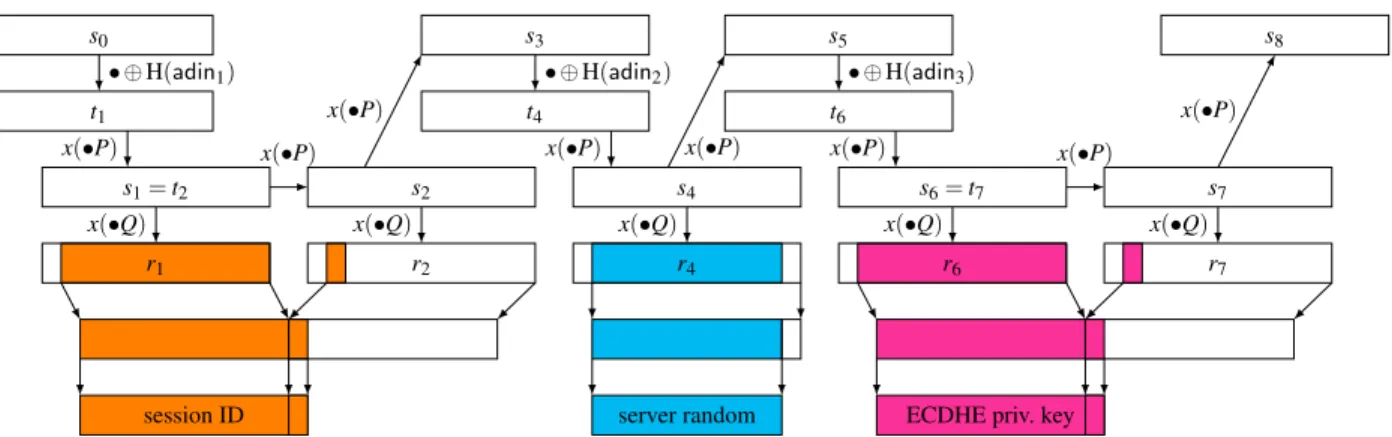
Figure 2:Dual EC usage in OpenSSL-FIPS using ECDHE with P-256.
sion 2.0.5 in combination with OpenSSL 1.0.1e (hence-forth “OpenSSL-fixed”). The library consists of two com-ponents, libcrypto.a which implements the core crypto-graphic routines, including Dual EC, and libssl.a which implements TLS. OpenSSL documentation provides guid-ance on building the library, as well as usage in common scenarios.
OpenSSL-fixed supports TLS 1.2 with the full comple-ment of elliptic curve cryptography for key exchange and digital signatures. By default, the preferred cipher suites use ECDHE key exchange and either RSA or ECDSA signatures. We investigated connections made using the ECDHE handshake.
OpenSSL includes a textbook implementation of Dual EC based on the NIST SP 800-90 March 2007 revision. On the server side of the standard ECDHE handshake, the generate function is called repeatedly to generate the following values: (1) a 32-byte session iden-tifier, (2) a 28-byte server random,6(3) a 32-byte ECDHE
ephemeral private key,7and, when ECDSA is being used,
a 32-byte nonce. OpenSSL’s implementation of Dual EC does not cache unused random bytes at the conclusion of a generator call, hence each sequence of random bytes be-gins with up to 30 bytes drawn from a single elliptic curve point. Figure 2 illustrates the generation of these values.
OpenSSL’s use of additional input. While analyzing OpenSSL’s implementation of SP 800-90, we discovered an important difference between OpenSSL and the other libraries analyzed in this work. Specifically, OpenSSL provides additional input with each call to the gener-ate function. The additional input string is constructed uniquely by the function FIPS_get_timevec() prior to
6Although we do not discuss attacks against the client, a recent fix to the OpenSSL client implementation increases the amount of PRNG output in the client random to 32 bytes (seehttp://bit.ly/ 1ftSQrM) which may decrease the attack complexity significantly.
7OpenSSL generates this key by drawing 32 random bytes and checking whether the result (expressed as an integer) is less than the group ordern. If not, the process is repeated.
each query for random bytes. It comprises 16 bytes with the following structure.
adin= (time in secs || time inµsecs || counter || pid) Each of the component fields in the additional input string is 4 bytes in length. On Unix-based systems the time fields are computed usinggettimeofday(). The counter is a monotonically increasing global counter that is set to 0 at library initialization, and increments with each call toFIPS_get_timevec(). On operating systems where the process IDs are available, pid contains the process ID returned fromgetpid().
A passive attacker can capture 32 consecutive bytes of Dual EC output by observing the session ID sent to the client by an OpenSSL server. Assuming the generator is instantiated with P-256, the attacker can now execute the initial steps of the basic attack using the first 30 bytes, in order to recover multiple candidate states, and (using the additional two bytes) reduce the number of candidate states to one, or a small number. From this point, the OpenSSL attack differs from the basic attack. Given each candidate states, the attacker now calculates the final update steps=x(sP)and exhaustively guesses the ad-ditional input string used in the next call to the generate function ass0=s⊕H(adin). This requires the attacker to iterate through a set of candidateadininput strings, executing the steps of the generate algorithm to recover a candidate ECDHE private key, and comparing this value to the intercepted ECDHE public key from a real hand-shake trace.
The complexity of this attack depends on two factors: the number of candidate states remaining at the conclu-sion of the first portion of the attack, and the number of candidateadin strings. Since we are guessing 16-bits, only about half of all strings give a validx-coordinate, and are comparing the resultant output against 16 bits, we expect to see 1 or 2 candidate states that generate the correct first two values. We did not see more than 3 can-didate states in any of our test runs, although we would
expect to occasionally see more if we repeated the attack enough times.
Since the time in seconds is already transmitted as part of the server random, the first portion ofadinis known. Thus it remains to predict the time inµseconds, process ID and counter. Under reasonable assumptions about the operating system and the number of connections so far handled by the server, this can range from approximately 220(primarily guessing theµsecs field) to 235with a typ-ical Unix range of pid values and known counter value, and possibly 245or more depending on how recently the library was initialized. Notice that once an attacker re-covers theadinstring for a first TLS connection, it may be relatively easy to predict these values for later connec-tions.
The inclusion of additional input complicates the attack since recovering the Dual EC state when it is most con-venient, namely during the generation of the session ID, does not immediately translate into recovering the session keys. There are two cases to consider.
In the first case, the attacker knows nothing about the state of the generator except that the counter value is no bigger than k≤32 bits. The first step is to re-cover the generator state (for ease of analysis, assume only one candidate state is possible). As with BSAFE-C, this requires approximately 215 variable-base-point multiplications and an equal number of fixed-base-point multiplications. Next, the additional input string needs to be guessed. For each guess, this takes two fixed-base-point multiplications. There are at most 235+k ad-ditional input strings to try. A guess can be validated by comparing to the server random field. Finally, the ECDHE secret and public keys need to be computed for each guess of the second additional input string. Each guess takes five fixed-base-point multiplications; how-ever, since the attacker has already determined the pid and the counter value, the attacker has a good estimate of the time and increments the microsecond value from there; this takes about 213guesses. This gives a total cost of 215(Cv+Cf) +235+k(2Cf) +213(5Cf). The 213is an
upper bound for our observations. Usually fewer than 212 tests were sufficient and on a fast Internet server even less time passes between two calls of Dual EC.
In the second case, the attacker has already broken a previous connection and so the pid and counter values are known. The cost of performing the whole attack a sec-ond time becomes 215(C
v+Cf) +220(2Cf) +213(5Cf).
However, the cost of computing a scalar multiplication with a variable base point is significantly higher than for a fixed base point. It may be in the attacker’s best interest to keep track of the generator’s state throughout each ses-sion. This involves keeping track of counter updates and recovering the state after each encrypted TLS record sent and randomness used for ECDSA and IVs. The search
space for the time inadinfor these values is usually small, similar to that in the ECDHE key.
Then the cost of recovering the state at the beginning of a new connection is at most 220(2Cf)for testing the
time (and less if better estimates of the time are known) in place of the 215(Cv+Cf), for a total cost of 220(2Cf) +
213(7Cf). This is faster if the time update for the server
random call requires a smaller search space for the time after the time has been determined for the session ID.
4.4
Attack validation
We implemented each of the attacks against TLS libraries described above to validate that they work as described. Since we do not know the relationship between the NIST-specified pointsPandQ, we generated our own pointQ0
by first generating a random valuee← {R 0,1, . . . ,n−1}
wherenis the order ofP, and setQ0=eP. This gives our trapdoor valued≡e−1 (modn)such thatdQ0=P. We then modified each of the libraries to use our pointQ0and captured network traces using the libraries. We ran our attacks against these traces to simulate a passive network attacker.
We would like to stress that anybody who knows the back door for the NIST-specified points can run the same attack on the fielded BSAFE and SChannel implementa-tions without reverse engineering.
We describe the concrete performance results of our attacks in the next section and give details on the libraries here.
RSA BSAFE. The Dual EC implementation in BSAFE-C contains the pointsPandQas well as three tables of scalar multiples of each of the points for fast multiplica-tion. The tables contain 65, 517, and 573 multiples. After working out the corresponding scalar factor for each entry in the tables, we computed our own tables and modified the relevant object files in the library. There were no health checks or known-answer tests (KATs) to bypass.
BSAFE-Java is distributed as a signed, obfuscated jar file. We reverse engineered the code sufficiently to find and bypass the checks that prevent modification and re-placed the jar’s signature with our own. BSAFE-Java has a single table of 431 scalar multiples of each ofPandQ.
Windows SChannel. Dual EC in SChannel is imple-mented both in the kernel and a user-mode library. We modified the user-mode library, which performs a KAT when the operating system first loads the module at boot, as well as continuously during operation when FIPS mode is enabled. To sidestep these checks, we disabled FIPS mode, and wrote a system service that (1) replacesQwith
Q0in the the address space of the Local Security Authority Subsystem Service (IIS and IE delegate TLS handshakes to this process), and (2) makes Dual EC the system-wide default PRNG.
OpenSSL-fixed. Dual EC in OpenSSL is implemented in the separate OpenSSL-FIPS library. This library con-tains both runtime KATs and a check of the SHA-1 hash of the object code. Since the hash is computed each time the library is compiled, we simply fixed the bug which prevents Dual EC from being used (described above), bypassed the KATs, and substitutedQ0forQ.
5
Implementation
We implemented all attacks for parallel architectures, specifically clusters of multicore CPUs. The attacks are parallelized using OpenMP and MPI, with the search space distributed over all cores of the cluster nodes, using one process per CPU and one thread per (virtual) core. The attacks are “embarrassingly parallel”: there are no data dependencies between the parallel computations and thus no communication overhead and no limit on the scal-ability of the parallelization, other than the total number of independent computations.
5.1
Algorithmic optimizations
For finite-field arithmetic, we use the Gueron/Krasnov OpenSSL patch for NIST P-256, described in [10] and available at [11]. Square-root computations, to recover the
y-coordinates, use thatp≡3 mod 4 and compute√aas
a(p+1)/4. We refer to the cost of recovering ay-coordinate asCy.
The definition of the update function in Dual EC re-quires all scalar multiplications to result in affine points (to derive a uniquex-coordinate). To improve the per-formance of our implementation we compute all point operations in affine coordinates and batch the inversions using Montgomery’s trick [20] across several parallel computations. We use a batch size of 256 for all experi-ments; increasing the batch size any further does not have a measurable effect on the runtime.
The most performance-critical operations on EC points in the attack logic are:
1. Scalar multiplications using fixed base pointsPand
Qin order to compute the next internal state and to compute the output string respectively;Pis also used as base point for ECDHE and ECDSA computations.
2. Scalar multiplications using variable base points and a fixed scalar, the back doord, in order to compute a candidate internal state given an output string.
In Table 1 we refer to the costs of a fixed-base-point scalar multiplication asCf and those of a
variable-base-point one asCv.
For the fixed-base-point computations we use large pre-computed tables of multiples of the base point. For a given widthwwe compute a lookup table consisting ofTP,i,j=
i2jwPfor 0<i<2w, 0≤j<d256/we. A scalar multi-plicationsPcan then be performed asd256/we −1 addi-tions of precomputed points from the lookup table using
sP=∑dj=2560/we−1TP,s(j),j, where s=∑dj256=0/we−1s(j)2jw.
We do the same forQin place ofP. These tables are shared among all threads of each process in the imple-mentation. We choosew=16 for all our experiments for a reasonable balance between performance and lookup-table size. This bringsCf down to 15 point additions.
We implemented the scalar multiplications with the fixed scalardusing signed sliding windows with window width 5 and fully unrolled the code. This wayCvtakes
253 doublings and 50 additions. Ourdwas a randomly chosen 256-bit integer. An attacker can choosedto mini-mize the cost of the fixed-scalar variable-base-point scalar multiplication by choosingdwith low Hamming weight or more generally with a short addition chain, although a sufficiently low weight runs the risk that someone will discoverdby a discrete-logarithm computation. To put an upper bound on the Dual EC attack time we avoid this optimization.
An independent blog post by Adamantiadis [2] has a proof of concept of the general Dual EC attack using OpenSSL’s libcrypto for curve and large integer arith-metic. Adamantiadis does not implement a complete at-tack but recovers the state from a 30 byte random output. His proof of concept iterates through all 216candidates to recover the missing bits of thex-coordinate and computes the correspondingycoordinate. In case he discovers a point on the curve, he applies the back-door computa-tion and computes the next random output. This proof of concept has an expected cost of 216Cy+215(Cv+Cf).
On a single core of an Intel Xeon CPU E3-1275 v3, Adamantiadis’s code requires about 18.5 s compiled with gcc version 4.8.1. Adamantiadis is using an older version of OpenSSL’s libcrypto. For comparison, we modified Adamantiadis’s code to run with libcrypto from OpenSSL version 1.0.1e; this version requires about 12.1 s. Fur-thermore, we reimplemented Adamantiadis’s proof of concept using our optimized primitives. The optimized version requires about 3.7 s on a single core. Thus, our optimizations give an improvement by a factor of 3.3 over libcrypto.
In Adamantiadis’s code (using libcrypto version 1.0.1e), the computation of aycoordinate (corresponding to costCy) takes about 15 µs on average. In our optimized
version, this computation requires only 6 µs, which is an improvement by a factor of 2.5. The application of the back-door computation in Adamantiadis’s code (scalar multiplication of a variable point by a fixed factor, cost
Cv) requires about 168 µs on average; our code requires
about 98 µs, which is an improvement by a factor of 1.7. Scalar multiplication with fixed base pointsPand
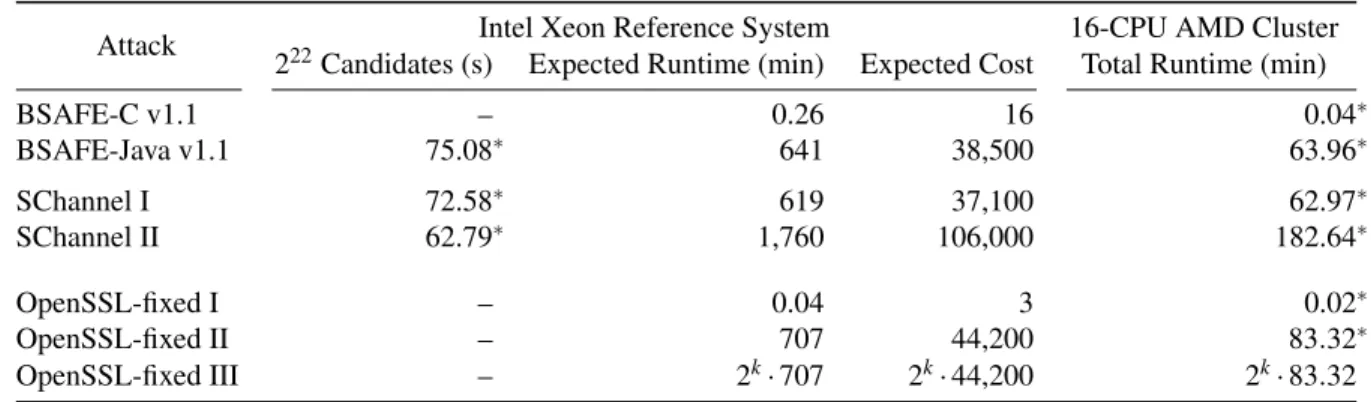
Table 2:Performance measurements and estimates.
Attack Intel Xeon Reference System 16-CPU AMD Cluster
222Candidates (s) Expected Runtime (min) Expected Cost Total Runtime (min)
BSAFE-C v1.1 – 0.26 16 0.04∗
BSAFE-Java v1.1 75.08∗ 641 38,500 63.96∗
SChannel I 72.58∗ 619 37,100 62.97∗
SChannel II 62.79∗ 1,760 106,000 182.64∗
OpenSSL-fixed I – 0.04 3 0.02∗
OpenSSL-fixed II – 707 44,200 83.32∗
OpenSSL-fixed III – 2k·707 2k·44,200 2k·83.32
∗
measured
Adamantiadis’s code, one scalar multiplication requires about 171 µs on average. In our optimized code, the com-putation for fixed base points requires only about 6µs on average, which is an improvement by a factor of 28. For an actual attack, the proportion ofCf toCv is usually
significantly larger than in the proof of concept. This increases the impact of our improvements on the attacks.
5.2
Performance measurements and estimates
All our attacks are based on the fact that some fields in the handshake messages (e.g., session ID and server random) contain a bit sequence derived from thex-coordinate of a pointR. In order to recoverR, we iterate through all possible combinations of the missing bits, check whether each candidateriactually is a validx-coordinate and gives
a point candidateRi, apply the back door by computing dRi, and follow all the steps (includingadinfor the attacks
on OpenSSL-fixed) to check whether the candidate ri
eventually allows us to recover the (EC)DH secret. As the steps differ for each implementation, a different amount of computation is required for each attack (see Table 1, column “Attack Complexity”).
We measure the cost of the attacks on a reference CPU, an Intel Xeon CPU E3-1275 v3, which has 4 cores and 2 hardware threads per core when enabling Hyper Thread-ing. Table 2 lists measured and estimated performance numbers of the attacks. Turbo Boost and Hyper Thread-ing are enabled; thus, we were usThread-ing 8 OpenMP threads for the measurements on the reference system.
We measure the runtime of testing 222 candidates (about 221candidate points). From these measurements, we extrapolate the expected runtime of the attack. From the expected runtime, we compute the cost of the attack as the number of Intel Xeon reference processors that would be required to perform the attack in an expected time of less than one second.
Finally, to verify the efficiency of the attack on multi-ple nodes, we measure the total worst-case runtime of the
attack on a four-node, quad-socket AMD Opteron 6276 (Bulldozer) computing cluster. The cluster has an In-finiband interconnect and 256 GB memory per node — however, neither of these is relevant for the attacks: the attacks require less than 1 GB of RAM per process and do not need much communication.
For the timing measurements we ran each case sev-eral times to verify that there is no significant variance and finally picked the time from a representative test run. We are using gcc version 4.8.1 (Ubuntu/Linaro) with op-timization level O3. In the following, all estimates for expected runtime and expected cost are rounded to three significant digits.
BSAFE-C v1.1. For the BSAFE-C attack, we simply concatenate session ID and server random and guess 16 bits of the target x-coordinate for the 30 possible cases. The complexity of the attack on BSAFE-C is 30· 216Cy+215(Cv+Cf)
. In the worst case this only requires testing 30·216candidates which is less than 222, so we do not have a measurement for the first column in Table 2. Instead, we measured the worst-case time for the whole attack (31.12 seconds) and list half of the worst-case time, i.e., 31.12 s/2≈0.26 min as expected runtime. This gives an expected cost of 16 reference CPUs. This attack required 0.04 min on our cluster; most of this time is probably due to initialization overhead.
BSAFE-Java v1.1. In this case, the session ID of the handshake is not derived from Dual EC — so we have to use the 28 bytes of the server random, missing 32 bits of the targetx-coordinate. The complexity of the attack on BSAFE-Java is 232Cy+231(Cv+5Cf). We measured
a time of 75.08 s to check 222candidates. In total, this attack requires checking at most 232candidates, so the expected runtime is 232−22·75.08 s/2≈641 min on the reference CPU. Therefore, the expected cost to finish this attack within one second is about 38,500 reference CPUs.
We measured a worst-case total runtime of 63.96 min on our cluster.
SChannel I. The SChannel I attack uses the server dom from the preceding handshake to hook into the ran-dom number stream and to discover the server’s ECDHE private key in the handshake when the private key is re-freshed. The complexity of this attack is 232Cy+231(Cv+
4Cf). Checking 222 candidates takes 72.58 s. This is
slightly less than the time for BSAFE-Java, because this attack requires only four instead of five multiplications by a fixed base point for each point candidate. The whole attack requires checking at most 232 candidates, so the expected runtime is 232−22·72.58 s/2≈619 min. There-fore, the expected cost of the attack is 37,100 reference CPUs. The measured worst-case total time on our cluster is 62.97 min.
SChannel II. The SChannel II attack uses just one single handshake to recover the secret keys and there-fore relies on the session ID (where the 4 least signif-icant bytes have been replaced by their value modulo 20,000) to recover the state of the PRNG. The complexity of the attack is 234Cy+233(Cv+Cf) +217(5Cf), more
precisely 232/20,000·216 Cy+ (Cv+Cf+5Cf/216)/2
. The dominant part for each candidate check is Cy+
(Cv+Cf)/2 which requires a smaller number of
mul-tiplications with a fixed base point than SChannel I.
We measured 62.79 s to check 222 candidates. This
attack requires checking up to 232/20,000·216
candi-dates; therefore, this attack has an expected runtime of 232−22/20,000·216·62.79 s/2≈1,760 min. This gives an expected cost of 106,000 reference CPUs.
OpenSSL-fixed. Due to the use ofadin before each random draw, OpenSSL is a special case among the im-plementations of Dual EC. The attack on OpenSSL takes three steps: First, we find the current state by finding the 16 missing bits for the session ID. This requires checking at most 216candidates; thus, we do not give a measure-ment for 222 candidates in the first column of Table 2. Since this step might result in more than one state can-didate, we always compute all 216 candidates. If more than one candidate is recovered, the attacker either has to check all candidates (in parallel) or retry with a different handshake if applicable. In the following we investigate the expected case that only one candidate is found. In the second step, we need to find theadin used to gen-erate server random. Here,adinconsists of the current system time (including µs), the process ID (pid), and a counter value. In the last step, we need to find the next adinbefore the call to generate the DH key. The pid and the counter are known from the previousadin; we only need to find the µs over a very short time span by iter-atively incrementing the time counter until the correct value is reached. The complexity of the OpenSSL
at-tack is 216Cy+215(Cv+Cf) +220+k+l(2Cf) +213(5Cf)
wherekis the number of unknown bits of theadincounter andlis the number of unknown bits of theadinpid.
The first step requires to check at most 216x-coordinate candidates; for the last step, we expect a maximum of 213 increments to find the correct µs for theadin, as discussed earlier. Therefore, the scalability of the parallelization of step one and three is limited due to the small work-load. We are using a batch size of 256. Therefore, the workload of checking 216candidates in the first step can be split across at most 216/256=256 threads without loss of efficiency. The last step requires at most 213 iter-ations, so the maximum number of threads for this step is 213/256=32. Step one and three contribute to only an insignificant fraction of the total complexity when pid or counter are not known.
We examine three cases:
OpenSSL-fixed I: pid and counter are known, µs of time are unknown,
OpenSSL-fixed II: counter is known, µs of time and pid (15 bits) are unknown,
OpenSSL-fixed III: µs of time, pid (15 bits), and counter (kbits) are unknown.
The system time in seconds is known from the titamp in the server-random field of the handshake mes-sage. Therefore, only the µs must be found by exhaus-tive search. The seconds might have clocked since the timestamp was obtained; thus, we need to test up to 1,000,000+∆candidates for the µs. An upper limit on∆
is the time between the server receiving the ClientHello message and sending the ServerHello message. We use 1,000,000 µs+48,576 µs=220µs as upper limit.
The standard maximum pid on Linux systems is 215. If the attacker starts listening to the server right after bootup, he can assume the initial counter to be zero; otherwise, he may make an educated guess about the current counter state based on uptime and the average connection number. To compute the expected runtime of this attack we measured the worst-case runtime of the case OpenSSL-fixed I. The first step to compute state candidates took about 0.96 s; the second step checking all possible 220µs for one single state candidate took 2.59 s. The final step checking the next 213µs took only 0.05 s.
There-fore, the expected runtime of OpenSSL-fixed I is 0.96 s+
2.59 s/2+0.05 s/2≈0.04 min; the expected cost is three reference CPUs. The expected runtime of OpenSSL-fixed II is 0.96 s+215·2.59 s/2+0.05 s/2≈707 min. We are using 8 threads in the reference system; the maximum number of threads is 256 threads for the first step and 32 threads for the last step. Therefore, the first step can-not be faster than 0.96 s/(256/8)≈0.03 s and the last step requires at least 0.05 s/(32/8)≈0.01 s in the worst