Worth Their Weight
An Assessment of the Evolving Field of Library Valuation
by the Bill & Melinda Gates Foundation
© 2007 Americans for Libraries Council
Cover image: ©2006 Seattle Public Library This report is offered for free electronic download.
Please credit Americans for Libraries Council in any transmission or reproduction. americansforlibraries.org
Worth Their
Weight
An Assessment of the Evolving
Field of
Library Valuation
Americans for Libraries Council
THIS REPORT IS AVAILABLE FOR FREE DOWNLOAD AT:
americansforlibraries.org
Americans for Libraries Council is a non-profit organization dedicated to increasing innovation and investment in the nation’s libraries.
The Council’s program division, Libraries for the Future, develops national programs to strengthen libraries, provides training in community librarianship, and facilitates planning for 21st century libraries.
Authors:
Susan Imholz, Ph.D., consultant to Americans for Libraries Council for the “Building Knowledge for Library Advocacy” project
Jennifer Weil Arns, Ph.D. University of South Carolina School of Library and Information Science
Editors:
William Zeisel, Ph.D. Americans for Libraries Council Nina Sonenberg, Ph.D. Americans for Libraries Council
Graphics and Layout:
Alejandra Ramos, Americans for Libraries Council Lauren Miller, MDesign
27 Union Square West, Suite 204 / New York, New York 10003 / 646.336.6236 / americansforlibraries.org
Foreword and Acknowledgements
Worth Their Weight: An Assessment of the Evolving Field of LibraryValuation is part of “Building Knowledge for Library Advocacy,” an initiative carried out by Americans for Libraries Council with major support from the Bill & Melinda Gates Foundation. “Build-ing Knowledge for Library Advocacy” aims to develop the knowl-edge necessary for strengthening advocacy for libraries and public-access computing. The components of the project are designed to empower librarians and library trustees, members of library foun-dations, advocates and Friends, constituency leaders, researchers, and other community members with the information they need to strengthen library advocacy.
Besides this report on the emerging field of library economic valu-ation, other components of the initiative are:
Long Overdue: A Fresh Look at Public and Leadership Opinions
<
of Libraries: A national opinion study carried out in 2006, in partnership with Public Agenda, a leading public interest re-search firm. Long Overdue provides insight into the views of typical Americans and their elected officials about libraries. The research included focus groups, interviews with com-munity leaders and elected officials, and a national telephone poll.
Act for Libraries
< : An online, interactive knowledge center de-signed to sharpen and strengthen library advocacy. The in-teractive site provides a clearinghouse of information for all concerned with the future of public libraries and public access to information and information technology. It offers ideas, re-search, stories, analysis, testimonials, and access to tools that, collectively, encourage and inspire action for and investment in libraries.
Dissemination: National dissemination of the two reports,
<
Long Overdue: A Fresh Look at Public and Leadership Opinions of Libraries and Worth Their Weight: An Assessment of the Evolv-ing Field of Library Valuation is an ongoing process that will extend the life of “Building Knowledge for Library Advocacy” and connect individuals and organizations back to the Act for Libraries website as a dynamic resource for advocacy. The components of “Building Knowledge for Library Advocacy” are complementary. They provide targeted data and recommenda-tions for different segments of the library community and reinforce one another in format and in content. The Act for Libraries website unites all the pieces, offering findings from the two research proj-ects along with additional materials.
The components of “Building Knowledge for Library Advocacy” are connected in purpose and content to a larger universe of re-search activities being carried out simultaneously by others in the library community. Most of these activities, whether surveys of library staff, public opinion polls, or other market research, are geared to strengthening the capacity of the field to advocate for investment in libraries and public computers. Like “Building Knowledge for Library Advocacy,” the majority of the new studies
are underwritten by the Bill & Melinda Gates Foundation, which recognizes the urgent need for libraries to reassess and reassert their image and their value in the information age.
Other key studies recently completed with the support of the Gates Foundation include Public Libraries and the Internet 2006 (Information Use and Management Policy Institute, Florida State University, 2006) and the Urban Library Council’s Making Cities Stronger: Public Library Contributions to Local Economic Development (http://www.urbanlibraries.org/jan1006makingcitiesstronger. html). Americans for Libraries Council is proud to partner with these initiatives, which are beginning to generate the critical mass required for making a major new case for libraries and public com-puters.
Many people have contributed insights, expertise, and time to this project. We especially want to recognize Dr. Susan Imholz, a con-sultant to the Americans for Libraries Council, who is the lead author of this report with Dr. Jennifer Weil Arns of the University of South Carolina. Steve Lydenberg, CFO of Domini Social In-vestments, also made important contributions to the project. The library research experts who allowed us to share their insights and those who assisted in writing the report also deserve recogni-tion. Special thanks are due to the participants of ALC’s November 2005 forum on economic valuation: Jennifer Arns, Denise Davis, Donald Elliott, Martin Gomez, Jose-Marie Griffiths, Pearl Kamer, Bruce Kingma, Steve Lydenberg, Tim Lynch, Chuck McClure, Danielle Milam, Bob Molyneux, Joyce Ray, and Joe Ryan. We are very grateful for their time and effort, which were given freely. All of the researchers consulted have expressed their willingness to continue to work with ALC and others to help develop a firmer library research agenda. We particularly appreciate the advice and encouragement we received this January and during the follow-up discussion on January 19 during the 2007 American Library As-sociation Midwinter meeting.
Worth Their Weight: An Assessment of the Evolving Field of Library Valuation and the other components of “Building Knowledge for Library Advocacy” contribute to an exciting new phase in library advocacy. We thank the Bill & Melinda Gates Foundation for the opportunity to examine the emerging field of library valuation and to contribute to the new discourse on libraries as community assets.
Diantha Dow Schull Bruce Astrein President, ALC Executive Director, ALC
Table of Contents
FOREWORD AND ACKNOWLEDGMENTS ...
1EXECUTIVE SUMMARY ...
5KEY FINDINGS IN BRIEF ...
7RECOMMENDATIONS IN BRIEF ...
9SECTION 1: AN ASSESSMENT OF THE FIELD ...
111. Introduction ...11
1.1 Growing Interest in Library Valuation ...11
1.2 Goals of the Report ...11–12 2. Overview of Valuation Tools and Methods ...13
2.1 The Milieu ...13
2.2 Terms and Concepts: Traditional Approaches to Explaining Public Library Value ...13
2.3 Promising Directions ...14–15 2.4 Economic Valuation Methodologies ...16
2.4.1 Cost/Benefit Analysis ...16
2.4.2 Contingent Valuation ...16
2.4.3 Secondary Economic Impact Analysis ...16–17 2.5 Conclusion ...17
3. Examples Illustrating Methodologies and Trends ...18
3.1 Suffolk Cooperative Library System Study: Designed to Engage Stakeholders and Decision Makers...18
3.1.1 Cost/Benefit Measures ...18–19 3.1.2 Secondary Economic Impact Measures ...19–20 3.2 Seattle: Repositioning the Library ...20–21 3.3 Florida 2004: Multiple Assessment Methods ...21–22 3.4 Mastic-Moriches-Shirley Community Library: A Cautionary Tale ...22
3.5 A Patchwork Field ...22–24 3.6 Encouraging Developments ...24
3.7 Conclusion ...24–25 4. Adapting Techniques from Business and the Nonprofit Sector ...26
4.1 SROI: A New Method for Library Valuation ...26
4.2.1 Balanced Scorecard ...27
4.2.2 Triple-Bottom-Line Accounting and the Global Reporting Initiative ...27
4.2.3 Corporate Social Responsibility Reports ...28
4.2.4 Evidence-Based Policy and Practice Framework ...28–29 5. From Research to Advocacy ...30
5.1 A Changing Library and Advocacy Landscape ...30
5.2 Hints of Success ...31
5.3 Conclusion ...31
6. Recommendations ...32–34
SECTION II: STUDY SUMMARIES ...
35Study Summary Guidelines ...36
1. Economic Benefits of Public Libraries: Value for Money Southwestern Ohio’s Return from Investment in Public Libraries 2006 ...37–38 2. Tax Payer Return on Investment in Pennsylvania Public Libraries 2006 ...39–40 3. Carnegie Library of Pittsburgh: Community Impact and Benefits 2006 ...41–43 4. Placing Economic Value on the Services of the Mastic-Moriches-Shirley Community Library in Suffolk County, New York 2006 ...44–45 5. Placing Economic Value on the Services of the Middle Country Public Library in Suffolk County, New York 2006 ...46–47 6. The Economic Value of the Port Jefferson Free Library in Suffolk County, New York 2006 ...48–49 7. Placing Economic Value on the Services of the Northport-East Northport Public Library in Suffolk County, New York 2006 ...50–51 8. The Seattle Public Library: Economic Benefits Assessment 2005 ...52–53 9. Placing Economic Value on the Services of Public Libraries in Suffolk Counthy 2005 ...54–55 10. The Economic Impact of Public Libraries on South Carolina 2005 ...56–58 11. Making Book: Gambling on the Future of Our Libraries 2004 ...59–60 12. State of Florida Taxpayer Return on Investment in Public Libraries 2004 ...61–63 13. State of Maryland: Customer Survey of Maryland Residents About Public Libraries 2003 ...64–66 14. Cost/Benefit Analysis Manual for Medium-Sized and Smaller Public Libraries 2003 ...67–83 15. Economic Benefits and Impacts from Public Libraries in the State of Florida 2001 ...84–88 16. Economic Importance of Arts and Cultural Attractions in Louisville 2000 ...89–90 17. Public Library Use in Pennsylvania: Identifying Uses, Benefits, and Impacts 1998 ...91–92
BIBLIOGRAPHY ...
94–97GLOSSARY ...
98sharing information, multiple datasets, and open-source experi-mental tools. With the participation of professional library leader-ship, private enterprise, and academic researchers, such a forum might catalyze the conversion of research into effective advocacy messages.
Worth Their Weight is based on an ongoing dialogue among valua-tion experts within and outside the library community that began at a meeting that ALC convened on November 10, 2005, and for-mally concluded in January 2007. Participants discussed the pros and cons of different research methods and approaches used in other disciplines and fields. The meetings involved representatives from the Institute of Museum and Library Studies (IMLS), Urban Library Council (ULC), American Library Association (ALA), and the library vendor community. The meetings also featured guest speakers from other disciplines who had quantified difficult-to-measure social and economic impacts. These substantive discus-sions have provided researchers with an opportunity to reflect on their own work and to consider the strengths and weaknesses in the field. They have also helped ALC shape this report’s main focus— the relationship between research and advocacy.
Section I of Worth Their Weight approaches the subject of economic valuation from three directions: (1) a discussion of recent library valuation studies that illustrate important quantitative analysis techniques and other notable characteristics, including aspects of their structure, presentation, and use; (2) a discussion of alterna-tive social return on investment (SROI) methods as they relate to public libraries; and (3) a set of detailed action-oriented recom-mendations for accelerating growth in the field of library valuation and facilitating its use in advocacy settings.
Section II presents summary profiles of 17 valuation and impact studies done since 1998. While these study summaries are not a substitute for reading the full reports themselves, they offer a unique overview of the field. The profiles are abridged to essential data, including authors, algorithms and methodological approach, results, and survey questions, and include links to the full reports online. The summaries are intended to provide researchers and ad-vocates interested in this subject with a quick and efficient means of obtaining an overall appraisal of the field without wading through hundreds of pages of research reports.
Worth Their Weight: An Assessment of the Evolving Field of Library Valuation does not claim to be definitive, nor could it be in such a dynamic and fast-changing field. Rather, this report provides a base for further development of the field of library valuation and to stimulate analysis of the results of valuation studies in terms of library investment. The ultimate goal is to provide meaningful answers to communities as they ask what benefits they receive by continuing to invest in a strong public library.
Worth Their Weight: An Assessment of the Evolving Field of Library Valuation takes stock of the new work being done in the field of library valuation, puts that work into context, and provides recom-mendations for building the field in terms of both research and ap-plications. The assessment was carried out by Americans for Librar-ies Council (ALC) as part of its Building Knowledge for Advocacy Initiative, supported by the Bill & Melinda Gates Foundation and involving experts from within and beyond the library community. Coauthors of the study are Dr. Susan Imholz, consultant to ALC, and Dr. Jennifer Weil Arns, University of South Carolina School of Library and Information Science.
Worth Their Weight was prompted by the recognition that new ap-proaches to library advocacy are needed and that these apap-proaches must involve “making the case” for the public library in quantita-tive terms. Government officials generally expect library directors to be conversant with the language used in the business world, without realizing that library valuation is only beginning to use these sophisticated calculations and toolsets.
While the field of library valuation is still young, we have observed several salient trends which form the basis for this report’s key find-ings and recommendations. Our first observation is that over the past decade, public library valuation researchers have sought out and adopted valuation methods from the field of economics that allow the library to put a dollar value on its programs and services and show efficient use of tax dollars in cost/benefit terminology. The studies we reviewed clearly demonstrate the field’s growing sophistication, showing advancement from simple questionnaires to complex surveys, and from simple economic cost/benefit assess-ments to complex economic algorithms and forecasts.
Our second observation is that mastery of purely economic mea-sures is giving way to concerns about incorporating the public li-brary’s more intangible social dividends, and to finding new ways to express and quantify learning values and cultural benefits. We have noted that the concept of social return on investment (SROI) is gaining acceptance in the corporate world through tools such as the Balanced Score Card—which combines financial and non-financial measures to create a richer framework for evaluation— and triple-bottom-line reporting—which characterizes the social, financial, and environmental debits and credits of a business. Some of these and other concepts from the business world can be usefully applied to the valuation of public libraries. These expanded value propositions highlight the need to draw upon education research and social science expertise, and even to redefine monetary value and efficiencies in the context of sustainable, healthy communities when making the case for public libraries.
Finally, we focus on what’s needed to support the systematic growth and development of the field of library economic valuation. In its current stage, the field could benefit enormously from a formalized “collaboratory,” a web-based environment that includes forums for
Executive Summary
4. A Few Barriers to Address
The library community is rich in information, but the research related to economic impacts is uncoordinated, and several barriers need to be addressed if it is to reach its potential as an advocacy tool.
• The absence of a coordinating body that can focus resources on important advocacy and research issues.
• The lack of an informational forum for sharing knowledge and lessons learned about the effective use of evaluation studies and datadriven advocacy.
• The absence of a national research agenda that would encourage consistency in methodologies and applications. • The absence of data standards and a common vocabulary
that would facilitate sharing statistical data across platforms. • The lack of a comprehensive opensource database that could
link operational and usage data to broader social issues such as education and literacy.
• The absence of the financial resources required for comprehensive metaanalysis that integrates the results of completed valuation studies.
• Limited awareness among library practitioners and advocates concerning the steps required to complete a valuation study and effectively communicate the results to important stakeholders.
1. Talking Dollars Makes Sense
• Public and private funding communities are demanding more quantifiable results for their investment.
• Public library leaders and advocates are strongly voicing the need for new and convincing arguments that link library facts and figures to community development and social and economic prosperity.
2. Private Sector Tools Can Help
Private sector resources and tools are creating additional opportunities to make the case for public libraries’ efficiency and many contributions.
• Data sets and software offered by library vendors are
providing more timely and complex local and national statistics that will help researchers and advocates calculate the library’s worth in new ways.
• SROI and new “triplebottomline” reporting practices developed by corporations and nonprofit organizations are capturing new types of “profitability” and providing a broader picture of the value of organizations to their communities.
3. Valuation Studies Hold Promise
Recent advances in economic valuation research suggest that this discipline can provide tools and data making a strong fiscal case for the operational efficiency of public libraries and their contributions to national prosperity.
• Initial studies conducted within the academic and public library communities demonstrate promising methodologies and reach conclusions that have been used successfully by library advocates.
• Recent cost/benefit analyses using tools developed by business and industry suggest that public libraries often outpace other sectors in the efficient use of tax dollars. • The emergence of new tools like the Emetrics Instructional
System and NCES Comparison Tool are helping libraries capture the value of their electronic services and collections and express their value more readily tolegislators and decisionmakers.
• Recent investments by IMLS and the Gates Foundation are creating new opportunities to explore the value of new services such as public access computers in libraries.
Key Findings in Brief
Recommendations in Brief
1. Improve coordination and communication among stakeholders.
Researchers and advocates need a forum that encourages the sharing of ideas and helps stakeholders work to one anoth-er’s strengths. A Collaboratory, or an electronic interactive research forum that acts as a center without walls, would allow participants to share their research and thoughts across institutions, focus attention on key issues, and foster agreement on norms, principles, values, and rules to advance the field of library valuation and to build collective knowledge.
2. Develop a comprehensive research agenda that promotes systematic valuation of
libraries’ contribution to education, civic participation, and improved quality of life.
The library research community should accelerate efforts to develop the conceptual models, research methods, and ana-lytical tools required to make a unified and full case for public libraries.3. Create a varied set of innovative tools.
Library managers, trustees, advocates, and practitioners need a diverse set of tools to make persuasive advocacy argu-ments that bring value to discussions at multiple levels. These tools should range from sophisticated statistical studies to easily understood open-source calculators that generate reports, create ready-to-use marketing material, and provide guidance related to advocacy issues.
4. Take advantage of valuation and evaluation reporting lessons from other sectors
and fields.
Those conducting valuation research and those who are using this research to prove public value should take advantage of approaches developed by similar fields, including the arts, environment, and education.
5. Define a national library valuation research agenda as part of a research
coordination infrastructure.
Those with an interest in valuation research need to identify issues that benefit from a national perspective and put in place mechanisms that allow individual efforts to build an argument capable of national impact.
6. Seek support for impact assessments enabling libraries, advocates, and researchers
to work together to evaluate the impact of studies in different contexts.
As the field of public library economic research expands and diversifies, a second stream of research should be done that assesses these studies from the viewpoint of library advocates and captures their value as part of a national advocacy policy agenda.
1.1 Growing Interest in Library Valuation
Americans have been making large investments in their public li-braries for well over a century—investments that continue today and typically result in substantial, regular improvements in facili-ties, services, and technological capacity. Until recently, these ex-penditures reflected a general understanding that public libraries enrich the fabric of personal and community experience. Today, however, as the competition for public funding continues to inten-sify, legislators and others have begun asking: How much return are Americans getting from these substantial investments?
The answer to this question is somewhat speculative. Libraries can be valued in many different ways, from hard
dol-lars to intangibles like community goodwill and historical significance (Elliott, 2005). In general discourse they are typically characterized as pub-lic goods with obvious social impact, but there is growing recognition of the need for more specific valuation. As a result, methods of economic anal-ysis used for “intangibles” (arts, cultural organiza-tions, environmental assets such as wetlands) have migrated to the discourse about the value of the library, and are being used to suggest benefits that frame public libraries more advantageously. In some cases, these developments have been
initiated by public library professionals engaged in conversation with policymakers and council members, who exercise the budget authority that ultimately shapes community priorities. At other times, library advocates and the many others who raise their voices in support of public libraries have made it clear that their argu-ments for public funding would benefit from a better understand-ing of the “total return” that could be expected from the support and investments they are seeking.
Not surprisingly, these valuation efforts have often differed in their methods, aims, and scope, and each has characteristic strengths and weaknesses. The multiplicity of the approaches they employ lim-its their use in concert and in the comparability of their findings. Nevertheless, there is substantial interest in them and a growing understanding that this work advances the field toward an infor-mation-rich environment addressing the needs of both public li-brary administrators and public lili-brary advocates.
1.2 Goals of the Report
The report is designed to empower librarians and library trustees, members of library foundations, advocates and Friends, constitu-ency leaders, researchers, and other community members by pro-viding information to strengthen library advocacy. The goals of the report are to:
Characterize public library valuation research and its tools
<
and methods.
Identify opportunities to expand and accelerate valuation
<
research using techniques developed in the business and non-profit sectors.
Suggest a public policy agenda for
<
ing valuation research and the needs of public library advocates.
Worth Their Weight: An Assessment of the Evolving Field of Library Valuation is based on a multifac-eted assessment. ALC staff and consultants car-ried out a literature search of studies conducted since 1991. Most importantly, ALC convened a panel of leaders in the field of library valuation in New York City in November 2005 to explore the nature and status of library economic valuation as a discipline. The event also involved representa-tives from the Institute of Museum and Library Services (IMLS), Urban Library Council (ULC), American Library Association (ALA), and the vendor community. It featured guest speakers from other disciplines who had quantified difficult-to-measure social and economic impacts. All guest speakers supplied important insights into how their work intersects with the valua-tion of libraries. The three major subject areas addressed at length were (1) metrics and quantitative analysis, (2) social return on investment (SROI), and (3) recommendations for advancing the field of library valuation.
The meeting was also intended to develop a better understanding of the reasons why many library researchers, decision-makers, and advocates lack cumulative evidence concerning the changing state of the nation’s libraries, their user communities, and the costs and benefits associated with their activities. From this perspective, the meeting illuminated current options for valuation, revealing major barriers to moving the field forward and identifying steps needed to
1.
Introduction
“ We have a huge landscape of possibilities here.... How can
we hone these down to a kind ‘collective action’ program
for the short and the long term to bring more cohesion to
the field [of library valuation]?”
—Jose Marie Griffiths, UNC School of Information and Library Science
Libraries can be
valued in many
different ways,
from hard dollars
to intangibles like
community goodwill
and historical
significance.
create new tools for evidence-based advocacy. Discussion concern-ing the last topic focused on how the field of economic valuation needs to evolve to become more useful to library advocates. The key points of agreement included the following:
The public library world is rich in data that could be
<
bilized to make the economic case for specific public libraries and the public library at the national level. The challenge lies in aggregating and synthesizing this data into a cohesive argument that meets the needs of local and national advocates.
Although economic valuation studies of public libraries are
<
appearing more frequently, they do not produce the comparable data needed for more effective and sustained advocacy. The next step is the development of mechanisms that facilitate these comparisons and a broader picture.
Researchers and advocates need a better sense of how
<
nomic research can be transformed into effective messages and the contextual factors that strongly influence the public impact of this type of statistical analysis.
Coordinated and sustained conversations with the public and
<
elected officials are needed to turn library valuation reports into compelling advocacy tools.
Research should not be limited to traditional economic
<
measures. The identification and impact of social benefits needs to be included in a research agenda intended to support public library advocacy.
Working from these premises, this report begins with a review of traditional valuation methods and addresses the interests of both lay readers and experts.
Among the unique contributions of this report are the 17 Eco-nomic Valuation Study Summaries to be found in Section II, which offer a concise overview of recent research for both special-ists and library professionals interested in learning more about this topic. The profiles condense hundreds of pages of reports into ba-sic elements, including author, algorithms and methodological ap-proach, results, and survey questions when applicable, along with URLs and references for finding the source documents.
This collection of summaries facilitates a broad assessment of the research from a developmental perspective. It is hoped that this will be a particularly useful contribution to the field of library eco-nomic valuation.
Taken together, these summaries show the progression of the field, from simple questionnaires to complex surveys, and from simple economic cost/benefit assessments to complex economic calcula-tions and forecasts related to the perceived value of the contribu-tions public libraries make to their communities.
Key Finding: Talking Dollars Makes Sense
In today’s climate of accountability, a better understanding of the value of public libraries is becoming essential to preserving and encouraging public and private investment.
Public and private funding communities are demanding more quantifiable results for
<
their investment.
Public library leaders and advocates are strongly voicing the need for new and convincing
<
arguments that link public library facts and figures to community development and social and economic prosperity.
2. Overview of Valuation Tools and Methods
“ You must value yourself in today’s economy.
If you don’t, you have no value.”
—Tim Lynch, Florida State University Center for Economic Forecasting
2.1 The Milieu
Auto insurance companies value human life in monetary terms. The Federal Aviation Administration has another figure for valu-ing a human life, and the federal Environment Protection Agency has yet another. These figures differ because their underlying actu-arial calculations are different, yet they have one thing in common. They are very useful to policymakers, as would be similar guidelines for valuing public library services. Fortunately, the cornerstone for devising both public library valuation guidelines and standardized measures is beginning to be put in place as the number of valuation studies rises.
2.2 Terms and Concepts:
Traditional Approaches to
Explaining Library Value
Data and measurement form the underpinning of economic research, just as carefully selected performance measures underpin descriptions and assessments of public library activities. At one time, interviews and surveys were the pri-mary tools employed to collect these data, and landmark studies conducted with ALA support during the 1930s and 1940s used surveys to col-lect data that characterized public libraries dur-ing those periods.
Despite their age, these studies are still of significant interest to librarians and public library scholars, and interviews and surveys continue to be used to collect a wide array of data, including pa-tron perceptions of the value of library service. (Joeckel, 1935; Gar-ceau, 1949).
Librarians and library vendors also frequently use interviews and surveys to inform product development, collection development guidelines, and important decisions related to the allocation of staff and financial resources. In some cases, library professionals gather this information by directly asking patrons to identify the types of products and services they would like to have. In others, research-ers and academicians pose similar questions in an effort to develop a better understanding of user behavior and information-seeking strategies.
Two reports recently released by the Online Computer Library Center (OCLC) provide useful examples. The first, The Envi-ronmental Scan (http://www.oclc.org/reports/escan/downloads/ escansummary_en.pdf), is notable for the way it embraces market research as a strategic planning tool. Based on interviews with li-brarians, vendors, archivists, and others operating within the infor-mation world, and focus groups that included students, teachers, and residents across 29 countries, it renders a portrait of library users who tend to be highly technology literate and libraries that are valued as community centers and places for civic and social as-sembly. It also highlights aspects of library service likely to be most
valued to future users: self-sufficiency, satisfac-tion, and seamlessness.
The second report, Perceptions of Libraries and Information (2005; http://www.oclc.org/reports/ pdfs/Percept_all.pdf), explores the resource pref-erences of electronic library users and their rela-tionship to the physical library, as well as per-ceptions of trust and the reliability of electronic information, knowledge of electronic resource offerings, and “library brand” issues. The re-port targeted students aged 16-25. Some 3,348 subjects from several countries completed the 83-question survey, which covered topics such as search engines, libraries, bookstores, online libraries, online bookstores, and differences in perceived value be-tween free and fee-based information.
Surveys and interviews are also used frequently to focus attention on library activities and to inform local advocacy efforts. In the recent research literature, the differences between product develop-ment and advocacy surveys appear to be becoming less and less obvious. Questions designed to inform product development typi-cally focus directly on patron/customer behaviors and lifestyle is-sues and preferences. Other questions are used to give advocates insight into the library’s status in a community, its fiscal health, and its stakeholders’ perceptions. Questions of both types provide new insights into the factors that affect patron support and behavior.
The cornerstone
for devising both
public library
valuation guidelines
and standardized
measures is
beginning to be
put in place as the
number of valuation
studies rises.
2.3 Promising Directions
Since 1989, the National Center for Education Statistics (NCES) has provided the data most commonly used to describe and assess public library programs in the United States. It captures the data through the Federal-State Cooperative System (FSCS) and makes the data files, including more than 50 elements related to staffing, collection size, operating expenditures, programs presented, circu-lation, technology, and other items of substantial interest, available on the Internet in coordination with the National Commission on Library and Information Science (NCLIS). NCES also supports the NCES Public Library Peer Comparison Tool (http://nces.ed.gov/ surveys/libraries/compare/index.asp?LibraryType=Public),which is often used by librarians and library administrators to create com-parative assessments of service levels, usage, and the efficiency with which services are provided.
Researchers also use NCES data, sometimes combining it with information from other sources to develop national and regional snapshots of library services and performance (Arns, 2003). The data can be used similarly to track trends that suggest changes in value perceptions, such as increases in the number of visits per capita, reported in Table 1 below. The table shows that the smallest libraries (the first quartile) had more visits per capita, and the larg-est experienced the greatlarg-est growth.
Similar data are now readily available to public libraries through automated management and circulation systems. A number of promising tools are also associated with these sophisticated circula-tion systems, such as the E-metrics Instruccircula-tional System, which provides guidance and tools to libraries that want to monitor and assess the use of their e-services and e-products (http://www.ii.fsu. edu/emis/index.cfm). This difficult task has gained significant at-tention. According to a recent Library Journal assessment of the automation marketplace, vendors are beginning to focus their at-tention on technologies that help libraries manage their electronic resources more effectively (Breeding, 2006; http://www.library-journal.com/article/CA6319048.html). Until recently it has been difficult to estimate this type of usage and consequently character-ize its value.
Two other recent projects are producing new types of data of par-ticular interest to valuation efforts. The first, the U.S. Public Li-braries Geographic Database (PLDGB) Project (http://www.geolib. org/PLGDB.cfm), funded by IMLS and conducted by the Florida State University (FSU) GeoLib program (http://www.geolib.org), is developing a nationwide public library database system that links digital maps and U.S. Census data with NCES data elements. This new database is intended to consolidate data into a new research platform and make it publicly available over the Internet.
Table 1: Library Visits per Capita by Size
First Quartile
Second
Quartile
Third Quartile
Fourth Quartile
95%
1990
<
1991
< < 5.74 < 4.80 < 5.14 < 4.24 < 3.33
1992
< < 6.06 < 4.97 < 5.25 < 4.57 < 3.75
1993
< < 6.03 < 5.00 < 5.25 < 4.61 < 3.84
1994
< < 5.81 < 4.78 < 5.05 < 4.48 < 3.77
1995
< < 5.94 < 4.85 < 5.18 < 4.52 < 3.77
1996
< < 5.94 < 4.99 < 5.15 < 4.51 < 3.78
1997
< < 5.88 < 5.01 < 5.28 < 4.63 < 3.89
1998
< < 5.95 < 5.04 < 5.30 < 4.68 < 3.98
1999
< < 5.84 < 5.02 < 5.39 < 4.70 < 4.00
2000
< < 5.93 < 5.05 < 5.44 < 4.70 < 4.05
2001
< < 5.96 < 5.19 < 5.42 < 4.69 < 4.09
2002
< < 5.96 < 5.37 < 5.65 < 4.82 < 4.24
# increase, < 1991-2002 < .22
< < .57 < .51 < .58 < .91
% increase, < 1991-2002 < 3.8
value of public libraries to elected officials, library board members, and donors. In 1994, the Public Library Association (PLA) and the Urban Libraries Council (ULC) provided funding to the St. Louis Public Library to advance these efforts, and the resulting report (http://www.slpl.lib.mo.us/libsrc/valuation.htm) propelled the topic to new prominence. Since then, the IMLS has targeted significant funding to states for conducting valuation studies.
2.4.1 Cost/Benefit Analysis
Cost/benefit analysis (CBA), in simple and complex forms, is by far the most popular means of characterizing the direct dollar ben-efits that accrue to communities when they provide tax support to public libraries. It does so by assigning a cost or purchase price to a library service or collection item and comparing this amount to the value of that service or item to library patrons and their
communi-ty. The resulting “benefit-to-cost ratio” measures the benefits per dollar spent. If the ratio is greater than one, the community receives benefits in ex-cess of costs. To date, most library CBA studies have evaluated only direct benefits to library us-ers, while enumerating and describing indirect benefits to others in the community.
Cost/benefit analysis requires that consistent measurements be used within comparisons, and while this tended to be the case in the studies we reviewed, they often used differing approaches and variables in their calculations. Despite this problem, cost/benefit analysis appears to be the most effective language for conveying the effi-ciency of investments of tax dollars in public libraries to public constituents. As a methodological approach, it is relatively inex-pensive and the results are relatively easy to understand. Surveys of library users and data from automated library systems that record collection, staff, and operating costs can usually support this type of analysis. Once the analysis is performed, benefits per dollar of tax support can be calculated. In economic terms, a standard method used to measure the net economic benefit of a good or service in a market involves an examination of consumer and producer surplus. Consumer surplus is the difference between what each customer is willing to pay and the price of the good or service. (This defintion of consumer surplus was borrowed from the environmental sci-ences: http://www.csc.noaa.gov/coastal/economics/envvaluation. htm.) Excess value is referred to as a “consumer surplus” in some of the studies we reviewed.
During the mid- to late 1990s, Glen Holt, Don Elliott, and their colleagues used IMLS funds to demonstrate the efficacy of using cost/benefit analysis and econometric measures to characterize the value of the St. Louis Public Library, the Baltimore County Public Library, the Birmingham Public Library, the Phoenix Pub-lic Library, and the King County Library (Seattle). The success of these seminal studies has encouraged others to include valuation assessments in the arguments they present when seeking funding increases and launching capital development campaigns.
The second, the Normative Data Project (NDP; http://www.li-braryndp.info), demonstrates the viability of a fully integrated da-tabase and the value it can bring to valuation research. Originally developed within the public sector, the NDP is now available from SirsiDynix on a subscription basis. Using proprietary algorithms, the NDP data combines NCES data elements with U.S. Census data and quarterly transaction data provided by contributing li-braries. SirsiDynix currently lists over 350 contributing library systems (http://www.libraryndp.info/why_ndp.html) and expects this number to increase substantially in the near future. It will con-tribute a new statistical portrait of library use and the value of par-ticular materials to different parts of the community.
Baker and Taylor’s Bibliostat programs (http://www.btol.com/pdfs/ biblio_collect.pdf) provide a different service, helping libraries col-lect and gain timely access to their NCES and other operational data. The software also supports comparisons of service levels to other outlets and library systems, and it can be
used to generate reports that demonstrate the rel-ative effectiveness of different libraries. The Pub-lic Library Association (PLA) PubPub-lic Library Data Service (PLDS) also collects data intended to fa-cilitate planning and evaluation (http://www.ala. org/PLATemplate.cfm?Section=plapubs). Their reports include data elements similar to those collected by the FSCS for the NCES, and they provide more detailed, granular information on trends and specific library activities such as chil-dren’s services and technology planning.
2.4 Economic Valuation Methodologies
This report uses the term “methodologies” to refer to conceptual frameworks that support specific approaches to data analysis. The public library valuation studies we reviewed tend to rely on two types of methodologies: those that produce estimates of direct ben-efits and those that produce estimates of indirect benben-efits. These terms are applied across the spectrum of valuation methodologies. The manner in which they apply to libraries is well presented in a statement from the Carnegie Library of Pittsburgh study, “Com-munity Impacts and Benefits” (2006; http://www.clpgh.org/about/ economicimpact/CLPCommunityImpactFinalReport.pdf, p. 4): When an individual uses library services to get information, there is a direct benefit to that individual.… When a library helps someone start a business or learn to read, there are fur-ther benefits to ofur-ther individuals [and to the community]. Interest in economic valuation is not an entirely new phenome-non. In 1999, an Association of Research Libraries (ARL) white paper pointed to the need for better understanding of the processes through which resources invested in academic libraries yield eco-nomic benefits to academic institutions (Deiss, 1999; http://www. arl.org/stats/program/capacity.pdf). Glen Holt and his colleagues (Holt et al., 2003; http://www.slpl.lib.mo.us/using/valuationtoc. htm) refer to similar early conversations concerning the need for methodologies that more effectively demonstrate the economic
Cost/benefit
analysis appears to
be the most effective
language for conveying
the efficiency of
investments of tax
dollars in public
libraries to public
constituents.
2.4.2 Contingent Valuation
Contingent valuation is a survey methodology developed to assign value to non-market goods, such as those produced by educational and environmental organizations. In the case of library services, value is explored by presenting subjects with various funding sce-narios and service levels and asking them to make hypothetical funding decisions. The resulting estimates of “willingness to pay” (WTP) more taxes or purchase public goods or the “willingness to accept” (WTA) less service, can be developed through surveys or questionnaires. Aabo’s paper, “The Value of Public Libraries,” de-livered at the 2005 IFLA Conference, is an interesting example of valuation measures developed from respondents’ value perceptions (http://www.ifla.org/IV/ifla71/papers/119e-Aabo.pdf).
2.4.3 Secondary Economic Impact Analysis
Economic analysts have devised a number of formulas and algo-rithms for assessing the secondary economic impacts of industries; these measurements are also considered “indirect” benefits. The employment contribution that public libraries make to their lo-cal economies may be seen as an example. Indirect benefits accrue when library employees who live locally spend their wages in their community and thereby contribute to its prosperity. As these wages undergo re-spending, they multiply the effect of the original ex-penditures. Secondary and future forecasts of economic benefit are called the “ripple or multiplier effects” (Kamer, 2005).
Both secondary economic benefits and future forecasts can be calculated with modeling software driven by mathematical algo-rithms. These modeling tools are called “input-output” models. They typically use data, or inputs, available from the Bureau of Economic Analysis (BEA) at the U.S. Department of Commerce and other sources.1
Their outputs are the result of calculations generated by the special-ized software algorithms. During the 1970s, the BEA developed a statistical modeling calculator known as the Regional Industrial Multiplier System (RIMS) for estimating regional economic ex-pansion and contraction. The RIMS modeling system was updated to RIMS II (Regional Input-Output Modeling System II; http:// www.bea.gov/bea/regional/rims) in the 1980s, and it has been used to calculate the economic impact of library employment and li-brary spending in a number of lili-brary valuation studies (Kamer, 2005). The Department of Commerce collects statistics on more than 224 industries nationwide by region, and the BEA gathers data continuously from business sectors around the country.
1 The mission of BEA is to produce and disseminate economic accounts statistics that provide government, businesses, households, and individuals with a compre-hensive picture of U.S. economic activity (http://www.bea.doc.gov). Bureau of Labor Statistics data covers employment, prices and living conditions, compensa-tion and living condicompensa-tions, and productivity and technology (http://www.bls.gov/
Many other proprietary econometric modeling tools can be pur-chased from the private sector, at greater cost. One of these, the REMI input/output model2 (http://www.remi.com), was used in
the Florida taxpayer return on investment study (Griffiths et al., 2004). Like RIMS and RIMS II, REMI uses BEA data to populate its modeling algorithms with additional industry-specific “policy variables” that let experts in fields such as transportation, technol-ogy, energy, and the environment apply their observations and knowledge to the output analysis calculations. In addition to cost, REMI differs from other input-output models in its ability to cal-culate and forecast economic benefits forward over a span of several decades.
2.5 Conclusion
Over the past ten years, public library valuation research and its tools and methods have been strongly influenced by terminol-ogy and analytical tools borrowed from economics. Cost/benefit analysis was originally used by governments to assess the economic benefits of water management, transportation, and capital develop-ment projects. Contingent valuation measures, first used to assess the intangible economic impacts of wetlands, have carried over to economic analysis of arts and cultural organizations and library valuation.
What library professionals can do with their own data has also changed dramatically over the past five to seven years. The growing sophistication of library technology platforms has created a direct feedback loop between library administrators and the communities they serve. In most cases these data are easily accessible, cumulative, and quickly available for decisions related to acquisitions, product development, and fund raising. With the right expertise and guid-ance, libraries can do their own research and create evidence-based briefs for use in conversations with local leaders and stakeholders. Some library researchers, however, are sensing that these traditional econometric measurements are providing limited insight into the broader social capital that libraries create and the social benefits they bestow. Consequently, researchers are beginning to turn their attention to the difficult problem of articulating a value proposi-tion that can be expressed in social as well as economic terms and presented in credible and evidence-based advocacy arguments.
Key Finding: Private Sector Tools Can Help
Private-sector tools and resources are creating additional opportunities to make the case for public libraries’ efficiency and many contributions.
Data sets and software provided by library vendors are facilitating more timely and complex local
<
and national value calculations.
SROI and new “triple-bottom-line” reporting practices developed by corporations and non-profit
<
organizations are capturing new types of “profitability” and providing a broader picture of the value of organizations to their communities.
3. Examples Illustrating Methodologies
and Trends
“ There is a lot that can be written prospectively about the library’s
potential impact, given the fact that public libraries are one of the
most democratically distributed physical institutions in America.
What does that mean when we compare this resource to other
com-munity resources? It’s looking at the potential impact that we could
have if we had more resources.”
—Bob Molyneux, SirsiDynix
Choosing a limited number of studies that illustrate current trends presents a unique challenge for a variety of reasons. As already noted, multiple approaches are used to value library services, and this multiplicity limits the ability to replicate research and apply research findings. The lack of coordination among researchers also makes it impossible to compare valuation results between and among libraries.
With these problems in mind, we reviewed the literature from the viewpoint of the library advocate. The initial four studies for dis-cussion were selected for the following reasons:
Each represents a different approach to the valuation
<
process;
Each was instigated by a different level of library leadership;
<
Each addressed different constituencies.
<
As a group, these studies also showcase several of the methodolo-gies, exemplify current trends and directions in research, and vary in scope as they examine libraries at the county, city, and state lev-els:
(a) Placing an Economic Value on the Services of Public Librar-ies in Suffolk County, New York This (Kamer, 2005) and three other Suffolk County library studies by Pearl Kamer in 2006 ex-emplify the new level of interest by a county library system director and individual library directors in deploying economic valuation to engage local stakeholders in advocacy issues.
(b) The Seattle Public Library Central Library: Economic Ben-efits Assessment This study (Berk & Associates, 2005; http://www. spl.org/pdfs/SPLCentral_Library_Economic_Impacts.pdf) takes a descriptive approach to its subject, combining colorful stories from Seattle’s history with survey data and statistics related to the library’s role as a local economic generator. A combination of quali-tative and quantiquali-tative methodologies makes the report popular and widely distributed among many audiences.
(c) State of Florida Taxpayer Return on Investment in Public Libraries This study (Griffiths et al., 2004; http://dlis.dos.state.
fl.us/bld/roi/publications.cfm) is notable for the breadth of meth-odologies used and its large scope. It is a good model for how to create an economic valuation study that is “advocacy-ready” with documents formatted for different audiences. It illustrates how the field is evolving in its use of multiple methodologies.
3.1 Suffolk Cooperative Library System
Study: Designed to Engage Stakeholders and
Decision Makers
The Suffolk Cooperative Library System (SCLS) is a consortium that provides electronic and programmatic services to public librar-ies serving the 1.4 million residents of Suffolk County, New York, located on Long Island. The cooperative is funded by New York State and by participating membership dues from individual Suf-folk County public libraries, whereas the public libraries it serves are fully supported by local tax dollars. The county itself typically does not provide support to public libraries (Kamer, 2005). In 2004, the SCLS engaged a business and civic organization, the Long Island Association (LIA), to execute an economic valuation study that looked at the collective value of the SCLS membership libraries. The LIA is a well-regarded, 80-year-old business and civic organization with a reputation for an independent viewpoint. Its mission—to “actively advocate [for] the interests of, and promote cooperation among, the business, labor, educational, scientific, technology, and not-for-profit communities” on Long Island— made it a logical choice to conduct the study. Pearl Kamer directed the study and used the 1998 St. Louis library valuation report (Holt et al., 1998; http://www.slpl.lib.mo.us/using/valuationtoc. htm) as a guide. To capture both direct and indirect economic ben-efits, she chose two econometric measures for the analysis that she considered persuasive and cost effective. These were (1) cost/ben-efit analysis and (2) computation of secondary economic bencost/ben-efits to the surrounding community.
3.1.1 Cost/Benefit Measures
Within this framework, the study examined the value of the ser-vices provided by 42 Suffolk Cooperative Library System libraries and compared this figure to the tax dollars used to support them. Frequently used services, such as circulation, reference, program-ming, and the provision of electronic resources were selected for analysis. The total value of the library collection was also included. The formula calculations used:
the frequency with which each service was accessed;
<
the market value, in dollars, assigned to each service
<
in the New York State Annual Reports for Public and Association; and Libraries
Other library industry sources.
<
A standard formula was used to determine a benefit-to-cost ratio that calculated the value of the services selected, multiplied by the number of times each service was accessed. This calculation returned the total value of library services in 2003. As indicated in Table 2, this number was divided by the total operating budget (in public tax dollars) for public libraries in the SCLS service area in that year, and rendered a benefit-to-cost ratio of 3.87:1. In other words, for every $1 residents of Suffolk County paid for library services, they received $3.87 of benefits.
A benefit-to-cost ratio of 3:1 or better is common among the li-brary valuation studies ALC reviewed. Because this type of eco-nomic analysis is commonly used across industries and businesses, it puts libraries into an evaluative framework that permits compari-sons with other types of organizations. When this occurs, public libraries consistently outpace other sectors, such as transportation, health, and education, on the efficient use of tax dollars.
However, the use of a particular methodology does not always guarantee similar ratio results, even if the same parameters are used. Any difference in the value of the variables used in a formula, such as the total cost of a library collection or the frequency of its use, would change the outcome ratio of the calculation. Add to this the variables introduced by different automated library systems that may define collection usage differently, and it becomes clearer whystudies that use similar calculations cannot be compared or combined for establishing validity or creating a larger fiscal portrait of the public library world.
3.1.2 Secondary Economic Impact Measures
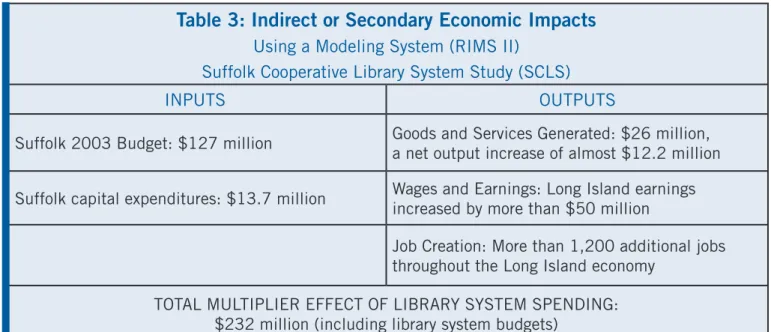
Kamer used the RIMS II input-output modeler to measure the in-direct, or secondary, economic impacts of SCLS’s presence in the region as an employer and economic engine. She selected a custom-ized database of economic information specific to the Long Island economy as an input to the software modeling program (Kamer, 2005). These BEA data contained statistics on 224 industries on Long Island, each with as many as 38 different parameters (i.e., wages, salaries, personal income). When this information and the Suffolk libraries’ total 2003 library operating and capital expendi-tures were entered into the modeling algorithm, they amplified, or multiplied, the effect of the money as it circulated through the re-gional economy (see Table 3, next page). The secondary economic outputs were expressed as (a) jobs generated regionally by the pres-ence of Suffolk libraries, (b) the value of goods and services gener-ated regionally by the Suffolk libraries, and (c) other impacts such as the wages and disposable income generated by library spending.
Table 2: Suffolk Cooperative Library System Study Cost/Benefit Analysis
Services selected for analysis:
Circulation, reference transactions, programming, and electronic resources
Frequency of use of each key service:
The dollar amount that users would have paid in the marketplace for services, multiplied by the frequency of use (quantified by using the New York State Annual Reports for Public and Association Libraries)
Total value of existing library collections:
$338,668,897 (number of items multiplied by estimated market value)
Algorithm for calculating tax dollar cost/benefit:
Number of key service item uses × Market value of each service = Total Value of Library Total Value of Library Services $509,415,038
Tax dollars supporting service $131,647,566
Kevin Verbesey, the Director of the SCLS, shared the study’s very favorable results with patrons, local legislators, media outlets, and local institutions. He also discussed the study in meetings and with others who might have an interest in it.
In a recent conversation, Verbesey noted that the CBA report did not seem to impress patrons, but it did appear to be very persuasive when included in outreach efforts targeted to state senators and local legislators. He also suggested that the report seemed to raise the library’s public profile and provide an additional platform for arguing for greater resources. Kamer’s report was published in early fall of 2005, and SCLS had its most successful funding year ever, in terms of state aid, the following year. The study also report-edly fostered new levels of cooperation between local public service agencies. The SCLS library staff was asked to share management practices with local school systems and fire districts and to impart the secrets of its efficiency in managing money.
The Suffolk Cooperative Library System’s successful use of an economic valuation study to increase state funding encouraged individual libraries within the county to commission their own valuation studies. The Long Island Association and Kamer were engaged to conduct additional studies for the Middle Country Li-brary in Centereach (2006a), the Port Jefferson Free Public LiLi-brary (2006b), and the Mastic-Moriches-Shirley Community Library (2006c), among others. Using the same methodology (cost/ben-efit analysis of direct economic ben(cost/ben-efits and secondary impacts of library spending using a RIMS II modeler), Kamer reported find-ings showing positive ROI and secondary impacts for the local economy.
Since these studies are all relatively recent, their value as advocacy tools is still an unfolding story.
Sandy Feinberg, director of the Middle Country Library, notes that “we have always tried to cost-out and compare our services to those in the marketplace…. Using a reputable person underscores the credibility of the study as opposed to ‘us’ doing the valuation.” The library directors of the Northport, Port Jefferson, and
Mastic-Moriches-Shirley libraries report that they were motivated to do these studies to find out what their individual ROI ratios were, and to use this information in discussion with the public on a variety of issues from efficiency to assisting in the passage of bond issues and budgets.
3.2 Seattle: Repositioning the Library
The Seattle Central Library has undergone four major transfor-mations since 1890, the first by fire and the next three by design. The well-known architect Rem Koolhaas executed the most recent renovation. The Seattle Public Library system’s 23 branches serve a population of about 573,000. Funding comes largely from local tax dollars, with addition income from the state and foundations. In 1998, the state passed a $196.4 million bond issue for improving services and modernizing the library system. The reconstruction of the impressive downtown Seattle Central Library was completed in 2004.
The Seattle study used survey data to determine the social and in-direct economic benefits that resulted from the library’s presence. Survey data developed from questions concerning the library’s impact on the city’s livability were combined with a literature re-view that focused on previous economic valuation studies. The study also surveyed 189 library patrons and 30 business owners located near the library and used systemwide circulation trends, 1997-2004, and door-count statistics from the Central Library and branches. Planned as a joint project of the Seattle Office of Eco-nomic Development and the Seattle Public Library Foundation, it received funding from both agencies.
This study was particularly notable for the way it contrasted the value of the dollars expended on the library renovation with in-creases in library use and traffic. Key findings were all framed in positive terms, and the results confirmed that the Central Library had become a compelling destination and had promoted eco-nomic activity in the city, enhanced the character and livability of the city, and improved the city’s image to patrons. That said,
Table 3: Indirect or Secondary Economic Impacts
Using a Modeling System (RIMS II)
Suffolk Cooperative Library System Study (SCLS)
INPUTS
OUTPUTS
Suffolk 2003 Budget: $127 million Goods and Services Generated: $26 million, a net output increase of almost $12.2 million
Suffolk capital expenditures: $13.7 million Wages and Earnings: Long Island earnings increased by more than $50 million
Job Creation: More than 1,200 additional jobs throughout the Long Island economy
TOTAL MULTIPLIER EFFECT OF LIBRARY SYSTEM SPENDING: $232 million (including library system budgets)
the broad claims of economic benefit must be weighed against the small number of patrons surveyed (189) and the smaller number of surveyed businesses (30) used to calculate estimates of projected dollar benefit to the local economy. Despite these issues, the meth-odology was sound.
From the advocacy viewpoint, The Seattle Central Library Eco-nomic Benefits Assessment study (Berk & Associates, 2005) has many attributes that make it an exemplary study. Its descriptive and historical approach offers a readable and engaging document for public consumption. Of all the studies we reviewed, it also comes closest to a work of literature in style and tone. According to Marilynne Gardener, the library’s chief financial officer, the report is often used by the Central Library’s director and a wide variety of constituency groups for briefings to the Library Foundation, May-or, City Council, Convention & Visitors Bureau, the Downtown Seattle Association, donors, and business groups.
3.3 Florida 2004:
Multiple Assessment Methods
Like the Suffolk County and the Seattle library studies, the Flor-ida taxpayer return on investment study (Griffiths et al., 2004) deployed multiple assessment methods in its analysis. It used a statewide survey of library patrons and non-patrons, an in-library survey of users, a follow-up survey of library administrators, and surveys of local community organizations. Organizations surveyed included businesses statewide, schools, and not-for-profit organiza-tions. Stakeholder interviews with key decision-makers included the Secretary of State, library officials, and local library leaders.
The survey population included 2,388 adults, home telephone in-terviews, in-library user surveys of adults, and surveys or interviews with 169 community organizations.
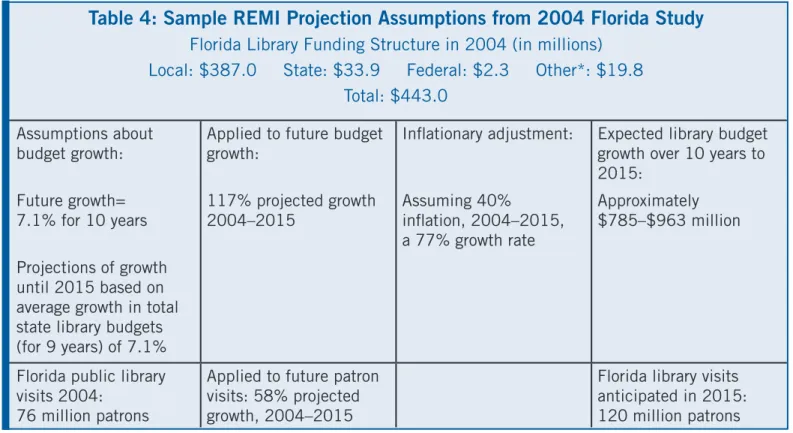
The study did an exemplary job of cross-referencing patron sub-ject-matter queries with patron satisfaction measures. While sur-veys have a long history of use in the library profession, only recent-ly have they queried behavior and use and contrasted them with attitudes toward the library. The study’s remarkably broad scope and range of methodologies included cost/benefit analysis of tax dollar expenditures and measures of secondary economic impacts using the REMI technical regional modeling tool. The custom-ized REMI modeler included BEA data and data on 169 industry sectors in Florida. The researchers asked many different kinds of questions and ran two different REMI scenarios: one that consid-ered the economic impact of redistributing the revenue that funds Florida’s public libraries to other government spending activities, and another scenario in which library funding revenues were re-moved and redistributed to “alternative” private sector businesses that would provide the same services as libraries.
In the first scenario, cost/benefit findings showed that for every tax dollar Floridians invested in their public libraries, $6.54 of benefits was returned to them. The second scenario showed that the private sector would be a lot less efficient than the library in delivering library services, and would create higher costs to taxpayers. The REMI calculations also suggested that reallocation of Florida’s pub-lic library monies would result in a net decline of $5.6 billion in wages and a loss of 68,700 jobs across the state. Many other eco-nomic impacts were calculated as well.
Table 4: Sample REMI Projection Assumptions from 2004 Florida Study
Florida Library Funding Structure in 2004 (in millions)
Local: $387.0 State: $33.9 Federal: $2.3 Other*: $19.8
Total: $443.0
Assumptions about budget growth:
Future growth= 7.1% for 10 years
Projections of growth until 2015 based on average growth in total state library budgets (for 9 years) of 7.1%
Applied to future budget growth:
117% projected growth 2004–2015
Inflationary adjustment:
Assuming 40%
inflation, 2004–2015, a 77% growth rate
Expected library budget growth over 10 years to 2015:
Approximately $785–$963 million
Florida public library visits 2004:
76 million patrons
Applied to future patron visits: 58% projected growth, 2004–2015
Florida library visits anticipated in 2015: 120 million patrons