Computing Surveys, Vol 17 n. 4, pp 471-522, December 1985
On Understanding Types,
Data Abstraction, and Polymorphism
Luca Cardelli
AT&T Bell Laboratories, Murray Hill, NJ 07974 (current address: DEC SRC, 130 Lytton Ave, Palo Alto CA 94301)
Peter Wegner
Dept. of Computer Science, Brown University Providence, RI 02912
Abstract
Our objective is to understand the notion of type in programming languages, present a model of typed, polymorphic programming languages that reflects recent research in type theory, and examine the relevance of recent research to the design of practical programming languages.
Object-oriented languages provide both a framework and a motivation for exploring the interaction among the concepts of type, data abstraction, and polymorphism, since they extend the notion of type to data abstraction and since type inheritance is an important form of polymorphism. We develop a λ -calculus-based model for type systems that allows us to explore these interactions in a simple setting, unencumbered by complexities of production programming languages.
The evolution of languages from untyped universes to monomorphic and then polymorphic type systems is reviewed. Mechanisms for polymorphism such as overloading, coercion, subtyping, and parameterization are examined. A unifying framework for polymorphic type systems is developed in terms of the typed λ-calculus augmented to include binding of types by quantification as well as binding of values by abstraction.
The typed λ-calculus is augmented by universal quantification to model generic functions with type parameters, existential quantification and packaging (information hiding) to model abstract data types, and bounded quantification to model subtypes and type inheritance. In this way we obtain a simple and precise characterization of a powerful type system that includes abstract data types, parametric polymorphism, and multiple inheritance in a single consistent framework. The mechanisms for type checking for the augmented
λ-calculus are discussed.
The augmented typed λ-calculus is used as a programming language for a variety of illustrative examples. We christen this language Fun because fun instead of λ is the functional abstraction keyword and because it is pleasant to deal with.
Fun is mathematically simple and can serve as a basis for the design and implementation of real programming languages with type facilities that are more powerful and expressive than those of existing programming languages. In particular, it provides a basis for the design of strongly typed object-oriented languages.
Contents
1. From Untyped to Typed Universes 1.1. Organizing Untyped Universes 1.2. Static and Strong Typing 1.3. Kinds of Polymorphism
1.4. The Evolution of Types in Programming Languages 1.5. Type Expression Sublanguages
1.6. Preview of Fun 2. The λ-Calculus
2.1. The Untyped λ-Calculus
2.2. The Typed λ-Calculus
2.3. Basic Types, Structured Types and Recursion 3. Types are Sets of Values
4. Universal Quantification
4.1. Universal Quantification and Generic Functions 4.2. Parametric Types
5. Existential Quantification
5.1. Existential Quantification and Information Hiding 5.2. Packages and Abstract Data Types
5.3. Combining Universal and Existential Quantification 5.4. Quantification and Modules
5.5. Modules are First-Class Values 6. Bounded Quantification
6.1. Type Inclusion, Subranges, and Inheritance 6.2. Bounded Universal Quantification and Subtyping 6.3. Comparison with Other Subtyping Mechanisms
6.4. Bounded Existential Quantification and Partial Abstraction 7. Type Checking and Type Inference
8. Hierarchical Classification of Type Systems 9. Conclusions
Acknowledgements References
1. From Untyped to Typed Universes
1.1. Organizing Untyped Universes
Instead of asking the question What is a type? we ask why types are needed in programming languages. To answer this question we look at how types arise in several domains of computer science and mathematics. The road from untyped to typed universes has been followed many times in many different fields, and largely for the same reasons. Consider, for example, the following untyped universes:
(1) Bit strings in computer memory (2) S-expressions in pure Lisp (3) λ-expressions in the λ-calculus (4) Sets in set theory
The most concrete of these is the universe of bit strings in computer memory. ‘Untyped’ actually means that there is only one type, and here the only type is the memory word, which is a bit string of fixed size. This universe is untyped because everything ultimately has to be represented as bit strings: characters, numbers, pointers, structured data, programs, etc. When looking at a piece of raw memory there is generally no way of telling what is being represented. The meaning of a piece of memory is critically determined by an external interpretation of its contents.
Lisp's S-expressions form another untyped universe, one which is usually built on top of the previous bit-string universe. Programs and data are not distinguished, and ultimately everything is an S-expression of some kind. Again, we have only one type (S-expressions), although this is somewhat more structured (atoms and cons-cells can be distinguished) and has better properties than bit strings.
In the λ-calculus, everything is (or is meant to represent) a function. Numbers, data structures and even bit strings can be represented by appropriate functions. Yet there is only one type: the type of functions from values to values, where all the values are themselves functions of the same type.
In set theory, everything is either an element or a set of elements and/or other sets. To understand how untyped this universe is, one must remember that most of mathematics, which is full of extremely rich and complex structures, is represented in set theory by sets whose structural complexity reflects the complexity of the structures being represented. For example, integers are generally represented by sets of sets of sets whose level of nesting represents the cardinality of the integer, while functions are represented by possibly infinite sets of ordered pairs with unique first components.
As soon as we start working in an untyped universe, we begin to organize it in different ways for different purposes. Types arise informally in any domain to categorize objects according to their usage and behavior. The classification of objects in terms of the purposes for which they are used eventually results in a more or less well-defined type system. Types arise naturally, even starting from untyped universes.
In computer memory, we distinguish characters and operations, both represented as bit strings. In Lisp, some S-expressions are called lists while others form legal programs. In λ-calculus some functions are chosen to represent boolean values, others to represent integers. In set theory some sets are chosen to denote ordered pairs, and some sets of ordered pairs are then called functions.
Untyped universes of computational objects decompose naturally into subsets with uniform behavior. Sets of objects with uniform behavior may be named and are referred to as types. For example, all integers exhibit uniform behavior by having the same set of applicable operations. Functions from integers to integers behave uniformly in that they apply to objects of a given type and produce values of a given type.
After a valiant organization effort, then, we may start thinking of untyped universes as if they were typed. But this is just an illusion, because it is very easy to violate the type distinctions we have just created. In computer memory, what is the bit-wise boolean or of a character and a machine operation? In Lisp, what is the effect of treating an arbitrary S-expression as a program? In the λ-calculus, what is the effect of a conditional over a non-boolean value? In set theory, what is the set-union of the function successor and the function predecessor?
Such questions are the unfortunate consequence of organizing untyped universes without going all the way to typed systems; it is then meaningful to ask about the (arbitrary) representations of higher-level concepts and their interactions.
1.2. Static and Strong Typing
A type system has as its major purpose to avoid embarrassing questions about representations, and to forbid situations where these questions might come up. In mathematics as in programming, types impose constraints which help to enforce correctness. Some untyped universes, like naive set theory, were found to be logically inconsistent, and typed versions were proposed to eliminate inconsistencies. Typed versions of set theory, just like typed programming languages, impose constraints on object interaction which prevent objects (in this case sets) from inconsistent interaction with other objects.
A type may be viewed as a set of clothes (or a suit of armor) that protects an underlying untyped representation from arbitrary or unintended use. It provides a protective covering that hides the underlying representation and constrains the way objects may interact with other objects. In an untyped system untyped objects are naked in that the underlying representation is exposed for all to see. Violating the type system involves removing the protective set of clothing and operating directly on the naked representation.
Objects of a given type have a representation that respects the expected properties of the data type. The representation is chosen to make it easy to perform expected operations on data objects. For example,
positional notation is favored for numbers because it allows arithmetic operations to be easily defined. But there are nevertheless many possible alternatives in choosing data representations. Breaking the type system allows a data representation to be manipulated in ways that were not intended, with potentially disastrous results. For example, use of an integer as a pointer can cause arbitrary modifications to programs and data.
To prevent type violations, we generally impose a static type structure on programs. Types are associated with constants, operators, variables, and function symbols. A type inference system can be used to infer the types of expressions when little or no type information is given explicitly. In languages like Pascal and Ada, the type of variables and function symbols is defined by redundant declarations and the compiler can check the consistency of definition and use. In languages like ML, explicit declarations are avoided wherever possible and the system may infer the type of expressions from local context, while still establishing consistent usage.
Programming languages in which the type of every expression can be determined by static program analysis are said to be statically typed. Static typing is a useful property, but the requirement that all variables and expressions are bound to a type at compile time is sometimes too restrictive. It may be replaced by the weaker requirement that all expressions are guaranteed to be type-consistent although the type itself may be statically unknown; this can be generally done by introducing some run-time type checking. Languages in which all expressions are type-consistent are called strongly typed languages. If a language is strongly typed its compiler can guarantee that the programs it accepts will execute without type errors. In general, we should strive for strong typing, and adopt static typing whenever possible. Note that every statically typed language is strongly typed but the converse is not necessarily true.
Static typing allows type inconsistencies to be discovered at compile time and guarantees that executed programs are type-consistent. It facilitates early detection of type errors and allows greater execution-time efficiency. It enforces a programming discipline on the programmer that makes programs more structured and easier to read. But static typing may also lead to a loss of flexibility and expressive power by prematurely constraining the behavior of objects to that associated with a particular type. Traditional statically typed systems exclude programming techniques which, although sound, are incompatible with early binding of program objects to a specific type. For example they exclude generic procedures, e.g. sorting, that capture the structure of an algorithm uniformly applicable to a range of types.
1.3. Kinds of Polymorphism
Conventional typed languages, such as Pascal, are based on the idea that functions and procedures, and hence their operands, have a unique type. Such languages are said to be monomorphic, in the sense that every value and variable can be interpreted to be of one and only one type. Monomorphic programming languages may be contrasted with polymorphic languages in which some values and variables may have more than one type. Polymorphic functions are functions whose operands (actual parameters) can have more than one type. Polymorphic types are types whose operations are applicable to values of more than one type.
polymorphism
universal
ad-hoc
parametric
inclusion
overloading
coercion
Figure 1: Varieties of polymorphism.
Strachey [Strachey 67] distinguished, informally, between two major kinds of polymorphism. Parametric polymorphism is obtained when a function works uniformly on a range of types: these types normally exhibit some common structure. Ad-hoc polymorphism is obtained when a function works, or appears to work, on several different types (which may not exhibit a common structure) and may behave in unrelated ways for each type.
Our classification of polymorphism in Figure 1 refines that of Strachey by introducing a new form of polymorphism called inclusion polymorphism to model subtypes and inheritance. Parametric and inclusion polymorphism are classified as the two major subcategories of universal polymorphism, which is contrasted with nonuniversal or ad-hoc polymorphism. Thus Figure 1 reflects Strachey's view of polymorphism but adds inclusion polymorphism to model object-oriented programming.
Parametric polymorphism is so called because the uniformity of type structure is normally achieved by type parameters, but uniformity can be achieved in different ways, and this more general concept is called universal polymorphism. Universally polymorphic functions will normally work on an infinite number of types (all the types having a given common structure), while an ad-hoc polymorphic function will only work on a finite set of different and potentially unrelated types. In the case of universal
polymorphism, one can assert with confidence that some values (i.e., polymorphic functions) have many types, while in ad-hoc polymorphism this is more difficult to maintain, as one may take the position that an ad-hoc polymorphic function is really a small set of monomorphic functions. In terms of implementation, a universally polymorphic function will execute the same code for arguments of any admissible type, while an ad-hoc polymorphic function may execute different code for each type of argument.
There are two major kinds of universal polymorphism, i.e., two major ways in which a value can have many types. In parametric polymorphism, a polymorphic function has an implicit or explicit type parameter, which determines the type of the argument for each application of that function. In inclusion polymorphism an object can be viewed as belonging to many different classes which need not be disjoint, i.e. there may be inclusion of classes. These two views of universal polymorphism are not unrelated, but are sufficiently distinct in theory and in practice to deserve different names.
The functions that exhibit parametric polymorphism are also called generic functions. For example, the length function from lists of arbitrary type to integers is called a generic length function. A generic function is one which can work for arguments of many types, generally doing the same kind of work independently of the argument type. If we consider a generic function as a single value, it has many functional types and is therefore polymorphic. Ada generic functions are a special case of this concept of generic.
There are also two major kinds of ad-hoc polymorphism. In overloading the same variable name is used to denote different functions, and the context is used to decide which function is denoted by a particular instance of the name. We may imagine that a preprocessing of the program will eliminate overloading by giving different names to the different functions; in this sense overloading is just a convenient syntactic abbreviation. A coercion is instead a semantic operation which is needed to convert an argument to the type expected by a function, in a situation which would otherwise result in a type error. Coercions can be provided statically, by automatically inserting them between arguments and functions at compile time, or may have to be determined dynamically by run-time tests on the arguments.
The distinction between overloading and coercion blurs in several situations. This is particularly true when considering untyped languages and interpreted languages. But even in static, compiled languages there may be confusion between the two forms of ad-hoc polymorphism, as illustrated by the following example.
3 + 4
3.0 + 4
3 + 4.0
3.0 + 4.0
Here, the ad-hoc polymorphism of + can be explained in one of the following ways:
- The operator + has four overloaded meanings, one for each of the four combinations of argument types.
- The operator + has two overloaded meanings, corresponding to integer and real addition. When one of the argument is of type integer and the other is of type real, then the integer argument is coerced to the type real.
- The operator + is defined only for real addition, and integer arguments are always coerced to corresponding reals.
In this example, we may consider the same expression as exhibiting overloading or coercion, or both (and also changing meaning), depending on an implementation decision.
Our definition of polymorphism is applicable only to languages with a very clear notion of both type and value. In particular, there must be a clear distinction between the inherent type of an object and the apparent type of its syntactic representations in languages that permit overloading and coercion. These issues are further discussed below.
If we view a type as partially specifying the behavior, or intended usage, of associated values, then monomorphic type systems constrain objects to have just one behavior, while polymorphic type systems allow values to be associated with more than one behavior. Strictly monomorphic languages are too restrictive in their expressive power because they do not allow values, or even syntactic symbols that denote values, to exhibit different behavior in different contexts of use. Languages like Pascal and Ada have ways of relaxing strict monomorphism, but polymorphism is the exception rather than the rule and we can say that they are mostly monomorphic. Real and apparent exceptions to the monomorphic typing rule in conventional languages include:
(1) Overloading: integer constants may have both type integer and real. Operators such as + are applicable to both integer and real arguments.
(2) Coercion: an integer value can be used where a real is expected, and vice versa. (3) Subtyping: elements of a subrange type also belong to superrange types. (4)Value sharing: nil in Pascal is a constant which is shared by all the pointer types.
These four examples, which may all be found in the same language, are instances of four radically different ways of extending a monomorphic type system. Let us see how they fit in the previous description of different kinds of polymorphism.
Overloading is a purely syntactic way of using the same name for different semantic objects; the compiler can resolve the ambiguity at compile time, and then proceed as usual.
Coercion allows the user to omit semantically necessary type conversions. The required type conversions must be determined by the system, inserted in the program, and used by the compiler to generate required type conversion code. Coercions are essentially a form of abbreviation which may reduce program size and improve program readability, but may also cause subtle and sometimes dangerous system errors. The need for run-time coercions is usually detected at compile time, but languages like (impure) Lisp have plenty of coercions that are only detected and performed at run time.
Subtyping is an instance of inclusion polymorphism. The idea of a type being a subtype of another type is useful not only for subranges of ordered types such as integers, but also for more complex structures such as a type representing Toyotas which is a subtype of a more general type such as Vehicles. Every object of a subtype can be used in a supertype context in the sense that every Toyota is a vehicle and can be operated on by all operations that are applicable to vehicles.
Value sharing is a special case of parametric polymorphism. We could think of the symbol nil as being heavily overloaded, but this would be some strange kind of open-ended overloading, as nil is a valid element of an infinite collection of types which haven't even been declared yet. Moreover, all the uses of nil denote the same value, which is not the common case for overloading. We could also think that there is a different nil for every type, but all the nil's have the same representation and can be identified. The fact that an object having many types is uniformly represented for all types is characteristic of parametric polymorphism.
How do these relaxed forms of typing relate to polymorphism? As is implicit in the choice of names, universal polymorphism is considered true polymorphism, while ad-hoc polymorphism is some kind of apparent polymorphism whose polymorphic character disappears at close range. Overloading is not true polymorphism: instead of a value having many types, we allow a symbol to have many types, but the values denoted by that symbol have distinct and possibly incompatible types. Similarly, coercions do not achieve true polymorphism: an operator may appear to accept values of many types, but the values must be converted to some representation before the operator can use them; hence that operator really works on (has) only one type. Moreover, the output type is no longer dependent on the input type, as is the case in parametric polymorphism.
In contrast to overloading and coercion, subtyping is an example of true polymorphism: objects of a subtype can be uniformly manipulated as if belonging to their supertypes. In the implementation, the representations are chosen very carefully, so that no coercions are necessary when using an object of a subtype in place of an object of the supertype. In this sense the same object has many types (for example, in Simula a member of a subclass may be a longer memory segment than a member of its superclass, and its initial segment has the same structure as the member of the superclass). Similarly, operations are careful to interpret the representations uniformly so that they can work uniformly on elements of subtypes and supertypes.
Parametric polymorphism is the purest form of polymorphism: the same object or function can be used uniformly in different type contexts without changes, coercions or any kind of run-time tests or special encodings of representations. However, it should be noted that this uniformity of behavior requires that all data be represented, or somehow dealt with, uniformly (e.g., by pointers).
The four ways of relaxing monomorphic typing discussed thus far become more powerful and interesting when we consider them in connection with operators, functions and procedures. Let us look at some additional examples. The symbol + could be overloaded to denote at the same time integer sum, real sum, and string concatenation. The use of the same symbol for these three operations reflects an approximate similarity of algebraic structure but violates the requirements of monomorphism. The ambiguity can usually be resolved by the type of the immediate operands of an overloaded operator, but this may not be enough. For example, if 2 is overloaded to denote integer 2 and real 2.0, then 2+2 is still ambiguous and is resolvable only in a larger context such as assignment to a typed variable. The set of possibilities can explode if we allow user-defined overloaded operators.
Algol 68 is well known for its baroque coercion scheme. The problems to be solved here are very similar to overloading, but in addition coercions have run-time effects. A two-dimensional array with only one row can be coerced to a vector, and a vector with only one component can be coerced to a scalar. The conditions for performing a coercion may have to be detected at run time, and may actually arise from programming errors, rather than planning. The Algol 68 experience suggests that coercions should generally be explicit, and this view has been taken by many later language designs.
Inclusion polymorphism can be found in many common languages, of which Simula 67 is the earliest example. Simula's classes are user-defined types organized in a simple inclusion (or inheritance) hierarchy where every class has a unique immediate superclass. Simula's objects and procedures are polymorphic because an object of a subclass can appear wherever an object of one of its superclasses is required. Smalltalk [Goldberg 83], although an untyped language, also popularized this view of polymorphism. More recently, Lisp Flavors [Weinreb 81] (untyped) have extended this style of polymorphism to multiple immediate superclasses, and Amber (typed) [Cardelli 85] further extends it to higher-order functions.
The paradigmatic language for parametric polymorphism is ML [Milner 84], which was entirely built around this style of typing. In ML, it is possible to write a polymorphic identity function which works for every type of argument, and a length function which maps a list of arbitrary element type into its integer length. It is also possible to write a generic sorting package that works on any type with an ordering relation. Other languages that used or helped develop these ideas include CLU [Liskov 81], Russell [Demers 79, Hook 84], Hope [Burstall 80], Ponder [Fairbairn 82] and Poly [Matthews 85].
Finally, we should mention generic procedures of the kind found in Ada, which are parametrized templates that must be instantiated with actual parameter values before they can be used. The
polymorphism of Ada's generic procedures is similar to the parametric polymorphism of languages like ML, but is specialized to particular kinds of parameters. Parameters may be type parameters, procedure parameters, or value parameters. Generic procedures with type parameters are polymorphic in the sense that formal type parameters can take different actual types for different instantiations. However, generic type polymorphism in Ada is syntactic since generic instantiation is performed at compile time with actual type values that must be determinable (manifest) at compile time. The semantics of generic procedures is macro-expansion driven by the type of the arguments. Thus, generic procedures can be considered as abbreviations for sets of monomorphic procedures. With respect to polymorphism, they have the advantage that specialized optimal code can be generated for the different forms of inputs. On the other hand, in true polymorphic systems code is generated only once for every generic procedure.
1.3. The Evolution of Types In Programming Languages
In early programming languages, computation was identified with numerical computation and values could be viewed as having a single arithmetic type. However, as early as 1954, Fortran found it convenient to distinguish between integers and floating-point numbers, in part because differences in hardware representation made integer computation more economical and in part because the use of integers for iteration and array computation was logically different from the use of floating point numbers for numerical computation.
Fortran distinguished between integer and floating point variables by the first letter of their names. Algol 60 made this distinction explicit by introducing redundant identifier declarations for integer real and Boolean variables. Algol 60 was the first significant language to have an explicit notion of type and associated requirements for compile time type checking. Its block-structure requirements allowed not only the type but also the scope (visibility) of variables to be checked at compile time.
The Algol 60 notion of type was extended to richer classes of values in the 1960s. Of the numerous typed languages developed during this period, PL/I, Pascal, Algol 68, and Simula, are noteworthy for their contributions to the evolution of the concept of type.
PL/I attempts to combine the features of Fortran, Algol 60, Cobol, and Lisp. Its types include typed arrays, records, and pointers. But it has numerous type loopholes, such as not requiring the type of values pointed to by pointer variables to be specified, which weaken the effectiveness of compile-time type checking.
Pascal provides a cleaner extension of types to arrays records and pointers, as well as user-defined types. However, Pascal does not define type equivalence, so that the question of when two type expressions denote the same type is implementation-dependent. There are also problems with type granularity. For example, Pascal's notion of array type, which includes the array bounds as part of the type, is too restrictive in that procedures that operate uniformly on arrays of different dimensions cannot be defined. Pascal leaves loopholes in strong type specification by not requiring the full type of procedures passed as parameters to be specified, and by allowing the tag field of variant records to be independently manipulated. The ambiguities and insecurities of the Pascal type system are discussed in [Welsh 77].
Algol 68 has a more rigorous notion of type than Pascal, with a well-defined notion of type equivalence (structural equivalence). The notion of type (mode in Algol 68) is extended to include procedures as first-class values. Primitive modes include int, real, char, bool, string, bits, bytes, format, file, while mode constructors (type constructors) include array, struct, proc, union, and ref for respectively constructing array types, record types, procedure types, union (variant) types, and pointer types. Algol 68 has carefully defined rules for coercion, using dereferencing, deproceduring, widening, rowing, uniting, and voiding to transform values to the type required for further computation. Type checking in Algol 68 is decidable, but the type-checking algorithm is so complex that questions of type equivalence and coercion cannot always be checked by the user. This complexity was felt by some to be a flaw, resulting in a reaction against complex type systems. Thus, later languages, like Ada, had simpler notion of type equivalence with severely restricted coercion.
Simula is the first object-oriented language. Its notion of type includes classes whose instances may be assigned as values of class-valued variables and may persist between execution of the procedures they contain. Procedures and data declarations of a class constitute its interface and are accessible to users. Subclasses inherit declared entities in the interface of superclasses and may define additional operations and data that specialize the behavior of the subclass. Instances of a class are like data abstractions in having a declarative interface and a state that persists between invocation of operations, but lack the information-hiding mechanism of data abstractions. Subsequent object-oriented languages like Smalltalk and Loops combine the class concept derived from Simula with a stronger notion of information hiding.
Modula-2 [Wirth 83] is the first widespread language to use modularization as a major structuring principle (these ideas were first developed in Mesa). Typed interfaces specify the types and operations available in a module; types in an interface can be made opaque to achieve data abstraction. An interface can be specified separately from its implementation, thereby separating the specification and implementation tasks. Block-structured scoping, preserved within modules, is abandoned at a more global level in favor of flexible inter-module visibility rules achieved by import and export lists. Module interfaces are similar to class declarations (except for the above-mentioned scoping rules), but unlike class instances, module instances are not first-class values. A linking phase is necessary to interconnect module instances for execution; this phase is specified by the module interfaces but is external to the language.
ML has introduced the notion of parametric polymorphism in languages. ML types can contain type variables which are instantiated to different types in different contexts. Hence it is possible to partially specify type information and to write programs based on partially specified types which can be used on all
the instances of those types. A way of partially specifying types is just to omit type declarations: the most general (less specific) types which fit a given situation are then automatically inferred.
The above historical framework provides a basis for a deeper discussion of the relations between types, data abstraction, and polymorphism in real programming languages. We consider the untyped data abstractions (packages) of Ada, indicate the impact on methodology of requiring data abstractions to have type and inheritance, discuss the interpretation of inheritance as subtype polymorphism, and examine the relation between the subtype polymorphism of Smalltalk and the parametric polymorphism of ML.
Ada has a rich variety of modules, including subprograms to support procedure-oriented programming, packages to support data abstractions, and tasks to support concurrent programming. But it has a relatively weak notion of type, excluding procedures and packages from the domain of typed objects, and including task types relatively late in the design process as an afterthought. Its choice of name equivalence as type equivalence is weaker than the notion of structural equivalence used in Algol 68. Its severe restriction against implicit coercion weakens its ability to provide polymorphic operations applicable to operands of many types.
Packages in Ada have an interface specification of named components that may be simple variables, procedures, exceptions, and even types. They may hide a local state either by a private data type or in the package body. Packages are like record instances in having a user interface of named components. Ada packages differ from records in that record components must be typed values while package components may be procedures, exceptions, types, and other named entities. Since packages are not themselves types they cannot be parameters, components of structures, or values of pointer variables [Wegner 83]. Packages in Ada are second-class objects while class instances in Simula or objects in object-oriented languages are first-class objects.
The differences in behavior between packages and records in Ada is avoided in object-oriented languages by extending the notion of type to procedures and data abstractions. In the context of this discussion it is useful to define object-oriented languages as extensions of procedure-oriented languages that support typed data abstractions with inheritance. Thus we say that a language is object-oriented iff it satisfies the following requirements:
- It supports objects that are data abstractions with an interface of named operations and a hidden local state
- Objects have an associated object type - Types may inherit attributes from supertypes These requirements may be summarized as:
object-oriented = data abstractions + object types + type inheritance
The usefulness of this definition may be illustrated by considering the impact of each of these requirements on methodology. Data abstraction by itself provides a way of organizing data with associated operations that differs considerably from the traditional methodology of procedure- oriented programming. The realization of data abstraction methodology was one of the primary objectives of Ada, and this methodology is described at length in the Ada literature in publications such as [Booch 83]. However Ada satisfies only the first of our three requirements for object-oriented programming and it is interesting to examine the impact of object types and inheritance on data abstraction methodology [Hendler 86].
The requirement that all objects have a type allows objects to be first-class values so that they can be managed as data structures within the language as well as used for computation. The requirement of type inheritance allows relations among types to be specified. Inheritance may be viewed as a type composition mechanism which allows the properties of one or more types to be reused in the definition of a new type. The specification B inherits A may be viewed as an abbreviation mechanism which avoids redefining the attributes of type A in the definition of type B. However, inheritance is more than a shorthand, since it imposes structure among a collection of related types that can greatly reduce the conceptual complexity of a system specification. This is illustrated by the Smalltalk object hierarchy in [Goldberg 83].
The Smalltalk object hierarchy is a description of the Smalltalk programming environment in Smalltalk. It is conceptually similar to the Lisp apply function which describes the Lisp language interpreter in Lisp, but is a great deal more complex. It describes a collection of over 75 related system object types by an inheritance hierarchy. The object types include numerical, structured, input-output, concurrent, and display objects. The object hierarchy carefully factors out properties common to numeric objects into the supertype Number. It factors out properties common to different kinds of structured objects into the supertype Collection. It further factors out properties common to numbers, collections, and other kinds of objects into the supertype Object. In doing this the collection of over 75 object types that comprise the Smalltalk environment is described as a relatively simple structured hierarchy of object types. The shorthand provided by the object hierarchy in reusing superclasses whose attributes are shared by subclasses is clearly incidental to the conceptual parsimony achieved by imposing a coherent structure on the collection of object types.
The Smalltalk object hierarchy is also significant as an illustration of the power of polymorphism. We may characterize a polymorphic function as a function applicable to values of more than one type and inclusion polymorphism as a relation among types which allows operations to be applied to object of different types related by inclusion. Objects are seen as collections of such polymorphic operations
(attributes). This view emphasizes the sharing of operations by operands of many types as a primary feature of polymorphism.
The Smalltalk object hierarchy realizes polymorphism in the above sense by factoring out attributes common to a collection of subtypes into a supertype. Attributes common to numerical types are factored out into the supertype Number. Attributes common to structured types are factored out into the supertype Collection. Attributes common to all types are factored out into the supertype Object. Thus polymorphism is intimately related to the notion of inheritance, and we can say that the expressive power of object-oriented type systems is due in large measure to the polymorphism they facilitate.
In order to complete our discussion of the evolution of types in programming languages we examine the type mechanisms of ML [Milner 84]. ML is an interactive functional programming language in which type specifications omitted by the user may be reintroduced by type inference.If the user enters "3+4" the system responds "7:int", computing the value of the expression and inferring that the operands and the value are of type int. If the user enters the function declaration "fun f x = x+1" the system responds "f:int→int", defining a function value for f and inferring that it is of type "int→int". ML supports type inference not only for traditional types but also for parametric (polymorphic) types, such as the length function for lists. If "fun rec length x = if x = nil then 0 else 1+length(tail(x));" is entered, ML will infer that "length" is a function from lists of arbitrary element type to integers (length: 'a list → int). If the user then enters "length[1;2;3]", applying length to a list of integers, the system infers that length is to be specialized to the type "int list → int" and then applies the specialized function to the list of integers.
When we say that a parametric function is applicable to lists of arbitrary type we really mean that it may be specialized by (implicitly or explicitly) providing a type parameter T, and that the specialized function may then be applied to the specialized operands. There is an important distinction between the parametric function length for lists of arbitrary type and the specialized function for lists of type int. Functions like length are applicable to lists of arbitrary type because they have a uniform parametric representation that allows them to be specialized by supplying a type parameter. This distinction between a parametric function and its specialized versions is blurred in languages like ML, because type parameters omitted by the user are automatically reintroduced by the type inference mechanism.
Supertypes in object-oriented languages may be viewed as parametric types whose parameter is omitted by the user. In order to understand the similarity between parametric types and supertypes it is useful to introduce a notation where supertype parameters must be explicitly supplied in specializing a supertype to a subtype. We shall see below that Fun has explicit type parameters for both parametric types and supertypes in order to provide a uniform model for both parametric and subtype polymorphism. This results in a uniform treatment of type inference when parameters are omitted in parametric types and supertypes.
1.5. Type Expression Sublanguages
As the set of types of a programming language becomes richer, and its set of definable types becomes infinite, it becomes useful to define the set of types by a type expression sublanguage. The set of type expressions of current strongly typed programming languages is generally a simple sublanguage of the complete language that is nevertheless not altogether trivial. Type expression sublanguages generally include basic types like integer and boolean and composite types like arrays, records, and procedures constructed from basic types.
Type ::= BasicType | ConstructedType BasicType ::= Int | Bool | ...
ConstructedType ::= Array(Type) | Type→ Type | ...
The type expression sublanguage should be sufficiently rich to support types for all values with which we wish to compute, but sufficiently tractable to permit decidable and efficient type checking. One of the purposes of this paper is to examine tradeoffs between richness and tractability for type expression sublanguages of strongly typed languages.
The type expression sublanguage can generally be specified by a context-free grammar. However, we are interested not only in the syntax of the type expression sublanguage but also in its semantics. That is, we are interested in what types denote and in relations among type expressions. The most basic relation among type expressions is type equivalence. However, we are also interested in similarity relations among types that are weaker than equivalence, such as inclusion which is related to subtypes. Similarity relations among type expressions that permit a type expression to denote more than one type, or to be compatible with many types, are referred to as polymorphism.
The usefulness of a type system lies not only in the set of types that can be represented but also in the kinds of relationships among types that can be expressed. The ability to express relations among types involves some ability to perform computations on types to determine whether they satisfy the desired relationship. Such computations could in principle be as powerful as computations performable on values. However, we are concerned only with simple, easily computable relationships that express uniform behavior shared by collections of types.
The reader interested in a discussion of type expression languages and type-checking algorithms for languages like Pascal and C is referred to chapter 6 of [Aho 85], which considers type checking for overloading, coercion, and parametric polymorphism. Fun adds abstract data types to the set of basic types and adds subtype and inheritance to the forms of polymorphism that are supported.
1.6. Preview of Fun
Fun is a λ-calculus-based language that enriches the first-order typed λ-calculus with second-order features designed to model polymorphism and object-oriented languages.
Section 2 reviews the untyped and typed λ-calculus and develops first-order features of the Fun type expression sublanguage. Fun has the basic types Bool, Int, Real, String and constructed types for record, variant, function, and recursive types. This set of first-order types is used as a base for introducing parametric types, abstract data types, and type inheritance by means of second-order language features in subsequent sections.
Section 3 briefly reviews theoretical models of types related to features of Fun, especially models which view types as sets of values. Viewing types as sets allows us to define parametric polymorphism in terms of set intersection of associated types and inheritance polymorphism in terms of subsets of associated types. Data abstraction may also be defined in terms of set operations (in this case unions) on associated types.
Sections 4, 5, and 6 respectively augment the first-order λ-calculus with universal quantification for realizing parameterized types, existential quantification for realizing data abstraction, and bounded quantification for realizing type inheritance. The syntactic extensions of the type expression sublanguage determined by these features may be summarized as follows:
Type ::= ... | QuantifiedType QuantifiedType ::=
∀A. Type | Universal Quantification
∃A. Type | Existential Quantification
∀A⊆Type. Type | ∃A⊆Type. Type Bounded Quantification Universal quantification enriches the first-order λ-calculus with parameterized types that may be specialized by substituting actual type parameters for universally quantified parameters. Universally quantified types are themselves first-class types and may be actual parameters in such a substitution.
Existential quantification enriches first-order features by allowing abstract data types with hidden representation. The interaction of universal and existential quantification is illustrated in section 5.3 for the case of stacks with a universally quantified element type and an existentially quantified hidden data representation.
Fun supports information hiding not only through existential quantification but also through its let construct, which facilitates hiding of local variables of a module body. Hiding by means of let is referred to as first-order hiding because it involves hiding of local identifiers and associated values, while hiding by means of existential quantifiers is referred to as second-order hiding because it involves hiding of type representations. The relation between these two forms of hiding is illustrated in section 5.2 by contrasting hiding in package bodies with hiding in private parts of Ada packages.
Bounded quantification enriches the first-order λ-calculus by providing explicit subtype parameters. Inheritance (i.e. subtypes and supertypes) is modeled by explicit parametric specialization of supertypes to the subtype for which the operations will actually be executed. In object-oriented languages every type is potentially a supertype for subsequently defined subtypes and should therefore be modelled by a bounded quantified type. Bounded quantification provides an explanatory mechanism for object-oriented polymorphism that is cumbersome to use explicitly but useful in illuminating the relation between parametric and inherited polymorphism.
Section 7 briefly reviews type checking and type inheritance for Fun. It is supplemented by an appendix listing type inference rules.
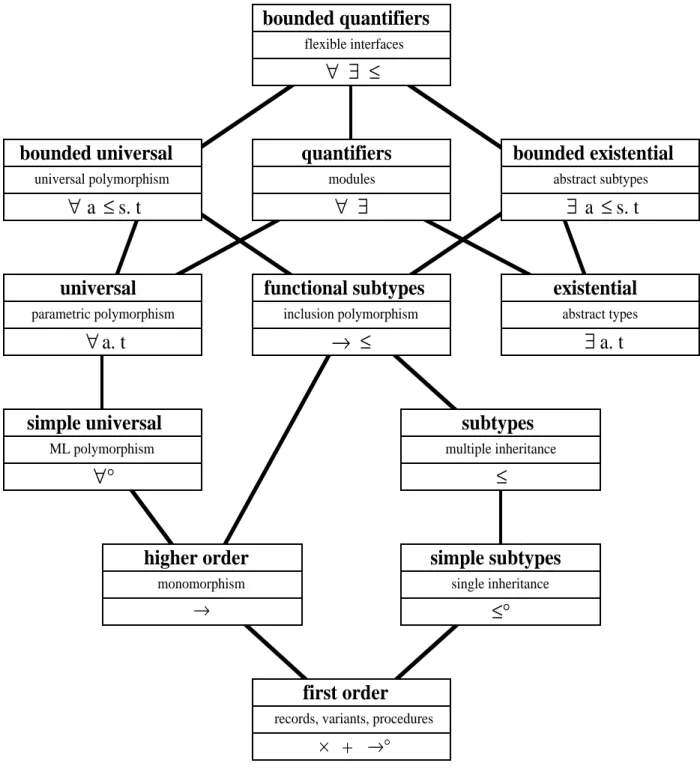
Section 8 provides a hierarchical classification of object-oriented type systems. Fun represents the topmost (most general) type system of this classification. The relation of Fun to less general systems associated with ML, Galileo, Amber, and other languages with interesting type systems is reviewed.
It is hoped that readers will have as much fun reading about Fun as the authors have had writing about it.
2. The
λ-Calculus
2.1. The Untyped
λ-Calculus
The evolution from untyped to typed universes may be illustrated by the λ-calculus, initially developed as an untyped notation to capture the essence of the functional application of operators to operands. Expressions in the λ-calculus have the following syntax (we use fun instead of the traditional λ to bring out the correspondence with programming language notations):
e ::= x -- a variable is a λ-expression e ::= fun(x)e -- functional abstraction of e e ::= e(e) -- operator e applied to operand e
The identity function and successor function may be specified in the λ-calculus as follows (with some syntactic sugar explained later). We use the keyword value to introduce a new name bound to a value or a function:
value id = fun(x) x -- identity function
value succ = fun(x) x+1 -- successor function (for integers)
The identity function may be applied to an arbitrary λ-expression and always yields the λ-expression itself. In order to define addition on integers in the pure λ-calculus we pick a representation for integers and define the addition operation so that its effect on λ-expressions representing the integers n and m is to produce the λ-expression that represents n + m. The successor function should be applied only to λ -expressions that represent integers and suggests a notion of typing. The infix notation x + 1 is an abbreviation for the functional notation + (x) (1). The symbols 1 and + above should in turn be viewed as abbreviations for a pure λ-calculus expression for the number 1 and addition.
Correctness of integer addition requires no assumptions about what happens when the λ-expression representing addition is applied to λ-expressions that do not represent integers. However, if we want our notation to have good error-checking properties, it is desirable to define the effect of addition on arguments that are not integers as an error. This is accomplished in typed programming languages by type checking that eliminates, at compilet time, the possibility of operations on objects of an incorrect type.
Type checking in the λ-calculus, just as in conventional programming languages, has the effect that large classes of λ-expressions legal in the untyped λ-calculus become illegal. The class of illegally-typed expressions depends on the type system one adopts, and, although undesirable, it may even depend on a particular type-checking algorithm.
The idea of λ-expressions operating on functions to produce other functions can be illustrated by the function twice which has the following form:
value twice = fun(f) fun(y) f(f(y)) -- twice function
The application of twice to the successor function yields a λ-expression that computes the successor of the successor.
twice(succ) ⇒ fun(y) succ(succ(y))
twice (fun(x)x+1) ⇒ fun(y) (fun(x)x+1) ((fun(x)x+1) (y))
The above discussion illustrates how types arise when we specialize an untyped notation such as the
λ-calculus to perform particular kinds of computation such as integer arithmetic. In the next section we introduce explicit types into the λ-calculus. The resulting notation is similar to functional notation in traditional typed programming languages.
2.2. The Typed
λ-Calculus
The typed λ-calculus is like the λ-calculus except that every variable must be explicitly typed when introduced as a bound variable. Thus the successor function in the typed λ-calculus has the following form:
value succ = fun (x: Int) x+1
The function twice from integers to integers has a parameter f whose type is Int → Int (the type of functions from integers to integers) and may be written as follows:
value twice = fun(f: Int → Int) fun (y:Int) f(f(y))
This notation approximates that of functional specification in typed programming languages but omits specification of the result type. We may denote the result type with a returns keyword as follows:
value succ = fun(x: Int) (returns Int) x + 1
However, the type of the result can be determined from the form of the function body x + 1. We shall omit result type specifications in the interests of brevity. Type inference mechanisms that allow this information to be recovered during compilation are discussed in a later section.
Type declarations are introduced by the keyword type. Throughout this paper, type names begin with upper-case letters while value and function names begin with lower-case letters.
type IntPair = Int × Int type IntFun = Int → Int
Type declarations introduce names (abbreviations) for type expressions; they do not create new types in any sense. This is sometimes expressed by saying that we used structural equivalence on types instead of name
equivalence: two types are equivalent when they have the same structure, regardless of the names we use as abbreviations.
The fact that a value v has a type T is indicated by v:T. (3,4): IntPair
succ: IntFun
We need not introduce variables by type declarations of the form var:T because the type of a variable may be determined from the form of the assigned value. For example the fact that intPair below has the type IntPair can be determined by the fact that (3,4) has type Int × Int, which has been declared equivalent to IntPair.
value intPair = (3,4)
However, if we want to indicate the type of a variable as part of its initialization we can do so by the notation value var:T = value.
value intPair: IntPair = (3,4)
value succ: Int → Int = fun(x: Int) x + 1
Local variables can be declared by the let-in construct, which introduces a new initialized variable (following let) in a local scope (an expression following in). The value of the construct is the value of that expression.
let a = 3 in a + 1 yields 4 If we want to specify types, we can also write:
let a : Int = 3 in a + 1
The let-in construct can be defined in terms of basic fun-expressions: let a : T = M in N ≡ (fun(a:T) N)(M)
2.3. Basic Types, Structured Types and Recursion
The typed λ-calculus is usually augmented with various kinds of basic and structured types. For basic types we shall use:
Unit the trivial type, with only element () Bool with an if-then-else operation
Int with arithmetic and comparison operations Real with arithmetic and comparison operations String with string concatenation (infix) ^
Structured types can be built up from these basic types by means of type constructors. The type constructors in our language include function spaces ( → ), Cartesian products ( × ), record types (also called labeled Cartesian products) and variant types (also called labeled disjoint sums).
A pair is an element of a Cartesian product type, e.g. value p = 3,true : Int × Bool
Operations on pairs are selectors for the first and second components: fst(p) yields 3
snd(p) yields true
A record is an unordered set of labeled values. Its type may be specified by indicating the type associated with each of its labels. A record type is denoted by a sequence of labeled types, separated by commas and enclosed in curly braces:
type ARecordType = {a: Int, b: Bool, c: String}
A record of this type may be created by initializing each of the record labels to a value of the required type. It is written as a sequence of labeled values separated by commas and enclosed in curly braces:
The labels must be unique within any given record or record type. The only operation on records is field selection, denoted by the usual dot notation:
r.b yields true
Since functions are first-class values, records may in general have function components. type FunctionRecordType = {f1: Int → Int, f2: Real → Real}
value functionRecord = {f1 = succ, f2 = sin}
A record type can be defined in terms of existing record types by an operator & which concatenates two record types:
type NewFunctionRecordType = FunctionRecordType & {f3: Bool → Bool}
This is intended as an abbreviation, instead of writing the three fields f1, f2, and f3 explicitly. It is only valid when used on record types, and when no duplicated labels are involved.
A data structure can be made local and private to a collection of functions by let-in declarations. Records with function components are a particularly convenient way of achieving this; here is a private counter variable shared by an increment and a total function:
value counter = let count = ref(0)
in {increment = fun(n:Int) count := count + n, total = fun() count
}
counter.increment(3)
counter.total() yields 3
This example involves side-effects, as the main use of private variables is to update them privately. The primitive ref returns an updateable reference to an object, and assignments are restricted to work on such references. This is an common form of information hiding that allows updating of local state by using static scoping to restrict visibility.
A variant type is also formed from an unordered set of labeled types, which are now enclosed in brackets:
type AVariantType = [a: Int, b:Bool, c: String]
An element of this type can either be an integer labeled a, a boolean labeled b, or a string labeled c: value v1 = [a = 3]
value v2 = [b = true] value v3 = [c = "abcd"]
The only operation on variants is case selection. A case statement for a variant of type AVariantType, has the following form:
case variant of
[a = variable of type Int] action for case a [b = variable of type Bool] action for case b [c = variable of type String] action for case c
where in each case a new variable is introduced and bound to the respective contents of the variant. That variable can then be used in the respective action.
Here is a function which, given an element of type AVariantType above, returns a string: value f = fun (x: AVariantType)
case x of
[a = anInt] "it is an integer" [b = aBool] "it is a boolean"
[c = aString] "it is the string: " ^ aString otherwise "error"
where the contents of the variant object x are bound to the identifiers anInt, aBool or aString depending on the case.
In the untyped λ-calculus it is possible to express recursion operators and to use them to define recursive functions. However, all computations expressible in the typed λ-calculus must terminate (roughly, the type of a function is always strictly more complex than the type of its result, hence after some number of
applications of the function we obtain a basic type; moreover, we do not have non-terminating primitives). Hence, recursive definitions are introduced as a new primitive concept. The factorial function can be expressed as:
rec value fact =
fun (n:Int) if n=0 then 1 else n * fact(n-1)
For simplicity we assume that the only values which can be recursively defined are functions.
Finally, we introduce recursive type definitions. This allows us, for example, to define the type of integer lists out of record and variant types:
rec type IntList = [nil:Unit,
cons: {head: Int, tail: IntList} ]
A integer list is either nil (represented as [nil = ()]) or the cons of an integer and an integer list (represented as, e.g., [cons = {head = 3, tail = nil}]).
3. Types are Sets of Values
What is an adequate notion of t y p e which can account for polymorphism, abstraction and parametrization? In the previous sections we have started to describe a particular type system by giving informal typing rules for the linguistic constructs we use. These rules are enough to characterize the type system at an intuitive level, and can be easily formalized as a type inference system. The rules are sound and can stand on their own, but have been discovered and justified by studying a particular semantics of types, developed in [Hindley 69] [Milner 78] [Damas 82] [MacQueen 84a] and [Mitchell 84].
Although we do not need to discuss that semantic theory of types in detail, it may be useful to explain the basic intuitions behind it. These intuitions can in turn be useful in understanding the typing rules, particularly regarding the concept of subtypes which will be introduced later.
There is a universe V of all values, containing simple values like integers, data structures like pairs, records and variants, and functions. This is a complete partial order, built using Scott's techniques [Scott 76], but in first approximation we can think of it as just a large set of all possible computable values.
A type is a set of elements of V. Not all subsets of V are legal types: they must obey some technical properties. The subsets of V obeying such properties are called ideals. All the types found in programming languages are ideals in this sense, so we don't have to worry too much about subsets of V which are not ideals.
Hence, a type is an ideal, which is a set of values. Moreover, the set of all types (ideals) over V, when ordered by set inclusion, forms a lattice. The top of this lattice is the type Top (the set of all values, i.e. V itself). The bottom of the lattice is, essentially, the empty set (actually, it is the singleton set containing the least element of V).
The phrase having a type is then interpreted as membership in the appropriate set. As ideals over V may overlap, a value can have many types.
The set of types of any given programming language is generally only a small subset of the set of all ideals over V. For example any subset of the integers determines an ideal (and hence a type), and so does the set of all pairs with first element equal to 3. This generality is welcome, because it allows one to accommodate many different type systems in the same framework. One has to decide exactly which ideals are to be considered interesting in the context of a particular language.
A particular type system is then a collection of ideals of V, which is usually identified by giving a language of type expressions and a mapping from type expressions to ideals. The ideals in this collection are elevated to the rank of types for a particular language. For example, we can choose the integers, integer pairs and integer-to-integer functions as our type system. Different languages will have different type systems, but all these type systems can be built on top of the domain V (provided that V is rich enough to start with), using the same techniques.
A monomorphic type system is one in which each value belongs to at most one type (except for the least element of V which, by definition of ideal, belongs to all types). As types are sets, a value may belong to many types. A polymorphic type system is one in which large and interesting collections of values belong to many types. There is also a grey area of mostly monomorphic and almost polymorphic systems, so the definitions are left imprecise, but the important point is that the basic model of ideals over V can explain all these degrees of polymorphism.
Since types are sets, subtypes simply correspond to subsets. Moreover, the semantic assertion T1 is a subtype of T2 corresponds to the mathematical condition T1 ⊆ T2 in the type lattice. This gives a very simple interpretation for subrange types and inheritance, as we shall see in later sections.
Finally, if we take our type system as consisting of the single set V, we have a type-free system in which all values have the same type. Hence we can express typed and untyped languages in the same semantic domain, and compare them.
The type lattice contains many more points than can be named in any type language. In fact it includes an uncountable number of points, since it includes every subset of the integers. The objective of a language for talking about types is to allow the programmer to name those types that correspond to interesting kinds of behavior. In order to do this the language contains type constructors, including function type constructors
(e.g., type T = T1 → T2) for constructing a function type T from domain and range types T1, T2. These constructors allow an unbound number of interesting types to be constructed from a finite set of primitive types. However, there may be useful types of the type lattice that cannot be denoted using these constructors.
In the remaining sections of this paper we introduce more powerful type constructors that allow us to talk about types corresponding to infinite unions and intersections in the type lattice. In particular, universal quantification will allow us to name types whose lattice points are infinite intersections of types, while existential quantification will allow us to name types corresponding to infinite unions. Our reason for introducing universal and existential quantification is the importance of the resulting types in increasing the expressive power of typed programming languages. It is fortunate that these concepts are also mathematically simple and that they correspond to well-known mathematical constructions.
The ideal model is not the only model of types which has been studied. With respect to other denotational models, however, it has the advantage of explaining simple and polymorphic types in an intuitive way, namely as sets of values, and of allowing a natural treatment of inheritance. Less satisfactory is its treatment of type parametrization, which is rather indirect since types cannot be values, and its treatment of type operators, which involves getting out of the model and considering functions over ideals. In view of this intuitive appeal, we have chosen the ideal model as our underlying view of types, but much of our discussion could be carried over, and sometimes even improved, if we chose to refer to other models. The idea of types as parameters is fully developed in the second-order λ-calculus [Bruce 84]. The (only known) denotational models the second-order λ-calculus are retract models [Scott 76]. Here, types are not sets of objects but special functions (called retracts); these can be interpreted as identifying sets of objects, but are objects themselves. Because of the property that types are objects, retract models can more naturally explain explicit type parameters, while ideal models can more naturally explain implicit type parameters.
4. Universal Quantification
4.1. Universal Quantification and Generic Functions
The typed λ-calculus is sufficient to express monomorphic functions. However it cannot adequately model polymorphic functions. For example, it requires the previously defined function twice to be unnecessarily restricted to functions from integers to integers when we would have liked to define it polymorphically for functions a → a from an arbitrary type a to itself. The identity function can similarly be defined only for specific types such as integers: fun(x:Int)x. We cannot capture the fact that its form does not depend on any specific type. We cannot express the idea of a functional form that is the same for a variety of types, and we must explicitly bind variables and values to a specific type at a time when such binding may be premature.
The fact that a given functional form is the same for all types may be expressed by universal quantification. In particular, the identity function may be expressed as follows:
value id = all[a] fun(x:a) x
In this definition of id, a is a type variable and all[a] provides type abstraction for a so that id is the identity for all types. In order to apply this identity function to an argument of a specific type we must first supply the type as a parameter and then the argument of the given type:
id [Int] (3)
(We use the convention that type parameters are enclosed in square brackets while typed arguments are enclosed in parentheses.)
We refer to functions like id which require a type parameter before they can be applied to functions of a specific type as generic functions. id is the generic identity function.
Note that all is a binding operator just like fun and requires a matching actual parameter to be supplied during function application. However, all[a] serves to bind a type while fun(x:a) serves to bind a variable of a given (possibly generic) type.
Although types are applied, there is no implication that types can be manipulated as values: types and values are still distinct and type abstractions and application serve type-checking purposes only, with no run-time implications. In fact we may decide to omit the type information in square brackets:
value id = fun(x:a) x where a is now a free type variable id(3)
Here the type-checking algorithm has the task of recognizing that a is a free type variable and reintroducing the original all[a] and [Int] information. This is part of what a polymorphic type-checker can do, like the one used in the ML language. In fact ML goes further and allows the programmer to omit even the remaining type information:
value id = fun(x) x id(3)
ML has a type inference mechanism that allows the system to infer the types of both monomorphic and polymorphic expressions, so that type specifications omitted by the programmer can be reintroduced by the system. This has the advantage that the programmer can use the shorthand of the untyped λ-calculus while the system can translate the untyped input into fully typed expressions. However, there are no known fully automatic type inference algorithms for the powerful type systems we are going to consider. In order for us to clarify what is happening, and not to depend on the current state of type-checking technology, we shall always write down enough type information to make the type checking task trivial.
Going back to the fully explicit language, let's extend our notation so that the type of a polymorphic function can be explicitly talked about. We denote the type of a generic function from an arbitrary type to itself by ∀a. a → a:
type GenericId = ∀a. a → a id: GenericId
Here is an example of a function taking a parameter of a universally quantified type. The function inst takes a function of the above type and returns two instances of it, specialized for integers and booleans:
value inst = fun(f: ∀a. a → a) (f[Int],f[Bool]) value intid = fst(inst(id)) : Int → Int
value boolid = snd(inst(id)) : Bool → Bool
In general, function parameters of universally quantified types are most useful when they have to be used on different types in the body of a single function, e.g., a list length function passed as a parameter and used on lists of different types.
In order to show some of the freedom we have in defining polymorphic functions, we now write two versions of twice which differ in the way type parameters are passed. The first version, twice1, has a function parameter f which is of a universal type. The specification
fun(f: ∀a. a → a) body-of-function
specifies the type of function parameter f to be generic and to admit functions from any given type into the same type. Applied instances of f in the body of twice1 must have a formal type parameter f[t] and require an actual type to be supplied when applying twice1. The full specification of twice1 requires binding of the type parameter t as a universally quantified type and binding of x to t.
value twice1 = all[t] fun(f: ∀a. a → a) fun(x: t) f[t](f[t](x))
Thus twice1 has three bound variables for which actual parameters must be supplied during function application.
all[t] -- requires an actual parameter which is a type fun(f: ∀a. a → a) -- requires a function of the type ∀a. a → a fun(x: t) -- requires an argument of the type substituted for t
An application of twice1 to the type Int, the function id, and the argument 3 is specified as follows: twice1[Int](id)(3)
Note that the third argument 3 has the type Int of the first argument and that the second argument id is of a universally quantified type. Note also that twice1[Int](succ) would not be legal because succ does not have the type ∀a. a → a.
The function twice2 below differs from twice1 in the type of the argument f, which is not universally quantified. Now we do not need to apply f[t] in the body of twice:
value twice2 = all[t] fun(f: t → t) fun(x: t) f(f(x))
twice2[Int] yields fun(f: Int → Int) fun(x: Int) f(f(x)) It is now possible to compute twice of succ:
twice2[Int](succ) yields fun(x: Int) succ(succ(x)) twice2[Int](succ)(3) yields 5
Thus twice2 first receives the type parameter Int which serves to specialize the function f to be Int → Int, then receives the function succ of this type, and then receives a specific element of the type Int to which the function succ is applied twice.