LARGE-SCALE RENEWABLE ENERGY GUIDE
Developing Renewable Energy Projects
Larger Than 10 MWs at Federal Facilities
A Practical Guide to Getting Large-Scale Renewable
Energy Projects Financed with Private Capital
built on site, that will cover 3 square miles at Abengoa’s Solana Plant. Solana a 280 megawatt utility scale solar power plant (CSP) under construction in Gila Bend, Arizona, USA. When finished it will generate 280 MW ‘s of clean, sustainable power serving over 70,000 Arizona homes. Photo by Dennis Schroeder, NREL 20097
Dry Lake Wind Power Project in Arizona; Suzlon S88 wind turbines – The 63-MW Dry Lake Wind Power Project in Arizona is the first utility-scale power project. The Salt River Project is purchasing 100% of the power from the Phase I of this project for the next 20 years. The project is located just southwest of I-40 and Holbrook. Photo courtesy Iberdrola Renewables, Inc., NREL 16701
Aerial view of the 2 MW PV system at U.S. Army Fort Carson – Aerial view of the 2 MW PV system at U.S. Army Fort Carson financed through a Power Purchase Agreement (PPA). Photo Courtesy U.S. Army Fort Carson, NREL 17394
McNeil Generating Station of Burlington Electric Department – The ever increasing demand for electrical power leads public utilities, such as the Burlington Electric Department (BED), to find new, more efficient ways to generate electricity. Wood gasification has the potential to meet this requirement by converting the wood into a gaseous, energy intensive fuel source that can be used in high efficiency gas turbines to generate electric power at low cost. A proposal currently under discussion for a planned gasification project at Burlington Electric’s McNeil station in Burlington, VT, has as its overall objective the demonstration, at large scale, of Battelle’s High-Throughput Biomass Gasification Process as an efficient, low cost means of generating electric power from wood. Shown here, wood chips are stockpiled in the foreground and the gasifier building is pictured in the background. Photo by Warren Gretz, NREL 04745
Solar Two proves the technology is in place for producing utility-scale power from the sun when you need it – during periods of peak electricity demand by consumers – Supplying 10 MW—enough to power 10,000 homes—to Southern California Edison Company’s electric distribution grid during periods of peak demand, Solar Two is proving the value and technical capability of power towers. Photo by Warren Gretz, NREL 02157
Executive Summary
To accomplish Federal goals for renewable energy, sustainability, and energy security, large-scale renewable energy projects must be developed and constructed on Federal sites at a significant scale with significant private investment. For the purposes of this Guide, large-scale Federal renewable energy projects are defined as renewable energy facilities larger than 10 megawatts (MW) that are sited on Federal property and lands and typically financed and owned by third parties.1 The U.S. Department of Energy’s Federal Energy Management Program (FEMP) helps Federal agencies meet these goals and assists agency personnel navigate the complexities of developing such projects and attract the necessary private capital to complete them.
This Guide is intended to provide a general resource that will begin to develop the Federal employee’s awareness and under-standing of the project developer’s operating environment and the private sector’s awareness and understanding of the Federal environment. Because the vast majority of the investment that is required to meet the goals for large-scale renewable energy projects will come from the private sector, this Guide has been organized to match Federal processes with typical phases of commercial project development. FEMP collaborated with the National Renewable Energy Laboratory (NREL) and professional project developers on this Guide to ensure that Federal projects have key elements recognizable to private sector developers and investors.
The main purpose of this Guide is to provide a project develop-ment framework to allow the Federal Governdevelop-ment, private developers, and investors to work in a coordinated fashion on large-scale renewable energy projects. The framework includes key elements that describe a successful, financially attractive large-scale renewable energy project.
This framework begins the translation between the Federal and private sector operating environments. When viewing the overall effort of both parties in this framework, four key points are clear: 1. The efforts of Federal agencies, private developers, and
financiers are inter-dependent.
2. Federal agencies can play a large role in reducing project risk and thereby attract developers and private capital investment. 3. Each party’s operating context, constraints, and language must
be acknowledged by the other.
4. Successful projects are often the result of each party working together to define a common goal and an understanding of each other’s terminology and processes.
Defining Success: A Common Goal
The Federal Government and the private sector renewable energy developer share a common goal: to deploy significant amounts of large-scale renewable energy projects on Federal lands using private capital financing. Federal statutes and Executive Orders have set forth requirements and goals for renewable energy use by the Federal Government; the scale of this effort is very large. The Department of Defense (DOD) has set a goal of deploying 3 gigawatts of renewable energy on Army, Navy, and Air Force installations by 2025. The Army prepared a solicitation estimated at $7 billion, to buy renewable energy from projects financed by the private sector.2 Thus, private financing must be available to achieve these goals. Meanwhile, developers and investors demand a return on their investments. Renewable energy projects have proven to be profitable, so investors, eager to find new markets, will be interested in the opportunity that large-scale renewable energy projects on Federal agency lands present.
A Common Language
Establishing a working relationship between Federal agencies and private developers is complicated by the fact that the language of each is very different, even unrecognizable, from the other. Behind this language barrier, however, both parties have pro-cesses and procedures designed to produce measurable results, limit wasteful effort or spending, and provide transparency to those investing in the effort. These underpin the common goals and intentions while the similarities of purpose drive the parties to overcome the differences and forge a common language that creates the effective, essential communication for a successful working relationship.
1 These projects may include utility-scale facilities, which connect to the electric transmission system and have a primary consumer (off-taker) besides a Federal agency as well as
commercial-scale facilities that may be interconnected to the grid but have the Federal agency as the primary off-taker.
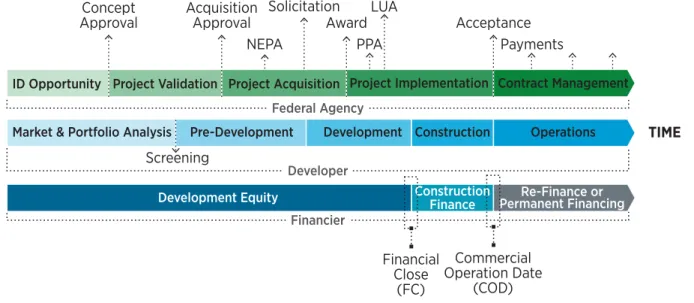
Figure 1 provides an overall view of some of the similarities of process and differences in language from three key perspec-tives: that of the Federal agency, the private developer, and the financier. This translation between the three key parties involved in procuring and supplying privately financed renewable energy projects is the starting point for the development of effective communication and a successful project.
A Common Process
To achieve the shared goal of large-scale renewable energy pro-duction, Federal agencies and private developers must recognize that they are working as separate parts of a larger, common project development and finance process. Like members of a relay team, the two parties must be synchronized at the point of exchange to be successful, requiring a common framework that recognizes the overall project development environment while accommodating the unique requirements and constraints of each party’s operating context. The developer and financier assess and manage risk throughout the project; Federal agencies must do the same.
Under certain methods of financing, the party assuming the lead role of the project will change throughout the life of the project. Accordingly, to be successful, both parties must share a common view of the project’s viability. For Federal agencies and employ-ees, this means making early-stage decisions that make projects attractive to the private financial markets and minimizing both real and perceived project risks when possible, so that projects are competitive when taken to the market for development and project financing. For private developers, it means understanding the intricacies of Federal requirements and financing options and being prepared for the Federal process to run its course. As developers and Federal agencies begin to recognize their contributions as part of a larger, continuous process, continuity in
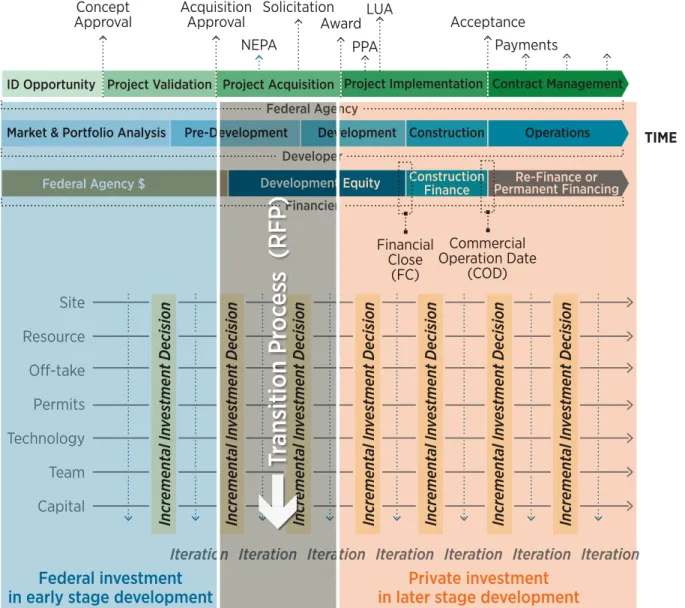
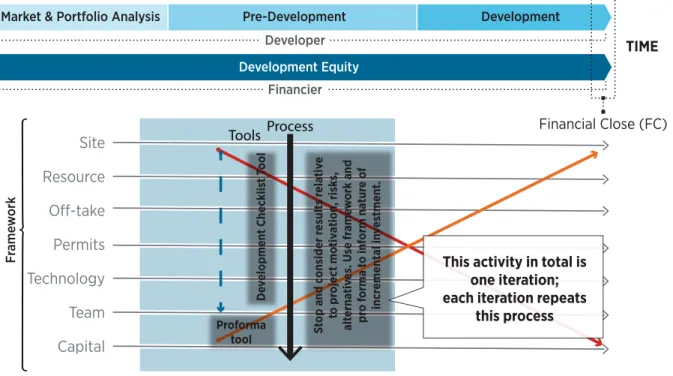
approach and methodology will begin to emerge. A framework to visualize a common process is shown in Figure 2, which is discussed in further detail in Section II (A Reliable, Repeatable Project Development Process).
The framework in Figure 2 was established by NREL and is based on widely used commercial practice. Federal agencies can benefit from understanding the principles of this framework; some may recognize certain elements manifesting in their current practices. The framework becomes a system made up of the following four elements:
1. A timeline of the project development lifecycle that maps influential forces (risk and unknowns).
2. A framework that introduces seven categories of project development, used to organize information.
3. A process that runs across the framework, analyzing project potential (iterative, fatal flaw).
4. Tools used to support decision making, including financial pro formas (Appendix F. Project Pro Forma Example) and development checklists (see Appendix B. Project Development Framework Categories).
Note that it is not possible to show all the detail in Figure 2. Key project milestones such as site control (e.g., land use agree-ment [LUA]), off-take contract (e.g., power purchase agreeagree-ment [PPA]), Large-Generator Interconnection Agreement, and Permits will occur on a sliding scale during the “Development” part of the process, depending on the characteristics of the Developer and its corporate objectives. In addition, the National Environmental Policy Act (NEPA) activity shown is if the project is well defined with regards to location and size. If the project is to be defined by the project developer, the NEPA process would start after the solicitation/selection of the project and be completed prior to
TIME
Financial
Close
(FC)
Commercial
Operation Date
(COD)
ID OpportunityFederal Agency
Project Validation Project Acquisition Project Implementation Contract Management Pre-Development
Market & Portfolio Analysis
Development Equity ConstructionFinance Permanent FinancingRe-Finance or Development Construction Operations
Developer Financier
Concept
Approval
Acquisition
Approval
Solicitation
Award
Acceptance
PPA
LUA
Payments
NEPA
Screening
3Acronyms defined: NEPA = National Environmental Policy Act, PPA = Power Purchase Agreement, LUA = Land Use Agreement.
final agency project approval. The commercial project financ-ing of a large-scale project would typically not reach “Financial Close” without these project attributes in place; however, a company can independently decide the amount of risk it is willing to take during the development process in allocating develop-ment capital to achieve project milestones, meet contractual obligations, and respond to changes in market conditions (such as pricing or competitive bidding). See “Limitations of Figures” in Section I, for additional discussion of the simplification in this graphic.
The success of Federal renewable energy projects depends on the ability of both parties to recognize each other as essential to reaching a common goal. Neither party will be successful if the requirements and constraints of the other are not met and understood. The methodologies of each party must be merged or
translated so that a common language, purpose, and process are developed and maintained between all parties.
This Guide acts as a first step in facilitating the process of financing certain types of large-scale renewable energy proj-ects by beginning to translate the differences in language and by mapping a process that is grounded in the foundations of commercial project development while integrating traditional Federal methodologies. An organizational framework, evaluation process, and sample tools are provided for Federal employees seeking to benefit from or gain insight into private development methodologies.
FEMP intends to update this Guide regularly to improve Federal capabilities in this nascent field.
TIME
Financial
Close
(FC)
Commercial
Operation Date
(COD)
ID Opportunity Federal AgencyProject Validation Project Acquisition Project Implementation Contract Management Pre-Development
Market & Portfolio Analysis
Development Equity ConstructionFinance Permanent FinancingRe-Finance or Development Construction Operations
Developer Financier
Concept
Approval
Acquisition
Approval
Solicitation
Award
Acceptance
Payments
NEPA
Federal Agency $
Site
Resource
Off-take
Permits
Technology
Team
Capital
Iteration Iteration Iteration Iteration Iteration Iteration Iteration
Incr
emen
tal In
ves
tmen
t Decision
Incr
emen
tal In
ves
tmen
t Decision
Incr
emen
tal In
ves
tmen
t Decision
Incr
emen
tal In
ves
tmen
t Decision
Incr
emen
tal In
ves
tmen
t Decision
Incr
emen
tal In
ves
tmen
t Decision
Incr
emen
tal In
ves
tmen
t Decision
Tr
ansition Pr
oc
es
s (RFP
)
Federal investment
in early stage development
in later stage development
Private investment
PPA
LUA
Figure 2. Developing a common process 4
4 Figure 2 provides a general description of each party’s responsibilities throughout the stages of project development. However, each party’s responsibilities will depend on the type
of financing employed (e.g., the private sector party has the lead role in the project development stage in the Energy Savings Performance Contract context). Please refer to the FEMP website for guidance on specific types of financing: http://www1.eere.energy.gov/femp/financing/mechanisms.html.
This Guide is not legally binding and it does not provide legal advice or explanations. Anyone with additional questions should seek appropriate and qualified counsel.
Please check the FEMP website for the latest developments at www.femp.energy.gov.
Acknowledgements
The Federal Energy Management Program (FEMP) would like to acknowledge the contribution and assistance provided by the
staff of the U.S. Army Energy Initiatives Task Force (EITF). This framework was developed in concert with the EITF’s process for large-scale renewable energy project development. FEMP, NREL, and the EITF have worked collaboratively and in parallel on these processes.
FEMP also thanks the agencies that provided input on early drafts and those who provided comment to the Federal Register draft for their time and thoughtfulness.
Table of Contents
Executive Summary ...1
Defining Success: A Common Goal ...1
A Common Language ...1
A Common Process ...2
Acknowledgements ...4
Table of Contents ...5
List of Figures and Tables ...8
Introduction ...9
Purpose ...9
Background ...9
How This Guide is Set Up ... 10
I. Language ... 11
Alignment and Sequencing ...12
Limitations of Figures ...12
II. A Reliable, Repeatable Project Development Process ...13
Project Development Stages ...13
Stage 1. Market and Portfolio Analysis... 14
Stage 2. Pre-Development ... 16
Stage 3. Development ... 16
Applying the Framework in a Project Environment (Considering the Financier’s View Point) ... 18
Risk in the Development Equity Phase ... 18
Iterative Approach/Incremental Investment ... 20
III.Application of Project Development by a Federal Agency ...22
Making Federal Projects Attractive to the Private Sector ...22
The Federal Process ...23
Stage 1. Identify Opportunities ... 24
Stage 2. Project Validation ...25
Stage 3. Project Acquisition ... 26
Stage 4. Project Implementation...27
Stage 5. Contract Management ...27
Conclusion ...27
IV. Outlook ... 29
Additional Resources ... 29
Appendix A. Portfolio Approach ... 30
Portfolio Then Project ... 30
Portfolio Analysis Steps ... 30
Strategy ...31
Competition and Discipline ...31
Competition ...31
Discipline ...31
Appendix B. Project Development Framework Categories ...32
B1. Site ...32
Pre-Development Stage Site Elements ...32
Development Stage Site Elements ...32
Inter-relationships: How Site Issues Affect Other Project Development Elements ...32
Example Project Questionnaire – For Federal Sites ...33
B2. Resource ...35
Pre-Development Stage Resource Elements ...35
Development Stage Resource Elements ...35
Inter-relationships: How Resource Issues Affect Other Project Development Elements ...35
Example Project Questionnaire - Resource ... 36
B3. Off-take ... 36
Pre-Development Stage Off-take Elements ...37
Development Stage Off-take Elements ...37
Inter-relationships: How Off-take Issues Affect Other Project Development Elements ...37
Example Project Questionnaire - Off-take ...38
B4. Permits including NEPA Compliance and Permitting Activities ... 39
Pre-Development Stage Permit Elements ... 39
Development Stage Permit Elements ...40
Inter-relationships: How Permit Issues Affect Other Project Development Elements ...40
Example Project Questionnaire - Permits ...40
B5. Technology ... 41
Pre-Development Stage Technology Elements ... 41
Development Stage Technology Elements ... 41
Inter-relationships: How Technology Issues Affect Other Project Development Elements ... 41
B6. Team ... 42
Pre-Development Stage Team Elements ... 42
Development Stage Team Elements ... 42
Inter-relationships: How Team Issues Affect Other Project Development Elements ... 42
Example Project Questionnaire - Team ... 43
B7. Capital ... 43
Pre-Development Stage Capital Elements ... 43
Development Stage Capital Elements ... 43
Inter-relationships: How Capital Issues Affect Other Project Development Elements ... 43
Example Project Questionnaire - Capital ... 43
Appendix C. Overview of Electricity Markets and Key Terms... 45
Utility Market Structures ... 45
Balancing Authority Areas ... 45
Transmission and System Operators ... 46
Congestion ... 46
Ancillary Services ... 46
Renewable Markets and RECs ... 46
National Organizations ... 46
Appendix D. Commercial Project Financing ...47
What Makes a Deal? ...47
Appendix E. 10-Step Project Development Framework Approach ... 49
Coordination of Government Phases and 10-Step Process ... 50
Stage 1. ID Opportunity ... 50
Stage 2. Project Validation ... 50
Stage 3. Project Acquisition ... 50
Stage 4. Project implementation ... 50
Appendix F. Project Pro Forma Example ...52
Appendix G. Project Risk Assessment Template ...67
Appendix H. Project Validation Report (DRAFT) ... 69
List of Figures and Tables
Figure 1. Developing a common language ...2
Figure 2. Developing a common process ...3
Figure 3. The language barrier ... 11
Figure 4. Developing a common language ...12
Figure 5. Project lifecycle phases...13
Figure 6. Project development stages, translated between government and private sectors ... 14
Figure 7. A financier’s perspective of project lifetime and milestones ... 18
Figure 8. Process translation adding the financier’s language ... 19
Figure 9. Project phases with risks and unknowns... 19
Figure 10. A single iteration in a project development framework ... 20
Figure 11. Iterations and incremental investment decisions lead to financial close ...21
Figure 12. Project stages ...23
Figure 13. A typical government process for certain types of financing ... 24
Figure 14. Transition between Federal sector role and private sector role across project lifecycle ...28
Figure E-1. Project development framework with 10-step process ... 49
Table 1. Financial Model Basic Elements ...52
Figure G-1. Example Army project risk assessment framework ...67
Introduction
Purpose
This Guide has been created to help Federal agencies effectively develop large-scale renewable energy projects5 at Federal facili-ties. For the purposes of this Guide, large-scale Federal renewable energy projects are defined as renewable energy facilities larger than 10 megawatts (MW) that are sited on Federal facilities, property, and lands, and are typically financed and owned by third parties. Because these projects often rely on private invest-ment, it is necessary for Federal agencies to understand the types of large-scale renewable energy projects that the private sector is pursuing. In other words, if the projects that need private sector funding do not attract the private sector, they will never be built. Therefore, this Guide provides the Federal employee with an understanding of a common process that private sector develop-ers use to select projects for investment.
Federal agencies and the private sector share a similar overall process but use and understand different languages. This language barrier masks the similarities in each party’s overall process; different language can prevent Federal employees from understanding the important details in the developer’s process and vice-versa.
This Guide, while written primarily for the Federal employee, will also be relevant to private sector renewable energy developers and financiers interested in participating in the Federal market. Its scope is limited to large-scale renewable energy project development on Federal lands or facilities in which the energy is consumed by or sold to the Federal facility, a utility, or another project participant.
This Guide is distinct from many other documents on Federal energy projects by de-emphasizing the contracting methods used to execute the project. The purpose of this Guide is to describe the fundamentals of a successful, financially attractive, large-scale renewable energy project. If a project is solid, it is likely that one of several contracting mechanisms can be used to execute a deal. Projects may be funded by private financing through one or more of the project funding options available to the Federal sector,6 including Power Purchase Agreements (PPA), Energy Savings Performance Contracts, Utility Energy Service Contracts, Enhanced Use Leases, and others. Project procurement would occur through some form of competitive offer framework, often using a solicitation or Request for Proposals (RFP) format or other appropriate mechanism.
This Guide is not legally binding and it does not provide legal advice or explanations. Anyone with additional questions should seek appropriate and qualified counsel.
Background
The United States Government is committed to increasing its consumption of renewable energy and allowing more renewable resources to supply the utility grid. This requires the development of large-scale renewable energy projects at Federal facilities. By deploying large-scale renewables, the Federal Government contributes to energy independence and security, environmental protection, and economic development.
5 These projects may include utility-scale facilities that connect to the electric transmission system and have a primary consumer (off-taker) besides a Federal agency, as well as
commercial-scale facilities that may be interconnected to the grid but have the Federal agency as the primary off-taker.
6 This Guide describes a general process on how to develop large-scale renewable energy projects at Federal facilities using private capital. It does not, however, discuss the approaches
that are to be followed under any specific type of financing. For more information on financing a large-scale renewable energy project using a power purchase agreement, energy savings performance contract, utility energy service contract, enhanced use lease, or other method of financing, please refer to guidance on the FEMP website as well as other Federal regulatory materials. http://www1.eere.energy.gov/femp/financing/power_purchase_agreements.html
Renewable Energy Use Requirements, Goals,
and Related Guidance
1. Beginning in FY 2013, the Federal Government has a goal for not less than 7.5% of the total amount of electric energy consumed to come from renewable energy.
• 42 U.S.C. § 15852(a) (EPAct 2005, section 203).
• http://www1.eere.energy.gov/femp/regulations/ epact2005.html#rer.
2. Each agency shall ensure that at least half of its renewable energy consumption comes from “new” renewable sources (placed into service after January 1, 1999) and to the extent feasible, the agency implements renewable energy generation projects on agency property for agency.
• Executive Order 13423, section 2(b).
• http://www1.eere.energy.gov/femp/regulations/ eo13423.html
3. DOE Federal Energy Management Program Renewable Energy Requirement Guidance for EPAct 2005 and E.O. 13423.
• www.eere.energy.gov/femp/pdfs/epact05_ fedrenewenergyguid.pdf.
4. Each agency shall increase agency use of renewable energy, implement renewable energy generation projects on agency property, and prepare targets for agency-wide reductions of greenhouse gas (GHG) emissions. (Federal renew-able energy projects implemented on-site may contribute to each agency’s scope 1 and scope 2 GHG reduction targets. )
• Executive Order 13514, sections 2(a)(ii), 7(b)(i). 5. Individual agencies may also have agency-specific
goals. For example, DOD has a 25% goal beginning in 2025.
Federal energy policies, requirements, and goals involve levels of renewable energy consumption that are estimated to require the development of as much as $20 billion of renewable power projects over the next decade. Federal law authorizes, and the current administration has emphasized, the use of private capital to make these investments. These investments will be re-paid under the various types of financing methods available to the Federal Government. These include long-term PPAs, or other energy services agreements, whereby the government, a utility provider, or other project participant will purchase the energy produced by the projects installed and operated on Federal lands. The definition of renewable energy for Federal facilities is based on the language in the legislative renewable goal for Federal agencies in EPAct 2005 section 203 (42 U.S.C. § 15852(a)). As described in detail in FEMP’s guidance for that goal, Renewable Energy Requirement Guidance for EPAct 2005 and Executive Order 13423, Federal renewable energy includes electric energy generated from solar, wind, biomass, landfill gas, ocean, geo-thermal, waste to energy, new incremental hydroelectric genera-tion at existing plants, or hydrokinetic energy. In addigenera-tion, the Department of Defense (DOD) has a different renewable goal of 25% of facility energy use by 2025 (10 U.S.C. § 2911(e)), last amended by the National Defense Authorization Act (NDAA of FY2012) with slightly different definitions allowing thermal energy and energy from ground source heat pumps, but not including hydrokinetic energy.
This guide is focused on renewable energy generated to provide energy to a Federal facility or utility. It is not a guide for develop-ing biofuel plants to produce fuel for vehicles. The intent of this document is to present general steps that should be applicable to any project that would generate energy at a Federal facility. In addition to providing energy, renewable energy projects can help agencies reduce greenhouse gas emissions under Executive Order (EO) 13514. The Federal definitions for renewable energy only change slightly for hydropower under EO 13514.
While the renewable energy industry has experienced rapid growth around the world, the industry and its business models may still be unfamiliar to the capital markets. This tends to limit the pool of investors that are willing to participate in renewable energy projects, as does the tax driven nature of the investment requirements. Global economic concerns significantly limit the types of risks and projects that investors will consider, constrain-ing the ability of renewable energy project developers to attract financing for new market opportunities.
These market conditions present both a challenge and an oppor-tunity to the U.S. Federal sector as it strives to attract closely held project development and project finance funds from the private sector. Banks, which are essential participants in the project capi-tal markets, often capi-talk about the “flight to quality” when referring to an investor’s appetite for projects, a phrase referring to a very strong preference for low-risk deals.
A long-term agreement with the Federal Government can be seen as an attractive, low-risk revenue stream for the developer that may garner a corresponding low cost of financing for the
developer and a resulting lower energy cost for the government. This may spur more Federal renewable energy projects because power prices will generally be lower with lower costs of financing, while a well-developed market will influence competitive behav-ior, driving innovation and keeping prices down.
The challenge for developers is that unfamiliarity with the Federal contracting process can result in the perception of tremendous development risks. Given the condition of financial markets, developers are likely to choose transaction partners with whom the development risk is perceived to be lowest. To flourish, the Federal sector should be seen as a viable market segment for project development investment funds.
To efficiently attract private capital, projects on Federal property should be well defined with manageable and financeable devel-opment risk that is consistent with market conditions.
Large-scale renewable energy projects on Federal lands should be competitive with other project investment alternatives and attract a broad range of investors. Interest from the financial community to provide long term financing in turn attracts developers willing and ready to put private development capital at risk. The commitment of developers and investors together significantly increases the likeli-hood of project completion and overall quality of the end result.
How This Guide is Set Up
Section I (Language) of this document highlights the language barrier between Federal agencies and the private sector— this language translation continues throughout the document. The section is not meant to be comprehensive; instead, the intent is to begin the process of developing a common language between parties. Once the Federal employee understands some of the pri-vate sector terminology, he or she can start to better understand the developer’s process and how it relates to the government’s process.
Section II (A Reliable, Repeatable Project Development Process) describes a process commonly used by the private sector to develop large-scale renewable energy projects.
In Section III (Application of Project Development by a Federal Agency), the government employee is provided with a reason-able understanding of what his or her responsibility and/or role is within the context of the large-scale renewable energy project development process, while attempting to provide the developer community with a recognizable, reliable, and predictable process in which it can engage with a reasonable likelihood of commercial success. Each of the appendices provides more detail on the subjects covered in sections two and three.
To efficiently attract private capital, projects on
Federal property should be well defined with
man-ageable and financeable development risk that is
consistent with market conditions.
I. Language
The intent of this Guide is to minimize the language barrier that may exist between Federal agencies and private developers, and to highlight the importance of government agencies and private developers’ understanding of each other as they navigate the project development and execution process. Language provides a foundation for understanding and trust between the parties involved in project development. It can also be a barrier to success if disparate jargon is used without thoughtful translation. Because the Federal agency is, in all likelihood, contracting with a project developer, and not directly with the financier, this Guide will focus on the language of government and the private sector developer.
Each party’s language is formed and developed with respect to the unique perspective and context of the party involved, both of
which are driven by different (but compatible) motivations and constraints. The essential activity between the parties is to come together in a mutually beneficial relationship that achieves a common goal that neither party can obtain alone. In other words, the goal is to get a deal done.
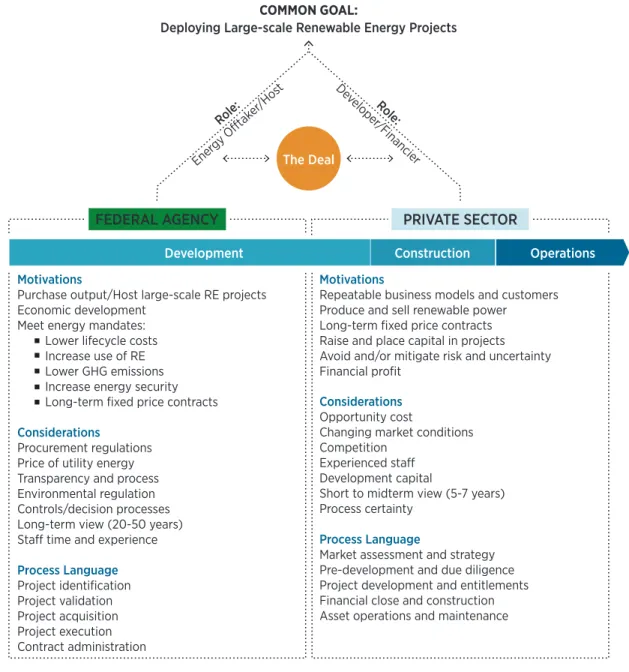
Beyond the elements of scope, schedule, quality, and budget (fundamental concepts of project management), the develop-ment and procuredevelop-ment of a renewable energy project introduces both risk and financial issues that are complex and lasting. These issues cannot be negotiated efficiently while language barriers exist. An illustration of the differences in context and languages between Federal and private parties is shown in Figure 3, which shows both parties joined by a common goal (deploying large-scale renewable energy projects), but potentially undermined in achieving that goal by the uncertainty created by different perspectives and language.
Operations Construction
Development
COMMON GOAL:
Deploying Large-scale Renewable Energy Projects
PRIVATE SECTOR
Motivations
Purchase output/Host large-scale RE projects Economic development
Meet energy mandates: Lower lifecycle costs Increase use of RE Lower GHG emissions Increase energy security Long-term fixed price contracts Considerations
Procurement regulations Price of utility energy Transparency and process Environmental regulation Controls/decision processes Long-term view (20-50 years) Staff time and experience Process Language Project identification Project validation Project acquisition Project execution Contract administration Motivations
Repeatable business models and customers Produce and sell renewable power
Long-term fixed price contracts Raise and place capital in projects Avoid and/or mitigate risk and uncertainty Financial profit
Considerations Opportunity cost
Changing market conditions Competition
Experienced staff Development capital
Short to midterm view (5-7 years) Process certainty
Process Language
Market assessment and strategy Pre-development and due diligence Project development and entitlements Financial close and construction Asset operations and maintenance
FEDERAL AGENCY
Role: Ener gy Offtak er/Hos t Role: De veloper /Financier The DealBehind these differences, however, both parties have processes and procedures designed to produce measurable results, limit wasteful effort or spending, and provide transparency to those investing in the effort. These are the underpinnings of common goals and intentions.
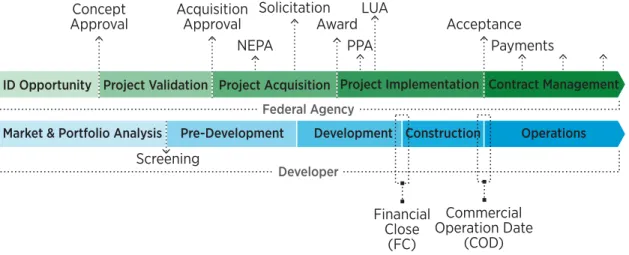
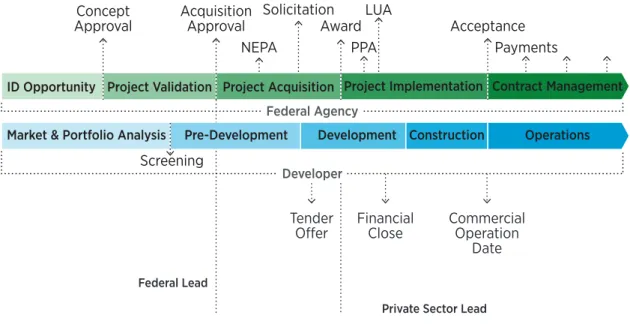
Figure 4 shows an overall view of some of the potential similari-ties of process and differences in language between the Federal agency and the private developer perspectives. This translation is the starting point for the development of a consistent, common language.
Alignment and Sequencing
Figure 4 is intended to be descriptive, not prescriptive. The stages in the private sector and Federal processes may not always explicitly match and are shown graphically to reflect specific points of alignment as well as relative process alignment. For example, at the end of construction, both the Federal agency and developer will recognize a common point in time, represented here by the term “Acceptance” by the Federal agency and “Commercial Operation Date” by the developer.
The majority of stages are not shown to explicitly align because the stakeholders are driven by different goals; each stake-holder’s stages do not coincide in time. Timelines for specific stages and descriptions of process are less rigid and not always aligned between parties, and so are shown this way in Figure 4. For instance, a Federal goal will be the release of a solicita-tion, whereas the developer’s goal may be to obtain funding to respond to the solicitation. Therefore, the developer’s milestone will not occur until after the solicitation has been released. Another area of difference is in the early stages of Market and Portfolio Analysis for the developer and the ID Opportunity Stage for the Federal agencies. These stages may have different lengths, with the Developer’s stage shorter than the Federal agency’s stage, as discussed below.
Limitations of Figures
Figure 4, and several variations of the same graphic, is used throughout this document as a tool to compare, at a high level, language and process across project participants. The figure is intended to represent, but not define, relative language and process stages of the parties. This is not intended, and cannot be used, as a representation or prescription of schedule or event timing for any given project type. To allow this high level contex-tual comparison, many simplifying assumptions were made – and some creative license taken, resulting in a simplified depiction of what can be a highly complex and variable multi-year process.
Figure 4. Developing a common language ID Opportunity
Federal Agency
Project Validation Project Acquisition Project Implementation Contract Management Pre-Development
Market & Portfolio Analysis Development Construction Operations
Developer
Concept
Approval
Acquisition
Approval
Solicitation
Award
Acceptance
PPA
LUA
Payments
NEPA
Screening
Commercial
Operation Date
(COD)
Financial
Close
(FC)
II. A Reliable, Repeatable Project
Development Process
This Guide establishes a common understanding around the fundamental principles of project development that can then be applied to both the Federal and private sector perspectives. The framework that emerges describes a project development risk management approach using an established, repeatable, disciplined process that is consistent with professional com-mercial practices and Federal requirements (including the Federal Acquisition Regulation). The general concepts of commercial project development and the project development framework are introduced in this section, with brief references to the comparable Federal process. In Section III (Application of Project Development by a Federal Agency), a Federal model that adapts the commercial process in more detail is highlighted.
The lifecycle of any project, Federal or private, begins with project development, moves to the construction phase, and transitions to the final operations phase. As a reliable, repeatable development process is developed, it is important to first establish its relation-ship to the other key elements in the project lifecycle, such as financial close and commercial operation date, as shown in Figure 5 (using terminology for phases that are generally understood by project developers).
The three elements of project development, construction, and operations are fairly universal, though the language within the Federal context can differ somewhat from the generic, com-mercial terms used here (see Section III, Application of Project Development by a Federal Agency, for more details). To allow the translation of terms from private sector to Federal sector and back, a more granular view of the project development stages will be discussed below and commercial and Federal terms will be translated so they can be used interchangeably. The activities included in the construction and operations phases, as defined above, will not be addressed as they are not the focus of this Guide.
Project Development Stages
To successfully attract private financing, a project must be fully defined with risks and unknowns mitigated and allocated to appropriate parties. For developers and providers of capital, judging the success of any project at its earliest stages depends on having a market, a way to get to the market, and the ability to obtain all of the relevant permits. The project development process ends with either an active decision to abandon the effort
or a successful project financing and the subsequent start of construction. The level of effort and investment required to fully define a project can be quite significant and, whether from the Federal or private sector perspective, this level of investment must be managed diligently through a rigorous process to protect resources.
For the purposes of this Guide, the project development phase is broken down into three stages: (1) Market and Portfolio Analysis, (2) Pre-Development, and (3) Development. These are generic commercial terms; those working from the Federal context may recognize terms such as (1) ID Opportunity, (2) Project Validation, and (3) Project Acquisition. These represent roughly the same activities with different naming conventions than the commercial terms mentioned above. A translation between these sets of terms is shown in Figure 6.
Depending on the method of financing used, early project development stages can be conducted and led by the sponsoring Federal agency, while the private sector takes the lead role during the project acquisition phase. Though this is a rough approxima-tion of when the lead project development role switches from the Federal to the private sector, it is important for the agency to acknowledge that under certain methods of financing, the agency may incur the risk of losing its pre-development investment if the parties ultimately fail to reach an agreement. Consequently, agencies should seek to avoid investing in an acquisition process that generates a lackluster response by the private sector and can
Section II focuses on developing a process
blueprint aimed at managing development risk
and limiting financial losses from investments
made in the development stage of a project or
portfolio of projects, a key focus of the project
developer. Understanding this, Federal agencies
seeking to attract developers with private capital
should focus on reducing real and perceived
risks through the development and availability of
data defining project feasibility and on providing
transparency in both process and schedule.
Figure 5. Project lifecycle phases
TIME
Financial Close
(FC)
Operation Date
Commercial
(COD)
Project Development Construction Operations
do so by adopting the discipline, analysis, and decision making involved in the processes and frameworks provided in this Guide.
Stage 1. Market and Portfolio Analysis
The first stage of project development does not focus on a project, which may just be a concept at this stage. Stage 1 focuses instead on the market fundamentals that define or influence the project’s operating environment. A project opportunity positioned in a market with supporting fundamentals has a strong economic business case, development and operational risks that are accept-able to all parties, acceptaccept-able technology or performance risk, site characteristics suitable for a given technology, supportive policies, and an execution pathway providing either access to markets or financing, or both.
Translation: The private sector will commonly refer to this stage as “Market and/or Portfolio Analysis”; Federal agencies may use the term “Opportunity Identification,” or something similar.
Developers identify market opportunities at several levels, and some of these levels are related to their core business model. By focusing on a set of technologies, or renewable resources, or other areas where the company may have a market advantage, the developers often have a shorter timeline in assessing a particular set of project opportunities than Federal agencies do. Some of the background work may have been done when setting up the company or developing the company business plan. Federal agencies often view the planning and Market and Portfolio Analysis step as a new activity, which is sometimes not
related to their core mission or area of expertise. The Federal agencies can take longer to identify opportunities, and this early stage can include significant planning at a regional or agency portfolio level. The agency also must review the potential projects despite limited familiarity with important facets of large renewable project development. While this process may seem long to the developers, it is critical to presenting sound projects for competition within the Federal system. This also introduces unique risk, as a project may face difficulty when market condi-tions change during the Federal planning process.
Strong project fundamentals and an understanding of how a project fits within a portfolio of opportunities are key foundations to the process. These provide the source of commitment and clar-ity of purpose necessary to both secure the resources required to develop a project and to persevere throughout the process. Without properly establishing project fundamental characteristics, the necessary resources (funding and skilled personnel) should not be allocated to move the project forward. A common mistake made by development teams in the early phases of project
The discipline of avoiding, or abandoning
low-probability projects as early in the development
process as possible is a fundamental risk
management function, and begins with market
analysis.
Federal Lead
Private Sector Lead
Tender
Offer
Financial
Close
Commercial
Operation
Date
ID Opportunity
Federal Agency
Project Validation Project Acquisition Project Implementation Contract Management Pre-Development
Market & Portfolio Analysis Development Construction Operations
Developer
Concept
Approval
Acquisition
Approval
Solicitation
Award
Acceptance
PPA
LUA
Payments
NEPA
Screening
Figure 6. Project development stages, translated between government and private sectors 7
7 Figure 6 provides a general description of each party’s responsibilities throughout the stages of project development. However, each party’s responsibilities will depend on the type
of financing employed (e.g., the private sector party has the lead role in the project development stage in the Energy Savings Performance Contract context). Please refer to the FEMP website for guidance on specific types of financing. http://www1.eere.energy.gov/femp/financing/mechanisms.html
development is to invest too heavily in technical or financial details before establishing that the project fundamentals are suf-ficient to maintain a sustained effort backed by common purpose and supported by leadership. Most developers will screen identi-fied projects prior to moving into the next stage, moving only the strongest opportunities forward to the pre-development stage.
Elements of Project Fundamentals
FEMP has adopted the following five elements or categories from a NREL-developed framework to help organize the information required to establish sound project fundamentals.
Baseline
An objective analysis of the current energy market for the site that defines the market-based drivers supporting or motivating the development of the project. This analysis may consider the fuel source of the local utility, local or imported energy supply, existing or necessary infrastructure to support a project such as interconnection requirements, an assessment of competitive forces in the market, and the schedule of various factors such as incentives, transmission availability, and other market factors. Most Federal sites will consider Federal renewable energy goals and support for the mission(s) at the site, often including some element of energy security as motivation for a project. However, this Baseline analysis must go beyond Federal goals to consider the market context that will motivate a privately financed project. A clear summary of the analysis and project objectives will help the project move forward.
Economics
An objective analysis of fundamental energy economics must be established—both in terms of the market price of acquiring energy from existing sources (self-generated or utility-based) and from the proposed sources as comparison. If the proposed sources are likely to be more expensive, the differences must be acknowledged and dealt with upfront. Will the agency pay a premium for renewable energy? Is there some other value to be delivered by the project? Development and financing costs should be considered along with “overnight” construction costs 8 when considering project economics.
Policy
Policy and Execution Authorities must be addressed prior to expending significant resources pursuing a project. The Contracting Authority to purchase the energy and legal basis to provide the land to the developer must be clear. These can vary significantly between agencies and across the military services. Federal agency, state, local, and regulatory policy environments, including environmental regulations, must be examined for barri-ers to the project and steps should be taken to mitigate, remove, or deal with these policies to create the conditions for success. An assessment of local stakeholder support or opposition can be included in this category if information is available to gauge local support.
Technology
Fundamental technology assessment and analysis may be the most straightforward part of establishing project fundamentals. Engineering will be completed in Stage 2. In Stage 1, an assess-ment of available renewable resources and the commercially available conversion technologies to use the resource is essential to establish the likely reliability of the project’s performance and gauge the investment community’s willingness to finance it (bankability). This assessment should include a constructability review to establish fatal-flaw site constraints.
Consensus
Building from the Technology section, identifying key stakehold-ers (including local community and non-governmental organiza-tions), and then communicating with and consensus-building among those project stakeholders are vital. To generate buy-in, a common understanding of the project’s objectives and funda-mental characteristics, and a unification of purpose are essential. Without consensus, staff and financial resources will not be made available, and stakeholders can become adversaries to the project when it is most vulnerable—before it gets off the ground. Ideally, the end of Stage 1 in the Federal context will result in team consensus often demonstrated by a project concept approval or similar document.
Portfolio Analysis
In conjunction with an analysis of project fundamentals, or market analysis, a portfolio level view can be established. To achieve the highest return on the effort and resources expended to pursue large-scale renewable energy projects, a Federal agency should consider not only each potential project on its own merits of technical feasibility and market environment, but also the project within the context of the agency’s portfolio of opportunities to choose the most valuable, feasible projects.
Federal agencies typically own and operate a portfolio of facilities and installations, with a wide range of size, geographic location, mission, and energy demand requirements. Each property has some technical potential for one or more renewable projects; for example, simply by virtue of being outdoors, the facility is subject to both solar and wind resources. Project economics are the next measure of feasibility; the constraint of energy cost is an impor-tant measure and may introduce a fatal flaw and direct efforts elsewhere.
For a more detailed discussion and an example of establishing a portfolio approach in the Federal context see Appendix A. Portfolio Approach.
8 Overnight cost is an estimate of the cost at which a plant could be constructed assuming the entire process of planning through completion could be accomplished in a single day. This
Stage 2. Pre-Development
The Pre-Development stage is meant to identify significant barri-ers to ultimate project execution prior to significant investment of time and money in the development stage. The goal of this stage is to uncover any fatal flaws with minimal investment of time and money and to confirm and establish project economics and the feasibility of obtaining all necessary agreements, approvals, permits, or contracts from third parties—without contracting or formally applying for them.
Translation: The term “Pre-Development” is commonly used in the private sector for this stage; Federal agency employ-ees may be more familiar with the term “Project Validation,” or something similar.
Depending on the method of financing, early project develop-ment stages may be conducted and led by the sponsoring Federal agency. Agency leadership in the Pre-Development stage is important because the project at this stage is likely to be too risky to command an economic energy price, or perhaps any interest from the private sector at all. By performing some early development activities for the project, the agency can reduce the project risk. Lower risk will reduce the returns necessary for the developer and may lower the price of power for the Government. Early development activities can consist of creating a financial model, or “pro forma,” for the project to “run the numbers” and evaluate sector developers use their own proprietary pro forma analysis to assess these elements, and they apply their own risk tolerance and professional judgment to a project. Other activities may include:
• establishing that the site is available for development and transferrable to a private sector entity;
• producing a critical issues analysis (“CIA”) report; • confirming the renewable resource with site-specific
data collection (solar and wind projects will generally require at least 12 months of data); and
• establishing a dialogue with potential off-takers or purchasers of the renewable energy produced by the project.
At the end of Stage 2, the project is likely ready to be offered to the public through a competitive procurement. Even projects with very strong project fundamentals require intensive data collection, analysis, and verification before a project becomes financeable and ultimately buildable. The data needed to cre-ate a government solicitation includes a large amount of this information.
Significant capital and investment of time by skilled profession-als are required to develop a cohesive set of project data that will attract financing. Elements such as a development budget, permitting memo, tax opinion, and development plan for the full development cycle should be established in this stage to manage development cost and risk. These development costs may be an investment made at risk of significant or total loss—a risk that the private sector may be better equipped to take on. Accordingly, depending on the financing method, it may be more beneficial to both parties if the private developer assumes the lead role of the project at the end of this stage. To visualize this handoff of the project – and implicit transfer of the majority of develop-ment investdevelop-ment risk – to the developer, refer to Figure 2 in the Executive Summary.
In the Federal context, the successful completion of pre-develop-ment activities will likely result in approval of an acquisition plan. Pre-Development activities are the beginning of the formal devel-opment process. The activities of this stage should be considered early steps within the same framework and approach as detailed in Stage 3, Development. Appendix B. Project Development Framework Categories lists pre-development steps for each of the framework categories described in Stage 3.
Stage 3. Development
Once a potential project is found to have strong fundamentals in Stages 1 and 2, it moves into Stage 3, Development, in which the information needed to close a deal is generated, verified, and compiled as the basis of an executable transaction. It can be expected that developers of large-scale projects would require an off-take agreement or PPA prior to investing in Stage 3.
Thought experiment: Imagine being a developer
and having a monthly meeting to discuss projects
under consideration. Of the dozens of projects
on the table, what ones get the majority of the
attention and the commitments to action? Answer:
Those with the most likelihood of being completed
– those with the lowest risk.
A private developer may not have easy access
to information that would reduce cost and risk
to early stage projects. Federal agencies should
collect relevant information from previous studies
such as NEPA documents and land use plans and
make those available to developers. The Bureau
of Land Management (BLM) has taken a proactive
and coordinated approach by identifying land
areas appropriate for Renewable Energy project
development and developing “programmatic”
assessments which pave the way for individual
projects.
Managing the inherent risk of investing in this activity requires a regular, repeatable, documented project development discipline grounded in commercial project development practice paired with Federal procurement practices.
Translation: The private sector refers to Stage 3 as “Development” to represent the largest commitment of time and money to prepare the project for financing and construction. Under certain financing methods, Federal agencies may use the term “Project Acquisition” or some-thing similar to denote the transfer of the lead role to a private vendor.
In Stage 3, the investment required by the developer or Federal agency may increase dramatically as all the necessary documen-tation for the project is generated and negotiated by engineer-ing, contract, and legal professionals preparing the project for financing and construction. This effort can entail significant resources (1% to 5% of total project costs), and can take from nine months to three years (or more). In Federal projects, this stage has two parts. One part is the detail developed by the Federal agency in order to issue a competitive process document and negotiate it through to acquisition award. The second part is the more detailed development work done by the project developer selected by the Federal agency to implement the project. In the Federal context, this stage includes developing the RFP or other acquisition agreement (instrument), negotiations, and awards, and ensuring compliance with the Federal requirements for the type of financing method employed and other contract requirements. These requirements can include the PPA, land use agreement, and other activities that are critical to the dev eloper’s financial close. This stage is discussed in detail in Section III (Application of Project Development by a Federal Agency). FEMP has adopted seven categories of information from an NREL-developed framework that can be used to organize and evaluate the risks and investment decisions required in Stages 2 and 3 of project development.9 These categories form a frame-work of information on which an iterative process is conducted, supported by tools such as pro formas and development checklists or questionnaires. For more information on each of the seven categories below, see Appendix B. Project Development Framework Categories.
The seven categories are:
Site
Site is the first element because a physical location for a renew-able energy power project is required. An investor must be assured that he or she has access to the site for construction and operation of the facility for the term of the contract (Site Control). Federal agencies must also especially understand whether the site is affected by Bureau of Land Management (BLM) withdrawal terms, which affect terms of land use.
Resource
The renewable resource under consideration (sun, wind, biomass, or geothermal) needs to be characterized and understood at a level of detail and confidence appropriate to the project’s stage of development. Whether the government or developer is invest-ing in this resource data is an important consideration and can impact the viability and marketability of a project. Installation of measuring equipment and verifiable data collection can be costly and must meet lender and investor requirements; see Appendix B for more discussion.
Off-take
The off-take agreement is a PPA or other agreement that includes the terms of sale of energy between the project owner and the government, and any other characteristics of output of the proj-ect (such as Renewable Energy Certificates [RECs]) that generate funds to pay for the project.
This category also includes any necessary transmission access and related agreements necessary to get the power to the ultimate power purchaser; the terms of the PPA and other agreements must be established early in contract negotiation and ultimately, secured by a contract. For the Federal agency, the terms may be identified in the RFP or other document for the competitive process. In general, the rates proposed for the sale of power and RECs must meet the government’s requirements, state laws, and procurement policy.
Permit
The permitting area encompass all permits necessary for project construction and operation—including all Federal requirements related to environmental regulations, such as NEPA, local electric utility interconnections, and necessary transmission rights or facil-ities. Permitting is an important element to understand from both a feasibility and risk standpoint—if a project has a high hurdle for permitting, and therefore includes significant risks, it needs to be considered with this in mind.
Technology
The technology area begins with the technical design feasibil-ity of a given technology that was developed in earlier project fundamentals work and becomes more detailed through the project development process. This work culminates in the final selection of all technology vendors and manufacturers, securing quotes from Engineering, Procurement, and Construction (“EPC”)
Site, Resource, and Off-take categories are the
core elements of project development because
together they create value that promotes further
investment. Securing these three elements by
contract is a significant milestone for the project
developer.
9 SROPTTC™ is the project development framework, discussed herein, and developed at NREL. SROPTTC™ is a trademark owned by the Alliance for Sustainable Energy, LLC, the manager
contractors, selecting the team, and executing all supporting and related documentation such as warranties, guarantees, and performance requirements. Note that most large RE systems are designed to feed power only to an operating utility system. Special hardware and operational approaches are needed if the RE system is to contribute to energy security. These measures can increase costs.
Team
Early on, it is essential to assemble a qualified Federal team rep-resenting all aspects of the project including technical, financial, contracting, legal, real property, master planning, environmental, and operational aspects. Investors will look for a qualified and committed Federal team with requisite experience and capability.
Capital
Development capital is invested by developers to put all project development elements in place: Site, Resource, Off-Take, Permits, Technology, and Team. With every element documented, the project will attract the financial resources necessary for construc-tion, commissioning, and initial operations. Raising and closing this financing is the final element in project development—but it is important to note that capital requirements do not begin at construction; they are required throughout the multi-year development process.
Applying the Framework in a Project Environment
(Considering the Financier’s View Point)
Large-scale renewable energy projects need private capital to succeed. Financiers provide that private capital and have their own language and processes to navigate through project development. Ultimately, once a developer assumes the lead role on the project, a financier will likely be involved—the developer needs to assure he or she can attract an investor or financier, just as the Federal agency needs to assure it can attract a developer. To assure Federal agencies develop projects that are viable to developers, Federal agencies need to understand how develop-ers and financidevelop-ers execute and invest in a project development process. This process, showing three distinct phases of activity
from the financier’s perspective, with milestones that separate and define them, is shown in Figure 7.
The three phases can be summarized from the financier’s perspective with an eye toward financial risk characteristics as follows:
1. The development equity phase represents the most speculative phase in which funds invested are at risk of total loss in the event a deal is not closed. Most of the development equity comes from the developer or other equity investors. Because this is the most speculative phase, debt is not available. Although equity investors will provide capital, they will expect a high return.
2. The construction finance phase represents the total capital cost of the project. Project financing incurs construction risks, but is mitigated by the creation of an asset, which is usually covered by some form of performance bonds or guarantees. Debt provided by the banking community is typically included at the construction phase. Because many of the risks have been mitigated at this point, debt providers, which are risk averse, can provide capital at a lower rate than equity investors. However, interest rates are still higher at this phase than at the next phase because of the reasons mentioned below.
3. The re-finance or permanent financing phase (also commonly called “take-out” financing) occurs when the speculative project has been converted into a stable asset generating income that is no longer sub-ject to development or construction risks. Bank debt is also typically deployed as part of the permanent financing or re-financing phase.
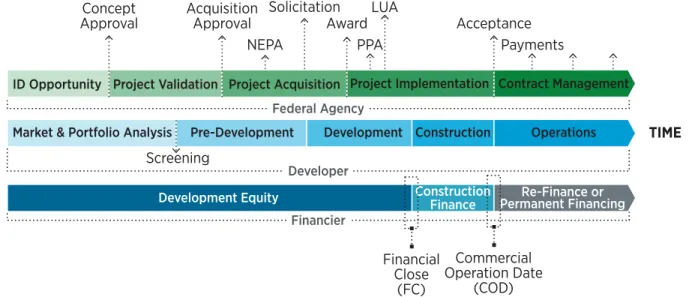
The Financier’s perspective and language can now be added to the translation diagram developed in Figure 4 to represent the terminology used by the financial community. Figure 8 shows this as a new horizontal band at the bottom labeled Financier. Third-party financing partners generally refer to the major phases of the project lifecycle in terms of financial risk. They may refer to the development equity phase, construction finance phase, and re-finance or permanent financing phase.
Risk in the Development Equity Phase
From the financier’s perspective, different levels of risk toler-ance and the skills and experience to mitigate those risks are
TIME
Development Equity ConstructionFinance Permanent FinancingRe-Finance or
Financial
Close
(FC)
Commercial
Operation Date
(COD)
FinancierFigure 7. A financier’s perspective of project lifetime and milestones
It is important to note that capital requirements
do not begin at construction; they are required
throughout the development process.
commonly found in the investors and lenders participating in funding each of these three phases. Different sources of capital may be employed to match the appetite for the risks and returns associated with a particular project lifecycle phase. Between the phases are two key milestones: first is financial close (“FC” in Figure 8), in which project financing transitions from develop-ment equity to construction finance. The second is commercial operations date (“COD” in Figure 8), where the project is considered fully constructed and ready for normal operations, and is therefore eligible for permanent financing.
Each phase of the project lifecycle has unique risk characteristics and the source of capital used reflects these different risk profiles. In general, as the project matures through the lifecycle, unknowns are steadily reduced as is risk.
The development equity phase does not follow this pattern; during project development, risk of loss moves counter to the decreasing unknowns. This occurs because any resources expended in the development equity phase can be lost com-pletely if the project is not executed. As investments are made, the risk of loss increases along with the amount of money at risk – much of this investment may not be recoverable without a successful financial close.
Figure 9 shows a general risk profile across a project’s lifecycle and financing phases. This profile does not parallel the declining trend of unknowns throughout the project lifecycle, but instead, the risk profile increases during the development equity phase. The project owner’s perceived risk is actually increasing because each incremental dollar invested is subject to a total loss should a fatal flaw emerge prior to financial close.
TIME
Financial
Close
(FC)
Commercial
Operation Date
(COD)
ID OpportunityFederal Agency
Project Validation Project Acquisition Project Implementation Contract Management Pre-Development
Market & Portfolio Analysis
Development Equity ConstructionFinance Permanent FinancingRe-Finance or
Development Construction Operations Developer
Financier
Concept
Approval
Acquisition
Approval
Solicitation
Award
Acceptance
PPA
LUA
Payments
NEPA
Screening
Figure 8. Process translation adding the financier’s language
Asset $
Risk
Unknowns
Development
Risk $
Construction $
Risk
TIME
Financial
Close
(FC)
Commercial
Operation Date
(COD)
Development Equity ConstructionFinance Permanent FinancingRe-Finance or Financier