R E S E A R C H
Open Access
Evaluation of smart classroom from the
perspective of infusing technology into
pedagogy
Junfeng Yang
1*, Hui Pan
1, Weiying Zhou
1and Ronghuai Huang
2* Correspondence: [email protected] 1School of Education, Hangzhou Normal University, Hangzhou 311121, China
Full list of author information is available at the end of the article
Abstract
Smart classroom was regarded as one of the essential methods to transform the traditional instructional mode. The research and practice of smart classroom became popular since 2012. However, there were few research on the large scale survey of smart classroom from the both technological and pedagogical perspective to provide baselines for smart classroom building. In this study, a large-scale survey of smart classroom was conducted in China. A total of 13, 495 students from 135 primary and middle schools participated in the survey. Data were analyzed in SPSS 23. Results indicated that participants generally did not perceive much smart learning in
classrooms, especially in the dimension of resource and enhancement. The results also confirmed that digital device and Internet were the basis for equipping smart
classroom. Technology equipment plus advanced technology could lead to the success of learning. Future research could be conducted to investigate how to match
technologies, pedagogies and smart classroom to improve student’s achievements.
Keywords:Classroom environment, Learning space, Smart classroom, Smart learning environment
Introduction
Since the late 1990s, many governments increased their investments in educational technologies, with the assumption that use of technology in schools could enhance teach-ing and promote learnteach-ing outcomes (Huang et al.2010). However, since the beginning of the investments, some researchers argued the effectiveness of technology in classroom. Researchers had also seen the modest use of technologies without significant influence on teaching and learning in most schools and classrooms (JISC2009; Cuban2009; Rams-den2011). Organization for Economic Co-operation and Development (OECD) released a report with the conclusion that investing heavily in school computers and classroom technology did not improve pupils’performance (OECD2015).
The modern classroom started at the end of the sixteenth century when classroom teaching was invented, with instructors lecturing from raised platforms and pupils sitting at fixed desks many rows deep (Song et al.2014). Rows of seats, instructor front and cen-ter, student eyes trained on the teacher, this classroom model worked well for centuries. However, traditional approaches were ineffective for today’s needs (Finch2018).
Now most classrooms in China remained the same layout as when they were invented (Yang et al. 2013). Technologies in classroom shifted with time. Since chalk-board was introduced into classroom in 1890, technologies such as film strips, over-head projector, desktop computer, interactive white board, smart phones and tablets were gradually used in classroom. With the use of these technologies, teaching in class-room has changed from “blackboard & chalk” mode to the “computer & projection” mode. Although technologies use in classroom had enhanced teaching to some extent, many predicaments still existed in today’s classroom.
First, multimedia console was fixed in front of the classroom, which limited the flexibil-ity of teaching. In classroom, teachers were always busy with operating computers, with few gesture interactions or eye interactions with students (Yang and Lin2009). Second, the unified and fixed classroom layout enhanced the didactic pedagogy, but hindered teacher’s adoption of student-centered pedagogy. Research showed that classroom with the specially designed layout such as“X-shaped”or“round”shape could meet the need of student-centered pedagogies (JISC2009). Third, the misuse of slides in multimedia class-room hindered student’s knowledge processing. Slides used by teachers in classroom were normally filled with texts, with no figures, tables or multimedia materials. It was easily for students to distract their attention from slides where the learning contents were listed (Huang et al.2012). Last, big gaps existed in teacher’s technological pedagogy knowledge and the needs for using emerging technologies in classroom. For example, interactive white boards (IBW) were equipped to lots of classrooms, however, most of them were used just like a projector screen (Huang et al.2012).
To some extent, the plight of the technology-rich classroom had a close relationship with the design and equipment of the classroom environment. Acknowledging the chal-lenges of technological use in classroom, scholars argued the need of shifting attention from technology and software and learning activities design in smart classroom (Simsek 2005; Aguilar et al.2015).
The phrase smart classroom had been used since 1995 in San Diego State University when they built the first smart classroom with the aim to enhance learning in big class-room by integrating technologies, like clickers, sympodium, multichannel audio system, etc. (Frazee et al.2006). In the following years until 2012, researchers investigated vari-ous technologies, like multimedia communicational supporting platform (Shi et al. 2003), Ambient intelligence (Augusto 2009), Internet of things (Temkar et al. 2016), etc. to make either physical classroom or virtual classroom smart. In this period, not many research could be found on smart classroom, and smart classroom was not well defined. The existed research of smart classroom were mainly investigated from technological point, however, few studies focused on the pedagogical aspect.
Huang et al. (2012) defined smart classroom as a physical classroom space that was effective for showing teaching content, easy for class management, convenient for accessing learning resources, easy for instructional interaction, and combined with con-textual awareness. Although the definition started to integrate the pedagogical issues into consideration, few follow-up researches were found on the design and evaluation of smart classrooms from both pedagogical and technological issues.
are able to contribute and become active agents (Jahnke et al. 2017). More and more research on smart classroom/ smart learning environments emerged since 2012. How-ever, pedagogical changed such as innovation in the teaching role, or the new role stu-dents take, the role of the contents, who decided on the learning process, resources, etc., was usually overlooked (Bautista and Borges2013).
In April 2018, China Ministry of Education issued the “The action plan of ICT in Education 2.0”, which emphasized the importance for building smart learning environ-ments to promote smart education (China Ministry of Education 2018). Lots of prov-inces also announced their local action plans to build smart classrooms for smart learning, like Zhejiang Province and Fujian Province. However, few study revealed the pedagogical issues of smart classroom, especially from the large scale survey perspec-tive. Therefore this study aimed at investigating smart classroom from the combined perspective of both pedagogy and technology through a large scale survey to provide information and reflections on the building and application of smart classroom.
Evaluation of smart classroom
In order to evaluate smart classroom, a large scale survey was conducted in 135 pri-mary and middle schools in China, with 13, 495 students participated in the survey. Data were collected by using the Likert-type smart classroom evaluation questionnaire (SCEQ) that should be illustrated in section 2.1.
The framework and tools for evaluating smart classroom
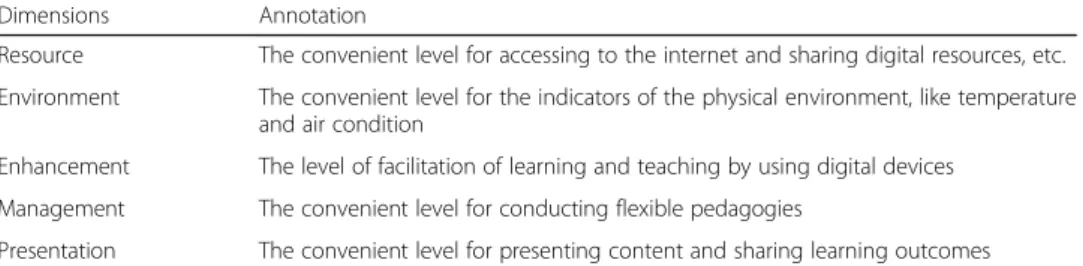
Few research focused on the evaluation of smart classroom. Li et al. (2015) developed an in-ventory for smart classroom included the 10 factors of physical design, flexibility, technology use, learning data, differentiation, investigation, cooperation, students’cohesiveness, equity and learning experience, with the 640 participants survey. MacLeod et al. (2018) developed an instruments for understanding students’ preferences toward smart classroom included the 8 factors of student negotiation, inquiry learning, reflective design, connectedness, ease of use, perceived usefulness and multiple sources, with 507 students participated in the sur-vey. Yang and Huang (2015) developed classroom environment evaluation scale (CEES) evaluating both physical classroom environments and psychological classroom environ-ments, from the 10 dimensions of showing, manageable, accessible, tracking, enhancement, teacher support, involvement, investigation, task orientation and cooperation. Adapted from the 5 factors of physical environment from Yang and Huang (2015) and considering the the inventories by Li et al. (2015) and MacLeod et al. (2018), we created the five dimensions framework for evaluating smart classroom (see Table1).
Table 1Framework for evaluating smart classroom
Dimensions Annotation
Resource The convenient level for accessing to the internet and sharing digital resources, etc.
Environment The convenient level for the indicators of the physical environment, like temperature and air condition
Enhancement The level of facilitation of learning and teaching by using digital devices
Management The convenient level for conducting flexible pedagogies
Based on the framework, the smart classroom evaluation questionnaire (SCEQ) with 24 items and 5 dimensions was developed (See Appendix). The survey items were an-swered by means of a Likert-type scale with five response choices, including“1 = almost never” “2 = seldom,” “3 = sometimes,” “4 = often,”and“5 = almost always”.
Participants
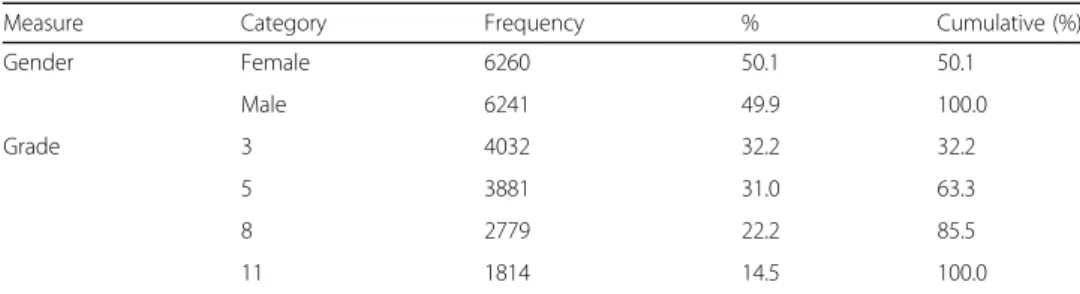
The SCEQ was used in a large scale survey on the status of smart classroom with 13, 495 students from 135 primary and middle schools in China. 12, 514 questionnaires were collected. Data were analyzed in SPSS 23.0. Students from Year 3 (8–9 years) accounted for 32.2.6%; students from Year 5 (10–11 years) accounted for 31.0%; stu-dents from Year 8 (13–14 years) accounted for 22.2%; students from Year 11 (16– 17 years) accounted for 14.5%, as shown in Table2.
Results
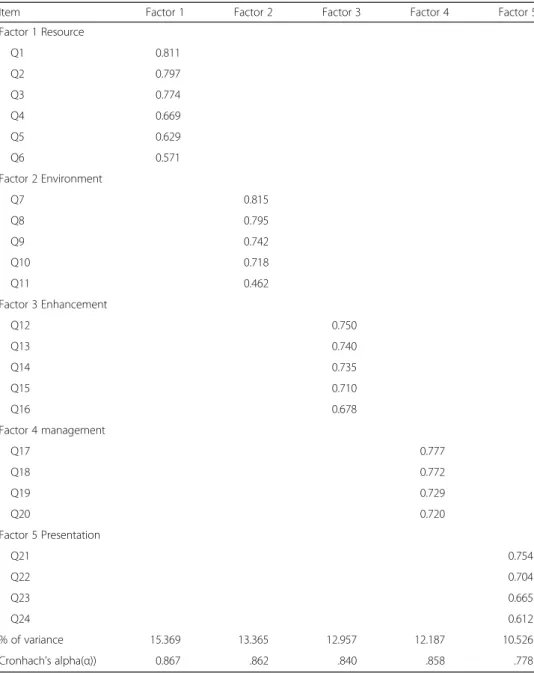
For each scale of SCEQ, the Cronbachαranged from 0.778 of presentation to 0.867 of resource, indicating that the internal consistency of the responses was acceptable for evaluating smart classroom in the 5 constructs. Exploratory factor analysis by principal component analysis with varimax rotation showed that the 5 factors of resource, envir-onment, enhancement, management and presentation accounted for 64.405% of the total 24 variances, as shown in Table3.
Table 4 outlined and summarized the average scores and standard deviation for the five factors. As shown in Table 4, “Resource”and “Enhancement” were the two factors with the lowest scores, indicating the overall technology enhanced smart learning were not much perceived by students in classroom. Most students perceived that they could not get access to Internet or digital learning resources freely, and also the assistance from digital devices for learning. “Environment” was the only factor with score above 0.4, indicating students generally satisfied with the temperature, air and light in class-room. The big standard deviation of resource and enhancement indicated that there could be differences for students’perception of the smart classroom in the five factors.
In terms of the classroom types, 765 students (6.1%) expressed they usually studied in traditional classroom with no computers, with 7603 students (60.8%) in multi-media classroom, 419 students (3.4%) in tablet classroom, 482 students (3.9%) in computer classroom, 3228 students (25.9%) in interactive whiteboard classroom. One-way ANOVA method was used to verify whether there are obvious differences among the different kinds of classrooms (see Table 5). The results showed that there were signifi-cant differences (p< 0.001) in different kinds of classrooms for all the five factors.
Table 2Sample characteristics
Measure Category Frequency % Cumulative (%)
Gender Female 6260 50.1 50.1
Male 6241 49.9 100.0
Grade 3 4032 32.2 32.2
5 3881 31.0 63.3
8 2779 22.2 85.5
Table 3Factor loadings and Crobach’s alpha values for the five factors
Item Factor 1 Factor 2 Factor 3 Factor 4 Factor 5
Factor 1 Resource
Q1 0.811
Q2 0.797
Q3 0.774
Q4 0.669
Q5 0.629
Q6 0.571
Factor 2 Environment
Q7 0.815
Q8 0.795
Q9 0.742
Q10 0.718
Q11 0.462
Factor 3 Enhancement
Q12 0.750
Q13 0.740
Q14 0.735
Q15 0.710
Q16 0.678
Factor 4 management
Q17 0.777
Q18 0.772
Q19 0.729
Q20 0.720
Factor 5 Presentation
Q21 0.754
Q22 0.704
Q23 0.665
Q24 0.612
% of variance 15.369 13.365 12.957 12.187 10.526
Cronhach’s alpha(α)) 0.867 .862 .840 .858 .778
Table 4Average scores on the ten scales extracted out on CEES
Scale Mean S.D.
Resource 2.922 1.174
Environment 4.051 0.883
Enhancement 2.900 1.148
Management 3.895 1.031
Students perceived best presentation and enhancement in tablet classroom, however, the mean score was still under 0.4, which indicated that students did not perceived ef-fective technology enhanced learning even in tablet classroom. From Table 5, students usually studied in traditional classroom with no computer scored the lowest among all kinds of classrooms in all factors.
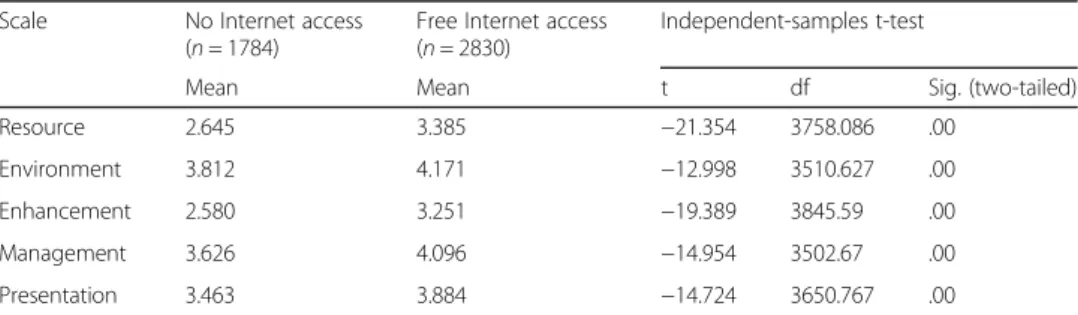
An independent-samples t-test was conducted to investigate if there were significant differ-ences in each scales of SCEQ between no Internet access classroom and free Internet access classroom. The independent samples t-test was significant for all the subscales (p< 0.01) as shown in Table6. Students in free Internet access classroom generally perceived better smart classroom environments than that in no Internet access classroom.
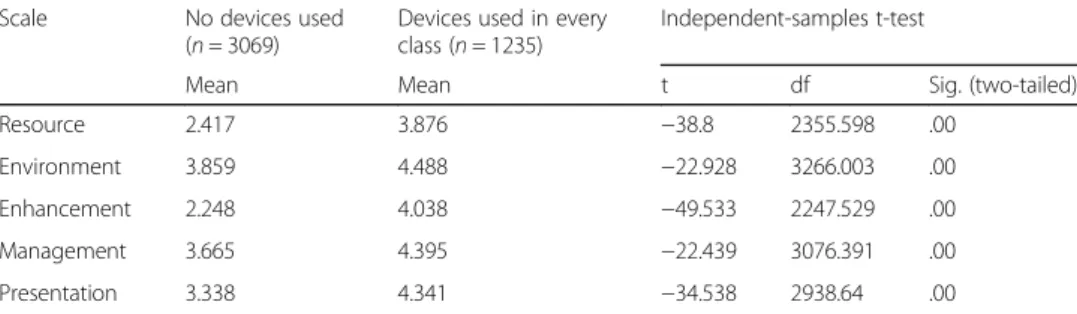
Independent-samples t-test was also conducted to test the difference between classroom with no devices used and classroom with devices in used every class. The independent samples t-test was significant for all the subscales (p< 0.01) as shown in Table7. Students perceived significant better classroom environment in classroom with devices used in every class. With digital devices used in every class, the score of presentation is 4.341, in-dicated that students could share learning outcomes with peers. However, the score of student’s perception of resource was still under 0.4 even devices was used in every class, indicating resources for students in classroom was not abundant.
Discussion
This study investigated smart classroom by a large scale survey, from the five dimensions of resource, environment, enhancement, management and presentation. Exploratory factor analysis showed that all the 24 questionnaire items loaded on the 5 factors, with 64.405% explanation of the total variance, indicated the reliability of the questionnaire. Resource dimension emphasized on the convenience for accessing digital learning resources, for example, the Wi-Fi and 1:1 tablets could be used for this purpose. Table 5One-way ANOVA for different kinds of classrooms
Scale traditional
classroom
multi-media classroom
tablet classroom
computer classroom
interactive whiteboard classroom
One way ANOVA
Mean Mean Mean Mean Mean F significance
Resource 2.810 2.826 3.458 3.474 3.017 69.43 .000
Environment 3.745 4.049 3.998 4.050 4.136 30.966 .000
Enhancement 2.646 2.800 3.467 3.355 3.054 84.411 .000
Management 3.594 3.879 3.938 4.040 3.979 24.66 .000
Presentation 3.379 3.666 3.874 3.777 3.798 38.749 .000
Table 6Comparison of students’perceptions of classroom environments with no Internet access and free Internet access
Scale No Internet access
(n= 1784)
Free Internet access (n= 2830)
Independent-samples t-test
Mean Mean t df Sig. (two-tailed)
Resource 2.645 3.385 −21.354 3758.086 .00
Environment 3.812 4.171 −12.998 3510.627 .00
Enhancement 2.580 3.251 −19.389 3845.59 .00
Management 3.626 4.096 −14.954 3502.67 .00
Environment emphasized the convenient level for the indicators of the physical environ-ment, like temperature and air condition. Enhancement emaphasized the facilitation of teachers for adapting new technology in smart classroom environment. Management em-phasized on the facilitation of student-teacher and student-student interaction, for in-stance, the U-layout or X-layout could be used for this purpose. Presentation dimension emphasized on the convenience for sharing learning materials from both teachers and students, for example, the dual screen and wireless display could be used for this purpose. The findings from the survey indicated that the participants generally did not per-ceive much technology enhanced smart learning in their classrooms, especially in “ Re-source” and “Enhancement”. Lots of students could not get access to digital learning resources and share these resources with their peers. Lots of students did not perceive technology enhanced teaching and learning even in tablet classroom, which revealed that the building and applying of smart classroom were only in the primary stage and there was much work need to be done. Pedagogy fit should be a key issue for the appli-cation of smart classroom. Technology equipment plus enhanced pedagogy could pro-duce behavior change (Yang et al.2017).
The independent-samples t-test showed that students perceived significantly better in classroom with free Internet access and digital devices used in every class, which indi-cated students gained better learning experience in classroom with digital devices and free Internet access. Today’s learners were grown up with digital technologies and Internet, and they had very different characters from the previous generation of learners (Howe and Strauss 2000; Prensky2001; Gasser and Palfrey2009). Teo (2013) identified the 4 characters of “grow up with technology”, “comfortable with multi-tasking”, “reliant on graphics for communication”,“thrive in instant gratification and rewards” of the new generation of learners. Smart classroom should meet the learner’s needs (Koper2014). Digital devices and Internet access were the basis for con-ducting high order cognitive learning activities for digital native.
For management, the means score of students’perception was 3.895(the best experi-ence in computer classroom with the score of 4.040), which indicated that the work-space and layout should be improved for digital native students. In fact, 10, 815 (86.4%) students expressed they were sitting at fixed desks many rows deep, indicated that most of the classroom still had the rigid classroom layout with no flexibility for teaching and learning. This result confirmed the conclusion by Yang et al. (2013) that most class-rooms in China remained the same layout as when they were invented. Classroom lay-out should be flexible to accommodate the new learning/teaching trends and to respond to the impacts of massive open online courses (Alwash et al.2014).
Table 7Comparison of students’perceptions of classroom environments for devices and PPT used
Scale No devices used
(n= 3069)
Devices used in every class (n= 1235)
Independent-samples t-test
Mean Mean t df Sig. (two-tailed)
Resource 2.417 3.876 −38.8 2355.598 .00
Environment 3.859 4.488 −22.928 3266.003 .00
Enhancement 2.248 4.038 −49.533 2247.529 .00
Management 3.665 4.395 −22.439 3076.391 .00
For environment, the mean score of students’perception was 4.051 (best experience in interactive whiteboard classroom with the score of 4.136), which indicated students generally satisfied with the condition of air, light and temperature in classroom. The item of environment evaluated the basic condition for students’ learning in a class-room. If the mean score was too low, it should be warned that the environment might hinder student’s learning or cause some bad effects. It was suggested the baseline for the mean score of environment factor should be 3.8.
For presentation, the mean score was 3.694 (the best experience in tablet classroom with the mean score of 3.874), which indicated that student did not perceived they could conveniently share learning outcome by using technology. However, the presen-tation and sharing students’learning results played an essential role for student’s per-ception in classroom climate and therefore influence their learning. In fact, research has revealed that presentation methods will affect student’s cognitive results (Moulton et al. 2017), and clear digital presentation could enhance retention and promote learn-ing effects. Future classroom optimization should consider uslearn-ing technology to facili-tate student’s presentation and sharing of learning contents. In the design of smart classroom, presentation could be enhanced by dual-large screen, high resolution, wire-less display for students, and etc.
All in all, it was apparent that the resource and enhancement were the two factors with the lowest satisfaction from digital native students. It was suggested that digital device equipped for every students and high speed internet should be considered as the basic infrastructure for smart classroom. Digital resources should be provided to both teachers and students, and the resources should be abundant and associated with each specific learning objective for the specific class. Hardware or software should be equipped in classroom to facilitate the sharing of learning materials and learning out-comes for digital native students. Equipping technology is just one of the factors that influence students’ learning experience in smart classroom. Pedagogy adopted by teachers plays another vital role in students’perception to classroom environment, es-pecially the psychological classroom environments. Physical classroom environments equipped with technologies interacts with pedagogy adopted by teachers. Different pedagogy asks for different learning environment, and vice versa (Radcliffe2009).
Conclusion
In order to optimize classroom environments to improve student’s learning experience, the present study investigated smart classroom from both pedagogical and techno-logical perspective by a large scale survey considering the five dimensions of resource, environment, enhancement, management and presentation .
results also confirmed that display of students’learning results played an essential role for student’s perception of classroom climate.
This study was conducted with a survey research model. Although a survey method-ology was appropriate to examine characteristics from a population, it is not as accur-ate as observing behavior and perception (Archambault and Barnett2010). The process could be stronger if qualitative data were gathered to validate the results of the survey (Yurdakul et al., 2012). The future study should be conducted by using the methods of classroom observation and interview in different kinds of classrooms, especially the tablet classroom, to interpret the phenomenons and produce concrete solutions. Pos-sible future studies also include designing a smart classroom and carrying out instruc-tions in the classroom, and then evaluate the effects of learning with technologies, and investigate the patterns of teaching activities and learning activities in smart classroom to match technology, teaching and learning space.
Appendix
Smart Classroom Evaluation Questionnaire (SCEQ)
Resource
In class.
1.I can get on internet to search for learning materials 2.I can get on internet
3.I can share digital resources with peers
4.I can get the videos that the teacher uses in class 5.I can get digital learning resources.
6. I can find that computer sockets in classroom when I need to use them
Environment
In class.
7. Temperature in classroom is suitable for concentrating on learning. 8. I don’t feel sleepy in classroom because of fresh air in classroom. 9. No unnecessary noises exist in classroom.
10. Light in classroom is enough for reading books or digital books. 11. I can hear teacher and other students clearly
Enhancement
In class, digital devices enable.
12. I can get the correct answer for questions. 13. I can get learning guidance from devices. 14. I can work with peers for learning tasks. 15. Teachers can assess my practice instantly. 16. I can accomplish tasks by using devices.
Management
In class.
17. I have adequate workspace for the placement of textbooks, tablet PCs and other resources.
19. The layout in classroom is suitable for my ways of learning.
20. The podium, blackboard and projector are at the right place for teaching and learning
Presentation
In class.
21. I feel the digital devices promote my sharing.
22. I understand teaching content better with multi-screen display. 23. I fell the network promote my sharing.
24 I can share my learning outcomes with others.
Abbreviations
OECD:Organization for Economic Co-operation and Development; SCEQ: Smart Classroom Evaluation Questionnaire
Funding
This research work is supported by 2016 National Natural Science Fund Youth Project“Blended synchronous cyber classroom supporting educational balanced development (No. 71603067)”, and Hangzhou outstanding young social science personnel training program“Design and Evaluation of Smart Classroom (No. 2016RCZX36)”.
Authors’contributions
YJF conceived and designed the study. YJF performed the experiments and wrote the paper. YJF, PH and ZWY reviewed and edited the manuscript. HRH give suggestions for editing the paper. All authors read and approved the manuscript.
Competing interests
The authors declare that they have no competing interests.
Publisher’s Note
Springer Nature remains neutral with regard to jurisdictional claims in published maps and institutional affiliations.
Author details
1School of Education, Hangzhou Normal University, Hangzhou 311121, China.2Smart learning institute, Beijing Normal University, Beijing 100875, China.
Received: 17 July 2018 Accepted: 17 September 2018
References
Aguilar, J., Valdiviezo, P., Cordero, J., & Sánchez, M. (2015). Conceptual design of a smart classroom based on multiagent systems. In:Proceedings on the International Conference on Artificial Intelligence (ICAI)(p. 471). The Steering Committee of The World Congress in Computer Science, Computer Engineering and Applied Computing (WorldComp)
Alwash, M., Grills, J., Hinrichs, R., & Wasserman, B. (2014). Recommendations for the classroom technology and layout at WPI. Retrieved from:https://web.wpi.edu/Pubs/E-project/Available/E-project-030514-201029/unrestricted/CD_IQP_Report_Final.pdf L.M. Archambault, J.H. Barnett, Revisiting technological pedagogical content knowledge: Exploring the TPACK framework.
Comput. Educ.55(4), 1656–1662 (2010)
J.C. Augusto, Ambient intelligence: Opportunities and consequences of its use in smart classrooms. Italics8(2), 53–63 (2009) G. Bautista, F. Borges, Smart classrooms: Innovation in formal learning spaces to transform learning experiences. Bulletin of
the IEEE Technical Committeee on Learning Technology15(3), 18–21 (2013)
China Ministry of Education (2018). The announcement of action plan for ICT in education 2.0. Retrieved from:http://www. moe.gov.cn/srcsite/A16/s3342/201804/t20180425_334188.html
L. Cuban,Oversold and Underused: Computers in the Classroom(Harvard University Press, Cambridge, MA, 2009)
Finch G. (2018). Classroom design then and now. Retrieved from: https://www.viewsonic.com/library/education/classroom-design-trends-layout
J. Frazee, R. Greene, J. Julius,“Smart”classrooms : An IQ shift. College & University Media Review12(2), 19–40 (2006) U. Gasser, J. Palfrey, Mastering multitasking. Educ. Leadersh.66, 14–19 (2009)
N. Howe, W. Strauss,Millennials Rising: The Next Greatest Generation(Vintage Books, New York, 2000)
C.-J. Huang, M.-C. Liu, K.-E. Chang, Y.-T. Sung, T.-H. Huang, C.-H. Chen, et al., A learning assistance tool for enhancing ICT literacy of elementary school students. Education Technology & Society13(3), 126–138 (2010)
R. Huang, Y. Hu, J. Yang, G. Xiao, The concept and characters of smart classroom(in Chinese). Open Education Research18(2), 22–27 (2012)
I. Jahnke, P. Bergström, E. Mårell-Olsson, L. Häll, S. Kumar, Digital didactical designs as research framework: iPad integration in Nordic schools. Computers and Education113, 1–15 (2017).https://doi.org/10.1016/j.compedu.2017.05.006
JISC,Designing Spaces for Effective Learning: A Guide to 21st Century Learning Space Design(JISC, Bristol, 2009) Retrieved from: http://www.jisc.ac.uk/media/documents/publications/learningspaces.pdf
B. Li, S.C. Kong, G. Chen, Development and validation of the smart classroom inventory. Smart Learning Environments2(1) (2015).https://doi.org/10.1186/s40561-015-0012-0
J. MacLeod, H.H. Yang, S. Zhu, Y. Li, Understanding students’preferences toward the smart classroom learning environment: Development and validation of an instrument. Computers and Education122(March), 80–91 (2018).https://doi.org/10. 1016/j.compedu.2018.03.015
S.T. Moulton, S. Türkay, S.M. Kosslyn, Does a presentation’s medium affect its message? PowerPoint, Prezi, and oral presentations. PLoS One12(7), e0178774 (2017)
OECD,Students , Computers and Learning: Making the Connection(OECD Publishing, Paris, 2015) M. Prensky, Digital natives, digital immigrants (part 1). On the Horizon9(5), 1–6 (2001)
D. Radcliffe, inLearning Spaces in Higher Education: Positive Outcomes by Design, ed. by D. Radcliffe, H. Wilson, D. Powell, B. Tibbetts. A pedagogy-space-technology (PST) framework for designing and evaluating learning places (University of Queensland and the Australian Learning and Teaching Council, Brisbane, 2009), pp. 9–16
B. Ramsden, Evaluating the impact of learning space. Ref. Serv. Rev.39(3), 451–464 (2011)
Shi, Y., Xie, W., Xu, G., Xiang, P., Zhang, B., Y, S.,…B, Z. (2003). Project smart remote classroom--providing novel real-time interactive distance learning technologies. International Journal of Distance Education Technologies, 1 (3), 28 N. Simsek, Perceptions and opinions of educational technologists related to educational technology. J. Educ. Technol. Soc.
8(4), 178–190 (2005)
S. Song, X. Zhong, H. Li, J. Du, F. Nie, in2014 International Conference on Intelligent Environments, (2012). Smart classroom: From conceptualization to construction (2014), pp. 330–332
P.R. Temkar, M. Gupte, S. Kalgaonkar, Internet of things for smart classrooms. International Research Journal of Engineering and Technology3(7), 203–207 (2016)
T. Teo, An initial development and validation of a digital natives assessment scale (DNAS). Comput. Educ.67, 51–57 (2013) V.L. Uskov, J.P. Bakken, A. Pandey, inSmart Education and Smart e-Learning, ed. by V. L. Uskov, R. J. Howlett, L. C. Jain. The
ontology of next generation smart classrooms (Springer International Publishing, Cham, 2015), pp. 3–14 J. Yang, R. Huang, Development and validation of a scale for evaluating technology-rich classroom environment. J
Computers Education2(2) (2015).https://doi.org/10.1007/s40692-015-0029-y
J. Yang, R. Huang, Y. Li, inHuman-Computer Interaction and Knowledge Discovery in Complex, Unstructured, Big Data SE - 24 (Vol. 7947, pp. 275–284), ed. by A. Holzinger, G. Pasi. Optimizing Classroom Environment to Support Technology Enhanced Learning (Springer, Berlin Heidelberg, 2013)
J. Yang, H. Yu, C. Gong, N. Chen, Students’perceptions and behaviour in technology - rich classroom and multi-media classroom. EURASIA Journal of Mathematics Science and Technology Education13(3), 621–647 (2017).https://doi.org/10. 12973/eurasia.2017.00636a
M. Yang, W. Lin, The difficulties and solutions of multimedia teaching in higher school (in Chinese). E-education Research10, 98–101 (2009)