STATISTICAL PROCESS IN MANUFACTURING COMPANIES AND ITS QUALITY CONTROL IMPLEMENTATION WITH ADOPTION OF PUBLIC RELATION
Ananya Singh1, Dr. Pardeep Singh Balhara2
Department of Mass Communication
1,2
OPJS University, Churu, Rajasthan,India
Abstract
This paper shows applicability of the statistical process control techniques in different manufacturing industries. A research articles and the case studies on the implementation of the Statistical Process Control Techniques in the manufacturing industries are selected for the review. This research focused on studying the statistical process control tool in manufacturing systems with the broad aim of upgrading them to improve on quality and cost effectiveness. It represents an attempt to address the deficiency in the literature of SPC implementation. With emphasis on early detection and prevention of the problems, SPC was shown to have a distinct advantage over quality methods such as inspection of end product. For the improvement in quality and productivity process variation needs to be reduced. For this Statistical Process Control techniques are used. SPC uses statistics to detect variations in the process so that it can be controlled. Control charts are used in SPC for measuring the variation in the process and that can be continuously improved by the different techniques used in the SPC.
1. OVERVIEW
The expression "Public Relations "was utilized without precedent for the United States and the United States Post Office Railway Union and in the principal decade of the twentieth century, this nation was made the workplace of public relations at the foundation. In 1906, the main privately-owned business which the public services offered to its customers was made. In 1987 Association of Public Relations (IPR) gives a meaning of public relations, which is as yet utilized. In this definition, PR is arranged and nonstop endeavours to build up and keep up goodwill and comprehension between an association and its intended interest group [1-5].
In the present intense world market condition, should be better is all the more
Therefore, data must be assembled and examined. This is the place factual process control (SPC) instruments comes in to help in the decision-making and deciding whether the process is operating at a satisfactory level. The significant test the industries in Madhya Pradesh confront is related with aggressiveness as manufacturing organization neglect to contend in area and comprehensively.We have picked numerous manufacturing companies in Madhya Pradesh. The modem economic growth originates from industrialization
2. SPC IMPLEMENTATION
In SPC application in Madhya Pradesh, it is important to understand and identify key product characteristics which are critical to customers or key process variation as shown in Figure 1. The key steps for implementing SPC are:
Identify defined processes
Identify measurable attributes of the process
Characterize natural variation of attributes
Track process variation
If the process is in control, continue to track
Figure 1 Steps in SPC implementation Control outlines are initially created for use in large scale manufacturing in Madhya Pradesh. These procedures are material to most different kinds of exercises in all sectors of the economy including service business, government, education and health mind. Quality is a standout amongst the most important decision factors in the determination of products and services. Thusly, quality prompts enormous business accomplishment, development, and builds aggressiveness. It is quality as a decision-making procedure that utilizations measurements to screen the consistency of a production process and the subsequent product as enhances the workplace. Quality Control (QC) is an important undertaking in factory as it manages product examination before the product was delivered to customers.
Position of Public Relations in
Organization
straightforwardness issues and responsibility, regard residents' rights, recognize duties and obligations of government, the correct control of people to the work and the ideal people in scrutinize and assess projects and practices of the association and having particular strategies and projects are isolated into three categories:
1- Justifier public relations 2- Explainer public relations 3- Analyzer public relations. Advantage of SPC implementation
SPC execution is important as it could create process performance by diminishing product fluctuation and enhances production fitness by diminishing scarp and revamp. In their endeavours to remain focused, US business had left on Total Quality management (TQM) strategies, for example, SPC that prompts higher quality product by diminishing inconstancy and deformities. The vast majority of the production and quality cost that SPC plans to decrease, for example, adjust loss of offers and procedures are quantifiable.
The systematic search method used in this research was time-consuming. Although different sets of keywords were tested, it was not possible in the databases to narrow the search down to solely include research on decision or policy making related to public relations or organizational/corporate communication. Consequently, the computerized search provided many results from other areas than those targeted, such as political decision making or medical decision making between the healthcare unit
and patients. This had to be corrected by scanning the articles one by one. It also demonstrated that there are no clear or logical boundaries to decision or policy making.
3. PUBLIC RELATION PROCEDURE BY MANUFACTURING INDUSTRY
Key quality 175
Valuable sources 133
Distinctive leadership
perceptions
79
High productivity 113
Table 1: Excellent Variable Leadership in Public Relation for the Manufacturing Above table 1 descriptive the Excellent variable leadership in public relation for the manufacturing, 175 employees come under key quality, 133 employees come in valuable sources, 79 employees come in distinctive leadership perceptions, and rest of service employees come in range of high productivity.
Figure 2: Excellent Variable Leadership in Public Relation for the Manufacturing 4.4 EFFECT OF PUBLIC RELATION
ADOPTED BY MANUFACTURING
INDUSTRY
Yes 375
Table 2: Public Relations Department Report Directly to the Senior Manager in Manufacturing Company
Above table 2 descriptive Public relations department report directly to the senior manager in manufacturing company, 135 employees say yes and 125 employees says no.
Figure 3: Public Relations Department Report Directly To the Senior Manager in Manufacturing Company
Yes 383
No 117
Strongly Agree 149
Agree 183
Neutral 53
Disagree 63
Strongly Disagree 52
Table 3: The Communication Gap and Bad Decision Makers Are the Most Important Factor Affects the Both I.E. Employees As Well As Management Above table 3 descriptive The Communication Gap and Bad Decision Makers Are the Most Important Factor Affects the Both I.E. Employees as Well As Management, 149 employees are strongly agree, 183 employees are agree, 53 employees are neutral, 63 employees are
disagree and 52 employees are strongly disagree.
Figure 4: The Communication Gap and Bad Decision Makers Are the Most Important Factor Affects the Both I.E. Employees As Well As Management
Strongly Agree 139
Agree 159
Neutral 78
Disagree 69
Strongly Disagree 55
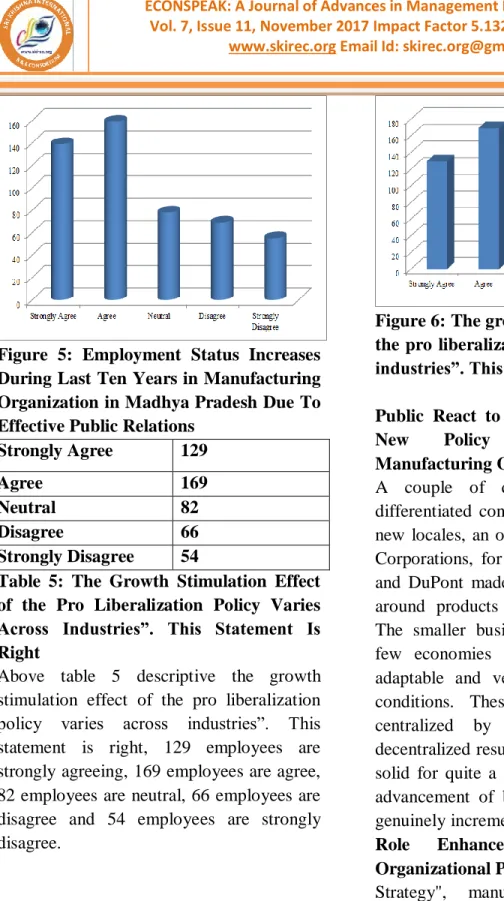
Table 4:Employment Status Increases during Last Ten Years in Manufacturing Organization in Madhya Pradesh Due To Effective Public Relations
Above table 4 descriptive Employment status increases during last ten years in manufacturing organization in Madhya Pradesh due to effective public relations, 139 employees are strongly agreeing, 159 employees are agree, 78 employees are neutral, 69 employees are disagree and 55 employees are strongly disagree.
0 100 200 300 400
Figure 5: Employment Status Increases During Last Ten Years in Manufacturing Organization in Madhya Pradesh Due To Effective Public Relations
Strongly Agree 129
Agree 169
Neutral 82
Disagree 66
Strongly Disagree 54
Table 5: The Growth Stimulation Effect of the Pro Liberalization Policy Varies Across Industries”. This Statement Is Right
Above table 5 descriptive the growth stimulation effect of the pro liberalization policy varies across industries”. This statement is right, 129 employees are strongly agreeing, 169 employees are agree, 82 employees are neutral, 66 employees are disagree and 54 employees are strongly disagree.
Figure 6: The growth stimulation effect of the pro liberalization policy varies across industries”. This statement is right
Public React to the Organization When
New Policy Applied by the
Manufacturing Organization
A couple of decades later, as firms differentiated contributions and moved into new locales, an opponent model developed. Corporations, for example, General Motors and DuPont made business units organized around products and geographic markets. The smaller business units relinquished a few economies of scale yet were more adaptable and versatile to neighbourhood conditions. These two business models centralized by work versus generally decentralized result and locale demonstrated solid for quite a while, largely because the advancement of business organization was genuinely incremental.
Role Enhance the Manufacturing
Organizational Performance
to be lined up with the strategic objectives of the organization. There is general assertion in the operations management (OM) writing that quality, conveyance, adaptability and cost are the centre manufacturing capacity measurements that have been linked to organizational performance. Organizational performance alludes to how well an organization accomplishes its market and financial objectives. In this we have embraced the resource-based view (RBV) to clarify the association between manufacturing abilities and organizational performance.
The main theory is the RBV and the second is CT. The RBV proposes that the upper hand can be gotten and supported after some time from the inward organization of resources. Resources in this setting allude to anything that may be thought as for quality (or shortcoming) to the firm, for example, resources, licenses, mark names, capacities, processes, traits, distribution areas, information, and learning. The RBV receives an inward view wherein the firm is the essential unit of analysis, and upper hand accumulates from the abuse of unmistakable and elusive resources.
Production strategies with the accentuation on squandering disposal and process streamlining can prompt business magnificence. There is an abnormal state of agreement to distinguish the practices related to Lean Production:
(a) Just in time (JIT);
(b) Total productive maintenance (TPM), (c) Total quality management (TQM), (d) Cellular manufacturing and
(e) Human resource management (HRM). Managerial Behaviour in the Public Relation View and Its Importance
We provided a review of public relations, including definitions, a short history of the calling, and a depiction of the models and sub functions normal in the calling. In these sections, public relations were characterized as an interesting management work that utilizations communication to help oversee relationships with key publics. In this part, we will elucidate this management work, clarifying why companies require public relations and how the public relations work is involved with specialized parts. Organizations, for the most part, have a few management functions to enable them to operate at their greatest limit: research and development, back, legitimate, HR, marketing, and operations. Every one of these functions is centered around its commitment to the accomplishment of the organization. Public relations' one of a kind capacity is to enable the organization to create and keep up relationships with the greater part of its key public and stakeholders by successfully speaking with these groups. Communication is entered in keeping up satisfactory, long haul, confiding in relationships with public and stakeholders.
Social Media in Building Public Relations
with Public and Development of
Manufacturing Industry
help change over intrigued consumers into customers. PR apparatuses are extremely financially savvy, and regularly give you a more noteworthy level of control than all the more extensively focused on advertising campaigns. Consider utilizing these PR devices to fabricate your business' notoriety. Media strategies centre on flowing messages through media channels to oversee how your business is depicted by the media.
4. QUALITY CONTROL
IMPLEMENTATION IN
MANUFACTURING COMPANIES:
MOTIVATING FACTORS AND
CHALLENGES
The weight from globalization has made manufacturing organizations moving towards three noteworthy aggressive fields: quality, cost, and responsiveness. Quality is a widespread value and has turned into a worldwide issue. Keeping in mind the end goal to survive and have the capacity to furnish customers with good products, manufacturing organizations are required to guarantee that their processes are ceaselessly observed, and product characteristics are made strides. Manufacturing organization applies various quality control procedures to enhance the quality of the process by decreasing its fluctuation. A range of procedures is accessible to control product or process quality. These incorporate seven statistical processes control (SPC) devices, acknowledgment examining, quality function deployment (QFD), failure mode and effects analysis (FMEA), six sigma’s, and design of experiments (DoE).
The reason for this section is to exhibit the usage of quality control in four manufacturing companies and recognize the factors that impact the determination of quality control strategies in these companies. The research examines the purposes of applying quality control methods, the systems utilized, and issues looked by them amid the execution. The research starts with an outline of quality control and its execution in organizations. This is trailed by the portrayal of four chose companies in this study including their products and company foundations. The use of quality control in each company is then displayed.
Capacity study is likewise a helpful method these companies should seriously think about to quantify organization's capacity to produce goods that satisfy resilience restrict. A few enhancements in control graph additionally should be considered by these companies. The new procedure based on the aggregate check of items produced before nonconforming ones are watched permits observing the process naturally. The utilization of information innovation and internet offices in QC is among ongoing development in this field. Constant QC would be a useful answer for companies confronting issues around the absence of quality mindfulness, aloof reaction, machine issue, inconsistent approaching materials quality, and tight customer plan.
5. CONTROL CHARTS-ORIGIN OF SPC
variety in manufactured products produced by the Western Electric development of the control diagram as ahead of schedule as 1924 and the idea of a condition of statistical control. There have been numerous expansions and changes of the essential control diagrams of Shewhart throughout the years. They are the primary apparatuses of statistical process control (SPC).
6. CONCLUSION
The most important apparatus of TQM is Statistical Process Control (SPC). It causes us observing a process consistently. The reason for control graphing is to demonstrate when the process is functioning as planned and when isn't. Some proper restorative measures should be taken at whatever point essential. In a manufacturing domain, the SPC device is utilized for consistent change of the production volume and also quality which prompts accomplishes manufacturing perfection. The main issue of any company is to make benefit by accomplishing the customers' satisfaction. This can be accomplished by proper usage of the SPC devices. SPC can be utilized as quality control instrument or it can add to expand the total volume of production. By this device, the production manager can without much of a stretch distinguish the causes in charge of poor product quality, machine breakdowns and furthermore colossal wastage. Shop floor control is presently a-days a noteworthy worry of any manufacturing industry.
New research is in progress to design new QC approach that consolidates the traditional and sans model framework to
stay aware of the propelling innovation, extending the manufacturing process and growing product assortments. Statistical process control (SPC) is the utilization of statistical methods to the observing and control of a process to guarantee that it operates at its maximum capacity to produce acclimating product. Under SPC, a process acts typically to produce however much-acclimating product as could reasonably be expected with the slightest conceivable waste. While SPC has been connected most as often as possible in controlling manufacturing lines, it applies similarly well to any process with a quantifiable yield. Enter apparatuses in SPC are control graphs and cause and impact outlines, concentrated on ceaseless change.
Varieties in the process that may influence the quality of the final result or service can be distinguished and revised, consequently lessening waste and additionally, the probability that issues will be passed on to the customer. With its accentuation on early recognition and aversion of issues, SPC has a particularly preferred standpoint over other qualitative methods. In mass-manufacturing, the quality of the finished article was customarily accomplished through post-manufacturing examination of the product; tolerating or dismissing each article (or tests from a production parcel) based on how well it met its design determinations.
outcome in the rejected product. Two sorts of variety happen in all manufacturing processes: both these kinds of process variety cause resulting variety in the last product. The first is known as regular or normal reason for variety and comprises of the variety innate in the process as it is designed.
I truly believe that our profession of public relations will be of greatest value to organizations and societies if it is based on the values and worldviews of many cultures. From the above study of the different case studies it can be concluded that to survive in the competitive market companies need to produce the quality products.
REFERENCES
[1].Skandari,M.(2004). Public opinion, public relations and communication, rah &danaei press.
[2].RezvaniGilkalaei,Gh.(2008). Public relations management and communication behaviour.
[3].Trochim, W. M. K. (2002). The Research Methods Knowledge Base (2nd ed.): Atomic Dog Pub Inc. [4].Wimmer, R. D., & Dominick, J. R.
(2002). Mass Media Research (7th ed.). Belmont, CA: Wadsworth. [5].Moorman, C. R., &Zaltman, G.