ISSN: 1305-578X
Journal of Language and Linguistic Studies, 11(1), 33-45; 2015
To what extent do educated British users of English accept certain established
norms in selected non-British Inner Circle and Outer Circle Englishes?
Abdel Halim Sykes a *
a SIM University, Teaching and Learning Centre,Singapore
APA Citation:
Sykes, A. H. (2015). To what extent do educated British users of English accept certain established norms in selected non-British Inner Circle and Outer Circle Englishes? Journal of Language and Linguistic Studies, 11(1), 33-45.
Abstract
Drawing on work that has attempted to describe and codify features of World Englishes, this study sought to address the question of whether certain established norms common to several varieties of English would be accepted by educated British users of English. The findings revealed that the respondents did not accept most of the selected norms. Only three items were acceptable to the majority of respondents. There was no significant difference in the responses of male and female respondents, and there was insufficient evidence to determine whether being a user of more than one language was a factor in the degree of acceptance. Whilst the lack of acceptance of non-British English norms does not imply deficiency in other Englishes, it does have implications for the identification of norms and standards that are commonly acceptable across all varieties of English. It could be argued that only those norms and standards that are commonly accepted provide the foundation of English as an International Language.
© 2015 JLLS and the Authors - Published by JLLS.
Keywords: World Englishes; standards and norms; Inner Circle; Outer Circle, acceptability
1. Introduction
This paper describes the findings of a questionnaire survey conducted to discover the extent to which a group of educated British users of English accept certain established norms in selected non-British Inner Circle and Outer Circle Englishes. The research arose out of issues of standards and norms in a variety of Englishes. It attempts to ascertain the degree of agreement and disagreement and convergence and divergence between the respondents in their acceptance of established non-British norms. It begins with a review of relevant literature. It then goes on to describe the research design and data collection procedures. An analysis of the data gathered via the questionnaire is provided, from which a number of conclusions are drawn on the respondents’ level of acceptance and non-acceptance of certain selected norms.
The paradigm of Inner Circle, Outer Circle and Expanding Circle English language using communities proposed by Kachru (1985) is useful in understanding the varieties of English currently found throughout the world. It takes account of the fact that whilst English has become a world language, it is, paradoxically, ‘breaking into multiple and increasingly differentiated Englishes’ (Kalantzis & Cope 1999, p.2). On the one hand, there is the case for English as an International
Language, and on the other, there lies the emergence of a ‘plurality of –lects’ (Davies et. al., 2003, p.572), which supports the notion of World Englishes. In order to find a point of convergence between these views of English, Kachru (1985) argued for recognition of English language norms within particular English using communities, both in the Inner Circle (e.g. Britain, the United States, and Australia) and in the Outer Circle (the former British and US colonies). He suggested that allowance for a variety of norms would not lead to problems of intelligibility among World Englishes, but would engender the emergence of an educated variety of English, intelligible across all varieties of English, i.e. English as an International Language. However, whereas the norms of one variety of English may be intelligible to users of other Inner and Outer Circle varieties of English, such norms may not be acceptable to those other users. Therefore, the notion of English as an International Language should be defined more in terms of acceptability rather than intelligibility. In order to explore this further, a review of relevant literature should be made before proceeding to a discussion of the study undertaken.
2. Literature Review
In the last two decades, a vast literature on World Englishes and English as an International Language has emerged and continues to grow apace. However, in a paper of this length, it would be difficult to explore the literature beyond the immediate scope of this study. Therefore, in order to allow more space to discuss the empirical aspects of this study, the review of the literature will be restricted to issues related to standards and norms, and acceptability.
2.1.
Standards and norms
Prior to independence, and for some time after, generally the standards and norms of Outer Circle Englishes were derived from either British or American English, and were presented in schools to Outer Circle users of English as formal or predominantly written norms (Platt et. al., 1984).However, more recent decades have seen the development in other Inner Circle countries, such as, Australia, Canada, and South Africa, of what MacArthur (2001) refers to as ‘projects that increase the cohesion and autonomy of their own Englishes’ (p. 10). The establishment of dictionaries and grammar reference texts by these Inner Circle users of English has reduced dependence on the norms and standards set by British English and American English. Furthermore, Outer Circle English users have also begun to produce dictionaries for local use.Higgins (2003) suggests that this scholarship, which brings with it the formalisation of these varieties, demonstrates that they are Englishes in their own right, rather than deficient versions of British English or American English. Indeed, Verma’s (1982) assertion, that Indian English is a self-contained system with its own set of rules, could also be applied to other non-British Inner and Outer Circle Englishes.
2.2.
Acceptability
Although English grammar is taught formally throughout the world, Strevens (1992) has suggested that beyond the English language teaching classroom, norms of usage are usually established informally and without conscious decision. Each community of English users sets its own goals and targets in the absence of any authority determining the norms of the local variety of English. Thus, acceptance of norms depends on the users’ particular variety of English. The norm becomes established and accepted when users 'demonstrate a solidarity, identity, and loyalty’ (Kachru 1992, p.67) towards it. This is the case not only in Outer Circle Englishes, but also within the Inner Circle. Indeed, as this paper will show, a norm that is acceptable in American English may not be acceptable in British English. Das (1982) argued that before classifying norms as acceptable or unacceptable it is necessary to consider the culturally and linguistically determined context in which they occur. This would imply that there is no ‘universal of acceptability since the situational components differ from place to place, person to person’ (Das 1982, p.146). Therefore, acceptability may be less a matter of grammatical accuracy and more a matter of social convention (Verma, 1982).
The analysis of the data gathered in this study will show that, as Strevens (1992) notes, it is not easy for native-speakers (in this case educated British users of English) to come to terms with, and to accept, the variations that occur in non-British Inner Circle and Outer Circle Englishes. Similarly, Kachru (1992) concluded that the attitude of Inner Circle users of English to the development of Outer Circle Englishes has not been one of acceptance or ontological recognition. Indeed, Outer Circle Englishes have been viewed as deficient models of Inner Circle Englishes, rather than as varieties of English in their own right. This unwillingness to accept norms of other varieties of English may come from ‘a total lack of awareness of the existence of flourishing, effective, functional, sometimes elegant’ (Strevens 1992, p. 37) Outer Circle Englishes. However, a more universalist and pluralistic view of English as an International Language suggests the language belongs, not only to those users in the Inner Circle, but also equally to those users of other varieties of English. Thus, the question of acceptability of norms both within and across the Inner and Outer Circles should be addressed to all those who play a role in defining English in the world today (Matsuda, 2003).
Having established the context for the study by discussing the notions of the Inner Circle and Outer Circle Englishes, and by considering issues of norms, standard and acceptability, this paper now turns to a description of the research undertaken and an analysis of the findings.
3. The Purpose of the Study
The primary purpose of this research was to discover to what extent educated British users of English accepted certain established norms in selected non-British Inner Circle and Outer Circle Englishes. The key aim was to ascertain the degree of agreement and disagreement and convergence and divergence between educated British users of English in their acceptance of established norms in selected non-British Inner Circle and Outer Circles Englishes. This finding could lead to an understanding of which selected norms were acceptable and which were unacceptable to the majority of respondents, and to identify any patterns of acceptance and non-acceptance, where they exist. The key questions this study seeks to answer are:
1. What norms are common in non-British Inner Circle and Outer Circle Englishes? 2. How does a sample of educated British users of English respond to those norms? 3. Does the sample of educated British users of English accept those norms?
Although ‘acceptability’ is subjective, we can measure respondents’ responses objectively without making value judgements on those responses and without making value judgements as to the relative merits or deficiencies of the Englishes selected for the study.
4. Method
As the focus of the study was on a) identifying norms common to non-British Inner Circle and Outer Circle Englishes and b) seeking the responses of educated British users of English to those norms, the first step in the research design was to select the norms to be included in the questionnaire. The second step was to design the questionnaire, and the third step was to pilot and then fine tune the questionnaire before sending it out to the target population. The use of a questionnaire survey instrument would provide a range of responses from a target population of respondents within a limited time frame.
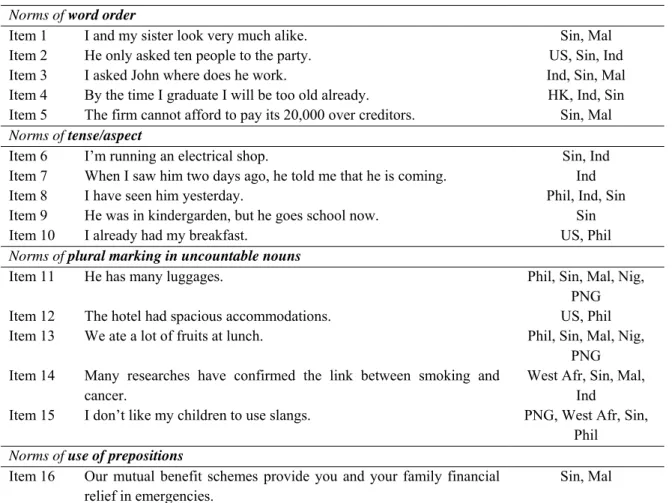
Drawing on the research conducted in the field of World Englishes (Hall et. al., 2013; Wahid, 2013; Kortmann, 2010; Rubdy et. al., 2008; Tickoo, 2005; Ahulu, 1998; Pakir, 1998; Baskaran, 1994; Parasher, 1994; Bamgbose, 1992; Awonusi, 1990; Lowenberg, 1986; Platt, 1980, 1984), five key types of norm attested in several non-British Inner Circle and Outer Circle Englishes were identified for inclusion in the questionnaire. Table 1 shows the norm categories and the sentences used to illustrate the selected norms.
Table 1. Items in the questionnaire
Norm attested in* Norms of word order
Item 1 I and my sister look very much alike. Sin, Mal
Item 2 He only asked ten people to the party. US, Sin, Ind
Item 3 I asked John where does he work. Ind, Sin, Mal
Item 4 By the time I graduate I will be too old already. HK, Ind, Sin Item 5 The firm cannot afford to pay its 20,000 over creditors. Sin, Mal
Norms of tense/aspect
Item 6 I’m running an electrical shop. Sin, Ind
Item 7 When I saw him two days ago, he told me that he is coming. Ind
Item 8 I have seen him yesterday. Phil, Ind, Sin
Item 9 He was in kindergarden, but he goes school now. Sin
Item 10 I already had my breakfast. US, Phil
Norms of plural marking in uncountable nouns
Item 11 He has many luggages. Phil, Sin, Mal, Nig,
PNG
Item 12 The hotel had spacious accommodations. US, Phil
Item 13 We ate a lot of fruits at lunch. Phil, Sin, Mal, Nig,
PNG Item 14 Many researches have confirmed the link between smoking and
cancer.
West Afr, Sin, Mal, Ind
Item 15 I don’t like my children to use slangs. PNG, West Afr, Sin, Phil
Norms of use of prepositions
Item 16 Our mutual benefit schemes provide you and your family financial relief in emergencies.
Sin, Mal
Item 17 We discussed about his new assignment. PNG, Sin, Mal,
Item 18 The book will be published Friday. US, Phil
Item 19 What are you doing on the weekend? US, Phil
Item 20 The teacher stressed on the importance of good manners. West Afr, Sin, PNG, Mal
Norms of use of adjectives
Item 21 The team played good. US
Item 22 He works in a twenty-four hours clinic. Sin, Mal
Item 23 Our prices are low everyday. Sin, Mal,
Item 24 The ambulance came quick. US, Sin
Item 25 The museum will be opened to the public between 10 a.m and 6 p.m. West Afr, Sin, Mal
* Hong Kong, India, Malaysia, Nigeria, Papua New Guinea, The Philippines, Singapore, The United States, West Africa
Having selected the norms and the sample sentences, the research instrument was designed. No indication of the origin of the norms was given to the respondents. They were told that the questionnaire sought their opinion on the sample sentences, which they could show by circling the most appropriate response: 'acceptable', 'unacceptable', 'don't know'. Respondents were advised that the questionnaire was not a test of their English and that they should not consult grammar books or other reference texts. Respondents were asked to state (1) their nationality (to confirm that only British users of English were included in the survey sample), (2) their sex (to check for distribution of the sexes, (3) whether English was their only language or one of their languages (monolingualism, bilingualism or multilingualism might be an important variable affecting the respondents opinions), and (4) their highest educational qualification (to confirm that they were educated to tertiary level, ensuring that the respondents had been exposed to a wide range of English language). The questionnaires were not numbered or coded and respondents were not requested for their names or any other identifying information.
A target population of 125 educated British users of English was deemed to be suitable. This number would be sufficient to give a reasonable quantity of returns that would provide an adequate range of responses that could be quantified. A combination of opportunity sampling and snowball sampling was utilised to reach the target population. Firstly, 25 respondents known to the researcher were contacted, and they agreed to participate in the study. Each member of this opportunity sample was sent five copies of the questionnaire by post. They were requested to complete one questionnaire and pass the remainder to contacts who were also educated to tertiary level. Completed questionnaires were to be returned by post in pre-paid envelopes by a specified date. Once the questionnaires had been sent to the opportunity sample, the success of the data collection and the study was largely dependent on their cooperation and goodwill in forwarding questionnaires to the snowball sample. This dual level sampling raised further issues of the honesty and integrity of the respondents and the honesty of the sample population in giving genuine responses that accurately reflected their acceptance of the norms in question. However, such issues would arise in any survey methods using instruments that rely on self-reporting and the giving of opinions.
which to draw conclusions as to the extent to which this sample of educated British users of English accepted certain established norms in selected non-British Inner and Outer Circle Englishes.
5. Findings and Discussion
Analysis of data using descriptive statistics and presented in the form of tables should ensure that the question of which, if any, of the selected norms of non-British Inner Circle and Outer Circle Englishes were acceptable could be quantified and presented in a clear and comprehensible manner. In the following tables, ‘Number’ refers to the number of respondents and ‘Percent’ refers to that number represented as a percentage of the total number of respondents. For the purposes of this study, ‘majority’ has been defined as more than 60% of the total number of respondents; ‘no consensus’ has been defined as less than 60% of the total number of respondents, and ‘unanimous’ has been defined as 100% of the total number of respondents.
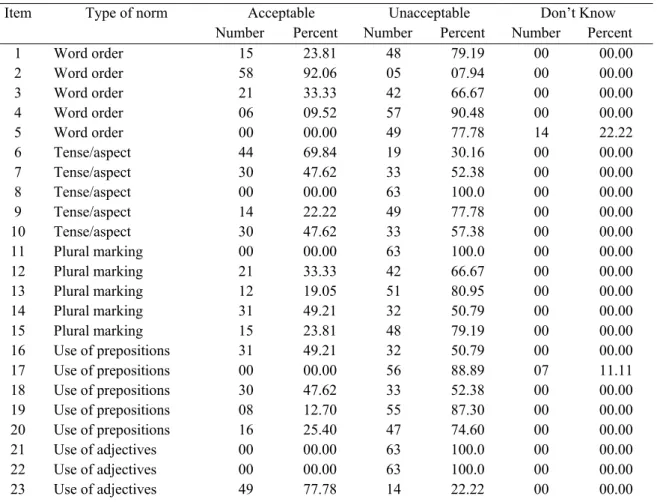
Table 2 provides the overall data gathered from analysis of the responses to the questionnaire. However, in order to analyse the data more closely, Tables 3 – 11 present specific aspects of the data.
Table 2 presents a comprehensive overview of the responses respondents made to all the items in the questionnaire. It can be seen that only two items (Item 5 ‘The firm cannot afford to pay its 20,000 over creditors’ and Item 17 ‘We discussed about his new assignment.’) have ‘Don’t know’ responses. It is interesting to note that there were no ‘acceptable’ responses for either of these items. The other 23 items were responded to with either ‘acceptable’ or ‘unacceptable’. All of the respondents returned completed questionnaires, with no missing responses.
Table 2. Responses to all items in the questionnaire
Item Type of norm Acceptable Unacceptable Don’t Know
Number Percent Number Percent Number Percent
1 Word order 15 23.81 48 79.19 00 00.00
2 Word order 58 92.06 05 07.94 00 00.00
3 Word order 21 33.33 42 66.67 00 00.00
4 Word order 06 09.52 57 90.48 00 00.00
5 Word order 00 00.00 49 77.78 14 22.22
6 Tense/aspect 44 69.84 19 30.16 00 00.00
7 Tense/aspect 30 47.62 33 52.38 00 00.00
8 Tense/aspect 00 00.00 63 100.0 00 00.00
9 Tense/aspect 14 22.22 49 77.78 00 00.00
10 Tense/aspect 30 47.62 33 57.38 00 00.00
11 Plural marking 00 00.00 63 100.0 00 00.00
12 Plural marking 21 33.33 42 66.67 00 00.00
13 Plural marking 12 19.05 51 80.95 00 00.00
14 Plural marking 31 49.21 32 50.79 00 00.00
15 Plural marking 15 23.81 48 79.19 00 00.00
16 Use of prepositions 31 49.21 32 50.79 00 00.00
17 Use of prepositions 00 00.00 56 88.89 07 11.11
18 Use of prepositions 30 47.62 33 52.38 00 00.00
19 Use of prepositions 08 12.70 55 87.30 00 00.00
20 Use of prepositions 16 25.40 47 74.60 00 00.00
21 Use of adjectives 00 00.00 63 100.0 00 00.00
22 Use of adjectives 00 00.00 63 100.0 00 00.00
24 Use of adjectives 15 23.81 48 79.19 00 00.00
25 Use of adjectives 31 49.21 32 50.79 00 00.00
Of the 25 items in the questionnaire, only three were acceptable to the majority of respondents. This represents 12% of the total number of items presented. Table 3 shows that the respondents overwhelmingly accepted the word order ‘He only asked ten people to the party’ whereas they did not accept other norms of word order. Whilst there was no clear consensus on two of the tense/aspect norms (Table 6), ‘I’m running an electrical shop’ was the only item in this category acceptable to the majority. ‘Our prices are low everyday’ was also deemed to be an acceptable use of the adjective, as a substitute for the det + noun form.
Table 3. Items containing norms acceptable to the majority* of respondents
Number Percent
Item 2 He only asked ten people to the party. 58 92.06
Item 6 I’m running an electrical shop. 44 68.84
Item 23 Our prices are low everyday. 49 77.78
* more than 60% of respondents
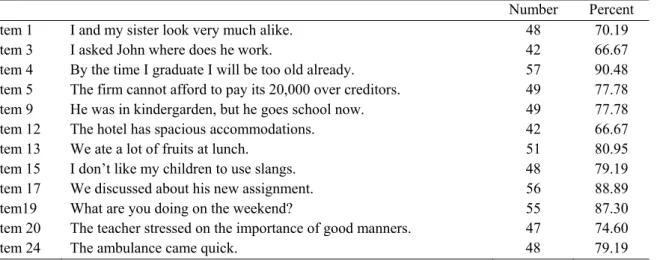
Table 4 shows that 12 of the norms presented in the questionnaire, i.e. 48%, were unacceptable to the majority of respondents. This included four items of word order (Items 1, 3, 4, 5), one item of tense/aspect (Item 9), three items of plural marking in uncountable nouns (Items 12, 13, 15), three items of the use of prepositions (Items 17, 19, 20), and one item of the use of adjectives (Item 24). These findings indicate that the majority of respondents were unwilling to accept a wide range of norms attested in a number of non-British Inner Circle and Outer Circle Englishes.
Table 4. Items containing norms unacceptable to the majority* of respondents
Number Percent
Item 1 I and my sister look very much alike. 48 70.19
Item 3 I asked John where does he work. 42 66.67
Item 4 By the time I graduate I will be too old already. 57 90.48 Item 5 The firm cannot afford to pay its 20,000 over creditors. 49 77.78
Item 9 He was in kindergarden, but he goes school now. 49 77.78
Item 12 The hotel has spacious accommodations. 42 66.67
Item 13 We ate a lot of fruits at lunch. 51 80.95
Item 15 I don’t like my children to use slangs. 48 79.19
Item 17 We discussed about his new assignment. 56 88.89
Item19 What are you doing on the weekend? 55 87.30
Item 20 The teacher stressed on the importance of good manners. 47 74.60
Item 24 The ambulance came quick. 48 79.19
* more than 60% of respondents
to the respondents. These were the U.S norm ‘The team played good’ and ‘He works in a twenty-four hours clinic’ common in Singapore and Malaysia.
Table 5. Items containing norms unacceptable to all respondent
Number Percent
Item 8 I have seen him yesterday. 63 100
Item 11 He has many luggages. 63 100
Item 21 The team played good. 63 100
Item 22 He works in a twenty-four hours clinic. 63 100
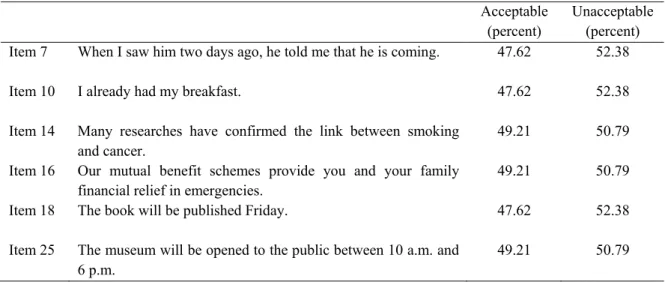
Six of the items, representing 24% of those in the questionnaire, presented no clear majority of respondents who found them either acceptable or unacceptable. These norms, on which a divergence of opinion was evident, were two items of tense/aspect (Items 7, 10), one of plural marking of uncountable nouns (Item 14), two of use of prepositions (Items 16, 18), and one of use of adjectives (Item 25).
Table 6. Items containing norms on which there was no clear consensus* from respondents
Acceptable (percent)
Unacceptable (percent) Item 7 When I saw him two days ago, he told me that he is coming. 47.62 52.38
Item 10 I already had my breakfast. 47.62 52.38
Item 14 Many researches have confirmed the link between smoking and cancer.
49.21 50.79
Item 16 Our mutual benefit schemes provide you and your family financial relief in emergencies.
49.21 50.79
Item 18 The book will be published Friday. 47.62 52.38
Item 25 The museum will be opened to the public between 10 a.m. and 6 p.m.
49.21 50.79
* less than 60% of respondents
When the data were analysed according to norm category, it could be seen that the respondents were discerning in their acceptance or non-acceptance of specific norms. For example, Table 7 illustrates that only Item 2 ‘He only asked ten people to the party’, attested in India, Singapore and the United States, was acceptable. Thus indicating that most of the selected norms of word order were unacceptable to the majority of respondents.
Table 7. Summary of responses to norms of word order
A U NC
Item 1 I and my sister look very much alike.
Item 2 He only asked ten people to the party.
Item 3 I asked John where does he work.
Item 5 The firm cannot afford to pay its 20,000 over creditors. A = Acceptable U = Unacceptable NC = No Consensus
The norm category of tense/aspect, shown in Table 8, presented the greatest range of responses, including two items on which there was no clear consensus. These were Item 7, a norm in Indian English and Item 10, attested in The United States and The Philippines. However, whereas ‘I’m running an electrical shop’ was acceptable, ‘I have seen him yesterday’ was unacceptable; in spite of the fact that these are both attested in India, and the latter also attested in The Philippines. This finding shows that the educated British users of English in this study do not have a tendency to accept norms from one particular non-British Inner Circle and Outer Circle English over another. For example, in the norms of tense and aspect, there is a difference in the degree of acceptance for Items 6, 7 and 8, all of which are examples of norms in Indian English.
Table 8. Summary of responses to norms of tense/aspect
A U NC
Item 6 I’m running an electrical shop.
Item 7 When I saw him two days ago, he told me that he is coming.
Item 8 I have seen him yesterday.
Item 9 He was in kindergarden, but he goes school now.
Item 10 I already had my breakfast.
A = Acceptable U = Unacceptable NC = No Consensus
Table 9 shows that the respondents found four of the norms of plural marking in uncountable nouns unacceptable, each of these being common in The Philippines. The item on which there was no consensus (Item 14) was a norm found in Indian, Malaysian, Singaporean and West African Englishes. The respondents were split almost 50-50 on this particular item. It appears, then, that educated British users of English in this survey were reluctant to accept pluralisation of uncountable nouns.
Table 9. Summary of responses to norms of plural marking in uncountable nouns.
A U NC
Item 11 He has many luggages.
Item 12 The hotel had spacious accommodations.
Item 13 We ate a lot of fruits at lunch.
Item 14 Many researches have confirmed the link between smoking and cancer.
Item 15 I don’t like my children to use slangs.
A = Acceptable U = Unacceptable NC = No Consensus
weekend?’ was a low 12.70 percent. This illustrates that the respondents were discerning in their acceptance of norms within as well as across non-British Inner Circle and Outer Circle Englishes.
Table 10. Summary of responses to norms of use of prepositions
A U NC
Item 16 Our mutual benefit schemes provide you and your family financial relief in emergencies.
Item 17 We discussed about his new assignment.
Item 18 The book will be published Friday.
Item 19 What are you doing on the weekend?
Item 20 The teacher stressed on the importance of good manners. A = Acceptable U = Unacceptable NC = No Consensus
Of the five items illustrating norms of use of adjectives, shown in Table 11, four are common to Singaporean English (Items 22, 23,24,25), as well as other Englishes. However, only Item 23 was acceptable to the majority of respondents. In Item 25, the substitution of the adjective open by the verb opened lead to a divergence of opinion as to the acceptability of this norm attested in Malaysian, Singaporean and West African Englishes.
Table 11. Summary of responses to norms of use of adjectives
A U NC
Item 21 The team played good.
Item 22 He works in a twenty-four hours clinic.
Item 23 Our prices are low everyday.
Item 24 The ambulance came quick.
Item 25 The museum will be opened to the public between 10 a.m and 6 p.m. A = Acceptable U = Unacceptable NC = No Consensus
6. Conclusion
This study has shown that there are a number of norms that are commonly acceptable across certain non-British Inner Circle and Outer Circle Englishes. However, the sample of educated British users of English who participated in the survey responded negatively to 22 of the 25 selected norms. Only three items were acceptable to the majority of respondents (Table 3). The overwhelming lack of acceptance of the identified norms suggests unwillingness among the respondents to accept diversity in English language usage. No significant difference in the responses of male and female respondents was discerned, and there was insufficient evidence to conclude whether being a user of more than one language was a factor in the degree of acceptance. It should be noted that the lack of acceptance of non-British English norms by the respondents in this study does not imply deficiency in other Englishes, but it does have implications for the identification of norms and standards that are commonly acceptable across varieties of English: for it is the common acceptability of norms and standards that is the foundation of English as an International Language.
acceptable across varieties. As the findings of this study suggest, there is a need to identify more common ground between World Englishes in order to develop English as an International Language. Having an awareness of the differences between varieties of English and drawing attention to the most commonly acceptable norms across varieties would enable teachers, learners and other users of English to recognise the character and peculiarities of their own variety in relation to other Englishes. This awareness would give users of English the opportunity to make their own choices as to which English they use dependent upon their specific communicative needs. In this way, users of English could take pride in, and enjoy the diversity of, the language found in World Englishes, while taking advantage of the unity of the language found in English as an International Language.
This study quantified the level of acceptance and acceptance of selected norms in certain non-British Englishes. However, since only a small sample was drawn, it is not generalisable. A wider study, with a larger sample population and with a wider range of selected norms, could offer a more comprehensive and conclusive set of data. This study could also be repeated, but using different sentences with which to present the selected norms. A comparison of the data from this study and a subsequent one would provide more conclusive results. Furthermore, a qualitative investigation into the reasons for acceptance and non-acceptance would serve to explain the respondents’ opinions. For example, further research might show that willingness to accept norms of non-British Inner Circle and Outer Circle Englishes is determined by such factors as (1) the respondents’ exposure to them, (2) not recognising them as being ungrammatical, or (3) the respondents’ own use of these norms. Finally, research could be conducted to ascertain whether or not having English as an only language is a major factor determining the degree of acceptance of norms of non-British Englishes.
References
Ahulu, S. (1998). Grammatical variation in International English. English Today, 56,19-25. http://dx.doi.org/10.1017/S0266078400010476
Awonusi, V.O. (1990). Coming of age: English in Nigeria. English Today, 22, 31-35. http://dx.doi.org/10.1017/S0266078400004715
Angihotri, R. K., & Khanna, A.L. (Eds.). Second language acquisition: Sociocultural and linguistic aspects of English in India. New Delhi: Sage Publications.
Bamgbose, A. (1992). Standard Nigerian English: Issues of identification. In B.B. Kachru (Ed.), The other tongue (pp. 148-161). Urbana: University of Illinois Press.
Baskaran, L. (1994). The Malaysian English Mosaic. English Today, 39, 13-15.
Brumfit, C. J. (Ed.) (1982). English for international communication. Oxford: Pergamon.
Das, S. K. (1982). Indian English. In J. Pride (Ed.), New Englishes. (pp. 141-149). Rowley, MA: Newbury House.
Davies, A, Hamp-Lyons, L., & Kemp, C. (2003). Whose norms? International proficiency tests in English. World Englishes, 22(4), 571-584. http://dx.doi.org/10.1111/j.1467-971X.2003.00324.x Hall, C.J., Schmidtke, D., & Vickers, J. (2013). Countability in world Engishes. World Englishes,
32(1), 1-22. http://dx.doi.org/10.1111/weng.12001
Kachru, B.B. (1985). Standards, codification and sociolinguistic realism: The English language in the outer circle. In R. Quirk & H. G. Widdowson (Eds.), English in the world (pp. 11-30). Cambridge: Cambridge University Press.
Kachru, B. B. (1992). Models for Non-native Englishes. In B. B. Kachru (Ed.), The other tongue (pp. 48-74). Urbana: University of Illinois Press.
Kalantzis, M., & Cope, B. (1999). Multiliteracies: Rethinking what we mean by literacy and what we teach as literacy in the context of global cultural diversity and new communication technologies. In Global Literacy: Visions, Revisions and Vistas in Education, Pandian, A. Serdang: Universiti Putra Malaysia Press, 1-12.
Kortmann, B. (2010). Variation across Englishes: syntax. In A. Kirkpatrick (Ed.), The Routledge handbook of world Englishes (pp. 400-424). Abingdon: Routledge.
Lowenberg, P. (1986). Non-native varieties of English: nativization, norms and implications. Studies in Second Language Acquisition, 8, 1-18. http://dx.doi.org/10.1017/S0272263100005805
Matsuda, A. (2003). The ownership of English in Japanese secondary schools. World Englishes, 22(4), 483-496. http://dx.doi.org/10.1111/j.1467-971X.2003.00314.x
McArthur, T. (2001). World English and world Englishes: Trends, tensions, varieties, and standards. Language Teaching, 34, 1-20. http://dx.doi.org/10.1017/S0261444800016062
McKay, S.L. (2002). Teaching English as an international language. Oxford: Oxford University Press.
Mehrotra, R.R. (1982). International Communication through non-native varieties of English: The case of Indian English. In C.J. Brumfit (Ed.), English for International Communication (pp. 150-173). Oxford: Pergamon Press.
Pakir, A. (1998). English in Singapore: the codification of competing norms. In S. Gopinathan, A. Pakir, W.K. Ho, & V. Saravanan (Eds.), Language, society and education in Singapore (2nd ed., pp. 65-84). Singapore: Times Academic Press.
Parasher, S.V. (1994). Indian English: Certain grammatical, lexical and stylistic features. In R. K. Angihotri and A. L. Khanna (Eds.), Second language acquisition: Sociocultural and linguistic aspects of English in India (pp. 145-164). New Delhi: Sage Publications.
Platt, J., Weber, H., & Ho, M. L. (1984). The new Englishes. London: Routledge & Kegan Paul. http://dx.doi.org/10.1056/NEJM198407053110102
Pride, J. B. (Ed.). New Englishes. Rowley: Newbury House.
Quirk, R., & Widdowson, H.G. (Eds.). English in the world (pp. xiii-xx). Cambridge: Cambridge University Press.
Rubdy, R., McKay, S. L., Alsagoff, L., & Bokhorst-Heng, W.D. (2008). Enacting English language ownership in the outer circle: A study of Singaporean Indians’ orientations to English norms. World Englishes, 27(1), 40–67. http://dx.doi.org/10.1111/j.1467-971X.2008.00535.x
Strevens, P. (1992). English as an International Language: Directions in the 1990s. In. B.B. Kachru (Ed.), The other tongue (pp. 27-47). Urbana: University of Illinois Press.
Verma, S. K. (1982). Swadeshi English: Form and function. In J. B. Pride (Ed), New Englishes (pp. xx-yy). Rowley: Newbury House.
Wahid, R. (2013). Definite article usage across varieties of English. World Englishes, 32(1), 23-41. http://dx.doi.org/10.1111/weng.12002
Eğitimli İngilizler seçilmiş iç ve dış grup İngilizcelerdeki belirli
normları ne derecede kabul ediyorlar?
Öz
Bu çalışma Dünya İngilizcelerinin özelliklerini tanımlamaya ve çözümlemeye çalışarak İngilizcenin eğitimli İngiliz kullanıcıları tarafından dilin birbirinden farklı çeşitlerinde ortak olarak yerleşmiş belli başlı normlarının kabul edilebilir olup olmadığı sorusunun cevabını bulmayı amaçlamaktadır. Çalışmanın bulguları katılımcıların seçilen normların birçoğunu kabul etmediğini göstermiştir. Katılımcıların çoğu tarafından sadece üç madde kabul edilebilir bulunmuştur. Kadın ve erkek katılımcıların cevaplarında önemli bir farklılık olmamakla birlikte birden fazla dilin kullanıcısı olmanın kabul edebilirliğin derecelendirilmesinde etkisini belirlemede yeterli kanıt bulunamamıştır. İngilizcenin İngiliz olmayan kişiler tarafından kullanımındaki normlarında kabul edilebilirlik olmaması bu İngilizcelerin kullanımında bir eksiklik olduğu anlamına gelmemesine rağmen bu durum İngilizcenin tüm çeşitliliklerindeki kabul edilebilir formların ve standartların belirlenmesi açısından anlam taşımaktadır. Uluslararası bir dil olarak İngilizcenin temelini oluşturan norm ve standartların sadece yaygın olarak kabul edilmiş bu norm ve standartlar olduğu öne sürülebilir.
Anahtar Sözcükler: Dünya İngilizceleri; standartlar ve normlar; merkezi grup; dış grup; kabul edilebilirlik
AUTHOR BIODATA