International Guidelines for
the Education of Learners
with Down Syndrome
International Guidelines for the Education of Learners
with Down Syndrome
Publisher: Down Syndrome International Publication date: 2020
ISBN: 978-1-78972-083-9 Authors:
Rhonda Faragher https://orcid.org/0000-0003-0245-9934 Penny Robertson, OAM
Gillian Bird Registered Office
Down Syndrome International Langdon Down Centre
2A Langdon Park Teddington Middlesex TW11 9PS United Kingdom +44 (0)1395 493108 [email protected] Cite as:
Faragher, R., Robertson, P., & Bird, G. (2020). International guidelines for the education of learners with Down syndrome. Teddington, UK: DSi
Copyright ©2020
International Guidelines for the Education of Learners with Down Syndrome
CONTENTS
Acknowledgements i 1. Introduction 1 1.1 Aim 1 1.2 Background 11.3 Structure and overview of these Guidelines 2
2. Key considerations in the education of learners with Down syndrome 4
2.1 Human rights concepts from the UNCRPD 4 2.1.1 Inclusive education for learners with Down syndrome 4 2.1.2 Lifelong learning 5 2.1.3 Equal Opportunity 5 2.2 Characteristics of a learner with Down syndrome 6
2.2.1 Vision 6
2.2.2 Hearing 6
2.2.3 Speech, language and communication 7 2.2.4 Memory and cognition 8 2.2.5 Fine and gross motor skills 8 2.2.6 Health issues and Pain 9 2.3 Recommendations arising from key considerations 10
3. Guidelines for Leading 11
3.1 Building an inclusive culture in an education setting 12 3.1.1 How to establish a shared common purpose around inclusion 13 3.1.2 Aligning with system policies and procedures 14 3.2 Leading, managing and organising staff 15 3.2.1 Process of inducting new staff into the culture 15 3.2.2 Leading a team including learning support assistants (LSA) 16 3.3 Recommendations for leading 18
4. Guidelines for Teaching 19
4.1 Teacher Education 19
4.1.1 Initial teacher education 19 4.1.2 Professional learning on Down syndrome 21 4.1.3 Specialist teachers 21
4.2 Planning for teaching 22
4.2.1 Planning for inclusive practice 22 4.2.2 Strategies for learning support needs 23 4.2.3 Individualised planning 24 4.3 Teaching in an inclusive classroom 26 4.3.1 Establishing a classroom for learning 26 4.3.2 Encouraging behaviour for learning 26 4.4 Recommendations for teaching 28
5. Guidelines for Learning 29 5.1 Prior to School 29 5.1.1. Early intervention 29 5.1.2. Transitioning to school 30 5.2 School 31 5.2.1. Primary School 32 5.2.2. Secondary School 32 5.2.3. Transitioning from school 34
5.3 Post school 35
5.3.1. Tertiary and vocational education 35 5.3.2. Learning on the job 37 5.3.3. Lifelong learning 38 5.4 Recommendations for learning 40
6. References 41
Appendix
Full List of Recommendations 50
Key considerations 50
Leading 50
Teaching 51
International Guidelines for the Education of Learners with Down Syndrome i
ACKNOWLEDGEMENTS
These Guidelines were developed for Down Syndrome International by Rhonda Faragher, Penny Robertson and Gillian Bird with input and oversight from Helen Powell and Andrew Boys. Iffat Jahan assisted with literature searching.
Name Declared interest
Dr Rhonda Faragher, PhD • Director, Down Syndrome Research Program at The University
of Queensland
• Associate Professor in Inclusive Education, School of Education, The University of Queensland
• Trustee, Down Syndrome International
• Independent Director, Down Syndrome Australia
• Chair, Down Syndrome Special Interest Research Group of the International Association for the Scientific Study of Intellectual and Developmental Disabilities
• Mother of an adult daughter with Down syndrome
Penny Robertson, OAM • Mother of an adult daughter with Down syndrome
• Past President: South Australian Down Syndrome Association, Australian Down Syndrome Association and Asia Pacific Down Syndrome Federation
• Founding Board Member and current trustee: Down Syndrome International
• Founder: Australian International Schools, Indonesia
Gillian Bird • Gillian Bird, Services Director, Down’s Syndrome Association
(England, Wales and Northern Ireland)
Helen Powell • Programme Manager, Down Syndrome International
Andrew Boys • Executive Director, Down Syndrome International
• Brother with Down syndrome
• Mother is Chief Executive of the Down’s Syndrome Association (England, Wales and Northern Ireland)
International Guidelines for the Education of Learners with Down Syndrome 1
1. INTRODUCTION
1.1 AIM
With the publication of these Guidelines, Down Syndrome International (DSi) aims to improve the education of learners with Down syndrome internationally and to contribute to the realisation of their right to inclusive and equitable quality education and the promotion of lifelong learning opportunities, in line with Article 24 (Education) of the United Nations Convention on the Rights of Persons with Disabilities (UNCRPD, United Nations, 2006) and Sustainable Development Goal 4 (SDG 4 - Education) of the United Nations 2030 Agenda for Sustainable Development (United Nations, 2015).
Through these Guidelines, DSi aims to:
●
distil recommendations from research, policy and practice;●
assist DSi member countries to meet their obligations under the UNCRPD in terms of education;●
assist education stakeholders, including, but not limited to, DSi’s national and world regional member organisations, to advocate for positive change and hold education authorities to account;●
provide specific guidance to all education stakeholders (including people with Down syndrome, their families, carers and advocates, education professionals, managers, commissioners of services and authorities, national, world, regional and international disability and education organisations and bodies) on how to adopt best practice education for learners with Down syndrome; and●
encourage the development of national (or other regional) guidelines for the provision of evidence-informed, best-practice education for learners with Down syndrome, taking into consideration resource differences in education settings around the world.1.2 BACKGROUND
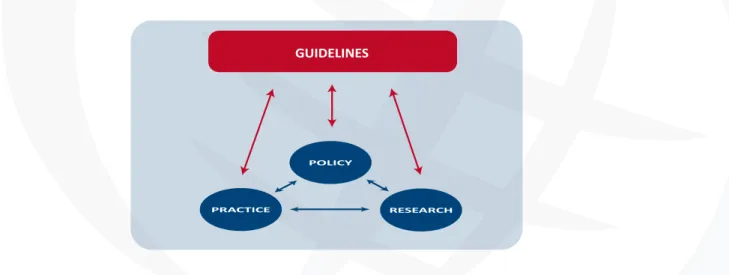
Research, practice and policy operate around the education provision for learners (OECD, 2007) including those with Down syndrome. These Guidelines sit outside those three, with the potential to inform and be informed by each. In Figure 1, we give a diagrammatic representation of the position of these Guidelines. Research, Policy and Practice influence each other in any country or context. These Guidelines may guide policy and practice and influence research undertaken. The double-headed arrows indicate that these Guidelines have been developed from evidence from those three aspects.
Figure 1- Relationship of these Guidelines to Research, Policy and Practice LEADING
TEACHING
LEARNING
• Building an inclusive culture • Leading staff
• Teacher educaon • Planning for teaching
• Teaching in an inclusive classroom • Prior to school • School • Post school GUIDELINES
EDUCATION
GUIDELINES
Social/emoonal development (incl. ASD) Speech/language development Physical development Behaviour management Health Hearing/vision Context of the learner (SES, country, family...)2 International Guidelines for the Education of Learners with Down Syndrome
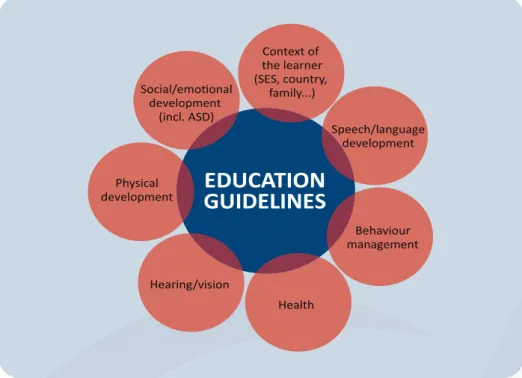
There are many factors that impinge on the education of learners with Down syndrome, such as health, socio-economic status (SES) and context. In Figure 2, we have listed some of the factors that may have an impact on learning. While the importance of these is recognised, they are not our central focus.
Figure 2 - Factors affecting learning and the place of the Education Guidelines
It should be noted that the overlapping regions in Figure 2 are often the place where issues educating learners with Down syndrome arise. The Guidelines acknowledge this and research, policy and practice evidence provides guidance. Key points are distilled in the Recommendations.
1.3 STRUCTURE AND OVERVIEW OF THESE GUIDELINES
Factors that influence the learning of people with Down syndrome across the lifespan have been organised into three sections: Leading (Section 3), Teaching (Section 4) and Learning (Section 5). In each section, we identify main findings from research, policy and practice and we distil recommendations. In Figure 3, we give a graphic overview of the Guidelines to follow.
Figure 3 - Graphic overview of the DSi Education Guidelines
LEADING
TEACHING
LEARNING
• Building an inclusive culture • Leading staff
• Teacher educaon • Planning for teaching
• Teaching in an inclusive classroom
• Prior to school • School • Post school PRACTICE POLICY RESEARCH GUIDELINES
EDUCATION
GUIDELINES
Social/emoonal development (incl. ASD) Speech/language development Physical development Behaviour management Health Hearing/vision Context of the learner (SES, country, family...) LEADING TEACHING LEARNING• Building an inclusive culture • Leading staff
• Teacher educaon • Planning for teaching
• Teaching in an inclusive classroom • Prior to school • School • Post school PRACTICE POLICY RESEARCH GUIDELINES
EDUCATION
GUIDELINES
Social/emoonal development (incl. ASD) Speech/language development Physical development Behaviour management Health Hearing/vision Context of the learner (SES, country, family...)Prior to this, Section 2 of these Guidelines outlines some key considerations in the education of learners with Down syndrome, with recommendations to assist in the interpretation of the Guidelines into local contexts. Three key human rights concepts identified in Article 24 of the UNCRPD of relevance to the education of learners with Down syndrome are considered in Section 2.1: namely, Inclusive Education, Lifelong Learning and Equal Opportunity. We discuss those concepts in these guiding notes to the Guidelines. That is followed by a brief overview of the learning characteristics of people with Down syndrome in Section 2.2.
4 International Guidelines for the Education of Learners with Down Syndrome
2. KEY CONSIDERATIONS IN THE EDUCATION OF LEARNERS WITH
DOWN SYNDROME
2.1 HUMAN RIGHTS CONCEPTS FROM THE UNCRPD
Underpinning these Guidelines in support of the implementation of the UNCRPD, are three key concepts related to education.
2.1.1 Inclusive education for learners with Down syndrome
A recent UNESCO International Forum on Inclusion and Equity in Education (UNESCO, 2019) defined Inclusion as:
a transformative process that ensures full participation and access to quality learning opportunities for all children, young people and adults, respecting and valuing diversity, and eliminating all forms of discrimination in and through education. The term inclusion represents a commitment to making preschools, schools, and other education settings, places in which everyone is valued and belongs, and diversity is seen as enriching.
Inclusive education means that all students attend and are welcomed in their local educational setting and
are supported to learn, contribute and participate in all aspects of that context. Inclusive schooling means all are welcomed by their neighbourhood schools and taught in age-appropriate, regular classes engaging in all aspects of the student life of the school, and all receive support appropriate to their needs.
By these definitions, special schools, and special classes are not inclusive, but we recognise that they may be the only option available in some contexts, and with discernment, some aspects of these Guidelines may apply in those settings. In those contexts, the Guidelines could be considered aspirational, in view of the commitment to Inclusive Education.
Similarly, Inclusive Education differs from Exclusion, Segregation and Integration, as defined by the CRPD Committee:
Exclusion occurs when students are directly or indirectly prevented from or denied access to education
in any form. Segregation occurs when the education of students with disabilities is provided in separate environments designed or used to respond to a particular or various impairments, in isolation from students without disabilities. Integration is a process of placing persons with disabilities in existing mainstream educational institutions, as long as the former can adjust to the standardized requirements of such institutions. (United Nations Committee on the Rights of Persons with Disabilities, 2016, p. 4)
Students with disabilities educated in general education classrooms outperform students who have been educated in segregated settings (for a review of the research literature, see Hehir et al., 2016). Research specifically in the context of Down syndrome also supports this finding (de Graaf, van Hove, & Haveman, 2013). Social / emotional development is greater in inclusive settings (Buckley, Bird, Sacks, & Archer, 2006). The link between inclusive schooling and social inclusion has also been established (European Agency for Special Needs and Inclusive Education, 2018).
2.1.2 Lifelong learning
The second important concept of the UNCRPD is the recognition that learning is a lifelong activity. Lifelong learning means that education occurs throughout life, including prior to and after the formal years of schooling. For people with Down syndrome, there are important implications for education. Currently, life expectancy is into the fifties with one in ten living into their seventies (Torr, Strydom, Patti, & Jokinen, 2010). A long adulthood can be anticipated. Whereas it was once thought that learning plateaued in late adolescence, various studies have refuted those claims and also indicate the critical importance of continuing opportunities for learning beyond secondary school (de Graaf & de Graaf, 2016; Moni & Jobling, 2001). Adults with Down syndrome are entitled to continue formal and informal learning after secondary school has finished.
2.1.3 Equal opportunity
Decisions about what is taught to students with Down syndrome are often framed around predictions of what will be needed for adulthood. In practice, this has the potential to limit learning opportunities e.g. the primary school child who is withdrawn from the foreign language awareness class or the secondary student who is not offered science studies. The right to a broad and balanced curriculum and extra curricula opportunities on an equal basis with others is a right affirmed in the UNCRPD. In these Guidelines, further explanation is provided about ways this might be achieved in various learning contexts. Notwithstanding the above, it is important to note that all human rights are interlinked. It is not possible to realise the right to education unless other rights are realised. And if the right to education is realised, this can lead to the realisation of other rights.
6 International Guidelines for the Education of Learners with Down Syndrome
2.2 CHARACTERISTICS OF A LEARNER WITH DOWN SYNDROME
Learners with Down syndrome are individuals with a variety of strengths and challenges. All have the capacity to learn and continue to do so throughout their lives. The myth that learning plateaus in adolescence has long been countered by research and practice. Around the world, individuals with Down syndrome are providing examples of accomplishments in many fields of education where they have received good teaching with the right support from educators who expected them to be able to succeed. There are some features of Down syndrome that are known to affect learning to a greater or lesser extent in individual learners. In this section, we provide a brief overview of the important characteristics that need to be taken into account when planning for learning. For further detail, refer to Couzens and Cuskelly (2014). It is important to be clear that every learner who has Down syndrome is unique and the following characteristics represent probabilistic attributes and are not necessarily found in all learners. Where learning issues exist, provision of learning support and adjustments must be provided. Lack of success with learning can be due to lack of appropriate provision of adjustments and not due to a student’s inability to learn.
2.2.1 Vision
Vision impairments are common in individuals with Down syndrome. Many will need corrective lenses. Cataracts are also common. Even if the person does not need glasses or is wearing the correct glasses, visual acuity may be diminished. Charleton and Woodhouse exhort:
It is vitally important that parents, educators and health professionals are aware that people with Down syndrome do not see the world as clearly as the typical population. Learning materials in schools that are easily seen by typical children may prove an obstacle for children with Down syndrome. Modification of materials, such as writing in black pen, and emboldening faint lines, can make the difference between success and failure in a school task. (Charleton & Woodhouse, 2015, p. 84)
2.2.2 Hearing
The majority of individuals with Down syndrome experience hearing loss. This is mostly conductive loss resulting from otitis media (glue ear) which affects up to 93% of toddlers and 68% of school-aged children (McNeill, Sheehan, & Marder, 2015). This is the time when language development is at its peak, so aggressive treatment of the condition is helpful where available. Sensorineural hearing loss (due to disease of the inner ear or nerve damage) is also prevalent, being the most common type of hearing loss in adulthood.
Conductive hearing loss in the early years may have a more significant effect on later speech and language development on learners with Down syndrome than on other children (Laws & Hall, 2014). Where available, speech and language therapy in combination with medical treatments and educational activities is recommended. Children with conductive hearing loss may not exhibit other symptoms, such as fever. Also, this condition fluctuates, making it particularly difficult for parents and teachers to be able to discern when hearing is compromised. It may be appropriate to assume a student’s hearing is diminished.
2.2.3 Speech, language and communication
Learners with Down syndrome frequently have speech and language impairments, although the nature of their language learning difficulties varies between individuals. In addition, as noted in the previous section, the extent of hearing impairment and the availability of treatment and provided supports affects the level of speech, language and communication impairment.Learners show specific relative strengths in receptive vocabulary (what they understand), and they may have more advanced vocabulary than their grammatical knowledge would suggest. The learning profile includes verbal processing difficulties (understanding what they hear) associated with verbal short term memory limitations. They also may experience phonological difficulties – their awareness of the sound structure of words (Couzens & Cuskelly, 2014). Reading is a relative strength for learners with Down syndrome (Cologon, 2013). Sign and gesture supports the learning of new vocabulary.
Learners may experience a range of difficulties that affect the clarity and fluency of their speech. This can be due to physical difficulties, such as low muscle tone, as well as cognitive difficulties of speech production. Keyword sign is an effective approach that supports initial communication during the development of speech. Speech and language therapy can be helpful, where available, as can activities such as participating in choirs and public speaking clubs. It is important to stress that communication takes many forms, and individuals without speech, or where speech is difficult to understand, should be supported to communicate in other ways, such as, for example, sign language, keyword sign, and electronic text to voice software. Support for communication development should continue throughout all stages of an individual’s life.
Some individuals with Down syndrome have more extensive social communication difficulties and approximately 10-18% meet criteria for dual diagnosis of autism spectrum disorder (Rachubinski, Hepburn, Elias, Gardiner, & Shaikh, 2017).
8 International Guidelines for the Education of Learners with Down Syndrome
2.2.4 Memory and cognition
Aspects of memory for individuals with Down syndrome have been studied over a number of years, mostly using Baddeley and Hitch’s model of working memory (Baddeley, 2000). Couzens and Cuskelly (2014) have summarised the research findings on memory and Down syndrome, concluding:
● Visual-spatial working memory is a relative strength. This is the memory system involved with retention of visual or spatial information, such as images or objects and their locations. ● Verbal working memory appears to be a significant weakness, even for those with relatively advanced spoken language. This is memory for holding speech-based and acoustic information and is called the phonological loop in the Badderley Hitch model.
● Long-term memory appears to be intact and may be a relative strength. Long-term memory refers to the storage of information beyond the few seconds of storage in working memory systems. Also, once material has been learned, the rate of forgetting mirrors that of those without Down syndrome.
Recent work by Zimpel (2016) suggests heightened memory records of people with Down syndrome may be due to strong emotional responses caused by increased activity of the brain’s limbic system.
Limitations of verbal working memory for storing and processing verbal information, and capacity for manipulating information in working memory, should be considered in education planning.
The ability to learn by imitation (I. Wright, Lewis, & Collis, 2006) is well-known and indeed was documented by John Langdon Down in the nineteenth century. This attribute is a powerful strength in an inclusive classroom where learners with Down syndrome are surrounded by students on whom they can model learning behaviour.
The learning profile of students with Down syndrome includes evidence for specific visual-spatial learning strengths (Couzens & Cuskelly, 2014). Visual support for learning is an effective strategy for all learners and the cognitive profile strengths in Down syndrome make it particularly valuable. Visual supports, unlike auditory input, remain in the learning setting allowing students to refer to them as often as they need.
2.2.5 Fine and gross motor skills
The pattern of gross motor development is the same though delayed when compared with normative development. Further, the delay is greater for more complex physical movements (Capio, Mak, Tse, & Masters, 2018). Clumsiness of movement is a pervasive feature of Down syndrome producing slow, less efficient gross motor movements in addition to high velocity, inaccurate fine motor movements (Vimercati et al., 2015).
Encouraging active movement and participation in physical education, recreation, sports and dance is important and will also promote good health (Jobling, Virji-Babul, & Nichols, 2006). Although learners will continue to develop handwriting and drawing skills throughout their lives, encouraging the use of computers will enhance the ability to communicate effectively. Occupational therapists, where available, can support the development of fine motor skills and advise on devices and aids to compensate for limitations.
2.2.6 Health issues and pain
Ill-health has an impact on learning, so regular health checks are recommended, as for any child. Specific guidelines from DSi on health issues and Down syndrome are in development. Pain is experienced differently by people with Down syndrome. Following a review of research, McGuire and Defrin tentatively concluded “that individuals with Down syndrome are more sensitive to pain than normal. The evidence suggests that although pain expression appears to be de-layed, once pain is registered, there appears to be a magnified pain response” (McGuire & Defrin, 2015, p. 5). They also noted that pain responses lasted longer.
Even articulate people with Down syndrome are known to have difficulty expressing the extent of their pain and locating it on their body. Those who are close to the individual might notice behavioural changes, e.g. becoming angry or aggressive, or physical changes, such as pallid skin colour. In an education context, if students exhibit challenging behaviour, it could be that they are in pain and unable to communicate their extreme discomfort.
In noting the impact of pain on behaviour, it is important to recognise that there may be many contributing factors that manifest in behavioural changes. Critically, challenging behaviour is not in itself a characteristic of Down syndrome, and the underlying cause or motivation needs to be addressed. This is especially the case where an individual has limited speech. See Section 4.3.2 for more discussion about managing behaviour.
10 International Guidelines for the Education of Learners with Down Syndrome
Recommendations
2.3 RECOMMENDATIONS ARISING FROM KEY CONSIDERATIONS
1. In all school settings, learners with Down syndrome should be placed in the mainstream classes appropriate to their age. Students should be withdrawn from those settings as infrequently as possible.
2. Education settings for all learners, including those with Down syndrome, should be safe, welcoming and free of all forms of violence, bullying and abuse.
3. Opportunities to learn should continue beyond the school years and throughout adulthood. 4. Decisions about what is taught to learners with Down syndrome should be framed around the
right to a broad and balanced curriculum and extra-curricula opportunities, on an equal basis with others, and not based on predictions about what will be needed for adulthood.
5. Academic achievement should be expected for all learners with Down syndrome with provision of appropriate learning supports.
6. Teaching staff should be aware of the high probability of vision and hearing impairments in learners with Down syndrome and that appropriate adjustments may be required to ensure effective learning and communication.
7. Speech and language therapy and other activities which promote good speech clarity and fluency should be available to learners with Down syndrome.
8. Teaching staff should make appropriate adjustments as required, given that learners with Down syndrome may have extensive social communication difficulties.
9. Teaching should take account of limitations of verbal working memory and information manipulation in working memory.
10. Visual supports for learning (including written words) should be used. 11. Active movement and participation should be used where possible.
12. Occupational therapy can support the continued development of fine motor skills throughout life.
13. If a student displays unusual behaviour, teachers first should rule out pain as a cause.
3. GUIDELINES FOR LEADING
Leadership in an education context involves more than just those in designated leadership positions (Gaffney, Bezzina, & Branson, 2014). Leadership can be exercised by any person working with a team and all can be instrumental in developing inclusive education practices. As noted by Riehl (2000, p. 58) “leadership can be dispersed across many persons and roles in educational contexts, and indeed is usually more effective as a distributed practice”. The school principal becomes the “leader of leaders” (Ainscow & Sandill, 2010, p. 408).
The school principal has a critical role in the provision of education for learners with Down syndrome. Through developing a school culture, leading, managing and organising staff (including learning support and specialist staff), school principals can be the key factor in the success of a child’s education. They can be particularly influential on the attitudes of staff (Jordan, Schwartz, & McGhie-Richmond, 2009). The alignment with system policies is also critical (Gaffney, Clarke, & Faragher, 2014).
The key tasks involved have been summarised by Riehl thus, “school administrators who seek to respond to diversity in their schools attend to issues of meaning construction, promote inclusive school cultures and instructional practices, and work to position schools within community, organizational, and service-related networks” (Riehl, 2000, p. 68).
Challenges of establishing inclusive education in low- and middle-income countries is frequently discussed, and problems such as extremely large class sizes, lack of qualified teaching staff, and limited educational resources are frequently cited. However, research (Ahmmed & Mullick, 2014; Ainscow & Sandill, 2010) indicates there can also be learnings from these contexts that can contribute to improvements in high-income countries, including the development of effective practice when resources are limited. Countries in the process of establishing an education system should avoid copying the outdated and expensive segregated special school model introduced in western countries where originally no education was on offer for students with intellectual disabilities. It was a start, but inclusive education has since been proven to offer the best education outcomes.
These Guidelines for Leading deal with three major areas that are fundamental to the education of learners with Down syndrome, namely: building an inclusive school culture, aligning with system policies and procedures, and leading staff. The literature underpinning this section arises almost exclusively from research in broader contexts than Down syndrome, however, it is supported by practice evidence that would suggest the findings are applicable to leading the education of learners with Down syndrome.
12 International Guidelines for the Education of Learners with Down Syndrome
3.1 BUILDING AN INCLUSIVE CULTURE IN AN EDUCATION SETTING
An inclusive culture comes from policy direction and strong community commitment to that policy, sharing a common moral purpose. Four key groups - education staff, students, carers and the community – must cooperate in decisions and implementation of inclusive policies (Ahmmed & Mullick, 2014). The leaders of the education system and each education setting need to be in complete agreement with the UNCRPD Article 24 on Education and both must be held to account by the community.
Changing a school culture so that the school becomes a place where all learners thrive will rely on understanding the features of social learning processes (Ainscow & Sandill, 2010). Simple technical solutions such as checklists and standardised processes are unlikely to lead to lasting change. Rather, building an inclusive school culture is an adaptive challenge embracing ‘the practice of mobilizing people to tackle tough challenges and thrive’ (Heifetz, Grashow, & Linsky, 2009, p. 14). A leader can support this process by providing opportunities for teaching teams to build communities of practice (Wenger, 1998) where teaching can be discussed, reflection on practice encouraged, and strategies for change proposed. Research indicates that whole school reform towards inclusive practice can be stimulated by the enrolment of diverse learners:
The presence of children who are not suited to the existing menu of the school can provide some encouragement to explore a more collaborative culture within which teachers support one another in experimenting with new teaching responses. In this way, problem-solving activities gradually become the reality-defining, taken-for-granted functions that are the culture of a school that is more geared to fostering inclusive ways of working. (Ainscow & Sandill, 2010, p. 407)
Allocation of necessary resources to support inclusion signals an intention to enact policies (Ahmmed & Mullick, 2014). In most situations, resourcing inclusive education for learners with Down syndrome is not expensive as most adjustments can be undertaken within a regular classroom by the teaching team. School leaders who support staff by enabling access to timely professional development and planning time for teaching teams, encouraging the use of technical support, demonstrate their commitment to effective inclusive education (Faragher & Clarke, 2016).
Principals, themselves, need support. Changing a school culture is challenging and leaders are likely to face resistance to innovation, particularly where staff or the community are not committed to, or do not value, inclusive practice (Osiname, 2018; Riehl, 2000). Building their own community of practice where they can discuss and share concerns while gaining strategies and support is essential. Virtual online communities can support leaders working in contexts where local support is not available.
3.1.1 How to establish a shared common purpose
around inclusion
In order to have a shared common purpose around inclusion, all educators from the staff at the classroom level to government policy advisors need to be aware that students with disabilities thrive when, to the greatest extent possible, they are able to participate in educational and social opportunities available to other students. Inclusive education is still an emerging practice in many school systems around the world and misconceptions are prevalent. Inclusive schools welcome all students into the school. A school is not inclusive when it does not accept all students, even if it labels itself as inclusive (see section 2.1). Cultural and attitudinal change based on greater awareness of the value of inclusive education is required. Parents and support organisations are best placed to advocate for this change (Riehl, 2000).
Advice from the Right to Inclusive Education (General Comment
No.4) on the United Nations Convention on the Rights of Persons with
Disabilities (2016) is an appropriate starting point for establishing a shared understanding of the importance of inclusion. As at 2020, 181 countries have ratified the UNCRPD . The following paragraphs from the General Comment are relevant to these Guidelines.
Historically viewed as welfare recipients, persons with disabilities are now recognized under international law as rights holders with a claim to the right to education without discrimination and on the basis of equal opportunities. (I.1.)
Only inclusive education can provide both quality education and social development for persons with disabilities, and a guarantee of universality and non-discrimination in the right to education. (I.2.)
The law alone will not change community values, though it does provide protection and direction for those who seek to implement change. Opportunities for dialogue between all members of the school community is a practice supportive of cultural change (Osiname, 2018). Principals should acknowledge difficulties that teachers face in teaching diverse learners and support their staff. However, this support should be through the provision of assistance to ensure that all students are taught well, rather than to affirm that some students are problems.
Key staff in the school (not necessarily those in designated leadership positions) who will be required for implementation of new inclusive education policies and practices need to be identified and involved in early planning (Poon-McBrayer, 2017). Similarly, distributing leadership to staff who do not have the skills and experience to lead change may be counter-productive (Miskolci, Armstrong, & Spandagou,
14 International Guidelines for the Education of Learners with Down Syndrome
2016). A great deal of effort is likely to be required to build a shared vision if change is imposed on those who will be tasked with enactment. Poon-McBrayer’s research (2017) offers three strategies for establishing a shared vision: 1. Forming partnerships with the learning support team leaders, 2. Serving as role models and 3. Motivating teachers through support.
The following strategies have been found effective in practice in establishing a shared culture of inclusive education.
● Begin with the designated leadership team showing alignment to system policies. It is important that advocates are able to articulate their goal of full inclusion in school to others, and to convince the school community.
● Widen the team to key staff in the school and eventually to all staff by providing professional development for all.
● Demonstrate that inclusion is central to the core business and not simply an add-on to school business. Act as a role model, interacting with students in and outside class to build rapport, teach or offer positive behaviour supports.
● Always address issues which concern staff openly and frequently refer back to the school’s shared vision.
● Don’t expect new staff to have all the skills. These skills take time to develop and require an open minded attitude to acquire them.
● Recognise that peers without disability in the regular classroom are an important resource, as are the students with disability.
3.1.2 Aligning with system policies and procedures
Almost all countries in the world have signed and ratified the UNCRPD. This process requires individual countries to enact legislation and formulate policies. System policies and procedures then support compliance within local contexts. Alignment of the policy and practice in individual education contexts with system policies supports the enactment of inclusive education. Advocacy and modelling is necessary as legislation and policies alone will not change practice. Advocacy is essential to ensure that system policies match the spirit and intent of inclusive education.
All in the education community (including self-advocates, parents, and teachers) are required to ensure alignment between these system policies and the application in context. In order for changes to inclusive structures and the resulting practices to be sustained, changes to beliefs, attitudes and values must also occur (Riehl, 2000).
3.2 LEADING, MANAGING AND
ORGANISING STAFF
The ethos of the school comes from the school leadership and sets the tone of the school. This has the effect of perpetuating the culture (Ainscow & Sandill, 2010) as teachers and families who feel the ethos of the school matches their philosophy will stay while others, where they can, move on.
Teachers will choose to come to the school as will parents as they learn the benefits of good inclusive education practice. Selection of staff is an important factor in building an inclusive school culture (Riehl, 2000), however many schools still report their systems limit principals’ opportunity to select appropriate staff (Ahmmed & Mullick, 2014). In all cases, careful induction of staff into the culture of a school is critical for inclusive practice. This would be particularly important where principals have not been involved in staff selection.
3.2.1 Process of inducting new staff into the culture
It is important that all staff are made aware of the policy of inclusion and that under the UNCRPD it is a right of every child to receive an inclusive education. This message must come from the leadership team and staff faculty and it must be instilled throughout the whole school. This is an important mechanism by which acceptance is demonstrated to all students (Ainscow & Sandill, 2010). Furthermore, ongoing support for all new staff is important as the education of a person with Down syndrome is the responsibility of ALL academic staff, not just the specialists in the field.
Research shows that the skills, techniques and attributes required of teachers in educating students with disabilities are those that can be applied effectively across the general classroom to the benefit of all students (see, for example, Riehl, 2000). Research also shows that there is “clear and consistent evidence that inclusive educational settings can confer substantial short-term and long-term benefits for students with and without disabilities” (Hehir et al., 2016, p. 1).
Orientation training that provides specific professional development in inclusion (Baker-Ericzen, Garnand Mueggenborg, & Shea, 2009), the vision of the school (Gaffney & Faragher, 2010) and strategies for working in inclusive education settings (Baker-Ericzen et al., 2009) help induct staff and support them in settling in to the new educational environment. Support for new staff through initial professional development will have most benefit if continuing professional learning is promoted (Webster-Wright, 2009), including continuing opportunities to engage with the inclusive education vision of the school and to reflect on aligning teaching practices.
16 International Guidelines for the Education of Learners with Down Syndrome
3.2.2 Leading a team including learning support assistants (LSA)
In many countries, teachers work in teams which may include learning support assistants, specialist teachers, therapists and administration staff. Learning support assistants (also termed teacher aides, inclusion aides, para-professionals, teaching assistants, shadow teachers etc.) are found in many schools around the world and provide additional adult presence in a learning environment. General Comment No. 4 (Committee on the Rights of Persons with Disabilities, 2016, para 32) notes, “support can … consist of a qualified learning support assistant, either shared or on a one-to-one basis, depending on the requirements of the student.”
The classroom teacher has a responsibility to manage the work of these teams and coordinate the planning, working collaboratively with LSA. Attention to school structures needs to be addressed at policy level. Adequate numbers of staff are needed to be able to support learning adjustments. Individual, full-time support is rarely required, but sufficient staffing to allow adjusted activities to be used in every lesson is important e.g. assistance with resource preparation.
School leaders need to ensure teaching staff are aware of their responsibilities for the education of all students within their care. Teachers need to have the appropriate leadership skills to manage the collaborative work of the teaching team including LSA, other professionals (e.g. therapists, learning support teachers) and para-professionals.
While we could find no study that explicitly investigated the role of LSA with students with Down syndrome, LSA work is likely to have considerable impact on the educational experience of those students. The role of LSA appears to be changing with a number of studies researching the role and discussing the evolution from general classroom support to undertaking increasingly sophisticated teaching and learning support roles for students with specific educational support requirements (see, for example, Cockroft & Atkinson, 2015).
Various studies have highlighted the importance of defined duty statements (Attwood & Bland, 2012; Keating & O’Connor, 2012; Roffey-Barentsen, 2014) with clear, shared understanding of their roles by teachers, principals and LSA. The importance of involvement in planning was identified by Keating and O’Connor and acknowledged by Roffey-Barentsen whose study participants indicated the need for a thorough briefing for anyone not involved in the lesson planning. Both studies also identified concerns about the practice of assigning the lowest attaining students or those with challenging behaviours to the LSA so those students who required highly skilled teaching were less likely to be taught by the qualified teacher. Butt (2016) in a detailed study of models of LSA support considers this practice to be inequitable; students without special education needs receive their instruction only from a qualified teacher in contrast to those with learning support needs who often have less time with the qualified teacher.
Cockroft and Atkinson’s findings raised the common practice of external therapists giving instructions to LSA, indicating concern that this was specialised work that the LSA did not feel qualified to deliver.
A common theme in the research studies was the training of LSA (see, for example, Butt, 2018) either as professional development within their job or through vocational studies. Both were considered important with opportunities for LSA to build their skills overall and for specific contexts, such as gaining skills in a particular communication system to support a student under their care. One study (Maher & Macbeth, 2013) addressed the prioritisation of some subject areas such as English and Mathematics and identified the issue that professional development opportunities to support development of skills of LSA in non-priority areas can be limited. Other research has identified risks in the use of LSA and the finding that increased support time does not equate to improved learning outcomes (see, for example, Blatchford, Bassett, Brown, & Webster, 2013). It would seem necessary to take
account of the research that indicates LSA can indeed add value so long as the practices adopted are supported by research evidence.
To obtain the most effective use of LSA, the assistants should be given:
● opportunities for induction and ongoing professional development and, where possible, formal vocational qualifications;
● clearly defined lines of supervision;
● explicit duty statements, taking advantage of the skills they bring without expecting LSA to undertake teaching roles for which they are unqualified;
● clear guidance by the teacher who remains responsible for the learning of all students in the class. In particular, the purpose of the lesson (learning intentions) must be made clear to the LSA.
Further, teachers should be given:
● professional development in leadership and staff management in order to be able to guide the work of assigned LSA;
● support from the school leadership team to implement school-wide inclusive policy around learning support teams; and
● opportunities to plan in collaboration with LSA or time to provide explicit guidance on the learning intentions and the role of the LSA in the lesson. The most challenging teaching should remain the work of the teacher.
18 International Guidelines for the Education of Learners with Down Syndrome
Recommendations
3.3 RECOMMENDATIONS FOR LEADING
14. Leaders need to be in complete agreement with Article 24 of the UN CRPD on education and aware of their role in driving the cultural change required.
15. Countries in the process of establishing an education system should avoid introducing a segregated special school system.
16. Leaders should provide opportunities for all staff, including learning support assistants, to undertake professional development on aspects of inclusive practice.
17. Leaders should ensure adequate planning time for teaching teams.
18. Leadership teams should be supported through the establishment of networks and communities of practice.
19. Leaders should establish a shared vision of inclusion across all levels of the educational system, working in partnerships with families and the broader community.
20. Principals should have responsibility for the selection of staff.
21. Teachers should be responsible for the learning of all students in their classes and must guide the work of assigned teaching assistants.
22. Support must be provided by the school leadership team to implement school-wide inclusive policy around learning support teams.
4. GUIDELINES FOR TEACHING
Teaching learners with Down syndrome has similarities across various educational contexts (including work and home), however, in this section, the Guidelines for Teaching specifically refer to teachers working in school settings. Three main areas are covered: the first refers to teacher education – initial and further professional learning; the second deals with planning for teaching; and the third with teaching in an inclusive classroom.
4.1 TEACHER EDUCATION
Inclusive education, being the practice of welcoming, valuing and supporting the learning of all students in the shared general classroom, requires teachers who are able to successfully manage the learning in these settings. Initial teacher education must prepare teachers for inclusive practice. Graduates must enter the profession with knowledge, skills and approaches that will allow them to teach all their students. This is the role of initial teacher education (ITE).
Evidence-informed teaching practice relies on strong connections between the university and school sectors. Effective teachers engage in career-long professional learning. In the event of being assigned a class with a learner with a specific learning support need, such as Down syndrome, targeted professional development is required. In some jurisdictions, it is possible to access support from a specialist teacher who can provide guidance and advice.
4.1.1 Initial teacher education
With inclusive education being an international goal for over a decade, ITE in many countries has undergone reform to ensure teachers entering the profession are competent to lead learning in inclusive classrooms with diverse students. For example, Australia has substantially revised accreditation requirements for ITE degree programs and the Australian Professional Standards for Teachers (Australian Institute for Teaching and School Leadership (AITSL), 2011) contains four standards explicitly directed towards inclusive practice. Even so, challenges continue in ITE. Teachers tend to replicate practices from their own educational background, particularly in situations where the issue to be resolved is not clearly defined or straightforward. However, changing work situations imposes changes to the “signature pedagogy” of a profession (Shulman, 2005). Pre-service teachers who were taught in inclusive classrooms during their own school years may demonstrate more acceptance and understanding of inclusive practice and as inclusive education rolls out around the world, students will enter ITE with lived experience of inclusive classrooms and be ready to learn how to build their own.
20 International Guidelines for the Education of Learners with Down Syndrome
Effective inclusive education is skilled work for teachers and requires a reflective attitude to professional practice, based on a research orientation. Adequate support in ITE is necessary for developing an ethical commitment to, and personal values around, inclusive education (Symeonidou, 2017). A thorough understanding of the legislative and policy requirements for inclusive education is also critical (Forlin, Sharma, & Loreman, 2007). Robinson (2017, p. 172) identifies the following components of an effective ITE program:
● the importance of collaboration;
● the value of adopting a research orientation;
● the importance of carefully structured field experiences; ● the relevance of critical-theorising and reflexive work; ● the centrality of deconstructing unhelpful discourses; ● the centrality of belief-systems; and
● the promise of a theory into practice model.
Professional experience opportunities within ITE programs are common practice and the opportunity to gain experience and to experience success working in inclusive classrooms is recognised as important. Forlin and colleagues note that “teacher education programs need to consider practicum placements in schools and classrooms where inclusion has been embraced as a philosophy and practice, and where appropriate supports exist to help ensure a successful experience for pre-service teachers” (Forlin et al., 2007, online). Unfortunately, in most countries at present, examples of effective inclusive practice on which pre-service teachers may model their practice are inconsistently available (Robinson, 2017; Symeonidou, 2017). This may explain why research findings on the value of practicum placements infused within initial teacher education programs are mixed (Symeonidou, 2017).
On completion of ITE, students must graduate with
● a well-formed, research-based personal philosophy for inclusive education; ● the skills to manage the learning in a classroom of diverse learners; and
4.1.2 Professional learning on Down syndrome
Attainment of initial teacher qualifications prepares teachers for inclusive classrooms. Research suggests a link between teacher training and positive attitudes towards inclusion (Forlin, Sharma, & Loreman, 2014; Hoskin, Boyle, & Anderson, 2015). At some stage in their careers, teachers may have a student with Down syndrome in their class. At this stage, targeted professional learning is required (Faragher & Clarke, 2016). The following components of professional learning, which ideally should be available throughout the school year, were found to be valued by teachers:1. Provision of syndrome-specific information ● phenotypical characteristics of Down
syndrome;
● impact of Down syndrome on learning, focus-sing on strengths and strategies to work around challenges; and
● establishing productive behaviour for learning, as for all
students in the class, including how the teaching team can foster positive interactions with peers.
2. A focus on academic learning and curriculum adjustment
● engaging in professional learning targeted at curriculum issues, rather than syndrome-specific information; and
● opportunity to engage in a community of practice (Wenger, 1998) with other colleagues and mentors or learning support advisors.
3. Sharing success
● opportunity to reflect on development of teachers’ inclusive practice; and
● opportunity to share their knowledge with other teachers, particularly if the student with Down syndrome would be taught by a different teacher in the subsequent year.
4.1.3 Specialist teachers
Some teachers may undertake post-graduate study to become qualified specialist teachers in learning support (Florian, 2012) and the education of students with Down syndrome. Learning support teachers can assist regular classroom teachers with particular issues, becoming a vital part of a community of practice. In some countries, these specialists are employed by a central education authority or by Down syndrome associations and are available to support teachers across a district, as needs arise. General classroom teachers indicate a need for syndrome-specific information, support for designing curriculum adjustments,
22 International Guidelines for the Education of Learners with Down Syndrome
Specialist studies should equip learning support teachers to be able to assist their colleagues with these aspects. Specialist teachers need training in coaching strategies, approaches to building communities of practice and how to guide teachers to work with teams and families (Robinson, 2017; Staples & Diliberto, 2010). Extensive opportunities to work with, and to learn from, individuals with Down syndrome of various ages should be provided to ensure learning support practice is based on lived experience (Forlin et al., 2007). In summary, postgraduate specialist studies in Down syndrome should comprise:
● syndrome-specific information; ● behaviour support strategies;
● inclusive classroom management strategies; ● coaching strategies;
● supporting teachers to lead teams and work with families; and
● extensive professional/field experience with people with Down syndrome
4.2 PLANNING FOR TEACHING
Effective inclusive teaching practice is underpinned by teachers’ attitudes to inclusive education. Attitudes matter a great deal, and negative attitudes among educators can affect the response of students to those with disability in their classes (Jordan et al., 2009). Teachers and school leaders need opportunities both to confront these attitudes and to demonstrate that successful inclusion does work (Jordan et al., 2009). Inclusive education practice is not a technical process or procedure. Instead, collaborative problem-solving is required. Through the development of a culture of collaborative problem solving, research indicates that working to include all learners leads to improved outcomes for all students (Florian, 2012; Jordan et al., 2009). This problem solving approach underpins professional learning and is a major factor in whole school improvement, as noted by Ainscow and Sandill, “students are likely to be more successful at school if their teachers are actively engaged in learning how to teach within the local context of the school” (2010, p. 409).
This section of the Guidelines provides guidance for planning for inclusive education of learners with Down syndrome from the premise that “educational programming and planning must start with the assumption of competence” (Toson, Burrello, & Knollman, 2012, p. 503).
4.2.1 Planning for inclusive practice
Inclusive education as a philosophy and practice avoids a focus on some students who are different to others in the class and in need of remediation. Rather, there is attention to provision of learning adjustments and curriculum differentiation that support the learning of everyone in the class. As Florian explains,
[Effective inclusive education teachers] have changed the way they think about the concept of inclusive education. Rather than only accommodating learner differences, they focus on extending what is available to everybody. This focus on learning as a shared activity is a subtle but important shift in thinking about individual differences between learners that avoids the potentially negative effects of treating some students as different. (Florian, 2012, p. 277)
Classroom planning techniques such as the Universal Design for Learning (UDL) framework (Rose, Gravel, & Gordon, 2014) underpin inclusive practice. By designing into the lesson learning adjustments available to any student who finds them helpful, teachers develop curricula that accommodate the diverse strengths and challenges of all learners, minimising the need for additional adjustments.
An important concept in inclusive practice is the teaching of year level curriculum with adjustments (Spooner & Browder, 2006), also known as ‘age-appropriate’ curriculum. In this approach, a classroom teacher begins planning with the curriculum materials established for the year level of the class. Appropriate adjustments are then planned, taking account of the anticipated needs of the diverse learners in the class, and paying careful attention to adjustments specified in Individual Education Plans. Enabling prompts are designed to assist a learner to be able to engage with the task but are only offered after the learner indicates the need for this support. Extending prompts are designed to provide challenge and greater depth for learners to go beyond the set task. This is preferable to assigning work from later year levels which would lead to boredom in subsequent classes. Examples of this approach in the context of mathematics have been developed by Sullivan and colleagues (Sullivan, Mousley, & Zevenbergen, 2006). Mitchell and colleagues in a review of research identified the following approaches for curriculum adjustment and modification:
To make the curriculum accessible, consideration should be given to the following alternatives in relation to content, teaching materials, and the responses expected from the learners:
(a) modifications (e.g., computer responses instead of oral responses, enlarging the print), (b) substitutions (e.g., Braille for written materials);
(c) omissions (e.g., omitting very complex work); and (d) compensations (e.g., self care skills).
Other modifications can include (a) expecting the same, but only less,
(b) streamlining the curriculum by reducing its size or breadth, (c) employing the same activity but infusing IEP objectives, and
(d) curriculum overlapping to help students grasp the connections between different subjects, for example. (Mitchell, Morton, & Hornby, 2010, p. 51)
Following the approach of adjusting the curriculum for the year level has led to remarkable results in the area of mathematics. Examples of learners with Down syndrome who had not demonstrated accomplishment of simple arithmetic achieving learning goals in areas such as algebra and trigonometry have been reported (Faragher, 2014; Monari Martinez, 1998; Monari Martinez & Pellegrini, 2010). It is important to note that these students were supported by the use of calculators as needed.
4.2.2 Strategies for learning support needs
The learning of students with Down syndrome in the general class will be enhanced with good teaching and the right support. Fundamentally, the most significant factor in inclusive education is the implementation of established effective education pedagogy, as noted by Jordan and colleagues, “effective teaching is effective intervention for all students” (Jordan et al., 2009, p. 536), and it underpins the clear research findings that high quality inclusive education benefits all learners (Hehir et al., 2016).
24 International Guidelines for the Education of Learners with Down Syndrome
Students with Down syndrome will benefit from effective support targeted to their individual requirements. In keeping with inclusive practice, additional supports and adjustments should be made available to all students in the class, should they wish to make use of them (Florian, 2012). The following supports have been found from extensive practice evidence to be effective for many students with Down syndrome. It is important to reiterate that learners with Down syndrome are individuals, and teachers should determine whether or not these or other supports are required.
In the classroom, limitations of verbal short-term memory may need practical supports in classroom contexts requiring extended attention and listening, such as whole class discussions, listening to a story, participating in school assemblies and responding to long sentences or complicated requests. Effective strategies include the use of:
● visual supports to focus attention;
● visual scaffolds such as photos and pictures to support language teaching;
● common classroom aids such as number lines, calculators, letter
charts, grids and diagrams (ready availability of these supports reduces the load on a student’s working memory and visual supports, such as letter and number charts, can be affixed to a child’s desk or kept in the back of an older student’s workbook);
● commonly available tools, such as using the calendar on smart phones for the classroom schedule (this supports attention as well as providing opportunities to become adept with devices in common usage);
● models, where relevant, of completed work as a guide.
4.2.3 Individualised planning
The practice of developing Individual Education Plans (IEP) for students with disability originated in the United States in the 1970s (Mitchell et al., 2010) and it is now common practice in many countries around the world (King, Ni Bhroin, & Prunty, 2018). IEP have been criticised in recent times for entrenching a theoretical perspective which is at odds with inclusive practice with the focus on individual difference requiring remediation (Shaddock, MacDonald, Hook, Giorcelli, & Arthur-Kelly, 2009). In a literature review undertaken by Mitchell and colleagues (2010), three main criticisms of IEP were identified: (i) an undue influence on behavioural psychology where learning is reduced to achievement of component parts; (ii) over-emphasis on the individual, in contradiction to the aims of inclusive practice; and (iii) unproven efficacy, where aside from behaviour intervention plans which have some evidence base, the evidence for the effectiveness of IEP does not exist.
Individual planning is a common approach so it is important to ensure the planning process and the resulting plan follow best practice principles. The following recommendations arise from research, policy and practice evidence.
● Plans must be developed collaboratively, including the family, and with the learner as a key member. Planning meetings should be arranged at a convenient time for the family, not at a time that suits school or system personnel. Planning should also include input from other agencies if they are involved in supporting the learning of the child, such as therapists and learning support experts.
● Involvement of students in planning meetings must be supported and can serve as the development of expertise in self-advocacy. Students can be supported to understand planning meetings and to improve their involvement. Gibbons et al (2016, p. 89) note, “using clear and simple language understandable to the student, speaking directly to the student, and preparing the student prior to the meeting can help enhance student performance and increase self-determination”.
● Students can be encouraged to set their own learning goals that might be generic learning skills such as giving oral presentations or identifying keywords in a sentence. Teachers can then fold those goals into curriculum planning.
● Plans should be reviewed regularly and goals should not be carried over from one plan to the next. This ensures that the plan is a ‘living’ document that genuinely underpins learning. Goals that were not achieved are studied to understand the reason for their non-achievement. ● All staff involved in the planning process (including all classroom teachers in secondary
schools) should undertake professional development (Stephenson & Carter, 2015) focused on the development of IEP and ways of collaborating with families.
● Plans should be comprehensive of all school learning, including social (social inclusion and friendships) and academic learning and suggested adjustments. Transition planning for learners at an appropriate age should be included in the plan. (For planning strategies, see Browder & Spooner, 2014).
26 International Guidelines for the Education of Learners with Down Syndrome
4.3 TEACHING IN AN INCLUSIVE CLASSROOM
Including a student with Down syndrome in a regular classroom requires similar considerations as managing any other class. Effective classroom management involves prior planning and designing activities that will support the attainment of the learning goals for the lesson. Consideration of the individuals that make up the class leads to decisions about grouping, furniture arrangement and timings, over and above the planning of the learning activities. In this section, the Guidelines address two issues that concern teachers when they first move into this role, namely establishing a classroom for learning and managing behaviour.
4.3.1 Establishing a classroom for learning
An essential feature of establishing an inclusive classroom is to begin with the assumption that all learners can learn (Toson et al., 2012), that all are welcome and belong (Swinton, 2012) and that teachers have a powerful influence on the inclusive culture of the classroom, because “students without disabilities are more likely to feel positively toward classmates with disabilities if their teachers do, as teacher attitude partially mediates peer acceptance” (Silverman, 2007, p. 42). The research evidence is strong that all learners benefit from being taught in effective inclusive classrooms (Hehir et al., 2016).
The practices of effective teachers of inclusive classes with students with Down syndrome have been studied recently (Clarke & Faragher, 2015). In key aspects of their practice, teachers:
• explicitly plan the lesson, including the tasks to be undertaken by learning support assistants (LSA); • explain the learning intention of the lesson to the LSA prior to the lesson, including contingency
plans such as alternative activities should they be needed;
• include the student with Down syndrome in all phases of the lesson, including whole class instruction and they support these activities through planned adjustments;
• monitor the learning of all students in their class, including the student with Down syndrome by moving around the class during group and individual activities;
• make learning adjustments available to all learners;
• assess learning throughout the lesson through questioning, observing and gathering work samples; • provide adjustments to tasks such as recording learning, to ensure the learner with Down
syndrome is able to take part;
• model respect and hold high expectations for all learners in the class; and
• display enjoyment in their teaching and speak with affection about the learner with Down syndrome.
4.3.2 Encouraging behaviour for learning
Behaviour is communication and it has an underlying purpose. This is particularly true when a person has limited language skills to draw on. Behaviour that achieves its purpose is rewarded and therefore reinforced, meaning that it is likely to be repeated. Behaviour that does not achieve its purpose will disappear. Humans are very good at learning from their experiences, including learning which behaviours produce desired results.