On the Acceptance and Usefulness of Personalized
Learning Objectives in MOOCs
Tobias Rohloff
Hasso Plattner Institute
Potsdam, Germany
[email protected]
Dominic Sauer
Hasso Plattner Institute
Potsdam, Germany
[email protected]
Christoph Meinel
Hasso Plattner Institute
Potsdam, Germany
[email protected]
ABSTRACT
With Massive Open Online Courses (MOOCs) the number of people having access to higher education increased rapidly. The intentions to enroll for a specific course vary significantly and depend on one’s professional or personal learning needs and interests. All learners have in common that they pur-sue their individual learning objectives. However, predom-inant MOOC platforms follow a one-size-fits-all approach and primarily aim for completion with certification. Specif-ically, technical support for goal-oriented and self-regulated learning to date is very limited in this context although both learning strategies are proven to be key factors for students’ achievement in large-scale online learning environments. In this first investigation, a concept for the application and techni-cal integration of personalized learning objectives in a MOOC platform is realized and assessed. It is evaluated with a mixed-method approach. First, the learners’ acceptance is examined with a multivariate A/B test in two courses. Second, a survey was conducted to gather further feedback about the perceived usefulness, next to the acceptance. The results show a positive perception by the learners, which paves the way for future research.
ACM Classification Keywords
K.3.m. Computers and Education: Miscellaneous Author Keywords
MOOCs; Learning Objectives; Goal-Oriented Learning; Self-Regulated Learning; E-Learning.
INTRODUCTION
The open and free nature of Massive Open Online Courses (MOOCs) attracts a diversity of thousands of learners with different cultural and educational backgrounds, different learn-ing needs, and various intentions [1]. To cope with this large scale, MOOCs usually provide the same learning content to all students in week-based, structured, and self-guided courses [14]. As a result of this, the student’s learning path is typically designed to complete a course with receiving a certificate at
Permission to make digital or hard copies of all or part of this work for personal or classroom use is granted without fee provided that copies are not made or distributed for profit or commercial advantage and that copies bear this notice and the full citation on the first page. Copyrights for components of this work owned by others than the author(s) must be honored. Abstracting with credit is permitted. To copy otherwise, or republish, to post on servers or to redistribute to lists, requires prior specific permission and/or a fee. Request permissions from [email protected].
L@S ’19,June 24–25, 2019, Chicago, IL, USA
© 2019 Copyright held by the owner/author(s). Publication rights licensed to ACM. ISBN 978-1-4503-6804-9/19/06. . . $15.00
DOI:https://doi.org/10.1145/3330430.3333624
the end since course completion indicates the success of a course from a provider’s perspective. However, looking at the motivations and the intentions of learners, a certificate is only one of many different desired outcomes [10, 27]. In a typical course, less than 50% of the learners are actually interested in completing a course for earning a certificate [10]. This trend is confirmed by several studies examining learners’ behavior and goal achievement (e. g. [6]) and reflected by overall low course completion rates of typically less than 13% [7]. Consequently, the completion-centered perspective of current MOOC plat-forms excludes a substantial portion of learners and should be revised to move beyond the one-size-fits-all approach and better align the students’ learning paths with their intentions and goals [6, 13].
Over the last years, specifically goal-oriented learning and self-regulated learning (SRL) have been recognized as a valu-able skill set in online learning due to their positive influence on students’ achievement [2, 8]. Further, they have been proven to be particularly important in environments with lit-tle support and guidance like MOOCs, where students have to autonomously guide their learning. Enabling learners to follow personal objectives aims to better address the varying learning needs, explicitly allows to follow different learning paths and connects the definition of success with the learners’ motivations and goal attainment. Thus, it even allows measur-ing the achievement of personal objectives which is desirable from the provider’s perspective, too. However, the current design of MOOCs neither supports nor motivates learners to complete personal objectives [10] and technical support of SRL in MOOCs is very limited in general [12].
Rohloff and Meinel [21] outlined a theoretical concept of per-sonalized learning objectives in MOOCs to support the SRL strategies goal setting, strategic planning, and self-evaluation. On this basis, this paper presents a first practical study with a focus on the first two strategies by examining the following research questions: How can personalized learning objectives be integrated into MOOCs? (RQ1) Are personalized learning objectives accepted and perceived as useful by MOOC stu-dents? (RQ2) To answer these questions, first the pedagogical foundations (Section 2) and related work (Section 3) are ex-plained. Then, a technical concept is introduced in Section 4. It is evaluated with a mixed-method approach in Section 5 by conducting a multivariate A/B test and a survey in two courses. At last, Section 6 concludes the paper.
PEDAGOGICAL RATIONALE
This section briefly describes the pedagogical model of SRL and the definitions of learning goals and learning objectives to determine their meaning in the context of this work.
Self-Regulated Learning
Naturally, there is great interest in the factors affecting stu-dents’ achievement in online learning environments as well as what characteristics distinguish successful from unsuccess-ful learners. SRL has been identified as an important factor positively associated with students’ achievement in traditional online learning [2] as well as in MOOCs [8, 12]. It originates from educational and cognitive psychology and refers to the learners’ ability to actively and autonomously take control of their learning process [19, 28]. Different definitions of SRL exist while the models of Pintrich [19] and Zimmerman [28] are most prominent. Both describe learning as a proac-tive and construcproac-tive process, wherein learners participate by setting goals, monitoring their progress, and adjusting their learning behavior and actions accordingly, i. e. they show self-corrective behavior. Additionally, they agree that SRL is a skill which can be learned and developed through experience and practice. This shows that SRL is important for the prepa-ration, during the actual learning, and in the aftermath of it. Learners must participate in all three phases to be able to successfully regulate their learning. To do so, both models suggest strategies that learners should apply. In particular, goal setting and strategic planning have been proven to positively affect learning success in terms of personal goal achievement [8]. These two strategies are subject to this work.
Setting goals means to agree on a specific goal and the effort that needs to be invested in achieving it. [28]. The goal can then provide guidance for the learning process and serve as a criterion against which the own performance is assessed [19]. Strategic planning addresses aspects of selecting proper tasks and how to approach them to eventually achieve a specific goal. Specifically, time and effort management are important strategies to regulate the own learning behavior.
Learning Goals and Learning Objectives
The terms learning goals and learning objectives are often used interchangeably as both describe the intended outcome of a learning process. However, the following distinction can be made [23, 19]. A learning goal is a broad statement of what a learner will be able to do at a certain time. It provides an overview describing a rather wide range of knowledge and skills a student will acquire and is therefore usually not explic-itly measurable. In contrast, learning objectives have a narrow focus, describing specific and discrete units of knowledge and skills being acquired. These objectives are the results of short time activities that can be achieved by following a certain number of steps. Consequently, they are specific enough to be observable and measurable. In pedagogy, learning objectives are typically classified and created using models like Bloom’s (Revised) Taxonomy [11]. Another well-known approach to define objectives is theSMARTacronym [5] – objectives should be specific, measurable, achievable, relevant, and time-bound. A learning goal thus can comprise multiple learning objectives.
Definition of Learning Objectives
Learning objectives describe the desired outcomes of learn-ing processes. A learnlearn-ing outcome can be the acquisition of subject-specific knowledge but also the development of skills and competences. This distinction is important since formally learned knowledge does not necessarily enable learners to ad-equately apply the knowledge in a specific situation. Proper assessment methods need to be in place to be able to measure and verify the attainment of objectives. Only if the outcome is measurable, a quantified decision about the level of suc-cess can be made and provided as feedback to the learner, which is desired to enable self-regulation. The predominant Extension MOOC (xMOOC) concept focuses on the acquisi-tion of subject-specific knowledge, mainly imparted with pre-recorded video lectures. Courses group the content by specific topics and typically address different smaller thematic units. In contrast to the predominant orientation towards the comple-tion of the course, individual objectives can be understood as completing certain parts of the course material. Therefore, we define the completion of these thematic units, built upon the single learning resources, as the basis for learning objectives since they represent the smallest unit of imparted knowledge within a course. This view is compatible with the xMOOC concept and reflects the needs of lifelong learners, who are primarily interested in gaining specific knowledge [16]. The verification of the acquired knowledge is possible through the provided exercises. Furthermore, personalization is achieved by offering different didactically appropriate objectives per course, created by the teaching team, from which the learner can select one if desired and follow it individually.
RELATED WORK
So far, SRL has been extensively researched in formal class-room settings and also in traditional online learning. The results show that SRL is an important factor for successful learning [2]. Over the last years, it has increasingly gained attention in the context of learning in MOOCs. A common focus in literature is on identifying how learners apply SRL strategies and which strategies are most effective with regard to the learner’s behavior and learning outcomes as this forms the basis for proper (technology-based) support of these strate-gies [12, 8]. This support is crucial since learners differ in their ability and motivation to regulate their learning [17, 15]. Different authors proposed design guidelines and patterns to facilitate SRL in MOOCs [18, 13].
Despite the recognized importance of goal-orientation in MOOCs, goal setting has been realized on the basis of pre-course surveys. For example, Wilkowski, Deutsch and Russell [25] used a survey to enable learners to set the initial goal and a post-course survey in combination with clickstream analy-sis to evaluate goal attainment. Also utilizing questionnaires, Henderikx, Kreijns and Kalz [6] analyzed goal achievement based on the intention-behavior gap. Last, Rohloff and Meinel [21] examined the intentions of learners in six courses using a survey for setting objectives and utilizing Learning Analyt-ics (LA) capabilities to evaluate their achievement. All of these studies show that a certain number of learners achieves their (initial) learning objectives while there is also a specific
portion of learners which exceed or underachieve their ob-jective. The actual achievement rates depend on the specific courses in terms of their design and difficulty as well as the required effort to complete the individual objectives. Since the current capabilities in terms of goal-setting are not sufficient to actively support learners, the following key requirements for future work were identified [21]. First, MOOC platforms should offer the possibility to set an objective within the plat-form itself so that learners can self-evaluate their progress towards the achievement of their objective. This can enable the automatic calculation of the achievement and is expected to allow for a more fine-grained definition of objectives. Sec-ond, learners should be enabled to adjust the objective as the course progresses. Interventions for strategic planning are rare, too. A time planner was integrated into a MOOC platform enabling students to schedule their next study sessions [22]. Asking learners to describe how they plan to study for the upcoming week supplemented by another prompt at the end of a week, instructing learners to reflect on the success of their plan, did not yield significant improvements [3]. In contrast, an intervention of Yeomans and Reich [26], who also provided a planning prompt at course start, positively influenced the learners’ course completion.
CONCEPT AND IMPLEMENTATION
This section describes the integration of personalized learning objectives into the HPI MOOC platform as a proof of con-cept for blurring the completion-oriented structure of current MOOCs. It introduces goal setting and selected aspects of strategic planning as part of a broader self-regulated learning strategy. To overcome the current limitations regarding goal setting in MOOCs, the fundamental idea is to provide a tool, integrated into the platform, that empowers learners to actively decide on and set a specific learning objective.
Course-Level Learning Objectives
Based on the presented definition of learning objectives, three types of objectives emerge that should be supported on course-level. These allow for different levels of engagement and are in line with learners’ objectives reported in literature. Striving for course completion to receive a certificate is further the intention of many learners participating in online courses, and therefore this represents the first type of objectives. In terms of the definition of learning objectives above, the completion of a course can be seen as the completion of a broader topic unit that comprises all course material. In the HPI MOOC plat-form, course completion is rewarded with a so-called Record of Achievement. In addition to this, a Confirmation of Par-ticipation can be received when a specific proportion of the learning material is consumed. Both types of certificates are possible objectives to be considered. Although these are not objectives according to pedagogical theory in a narrow sense, this type of objectives is reasonable as a simplification ap-proach in the MOOC context. Secondly, different thematic units can be derived and offered as learning objectives. Beyond the thematic focus, another option provided by these smaller objects is to adapt to proficiency or time aspects. While some objectives can go into detailed aspects of the courses, others could only give an overview to accommodate learners with
limited time or missing prior knowledge of a topic. Last, since there is a large number of learners just having a look at the course to find out whether it suits their needs and if it is worth pursuing, an objective approaching the course exploration may be desirable for specific courses. Course exploration is a typ-ical pattern that has been identified by different authors [9]. Similar to the first type, this is not a pedagogical learning objective in the narrow sense but enables the teaching team to track this intention.
Learning Objectives Model
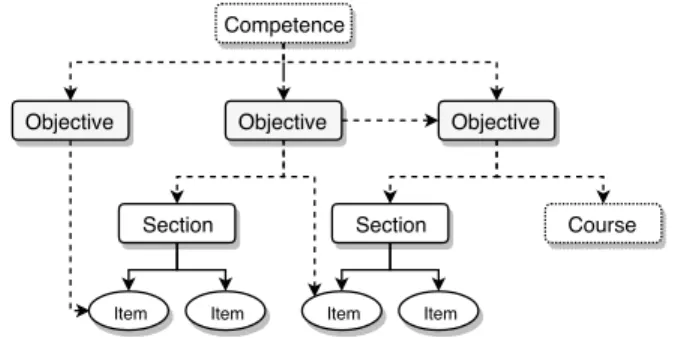
As presented in the related work, goal setting so far has been realized with surveys, which has several weaknesses. The goal of this work is to implement the learning objectives as a plat-form feature to be able to determine the learners’ achievement of objectives automatically. Therefore, a model for learning objectives needs to be defined. For the model, two require-ments are particularly important. Although our approach is initially limited to course-level learning objectives, it should be easily extensible to platform-wide objectives. Further, the model needs to be flexible in terms of creating learning objec-tives for various courses that differ in their structure, the type of included learning material and the actual content. With the definition of learning objectives above, learning items, mainly videos and quizzes, form the basis of learning objectives. In courses, items are grouped by sections, i. e. by the weeks of a course. When considering platform-wide objectives, learning objectives are likely to be defined across courses and thus also contain items or sections from different courses. Besides, learning objectives can be organized hierarchically, e. g. to represent sub-steps and aspects for the mastery of a larger objective. Figure 1 shows a simplified version of this logical composition of objectives. Objective Objective Objective Competence Section Course Section Item
Item Item Item
Figure 1. Logical composition of learning objectives. Bold arrows rep-resent course structure dependencies, while dashed arrows indicate the logical relation between the concepts.
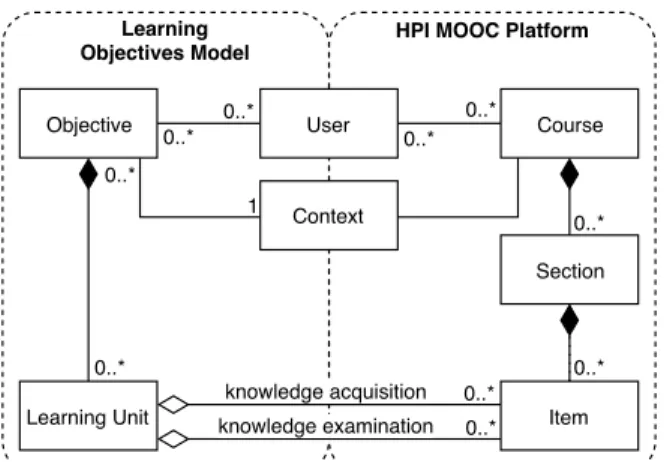
A natural consideration for creating learning objectives is to reuse the structural elements, i. e. course sections. However, sections are designed as a part of a course and thus are defined on a different granularity level than objectives and are likely not to fit an objective’s focus and intention. Consequently, learning objectives need to be built on the learning items as the most fine-granular structures within a course. As a sec-ond issue, several items often belong to one topic area or are useful if consumed after each other and can thus be grouped on a logical level. Therefore, it is necessary to introduce an abstraction layer, the so-called learning units, to enable both
0..* 0..* 0..* 0..* 0..* Learning Unit 0..* 0..*
knowledge examination Item 1 0..* Context Objective 0..* Section Course HPI MOOC Platform Learning
Objectives Model
0..* knowledge acquisition
User
Figure 2. Class diagram showing the conceptual learning objectives model and its relation to the HPI MOOC platform.
grouping of content and automatic calculation of goal achieve-ment. Learning units can encompass several items and classify items into knowledge acquisition items and knowledge exami-nation items. An objective can then be created from different learning units. This results in very high flexibility, which accommodates many use cases. To enable platform-wide ob-jectives, objectives need to be defined to be valid in a specific context rather than bound to a course directly. Figure 2 shows the resulting conceptual model for learning objectives. Integration into the Platform Architecture
In the current system based on a service-oriented architec-ture (SOA), the Course Service contains the domain logic concerning the courses and their item structure [24]. Conse-quently, the learning objectives could be implemented in this service as they depend on the course item representation and rely on its data. However, some arguments contradict an exten-sion of the Course Service. The learning objectives extend the course domain but do not represent core functionality critical for the platform. Besides, decoupling the new functionality from the course makes it easier to extend the concept with platform-wide objectives or competency models in the future. For these reasons, the learning objectives are integrated by creating a new Learning Objectives Service. Its core purpose is to store and manage the learning objectives and calculate their progress and completion. Figure 3 shows the concept of the new service.
Message Queue Web Service Course Service Database Platform- Agnostic LO Database Platform-Specific Update Handler Platform-Specific Objective Achievement Determination
Learning Objectives Service Course
Service Course Service Database
Requests for storing learner visits
Select a learning objective (learner) or manage the objectives (teaching team)
Push events to the Learning Objectives Service Publish events con-
taining the resource data
...
Requests updating the course item (teaching team)
HPI MOOC Platform
Figure 3. Overview of the concept of the Learning Objectives Service.
Selecting Objectives
A user interface must be created to empower learners to decide on a learning objective for a course. In the following, we present our concept for providing the learners with a list of available learning objectives and related information that en-ables informed decisions. Three aspects decisively influence the selection of an adequate presentation concept.
A first decision that has to be taken is whether the selection of a learning objective is optional or compulsory. While mandatory objectives might force learners to reflect on their intentions and thus provide an opportunity to improve learning, such an approach would restrict the open nature of learning in MOOCs and is likely to upset learners as they might want to stick to the learning path and platform features they are used to. Personal learning objectives as introduced in this work are an extension of the traditional learning and as such should be explorable as an optional feature.
Secondly, it needs to be determined when exactly learners should be allowed to choose a learning objective. New courses are usually announced weeks before their start, which leads to many learners enrolling impromptu but then never showing up for a course. Further peeks of enrollment are reached when actively advertising a course via email or social media. Conse-quently, an interesting option is to allow learners to select their learning objective directly after enrolling for a course. Goal setting at this point might increase engagement and help to build a stronger relation with a subject. A second possibility to select an objective is directly at course start when first visiting the learning content. This can help learners to focus on a specific part of the course and not spend time on personally less relevant content. Last, other options include the selection of an objective after the learner worked on some items, e. g. three items so the user already completed the introduction and typically the first video and quiz.
Figure 4. Screenshot of the infobox indicating available learning objec-tives.
A third decision must be made on how to present the objective selection as this might also affect the adoption of learning objectives as well. Multiple options are implemented, which are examined with an A/B test later. First, an infobox, which indicates that learning objectives are available for the course, is provided. This infobox as depicted in Figure 4, is added to the top of the learning item pages and thus prominently visible for the learner when working on the course material. Nevertheless, it is optional and the user has to click on a link to open the objective selection. Moreover, a modal is used for automatically prompting learners with the objective selection. It is explained in detail in the next subsection. For our purpose, the automatic display is an adequate approach to attract the students’ attention, which might be relevant since the feature is
entirely new to the platform. To avoid learner frustration, the modal can be dismissed and then never automatically shows up for the course again. The same applies to the infobox. The corresponding experiment setup and the results are detailed in Section 5.
Objective Selection Modal
As a basis for the objective selection, a modal is used for two reasons. With the modal, learners do not have to leave the current page and thus remain in the context in which they can continue after selecting or refusing an objective. Another advantage of the widget-like presentation is the reusability for different pages and use cases, e. g. to allow the learner to change the objective while working on course material.
Figure 5. Screenshot of the objective selection modal listing all available objectives and the respective details.
The modal itself contains information on how the selection of a learning objective affects the learning process and lists the different available objectives as shown in Figure 5. The objective details, which are necessary to enable learners to make an informed decision, can be expanded by clicking on an objective. Since time is an important factor, the students are presented with information about the time needed to com-plete a particular objective. Besides the total time effort for an objective, the distribution of learning material in terms of the estimated time to consume material constituting the learning objective is depicted aggregated by its type. With the provided details, the objectives can be compared with regard to the topics covered but also regarding the approximate effort to be invested for completing the objective successfully. The stated type of material can help learners to select an objective ap-propriate for the educational background or proficiency level, e. g. to focus on videos rather than programming tasks or vice versa. In this early phase of introducing learning objectives in MOOCs with the purpose of evaluating their acceptance, the
selection is currently limited to one objective per course at the time. After selecting a learning objective, the user is prompted with a confirmation of the selection as shown in Figure 6. The user can then choose to be directed to the first learning item part of the objective to immediately start learning.
Figure 6. Screenshot of the confirmation modal displayed after selecting a learning objective.
Learning Objective Adaption
A requirement emerging from the deficiencies of goal setting with surveys is that learners should be able to change their se-lected objective at any given time during the learning process in the event of changing personal conditions. For example, learners might face time constraints or become more or less in-terested and engaged and hence want to change their objective. Therefore, the personal learning objective can be reviewed and changed on the progress page of a course as shown in Figure 7.
Figure 7. Screenshot of the progress page of a course where the selected learning objective can be changed.
Learning Process Guidance
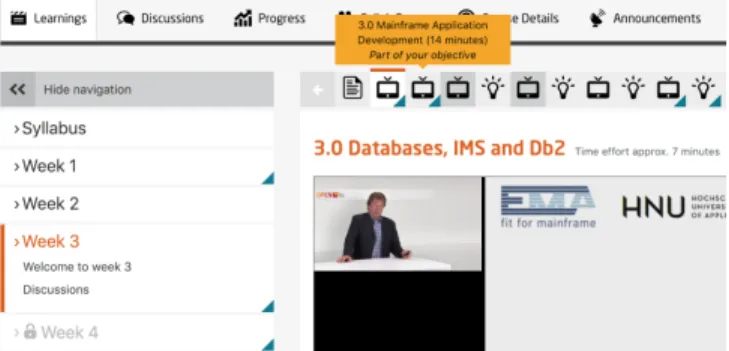
With the learning objectives, the traditional course structure can be opened up. To allow students to quickly identify rel-evant content, the respective learning resources according to one’s selected learning objective are highlighted. Specifically, the course items are indicated with blue triangles in the course navigation, as can be seen in Figure 8. Additionally, a textual clue is given. With that, learners can see where to start with the objective and the material to particularly focus on. Since there are cases where an objective might not start in the first week of a course or skips a week and thus no learning items can be suggested by then, the sections containing relevant learning material are emphasized as well. Beyond this indication of
relevant content, the time effort information is provided in the course navigation to help students to prioritize their learning activities and schedule learning sessions accordingly, i. e. it is provided to support strategic planning.
Figure 8. Screenshot of the learning process guidance highlighting the relevant content for a selected objective.
As can be seen, our selected approach of guidance does not pull learners entirely out of the classic course setting. Instead, the course structure is maintained, i. e. the learning content is not rearranged, and learners can decide whether they fol-low the defined course structure or change to a more flexible learning path according to the selected objective. This is im-portant to motivate learners to do more as initially intended since they can also view and access the course material not being part of the objective. The decision on a learning objec-tive consequently does not restrict the learning content in any way, and the control of learning is still with the learner. In the future, this guidance can be explored further and extended with additional suggestions.
EVALUATION
This section presents the evaluation of the integration of per-sonalized learning objectives into a MOOC platform. There-fore, the A/B test framework of the HPI MOOC platform [20] was used to conduct a controlled experiment to examine the acceptance of learning objectives. Since the usability and per-ceived usefulness of a user-facing tool are critical factors for its adoption, additionally a survey was carried out to quantify these factors.
Learning Objectives Acceptance Test
This section explains the design and evaluation of the per-formed A/B test to ascertain the acceptance of learning objec-tives and study the second research question. Specifically, the implemented presentation alternatives for the objective selec-tion are examined to determine their effectiveness in regard to engage learners to set an objective. In addition, the focus is on the analysis of the learners’ preferred choice of objectives. This also helps to give a comprehensive answer to the first research question by identifying the best integration option for the new feature.
A/B Test Setup
The test is designed in a multivariate manner that evaluates three different realizations of the objective selection. With that, four test groups emerge as follows.
Group 1 Learners assigned to this group were not able to
select a learning objective. In the context of this test, the group served as an independent control group.
Group 2 This group got to see the objective selection modal
directly after enrolling for a course.
Group 3 Learners of this group were automatically prompted
with the objective selection modal when visiting the learning content the first time after the course had started. Since a first decision might be to dismiss the modal, the infobox was added at the top of each item page, to open the modal again with a click on it.
Group 4 In contrast to the other groups, the learners assigned
to this group only saw the infobox at the top of each item page and therefore explicitly had to click on the link in the infobox to see the objective selection modal.
After the selection of an objective, the corresponding learning content was highlighted in the course navigation. If necessary, learners could review or change their objective on the progress page of the course.
Sample Courses
Two sample courses were selected – one for each of openHPI and openSAP, which are the two largest deployments of the HPI MOOC platform – to explore the results for different learner demographics and backgrounds.
openHPI Mainframe Course
On openHPI, the course "Mainframe - Crucial Role in Mod-ern Enterprise Computing" (mainframes2018)1was selected,
which started on November 5, 2018, running for six weeks until December 17, 2018. It covered different aspects of main-frames including its concepts and features like mainframe architecture, operating systems, application development and also gave industry examples. For the course, 2,270 learners were enrolled at course start and the course language was English. The following objectives for the course were derived: 1. Complete the course with a Record of Achievement. This ob-jective comprised all course material including the weekly assignments and the final exam.
2. Explore the course. Learners, who did not know whether the course is interesting for them or not, could choose this objective to take a look at the course.
3. Introduction into the modern mainframe and its concepts. The introduction covered the main parts of the first week and further mainframe concepts to give an overview of the topic.
4. – 7. Four more objectives covered the introductory content but then focused on specific aspects of the course: main-frame architecture and hardware, application development, database and transaction processing, and examples and sce-narios from industry.
openSAP Intelligent ERP Course
On openSAP, the course "Intelligent ERP with SAP S/4HANA Cloud" (s4h12)2was chosen which ran for four weeks from
1https://open.hpi.de/courses/mainframes2018 2https://open.sap.com/courses/s4h12
November 7, 2018, until December 6, 2018. The course presented SAP’s intelligent cloud ERP solution for SAP S/4HANA Cloud and showcased use cases for different ap-plication areas. 13,512 learners were enrolled at course start and the course language was English. The objectives for the s4h12course were defined by the openSAP teaching team as follows:
1. Complete the course with a course certificate. This ob-jective targeted learners who want to complete the entire course including all weekly assignments and the final exam. 2. Focus on the introduction into intelligent ERP. The objec-tive included the first week’s material providing the tech-nical foundation and selected videos of subsequent weeks, e. g. giving a general outlook for the course topic.
3. – 7. Five additional objectives covered the learning mate-rial of the introduction objective as well as the respective material detailing a specific use case: finance, procurement, project management, sales, and manufacturing.
Analysis and Discussion
This subsection discusses the results of the learning objectives acceptance test. The central questions to answer are whether learners do select objectives, what tested selection alternative is best suited for the examined platforms, and which type of objectives is preferred.
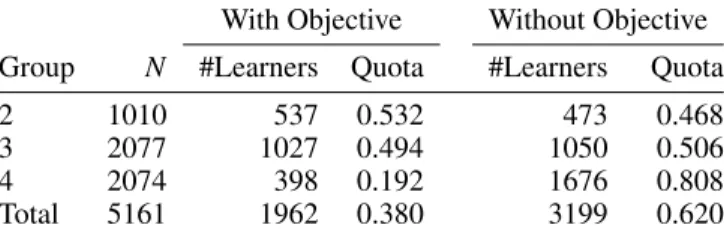
Table 1. Descriptive statistics of the learners with and without the selec-tion of objectives in thes4h12openSAP course.
With Objective Without Objective
Group N #Learners Quota #Learners Quota
2 1010 537 0.532 473 0.468
3 2077 1027 0.494 1050 0.506
4 2074 398 0.192 1676 0.808
Total 5161 1962 0.380 3199 0.620
Table 2. Descriptive statistics for the learners with and without the selec-tion of objectives in themainframes2018openHPI course.
With Objective Without Objective
Group N #Learners Quota #Learners Quota
2 116 68 0.586 48 0.414
3 322 189 0.587 133 0.413
4 323 106 0.328 217 0.672
Total 761 363 0.477 398 0.523
Table 1 and Table 2 show the proportion of learners who selected learning objectives for the examined openSAP and openHPI courses respectively. Since only members of the groups 2, 3, and 4 were allowed to choose an objective, the re-sult for these groups is displayed. Learners assigned to group 2 were prompted to select an objective immediately after the enrollment for the course. Because the number of additional enrollments after the start of a course is limited, this group contains fewer learners than the other groups, which also in-clude learners who enrolled prior to the A/B test start and then showed up during course run time. In general, a significant por-tion of 38% respectively 47.7% of the learners sets a personal
learning objective for a course demonstrating the interest of learners to select a personal objective and confirming findings of the related work [21, 25]. However, there are differences between the groups, i. e. the presentation alternatives for the selection, which are consistent across both courses. In the groups where the selection modal was shown, about 49.4% up to 58.7% of the learners selected an objective while the more subtle alternative of showing an infobox attracted significantly fewer learners. An analysis of demographic variables, i. e. the learners’ age and gender, did not yield significant differences. To further examine the effectiveness of the selection alter-natives, the different variants are compared for each group regarding the learners’ initial selection of an objective. The results, which are shown in Table 3 and Table 4, emphasize the importance of the objective selection via the modal as the majority of learners assigned to groups 2 and 3 decided on an objective when prompted with the modal. For the third group, the infobox additionally served as an important second step to attract many students who first dismissed the modal but then decided to set an objective. For both the second and third group, only a small portion of the learners have set the objective via the progress page. This suggests that it makes sense to explicitly encourage learners to use the feature in-stead of relying on its discovery by learners. Besides, there is relevance for offering different places and opportunities for selecting the objective. In sum, the third option of showing both a modal and an infobox is best suited to nudge learners to set a personal learning objective. Although the option of prompting learners when enrolling for a course seems promis-ing as well, the current course creation process does not allow to largely apply this selection alternative.
Table 3. Descriptive statistics for the alternative used by learners for selecting their initial learning objective in thes4h12openSAP course.
Modal Info Box Progress
G N NM Quota NI Quota NP Quota
2 537 529 0.985 – – 8 0.015
3 1027 885 0.862 123 0.120 19 0.019
4 398 – – 356 0.894 42 0.106
Table 4. Descriptive statistics for the alternative used by learners for selecting their initial learning objective in themainframes2018openHPI course.
Modal Info Box Progress
G N NM Quota NI Quota NP Quota
2 68 64 0.941 – – 4 0.059
3 189 155 0.820 30 0.159 4 0.021
4 106 – – 95 0.896 11 0.104
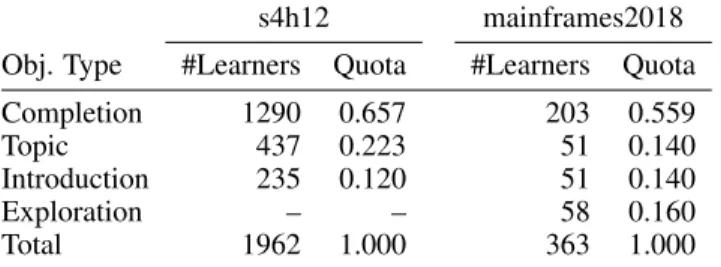
A relevant question concerning the selected objectives is whether the learners prefer to complete the entire course or rather choose a specific topic unit of interest. Table 5 com-pares the respective results for both courses revealing similar overall tendencies. For simplicity reasons, the results for the objectives focusing on particular topic units of a course have been aggregated. In both courses, the majority of learners in-tended to complete the course (65.7% and 55.9%) while about
thirty percent of the learners either want to get an overview about the course or focus on a more specific aspect of the course. In contrast to the openHPI course, where the shares are evenly distributed among these two groups, the openSAP learners tend to choose the latter. These findings confirm that the interests and intentions for a course vary significantly and learners do not solely focus on course completion but also prefer individual learning paths. Consequently, we can state that the concept of providing learning objectives based on dedicated topic units is reasonable and accepted by the learn-ers. For the openHPI course, an objective was provided for learners who wanted to have a look at the course to find out whether the course is interesting for them or not. This group is of considerable size with the objective being chosen the second-most. The learning objective feature can consequently help to identify a variety of intentions.
Table 5. Descriptive statistics for the distribution of selected learning objectives for thes4h12andmainframes2018courses. The objectives covering individual topics are aggregated.
s4h12 mainframes2018
Obj. Type #Learners Quota #Learners Quota
Completion 1290 0.657 203 0.559
Topic 437 0.223 51 0.140
Introduction 235 0.120 51 0.140
Exploration – – 58 0.160
Total 1962 1.000 363 1.000
In the related work presented before, learners tend to change their objective during the course. With the objectives inte-grated into the platform, the objective could now be explicitly set and adjusted as needed. However, changes between objec-tives rarely happened in the examined courses. In the openSAP course, only 2.7% of the learners changed their objective dur-ing the course while on openHPI even fewer learners (0.8%) adapted it. Two possible reasons may contribute to this low rate of changes. First, learners might simply not know or re-member how to change the objective as this is only described upon selecting an objective, but there is no further note or hint throughout the course yet. Another reason could be that learners change their objective for the course but do not re-flect the change by selecting a new objective on the platform. Further investigation of the learner’s goal achievement, which is scheduled as future work, can help to provide answers to this subject. A general trend can be recognized for the open-SAP course concerning the type of changes. The majority of learners switches to larger, more demanding objectives rather than between topic objectives or less demanding objectives (Table 6). This suggests that learners get motivated to exceed their initial intention.
Usability and Usefulness of Learning Objectives
In addition to the controlled experiment, a survey was con-ducted to further assess the usability and usefulness of person-alized learning objectives, next to the acceptance. This further elaborates the answer to the second research question.
Table 6. Descriptive statistics for the learners’ type of changes of the selected objective in both courses.
s4h12 mainframes2018
Objective Level Total Quota Total Quota
To Higher 45 0.763 2 0.500
Equal 4 0.068 0 0.000
To Lower 10 0.169 2 0.500
Methodology
According to the well-known Technology Acceptance Model (TAM) suggested by Fred Davis, two factors have a decisive influence on the acceptance of an information system: its usability and the perceived usefulness [4]. For this reason, the user survey particularly addressed the usefulness of the objectives itself and the usability of the selection modal to understand the influence of the chosen design and the pro-vided information. To quantitatively measure the learners’ perception of different aspects, the participants mainly had to rate their agreement with given statements on the basis of a five-point Likert scale. Because this type of questions is not diagnostic, the survey was complemented by open-ended questions to gather qualitative feedback. In total, the survey comprised 17 questions. The conducted survey targeted all participants who took part in the preceding A/B test and could decide on a learning objective, i. e. students who were assigned to groups 2, 3, or 4. In total, 323 learners answered the survey.
Analysis and Discussion
The majority of the learners (79.8%) who participated in the survey also selected an objective on the platform. Most of these learners were interested in trying out the new feature (56.9%) and in the experience of choosing and following a learning objective for the course (54.1%). While the available number of learning objectives is sufficient for the majority (56.8%), quite some learners would prefer to have even more objectives available (22.1%).
In general, the results regarding the learning objective selec-tion, specifically the selection modal, show that the usability is perceived well. Particularly, 73.98% of the participants liked the presentation with a modal and no usability issues were reported. Further, 68.5% of the learners consider the selec-tion of an objective as useful with the majority stating that it helps them to achieve their personal goals (63.01%). How-ever, compared to the usability, there is a stronger variation between the rating of the participants and the usefulness is considered slightly worse, which could be related to the yet limited use of learning objectives throughout the platform. In this experiment, the selection of a learning objective supported in determining the learning path but did not relate to other activities, such as the evaluation of the learning outcome, so far. With regard to the provided information for each objec-tive, the users agreed or even strongly agreed that it is useful (79.5%) and sufficient (72.6%) to decide on their objective for the course. While about half of the learners found the time effort information helpful but did not explicitly use it for their decision, 39.04% of the participants utilized it as a decision criterion. This confirms the relevance of the provided
infor-mation to allow learners to adequately choose the best-suited learning path based on personal (time) constraints.
Besides, several motivational effects and an influence on the students’ learning process can be recognized. From the learn-ers’ perspective, the objective selection helps to become clear about the primary interest for the course (60.96%) and to focus on it accordingly (63.7%). Moreover, the learning objective motivated 58.9% of the learners to commit to the course and improved their learning effectiveness (60.27%). An influence of the motivation to complete the learning material stands out as well since the majority of learners answered that they did complete at least the material included in the objective (62.3%) or the objective motivated them to complete even more mate-rial than they initially intended to complete (50.69%). Besides, the survey confirmed the results of the controlled experiment with regard to the limited number of changes be-tween objectives. Only 9.95% of the participants answered that they changed their objective during the course. Although changes have happened rarely in total, this emphasizes one of the major advantages of integrating learning objectives in the platform: it can be adapted if needed. After selecting an objective, the respective learning content is highlighted as described. Most learners who selected an objective did adhere to the course structure (31.51%), and 23.29% of the participants were focusing on the highlighted content only. Additionally, the learners were motivated by the objective to work on additional content (30.14%) and thus did not only adhere to the items being part of the objective. In total, the highlighting of the learning resources is helpful for 77.39% of the participants. With regard to the usability of the high-lighting, the users confirmed that it is clearly distinguishable which learning items belong to the objective as well as which sections contain respective learning content.
To sum up this part of the survey, the participants were asked to rate the learning objectives concept with stars ranging from 1, being the worst, to 5, being the best. A proportion of 58.29% gave 4 or even 5 stars resulting in a mean of 4.06 with a standard deviation of 0.98. Moreover, 63.24% would like to have learning objectives available in other courses as well. It can be concluded that the survey yielded positive results regarding the objective selection and the concept in general. The motivational component seems to be most beneficial and could be related to improved learning outcomes, which will be examined in future studies.
CONCLUSION
So far, the predominant MOOC platforms have been con-centrating on providing knowledge to thousands of learn-ers by adopting a one-size-fits-all approach. However, this completion-driven perspective neglected a considerable num-ber of learners since the motivations are diverse and not all learners seek to complete the course with certification. At the same time, learners in MOOCs need to autonomously di-rect their learning as support and guidance are limited. In particular, goal-oriented learning and SRL are crucial skills to succeed in this context. Therefore, this paper examined how personalized learning objectives can be integrated into a MOOC platform (RQ1) with the aim of explicitly providing
different learning paths and engaging learners in two SRL strategies: goal setting and strategic planning.
For this purpose, adequate tools for facilitating these activities have been developed for the HPI MOOC platform. First, the concept of learning objectives in MOOCs was defined under consideration of educational and platform-related limitations. Building on that, a new service was designed and implemented allowing to flexibly create objectives for multiple use cases. These objectives can particularly cover different topic units of a course, and thus individual learning needs can be better addressed. The learners are provided with an interface for selecting learning objectives and subsequently supported by guiding the learning with respect to the selected objective. Consequently, a learner can now follow individual learning paths while receiving guidance on the attainment of personal goals at the same time.
To provide a conclusive answer on how the new feature is perceived by the learners (RQ2), the concept was examined with a mixed-method approach. First, a multivariate A/B test in two courses analyzed the learners’ acceptance. The results show that the majority selects learning objectives in the platform and further confirm the learners’ varying needs including the demand for acquisition of specific knowledge. With regard to RQ1, nudging learners with an objective modal while offering multiple possibilities to set an objective has been identified as the best-suited approach to engage learners. Additionally, a survey was conducted to receive feedback on the perceived usefulness and usability. It revealed that the tools are well-perceived by the learners. Consequently, the goal of integrating personalized learning objectives to support students in their learning has been accomplished. The results pave the way for future research. Based on the ascertained ac-ceptance of personalized learning objectives, a next study will examine how learners perform in terms of achieving the de-fined objectives. Also, self-evaluation will be approached with integrated platform features to further foster self-regulation in MOOCs.
REFERENCES
1. Lori B. Breslow, David E. Pritchard, Jennifer DeBoer, Glenda S. Stump, Andrew D. Ho, and Daniel T. Seaton. 2013. Studying learning in the worldwide classroom: Research into edX’s first MOOC.Research & Practice in Assessment8 (2013), 13–25.http://www.rpajournal.com/ dev/wp-content/uploads/2013/05/SF2.pdf
2. Jaclyn Broadbent and Walter Poon. 2015. Self-regulated learning strategies & academic achievement in online higher education learning environments: A systematic review.The Internet and Higher Education27 (04 2015). DOI:http://dx.doi.org/10.1016/j.iheduc.2015.04.007
3. Dan Davis, Guanliang Chen, Tim van der Zee, Claudia Hauff, and Geert-Jan Houben. 2016. Retrieval Practice and Study Planning in MOOCs: Exploring
Classroom-Based Self-regulated Learning Strategies at Scale. InAdaptive and Adaptable Learning, Katrien Verbert, Mike Sharples, and Tomaž Klobuˇcar (Eds.). Springer International Publishing, 57–71.
4. Fred D. Davis. 1989. Perceived Usefulness, Perceived Ease of Use, and User Acceptance of Information Technology.MIS Q.13, 3 (9 1989), 319–340.DOI:
http://dx.doi.org/10.2307/249008
5. George T. Doran. 1981. There’s a SMART way to write management’s goals and objectives.Management review 70, 11 (1981), 35–36.
6. Maartje Henderikx, Karel Kreijns, and Marco Kalz. 2017. Refining success and dropout in massive open online courses based on the intention-behavior gap. (09 2017). 7. Katy Jordan. 2015. Massive Open Online Course
Completion Rates Revisited: Assessment, Length And Attrition. (06 2015).
8. René F. Kizilcec, Mar Pérez-Sanagustín, and Jorge J. Maldonado. 2017. Self-regulated Learning Strategies Predict Learner Behavior and Goal Attainment in Massive Open Online Courses.Comput. Educ.104 (Jan. 2017), 18–33.DOI:
http://dx.doi.org/10.1016/j.compedu.2016.10.001
9. René F. Kizilcec, Chris Piech, and Emily Schneider. 2013. Deconstructing Disengagement: Analyzing Learner Subpopulations in Massive Open Online Courses. In Proceedings of the Third International Conference on Learning Analytics and Knowledge (LAK ’13). ACM,
170–179.DOI:
http://dx.doi.org/10.1145/2460296.2460330
10. René F. Kizilcec and Emily Schneider. 2015. Motivation as a Lens to Understand Online Learners: Toward Data-Driven Design with the OLEI Scale.ACM Trans. Comput.-Hum. Interact.22 (2015), 6:1–6:24.DOI:
http://dx.doi.org/10.1145/2699735
11. David R. Krathwohl. 2002. A revision of Bloom’s taxonomy: An overview.Theory into practice41, 4 (2002), 212–218.
12. Daeyeoul Lee, Sunnie Watson, and William Watson. 2018. Systematic literature review on self-regulated learning in massive open online courses.Australasian Journal of Educational Technology(03 2018).DOI:
http://dx.doi.org/10.14742/ajet.3749
13. Allison Littlejohn and Colin Milligan. 2015. Designing MOOCs for professional learners: Tools and patterns to encourage self-regulated learning. 42 (06 2015), 38–45. 14. Anoush Margaryan, Manuela Bianco, and Allison
Littlejohn. 2015. Instructional quality of Massive Open
Online Courses (MOOCs). 80 (01 2015), 77–83.DOI:
http://dx.doi.org/10.1016/j.compedu.2014.08.005
15. Colin Milligan and Allison Littlejohn. 2016. How health professionals regulate their learning in massive open online courses.The Internet and Higher Education31 (2016), 113 – 121.DOI:
http://dx.doi.org/10.1016/j.iheduc.2016.07.005
16. Colin Milligan and Allison Littlejohn. 2017. Why study on a MOOC? The motives of students and professionals. The International Review of Research in Open and Distributed Learning18, 2 (2017).
17. Daniel Onah and Jane Sinclair. 2017. Assessing
Self-Regulation of Learning Dimensions in a Stand-alone MOOC Platform. 7 (05 2017), 4.
18. T.J. Park, H.J. Cha, and G.Y. Lee. 2016. A Study on Design Guidelines of Learning Analytics to Facilitate
Self-Regulated Learning in MOOCs.Educational
Technology International17, 1 (2016), 117–150. 19. Paul R. Pintrich. 2000. The Role of Goal Orientation in
Self-Regulated Learning. InHandbook of Self-Regulation, Monique Boekaerts, Paul R. Pintrich, and Moshe Zeidner (Eds.). Academic Press, 451–502.DOI:
http://dx.doi.org/10.1016/B978-012109890-2/50043-3
20. Jan Renz, Daniel Hoffmann, Thomas Staubitz, and Christoph Meinel. 2016. Using A/B Testing in MOOC Environments. InProceedings of the Sixth International Conference on Learning Analytics & Knowledge (LAK ’16). ACM, 304–313.DOI:
http://dx.doi.org/10.1145/2883851.2883876
21. Tobias Rohloff and Christoph Meinel. 2018. Towards Personalized Learning Objectives. Springer International Publishing, 202–215.DOI:
http://dx.doi.org/10.1007/978-3-319-98572-5_16
22. Sylvi Rzepka. 2018.Lifelong learning in context. Ph.D. Dissertation. Ruhr-Universität Bochum.
23. Daniel E. Steere and Domenico Cavaiuolo. 2002. Connecting outcomes, goals, and objectives in transition planning.Teaching Exceptional Children34, 6 (2002), 54–59.
24. Michael Totschnig, Christian Willems, and Christoph Meinel. 2013. openHPI: Evolution of a MOOC Platform
from LMS to SOA. InCSEDU.
25. Julia Wilkowski, Amit Deutsch, and Daniel M. Russell. 2014. Student Skill and Goal Achievement in the
Mapping with Google MOOC. InProceedings of the
First ACM Conference on Learning @ Scale Conference (L@S ’14). ACM, 3–10.DOI:
http://dx.doi.org/10.1145/2556325.2566240
26. Michael Yeomans and Justin Reich. 2017. Planning Prompts Increase and Forecast Course Completion in Massive Open Online Courses. InProceedings of the Seventh International Learning Analytics & Knowledge Conference (LAK ’17). ACM, 464–473.DOI:
http://dx.doi.org/10.1145/3027385.3027416
27. Saijing Zheng, Mary Beth Rosson, Patrick C. Shih, and John M. Carroll. 2015. Understanding Student
Motivation, Behaviors and Perceptions in MOOCs. In Proceedings of the 18th ACM Conference on Computer Supported Cooperative Work & Social Computing (CSCW ’15). ACM, 1882–1895.DOI:
http://dx.doi.org/10.1145/2675133.2675217
28. Barry J. Zimmerman. 2000. Attaining Self-Regulation: A Social Cognitive Perspective. InHandbook of
Self-Regulation, Monique Boekaerts, Paul R. Pintrich, and Moshe Zeidner (Eds.). Academic Press, Chapter 2, 13 – 39.DOI: