RESEARCH RESULTS–CLIENT
LEADERSHIP
DEVELOPMENT
INDUSTRY
BankingORGANIZATION
Business Development Bank of Canada
DDI PRODUCTS USED
Interaction Management®: Exceptional
Leaders…Extraordinary Results®
BUSINESS NEED
The Business Development Bank of Canada (BDC) is a financial institution wholly owned by the government of Canada. BDC plays a leadership role in delivering financial, investment, and consulting services to small and medium-sized Canadian businesses. Building on 60 years of success as Canada’s small business bank, BDC provides solutions to today’s business challenges to help small businesses develop into tomorrow’s business leaders.
BDC’s experienced, highly trained account managers and business consultants provide superior, customized service to meet the individual needs of entrepreneurs at every stage of their business development.
Equipping current leaders in the organization with the skills they need to move forward and thrive at BDC was important to their business
SOLUTION
In 2005 DDI worked with BDC to form their Practicing Leaders Transitional Leadership Program. This four-month comprehensive program consisted of behavioral assessment, formal training, learning journals, and manager coaching. It focused on current leaders who have been with BDC approximately 8 to 10 years but in their current leadership roles only 2 to 3 years. The program provided leaders with an opportunity to develop skills that have a direct impact on their performance and that of their direct reports.
The program was developed in part from DDI’s Interaction Management®: Exceptional
Leaders…Extraordinary Results® and included
the following DDI courses in the core curriculum:
> Essentials of Leadership > Coaching for Success > Coaching for Improvement > Retaining Talent
> Developing Others > Motivating Others > Resolving Conflict > Influential Leadership > Boosting Business Results REALIZATION RESULTS:
Trainees reported a 52 percent improvement in the number of leaders displaying positive leadership behaviors after attending the Practicing Leaders Transitional Leadership Program. The number of leaders providing ongoing coaching and support to help others overcome performance problems more than doubled. The number of practicing leaders at BDC retaining talent effectively has doubled. Manager reinforcement of training is strong, and trainees are satisfied with their jobs.
RESEARCH RESULTS BY:
JAZMINE BOATMAN CONSULTANT, CABER
© Development Dimensions International, Inc., MMVIII. All rights reserved. 2 RESEA RCH RES U LTS—LEA D E R SHIP DEVELO P MENT
RESEARCH DESIGN
Eighteen trainees and 24 of their observers (managers, direct reports, and peers)
participated in an online survey at least three months after trainees attended the Transitional Leadership Program. The survey focused on the changes in trainees’ behaviors after attending the training. Behaviors were tied specifically to the courses, and survey participants were asked to rate the extent to which the trained leaders displayed desired leadership behaviors before and after attending the program. The survey also gathered
perspectives on the work environment and the impact of the program on other organizational outcomes.
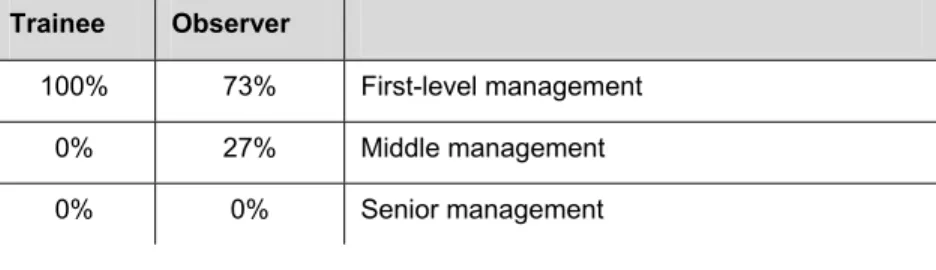
All trainees who participated in the survey had worked at BDC for at least three years, with the majority working there more than six years. The majority of observers had worked at BDC for more than six years. All trainees had worked in their current role for less than five years. Figure 1 presents the relationships of the observers to the trainees, and Table 1 presents the current level of management of all participants.
Figure 1. Relationships of Observers to Trainees
Table 1: Management Levels of Participants
Trainee Observer 100% 73% First-level management 0% 27% Middle management 0% 0% Senior management 17% 46% 37% Manager Coworker/Colleague Direct report
U LTS—LEA D E R SHIP DEVELO P MENT
RESULTS
Changes in BehaviorsBehavior improvements are defined here as increases in the percent of participants who frequently display positive leadership behaviors currently, compared to the percent who displayed the behaviors before attending the leadership program. Because the behaviors tied to the courses are critical, we focused on the percentage who displayed each behavior often or almost always.
Trainees reported a 52 percent
improvement in the number of leaders
displaying positive leadership behaviors after attending the Practicing Leaders Transitional Leadership Program.
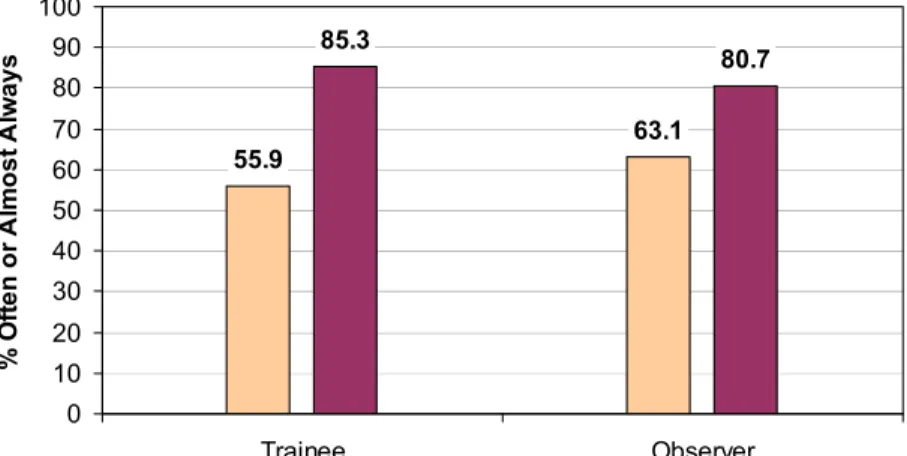
Across all courses in the Transitional Leadership Program, trainees reported a 52 percent improvement in positive leadership behaviors after the training. That is, 56 percent of participants reported displaying positive leadership behaviors often or almost always before attending training; this increased to 85 percent after attending (85-56=29; 29/56=52). Observers reported a 28 percent improvement after the training (see Figure 2).
Figure 2: Overall Reports of Behavior Improvements
How Frequently Behaviors Are Displayed
55.9 63.1 85.3 80.7 0 10 20 30 40 50 60 70 80 90 100 Trainee Observer % O ft e n o r Al m o s t Al w ay s
© Development Dimensions International, Inc., MMVIII. All rights reserved. 4 RESEA RCH RES U LTS—LEA D E R SHIP DEVELO P MENT
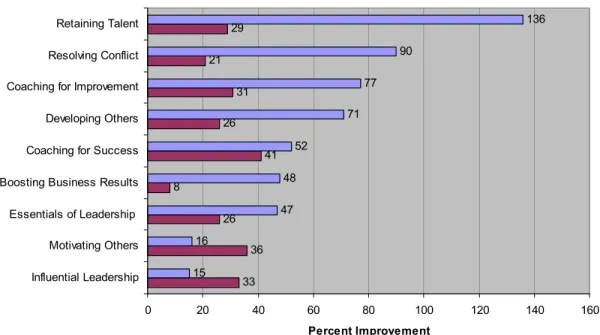
Figure 3: Average Percent Improvement by Course
Figure 3 presents the reported behavior improvements related to each of the courses in the program. Trainees reported the highest behavior improvements in the areas of retaining talent and resolving conflict. Observers reported the highest behavior improvements in coaching for success, motivating others, and influential leadership. It is common to see higher ratings of
improvement from trainees than from observers because observers have a limited number of opportunities to view trainees’ behaviors and can only report on this limited perspective. Here, however, observers reported higher behavior improvement in motivating others and influential leadership (the bottom two items in Figure 3). This was because trainees initially rated themselves high in these areas, so there was not as much room for improvement compared to other areas.
The number of practicing leaders at BDC who maintain or enhance others’ self-esteem increased by 88 percent after the training, such that 94 percent of leaders are doing this.
The foundation course, Essentials of Leadership, taught participants how to get results through people. During the course, trainees learned a set of essential skills to meet both practical business needs and people’s personal needs. Overall, 64 percent of leaders were frequently exhibiting these behaviors before training, and this rose to 94 percent after training—a 47 percent improvement. More specifically, the highest improvement in this area was the percentage of trainees who maintain or enhance others’ self-esteem. That behavior increased by 88 percent (according to trainees; 38 percent according to observers) since the training.
33 36 26 8 41 26 31 21 29 15 16 47 48 52 71 77 90 136 0 20 40 60 80 100 120 140 160 Influential Leadership Motivating Others Essentials of Leadership Boosting Business Results Coaching for Success Developing Others Coaching for Improvement Resolving Conflict Retaining Talent
Percent Improvement
Trainee Observer
U LTS—LEA D E R SHIP DEVELO P MENT
The number of leaders providing ongoing coaching and support to help others
overcome performance problems more than doubled.
Coaching is an important part of any leader’s job. After the transitional program, trainees reported a higher percentage improvement in coaching others for improvement, whereas observers reported higher improvement in coaching others for success. According to observers, the number of leaders providing objective feedback on others’ performance increased by 80 percent. Trainees reported a 115 percent improvement in the number of leaders providing ongoing coaching and support to help others overcome performance problems. Both areas of coaching are critical for managing and supporting direct reports, so these improvements are noteworthy. One trainee made the following comment:
“Before meeting with one of my employees, I now take the time to prepare to ensure that I will cover the issue or concern in a logical manner and to ensure that the objective of the meeting will be addressed. Whereas in the past I would just ad lib and I sometimes found myself coming out of the meeting not having addressed what I hoped to address.”
—Trained Practicing Leader
The number of practicing leaders at BDC retaining talent effectively has more than doubled.
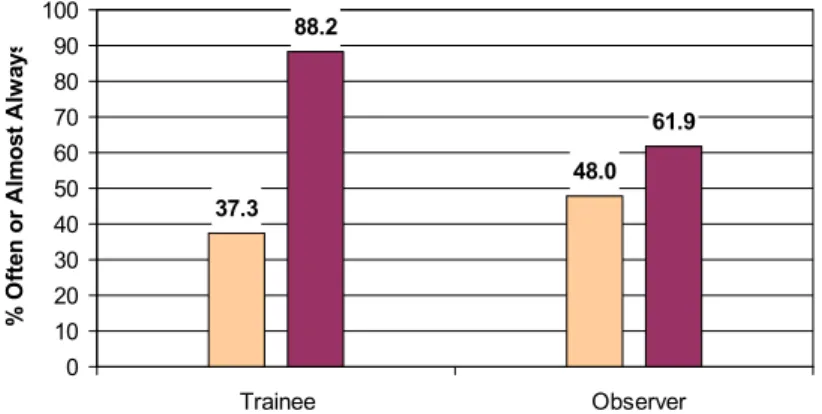
A critical part of a leader’s role is retaining talent within the organization. Dramatic improvements were reported in this area after leaders attended the transitional program. Figure 4 shows the average frequency for key behaviors related to retaining talent.
Figure 4: Average Frequency for Retaining Talent Behaviors
More specifically, the number of trainees who reported that they uncover factors that are important for retaining individuals and take actions to increase their satisfaction was at an
to 94 percent after the program—a 435 percent improvement! In addition, observers reported a significant increase in the number of leaders asking them about their job satisfaction and How Frequently Behaviors Are Displayed
37.3 48.0 88.2 61.9 0 10 20 30 40 50 60 70 80 90 100 Trainee Observer % O ft en or A lm o st A lw ay s
© Development Dimensions International, Inc., MMVIII. All rights reserved. 6 RESEA RCH RES U LTS—LEA D E R SHIP DEVELO P MENT
Observers reported that 96 percent of leaders are now providing support when others strive to reach their development goals.
A leader’s job of effectively motivating and developing others is crucial to a work group’s and an organization’s success. With respect to motivating others, both trainees and observers had relatively high initial ratings, but still saw between 16 and 36 percent improvement after the training. In particular, observers reported a 50 percent improvement in leaders helping others see how they contribute to achieving the organizational vision and objectives.
The Developing Others course in the Transitional Leadership Program provided leaders with a practical process and the skills to develop talent before, during, and after creating development plans. In fact, observers reported that 96 percent of leaders are now providing support when others strive to reach their development goals. After training, more trainees reported helping others create action plans for development. One trainee made the comment:
“I am much more aware of maintaining high standards for others, being clear with them on their responsibilities, and providing support without taking over the task.”
—Trained Practicing Leader Although zero conflict in the workplace is ideal, it is inevitable that situations will arise in which conflict resolution skills will be useful. The course Resolving Conflict teaches leaders how to recognize that a conflict is escalating and how to minimize damage by using appropriate resolution tactics. Trainees reported an overall 90 percent improvement in behaviors relating
to resolving conflict. Specifically, trainees reported a 120 percent improvement in
bringing people together so they can solve their conflicts. One trainee commented:
“I found all the leadership concepts that were covered and the work aids that were provided to be valuable. The concepts learned that were of most value to my personal situation was the resolving conflict and motivating others concepts.”
—Trained Practicing Leader The Influential Leadership course in the Transitional Leadership Program taught leaders influencing strategies and how to present ideas to gain others’ commitment. Both observers and leaders reported the most improvement in the frequency with which leaders won others’ support for new ideas or strategies. This area was one in which trainees and observers had relatively high initial ratings but still managed to see significant improvements after training. Finally, boosting business results is paramount in today’s results-driven environment. More than 8 of every 10 trainees are frequently tracking their progress toward meeting their objectives, and close to 95 percent of trainees are maintaining focus on business objectives when making day-to-day decisions.
Value of Training
Overall, participants found the training to be valuable and applicable to their jobs.
Ninety-four percent of trainees felt that the skills and concepts addressed in the program were important for their jobs, and 100 percent of trainees felt that they aligned with the company’s culture. On average, trainees reported that the program covered 70 percent of their total job skill set.
U LTS—LEA D E R SHIP DEVELO P MENT
Trainees also were asked to rate the value of a number of activities associated with the training. Table 2 below shows these results. Networking with peers and having leadership
discussions with senior management were the most valuable activities, according to trained practicing leaders.
Table 2: Value of Activities Not
valuable Minimally valuable Valuable valuable Highly
5.9 23.5 41.2 29.4 Meeting with your manager for feedback after your assessment
5.9 35.3 47.1 11.8 Meeting with your manager to review and finalize your development plan
5.9 11.8 70.6 11.8 Networking with peers during evening activities 0.0 25.0 50.0 25.0 Having leadership discussions with senior
management
Confidence After Training
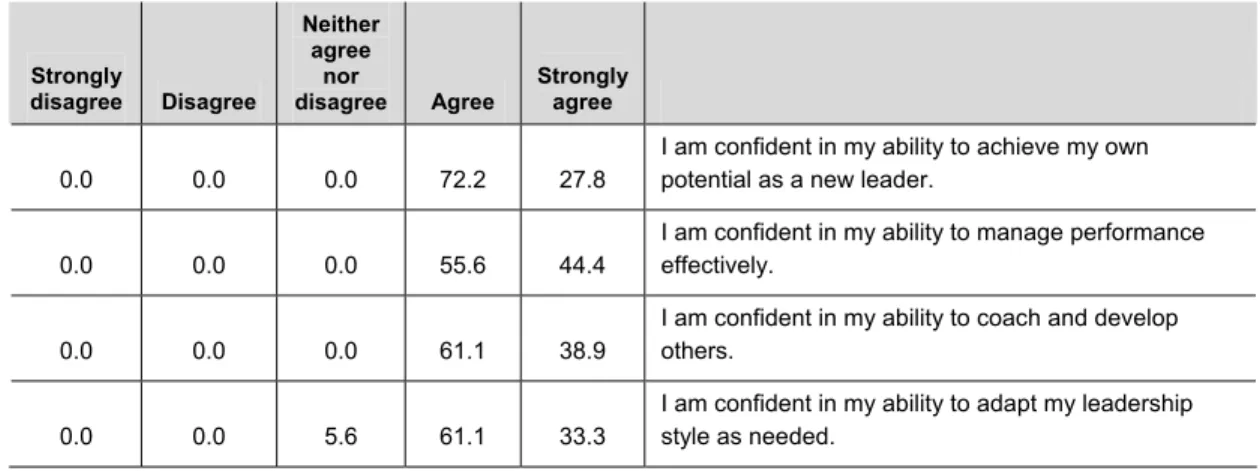
Trainees were asked to rate their confidence in their abilities in different areas covered by the training. Table 3 below shows their ratings. All
trainees reported confidence in their ability to achieve their own potential as a new leader, manage performance effectively, and coach and develop others.
Table 3: Confidence in Trainees’ Abilities
Strongly
disagree Disagree
Neither agree
nor
disagree Agree Strongly agree
0.0 0.0 0.0 72.2 27.8
I am confident in my ability to achieve my own potential as a new leader.
0.0 0.0 0.0 55.6 44.4
I am confident in my ability to manage performance effectively.
0.0 0.0 0.0 61.1 38.9
I am confident in my ability to coach and develop others.
0.0 0.0 5.6 61.1 33.3
I am confident in my ability to adapt my leadership style as needed.
© Development Dimensions International, Inc., MMVIII. All rights reserved. 8 RESEA RCH RES U LTS—LEA D E R SHIP DEVELO P MENT
Other Organizational Outcomes of the Transitional Leadership Program
Trainees and observers agreed that the program has helped trainees to become more effective leaders.
Trainees reported a 9 percent improvement in their overall job performance after attending the training (rating themselves 80 on a
100-point scale before the training and 87 after the training). It is important to remember that the direct impact of training should be most prevalent and observable in specific behaviors as opposed to overall job performance, which is associated with countless other variables. Trainees attributed 64 percent of their overall job performance improvement to the
Transitional Leadership Program. All trainees
felt that the program helped them to become more effective leaders, and 96 percent of observers agreed. Furthermore, observers reported a 21 percent improvement in their own productivity since leaders attended the training, 32 percent of which was directly influenced by changes in leaders’ behaviors.
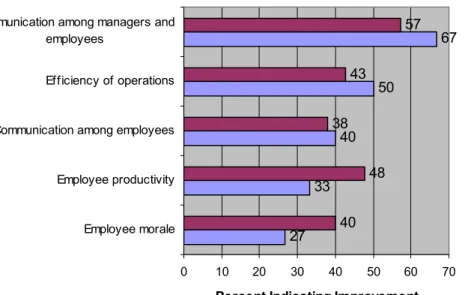
Almost 70 percent of trainees reported improvements in communication since the training.
As Figure 5 shows, the areas in which the most employees reported improvements are
communication and efficiency. At least 7 out of every 10 trainees reported improvements in communication among managers and
employees.
Figure 5: Improvements Since the Training
27 33 40 50 67 40 48 38 43 57 0 10 20 30 40 50 60 70 Employee morale Employee productivity Communication among employees Efficiency of operations Communication among managers and
employees
Percent Indicating Improvement
Observer Trainee
U LTS—LEA D E R SHIP DEVELO P MENT CONTACT INFORMATION WORLD HEADQUARTERS 412.257.0600 E-MAIL [email protected] WWW.DDIWORLD.COM/LOCATIONS
This document was developed by DDI’s Center for Applied Behavioral Research (CABER). For more information, contact [email protected].
Factors Related to Training
Manager reinforcement of training is strong, and trainees are satisfied with their jobs.
When asked about the on-the-job environment at BDC, more than 90 percent of trainees and observers reported having a sense of
accomplishment from their work and feeling that their coworkers respected their thoughts and feelings. Moreover, approximately 90 percent of all participants in this study reported being satisfied with their jobs.
After training, all trainees (100 percent) were motivated to apply the new skills they acquired in the program, and almost 9 in every 10 trainees felt that the program increased their confidence in applying their new skills. To ensure that trainees apply what they have learned, the work environment should support and encourage them to implement their new skills. Manager reinforcement in addition to organizational reinforcement of the training is critical to ensuring the lasting effects of the program. Results indicate that three-quarters of managers encourage their direct reports to pursue development activities and support and reinforce the application of the learned skills on the job.
Other methods of reinforcement at BDC are also strong. For example, 94 percent of trainees have had opportunities to apply the training on their jobs and approximately 88 percent of trainees feel that BDC provides
opportunities that actively support their development. Furthermore, 88 percent of trainees felt that they were held accountable for applying their learning. Peer support was one area of improvement for practicing leaders, such that only 50 percent felt that their peers supported and reinforced their new skills. However, the majority of evidence indicates a work environment at BDC that cultivates learning and growth in their employees.
CONCLUSIONS
The results clearly show the significant impact the Transitional Leadership Program has had on practicing leaders at BDC. Behavior
improvements after the training were significant and impressive. Observers supported trainees’ reports of behavior improvements, and the number of leaders exhibiting critical and effective leadership behaviors has increased by more than 50 percent.
These results clearly show that BDC was able to realize its goal of developing an approach for training leaders already in leadership roles at BDC. This program not only improved the skills of the trained leaders, but improvements in communication and the work environment were evident for other employees in the organization. The internal support system in place at BDC has helped to ensure that participants and their coworkers experience sustainable benefits and improvements on the job.