Solution |
Delivering value with Network Virtualization
As applications, computers, and networks have become more and more intrinsically linked, the convergence of services on the network requires higher availability for mission critical applications. Those providing advanced services to customers are well aware of the need to balance maximizing operational efficiency with meeting Service Level Agreements (SLAs). Virtualization provides the means to meet these increasing demands, with the unique ability to also provide businesses with cost benefits that include
• Streamlining operational efficiency
• Greater flexibility to adapt to changing business needs • Maximising benefit from IT investment
• Simplifying management of IT systems • Reduction in energy consumption • Improving network up-time
• Simplifying the integration of new hardware capacity • Simplifying the upgrading of software applications • Automating the movement of data storage locations • Optimizing disaster recovery provisioning
Virtualization – this innovative solution for multiplying the effectiveness and value of network infrastructure has captured the imagination and endeavour of the networking industry.
Whilst the early advances in IT virtualisation have related mainly to Server and workstation technology, there are some important virtualisation developments occurring in the underlying Ethernet infrastructure:
Virtualized Dual Backbone
Replacing the traditional LAN redundancy solution (a redundant pair of separate switches) with a resiliency solution based on a pair of switches operating as a single virtual switch.
Network
Service
Virtualization
Enabling network services, particularly security services, to be delivered in a distributed fashion across the network, without the requirement to deploy multiple specialized appliances for each service.
Virtualized
Networks
Enabling multiple networks to share the same Ethernet infrastructure, but remain quite isolated from each other. This is particularly powerful when delivered in an identity-based fashion.
Allied Telesis have been delivering innovation in these areas of virtualisation for some time.
In this paper, the innovative Allied Telesis solutions in these areas are surveyed. That is followed by an examination of the overall compatibility that the Allied Telesis LAN switch range has with the aims and requirements of IT virtualization.
Virtualized Dual Backbone
This development meets the current industry trend of moving to ‘Green IT’, and is an important theme in the move to virtualisation as it helps eliminate the need for expensive, energy consuming equipment to stand effectively idle just to provide fail-over redundancy. In the virtualized network, failed hardware is simply removed from the available pool, while processing is seamlessly distributed across other units.
Virtualization is a central theme in current IT
development and new technology implementation. With the power to maximise IT investment it is little wonder. The ability to leverage the performance of critical IT infrastructure and support converged networks, where multiple services share the underlying hardware, is proving to be an extremely high-value proposition for businesses in all industries.
8600
8000S
x900
Link aggregation 10 Gigabit link 1 Gigabit link 10/100 link
CORE
EDGE SwitchBlade x908
Servers
Solution |
Delivering value with Network Virtualization
Network Service Virtualization
Server virtualization enables applications to be decoupled from specific server hardware units or even specific physical locations in the network. The applications can be served in whatever distribution best fits the performance characteristics of the network.
The extension of the application virtualization concept from the servers onto the switches is referred to as Network Service Virtualization. The switches don’t serve desktop applications, but they do provide underlying network services. The virtualization of these services, so that they are not tied to single appliances, but distributed across the switching infrastructure, increases service availability and can reduce management overhead.
The most important service provided by Allied Telesis switches is security policy enforcement. The AlliedWare Plus operating system provides a unique combination of functionality for complete LAN policy enforcement:
• RADIUS: Embedded RADIUS server enables distribution of authentication facilities, ensuring very high availability of this service. • Tri-authentication: 802.1x, MAC-based and Web-based authentication
can all be used together on every port, ensuring that every device connected to the network edge can be authenticated, and forced to participate in the LAN security policy, as shown in figure 2.
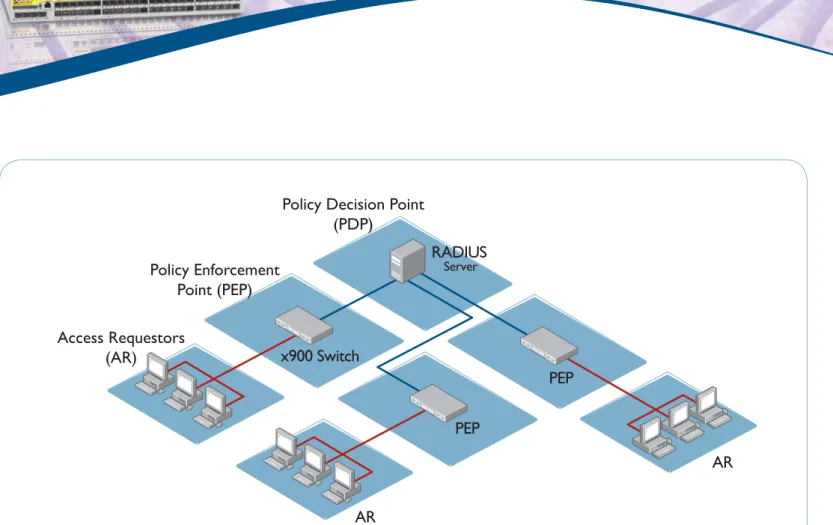
• NAC integration: the switches can operate as the Enforcement Point within all the leading Network Access control solutions currently in the market, as seen in figure 3.
Web authenticated
device
MAC authenticated
device
802.1X authenticated
device
EAPOL
exchange
HTTP
exchange
Tri-authentication
capable switch
MAC address gleaned
from any packet
x900
Server
RADIUS
All 3 types of authentication
require data exchange
By distributing this comprehensive security capability across the network switches, and divorcing them from centralized appliances, a network manager can implement a highly automated, reliable and foolproof LAN security system.
Allied Telesis switches also allow the virtualized distribution of other network services like DHCP address allocation, RADIUS authentication, boot image serving and network time synchronization.
By distributing these services across the network switches themselves, load is removed from application servers, and high availability of these fundamental network services is ensured.
Furthermore, the software and hardware architecture of the Allied Telesis switches provides a future-proof solution, where other services (including hardware-accelerated services) can be easily integrated, increasing the distribution of the workload across the network.
AR
AR
Solution |
Delivering value with Network Virtualization
Virtualized Networks
The capability to virtualize LANs has been inherent in Ethernet switching for some time, in the form of VLANs.
The creation of Virtualized Networks is achieved by extending this concept of network separation and virtualization further. By enforcing complete end-to-end data separation, Virtualized Networks truly enable multiple networks to share the same physical infrastructure. This separation can be extended across the WAN as well as the LAN, and provide different characteristics for different networks.
For example, this has been used to good effect to:
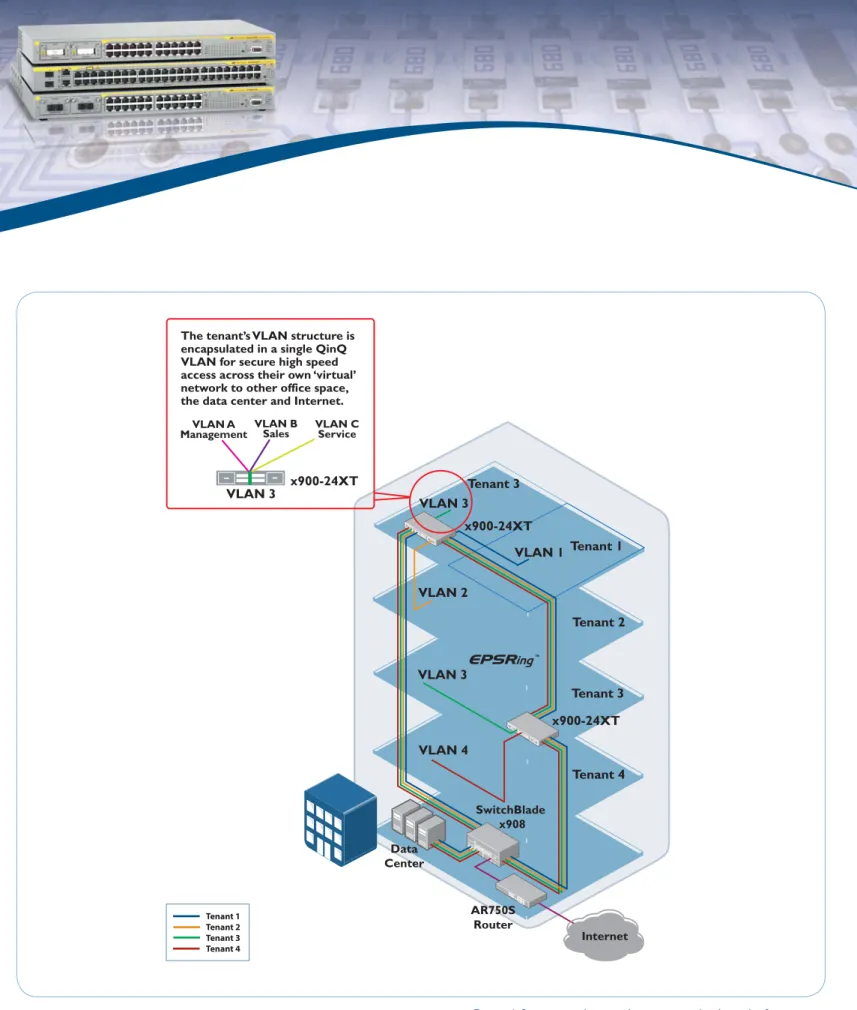
• provide separated logical networks to businesses sharing the same physical network within multi-business environments like shopping malls, airports, and multi-tenanted office buildings.
• enable retail chains to provide shared data access for instore-franchises, both within and between stores.
• give departments within a University campus the freedom to control and design their own LANs while still being able to share inter-building backbones.
• ease the process of network integration between merged companies. The Allied Telesis product range provides the necessary components to build Virtualized Networks.
User identification
In a truly Virtualized Network, the association of an end-device to a particular shared network is based not on the location of the connecting port, but on the identity of the connected user. This enables users to roam across the network, and be able to access their particular virtualized network wherever they connect. For example, in an airport, where different airlines will use a gate at different times, an identity-based network allocation enables every airline to access their own network from any gate. Similarly, in a University campus, academic staff can access their own departmental network from any lecture theatre or even from within other departments.
So, user identification is a key component of full network virtualization. The Allied Telesis tri-authentication capability ensures that any end-user device can be identified and authenticated, irrespective of whether it supports 802.1x.
Path Isolation
Once an end-device has been allocated to a particular network, it is essential that its data remain confined within the paths allocated to that network. The Allied Telesis product range implements reliable and scalable path isolation mechanisms at both Layer 2 and Layer 3.
The technology employed for creating isolated Layer 2 paths over Layer 2 networks is VLAN stacking (QinQ double tagging), which enables multiple entire VLAN structures to share the same physical Ethernet infrastructure., as seen in figure 4.
A variety of technologies have been implemented by Allied Telesis for overlaying virtual paths across Layer 3 networks – L2TP, GRE, Policy Routing and transparent LAN bridging over L2TP. This provides a range of options for overlaying Layer 2 or Layer 3 networks across Layer 3 networks (including the Internet, of course). These can be combined with IPSEC to ensure full data security.
Quality of Service
When multiple virtual networks share the same links, it is necessary to ensure that each separate network experiences the Quality of Service that it expects. Bandwidth usage must be controlled, so that no one network can starve the others of bandwidth. Latency and jitter must also be managed for those virtual networks that are supporting real-time applications, like Voice over IP (VoIP) and streaming video.
The Allied Telesis x900-series switches have an extremely feature-rich Quality of Service offering that can manage the characteristics of over 1000 separate data streams simultaneously, thereby making them ideal for the provisioning of Virtualized Networks.
SwitchBlade x908 Data
Center
AR750S Router
Internet
x900-24XT VLAN 2
VLAN 3
VLAN 4
Tenant 2
Tenant 3
Tenant 4
Tenant 1 Tenant 2 Tenant 3 Tenant 4
Solution |
Delivering value with Network Virtualization
Integration of Allied Telesis switches with server and
workstation virtualisation
Having recognised that the Allied Telesis product range is uniquely able to deliver virtualization within the Ethernet network itself, let us now examine how well these products integrate with the aims and requirements of Server/ workstation virtualisation.
Allied Telesis has an Enterprise LAN offering that is highly compatible with successful IT virtualisation, as the Allied Telesis hardware and feature-set offering has been developed to deliver similar outcomes.
Reduction of wastage, optimization of cost, and maximisation of network performance and uptime have been key drivers of Allied Telesis technology development for some time, and are among the defining characteristics of the new generation x-Series switches and the AlliedWare Plus operating system.
The flexible and expandable nature of the product-line, with a low-investment entry point, and the ability to later on add building blocks almost seamlessly, fit very well with the aims of IT virtualisation.
The delivery of a full enterprise switching feature-set on a series of products with increasing performance and physical-resiliency capabilities enables an enterprise to target its investments at levels that are appropriate to the needs of different parts of its organisation.
To fully understand the extent to which the Allied Telesis enterprise switch offering is compatible with IT virtualisation, we need to look at some of the specific capabilities of the IT virtualisation solutions currently available in the market.
Appropriate provisioning of hardware capacity
Server virtualisation enables the network to maximise the utilisation of the processing capability across all available servers. This avoids the need to over-invest in individual high-powered servers which must, alone, meet the peak requirements of particular applications, but spend much of their time underutilised. Instead, that peak load can be spread across existing lower-powered units. As processing requirements increase, the capacity can be increased in cost-effective manner by gradually adding more units. Similarly, it is possible to have a regular program whereby sets of older units are retired (or redeployed to other tasks) and replaced by a smaller number of more
made more expensive by the need to over-provision in order to cover (unquantifiable) future growth.
Similarly, Allied Telesis have taken the approach of delivering LAN switching capacity in a manner that allows for gradual increments. With a very affordable entry cost for standalone gigabit switches, further gigabit and 10-gigabit switching capacity can be gradual added by integrating new units into virtual chassis stacks. As older models are retired out of core switching roles, they can continue to be used in access or edge roles. At no point do you need to make a big investment into a single large chassis type switching unit that has no migration path when its useful life in the core is over. Moreover, building core switching capacity from discrete units provides flexibility as business needs change. Individual units of switching capacity can be moved to where there are needed, rather than having to remain concentrated in a monolithic core.
Seamless addition/replacement of hardware components
Virtualisation has had a remarkable affect on the ease with which physical servers can be added, removed, or replaced in the network. The ability to shift load off a particular server prior to its removal, coupled with the automatic assimilation of newly added servers, has moved the industry towards the concept of a plug-and-play data-centre. Hardware can be rearranged with zero downtime, and very little management overhead. Similarly, the Allied Telesis product line delivers hitless hardware rearrangement:
• Service modules can be hotswapped in and out allowing you to add extra connectivity or backbone bandwidth with zero downtime. Connectivity and bandwidth can also be rearranged within the network with zero downtime. • Individual switches can be swapped in and out of a virtual chassis stack
with zero downtime. Just as server processing capacity can be increased in a gradual, managed fashion, so too can core switching capacity; and without any need to schedule any network downtime.
• Redundant power-supplies can be hot-swapped, ensuring no downtime due to power supply failures.
Reliable management of network resources
The advantages of virtualization are most fully realized when the management system is able to achieve finely tuned dynamic load balancing
An emerging benefit of IT virtualization is its ability to simplify the managing
of a remote site to be used for disaster recovery. Using EPSR over one or more 10-gigabit links is a cost-effective means to enable extremely reliable and rapid communications between a live site and a disaster recovery site.
10 Gigabit link 1 Gigabit link
Head Office x900-24XT
SwitchBlade x908 SwitchBlade x908
Servers
Remote Storage Site
Conclusion
The Allied Telesis product range delivers unique capabilities and solutions in the virtualisation of Ethernet infrastructure. The flexible, scalable, reliable product set integrates naturally with the aims and needs of IT virtualization. The characteristic benefits of virtualized networks are enhanced by complementary features and solutions from Allied Telesis.
About Allied Telesis Inc.
Allied Telesis is a world class leader in delivering IP/Ethernet network solutions to the global market place. We create innovative, standards-based IP networks that seamlessly connect you with voice, video and data services. Enterprise customers can build complete end-to-end networking solutions through a single vendor, with core to edge technologies ranging from powerful 10 Gigabit Layer 3 switches right through to media converters. Allied Telesis also offer a wide range of access, aggregation and backbone solutions for Service Providers. Our products range from industry leading media gateways which allow voice, video and data services to be delivered to the home and business, right through to high-end chassis-based platforms providing significant network infrastructure.
Allied Telesis’ flexible service and support programs are tailored to meet a wide range of needs, and are designed to protect your Allied Telesis investment well into the future. Visit us online at www.alliedtelesis.com.