Curriculum Guide
Definitions, Processes, and Procedures
TABLE OF CONTENTS
THE UNIVERSITY OF TEXAS AT SAN ANTONIO MISSION 4
THE UNIVERSITY OF TEXAS AT SAN ANTONIO VISION 4
GENERAL POLICY STATEMENT 4
UNDERGRADUATE PROGRAMS 6
Academic Major 6
Academic Minor 7
Concentration 8
Undergraduate Certificate Program 8
GRADUTE PROGRAMS 9
Graduate and Post-Baccalaureate Professional Degree Programs 9
Master’s Degree Programs 9
Doctoral Degree Programs 9
LEVELS AND NUMBERING OF COURSES 10
Developmental Courses 10
Lower Division Courses 10
Upper Division Courses 10
Graduate Courses 11
CHANGES TO PROGRAMS AND COURSES 12
NONSUBSTANTIVE CHANGE 12
Nonsubstantive degree title changes 12
Changes to authorized undergraduate programs 12
Changes to authorized graduate programs 12
Other nonsubstantive program changes 12
SUBSTANTIVE CHANGE 13
THECB POLICIES AND PROCEDURES 13
Substantive Requests to the THECB for Bachelor’s and Master’s Degrees 13 Substantive Requests to the THECB for Undergraduate and Graduate Certificate
Programs 13
Substantive requests to the THECB for offering doctoral degree programs 14
Institutional Responsibilities to the THECB 15
Institutional Policies 15
TABLE A, SUBSTANTIVE CHANGE PROCESS 17
SACSCOC POLICIES AND PROCEDURES 19
INSTITUTIONAL POLICIES AND PROCEDURES ON SUBSTANTIVE CHANGE 20
Institutional Responsibilities to the SACSCOC 20
Institutional Policy 20
Procedures for Reporting: An Overview 21
Reporting the Various Types of Substantive Change 22
TABLE B, SUBSTANTIVE CHANGE PROCESS 22
APPROVAL OF DISTANCE EDUCATION COURSES AND PROGRAMS/THECB 24
Institutional Plan for Distance Education 24
Notification Procedures for Off-Campus Upper-Division and Graduate Courses
and Programs (excluding doctoral and special professional programs) 25 Distance Education and Off-Campus Doctoral and Special Professional Programs 27
APPROVAL OF DISTANCE EDUCATION COURSES AND PROGRAMS/SACSCOC 29
Notification Procedures 29
THE PROGRAM APPROVAL PROCESS 30
Approval of Programs (flow chart) 31
THE CURRICULUM APPROVAL PROCESS 32
Course Development 32
APPROVAL OF COURSES 32
Approval of Courses (flow chart) 33
Approval of Courses for Inclusion in the UTSA Core Curriculum 34
The Graduate Council 35
THE UNIVERSITY OF TEXAS AT SAN ANTONIO MISSION
The University of Texas at San Antonio is dedicated to the advancement of knowledge through research and discovery, teaching and learning, community engagement and public service. As an institution of access and excellence, UTSA embraces multicultural traditions, serving as a center for intellectual and creative resources, as well as a catalyst for socioeconomic development for Texas, the nation, and the world.
THE UNIVERISTY OF TEXAS AT SAN ANTONIO VISION
To be a premier public research university, providing access to educational excellence and preparing citizen leaders for the global environment.
GENERAL POLICY STATEMENT
The development of new courses and degree programs is essential to The University of Texas at San Antonio (UTSA) mission to achieve excellence in teaching, research, and public service. New
instructional courses and programs must be brought about through a comprehensive evaluative process that ensures:
The integrity of the courses and programs.
The ability of the university to provide and sustain support of resources. The relevance of the courses to the university’s educational mission. The investment of faculty knowledge and expertise.
The advancement of the university’s strategic goals.
The following policies apply to development of new courses and programs at UTSA:
1. Course and/or program changes must be executed within the prescribed processes as outlined in TheUniversity of Texas at San Antonio Curriculum Guide.
2. The development of new Bachelor’s and Master’s degree programs that are not engineering programs for which the total cost will not exceed two million dollars over the first five years require the completion of the Certification Form for New Bachelor’s and Master’s Programs. Although the Texas Higher Education Coordinating Board does not require a full New Bachelor’s or Master’s Program Request Form, the UT System does, and this must be submitted along with the Certification Form. Submission to UT System goes through Dr. Kevin Lemoine, Assistant Vice Chancellor of Academic Affairs.
3. The development of new Bachelor’s and Master’s degree programs that are not engineering programs for which the total cost will be over two million dollars or more over the first five years require the completion of the New Bachelor’s or Master’s Program Request Form. This form is submitted to the Texas Higher Education Coordinating Board through UT System, Dr. Kevin Lemoine.
New Bachelor’s or Master’s Program Request Form is online: http://tinyurl.com/jvmcfps Certification Form is online: http://tinyurl.com/l2qyweo
4. All new programs are subject to internal approval through the policies set forth by University of Texas at San Antonio, and to external approval processes through the policies set forth by the University of Texas System (www.utsystem.edu), the Texas Higher Education Coordinating Board (THECB) (www.thecb.state.tx.us), and the Commission on Colleges Southern Association of Colleges and Schools Commission on Colleges (SACSCOC) (www.sacscoc.org).
5. Institutions proposing a new doctoral or professional program should refer to the 1. Texas Higher Education Coordinating Board rules Chapter 5, subchapter C, Section 5.46, 2. Criteria for New Doctoral Programs, and the 18 Characteristics of Texas Public Doctoral Programs. Forms and instructions needed:
1. Doctoral Program Application Form: http://tinyurl.com/jvmcfps
2. Guidelines for Institutions Submitting Proposals for New Doctoral Programs: http://tinyurl.com/jvmcfps
3. Program Funding Estimation Tool: http://tinyurl.com/jvmcfps
6. Review of new degree and certificate programs requires the completion of a budget indicating all costs related to the proposed program and resources to be allocated. Budget information must be included as outlined on the form required for submission of a specific new program request. The specific budget formats required for master’s and doctoral requests are found in the new program requests forms provided by the Texas Higher Education Coordinating Board. For doctoral proposals, UT System may have additional budget requests, which can be discussed with UT System, Dr. Kevin Lemoine.
7. For a new course to be approved, a Course Inventory Update Form must be completed. Internal approval requires signatures from the Department Chair, the college Dean, and either the Vice Provost and Dean of University College or the Vice Provost and Dean of the Graduate School. There are no external processes required for a new course to be approved, although inclusion of any new material in the undergraduate or graduate catalog requires approval of the UT System. 8. No course or program will be implemented until approved by all requisite internal and external
approving bodies/agencies. Ultimate internal approval for new program implementation rests with the Provost and Vice President for Academic Affairs and the President of the university. Internal approvals and final external approvals to initiate approved courses and/or programs and to include them in academic publications and course/program inventory will be
communicated from the Office of the Provost and Vice President for Academic Affairs to the Vice Provost and Dean of the Graduate School, in the case of graduate-level approvals, or to the Vice Provost and Dean of Undergraduate Studies, in the case of undergraduate-level approvals.
UNDERGRADUATE PROGRAMS
A bachelor’s degree is usually the first academic degree awarded by a college or university signifying that the recipient has satisfactorily completed a course of study that typically lasts for four years. Its purpose is to enable a student to acquire a certain amount of general knowledge and intellectual skills and to become proficient in a particular branch of learning. The primary source of general knowledge in the curriculum of the bachelor’s degree is the core curriculum, which provides a uniform body of knowledge that all undergraduates should know. Moreover, students may select electives, which provide a measure of flexibility and individuality for degree programs. For most programs, those studies leading to proficiency in a branch of learning are majors complemented by a professional core or
support work requirements, which consist of courses selected from one or more fields closely related to the major.
The curricular structure of the bachelor’s degree at UTSA includes 42 semester credit hours in the core curriculum, the major requirements, and the support work requirements. Students are required to complete a minimum of 120 total credit hours, which may consist of courses that are free electives. Moreover, students may select one or two minors. The curricular structure allows for overlap between the requirements for the core curriculum, the major, the support work, and the minors. The
requirements for the major usually determine the type of bachelor’s degree. Typically, Bachelor of Arts degree programs are aimed at the learning of humanities, social sciences, and liberal arts, including the natural and physical sciences and mathematics; they tend to teach qualitative methods of scholarship that use methods that are analytic, critical, or speculative, although the social and natural sciences do focus on methods that are empirical and inferential. Bachelor of Science degree programs generally are oriented toward the completion of a program in the natural sciences, physical sciences, or mathematics, or toward programs based upon the natural sciences, physical sciences, or mathematics; they tend to teach quantitative and the scientific method of scholarship for purposes of understanding natural phenomena. Professional degree programs prepare holders for a particular profession by emphasizing competency skills along with theory and analysis. For example, the Bachelor of Music degree program is designed for students intending to pursue music as a profession, the Bachelor of Fine Arts degree program is designed for students wishing to become professionals in the visual or performing arts, and the Bachelor of Business Administration degree programs are designed for students wishing to become business professionals. These programs usually require a core of professional studies that conform to the standards of accrediting agencies or other professional bodies.
The relationships among the parts of the bachelor’s degree engender coherence. The core curriculum and electives provide the intellectual setting upon which to build a particular branch of learning. The development of proficiency in the branch of learning extends the student’s knowledge of one or more of the human perspectives or natural phenomena first encountered in the core curriculum.
Academic Major
An academic major is a curricular component that enables students to make an in-depth inquiry into a discipline. It is organized around a specific set of goals and objectives that are accomplished through an ordered series of courses whose connections define a coherent program of study. A major that focuses on a discipline draws its courses predominantly from one academic department. One that encompasses an interdisciplinary field of study usually obtains its courses from more than one department.
The number of credit hours in a major and its organizational structure will vary depending on whether it aims at disciplinary or professional preparation. Due to the demands of accrediting agencies,
certification requirements, and professional competence, a professional major normally is at the high end of the number of hours required for majors.
Each academic department has the responsibility for administering all majors within its unit and for approving particular programs of study and appropriate course substitution for students. Those departments involved with interdisciplinary majors perform the same functions as individual departments.
The most important feature of a major is in-depth study. A major introduces students to a discipline or field of study through a foundation of theory and method, which serves as a basis for further study. It exposes them to a broad yet thorough range of topics and analytical devices used in the study of the subject. It contains a series of courses that presume advancing levels of knowledge and understanding. It affords students foundations, and gives them a clear sense of its boundaries and its effectiveness as a means for understanding or serving human society.
Academic Minor
An academic minor is a curricular component which enables a student to make inquiry into a discipline or field of study, or to investigate a particular theme, usually in less depth than majors. It is organized around a specific set of competencies. The objectives of a minor are achieved through an ordered series of courses, whose connections are defined to indicate a coherent program of study. Minors are
intended to provide competency in the subject. Course offerings in a minor may be centered in a specific department or drawn from several departments, as in the case of a topical or thematic focus. The minimum number of credit hours required for a minor is 18 with at least 6 hours at the upper division level. A minor usually consists of 18 to 24 credit hours. This series of courses provides general direction for the student’s study while maintaining a degree of flexibility. Flexibility is achieved by offering the student a choice from among a group of courses to complete the credits. Each department has the responsibility to administer all minors within its unit and approve appropriate substitutions for students. Those units involved in interdepartmental minors perform the same functions as
departments. Courses taken to fulfill the requirements of a minor may ordinarily also be used to fulfill other academic requirements such as those for the major and core curriculum. However, no student may declare a major and a minor in the same discipline, and a student may not formally select more than two minors.
The integrity of a minor is measured by the degree to which the structure and content meet its
objectives and thereby serve the student. It is also determined by its relationship to the curricular goals and objectives of the department. The regular evaluation of a minor to ensure its integrity and the practice of noting it on a student’s transcript indicate its importance to the university curriculum. The true significance of a disciplinary minor is demonstrated by the extent to which it leads the student to some understanding of that discipline or field of study and to a certain degree of competence with methods of inquiry. The quality of an interdisciplinary or thematic minor is determined by its ability to suggest answers to questions upon which it is focused. In either case, a minor should provide basic insight into a subject that helps further the student’s educational goals.
Concentration
A concentration is a formally designated area of specialization within an existing degree program that has a distinctive curricular pattern. A concentration differs from a minor in that a concentration consists of courses that are part of a student’s major, whereas a minor can be in any discipline and usually consists of courses outside the student’s major.
Undergraduate Certificate Program
Undergraduate certificate programs provide training opportunities for students enrolled at UTSA as undergraduates. Certificate programs are narrower in scope and shorter in duration than baccalaureate degrees. Undergraduate certificate programs are neither “degree” programs nor teacher certification programs. Students wishing to be certified to teach at the elementary, middle school, or high school level should refer to the Teacher Certification Programs for Undergraduate Students. Undergraduate certificate programs require a minimum of 15 credit hours with at least 9 hours at the upper division level. A student completing an undergraduate certificate program will have that information recorded on his or her transcript.
GRADUATE PROGRAMS
According to the SACSCOC (http://www.sacscoc.org/pdf/PrinciplesofAccreditation.PDF), graduate and post-baccalaureate professional degree programs must meet the following criteria:
Post-baccalaureate professional degree programs and master’s and doctoral degree programs must be progressively more advanced in academic content than undergraduate programs (must have increased academic rigor).
The institution offering the degree programs must ensure that its graduate instruction and resources foster independent learning, enabling graduates of these programs to contribute to a profession or field of study. Programs must be characterized by a curricula that includes knowledge of the literature of the discipline and that ensures ongoing student engagement in research and/or appropriate professional practice and training experiences.
The majority of credits toward a graduate, post-baccalaureate, or professional degree must be earned through the institution awarding the degree. In the case of graduate and
post-baccalaureate or professional degree programs offered through joint, cooperative, or consortia arrangements, the student must earn a majority of credits from the participating institutions. Master’s Degree Programs
In broad terms, the Master’s degree indicates that the recipient has mastered a program in a particular field of study or area of professional practice. Programs are designed to provide students with advanced knowledge in a specific field of study that will allow them to solve complex problems and to think critically and independently. Normally, degree titles indicate one of the major categories. The Master of Arts and Master of Science are generally designed as academic degrees designed to provide an
introduction to scholarly activities and research. The professional master’s degree, such as the Master of Public Administration or the Master of Business Administration, is similar to the M.A. and the M.S., except that they emphasize instruction in professional practice and serve as preparation for careers in the professions.
Despite differences in title and objective, all Master’s degrees share common characteristics. The degree normally requires one to two years of full-time study (or equivalent) and the completion of a minimum of 30 semester hours of credit. The basic components of the degree may vary in emphasis, but generally include a common core in the discipline; a concentration in a subfield of study; related courses outside the department as a means of broadening the curriculum or to provide needed skills; and integrative experience to synthesize the program’s content and/or translate theory into practice such as seminars, practice, etc. Academic credit applicable to the degree should only be awarded for those courses designed to expand and strengthen skills beyond the level of the baccalaureate degree. Degree credit is not awarded for courses designed to fulfill prerequisites for admission to the graduate school.
Doctoral Degree Programs
Doctoral degree programs build on master’s programs to provide students with a higher level of specialized study in their area of focus. Typically, students enrolled in a doctoral degree program will spend three to four years engaging in post-master’s study that involves taking a common core of courses, as well as highly specialized courses in their area of study that are offered at a level of
complexity above those offered at the master’s level. In addition, it is expected that students enrolled in a doctoral program will spend a significant portion of their time engaged in specialized independent research efforts supervised by a faculty mentor. The culmination of their research efforts is expected to be a dissertation that makes a significant contribution to furthering knowledge in their field of study.
LEVELS AND NUMBERING OF COURSES
The definition of levels and numbering of courses at The University of Texas at San Antonio is intended to provide students with a clear understanding of the criteria that are used as guidelines to distinguish among lower division, upper division, and graduate courses. In general, levels of courses differ with regard to the breadth and depth of their content, the perspective from which the subject is viewed, the degree to which particular intellectual skills are emphasized, and the degree of responsibility expected of students as they study the subject. Course numbers usually correspond to the classification of students as freshman, sophomores, juniors, seniors, and graduate students. The following descriptions of course levels serve as guidelines for course development throughout the university.
Developmental Courses
Developmental courses are designed to bring underprepared students up to a level of proficiency necessary for college-level work. These courses carry no credit toward hours required for the bachelor’s degree. Developmental courses are zero-thousand level courses and are numbered 0XXX.
Lower Division Courses
The primary function of lower division courses is to begin making independent learners of students. Lower division courses increase the knowledge that students have of subjects with which they are already familiar, introduce them to new subjects, and establish a foundation for them to study a major subject in depth.
Lower division courses are usually tightly structured with the expectation that students are to receive considerable instructional guidance in the learning process. Instruction at the lower division level normally is informational and emphasizes learning skills; it usually entails the use of materials or
resources provided by the instructor. The intellectual skills emphasized in lower division courses include all levels of learning (knowledge, comprehension, application, analysis, synthesis, and evaluation), although the higher levels (analysis and evaluation) are not stressed to the same degree as in upper division courses. Evaluation of student performance at this level tests information, concepts, and skills. Lower division courses are one-thousand or two-thousand level courses and are numbered 1XXX or 2XXX. Courses should be taken in sequential order, and may have one or more of the following characteristics:
1. They are introductory courses or part of a series of basic courses in a discipline.
2. In some professional fields, they may build on the foundations of prerequisite collegiate courses.
3. They are courses that may be counted in majors, minors, electives, and the core curriculum. Upper Division Courses
The primary function of upper division courses is to refine students’ abilities as independent learners. Upper division courses enable students to study a major field in depth by building upon and integrating the knowledge gained in lower division courses.
Upper division courses are characterized by a flexible structure that allows for a variety of approaches to the subject matter, a wide range of course material, and an emphasis on independent study, including research in the laboratory, library, studio, or community. Students are expected to accept increasing responsibility for their own learning, both inside and outside the classroom. Upper division courses
strongly emphasize the higher levels of learning. Evaluation of student performance at this level stresses such outcomes as the ability to solve problems and to integrate knowledge.
Upper division courses are three-thousand or four-thousand level courses and are numbered 3XXX or 4XXX. Typically, they build on the prerequisite background of lower division courses. They also may have one or more of the following characteristics:
1. They are built on a foundation of prerequisite lower division courses in a discipline or related field of study.
2. They synthesize knowledge from several specific areas in a discipline or from related disciplines.
3. They are courses designed to integrate knowledge and skills from different areas of a discipline.
Graduate Courses
The primary function of graduate courses is to broaden the perspective and deepen the advanced knowledge students have of a particular discipline or professional field of study, or to provide students initial preparation in an advanced professional field that requires foundational knowledge and
experience in a related discipline or field of study.
Graduate courses are characterized by a high level of complexity and generalization in the study of a particular subject. They are structured in a manner that allows for a variety of approaches to the subject matter, a wide range of source material, considerable student interaction, and significant emphasis on independent study and/or research in the library, laboratory, studio, or community. They are designed to extend the knowledge and intellectual maturity of students beyond the baccalaureate level. They are intended for students who are capable of analyzing, exploring, questioning, evaluating, and synthesizing knowledge. Evaluation of student performance in graduate courses entails a variety of means and is commensurate with the level of complexity of these courses.
Graduate courses are numbered at the 5XXX, 6XXX, and 7XXX levels (master’s through doctoral degree levels). Typically, graduate courses are restricted to students who have successfully completed a bachelor’s degree. They also may have one or more of the following characteristics:
1. They build upon a foundation of prerequisite undergraduate or master’s level courses in single or related disciplines.
2. They require intellectual maturity of students and stress independent study.
3. They emphasize the use of library, studio, laboratory, community, and field-based facilities and resources inways commensurate with the level of learning.
CHANGES TO PROGRAMS AND COURSES
Changes to programs and courses may involve a change made to an existing program or course, or the addition or deletion of a program or course to the existing inventory. These changes may require notification to or approval by The Texas Higher Education Coordinating Board (THECB) and/or the Southern Association of Colleges and Schools Commission on Colleges (SACSCOC). Because the policies and procedures associated with notification and/or approval differ somewhat for the two agencies, they are presented separately in this document. Please remember that the requirements of both THECB and the SACSCOC may apply in order for a change to a program or course to be implemented.
NONSUBSTANTIVE CHANGE
According to THECB, a nonsubstantive change involves: (1) no implications for changes in institutional role and scope and conforms to the current Table of Programs; (2) no significant new costs; (3) no issues of unnecessary duplication with programs at other institutions; and (4) the potential for high-quality programming given the institution’s previous experience in the same or closely related subject field. Nonsubstantive degree title changes: To change a title for an existing degree program, submit a letter with the president’s signature to the Executive Vice Chancellor for Academic Affairs at the University of Texas System that is prepared for the Executive Vice Chancellor’s signature. If the request is found to be appropriate, it does not need to receive UT Board of Regents’ approval, but can be approved by the Executive Vice Chancellor for Academic Affairs. If approved, the request for change will be forwarded by the UT System Office of Academic Affairs to THECB for review. THECB Commissioner has the authority to approve these requests without requiring a vote of THECB board members.
Changes to authorized undergraduate programs: Typically, any change that is over 21 credit hours that will be specified in the catalog or reflected in a variation of the degree title raises program inventory questions and should be forwarded to the THECB for review. Changes of 21 hours or less that do not involve changes to degree titles typically do not require review and approval by the THECB. However, if there is a question about whether a change of 21 or fewer hours may create a new/different degree program, the change should be discussed with the Vice Provost and Dean of University College to determine the appropriate course of action.
Changes to authorized graduate programs: Typically, program options (called concentrations or tracks) of 12 or fewer hours can be established and advertised in the catalog without THECB review or approval. Any change that is over 12 hours should be forwarded for review. Additionally, changes of 12 or fewer hours that could be considered creation of a new program should be discussed with the Vice Provost and Dean of the Graduate School to determine the appropriate course of action.
Other nonsubstantive program changes: Minor program changes such as addition or deletion of courses, or adding/deleting thesis or nonthesis options for authorized degree programs do not require review or approval by THECB, as long as these changes are within the normally accepted ranges for the type of program that was originally authorized.
Changes to the credit-hour requirements of existing programs require the submission of a Semester Credit Hour Change Form to the Texas Higher Education Coordinating Board.
Semester Credit Hour Change Form is online:
SUBSTANTIVE CHANGE
THECB POLICIES AND PROCEDURES
Substantive Requests to the THECB for Bachelor’s and Master’s Degrees: Typically, bachelor’s and master’s degree proposal requests are automatically approved if all of the following conditions are met:
The program has institutional and UT System approval.
The institution certifies compliance with the Standards for New Bachelor’s and Master’s Programs.
The institution certifies that adequate funds are available to cover the costs of the new program.
New costs during the first five years of the program would not exceed $2 million. The program is a non-engineering program (i.e. not classified under CIP code 14).
The program is not one which the institution previously offered and has been closed due to low productivity in the last 10 years.
The program would be offered by a university or health-related institution.
No objections to the proposed program are received by THECB during the 30-day comment period.
If a proposed bachelor’s or master’s program meets the conditions outlined above, the institution may submit a request to add the program to the Assistant Commissioner of Academic Affairs at THECB. If the conditions above are not met, the institution must submit a proposal using the standard degree form. Please contact the Vice Provost and Dean of University College to determine the appropriate course of action for initiating substantive change involving the addition of a bachelor’s degree program, or the Vice Provost and Dean for the Graduate School to determine the appropriate course of action for initiating substantive change involving the addition of a master’s degree program.
Also note that the institution must have preliminary planning authority to offer any level of an engineering degree program or a doctoral degree program. (Preliminary planning authority is not required for non-engineering bachelor’s and master’s degree programs.) If the institution does not have the required preliminary planning authority to offer a degree in a specific content area at the level being requested (e.g., bachelor’s or master’s), that must first be obtained. THECB website provides a list of all institutions’ approved programs and programs for which preliminary planning authority has been granted on their program inventory web page. The office of the Vice Provost and Dean of University College and the office for the Vice Provost and Dean of the Graduate School can also provide assistance should you have a question about preliminary planning authority.
Once THECB receives a request for a bachelor’s or master’s program, THECB will post the proposed program online for public comment for a period of 30 days. If no objections occur, THECB staff will update the institution’s program inventory accordingly. NO new program shall be implemented until all objections are resolved. THECB reserves the right to audit a certificate or degree program at any time to ensure compliance with any of the criteria listed above.
Substantive Requests to the THECB for Undergraduate and Graduate Certificate Programs: New undergraduate certificate programs of 20 or fewer hours and graduate certificate programs of 15 or fewer hours do not require approval by the THECB. Approval of new undergraduate and graduate certificate programs of over 20 and 15 hours, respectfully, will be granted automatically if the following conditions are met:
The certificate program has institutional and UT System approval.
The institution certifies that adequate funds are available to cover the costs of the new certificate program.
The certificate program meets all other criteria in Texas Administrative Code 5.48, Criteria for Certificate Programs at Universities and Health-Related Institutions.
No objections to the proposed certificate program are received by THECB during the 30 day comment period.
If a proposed certificate program meets the conditions outlined above, the institution shall submit a Request to the Assistant Commissioner of Academic Affairs and Research at THECB. If a proposed certificate does not meet the conditions outlined above, the institution must submit a proposal using the standard program request form. If you are uncertain about whether the certificate proposal does or does not meet the criteria above, please contact the Vice Provost and Dean of Undergraduate Studies if the certificate is to be offered at the undergraduate level, or the Vice Provost and Dean of the Graduate School if the certificate is to be offered at the graduate level, for assistance.
THECB will post the proposed certificate program online for public comment for a period of 30 days. If no objections occur, THECB staff shall update the institution’s program inventory accordingly. No new certificate program will be implemented until all objections are resolved. THECB reserves the right to audit a certificate program at any time to ensure compliance with any of the conditions listed above. Substantive requests to the THECB for offering doctoral degree programs: An institution requesting a new doctoral program shall submit a proposal using the standard doctoral program request form. All requests for new doctoral programs require preliminary planning authority prior to the submission of a degree program request. All proposals for doctoral degree programs need to have institutional
approval, and then are submitted for review and approval at regular meetings of the UT System Board of Regents and THECB.
The doctoral program request form can be found on THECB website or through contacting the Office of the Vice Provost and Dean of the Graduate School. Although the request form is updated/revised on a regular basis, generally the proposal is evaluated in the following areas:
Consistency with the mission and strategic goals of the proposing institution. National, state, and regional need for the proposed program.
Program quality and assessment.
Institutional and financial support for the program. Student quality and financial support.
When planning and preparing doctoral program proposals, carefully consider the criteria listed in THECB’s Rules, Chapter 5. Information about duplication of programs in the state can be found most easily by first finding the most appropriate CIP code for the proposed program on THECB’s website and then accessing the list of all degree programs in the state by linking to THECB’s program inventory web page. You can select the institutions to be searched by choosing from the list in the Institutions dialog box, enter the appropriate CIP code, and then click the Search Inventory button to obtain results. Individuals who are planning and preparing proposals for any new undergraduate or graduate program
should contact the Vice Provost and Dean for Undergraduate Studies or the Vice Provost and Dean of the Graduate School in order to determine whether the proposed program would duplicate or overlap with existing programs at UTSA. Please consult with the Vice Provost and Dean of the Graduate School and the Dean of your academic college as you begin preliminary planning for development of a doctoral program proposal, as they can provide assistance in the planning and preparation of the proposal. Doctoral proposals must gain institutional approval at the level of the administrative unit offering the program, the administering college, the Graduate Council, the Faculty Senate, the Provost, and the President. After institutional approval is received, the proposal is forwarded to the UT System Office of Academic Affairs. If the Executive Vice Chancellor for Academic Affairs determines that the proposal should be sent to THECB, it will be sent from that office. THECB staff will review, and will determine whether to recommend that the proposal warrants a site visit. If a site visit is recommended to and approved by the Commissioner, THECB, the UT System, and the institution work together to plan a one to two day visit that brings three outside consultants selected by THECB to campus. The
recommendations resulting from that visit contribute substantially to the final decision that is made regarding approval. If the decision is made to recommend approval, the proposal is first presented to the UT System Board of Regents for vote. If approved, the proposal is presented to the members of THECB for vote. Once THECB approves the proposal, it is submitted to the SACSCOC for review and approval. Only after final approval is given by the SACSCOC can the program be implemented. UT System approval guidelines must also be followed (http://www.utsystem.edu/offices/academic-affairs). Institutional Responsibilities to the THECB
It is the responsibility of an institution to follow the procedures for substantive and nonsubstantive changes of THECB and to inform THECB of such changes in accordance with those procedures. If an institution is unclear as to whether a change is substantive or nonsubstantive, it should contact THECB for clarification. These contacts should be made by the coordinating representative for undergraduate programs, the coordinating representative for graduate programs, the Provost, or the President. Institutional Policies
The following policies are applicable to the development of new degree programs, changes in degree levels, significant departures from current delivery modes of instruction, and other actions that result in significant modification or expansion of the nature or scope of the university.
1. For any and every type of proposed action that will result in a substantive or nonsubstantive change, the procedures for reporting these changes as outlined in Table A, Substantive and Nonsubstantive Change process of the UTSA Curriculum Guide, and THECB’s published policies on change shall be strictly adhered to at all institutional levels.
2. In determining the actions that must be taken to enable the institution to implement a proposed change, the institution must determine the procedures, timeframes, and required documentation to accurately communicate with THECB about the proposed change.
3. The initial responsibility for activating the actions that must be taken to enable the
institution to implement a proposed change rests with the Dean of the college from which the proposed change initiates. The Dean works through the coordinating representative for undergraduate programs, the coordinating representative for graduate programs, or the Office of the Provost to facilitate communication with THECB about any proposed change. 4. Due to the timeframes that must be considered for THECB review, approval, and
notification or approval should be discussed with the coordinating representative for undergraduate programs or coordinating representative for graduate programs, as well as with the Office of the Provost, before any documentation is prepared or submitted for internal review.
5. Internal approval of new programs and courses at the graduate level requires review and approval at the following levels: the appropriate graduate studies committee; the
appropriate departmental curriculum committee and department chair; the appropriate college curriculum committee and college dean; Vice Provost and Dean of the Graduate School; the Graduate Council; the Faculty Senate; the Provost and Vice President for
Academic Affairs; and the President. These changes must also be approved externally by the UT System Office of Academic Affairs.
6. Internal approval of new programs and courses at the undergraduate level requires review and approval at the following levels: the appropriate departmental curriculum committee and department chair; the appropriate college curriculum committee and college dean; Vice Provost and Dean of University College of Undergraduate Studies; the Faculty Senate; the Provost and Vice President for Academic Affairs; the President; and the UT System Office of Academic Affairs.
7. Formal communication with THECB rests with the President or Provost, or their designee. 8. No proposed action resulting in a substantive or nonsubstantive change will be
implemented prior to formal receipt of approval or acknowledgement, whichever is appropriate for the proposed action, by THECB.
9. In any instance whereby the substantive change approval process or nonsubstantive change notification process has not been completed, upon discovery the Dean of the college must notify the coordinating representative for undergraduate or graduate programs
immediately. The coordinating representative will notify the Provost to determine the appropriate course of action per THECB guidelines.
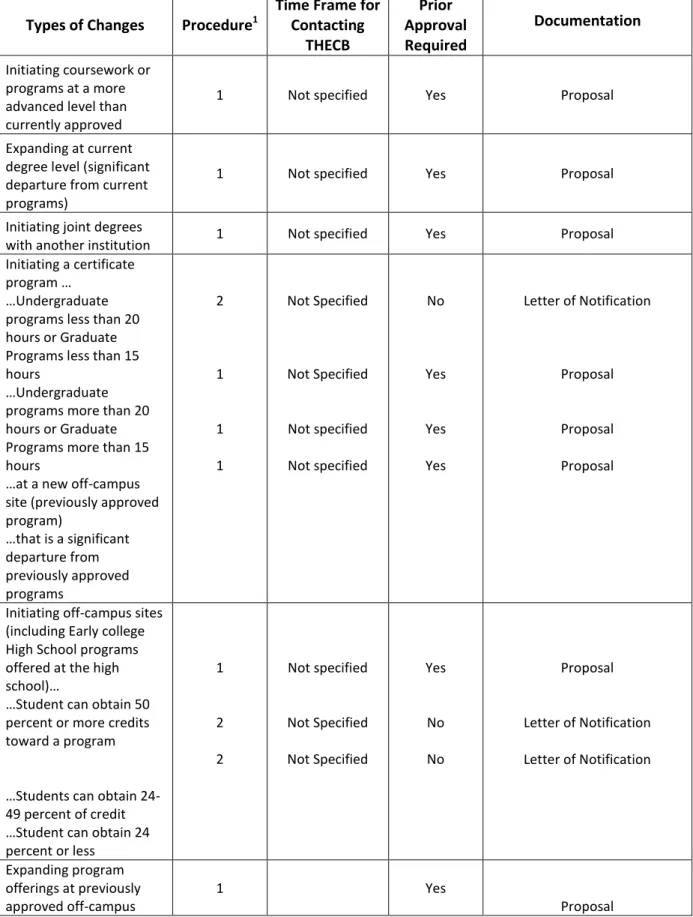
TABLE A. SUBSTANTIVE CHANGE PROCESS
Types of Changes Procedure1
Time Frame for Contacting THECB Prior Approval Required Documentation
Initiating coursework or programs at a more advanced level than currently approved
1 Not specified Yes Proposal Expanding at current
degree level (significant departure from current programs)
1 Not specified Yes Proposal Initiating joint degrees
with another institution 1 Not specified Yes Proposal Initiating a certificate
program … …Undergraduate programs less than 20 hours or Graduate Programs less than 15 hours
…Undergraduate programs more than 20 hours or Graduate Programs more than 15 hours
…at a new off-campus site (previously approved program)
…that is a significant departure from previously approved programs 2 1 1 1 Not Specified Not Specified Not specified Not specified No Yes Yes Yes
Letter of Notification Proposal Proposal Proposal
Initiating off-campus sites (including Early college High School programs offered at the high school)…
…Student can obtain 50 percent or more credits toward a program …Students can obtain 24-49 percent of credit …Student can obtain 24 percent or less
1 2 2 Not specified Not Specified Not Specified Yes No No Proposal Letter of Notification Letter of Notification
Expanding program offerings at previously approved off-campus
1 Yes
sites
…Adding programs that are significantly different from current programs …Adding programs that are NOT significantly different from current programs
1 Not specified Not specified
Yes
Proposal
Altering significantly the educational mission of the institute
1 Not specified Yes Proposal Initiating distance
learning…
… For the first time …Electronically-to-individual (non-doctorate) …Doctoral Degree
...Offering 50 percent or more of a program (adding subsequent programs requires advance notification only for programs that are significant departures from the originally approved programs) …Offering 25-49 percent …Offering 24 percent or less 1 1 1 1 2 2 Yes Yes Yes Yes No No
Institutional Plan for Distance Education
Notification and Certification Form for Off-Campus and
electronically delivered programs. Need to notify all
public institutions of higher education, including Higher Education Centers within a 50
mile radius
Distance Doctoral Submission Form
Proposal
Letter of Notification Letter of Notification Initiating
programs/courses offered through contractual agreement
1 Not specified Yes Letter of Notification
Relocating an off-campus
instructional site 1 Not specified No
Additional delivery site approval form. Must also notify
all institutions of higher education within a 50 mile radius of proposed delivery site Altering significantly the
Initiating degree
completion programs 1 Not specified Yes Proposal
Footnote 1:
Procedure 1: A significant departure in program is one in which the proposed new program has no closely related counterpart among the previously approved programs in the curriculum. To determine if a new program is a “significant departure,” it is helpful to ask if the new program requires any of the following:
New faculty? Many new courses?
New library or other learning resources? New equipment or facilities?
A new resource base?
Procedure 2: Significant changes in mission are those that lead to a fundamental shift in the nature of the institution, such as an institution that had offered only professional programs deciding to add general education offerings, or a technical college transforming itself into a comprehensive community college.
SACSCOC POLICIES AND PROCEDURES
According to the Commission on Colleges (www.sacscoc.org), a substantive change is a significant modification or expansion in the nature and scope of an accredited institution. Thirteen types of substantive changes and the procedures that the SACSCOC requires for addressing them can be found in the Commission’s Policy on Substantive Change. These include: (1) the addition of courses or programs that represent a significant departure, either in content or method of delivery, from those offered when the institution was last evaluated; (2) the addition of courses of programs at a degree or credential level above that which is included in the institution’s current accreditation or reaffirmation; (3) a substantial increase in the number of clock or credit hours awarded for successful completion of a program; (4) the establishment of an additional location geographically apart from the main campus at which the
institution offers at least 50 percent of an educational program; (5) entering into a collaborative academic arrangement; (6) acquiring a program or location from another institution; and (7) closing a program, off-campus site, branch campus or institution. However, THECB may have different criteria for reporting than SACSCOC, so it is important to be sure that the requirements of both the SACSCOC and THECB are fulfilled.
A substantive change to a program cannot be implemented prior to SACSCOC approval. It is critical to follow the guidelines in HOP 2.35 carefully to prevent delay in implementing a proposed substantive change. They were developed by the UTSA Accreditation Liaison, whose charge is to ensure compliance with accreditation requirements. The Accreditation Liaison is assigned to the Office of the Vice Provost for Institutional Effectiveness. Sandra Welch ([email protected]) is currently serving in that role.
Some changes, such as offering courses at an off-campus site that amount to less than 25% of the coursework needed to complete a degree, certificate or diploma, do not need to be reported to the SACSCOC. Caution: if the plan to increase the number of hours to ≥ 50%, given the six to nine months required to obtain SACSCOC approval, it is better to go ahead and submit materials to the Accreditation Liaison to avoid delays.
Others changes, such as offering from 25% to 49% of the coursework required for a program offered off-site require that the Commission be notified in advance of the implementation of the change. However, see the caution in the discussion regarding offering <25% of the coursework. The letter of notification should be submitted to the Accreditation Liaison, and should include the name of the actual change, implementation date, street address if it involves a new site, and the credential being offered. The Accreditation Liaison will provide guidance and submit the letter of notification.
UTSA must provide written notification to the Commission regarding planned larger scale changes of their intent significantly in advance of the proposed implementation date. These changes include adding significantly different programs to the academic curriculum (new degrees, certificates or other credentials that involve offering new courses, new levels of degrees, etc.); offering 50% or more of the coursework needed to complete a degree,
certificate, or diploma at an off-campus site; developing collaborative arrangements with other institutions to offer programs; or discontinuing a degree or certificate program. (See HOP 2.35 for a complete list.) Written notification includes a prospectus and a faculty roster, and should be submitted to the Accreditation Liaison at least six months in advance of the planned
implementation date. (The SACSCOC faces a continual backlog of prospectuses, so it is strongly encouraged that the Accreditation Liaison be provided the material even earlier.) The
Accreditation Liaison will provide guidance and submit the prospectus materials. The Accreditation Liaison ensures that prospectus packages are complete, submits them to the SACSCOC, consults with the appropriate staff member from the SACSCOC about any questions, and informs the college and department when SACSCOC approval has been obtained. Once approval has been obtained, the substantive change can be implemented. Contact the Accreditation Liaison for information and to receive report templates for the prospectus and Faculty Roster.
The Accreditation Liaison will work with the UTSA president to notify the Commission President of substantive changes.
INSTITUTIONAL POLICIES AND PROCEDURES ON SUBSTANTIVE CHANGE
The policies and procedures for reporting and review of institutional substantive change are outlined below.
Institutional Responsibilities to the SACSCOC
It is UTSA’s responsibility to follow the substantive change policies of the SACSCOC and inform them of such changes in accordance with those procedures. If there is a question as to whether a change is substantive in nature, the Accreditation Liaison will consult with the SACSCOC staff. The SACSCOC accredits institutions, not systems. While UT System may provide the SACSCOC with important information regarding changes planned or underway at its institutions, it is expected that UTSA will follow the reporting requirements of the substantive change policy, once approval for a substantive change is received from UT System and the THECB. See HOP 2.35.
Institutional Policy
The following substantive change policies are applicable to the development of new degree programs, changes in degree levels, significant departures from current delivery modes of instruction, and other actions that result in significant modification or expansion of the nature and scope of the university.
1. For any and every type of proposed action that will result in substantive change, the procedures for reporting substantive change as outlined in Table B, Substantive Change Process of The University of Texas at San Antonio Curriculum Guide and the SACSCOCs’ policies on substantive change shall be strictly adhered to at all institutional levels.
2. In assessing the degree to which proposed changes represent a significant departure from current delivery modes of instruction, the sources listed in item 1 above must be researched immediately so as to accurately categorize the specific type of substantive change and to determine the procedures, timeframes, and required documentation for accurate procedure on reporting substantive change to the SACSSACSCOC.
3. The initial responsibility for determining and promptly notifying the Dean of the Graduate School of a proposed program or outcome that may/will constitute a substantive change rests with the Associate Dean designated by the Dean of the college from which the proposed program or outcome will be implemented. In the event clarification about substantive change necessitates communication with the SACSSACSCOC, the Dean must consult with the
Accreditation Liaison, who will make formal inquiries with the SACSCOC.
4. Due to the timeframes that must be considered for SACSCOC review, approval, and development of required documentation for such, proposed actions that constitute a substantive change will require prior administrative approval by the President upon
recommendation of the Provost/Vice President for Academic Affairs before proceeding through the internal approval process. Further internal consideration of a proposed action that
constitutes a substantive change will only resume once prior administrative approval has been obtained from the President as communicated in the form of an Approval to Proceed
notification.
5. Formal communication of substantive change information to the SACSCOC for any proposed action rests with the President of the university via the Accreditation Liaison.
6. All required due diligence to fully and accurately report substantive change (including consultation with the SACSCOC through appropriate channels) must be completed before a proposed action can move to The University of Texas at San Antonio Board of Trustees for final internal approval and implementation.
7. No substantive change will be implemented prior to formal receipt of approval from the SACSCOC. Substantial sanctions will result from failure to adhere to this policy.
Procedures for Reporting: An Overview
There are three procedures for addressing the different types of substantive changes:
1. Procedure One for the Review of Substantive Changes Requiring Notification and Approval Prior to Implementation
2. Procedure Two for the Review of Substantive Change Requiring Only Notification Prior to Implementation
The initiation or revision of programs not offered for academic credit and that are not eligible for federal financial aid does not require reporting; however, such programs are subject to review at the time of reaffirmation.
Reporting the Various Types of Substantive Change
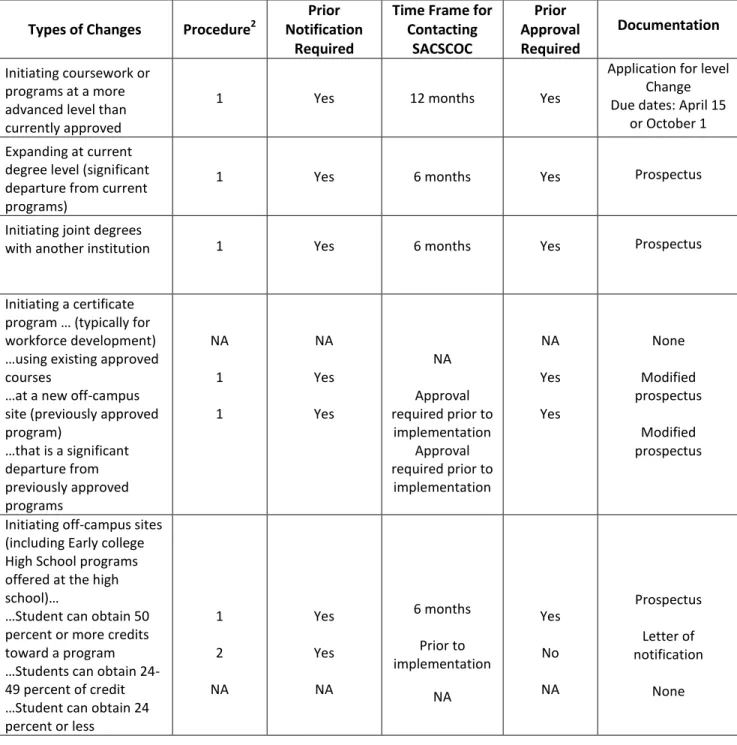
The different types of substantive change, the specific procedure to be used for each, their respective approval/notification requirements, and their reporting timelines are included in Table B. Please refer to the appropriate procedure for details regarding reporting when proposing a curriculum change if it is a substantive change.
TABLE B. SUBSTANTIVE CHANGE PROCESS
Types of Changes Procedure2
Prior Notification
Required
Time Frame for Contacting SACSCOC Prior Approval Required Documentation
Initiating coursework or programs at a more advanced level than currently approved
1 Yes 12 months Yes
Application for level Change Due dates: April 15
or October 1 Expanding at current
degree level (significant departure from current programs)
1 Yes 6 months Yes Prospectus Initiating joint degrees
with another institution 1 Yes 6 months Yes Prospectus Initiating a certificate
program … (typically for workforce development) …using existing approved courses
…at a new off-campus site (previously approved program)
…that is a significant departure from previously approved programs NA 1 1 NA Yes Yes NA Approval required prior to
implementation Approval required prior to
implementation NA Yes Yes None Modified prospectus Modified prospectus Initiating off-campus sites
(including Early college High School programs offered at the high school)…
…Student can obtain 50 percent or more credits toward a program …Students can obtain 24-49 percent of credit …Student can obtain 24 percent or less
1 2 NA Yes Yes NA 6 months Prior to implementation NA Yes No NA Prospectus Letter of notification None
Expanding program offerings at previously approved off-campus sites
…Adding programs that are significantly different from current programs …Adding programs that are NOT significantly different from current programs 2 NA Yes NA Prior to implementation NA No NA Letter of notification NA Altering significantly the
educational mission of
the institute 1 Yes 6 months Yes Prospectus
Initiating
programs/courses offered through contractual agreement or consortium
2 Yes Prior to
implementation No
Letter of notification and
copy of signed agreement Relocating an off-campus
instructional site 2 Yes
Prior to
implementation No
Letter of notification Altering significantly the
length of a program 1 Yes 6 months Yes Prospectus Initiating degree
completion programs 1 Yes 6 months Yes Prospectus
Footnote 2:
Procedure 1: A significant departure in program is one in which the proposed new program has no closely related counterpart among the previously approved programs in the curriculum. To determine if a new program is a “significant departure,” it is helpful to ask if the new program requires any of the following:
New faculty? Many new courses?
New library or other learning resources? New equipment or facilities?
A new resource base?
Procedure 2: Significant changes in mission are those that lead to a fundamental shift in the nature of the institution, such as an institution that had offered only professional programs deciding to add general education offering, or a technical college transforming itself into a comprehensive community college.
Procedure 3: Significant changes in program length are those with noticeable impact on the program’s
completion time (e.g., increasing a baccalaureate degree from 124 hours to 150 hours).Source: Commission on College Substantive Change Policy
APPROVAL OF DISTANCE EDUCATION COURSES AND PROGRAMS/THECB
Public institutions have guidelines explained in THECB rules that govern certain types of instruction provided through distance education. For instance, academic credit on-line and hybrid courses, degree and certificate programs, and self-supporting courses and programs (formerly defined as extension courses and programs) provided by all public institutions of higher-education, and formula-funded workforce continuing education provided by a public community college, Lamar State College, or public technical college are governed by Chapter 4, Subchapter P, of Board Rules (Chapter4SubChapterP). That subchapter does not apply to non-credit adult and continuing education courses provided by a senior college or university, a health-related institution, or non-formula-funded continuing education provided by a public community college, Lamar State College, or public technical college. Information related to the approval of off-campus face-to-face and electronic-to-groups courses and programs and self-supporting courses and programs for public institutions can be found in Chapter 4, Subchapter Q, of Board rules (Chapter4SubChapterQ).
Institutional Plan for Distance Education
Before institutions offer any distance education courses or programs for the first time, an Institutional Plan for Distance Education must be submitted to THECB. To clarify, the plan must be submitted by institutions who have never offered distance education, such as newly created institutions. The
Commissioner of Higher Education may require institutions to provide supplemental reports on distance education programs and/or courses.
Each Institutional Plan for Distance Education should reflect institutional academic and administrative policies that express commitment to maintain the quality of distance education courses and programs and should conform to THECB guidelines, including the Principles of Good Practice, as well as criteria set out by the Southern Association of Colleges and Schools. These criteria shall include provisions relating to:
Institutional Issues Educational Programs Faculty
Student Support Services
Distance Education Facilities and Support
Board rules cover standards and criteria for distance education programs, courses and faculty. Each program and/or course must comply with the following:
Be within the role and mission of the offering institution, and be on the inventory of approved programs/courses.
Any offered degree or certificate program shall comply with the standards and criteria of any specialized accrediting agency.
Courses shall meet the quality standards applicable to on-campus courses.
Programs shall be approved by the institution’s governing board or the governing board’s designee.
Doctoral or first-professional degree programs may not be offered via distance education unless specifically approved by THECB.
The instructor of record has the responsibility for the delivery of instruction and for evaluation of student progress.
Institutions shall report, in accordance with Board policy and procedures, all distance education courses and programs.
Prior board approval may be required before institutions may offer programs in certain subject area disciplines.
Additional criteria and standards associated with faculty teaching distance education are listed below: Faculty shall be selected and evaluated using the same standards and procedures used for on-campus faculty.
Institutions shall provide training and support to those faculty teaching distance education courses.
The supervision and monitoring processes shall be the same as those for on-campus faculty. Notification Procedures for Off-Campus Upper-Division and Graduate Courses and Programs (excluding doctoral and special professional programs)
Universities and health-related institutions shall notify all area institutions, Higher Education Centers, and THECB of their plans to offer distance education courses and programs.
Notification procedures for off-campus programs (excluding doctoral and special professional degrees)
An institution proposing a distance education degree program must have approval to offer the program. If an institution does not have approval, instructions for securing program approval may be found on THECB website (www.thecb.state.tx.us).
For programs that are to be delivered electronically to individuals (i.e., online) notification should take the form of an email to Dr. Andrew B. Lofters ([email protected])
and Dr. Judith Sebesta ([email protected]) and should include a pdf of the signed Certification Form for Electronically Delivered and Off-Campus Education Programs.
The notification email should include program level and name, CIP code, and implementation date. For programs that are to be delivered electronically-to-groups or off-campus face-to-face, notification should take the form of an email to Dr. Andrew B. Lofters ([email protected]) and Dr. Judith Sebesta ([email protected]) and should include a pdf of the signed Certification Form for Electronically Delivered and Off-Campus Education Programs. In addition to Coordinating Board notification, institutions should also notify all institutions of higher education, including Higher Education Centers, within a 50-mile radius of the proposed delivery site via email with a copy to Dr. Judith Sebesta ([email protected]). Notification should take place at least 60 days prior to the proposed program implementation. Once notified, institutions shall have 30 days to file an
objection. The objection should be made via email to the offering institution, with copies to the Coordinating Board staff previously mentioned. Institutions are encouraged to make every effort to resolve disputes on their own. If such a resolution isn’t possible, the Commissioner has the authority to resolve disputes between institutions regarding the offering of courses and programs and has the authority to approve or disapprove such courses or programs. The Commissioner will then report to area institutions on approvals and disapprovals of disputed courses and programs. The Board may hear
appeals to approvals and disapprovals made by the Commissioner. Approval for the program is considered automatic if no objections are made.
Notification procedures for off-campus courses
For electronic-to-group or off-campus face-to-face and self-supporting courses not part of approved distance education degree programs, the parent institution shall notify all institutions of higher
education and Higher Education Centers within a 50-mile radius of the proposed delivery site by email at least 60 days prior to the proposed first class day. A copy of the notification should be emailed to Dr. Andrew B. Lofters ([email protected]) and Dr. Judith Sebesta
([email protected]). Once notified, institutions shall have 30 days to file an objection. The objection should be made via email to the offering institution, with copies to the Coordinating Board staff previously mentioned. Institutions are encouraged to make every effort to resolve disputes on their own. If such a resolution isn’t possible, the Commissioner has the authority to resolve disputes between institutions regarding the offering of courses and programs and has the authority to approve or disapprove such courses or programs. The Commissioner will then report to area institutions on
approvals and disapprovals of disputed courses and programs. The Board may hear appeals to approvals and disapprovals made by the Commissioner.
Hybrid and Blended Programs and Online Courses
Online distance education is divided into two categories: fully online and hybrid/blended. 85%-100% of the content/curriculum of a fully online course or program is delivered online; mandatory face-to-face sessions may total no more than 15% of the instruction time. A course or program with 50-85% of the content/curriculum delivered online is considered hybrid or blended.
New online and hybrid/blended programs at all public institutions of higher education require governing board approval and prior to the Texas Higher Education Coordinating Board notification to
[email protected] and [email protected].
Distance Education and Off-Campus Doctoral and Special Professional Programs
All doctoral and special professional programs delivered at a distance require prior Coordinating Board approval. A doctoral or special professional program is considered to be offered through distance education and/or off-campus delivery when over half of the semester credit hours, excluding dissertation and research, may be completed without the student being in residence on campus. The Coordinating Board expects all doctoral and special professional programs delivered through distance education to meet the following standards:
The program is of high quality;
It is delivered in a way that preserves this high quality; The program meets a well-documented state need; and The program can be delivered at a reasonable cost.
An institution proposing a doctoral or special professional program for distance delivery must have approval to offer the program. (If an institution does not have approval, a Distance Education Doctoral Degree Proposal form must be submitted.) For institutions wishing to deliver an existing on-campus doctoral or special professional program as a distance education program, the on-campus program must be in good standing with all appropriate review and accreditation organizations. Additionally, the combined enrollments of an on-campus doctoral program and the distance delivery doctoral program must be sufficient to permit the program’s successful continuation. If a decision is made to phase out either program, arrangements must be made to allow students to complete the program in the most expedient and appropriate manner.
New distance education doctoral or special professional proposals must be submitted to the
Coordinating Board using the Distance Education Doctoral Degree Proposal form and must be submitted through the appropriate institutional and system administrative channels. If the proposed program is to be offered electronically-to-groups or off-campus face-to-face, institutions must notify all institutions of higher education within a 50-mile radius of the proposed delivery site at the time the proposal is submitted to the Coordinating Board. A copy of the notification should be emailed to Dr. Andrew B. Lofters ([email protected]) and Dr. Judith Sebesta ([email protected]). Once notified, institutions shall have 30 days to file an objection. The objection should be made via email to the offering institution, with copies to the Coordinating Board staff previously mentioned.
Once submitted the following steps occur:
Coordinating Board staff will review the proposal and, if appropriate, forward to the Learning Technology Advisory Committee for review;
The Learning Technology Advisory Committee shall review the proposal and make recommendations; and
Based upon those recommendations the Commissioner or his designee shall decide if the proposal will be approved.
Institutions that have received permission to offer off-campus electronic-to-groups or face-to-face doctoral programs may add additional delivery sites by submitting the Additional Delivery Site Approval form through appropriate institutional and system administrative channels. At that time all institutions of higher education within a 50-mile radius of the proposed delivery site must also be notified of the proposal. A copy of the notification should be emailed to Dr. Andrew B. Lofters
([email protected]) and Dr. Judith Sebesta ([email protected]). Once notified, institutions shall have 30 days to file an objection. The objection should be made via email to the offering institution, with copies to the Coordinating Board staff previously mentioned. The decision to approve additional delivery sites may be made by the Commissioner or his designee after review by Coordinating Board staff.
Institutions that have previously approved distance education doctoral and special professional degree programs may request permission to offer those programs via other distance education delivery modes. In order to do so, an institution should submit a new Distance Doctoral Submission form through appropriate institutional and system administrative channels. If the change would result in new off-campus face-to-face or electronic-to-groups delivery sites, all institutions of higher education within a 50-mile radius of the proposed delivery sites must also be notified of the proposal. The decision to approve additional delivery modalities may be made by the Commissioner or his designee after review by Coordinating Board staff and the Learning Technology Advisory Committee.
A limited number of doctoral and special professional courses may be delivered without distance doctoral program approval. As with other off-campus courses, these also require notification of area institutions. Additionally, institutions must provide notification to the Coordinating Board when more than four courses are offered via distance education in a single degree program. This notification ensures that institutions do not offer a doctoral or special professional program inadvertently via a distance education modality.
New doctoral programs offered for the first time at an institution (i.e. have not existed either on-campus or off) must first gain approval from the THECB using the Doctoral Program Application Form and