
1Institut f¨ur Theoretische Physik und Astrophysik,
Christian-Albrecht-Universit¨at zu Kiel, D-24098 Kiel, Germany
2
Dipartimento di Fisica, Universit´a di Modena e Reggio Emilia, Via Campi 213/A, 41125 Modena, Italy.
3S3 - Istituto di Nanoscienze - CNR, Via Campi 213/A, 41125 Modena, Italy
(Dated: September 20, 2018)
Using first-principles calculations, we show that the magnetic properties of a two-dimensional an-tiferromagnetic transition-metal surface are modified on the atomic scale by the adsorption of small organic molecules. We consider benzene (C6H6), cyclooctatetraene (C8H8) and a small transition
metal - benzene complex (BzV) adsorbed on a single atomic layer of Mn deposited on the W(110) surface – a surface which exhibits a nearly antiferromagnetic alignment of the magnetic moments in adjacent Mn rows. Due to the spin-dependent hybridization of the molecularpz orbitals with thed
states of the Mn monolayer there is a significant reduction of the magnetic moments in the Mn film. Furthermore, the spin-polarization at this organic-antiferromagnetic interface is found to be modu-lated on the atomic scale, both enhanced and inverted, as a result of the molecular adsorption. We show that this effect can be resolved by spin-polarized scanning tunneling microscopy (SP-STM). Our simulated SP-STM images display a spatially-dependent spin-resolved vacuum charge density above an adsorbed molecule – i.e., different regions above the molecule sustain different signs of spin polarization. While states withsandpsymmetry dominate the vacuum charge density in the vicinity of the Fermi energy for the clean magnetic surface, we demonstrate that after a molecule is adsorbed thosed-states, which are normally suppressed due to their symmetry, can play a crucial role in the vacuum due to their interaction with the molecular orbitals. We also model the effect of small deviations from perfect antiferromagnetic ordering, induced by the slight canting of magnetic moments due to the spin spiral ground state of Mn/W(110).
PACS numbers:
INTRODUCTION
The emerging field of organic spintronics aims to com-bine the advantages of molecular electronics, such as de-vice miniaturisation and fabrication ease, with the mas-sive potential for application inherent in spintronics [1– 3]. Organic materials are particularly promising in spin-tronic devices as they exhibit weak spin-orbit and hyper-fine interactions, resulting in long spin coherence times [4, 5]. Moreover, they have a high chemical diversity and offer the possibility for selectively tuning their electronic and magnetic properties via ligand modification. The first reported organic spin valve used a thin layer of Alq3 as an organic spacer between LSMO and Co electrodes [6]. Recently, a magnetoresistance of 300% was found for the same structure [7]. In an effort to meet the demand for miniaturisation there has been a drive to use single organic molecules as spacer elements [8–11]. An added advantage is that the resistance of such a device would be considerably smaller than that of a thin-film based device. Very high magnetoresistance effects have already been predicted [12–16] and achieved [17, 18] in such single molecule spin-valves for both the tunnelingand conduct-ing regime.
In many cases it is the interface between the organic molecule and the inorganic electrodes that determines the spin injection properties. The exchange-split densi-ties of states of the electrodes result in the spin-selective
shift and broadening of the molecular orbitals. The re-sult is a spin-polarized interface, the so-called ‘spinter-face’ [19]. The spin-split molecular orbitals [20, 21] as well as the spin-polarized interface itself [22] have been directly observed. Even a single organic molecule has been demonstrated to be capable of locally manipulat-ing the spin polarization emergmanipulat-ing from a clean magnetic surface. This was shown by Atodiresei et al. [23] and Brede et al. [24] who considered the effect the adsorption of small organic molecules can have on a ferromagnetic Fe/W(110) surface. They found that even a molecule as small as a benzene ring (Bz) can act as an efficient spin filter, capable of inverting the spin polarization of the surface, due to the particular hybridization of orbitals at the interface – an effect which has also been observed for single atoms adsorbed on magnetic surfaces [25, 26].
Most organic-inorganic interfaces studied to date in-volve ferromagnetic surfaces [27–32]. More recently, the adsorption and coupling of molecules on substrates with layered antiferromagnetic order has been used to ex-plore spin-polarized transport and the exchange bias ef-fect [33, 34]. In this work, we consider a surface with a more complex spin structure – a monolayer of Mn on the W(110) surface – which has been characterized on the atomic scale [35, 36]. It has been found to exhibit a spin spiral ground state propagating along the [1¯10] direction with an angle of∼173◦ between magnetic moments on adjacent rows [36]. This means that neighbouring rows of Mn atoms have magnetic moments approximately
posite in direction but with an orientation relative to the film that varies slowly across the surface. Locally one can therefore approximate it as a two-dimensional anti-ferromagnet. This surface has already been used as as a magnetic template in order to determine and manipu-late the spin direction of individual Co adatoms on the atomic scale [37]. Here, we explore the effect of single molecules on its local magnetic properties.
We present a density functional theory study of the structural, electronic and magnetic properties of several simple organic molecules adsorbed on the Mn/W(110) surface. Due to the long period of the spin spiral, we consider it as approximately collinear to model its inter-action with localized adsorbed molecules. The molecules under investigation include benzene (Bz: C6H6), cyclooc-tatetraene (COT: C8H8) and the small benzene - transi-tion metal complex BzV. We show that due to hybridiza-tion with the molecule the magnetic moments of the ad-jacent Mn atoms can be strongly reduced and that the spin polarization of such an organic-antiferromagnetic in-terface is modulated on the atomic scale and can be en-hanced and inverted with respect to the clean Mn film.
The modification of the spin polarization due to this interface can be revealed by spin-polarized scanning tun-neling microscopy (SP-STM) as demonstrated by our cal-culations. We find that the exact magnitude and sign of the spin polarization in the vacuum above the molecule is strongly dependent on the bonding details at the inter-face and, due to the antiferromagnetic surinter-face, exhibits a strong intra-molecular spatial dependence. In almost all cases, the sign of the vacuum spin polarization above the adsorbed molecule is inverted and its magnitude en-hanced. We demonstrate that this modification of the charge density in the vacuum is a hybridization-induced effect between thep-orbitals of the organic molecule and the spin-splitd-orbitals of the magnetic surface. The ef-fect of the non-collinear spin structure of the Mn mono-layer on the spin-polarized STM images is also calculated, using a model based on that of Tersoff and Hamann [38]. The paper is organized as follows. After briefly scribing the computational method, the structural de-tails of the adsorbed molecules are discussed. This is followed by a description of the electronic and magnetic properties of the hybrid organic - inorganic interface. In particular, we discuss the spin resolved local density of states as calculated in the vacuum above the molecules, i.e. the simulated STM images. Finally, we consider in an approximate way the effect the true spin spiral ground state can have on the simulated SP-STM images. The fi-nal section summarizes our main conclusions.
METHODS
In this work, density functional theory calculations are performed using the vasp code [39, 40]. The
Perdew-Burke-Ernzerhof (PBE) [41] parametrization of the gen-eralized gradient approximation (GGA) is employed. The projector-augmented wave (PAW) method [42] is used with the standard PAW potentials supplied with the VASP distribution. The plane wave basis set was converged using a 400 eV energy cutoff. A 6×6 ×1 k-point Monkhorst-Pack mesh [43] was used to sample the three-dimensional Brillouin zone. A Gaussian smearing of 0.01 eV was used for the initial occupations. Constant-height spin polarized scanning tunneling microscopy (SP-STM) images were simulated using the the method of Tersoff and Hamann [44] and its generalization to SP-STM [38]. The central quantity of this scheme is the spin dependent local density of states in the vacuum in-tegrated over a particular energy range corresponding to an experimental bias voltage.
The substrate is modelled using a 3 layer slab of W atoms and one layer of Mn atoms in the collinear checker-board antiferromagnetic configuration. The GGA calcu-lated lattice constant of W is 3.17 ˚A, in good agreement with the experimental value of 3.165 ˚A. The size of the supercell was chosen such that a distance of at least 12.5 ˚
A was maintained between the centre of neighbouring molecules. Additionally, a thick vacuum layer of approx-imately 3 nm was included in the direction normal to the surface to ensure no spurious interactions between repeating slabs. The relaxed interlayer distance between Mn and W is 2.08 ˚A whereas the interlayer distance be-tween two layers of W is 2.24 ˚A. The energy of thec(2×2) AFM configuration is 187 meV/atom and 109 meV/atom lower than the ferromagnetic and thep(2×1) AFM con-figurations, respectively. These energy differences were calculated for a symmetric slab consisting of seven layers of W(110) and a Mn layer on both sides and compare favourable to previous results in the literature [35].
STRUCTURES
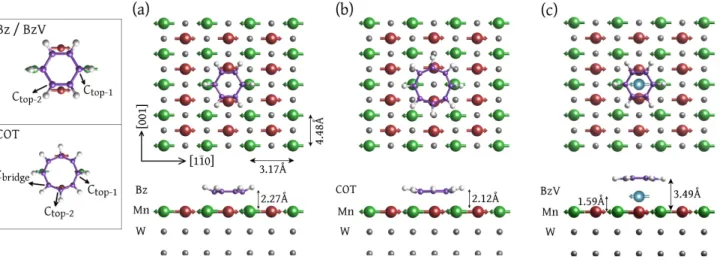
Several initial molecular adsorption configurations are considered for all molecules, including hollow, bridge and top sites. The most energetically stable molecular posi-tion is, in all cases, found to be over the hollow site of the Mn layer (Fig. 1). Rotations of the adsorbed molecule were also considered. Fig. 1 shows the most energeti-cally favourable configurations. The ionic positions of the molecular atoms and the Mn layer were optimized until all residual forces were less than 0.01 eV/˚A. In all cases the coordinates of the W atoms were held fixed. The effect of including dispersion forces was also consid-ered using the semi-empirical approach of Grimme [45] as implemented in thevaspcode [46]. For the case of the benzene molecule, the inclusion of dispersion forces were found to decrease the binding distance of the molecule to the surface by 0.04 ˚A. However, this was not found to have any appreciable effect on the spin polarization at
FIG. 1: (Color online) Top and side view of the adsorption geometry of a (a) Bz molecule, (b) COT molecule and (c) BzV molecule adsorbed on a Mn/W(110) surface. A c(6×8) surface unit cell was employed for the case of Bz and BzV adsorption while a larger surface unit cell of c(8 ×10) was used for the adsorption of the COT molecule (only a portion of this cell is shown). The antiferromagnetic alignment of Mn spins is depicted using green and red spheres and arrows.
the interface or the simulated STM images and so was neglected in all further calculations.
Fig. 1(a) shows a top and side view of the optimized Bz/Mn/W(110) structure. After relaxation the molecu-lar plane is no longer flat; the hydrogen atoms lie further from the surface than the carbon atoms by a distance of 0.41 ˚A. The shortest C – Mn bond length is 2.10 ˚A which occurs when the carbon atom sits directly on top of a Mn ion. These carbon atoms are referred to as Ctop−1(see Fig. 1). Additionally, the C – C bonds in Bz are no longer equal and are larger compared to the isolated molecule (1.456 ˚A and 1.419 ˚A compared to 1.398 ˚A), in order to facilitate its adsorption onto the surface lattice. The car-bon - hydrogen car-bonds remain at their isolated molecule length of 1.09 ˚A.
In contrast to planar Bz, the isolated COT molecule exists in a “tub-like” conformation [47] in order to reduce angle strain. However, when adsorbed on the surface con-sidered here, the planar structure of the carbon atoms is approximately restored. This has previously been shown to occur when COT is chemisorbed onto a surface with the resulting strong hybridization between molecular and surface electronic states [48]. Similar to the Bz case, the hydrogen atoms are positioned in a plane higher than that of the carbons, in this case by approximately 0.11 ˚A. The C – C bond lengths, while alternating in the isolated molecule between 1.47 ˚A and 1.35 ˚A, become approxi-mately equal when adsorbed on the surface, at 1.43 ˚A. As with Bz, the COT molecule prefers to bind at a hollow site of the Mn lattice. Due to the symmetry of the ad-sorption the C atoms can be grouped into three different types; two carbons that sit atop Mn atoms with negative spin polarization, two carbons that sit atop Mn atoms with positive spin polarization, and four carbons that lie across a Mn –Mn bridge site (see Fig. 1). These are
de-noted Ctop−1, Ctop−2and Cbridge, respectively. Note that due to the slightly asymmetric binding of the molecule to the surface the division into such categories is only approximate.
The final molecule studied introduces a magnetic adatom, in this case Vanadium, between the molecule and the surface. The resultant molecule is then a half-sandwich, representing an ideal candidate for the smallest possible organometallic molecular magnet. The interac-tion of 3d transition metal ions with Bz molecules have been previously studied both experimentally [49, 50] and theoretically [51, 52]. The distance between the benzene ring and the surface has now increased to 3.49 ˚A due to the V atom which is positioned over a hollow site in the Mn lattice and 1.59 ˚A above it.
RESULTS AND DISCUSSION Electronic structure
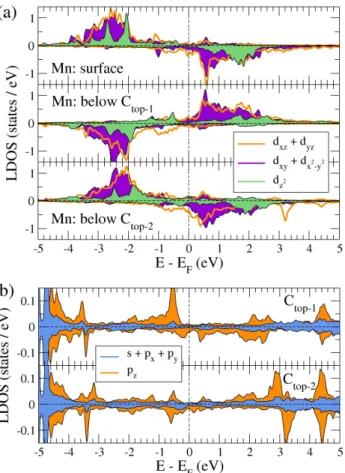
In order to illustrate the binding mechanism and hy-bridization between the organic molecules and the in-organic antiferromagnetic surface, the local density of states (LDOS) are shown in Fig. 2 (Bz), Fig. 3 (COT) and Fig. 4 (BzV). The upper panel of Fig. 2(a) shows the LDOS of a Mn atom far from the influence of the molecule with a magnetic moment pointing to the left (green atom in Fig. 1) which in our definition of the global spin quan-tization axis (SQA) exhibits a greater spin down density of states close to the Fermi level. In an energy window relevant to STM measurements, the dominant states are spin down withdxz symmetry. The density of spin up states in this energy range is much lower and has contri-butions from alldorbitals as well assstates. Comparing
FIG. 2: (Color online) The spin resolved local density of states for a Bz molecule adsorbed onto a Mn/W(110) surface, show-ing (a) states from the Mn layer and (b) states from the C atoms of the Bz molecule. The positive and negative values of the vertical axis correspond to spin-up and spin-down, re-spectively. Refer to Fig. 1(a) for the definition of the atom types.
the LDOS of this Mn atom to the LDOS of the Mn atoms located directly below Bz it becomes evident that states with a component in the direction normal to the plane of the surface, i.e., dz2, dxz and dyz, are most altered by the adsorption of the molecule due to the formation of hybridp–dbonds. States with in-plane components are not altered significantly. Fig. 2(b) shows the DOS of Ctop−1 and Ctop−2. For the case of Ctop−1 one can see a strong hybridization between the Mndz2 states and the Cpz states at−0.5 eV. For the case of the Mn atom be-neath a C – C bond, thedxz anddyzstates play a marked role. This can be seen at−0.6 eV and +0.2 eV for the spin downpz states of Ctop−2 and the dxz states of the Mn below Ctop−2. A similarly large overlap can be seen at +3.2 eV. The hybridization between the non-magnetic molecule and the magnetic surface has important conse-quences on the spin polarization of the molecule. Ex-amining the LDOS close to the Fermi level, one can see that the spin polarization of the carbon atoms is not only significant but that it varies in magnitude and sign from
FIG. 3: (Color online) The spin resolved local density of states for a COT molecule adsorbed onto a Mn/W(110) surface, showing (a) the Mn layer and (b) the C atoms of the COT molecule.
carbon atom to carbon atom. Consider, for instance, the LDOS of Ctop−1 and Ctop−2 at −0.6 eV. Here, the spin polarization of Ctop−1is positive, while that of Ctop−2is both much smaller in magnitude and of opposite sign.
For the case of the COT molecule (Fig. 3), there is a Mn atom, albeit with opposite directions of the mag-netic moment, directly below both Ctop−1 and Ctop−2. This is reflected in the very similar DOS for both types of carbon atoms. The remaining four carbons are po-sitioned above a Mn – Mn bond (Cbridge). As for the case of the Bz molecule, thedxz and dyz orbitals of Mn atoms below these carbon atoms contribute most to the hybridization. Of particular importance are the spin up dxz states which display a broad peak just below the Fermi level at−0.2 eV. Due to hybridization, this broad peak can also be seen in the spin up Cbridge pz states. This state dominates at the Fermi level and leads to a positive spin polarization, an important fact when
con-FIG. 4: (Color online) The spin resolved local density of states for a BzV molecule adsorbed onto a Mn/W(110) sur-face, showing (a) the Mn layer, (b) the V atom and (c) the C atoms of the BzV molecule.
sidering the STM images later.
Finally, the LDOS for the case of the BzV molecule adsorbed on the Mn/W(110) surface is shown in Fig. 4. The spin dependent hybridization now occurs between the Mn layer and the molecular orbitals of the V-Bz com-plex. In the isolated BzV molecule, the dominant states close to the Fermi level comprise of the doubly degenerate δ states [52]. Upon adsorption on the magnetic surface, the spin downδstates hybridize with the spin downdxz orbitals of the Mn atoms below Ctop−2. Furthermore, the unoccupied spin up δstates are hybridized with the dxz states of the Mn atom below Ctop−1. Looking now at the DOS of Ctop−1 and Ctop−2, it is clear that close to the Fermi level the carbonpz orbitals are strongly hy-bridized with the spin split in-plane vanadium orbitals of dxy and dx2−y2 symmetry. Below−4 eV, theπ, Ls and
Bz COT BzV Mn (clean surface) +3.37 +3.38 3.38 Mn (below Ctop−1) −3.09 −2.94 −3.08 Mn (below Ctop−2) +2.66 +2.83 +1.57 Ctop−1 +0.08 +0.05 +0.01 Ctop−2 −0.03 −0.04 −0.01 Cbridge +0.01 V −0.31
TABLE I: Magnetic moments of the Mn atoms and the C atoms inµBof the Bz, COT and BzV molecules adsorbed on the Mn/W(110) surface.
sσ molecular orbitals, which are located mostly on the carbon sites of the Bz ring, are not involved in the hy-bridization with the Mn layer and so remain unchanged.
Interfacial effects and magnetism
The hybridization between states of the molecule and the surface results in a strong modification of the in-terfacial properties of the system and in particular the magnetic properties of both the surface and the adsor-bents. The magnetic moments of the Mn atoms and the induced moments on the organic molecules are shown in Table I. The magnetic moment of a Mn atom on a clean Mn/W(110) surface is±3.4 µB. This moment is modi-fied by the adsorption of an organic molecule due to the hybridization of thedstates with the πorbitals. In the case of all three molecules studied here the Mn magnetic moments are significantly reduced, with the reduction de-pendent on the details of the bonding. The largest drop in moment occurs for the Mn atom beneath the Ctop−2 atoms, by 0.71 µB, 0.55 µB and 1.81 µB for Bz, COT and BzV, respectively. The largest reduction in surface magnetic moment occurs for Mn atoms with two neigh-bouring C atoms. If only one C atom is bound to the Mn atom, then the largest decrease in moment occurs when the bond between the Mn atom and the C atom is shortest. For instance, the reduction in moment below Ctop−1 and Ctop−2 for the case of the COT molecule is smaller than that below Ctop−2 for the case of the Bz molecule due to the larger Mn-C bond length for the ad-sorbed COT molecule. We highlight in particular the large reduction of the surface magnetic moment for the case of the magnetic molecule, in particular for the Mn atom bound to two C atoms.
The magnetic moments induced on the carbon atoms are also position dependent, with the highest induced moment, +0.08µB (+0.05µB) for Bz (COT), occurring for the carbon atoms bound directly on top of a Mn atom, i.e. for Ctop−1. However, the total magnetic moment
of the organic molecule is small and amounts to only +0.03µB, +0.05µB, and 0.00µBfor Bz, COT and BzV, respectively. Bader charge analysis [53] shows that the Bz (COT) molecule gains 0.77 e (0.96 e) on its adsorption onto the surface. The majority of this charge originates in the four Mn atoms directly underneath the carbon atoms.
For the case of the adsorbed BzV molecule, there is a strong interaction between the V atom and the Mn atoms beneath it. The result is a large change in their respective magnetic moments. While the isolated molecule has a magnetic moment of 1.0 µB with the majority of this found on the V ion, upon adsorption this is reduced to −0.3 µB, i.e. directed antiparallel to the moments of the Mn row located below it along the [001] direction (cf. Fig.1(c)). The magnitude of these Mn moments is then considerably reduced by 1.81 µB. The case where the V moment is directed parallel to the Mn row beneath could not be stabilized in the calculation. Due to the increased distance between the Bz ring and the magnetic surface (3.43 ˚A), and the small magnetic moment of the V atom, the moment induced on the Bz layer is negligible.
Spin resolved local density of states
Despite the small induced magnetic moment on the or-ganic molecules, there is a strong imbalance between the number of spin-up and spin-down states of the molecule in the vicinity of the Fermi level. This is not surprising due to the strong binding of these states with the spin-split states of the Mn atoms beneath the molecules and has been found to be a general feature for all organic molecules adsorbed on ferromagnetic surfaces [54–56].
To illustrate this, Fig. 5 shows the spin-resolved lo-cal density of states integrated in an energy window be-low the Fermi energy for a Bz molecule adsorbed on a Mn/W(110) surface calculated on a plane parallel to the surface and 5.1 ˚A above it. Evident for both spin up and spin down charge is the underlying antiferromagnetic pattern of the Mn/W(110) substrate, which is visible as stripes along the [001] direction. As seen in the figure, the Mn row passing directly underneath the molecule has a magnetic moment pointing to the right which in our definition of the SQA means that it has a higher spin down density of states in the vicinity of the Fermi en-ergy. These states, which have predominately adxz sym-metry, are highly localized on the clean surface and thus suppressed quickly in the vacuum. The spin up states, however, have a sphericals-like symmetry. Due to their larger extent, these states decay more slowly in the vac-uum and, at a particular height above the surface, dom-inate despite their lower density at the surface. Clearly, the inverse is also true; Mn atoms with an opposite mag-netic moment have a higher spin up density of states which decays quickly in the vacuum, leaving spin down
FIG. 5: (Color online) Charge density in the vacuum 3.0 ˚A above a Bz molecule adsorbed onto a Mn/W(110) substrate, calculated for occupied energy levels [−0.4 eV,EF]. (a) shows the spin up contribution to the charge density, (b) the spin down contribution, (c) a slice of the spin up charge density perpendicular to the surface plane along the black dashed line in (a) and (d) a slice of the spin down charge density perpendicular to the surface plane along the black dashed line in (b).
states with ans-like symmetry.
This decay of the states into the vacuum can be ob-served in Figs. 5(c) and (d) which shows cross-sectional plots of the charge density. A comparison of the spin up and spin down channels shows that, far from the influ-ence of the molecule, the spin down charge density at the Mn atoms is indeed larger but that the spin up charge density stretches further into the vacuum. From Fig. 5, it is clear that the strongest interaction is between the pz orbitals of Ctop−2 and the dxz orbitals of a Mn atom with magnetic moment pointing to the right, resulting in a strong propagation of spin down states into the vac-uum. A similar interaction strength could be expected to occur between the Ctop−1orbitals and thedxz orbitals of a Mn row with magnetic moment pointing to the left. However, details of the bonding result in a stronger in-teraction with thes-like orbitals. To summarise, the hy-bridization of the pz orbitals of the molecule with the
d-states of the surface, results in the enhancement of the spin character of these d-orbitals in the vacuum. This will have important repercussions when we consider the vacuum spin polarization in the next section.
Fig. 6 shows the spresolved local density of states in-tegrated in an energy interval of 0.4 eV below the Fermi energy for a COT molecule calculated on the same plane as for the Bz molecule. Here, it is clear that the strongest contribution stems from the spin up states of the four Cbridge atoms. This is due to the hybridization induced broad peak in the DOS of these carbon atoms just below EF(cf. Fig. 3(b)). The spin down charge density in the vacuum is centred around the other four carbon atoms,
FIG. 6: (Color online) Charge density in the vacuum 3.0 ˚A above a COT molecule adsorbed onto a Mn/W(110) sub-strate, calculated for occupied energy levels [−0.4 eV, EF]. (a) shows the spin up contribution to the charge density, (b) the spin down contribution, (c) a slice of the spin up charge density perpendicular to the surface plane along the black dashed line in (a), (d) a slice of the spin down charge density along the black dashed line in (b), (e) a slice of the spin up charge density along the black solid line in (a) and (f) a slice of the spin down charge density along the black solid line in (b).
namely Ctop−1 and Ctop−2. The small asymmetry seen in particular here can be attributed to the slightly asym-metric adsorption position of the COT molecule on the surface. Fig. 6(c) to (f) show cross sectional plots of the charge density along the [001] direction through the cen-tre of the molecule (c and d) and through the edge of the molecule close to the Cbridge atoms (e and f). One can clearly see the strong hybridization between the carbon pz orbitals and Mndxz orbitals which was visible in the DOS (cf. Fig. 3), and which leads to the large spin up contribution to the charge density in the vacuum above the Cbridgeatoms.
Finally, Fig. 7 shows the spin-resolved charge density in the vacuum for the case of an adsorbed BzV molecule, calculated on the same plane as for the Bz and COT molecules, i.e. 1.6 ˚A above the Bz ring [58] . The spin up states of V in this region are dominated by the dx2−y2 orbital. The shape of this orbital means that it is bond-ing approximately equally with both Ctop−1 and Ctop−2 atoms, with little charge density in the bond connect-ing the two. This hybridization can be seen clearly in the cross-sectional plot in Fig. 7(c). In contrast, for spin down, the molecular π orbitals of the benzene ring are nearly unperturbed in this energy range.
From the spin resolved charge density in the vacuum we define the spatially resolved spin polarization as:
Pvac(rk, z, ) = n˜ ↑ s(rk, z, )−n˜↓s(rk, z, ) ˜ n↑s(rk, z, ) + ˜n↓s(rk, z, ) (1)
where ˜n↑(↓)s (rk, z, ) is the spin up (spin down) charge density calculated in the vacuum at a lateral position
rk and a distance, z, from the surface, for an energy interval between a chosen energy,, and the Fermi level ([, EF]). This is shown for the case of the Bz molecule in Fig. 8. Above the molecule there is a strong inversion of spin polarization compared to the bare antiferromagnetic surface. As discussed in the previous section, when a molecule withπorbitals, such as Bz, is adsorbed on the surface, thepzorbitals couple to thedxz orbitals so that the propagation of this state, whether with positive or negative spin polarization, into the vacuum is extended. The overall effect is that, when imaged with an STM tip, an inversion of the clean surface spin polarization is observed. The strength of this inversion then depends on the exact details of the bonding.
To illustrate this local inversion of spin polarization, in the right hand panel we present three line profiles through three different rows of Mn atoms. LineÀshows the spin polarization of a Mn row with magnetic moments to the left far from the influence of the molecule. An av-erage value of−3.5% at a distance of 5.1 ˚A above the surface is found. LineÁdisplays a line profile that cuts
FIG. 7: (Color online) Charge density in the vacuum 1.6 ˚A above a BzV molecule adsorbed onto a Mn/W(110) substrate, calculated for occupied energy levels [−0.4 eV,EF]. (a) shows the spin up contribution to the charge density, (b) the spin down contribution, (c) a slice of the spin up charge density perpendicular to the surface plane along the black dashed line in (a) and (d) a slice of the spin down charge density perpendicular to the surface plane along the black dashed line in (b).
FIG. 8: (Color online) (a) Spin polarization Pvac(rk, z, ) in the vacuum 3.0 ˚A above a Bz adsorbed onto a Mn/W(110) substrate, calculated for occupied energy levels [−0.4 eV, EF]
according to Eq. (1). (b) Slice of the spin polarization per-pendicular to the surface plane along lineÂ. (c) Selected line profiles of the spin polarization. The red dashed line approx-imates the line profile if no molecule were present.
through an edge of the molecule. Far from the molecule a background spin polarization of −3.5% is measured. At the edge of the molecule this is increased in mag-nitude to −7.0% before being reduced again to −3.5% above Ctop−1. Line Â, cutting through the centre of the molecule, displays a total inversion of spin polarization. Far from the molecule the spin polarization is positive. At a distance of 4.0 ˚A from the centre of the Bz ring the spin polarization inverts, i.e. a distance of 1.86 ˚A from the physical extent of the molecule in the [001] direction. The spin polarization reaches a maximum value of−7.5% directly above the hydrogen atoms. That is, in addition to an inversion of spin polarization, the magnitude is also enhanced, in this case by a factor of two.
Fig. 8(b) shows a slice of the spin polarization in a plane perpendicular to that defined by the surface along the [001] direction corresponding to lineÂin Fig. 8(a). It is clear, that while the spin polarization cutting through the Mn atoms has spin polarization of a particular sign, with adxz symmetry, the sign is inverted as one extends into the vacuum above the surface. This effect is due to the slower decay of the s-states of the spin up channel as discussed in the previous section. The adsorption of the molecules clearly disrupts that decay. The hybridiza-tion between thepzanddxz states is particularly evident here with the resultant propagation of an inverted spin polarization into the vacuum.
A similar modulation and inversion of spin polariza-tion occurs in the case of the COT molecule. Due to the asymmetric adsorption and the greater extent of the molecule, however, the effect is more pronounced. This can be seen in Fig. 9. Far from the COT molecule, line
À shows a stable positive spin polarization of approxi-mately +3.5%. By line Á a dramatic inversion can be observed, going from −3.5% far from the molecule to
FIG. 9: (Color online) (a) Spin polarizationPvac(rk, z, ) in the vacuum 3.0 ˚A above a COT adsorbed onto a Mn/W(110) substrate, calculated for occupied energy levels [−0.4 eV, EF]
according to Eq. (1). (b) Slice of the spin polarization per-pendicular to the surface plane along lineÁ. (c) Selected line profiles of the spin polarization. The red dashed line approx-imates the line profile if no molecule were present.
+8.2% above the Cbridge atoms. Similarly, lineÂshows a large inversion, although in the opposite direction; from positive values far from the molecule to −8.2% directly in the centre of the COT ring, an enhancement of over 100%. Note that the adsorption asymmetry can also be easily detected in the line profile.
An examination of the density of states close to the Fermi level of the carbon atoms in Figs. 2, 3 and 4 sug-gests that the spin polarization could be quite energy de-pendent, varying considerably for different energy ranges. As an example case, we look at the spin polarization in the vacuum for a BzV molecule adsorbed on the surface. As we have seen, the spin polarization in the vacuum above the adsorbed molecule is driven by the binding between the molecule and the magnetic surface atoms. The change of polarization in the vacuum above the BzV molecule is induced now, not by the direct interaction of theπorbitals with the Mn surface, but indirectly via the dorbitals of the V atom close to the Fermi level. This is demonstrated in Fig. 10. Panels (a) and (b) show the spin polarization in the vacuum and LDOS of the V atom in an energy window between [−0.1 eV, EF]. It is evi-dent that the higher spin down density of states of the V atom results in the four negative lobes of spin polar-ization above the molecule. The observed cross-like sym-metry is due to the hybridization in the spin up channel between the V dxz orbitals and the Bzπ orbitals while in the spin down channel it is the hybridization between the in-plane Vdxyorbital and the carbonpzorbitals that plays a more important role.
Fig. 10(c) and (d) show the effect of increasing the size of the energy window probed to [−0.4 eV, EF]. Here it is clear that thedx2−y2orbital is the dominant contribution to the the spin up states. The hybridization of this orbital and the Ctop−1 atoms is very strong and results in the
FIG. 10: (Color online) Spin polarization in the vacuum 1.6 ˚A above a BzV molecule adsorbed onto a Mn/W(110) substrate, calculated for occupied energy levels [−0.1 eV,EF] ((a) and (b)) [−0.4 eV,EF] ((c) and (d)) according to Eq. (1). The spin resolved density of states are shown for the most relevant
dorbitals of the adsorbed V atom.
large area of positive spin polarization located approxi-mately above the Ctop−1atoms and extending beyond the physical extent of the molecule. It is remarkable that due to the adsorbed Bz ring atomic d-states of a symmetry type which are normally not detectable by STM, such as dxz ordx2−y2, play a major role for the spin polarization and image of a transition-metal-benzene complex.
Modelling the effect of the spin spiral
Finally, we consider how the experimentally observed spin spiral ground state of Mn/W(110) might influence the measured SP-STM images. As stated in the introduc-tion, the monolayer of Mn grown pseudomorphically on a W(110) substrate exhibits a spin spiral which propagates along the [1¯10] direction with a small angle of∼173◦ be-tween moments on adjacent rows. Although the orienta-tion direcorienta-tion relative to the surface plane changes quite slowly, across the width of the 13.45 ˚A unit cell consid-ered here there is a change of angle of 45◦ and so it is worth considering.
The tunnelingcurrent between the sample (S) and the tip (T) can be described by the spin-polarized Tersoff-Hamann model [38] and written in the following form:
I(~r,Θ)∝1/2[ ( 1 +PTcos Θ(~r))n↑ s(~r) +
( 1−PTcos Θ(~r))n↓s(~r) ] (2)
T (n↑T−n↓T)/(n↑T+n↓T), Θ is the angle between the tip and local sample magnetization at position~randn↑s(↓) is the spin up (spin down) charge density of the surface.
FIG. 11: (Color online) ∆ρspiral, as defined in Eq. 2, calcu-lated in the vacuum 1.6 ˚A above an Bz molecule adsorbed onto a Mn/W(110) substrate, for the occupied energy levels [−0.4 eV,EF].
The strength of the influence of the spin spiral on the simulated SP-STM images in a [−0.4 eV, EF] energy re-gion, can be seen in Fig. 11 for the example case of an adsorbed Bz molecule. The line profile is drawn at the same height above the surface as in Fig. 8. Here, we have assumed that the angle between the tip magneti-zation and the row of Mn atoms at the centre of the unit cell is 90◦. At the left hand edge of the unit cell, the angle between the tip and sample increases to 111◦, while the right-most row of Mn atoms have an angle of 69◦ between tip and surface. A tip polarization, PT, of 70% is assumed. Fig. 11 shows the difference between the charge density in the vacuum as determined by the spin polarized tip and that with a non-magnetic tip (or equivalently, by assuming a constant 90◦ angle between the magnetization of the tip and sample across the whole unit cell), i.e.,
∆ρspiral=
I(~r,Θ)−I(~r,90◦) I(~r,90◦)
The line profile shown is drawn through the centre of the molecule along the [1¯10] direction of propagation of the spin spiral. By construction, ∆ρspiral is zero at the centre of the cell. It can be seen that the maximum asymmetry induced by the spin spiral across the molecule is ≈ 6%, from +3% above the edge of one side of the molecule to−3% above the other side. While our simple model captures the main effect of an asymmetric spin-polarized STM contrast it does not explicitly contain the non-collinear spin structure of the surface and therefore cannot take into account changes in the electronic
struc-ture at the interface or induced by spin-orbit coupling. Nonetheless, the minor asymmetry induced by the spin spiral validates our use of the collinear approximation.
SUMMARY AND CONCLUSIONS
In this work, we have demonstrated that the spin po-larization of a hybrid organic - inorganic interface can have a strong spatial dependence varying on the scale of the adsorbed molecule and with a magnitude and sign that change relative to that which would be measured on a clean surface. This effect occurs for magnetic surfaces with a spin structure which varies on the atomic scale such as the Mn monolayer on W(110) even for small or-ganic molecules such as Bz, COT or BzV. Despite the negligible magnetic moment induced on the adsorbents, the spin polarization in the vacuum was found to be on the order of 10% with different regions of the molecule capable of sustaining different signs of spin polarization. This effect is shown to be driven by the hybridization of molecular orbitals with the spin split orbitals of the surface. For the clean surface, it is states with s-like symmetry that dominate in the vacuum despite their low density due to the fast decay of states withdcharacter. The adsorption of an organic molecule disrupts this de-cay. The hybridization of the p states of the molecule with thed states of the metal is shown to result in the extension of thed-states spin character, whether spin up or spin down, into the vacuum.
This work has been supported by Deutsche Forschungsgemeinschaft via the project B10 of the SFB 677 and FCRM “THE-SIMS”. Computational facilities were provided by the North-German Super-computing Alliance (HLRN). The authors would like to thank Valerio Bellini for useful discussions. The structures and the 2D graphs of the charge density were produced using the VESTA software [57].
∗
Electronic address: [email protected] [1] L. Bogani and W. Wernsdorfer, Nature Materials7, 179
(2008).
[2] V. A. Dediu, L. E. Hueso, I. Bergenti, and C. Taliani, Nature Materials8, 707 (2009).
[3] S. Sanvito, Chemical Society Reviews40, 3336 (2011). [4] V. Dediu, M. Murgia, F. Matacotta, C. Taliani, and
S. Barbanera, Solid State Communications 122, 181 (2002).
[5] S. Pramanik, C. G. Stefanita, S. Patibandla, S. Bandy-opadhyay, K. Garre, N. Harth, and M. Cahay, Nature Nanotechnology 2, 216 (2007).
[6] Z. Xiong, D. Wu, Z. Vardeny, and J. Shi, Nature 427, 821 (2004).
[7] C. Barraud, P. Seneor, R. Mattana, S. Fusil, K. Bouze-houane, C. Deranlot, P. Graziosi, L. Hueso, I. Bergenti,
V. Dediu, et al., Nature Physics6, 615 (2010).
[8] A. Rocha, V. Garcia-Suarez, S. Bailey, C. Lambert, J. Ferrer, and S. Sanvito, Nature Materials4, 335 (2005). [9] W. Haiss, C. Wang, I. Grace, A. S. Batsanov, D. J. Schiffrin, S. J. Higgins, M. R. Bryce, C. J. Lambert, and R. J. Nichols, Nature Materials5, 995 (2006).
[10] N. J. Tao, Nature Nanotechnology1, 173 (2006). [11] L. Bogani and W. Wernsdorfer, Nature Materials7, 179
(2008).
[12] S. Sanvito and A. R. Rocha, Journal of Computational and Theoretical Nanoscience3, 624 (2006).
[13] D. Waldron, P. Haney, B. Larade, A. MacDonald, and H. Guo, Phys. Rev. Lett.96, 166804 (2006).
[14] L. Senapati, R. Pati, and S. C. Erwin, Phys. Rev. B76, 024438 (2007).
[15] A. R. Rocha and S. Sanvito, Journal of Applied Physics
101, 09B102 (2007).
[16] A. Saffarzadeh, Journal of Applied Physics104, 123715 (2008).
[17] S. Schmaus, A. Bagrets, Y. Nahas, T. K. Yamada, A. Bork, M. Bowen, E. Beaurepaire, F. Evers, and W. Wulfhekel, Nature Nanotech.6, 185 (2011).
[18] M. Urdampilleta, S. Klyatskaya, J.-P. Cleuziou, M. Ruben, and W. Wernsdorfer, Nature Materials 10, 502 (2011).
[19] S. Sanvito, Nature Physics6, 562 (2010).
[20] S. L. Kawahara, J. Lagoute, V. Repain, C. Chacon, Y. Girard, S. Rousset, A. Smogunov, and C. Barreteau, Nano Letters12, 4558 (2012).
[21] J. Schw¨obel, Y. Fu, J. Brede, A. Dilullo, G. Hoffmann, S. Klyatskaya, M. Ruben, and R. Wiesendanger, Nature Comm.3, 953 (2012).
[22] F. Djeghloul, F. Ibrahim, M. Cantoni, M. Bowen, L. Joly, S. Boukari, P. Ohresser, F. Bertran, P. Le Fevre, P. Thakur, et al., Scientific Reports3, 1272 (2013). [23] N. Atodiresei, J. Brede, P. Lazi´c, V. Caciuc, G.
Hoff-mann, R. Wiesendanger, and S. Bl¨ugel, Phys. Rev. Lett.
105, 066601 (2010).
[24] J. Brede, N. Atodiresei, S. Kuck, P. Lazi´c, V. Caciuc, Y. Morikawa, G. Hoffmann, S. Bl¨ugel, and R. Wiesen-danger, Phys. Rev. Lett.105, 047204 (2010).
[25] L. Zhou, F. Meier, J. Wiebe, and R. Wiesendanger, Phys. Rev. B82, 012409 (2010).
[26] P. Ferriani, C. Lazo, and S. Heinze, Phys. Rev. B82, 054411 (2010).
[27] H. Wende, M. Bernien, J. Luo, C. Sorg, N. Ponpandian, J. Kurde, J. Miguel, M. Piantek, X. Xu, P. Eckhold, et al., Nature materials6, 516 (2007).
[28] S. Javaid, M. Bowen, S. Boukari, L. Joly, J.-B. Beaufrand, X. Chen, Y. J. Dappe, F. Scheurer, J.-P. Kappler, J. Arabski, et al., Phys. Rev. Lett.105, 077201 (2010).
[29] X. Chen and M. Alouani, Phys. Rev. B 82, 094443 (2010).
[30] S. Lach, A. Altenhof, K. Tarafder, F. Schmitt, M. E. Ali, M. Vogel, J. Sauther, P. M. Oppeneer, and C. Ziegler, Advanced Functional Materials22, 989 (2012).
[31] K. V. Raman, A. M. Kamerbeek, A. Mukherjee, N. Atodiresei, T. K. Sen, P. Lazi´c, V. Caciuc, R. Michel, D. Stalke, S. K. Mandal, et al., Nature493, 509 (2013). [32] E. Annese, F. Casolari, J. Fujii, and G. Rossi, Phys. Rev.
B87, 054420 (2013).
[33] A. Lodi Rizzini, C. Krull, T. Balashov, A. Mugarza, C. Nistor, F. Yakhou, V. Sessi, S. Klyatskaya, M. Ruben,
[34] A. Bagrets, S. Schmaus, A. Jaafar, D. Kramczynski, T. K. Yamada, M. Alouani, W. Wulfhekel, and F. Ev-ers, Nano Letters 12, 5131 (2012).
[35] M. Bode, S. Heinze, A. Kubetzka, O. Pietzsch, M. Hennefarth, M. Getzlaff, R. Wiesendanger, X. Nie, G. Bihlmayer, and S. Bl¨ugel, Phys. Rev. B 66, 014425 (2002).
[36] M. Bode, M. Heide, K. von Bergmann, P. Ferriani, S. Heinze, G. Bihlmayer, A. Kubetzka, O. Pietzsch, S. Bl¨ugel, and R. Wiesendanger, Nature447, 190 (2007). [37] D. Serrate, P. Ferriani, Y. Yoshida, S.-W. Hla, M. Men-zel, K. von Bergmann, S. Heinze, A. Kubetzka, and R. Wiesendanger, Nature Nanotechnology5, 350 (2010). [38] D. Wortmann, S. Heinze, P. Kurz, G. Bihlmayer, and
S. Bl¨ugel, Phys. Rev. Lett.86, 4132 (2001).
[39] G. Kresse and J. Furthm¨uller, Phys. Rev. B54, 11169 (1996).
[40] G. Kresse and D. Joubert, Phys. Rev. B59, 1758 (1999). [41] J. P. Perdew, K. Burke, and M. Ernzerhof, Phys. Rev.
Lett.77, 3865 (1996).
[42] P. E. Bl¨ochl, Phys. Rev. B50, 17953 (1994).
[43] H. J. Monkhorst and J. D. Pack, Phys. Rev. B13, 5188 (1976).
[44] J. Tersoff and D. R. Hamann, Phys. Rev. B 31, 805 (1985).
[45] S. Grimme, Journal of Computational Chemistry 27, 1787 (2006).
[46] T. Bucko, J. Hafner, S. Lebegue, and J. G. Angyan, The Journal of Physical Chemistry A114, 11814 (2010).
165 (1948).
[48] H. Harutyunyan, M. Callsen, T. Allmers, V. Caciuc, S. Bl¨ugel, N. Atodiresei, and D. Wegner, Chemical Com-munications49, 5993 (2013).
[49] T. Jaeger, D. van Heijnsbergen, S. Klippenstein, G. von Helden, G. Meijer, and M. Duncan, Journal of the Amer-ican Chemical Society126, 10981 (2004).
[50] M. A. Duncan, International Journal of Mass Spectrom-etry272, 99 (2008).
[51] A. K. Kandalam, B. K. Rao, P. Jena, and R. Pandey, The Journal of Chemical Physics120, 10414 (2004). [52] Y. Mokrousov, N. Atodiresei, G. Bihlmayer, S. Heinze,
and S. Bl¨ugel, Nanotechnology18, 495402 (2007). [53] G. Henkelman, A. Arnaldsson, and H. Jonsson,
Compu-tational Materials Science36, 354 (2006).
[54] N. Atodiresei, V. Caciuc, P. Lazi´c, and S. Bl¨ugel, Phys. Rev. B84, 172402 (2011).
[55] T. Methfessel, S. Steil, N. Baadji, N. Großmann, K. Kof-fler, S. Sanvito, M. Aeschlimann, M. Cinchetti, and H. J. Elmers, Phys. Rev. B84, 224403 (2011).
[56] X. Wang, Z. Zhu, A. Manchon, and U. Schwingenschlogl, Applied Physics Letters102, 111604 (2013).
[57] K. Momma and F. Izumi, Journal of Applied Crystallog-raphy44, 1272 (2011).
[58] The shape of the spin resolved charge density in the vac-uum, and consequently the vacuum spin polarization, does not change when calculated on a higher plane, e.g. 3 ˚A above the Bz ring.


![FIG. 10: (Color online) Spin polarization in the vacuum 1.6 ˚ A above a BzV molecule adsorbed onto a Mn/W(110) substrate, calculated for occupied energy levels [−0.1 eV, E F ] ((a) and (b)) [−0.4 eV, E F ] ((c) and (d)) according to Eq](https://thumb-us.123doks.com/thumbv2/123dok_us/8647312.2335077/9.918.83.450.75.432/color-polarization-molecule-adsorbed-substrate-calculated-occupied-according.webp)
