The agenda item number will be determined when the final sequence of items in the provisional agenda is
confirmed by the Co-Chairs.
Initial risk management
framework: implementation
progress and risk register
GCF/B.11/07
10 October 2015
Meeting of the Board 2–5 November 2015
Livingstone, Republic of Zambia Provisional Agenda Item 16
Summary
This document provides an overarching view of the progress made in operationalizing all
aspects of risk management in the GCF, presents the proposed risk register and discusses the
progress made towards implementing the risk appetite methodology. It is divided into three
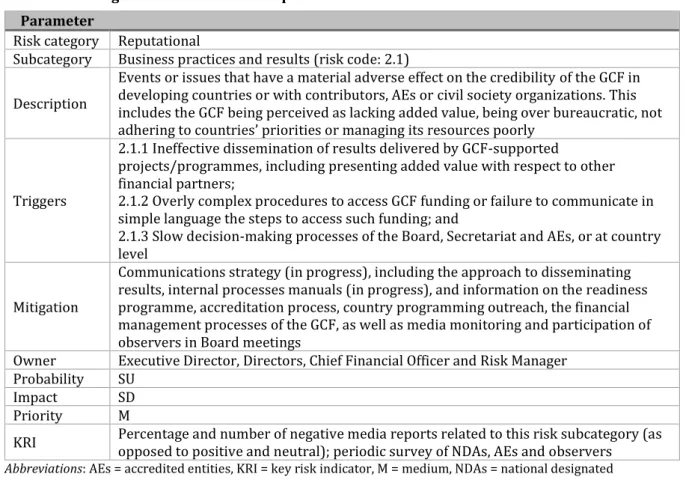
parts:
(a)
Description of the risk monitoring and reporting management system, including the
risk register that is being presented for Board approval as part of the draft decision
attached to this document;
(b)
Progress report on the application of the methodology to set the risk appetite of the
GCF to be presented for the consideration of the Board at its twelfth meeting; and
(c)
Description of additional tools that have been developed to operationalize the risk
GCF/B.11/07
Page b
Table of Contents
I.
Introduction
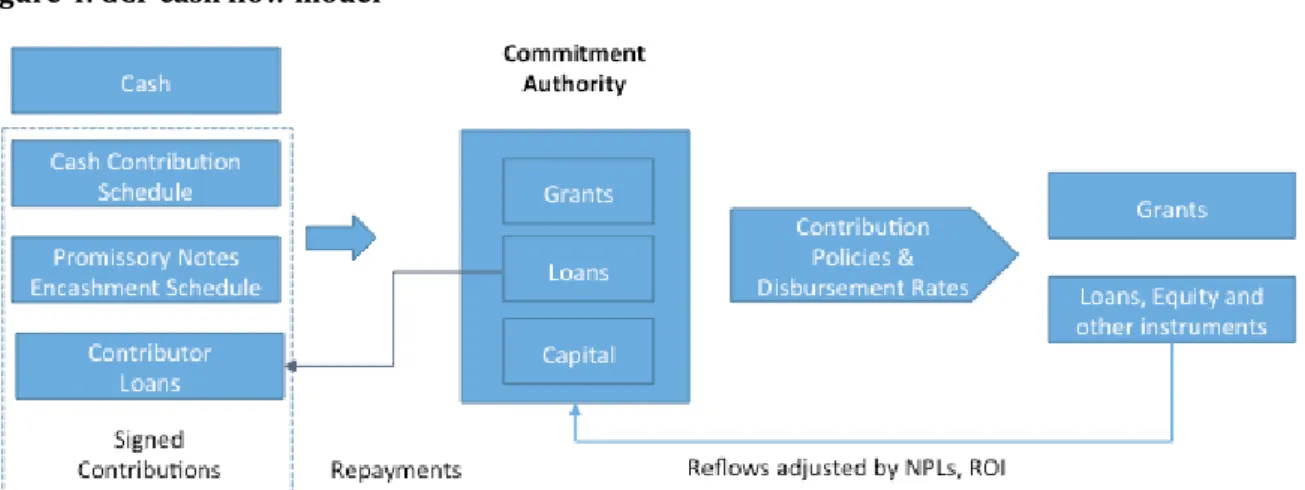
1
II.
Linkages with other documents
1
III.
Possible action by the Board
1
IV.
Linkages with previous decisions
1
V.
Objective
1
VI.
Risk monitoring and reporting management system
2
6.1
Financial statements and external audit reports
2
6.2
Risk register
3
6.3
Portfolio risk oversight
5
6.4
Internal controls: Committee of Sponsoring Organizations of the Treadway
Commission framework
7
VII.
Progress on establishing the risk appetite of the GCF
7
VIII.
Additional tools to operationalize risk management in the GCF
10
8.1
Cash flow model
10
8.2
Financial instrument management system
11
Annex I:
Draft decision of the Board
12
Annex II:
Risk register
13
Annex III:
Portfolio dashboard reporting template
27
GCF/B.11/07
Page 1
I.
Introduction
1.
The Board, through decision B.07/05, adopted the initial financial risk management
framework of the GCF, which included a financial risk monitoring and reporting management
system to be developed by the time the Board would consider funding proposals for approval.
Under the guidance of the Risk Management Committee, the GCF is developing the tools that
constitute this system. Each of its elements is presented for the information of the Board, except
for the risk register, which is presented as a draft decision for the consideration of the Board.
2.
Additionally, this document presents, for the information of the Board, a progress report
on the application of the methodology to establish the risk appetite of the GCF and a description
of other risk tools being developed to operationalize the risk management of the GCF.
II.
Linkages with other documents
3.
This document has linkages to the following documents:
(a)
Document GCF/B.11/Inf.07 titled “Strategic plan for the Green Climate Fund (progress
report)”; and
(b)
Document GCF/B.11/04 titled “Consideration of funding proposals”.
III.
Possible action by the Board
4.
Based on this document, the Board may consider adopting the proposed risk registry, an
essential element in the process of developing the risk appetite of the GCF.
IV.
Linkages with previous decisions
5.
Decision B.07/05 established the initial financial risk management framework of the
GCF, consisting of financial risk policies, a financial risk monitoring and reporting management
system and financial risk governance arrangements. The financial risk policies were further
elaborated through decision B.08/13 as part of the policies for contributions. Elements of the
financial risk monitoring and reporting management system were defined through decision
B.08/18 (financial reporting and the external auditing process) and decision B.BM-2015/06
(internal control framework).
6.
Decision B.07/05 also requested the Secretariat to start the process of analysis to
determine the risk appetite of the GCF. Through decision B.09/06, the Board took note of a
survey of methodologies to define and determine the risk appetite and through decision
B.10/08 it adopted the risk dashboard, its related risk categories and subcategories, and the
methodology to be followed by the GCF to set its risk appetite.
V.
Objective
7.
The purpose of this document is to provide an overarching view of the progress made in
operationalizing all aspects of risk management in the GCF, present the proposed risk register
and discuss the progress made towards implementing the risk appetite methodology. Figure 1
presents an expanded view of the GCF risk framework
1comprised of the risk monitoring and
1 For clarity, the term “risk framework” in this document refers to an expanded framework which includes both
financial and non-financial risks to take into account decision B.10/08. Decision B.07/05 only considered financial risks.
GCF/B.11/07
Page 2
reporting management system, the risk appetite setting methodology and tools, as well as
additional operational tools required to implement risk management in the GCF.
Figure 1.Elements of the risk framework
8.
This document is divided into the following three main sections, as outlined in figure 1
above:
(a)
Description of the risk monitoring and reporting management system, including the risk
register that is being presented for Board approval as part of the draft decision attached
to this document (Annex I);
(b)
Progress report on applying the methodology to set the risk appetite of the GCF to be
presented for the consideration of the Board at its twelfth meeting; and
(c)
Description of additional tools that have been developed to operationalize the risk
management of the GCF.
VI.
Risk monitoring and reporting management system
9.
The risk monitoring and reporting management system includes standard control
instruments (financial statements and external audit reports), a strategic risk planning tool
(risk register), risk and portfolio oversight tools (risk dashboard and portfolio management
system) and a methodology for periodic overall review of internal controls (self-evaluation
through the Committee of Sponsoring Organizations of the Treadway Commission (COSO)
framework).
6.1
Financial statements and external audit reports
10.
The GCF reviewed the main accounting standards in use globally and decided to adopt
the International Financial Reporting Standards (IFRS). This decision was based, inter alia, on
the fact that most jurisdictions are converging towards the IFRS; thus, its adoption by the GCF
would facilitate the process of resource mobilization and resource deployment as it would align
the accounting of the GCF with those of its partners. The GCF has now put in place an internal
accounting system to generate financial statements semi-annually using the IFRS.
GCF/B.11/07
Page 3
11.
In March 2015, Daemyung Grant Thornton was appointed as the external auditor of the
GCF for a period of three years. Its unqualified audit of the financial statements of the GCF is
being presented at the eleventh meeting of the Board for its consideration.
6.2
Risk register
12.
General definition:
a risk register is an inventory of all the risks to which an
organization is exposed, the mechanisms in place to mitigate them and an assessment of their
relative priority. For each risk, the following parameters are identified:
(a)
Triggers: key events
2the occurrence of which could lead to the risk materializing;
(b)
Mitigation: mechanisms in place to reduce the probability of occurrence or reduce the
impact of each type of risk if it were to materialize. Potential mitigation measures
include policies, procedures, internal controls and analytical tools;
(c)
Owner: unit or individual within the organization responsible for managing each risk;
(d)
Probability and impact: assessment, based on empirical evidence, qualitative tools or
expert judgement, of the likelihood of the risk materializing and, if the risk materializes,
the overall impact on the organization, taking into account the mitigation mechanisms in
place;
(e)
Priority: relative importance to the organization of each risk based on the combination
of the probability of occurrence and impact; and
(f)
Key risk indicator: parameter used to measure the level of risk that materialized.
13.
Proposed approach
. The draft risk register being proposed for Board decision (Annex
II) presents the parameters described above for each risk category and subcategory in the risk
dashboard approved by the Board at its tenth meeting. Table 1 illustrates the structure of the
risk register, taking as an example one of the risk subcategories – reputational risks arising from
business practices and results:
(a)
The
risk category
,
subcategory
and
description
are those approved by the Board
through decision B.10/08;
(b)
Three potential situations have been identified as
triggers
which could lead to the
materialization of this risk;
(c)
Mitigation
measures taken or under development in this case are as follows:
(d)
Communications strategy, including outreach to external stakeholders regarding the
activities and results achieved by the GCF;
(e)
Manuals clearly describing all internal processes, including accreditation and
second-level due diligence to ensure consistency of practices;
(f)
Readiness programme to support the development of the capacity of national
designated authorities (NDAs), including familiarizing them with the GCF processes and
results framework;
(g)
Continuous dialogue with national stakeholders through activities organized by the
Country Programming Division;
(h)
Financial management, including internal control processes to ensure adequate
management of resources;
2 Given the inherent uncertainty of risk, this is a non-exhaustive list. The proposed risk register for the GCF identifies
GCF/B.11/07
Page 4
(i)
Media monitoring to identify and allow an early response to external stakeholders’
adverse perception of the GCF; and
(j)
Participation of observers at Board meetings as well as other types of outreach to civil
society organizations to maximize transparency and understanding of the GCF;
(k)
Given the broad range of activities involved in mitigating this risk, the Executive
Director, Directors, the Chief Financial Officer and the Risk Manager are the
owners
of
this risk;
(l)
The
probability
and
impact
for this risk subcategory has been estimated as “somewhat
unlikely” and “somewhat disruptive” reflecting the overall medium level of likelihood
and impact given the mitigation measures in place. This assessment will be refined on
the basis of the simulation to be undertaken as part of the process of establishing the
risk appetite of the GCF;
(m)
The
priority
is assigned using the priority grid approved by the Board as part of the risk
dashboard (this grid is included at the end of Annex II) and it is effectively the result of
combining the probability and impact of occurrence as an ex-ante estimation of the
importance of such risk; and
(n)
The key risk indicator for this risk, as it is the case for any type of reputational risk, is
related to measuring media and other outside stakeholders’ perception.
Table 1: Risk register – illustrative exampleParameter
Risk category Reputational
Subcategory Business practices and results (risk code: 2.1) Description
Events or issues that have a material adverse effect on the credibility of the GCF in developing countries or with contributors, AEs or civil society organizations. This includes the GCF being perceived as lacking added value, being over bureaucratic, not adhering to countries’ priorities or managing its resources poorly
Triggers
2.1.1 Ineffective dissemination of results delivered by GCF-supported
projects/programmes, including presenting added value with respect to other financial partners;
2.1.2 Overly complex procedures to access GCF funding or failure to communicate in simple language the steps to access such funding; and
2.1.3 Slow decision-making processes of the Board, Secretariat and AEs, or at country level
Mitigation
Communications strategy (in progress), including the approach to disseminating results, internal processes manuals (in progress), and information on the readiness programme, accreditation process, country programming outreach, the financial management processes of the GCF, as well as media monitoring and participation of observers in Board meetings
Owner Executive Director, Directors, Chief Financial Officer and Risk Manager Probability SU
Impact SD
Priority M
KRI Percentage and number of negative media reports related to this risk subcategory (as opposed to positive and neutral); periodic survey of NDAs, AEs and observers
Abbreviations: AEs = accredited entities, KRI = key risk indicator, M = medium, NDAs = national designated authorities, SD = somewhat disruptive, SU = somewhat unlikely.
14.
Purpose and use of the risk register
. The risk register has two primary functions:
(a)
To verify the existence of risk mitigation measures for each of the risks faced by the GCF.
The identification of triggers (
what could lead to the materialization of the risk?
)
GCF/B.11/07
Page 5
materializing the risk?
). Good mitigation measures must be aligned with the triggers
to ensure that the GCF is seeking to control each of the sources of risk; and
(b)
To provide a framework to define the appetite with respect to each risk subcategory.
The assessment of probability and impact of each risk, along with simulations of
different scenarios, are key inputs to determine the risk appetite of the GCF as described
below.
15.
As described in decision B.07/05, the risk register is updated annually as the risk
environment in which the GCF operates evolves as a result of external events, changes in the
mix of instruments deployed by the GCF and other strategic priorities.
6.3
Portfolio risk oversight
16.
A key component of the process of operationalizing the initial risk management
framework is applying the GCF-wide risk dashboard to the review of individual projects to be
supported by the GCF and to their monitoring and evaluation once they enter into the portfolio.
Figure 2 shows the GCF project cycle. During the first stage (portfolio development), projects
are assessed against the GCF policy framework and investment criteria and are considered by
the Board for approval. In the second phase (portfolio management), the accredited entities
(AEs) and the GCF oversee the performance of projects and upon completion, evaluate their
results. This section discusses the risk analysis to be carried out at each of these stages so as to
ensure an adequate portfolio-wide risk oversight.
Figure 2. GCF project cycle
6.3.2
Portfolio development
17.
AEs working jointly with the NDAs/focal points have primary responsibility for
developing funding proposals. The GCF is responsible for ensuring that these funding proposals
are structured in a manner consistent with the mandate of the GCF so that they can become part
of the project pipeline. This is done through various mechanisms, including readiness
programmes through NDAs/focal points to strengthen their capacity to ensure strong country
ownership of funding proposals; continuous outreach and dialogue with the NDAs/focal points
and AEs; and periodic issuance of requests for proposals to stimulate pipeline development of
certain strategic characteristics. During this stage, the evolution of the GCF risk profile, as
defined in the risk dashboard and risk register, will be used to inform the process of pipeline
development. For example, an excessive concentration of the portfolio in a certain geographical
area may require focusing efforts in order to increase the pipeline of projects in other regions to
ensure a balanced portfolio.
18.
As part of the second-level due diligence carried out by the Secretariat, it assesses the
compliance of the proposed project with respect to GCF safeguards and policies. In this context,
the Secretariat carries out a risk assessment of projects at the following two levels during this
stage:
GCF/B.11/07
Page 6
(a)
Project-level risks: funding proposals submitted by AEs list the main
risks to the
projects
and the mitigating measures put in place to address each risk. Each AE can use
its own typology of risks but they are expected to be generally related to the
implementation, results and sustainability of the project. The Secretariat reviews the
completeness of the list of risks identified and the expected effectiveness of the
mitigation measures proposed as part of the project; and
(b)
GCF-level risks: additionally, the Secretariat assesses the
risks to the GCF
derived from
the project. This is done by reviewing the impact that the project may have on the nine
risk categories included in the risk dashboard.
3This includes, for example, the impact
that the project could have on increasing the risks related to the concentration of the
portfolio or the financial risks that it generates to the GCF.
19.
These two types of risk assessment are provided to the independent Technical Advisory
Panel in order to assist their review with respect to the six investment criteria and are also part
of the documentation provided to the Board as it considers the project for approval. As part of
the approval process, the Board may assign a new project to the special oversight category if,
given its risk characteristics, the project will require more frequent reporting from the AE and
analysis by the GCF as part of its portfolio management functions, as described below. The
Secretariat is in the process of developing internal processes manuals to be completed by the
end of the second quarter of 2016 in order to codify these processes to ensure the consistency
of the process of second-level due diligence, particularly once the number of AEs and projects of
the GCF increase.
6.3.3
Portfolio management
20.
Projects/programmes formally enter into the portfolio once they have been declared
effective following the completion of all legal documentation after Board approval.
4Oversight of
the portfolio will be carried out through a dashboard, the template of which is presented in
Annex III to this report. The dashboard will constitute the basic management and reporting tool
covering the following three aspects:
(a)
Description of the portfolio: presents a snapshot of the portfolio, including the financial
resources deployed (commitments and disbursements), distribution by region,
programme type (adaptation, mitigation, cross-cutting), financial instrument, AE type
and financial risk. It also lists the top 10 projects by size as well as projects categorized
as under special oversight if they have received a ‘risk flag’ if assessed as representing
particularly high levels of risk to the GCF. An annex to the dashboard will present all
GCF-funded projects;
(b)
Risk dashboard: for each risk category and subcategory in the risk register, the risk
dashboard presents the status of the key risk indicators and discusses significant
variations from the risk targets to be defined as part of the risk appetite setting process
and presents actions taken when risk limits are surpassed; and
(c)
Overall level of resources of the GCF: a full financial overview of the GCF is completed by
presenting the evolution of cash flows combining cash available, expected inflows based
on signed contributions and expected outflows based on the projected needs of the
existing portfolio.
21.
Financial data flows directly related to the GCF (e.g. payments from contributors,
disbursements to AEs) will be updated on a monthly basis. Overall risk assessments will be
3 The risk categories are: strategic, reputational, operational, legal, compliance, performance, funding, market and
liquidity.
4 Projects approved but not yet signed will be tracked separately and will be monitored to reflect that the
GCF/B.11/07
Page 7
updated monthly and data to be reported by AEs (e.g. project progress reports, disbursements
to implementing entities) will be updated quarterly. The Risk Manager, under the guidance of
the Risk Management Committee, will use the dashboard data to carry out quarterly risk
analyses of the portfolio as part of the process of risk reporting to the Board. As projects come
to an end and they undergo a final evaluation, the Risk Manager is part of this process to review
the risks that materialized during the project, the effectiveness of mitigation measures, risks to
the project’s continued sustainability and lessons learned.
6.4
Internal controls: Committee of Sponsoring Organizations of the
Treadway Commission framework
22.
Internal controls are an essential element of the governance, risk and compliance
oversight responsibilities of the GCF. The Secretariat reviewed several internal control
frameworks in use in major organizations and, on the basis of such analysis, the Board adopted
the COSO framework as the internal control framework of the GCF (decision B.BM-2015/06).
The GCF is implementing this framework in its five components, as follows:
(a)
A strong
control environment
mandated by decisions of the Board and guidance
received from the Executive Director;
(b)
Risk assessment
of the operations of the GCF, including through the implementation of
all elements of the risk framework;
(c)
Control activities
put in place in the operations of the GCF. Daeyoung Accounting
Corporation undertook an extensive internal audit of the GCF during March/April 2015
to assess the effectiveness of these activities. It reported that, based on its detailed audit
work, no major control weaknesses or issues were noted;
(d)
The financial statements and the dashboard mentioned above constitute critical
elements of the
information
and
communication
framework that has been put in place
to generate the data necessary to exercise effective internal controls; and
(e)
Periodic
monitoring activities
to test the continued effectiveness of internal controls
such as the one carried out earlier this year by an external firm.
23.
The overall effectiveness of the framework is reviewed by carrying out a COSO
self-assessment (CSA) of internal controls. CSA is a standard methodology that uses as a starting
point a questionnaire that the organization’s management responds to for each of the five COSO
components described in paragraph 22 above. Based on the responses, a more in-depth analysis
is performed in order to identify control weaknesses and solutions to address them. The GCF
will carry out its first CSA no later than at the end of the second quarter of 2017. At that time, it
is expected that the portfolio of the GCF would have reached a significant size, allowing for more
meaningful results from the CSA.
VII.
Progress on establishing the risk appetite of the GCF
24.
The Board, through decision B.10/08, adopted the methodology to establish the risk
appetite of the GCF. Under guidance from the Risk Management Committee, the Secretariat has
developed the components of the methodology and is working with the Risk Management
Committee in the preparation of the proposed risk limits and overall appetite statement. Figure
3 summarizes the progress to date for each of its components.
GCF/B.11/07
Page 8
Figure 3. GCF risk appetite – progress to date
25.
With the proposed risk registry drafted, the GCF is currently developing a set of ‘base’
scenarios generated by financial and non-financial events that will be used to analyse scenarios
and propose the target risk appetite for each risk subcategory in the registry. Ideally, the
proposed scenarios should be based on empirical evidence with a relatively long-term horizon
(e.g. 10 years) such as the historical variation in the price of a certain financial asset or the
number of occurrences of a particular event. For a new organization without a track record,
such as the GCF, alternative approaches are required and thus table 2 presents the rationale
used to select each scenario. In choosing these events, the GCF has sought to ensure that they
are both realistic and also significant (i.e. meaningful departures from what would be expected
to be the normal operation of the GCF). In most cases, the rationale for each event uses an
assumption anchored on a GCF policy parameter or historical information. In some cases, it has
been necessary to estimate a hypothetical, but possible, scenario.
Table 2. Draft scenarios for risk appetite simulations
Event Rationale
Non-financial events
The GCF has a moderate impact on climate change adaptation and mitigation
Paragraph 2 of the Governing Instrument for the GCF mandates the GCF to “promote the paradigm shift towards low-emission and climate-resilient development pathways”; having only a moderate impact could be considered as an event in which the GCF fails to fulfil such a mandate
Failure of the GCF to fulfil its gender policy, with only 25 per cent of projects including
specific gender elements and gender-sensitive implementation arrangements
While the GCF does not have a specific target, 25 per cent would be a level well below that of other comparable organizations
GCF/B.11/07
Page 9
Event Rationale
High concentration of accredited entities (AEs): six AEs disburse 90 per cent of resources
Such a concentration seeks to illustrate a scenario in which a small number of international access AEs take up most of the resources
Adaptation is only 25 per cent of the portfolio Mid-point to the target of 50 per cent Major misuse of funds in GCF projects carried out
by direct access AEs Test mitigation measures for risks associated with direct access AEs Impasse at the meeting of the Board leads to
eight months without project approvals No projects approved during a Board meeting GCF-funded projects lead to forced resettlement,
negatively affecting poor, vulnerable communities
A major risk that has materialized in other comparable organizations
AE violates local anti-money laundering laws Increasingly important for risk for comparable organizations and also permits analysis of non-compliance with local laws
Legal process against the Board is initiated by contractors of GCF-funded projects
In the absence of privilege and immunity arrangements, this is an important source of risk for the GCF
Country-ownership principles are not adhered to: no objections from national designated authorities/focal points are received but the GCF and the AEs fail to have a strong dialogue on pipeline development with countries
Assesses the impact of failing to follow paragraph 3 of the Governing Instrument on implementing a country-driven approach
Financial events The non-performing loans (NPLs) of the GCF
reach 20 per cent; loans are 10 per cent of the portfolio
The level of NPL reflects the level of cushion for losses required from loan contributors. The level of loans reflects the upper limit of expected loan and capital contributions to the GCF
A 19 per cent depreciation of EUR with respect to
USD Two times the standard deviation in the five years ending on 30 September 2015 Contributors reschedule by 18 months the
encashment schedule Rescheduling observed under stress scenarios in other comparable organizations GCF projects fully disburse within 24 months of
Board approval
While there are no guidelines on the expected period of disbursement, 24 months would test the impact on the liquidity of the GCF that a relatively fast pace of disbursement would have
Interim Trustee loses 5 per cent on liquid assets This is a stress scenario exceeding the Interim Trustee’s investment objectives of, at a minimum, preserving the invested capital
In total, 25 per cent of pledges are not converted into signed contributions by the end of the Initial Resource Mobilization (IRM)
In the absence of historical information or reasonable comparison from another
organization, this is a broad estimate to illustrate the potential impact of this event
The GCF provides a USD 100 million grant to a project which goes bankrupt
Reflects the expected median size of activities deemed to be “large” as per the accreditation policy (minimum size USD 50 million) The GCF invests 5 per cent of IRM resources in a
single equity fund which loses 50 per cent of principal
The 5 per cent represents the IRM initial expected level of loan contributions to the GCF. Losses of 50 per cent are an extreme but feasible loss level in high-risk activities such as equity funds
50 per cent of borrowers request five additional
years of a grace period Stress case to assess the impact of a generalized rescheduling of debts to the GCF Default on promissory notes/cash payment
schedule by one of the top three contributors
Stress case to assess the impact of contributions that do not materialize but are already accounted for as commitment authority
GCF/B.11/07
Page 10
26.
The impact of each non-financial scenario is initially assessed by looking at the different
risk triggers that would become active in each case and the adequacy of the risk mitigation
measures in place. Additionally, financial scenarios are provided as inputs to a cash flow model
in order to assess the impact on the financial position of the GCF and its ability to provide
liquidity to approved projects. In the final step of the simulation, both financial and
non-financial scenarios are pooled simultaneously to generate a range of combinations which permit
the identification of the types of risk most important to the GCF. At this point, the ex-ante
estimations of the risk priorities in the risk register can be updated. As a final step in the risk
appetite setting process, the Board will be presented with different options for its consideration
on the potential trade-off between different risk categories and will decide for which types of
risk the GCF can have a higher appetite, provided that the climate change benefits outweigh the
potential negative impact if those risks were to materialize.
VIII.
Additional tools to operationalize risk management in the GCF
27.
This section describes two additional tools essential for operationalizing the risk
management policies of the GCF: the cash flow model and the financial instrument management
system.
8.1
Cash flow model
28.
The cash flow model (see figure 4 below) developed as part of the risk appetite
methodology will be used not only to carry out simulations but more broadly as a key tool to
manage the overall asset liability and liquidity risk of the GCF. It combines a contributions
management module reflecting signed agreements and actual cash held by the GCF Interim
Trustee. Based on this, the resources of the GCF available for commitment (its commitment
authority) are calculated and allocated to approve projects according to the financial
instruments deployed to support them. In order to follow the policies of contributions, the
commitment authority is tracked in separate categories of contributions so that, for example,
resources coming from loan contributions are allocated only to loans extended by the GCF and
not to grants.
29.
Allocations are made following rules set by the policies for contributions and the rate of
disbursements are modelled using different scenarios based on the expected project execution
period (i.e. an estimate of the period over which disbursements will be made). In the case of
instruments generating reflows, these resources are fed back to the commitment authority of
the GCF and allocated to each contribution type as per the contribution policy (e.g. to ensure
that reflows from loans will be allocated on a pro rata basis to each type of contribution). The
model also permits the GCF to analyse the impact of different rates of non-performing loans and
returns on investments attained by GCF investments.
GCF/B.11/07
Page 11
Figure 4. GCF cash flow model
8.2
Financial instrument management system
30.
The financial instrument management system is the tool that the GCF will use to manage
its disbursements to AEs and, in the case of instruments generating reflows, receive fees,
interest, and principal and investment payments. The structure of the system has been designed
and is currently being implemented through a software developer procured by the GCF. Upon
testing and validation by the Secretariat, the systems will be operational by the end of the first
quarter of 2016.
GCF/B.11/07
Page 12
Annex I: Draft decision of the Board
The Board, having reviewed document GCF/B.11/07 titled “Initial risk management
framework: implementation progress and risk register”:
(a)
Adopts the risk register as contained in Annex II hereto;
(b)
Requests the Secretariat to present updates to such risk register to the Board for
adoption at least once a year;
(c)
Takes note of the implementation of the financial risk monitoring and reporting tools;
(d)
Also takes note of the progress report on the implementation of the risk appetite
methodology; and
(e)
Further takes note of additional tools being developed to implement the risk
GCF/B.11/07
Page 13
Annex II: Risk register
I.
Strategic risk
Risk code 1.1 1.2
Risk
category Strategic Strategic
Subcategory Climate impact and results Concentration
Description Failure to deliver the expected transformative mitigation and adaptation climate impact as defined by the objectives, investment criteria and the results management framework of the GCF
Concentration on a limited number or types of accredited entities (AEs) or geographies that fail to generate the required balance in mitigation/adaptation; pipeline of
projects/programmes
Triggers
1.1.1 Low scale (i.e. the GCF remains small relative to the size of the need); 1.1.2 Ineffective use of resources due to poor overall GCF strategy;
1.1.3 Ineffective use of resources due to the poor choice of projects/programmes to fund; and
1.1.4 Insufficient demand for GCF resources
1.2.1 Poor outreach or an excessively complicated accreditation process limits interest by entities to be accredited, leading to reliance on a limited number of them;
1.2.2 Pipeline management and approval process fail to adequately balance projects/programmes by
AE/geography/financial instrument; and
1.2.3 Deployment of funding through relatively few, large projects/programmes
Mitigation Internal governance, investment criteria, results management framework, monitoring and evaluation, resource mobilization, country programming outreach efforts, readiness programme, and accreditation process
Portfolio reports, including concentration levels (on profile of AEs, levels of approved funding, countries, instruments and project typology) to inform Board decisions on accreditation and funding approval and the Secretariat on pipeline development. Investment criteria
Owner Board, Executive Director and Directors Board, Executive Director and Directors
Probability Somewhat likely (SL) Likely (L)
Impact High (H) H
Priority H Medium (M)
Key risk
indicator Portfolio management overall annual assessment, including measurement of the core adaptation and mitigation indicators agreed in decision B.07/04
Herfindahl-Hirschman Index for AEs/ percentage distribution by number of projects and financial resources by geographical location and adaptation versus mitigation
GCF/B.11/07
Page 14
Risk code 1.3 1.4 1.5
Risk
category Strategic Strategic Strategic
Subcategory Portfolio management Accountability Country ownership
Description Failure to build an optimal portfolio of projects/programmes as defined by the initial results management framework of the GCF
Failure of governance to enable and make timely decisions in corporate affairs or to respond to guidance of the Conference of the Parties to the United Nations Framework Convention on Climate Change (COP)
Failure to develop a portfolio of projects and programmes that is fully aligned with country priorities and strategies; that fosters the involvement of local actors; and that is consistent with the country’s debt sustainability framework
Triggers
1.3.1 Weak oversight by AEs, national
designated authorities (NDAs) and the GCF on delivery of GCF investments and weak enforcement of remedial actions on low-performing projects;
1.3.2 Poor application of the results management framework to measure evolution of GCF-level results and adjust pipeline and portfolio accordingly; and 1.3.3 Ineffective identification (by the GCF, AEs, NDAs or other partners) of investment opportunities with strong paradigm shift potential
1.4.1 COP guidance that is difficult to
operationalize/translate into specific policies; 1.4.2 Inability to take timely decisions due to overloading of meeting agendas; and
1.4.3 Failure to implement and/or develop procedures to address decision-making between Board meetings
1.5.1 NDAs’/focal points’ low capacity, including due to limited support from the GCF or due to mismatch between NDAs/focal points with national overall priorities; 1.5.2 Failure of the GCF to incorporate NDAs/focal points, including due to
weaknesses in the no-objection process; and 1.5.3 Insufficient GCF support to direct access and other local accredited entities, leading to a low proportion of projects being proposed by these entities
Mitigation
Second-level due diligence process;
independent Technical Advisory Panel; active oversight in portfolio management;
monitoring and evaluation; and remedial actions when projects do not perform
Board procedures, intersessional decision-making arrangements and procedures for decision-making in the absence of consensus (under development)
Country programming outreach process to NDAs/focal points; GCF readiness
programme; no-objection process from NDAs/focal points; and second-level due diligence
Owner Board, Executive Director and Directors Board Board, Executive Director and Directors
Probability L L L Impact H H H Priority M M M Key risk indicator (KRI)
Analysis of portfolio distribution and linkages to observed GCF-level impacts on mitigation and adaptation
Delay in days between the presentation of a proposed decision to the Board and actual decision-making; and assessment of
divergence between COP guidance and actual Board decisions
GCF/B.11/07
Page 15
II.
Reputational risk
Risk code 2.1 2.2 2.3
Risk
category Reputational Reputational Reputational
Subcategory Business practices and results Unexpected shocks Accredited entities and other partners' activities
Description
Events or issues that have a materially adverse effect on the credibility of the GCF in developing countries or with contributors, accredited entities or civil society organizations. This includes the GCF being perceived as lacking added value, being over bureaucratic, not adhering to countries’ priorities or managing its resources poorly
Adverse publicity that occurs as a result of fraud, implementation failure or other types of unforeseen shocks related to the
operations of the GCF
Adverse publicity that occurs as a result of activities not related to the GCF of accredited entities (AEs) and other partners involved in projects/programmes, or from their lack of disclosure of relevant information
Triggers
2.1.1 Ineffective dissemination of results delivered by GCF-supported
projects/programmes, including presenting added value with respect to other financial partners;
2.1.2 Overly complex procedures to access GCF funding or failure to communicate in simple language the steps to access such funding; and 2.1.3 Slow decision-making processes at the Board, Secretariat, accredited entity or country level
2.2.1 Poor oversight of AEs by the GCF; 2.2.2 Poor oversight by AEs of executing entities, including with respect to adherence to procurement, environmental and social safeguards, as well as financial management; and
2.2.3 Failure to develop strong relationships with media, civil society organizations (CSOs) and other stakeholders
2.3.1 Failure of due diligence during the accreditation process;
2.3.2 Lack of internal ‘early warning systems’ based on media monitoring and engagement with other stakeholders; and 2.3.3 Lack of adequate institutional capacity in the Secretariat to monitor the number and complexity of AEs and other partners, thus increasing the difficulty of monitoring emerging risks
Mitigation
Communications strategy (in progress),
including the approach to disseminating results, internal processes manuals (in progress), readiness programme, accreditation process, country programming outreach, financial management processes of the GCF, media monitoring, participation of observers in Board meetings
Accreditation process, oversight actions taken by the GCF as specified in the master agreement signed with AEs, portfolio management, including review of the progress report for each project, activities of the Redress Mechanism and Integrity Unit, and media monitoring
Accreditation process, media monitoring, country programming and portfolio management units’ engagement with AEs, national designated authorities (NDAs), CSOs and other stakeholders
GCF/B.11/07
Page 16
Risk code 2.1 2.2 2.3
Owner Board, Executive Director, Directors and Chief Financial Officer Board, Executive Director, Directors and Heads of Accountability Units Executive Director and Director
Probability Somewhat unlikely (SU) Somewhat likely (SL) Likely (L)
Impact Somewhat disruptive (SD) High (H) H
Risk code 2.1 2.2 2.3
Priority Medium (M) H M
Key risk indicator
Percentage and number of negative media reports related to this risk subcategory (as opposed to positive and neutral); periodic survey of NDAs, AEs and observers
Percentage and number of negative media reports related to this risk subcategory (as opposed to positive and neutral)
Percentage and number of negative media reports related to this risk subcategory (as opposed to positive and neutral)
GCF/B.11/07
Page 17
III.
Operational risk
Risk code 3.1 3.2
Risk
category Operational Operational
Subcategory Accredited entities (AEs) and other parties’ risk Fiduciary
Description
Failure of AEs to comply with the AE master agreement, including in terms of information disclosure. Lack of implementation capacity of AEs, leading to lack of or slow disbursement. Failure of other parties, including executing entities (EEs), involved in GCF projects and programmes to comply with their respective agreements with the GCF or with AEs
Failure of the GCF to exercise effectively its fiduciary duty due to: (a) failure of internal controls in administrative and operational
procedures; (b) failure to effectively monitor risks and follow appropriate mitigation procedures, including due to the use of improper analytical models; (c) failure to oversee AEs (and their oversight over executing entities); (d) failure to monitor and engage national designated authorities (NDAs); and (e) internal or external fraud
Triggers
3.1.1 Inadequate accreditation process;
3.1.2 Accreditation master agreement not aligned with
implementation circumstances in certain countries/sectors/type of AEs; and
3.1.3 Deterioration in AEs’ institutional capacity and performance, including with respect to their ability to oversee executing entities
3.2.1 Absence of or unclear internal processes manuals and controls; 3.2.2 Defective AE master agreement that limits the ability of the GCF to exercise its fiduciary duty; and
3.2.3 Inadequate external audits of the GCF, AEs or EEs with respect to activities carried out with GCF funding
Mitigation Accreditation process; oversight of AEs through periodic monitoring and default clauses in the AE master agreement; portfolio management system
Technical imposed controls in computer systems; periodic internal controls review, including the Committee of Sponsoring Organizations of the Treadway Commission exercise. Risk management framework; portfolio management systems; periodic review, including spot checks, of AE activities; periodic engagement with NDAs; yearly audit of the GCF and of funded activities
Owner Executive Director and Directors Board, Executive Director and Directors
Probability Somewhat likely (SL) SL
Impact Somewhat disruptive (SD) SD
Priority High (H) H
Key risk indicator
(KRI)
Number of non-compliance with legal agreements/deviation in
GCF/B.11/07
Page 18
Risk code 3.3 3.4
Risk
category Operational Operational
Subcategory Staffing Business disruption
Description
Operational failures, losses and other disruptions arising from the staffing model of the GCF, including staff headcount level and external consultants, as well as from problems with recruitment, retention, succession planning, integrity and morale among GCF staff
Disruption of business due to catastrophic events or systems failures (hardware, software, telecommunications, unrest)
Triggers
3.3.1 Inadequate professional profile and insufficient GCF staff;
3.3.2 Inadequate workload per staff and/or lack of expectations regarding career progression; and
3.3.3 Use of consultants who only provide limited knowledge transfer to staff and who may have divided loyalties
3.4.1 Disruption in the provision of public services to GCF headquarters or strife that prevents temporary or permanent access to GCF headquarters;
3.4.2 Inaccessibility of GCF information assets, including failure of remote backup server systems and failure to develop and implement a remote-working location arrangement; and 3.4.3 Low-quality hardware and software developed or procured by the GCF
Mitigation
Human resources guidelines, including a competitive benefits package, effective performance management system, and continuous learning opportunities; actions to sustain staff morale; Board empowering of Secretariat staff; Integrity Unit
Cloud-centric way of holding and securing information assets, combined with mobile computing, to allow staff to work remotely. A business continuity management system consistent with International Organization for Standardization (ISO) 22301:2012 is under development
Owner Board, Executive Director, Directors and Integrity Unit Chief Financial Officer
Probability High (H) Likely
Impact SD H
Priority H Medium
Key risk indicator
(KRI)
Number of long-term unfulfilled positions, turnover rate, periodic benchmarking against similar organizations, number of incidents and associated losses involving rogue employees, consultants/staff ratio, staff survey, outcomes of performance management tools, ratios relating to: number of staff/level of GCF financial assets, number of staff/number of NDAs, AEs and projects
Number of events and associated impact, as well as outcomes of periodic simulated events
GCF/B.11/07
Page 19
IV.
Legal risk
Risk code 4.1 4.2 4.3
Risk category Legal Legal Legal
Subcategory Legislative Contractual Non-contractual
Description
Failure by the GCF, accredited entities (AEs) or executing entities to implement legislative or regulatory requirements related to the operations or engagements of the GCF in situations where governing laws or rules are ambiguous or untested
Use of defective contracts that expose the GCF to disputes and losses
The GCF, AEs or executing entities fail to keep to the spirit, as well as the letter, of non-contractual law: for example, with respect to infringement of third-party intellectual property rights
Triggers
4.1.1 Lack of privileges and immunities for the GCF and its staff in all countries where the GCF operates;
4.1.2 Improper monitoring of
legislative/regulatory changes applicable to the GCF, including due to poor communication with host country authorities; and
4.1.3 Inconsistency between regulations and laws applicable to the GCF and Board decisions, and other internal policies
4.2.1 Improper drafting of legal contracts by GCF legal staff, including due to improper monitoring of applicable laws;
4.2.2 Deviation from master/framework legal agreements; and
4.2.3 Improper drafting of a mediation mechanism clause
4.3.1 Non-compliance by the GCF, AE or executing entities with non-contractual law; 4.3.2 Failure of the GCF to follow generally accepted duty of care with staff, Board members or other stakeholders; and 4.3.3 Failure of an executing entity to follow procurement and environmental and social safeguards practices consistent with those established in the AE master agreement
Mitigation
General Counsel (GC) review of the operating environment of the GCF; accreditation process; portfolio and media monitoring; privileges and immunities (not yet in place)
GC and, where applicable, senior
management review of all contracts. Use of external counsel if necessary. Privileges and immunities (not yet in place)
GC oversight of legal documents and internal practices. Adequate staffing of portfolio management teams. Oversight of
commitments in the AE master agreement and in the funded activity agreement Owner Executive Director, Directors and GC Executive Director, Directors and GC Board, Executive Director and Directors
Probability Somewhat likely Likely (L) L
Impact High (H) H Somewhat non-disruptive
Priority H Medium (M) M
Key risk
indicator Number of events (sanctions, legal suits) and associated losses Number of events (sanctions, legal suits) and associated losses
Number of events (sanctions, legal suits) and associated losses
GCF/B.11/07
Page 20
V.
Compliance
Risk code 5.1 5.2
Risk category Compliance Compliance
Subcategory External Internal
Description Failure to comply with the applicable established laws, regulations, policies and standards and codes of conduct set by countries in which the GCF operates and by international law
Failure of staff or Board members to comply with the standards and codes of conduct that are set by the GCF itself through its policies and procedures
Triggers
5.1.1 Lack of privileges and immunities for the GCF and its staff in all countries where the GCF operates;
5.1.2 Ineffective/inefficient staff to monitor compliance; and
5.1.3 Uncertainty regarding laws/regulations/policies from countries where the GCF operates applicable to the GCF
5.2.1 Lack of compilation of policies, procedures, standards of codes;
5.2.2 Lack of enforcement by the Board or Secretariat management; and
5.2.3 Real or perceived ineffectiveness of the Integrity Unit Mitigation
Fiduciary policies, including anti-money laundering/countering the financing of terrorism (under development). Environmental and social safeguards; periodic exchanges with home country authorities; privileges and immunities (not yet in place)
Board meetings; internal processes manuals (under development); Integrity Unit
Owner Executive Director, General Counsel, Chief Financial Officer (CFO) and Directors Board, Executive Director, General Counsel, CFO, Directors and Integrity Unit
Probability Somewhat likely Somewhat unlikely
Impact High (H) Somewhat disruptive
Priority H Medium
Key risk
GCF/B.11/07
Page 21
VI.
Performance risk
Risk code 6.1 6.2 6.3
Risk
category Performance Performance Performance
Subcategory Temporal Monetary Investment criteria
Description
Failure of accredited entities (AEs) or executing entities (EEs) to respect tenors and/or schedules as pertain to financial obligations or the execution of projects/programmes
Failure of AEs and EEs to honour financial obligations in a timely manner. This includes credit risk; counterparty risk; equity risk; and political risk, including nationalization, expropriation, convertibility and
transferability
Failure of AEs or EEs to adhere to the investment criteria results to which they committed themselves
Triggers
6.1.1 Temporary inability of AE or EE to make timely payments either due to events related to the project/programme funded by the GCF or to external events; and
6.1.2 Lax project implementation by AE leads to significant delays in project execution
6.2.1 Inability (insolvency) of AE or EE to make payments, either due to events related to the project/programme funded by the GCF or to external events;
6.2.2 GCF remedies in cases of default are ineffective (or such perception exists among AEs and EEs), including due to the
arbitration clause in GCF legal agreements being successfully contested in court; and 6.2.3 Grant is lost in the bankruptcy process and the project is not implemented
6.3.1 Investment criteria are not specific enough to guide AE/EE and the GCF fails to provide further specificity in legal
documents associated with each investment; 6.3.2 Reporting requirements from AE/EE are insufficient to assess compliance with investment criteria (including due to a reporting time lag); and
6.3.3 Poor oversight by the GCF of AE activities or failure to identify potential deviations from the investment criteria during the project/programme approval phase
Mitigation
Accreditation process; project approval process; AE monitoring process as specified in the AE master agreement; portfolio management oversight and remedial actions for low-performing projects; media and other public sources monitoring
Accreditation process; project approval process; AE monitoring process as specified in the AE master agreement; portfolio management system; media and other public sources monitoring
Accreditation process; project approval process; AE monitoring process as specified in the AE master agreement; media and other public sources monitoring; periodic interaction with the national designated authorities (NDAs)
Owner Executive Director, Directors, Chief Financial Officer (CFO) and Risk Manager Executive Director, Directors, CFO and Risk Manager Executive Director, Directors, CFO and Risk Manager
GCF/B.11/07
Page 22
Risk code 6.1 6.2 6.3
Impact Somewhat non-disruptive (SND) High SND
Priority Low (L) Medium (M) L
Key risk indicator
(KRI)
Number and amount of rescheduled flows as
percentage of portfolio Non-performing loans and write-offs
Number of instances of deviation and amount of resources involved, costs (operational and financial) incurred on correcting such deviations
Risk code 6.4
Risk
category Performance Subcategory Concentration
Description Failure to sufficiently diversify the portfolio of AEs/EEs and/or investments such that a material adverse event related to a restricted number of AEs/EEs and/or projects would have a portfolio-level threatening impact on the GCF Triggers 6.4.1 Failure of the project approval process to identify impact of specific project on the overall concentration profile; and 6.4.2 Failure to periodically adjust the criteria for project approval to keep an adequate balance of the portfolio with respect to AE/EE or
instruments used
Mitigation Accreditation process; project approval process; portfolio management system; AE monitoring process as specified in the AE master agreement; media and other public sources monitoring; periodic interaction with the NDAs Owner Executive Director, Directors, CFO and Risk Manager
Probability SU
Impact Somewhat disruptive
Priority M
Key risk indicator
GCF/B.11/07
Page 23
VII.
Funding risk
Risk code 7.1 7.2
Risk category Funding Funding
Subcategory Conversion Encashment
Description Failure to convert pledges into contributions in a timely manner Expected payments in cash or the encashment of promissory notes do not materialize within the expected time frame
Triggers
7.1.1 Fiscal issues arising in contributor countries;
7.1.2 Delays in legal processes within contributor countries or changes in policy priorities with respect to climate change; and
7.1.3 Loss in confidence of contributor countries in the effectiveness of the GCF
7.2.1 Fiscal issues arising in contributor countries;
7.2.2 Change in policy priorities with respect to climate change; and
7.2.3 Real or perceived inability of the GCF to enforce contribution arrangements
Mitigation Resource mobilization reports to the Board; periodic engagement with contributors; media and other public sources monitoring Resource mobilization reports to the Board; periodic engagement with contributors; media and other public sources monitoring
Owner Executive Director, Chief Financial Officer (CFO) and Risk Manager Executive Director, CFO and Risk Manager
Probability Somewhat likely Likely (L)
Impact High (H) Somewhat disruptive
Priority H Low (L)
Key risk
GCF/B.11/07
Page 24
Risk code 7.3 7.4
Risk category Funding Funding
Subcategory Reflow Concentration
Description Expected reflows to the GCF from the project portfolio do not materialize within the expected time frame
Failure to sufficiently diversify the portfolio of contributors such that a materially adverse event related to one or a few key contributors would give rise to a GCF-threatening liquidity or solvency situation
Triggers 7.3.1 Performance risk; and 7.3.2 Failure of GCF grant/loan management (operational risk) system to identify missing flows
7.4.1 Support for climate change financing is limited to a relatively reduced number of countries due to evolving policy priorities;
7.4.2 Failure of replenishment processes due to ineffective outreach to contributors; and
7.4.3 Impasse occurs at the level of the Conference of the Parties to the United Nations Framework Convention on Climate Change
Mitigation Periodic testing of internal management systems Resource mobilization reports to the Board; periodic engagement with contributors; commitments management system; media and other public sources monitoring Owner Executive Director, CFO and Risk Manager Executive Director, CFO and Risk Manager
Probability Somewhat unlikely L
Impact H H
Priority Medium (M) M
Key risk indicator
(KRI) Amount of missing reflows and number of months of delay per AE
Herfindahl-Hirschman Index for contributors and/or list of top five contributors as percentage of replenishment
GCF/B.11/07
Page 25
VIII.
Market risk
Risk code 8.1 8.2 8.3
Risk category Market Market Market
Subcategory Foreign exchange (FX) Interest rate Liquidity
Description Foreign exchange risk
Adverse changes in interest rates, including investment losses in the liquid cash portfolio of the GCF
Timing mismatch between the cash inflows and cash outflows, leading to shortages in the ability of the GCF to face its payment obligations (including disbursements to accredited entities (AEs))
Triggers
8.1.1 FX fluctuations affecting the value of un-encashed signed contributions;
8.1.2 FX fluctuations affecting the value of reflows to the GCF; and
8.1.3 FX fluctuations affecting the value of commitments made to AEs for grants and loans made in currencies different to the holding currency of the GCF
8.2.1 Change in interest rates generates losses in the Trustee investment of the liquid portfolio of the GCF; and
8.2.2 Prepayment risk of fixed-rate financial instruments provided by the GCF
8.3.1 Delay in encashment of signed contributions;
8.3.2 Disbursement requests from AE exceeding expected rate; and
8.3.3 Rescheduling of loans extended by the GCF
Mitigation Instruments management system (in progress); FX reserve; FX hedging
Periodic review of trustee investment policies; project approval process; asset-liability management system
Cash flow model; financial instruments management system
Owner Board, Executive Director, Chief Financial Officer (CFO) and Risk Manager Executive Director, Director, CFO and Risk Manager Executive Director, CFO and Risk Manager
Probability Somewhat likely (SL) SL SL
Impact Somewhat disruptive (SD) Somewhat non-disruptive SD
Priority High (H) Medium H
Key risk indicator
Historical losses adjusted to take into account FX positions that cannot be hedged on an economic basis
Value at risk of liquid portfolio and amount of fixed-rate loans extended by the GCF subject to prepayment risk
Duration mismatch and/or percentage of available funds held as a liquidity cushion
GCF/B.11/07
Page 26
IX.
Priority table
Impact Occurrence
probability
Low (L) Somewhat non-disruptive (SND)
Somewhat disruptive
(SD) High (H)
Low (L) Low priority Low priority Low priority Medium priority
Somewhat unlikely (SU) Low priority Low priority Medium priority Medium priority
Somewhat likely (SL) Low priority Medium priority High priority High priority