Asset Management Strategy
5.1
Asset Management Strategy Overview
Asset Management is not new to London. It is a constantly evolving
set of procedures and actions intended to obtain best value from the
City’s assets. This chapter describes the current and future strategies
used to manage the asset base. The City of London has practiced
sound asset management throughout its history in the form of a
departmental asset based management style with the goal of
maintaining the asset in an acceptable condition. Over time, the
science of asset management has evolved to a service based focus
that looks at optimizing the asset lifecycle costs considering
quantifiable risk and level of service. London recognized this
philosophical shift in asset management away from asset condition to
the delivery of service and commenced active development of a
corporate asset management program in 2011. The current state of
London was analyzed and policy and strategies were written. Pilots
for implementation of the new strategies are intended for
implementation in 2014. This means that London is on the cusp of a
major change in asset management practices. This chapter presents
both existing and future asset management practices. In addition to
the overall strategies, the City walks a path of continuous
improvement with an ongoing flow of activities addressing asset
issues. These parallel activities are also described in this chapter and
are indicative of the flexibility the City exercises in the effective
management of its assets.
5.2
Existing Asset Management Activities
To conform to the Ministry guideline, this section summarizes in a tabular format, indexed in Table 5-1, the
planned actions (first table of each section) and describes the asset decision making approach (second table of
each section) for the key Ministry focus areas; water, wastewater-sanitary, wastewater-stormwater and roads &
structures. The remaining City of London service areas are overviewed in brief summaries. In addition to the life
cycle and growth planned actions, the City of London undertakes many ‘service improvements’ in order to
increase its efficiency and effectiveness.
TABLE 5-1 INDEX OF ASSET MANAGEMENT ACTIVITIES
Service Area Planned Actions Decision-Making Practices
Water Table 5-2 Page 5-2 Table 5-3 Page 5-3 Wastewater - Sanitary Table 5-4 Page 5-4 Table 5-5 Page 5-5 Wastewater - Stormwater Table 5-6 Page 5-6 Table 5-7 Page 5-7 Roads and Structures Table 5-8 Page 5-8 Table 5-9 Page 5-9
Asset Management Practices
5.2.1
Water
TABLE 5-2 CURRENT ASSET MANAGEMENT PRACTICES OR PLANNED ACTIONS FOR THE WATER SERVICE AREA
Non-Infrastructure Solutions Actions or policies that can lower
costs or extend useful lives
Operational improvements
Improvements to employee capabilities, communications, training, etc.
Ongoing search for additional funding: user fees, rates, lobby for transfer funding, P3’s (Public Private Partnerships), etc.
Public involvement practices
Updating and applying design standards
Coordination efforts to optimize construction between city projects and external parties (Utility Coordinating Committees)
Financial and Planning strategies to control costs
Development controls and approvals
Encouragement of conservation of water and energy through policy, procedures, public outreach, etc.
Developing Corporate Asset Management program
Developing computerized maintenance management system
Maintenance Activities Including regularly scheduled inspection and maintenance, or more significant repair and activities
associated with unexpected events.
Scheduled preventative maintenance programs including air and vacuum valve maintenance program
Scheduled inspection programs for key assets – e.g. leak detection
24 hour maintenance response capability
Reactive maintenance for significant portion of asset inventory
Maintenance also triggered by the public ‘inspection’ through phone and web interface available for public reports/complaints
Service improvements such as Acoustic Fibre Optic Conversion to SCADA
Renewal/Rehab Activities Significant repairs designed to
extend the life of the asset.
Watermain rehabilitation based on the current condition of the pipe o Cleaning
o Re-lining including cement lining and structural lining o Cathodic protection (anode program)
Water facilities are rehabilitated based on facility inspection reports o Refurbish pumps, etc.
Replacement Activities Activities that are expected to occur once an asset has reached the end of
its useful life and renewal/rehab is no longer an option.
Watermain replacement based on the current condition of the pipe o Complete open-cut replacement
o Horizontal directional drilling (HDD)
Meter Replacement using newer technology
Lead service replacement program – Water quality reasons
Water facilities replaced based on facility inspection reports o Replace pumps, valves, etc.
Whenever assets are built, applicable service improvements are made
Disposal Activities Activities associated with disposing
of an asset once it has reached the end of its useful life, or is otherwise
no longer needed by the municipality.
Water main disposal
o Abandoned in situ, no cost recovery o Removed, no cost recovery
o Data on old water main is stored in GIS (Geographic Information System). GIS tracks the asset status (i.e. active, abandoned, and/ or removed)
Water facilities disposal
o Equipment removed. Land reused or sold
o Equipment disposed or inventoried as spare parts, no cost recovery
Expansion Activities Planned activities required to extend services to previously unserved areas – or expand services to meet growth
demands.
Undertake Environmental Assessments
Capital growth projects-watermain extensions and expansions, pump stations
Assumption of subdivisions, commercial and industrial extensions, local improvements, etc.
Interim works (typically one to ten years) built to provide service until major works become operational
5.2.1.1
Water Assets Decision Making Approach
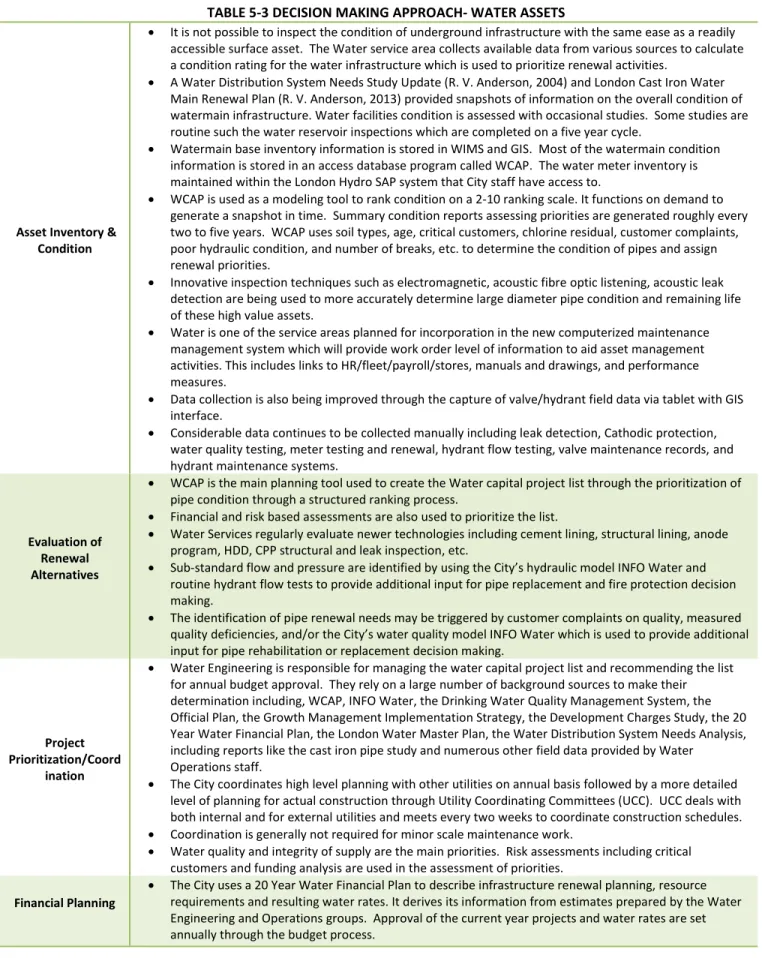
TABLE 5-3 DECISION MAKING APPROACH- WATER ASSETS
Asset Inventory & Condition
It is not possible to inspect the condition of underground infrastructure with the same ease as a readily accessible surface asset. The Water service area collects available data from various sources to calculate a condition rating for the water infrastructure which is used to prioritize renewal activities.
A Water Distribution System Needs Study Update (R. V. Anderson, 2004) and London Cast Iron Water Main Renewal Plan (R. V. Anderson, 2013) provided snapshots of information on the overall condition of watermain infrastructure. Water facilities condition is assessed with occasional studies. Some studies are routine such the water reservoir inspections which are completed on a five year cycle.
Watermain base inventory information is stored in WIMS and GIS. Most of the watermain condition information is stored in an access database program called WCAP. The water meter inventory is maintained within the London Hydro SAP system that City staff have access to.
WCAP is used as a modeling tool to rank condition on a 2-10 ranking scale. It functions on demand to generate a snapshot in time. Summary condition reports assessing priorities are generated roughly every two to five years. WCAP uses soil types, age, critical customers, chlorine residual, customer complaints, poor hydraulic condition, and number of breaks, etc. to determine the condition of pipes and assign renewal priorities.
Innovative inspection techniques such as electromagnetic, acoustic fibre optic listening, acoustic leak detection are being used to more accurately determine large diameter pipe condition and remaining life of these high value assets.
Water is one of the service areas planned for incorporation in the new computerized maintenance management system which will provide work order level of information to aid asset management activities. This includes links to HR/fleet/payroll/stores, manuals and drawings, and performance measures.
Data collection is also being improved through the capture of valve/hydrant field data via tablet with GIS interface.
Considerable data continues to be collected manually including leak detection, Cathodic protection, water quality testing, meter testing and renewal, hydrant flow testing, valve maintenance records, and hydrant maintenance systems.
Evaluation of Renewal Alternatives
WCAP is the main planning tool used to create the Water capital project list through the prioritization of pipe condition through a structured ranking process.
Financial and risk based assessments are also used to prioritize the list.
Water Services regularly evaluate newer technologies including cement lining, structural lining, anode program, HDD, CPP structural and leak inspection, etc.
Sub-standard flow and pressure are identified by using the City’s hydraulic model INFO Water and routine hydrant flow tests to provide additional input for pipe replacement and fire protection decision making.
The identification of pipe renewal needs may be triggered by customer complaints on quality, measured quality deficiencies, and/or the City’s water quality model INFO Water which is used to provide additional input for pipe rehabilitation or replacement decision making.
Project Prioritization/Coord
ination
Water Engineering is responsible for managing the water capital project list and recommending the list for annual budget approval. They rely on a large number of background sources to make their determination including, WCAP, INFO Water, the Drinking Water Quality Management System, the Official Plan, the Growth Management Implementation Strategy, the Development Charges Study, the 20 Year Water Financial Plan, the London Water Master Plan, the Water Distribution System Needs Analysis, including reports like the cast iron pipe study and numerous other field data provided by Water
Operations staff.
The City coordinates high level planning with other utilities on annual basis followed by a more detailed level of planning for actual construction through Utility Coordinating Committees (UCC). UCC deals with both internal and for external utilities and meets every two weeks to coordinate construction schedules.
Coordination is generally not required for minor scale maintenance work.
Water quality and integrity of supply are the main priorities. Risk assessments including critical customers and funding analysis are used in the assessment of priorities.
Financial Planning
The City uses a 20 Year Water Financial Plan to describe infrastructure renewal planning, resource requirements and resulting water rates. It derives its information from estimates prepared by the Water Engineering and Operations groups. Approval of the current year projects and water rates are set annually through the budget process.
Regulations continue to change rapidly in the water business impacting investment planning.
5.2.2
Wastewater - Sanitary
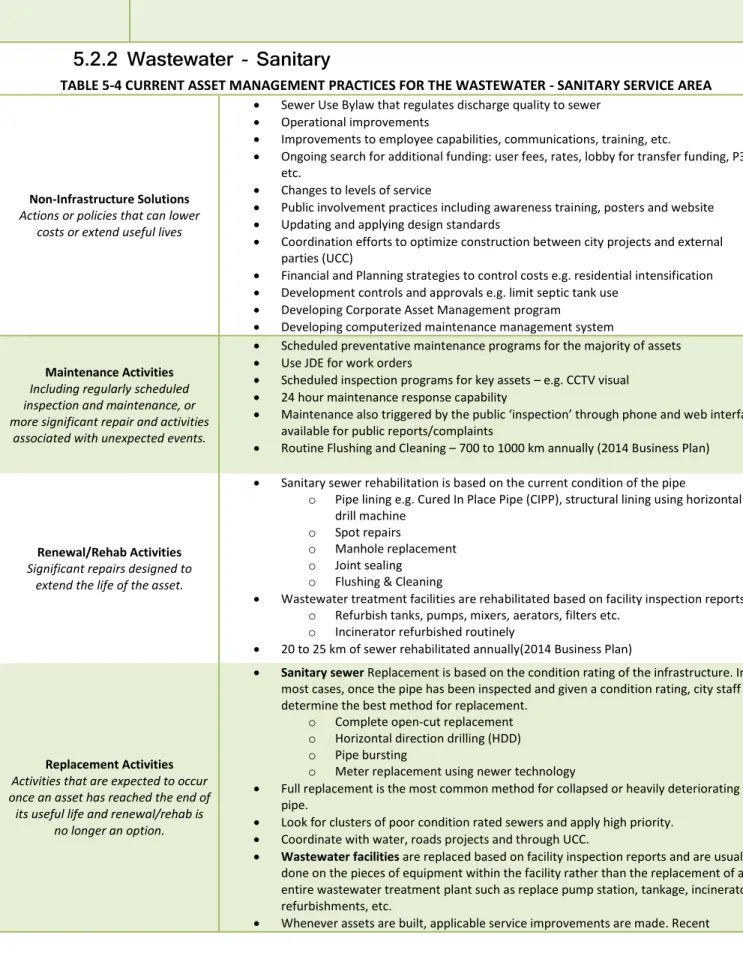
TABLE 5-4 CURRENT ASSET MANAGEMENT PRACTICES FOR THE WASTEWATER - SANITARY SERVICE AREA
Non-Infrastructure Solutions Actions or policies that can lower
costs or extend useful lives
Sewer Use Bylaw that regulates discharge quality to sewer
Operational improvements
Improvements to employee capabilities, communications, training, etc.
Ongoing search for additional funding: user fees, rates, lobby for transfer funding, P3’s, etc.
Changes to levels of service
Public involvement practices including awareness training, posters and website
Updating and applying design standards
Coordination efforts to optimize construction between city projects and external parties (UCC)
Financial and Planning strategies to control costs e.g. residential intensification
Development controls and approvals e.g. limit septic tank use
Developing Corporate Asset Management program
Developing computerized maintenance management system
Maintenance Activities Including regularly scheduled inspection and maintenance, or more significant repair and activities
associated with unexpected events.
Scheduled preventative maintenance programs for the majority of assets
Use JDE for work orders
Scheduled inspection programs for key assets – e.g. CCTV visual
24 hour maintenance response capability
Maintenance also triggered by the public ‘inspection’ through phone and web interface available for public reports/complaints
Routine Flushing and Cleaning – 700 to 1000 km annually (2014 Business Plan)
Renewal/Rehab Activities Significant repairs designed to
extend the life of the asset.
Sanitary sewer rehabilitation is based on the current condition of the pipe
o Pipe lining e.g. Cured In Place Pipe (CIPP), structural lining using horizontal drill machine
o Spot repairs
o Manhole replacement o Joint sealing
o Flushing & Cleaning
Wastewater treatment facilities are rehabilitated based on facility inspection reports o Refurbish tanks, pumps, mixers, aerators, filters etc.
o Incinerator refurbished routinely
20 to 25 km of sewer rehabilitated annually(2014 Business Plan)
Replacement Activities Activities that are expected to occur once an asset has reached the end of
its useful life and renewal/rehab is no longer an option.
Sanitary sewer Replacement is based on the condition rating of the infrastructure. In most cases, once the pipe has been inspected and given a condition rating, city staff can determine the best method for replacement.
o Complete open-cut replacement o Horizontal direction drilling (HDD) o Pipe bursting
o Meter replacement using newer technology
Full replacement is the most common method for collapsed or heavily deteriorating pipe.
Look for clusters of poor condition rated sewers and apply high priority.
Coordinate with water, roads projects and through UCC.
Wastewater facilities are replaced based on facility inspection reports and are usually done on the pieces of equipment within the facility rather than the replacement of an entire wastewater treatment plant such as replace pump station, tankage, incinerator refurbishments, etc.
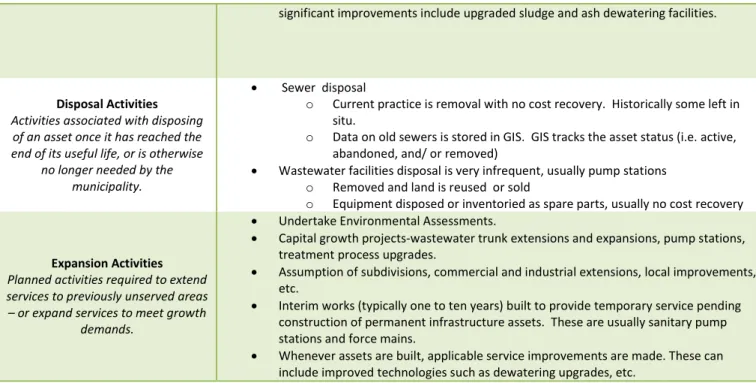
significant improvements include upgraded sludge and ash dewatering facilities.
Disposal Activities Activities associated with disposing
of an asset once it has reached the end of its useful life, or is otherwise
no longer needed by the municipality.
Sewer disposal
o Current practice is removal with no cost recovery. Historically some left in situ.
o Data on old sewers is stored in GIS. GIS tracks the asset status (i.e. active, abandoned, and/ or removed)
Wastewater facilities disposal is very infrequent, usually pump stations o Removed and land is reused or sold
o Equipment disposed or inventoried as spare parts, usually no cost recovery
Expansion Activities Planned activities required to extend services to previously unserved areas – or expand services to meet growth
demands.
Undertake Environmental Assessments.
Capital growth projects-wastewater trunk extensions and expansions, pump stations, treatment process upgrades.
Assumption of subdivisions, commercial and industrial extensions, local improvements, etc.
Interim works (typically one to ten years) built to provide temporary service pending construction of permanent infrastructure assets. These are usually sanitary pump stations and force mains.
Whenever assets are built, applicable service improvements are made. These can include improved technologies such as dewatering upgrades, etc.
5.2.2.1
Wastewater - Sanitary Decision Making Approach
TABLE 5-5 DECISION MAKING APPROACH- WASTEWATER, SANITARY
Determination of Asset Condition
Sanitary sewers face similar challenges for condition evaluation as water pipes but have the benefit of some better information through the use of video inspection capability.
Inventory information is stored in the SIMS and Geodatabase systems.
Condition information is most accurately determined through the video inspection which covers as much pipe as the budget allows usually in the order of 10 to 15% annually. All trunk pipes are video inspected within a minimum 10 year cycle. Video inspection is expensive and slow but very accurate for the pipe inspected.
Results from the CCTV investigations are used to develop strategic replacement, lining, and spot repair and excavation repair programs. This type of assessment is essential to administrators responsible for managing the City’s sewer assets.
The City also uses performance indicators like maintenance history via the number of failures and blockages to monitor condition and guide rehabilitation planning.
Condition inspection and video information is stored in the Sewer Sleuth software program and used to plan renewal activities.
Major process equipment in the wastewater treatment plants is addressed through specific assessment reports as well as routine operator inspection and maintenance. This equipment is monitored through SCADA processes with a high degree of reliability.
Wastewater-sanitary is one of the service areas planned for incorporation in the new computerized maintenance management system which will provide work order level of information to aid asset management activities. This includes links to HR/fleet/payroll/stores, manuals and drawings, and performance measures.
Evaluation of Renewal Alternatives
Sewer Sleuth is the main tool used to assess the work that is needed. The software system allows the analysis of pipe condition based on CCTV inspection, age, failure history, pipe material, hydraulics and importance factors. The Sewer Sleuth process rates the pipe as Good, Fair 1, 2, 3 Poor 1, 2, 3, etc.
Once the decision is made to replace the sewer, alternatives for replacement are evaluated considering needs for growth, alternate routing, capacity, available technologies and cost.
Based on the value of work;
o a distinct project is created,
o the work is merged into a pooled project containing several smaller locations, or o work is absorbed as part of the routine operating and maintenance workload.
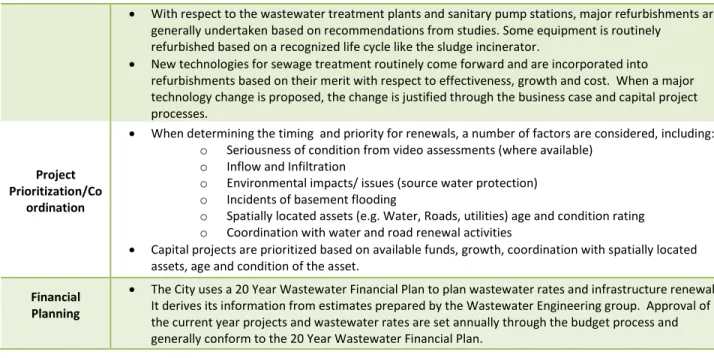
With respect to the wastewater treatment plants and sanitary pump stations, major refurbishments are generally undertaken based on recommendations from studies. Some equipment is routinely
refurbished based on a recognized life cycle like the sludge incinerator.
New technologies for sewage treatment routinely come forward and are incorporated into refurbishments based on their merit with respect to effectiveness, growth and cost. When a major technology change is proposed, the change is justified through the business case and capital project processes.
Project Prioritization/Co
ordination
When determining the timing and priority for renewals, a number of factors are considered, including: o Seriousness of condition from video assessments (where available)
o Inflow and Infiltration
o Environmental impacts/ issues (source water protection) o Incidents of basement flooding
o Spatially located assets (e.g. Water, Roads, utilities) age and condition rating o Coordination with water and road renewal activities
Capital projects are prioritized based on available funds, growth, coordination with spatially located assets, age and condition of the asset.
Financial Planning
The City uses a 20 Year Wastewater Financial Plan to plan wastewater rates and infrastructure renewal. It derives its information from estimates prepared by the Wastewater Engineering group. Approval of the current year projects and wastewater rates are set annually through the budget process and generally conform to the 20 Year Wastewater Financial Plan.
5.2.3
Wastewater - Stormwater
TABLE 5-6 CURRENT ASSET MANAGEMENT PRACTICES FOR THE WASTEWATER - STORMWATER SERVICE AREA
Non-Infrastructure Solutions Actions or policies that can lower
costs or extend useful lives
Ongoing search for funding mechanisms, fees, rates, lobby for transfer funding, P3’s, etc.
Improvements to employee capabilities, communications, training, etc.
Operational improvements
Changes to levels of service
Public involvement practices
Updating and applying design standards
Coordination efforts to optimize construction between city projects and external parties (UCC)
Financial and Planning strategies to control costs e.g. encourage private property stormwater management systems
Developing Corporate Asset Management program
Developing computerized maintenance management system
Maintenance Activities Including regularly scheduled inspection and maintenance, or more significant repair and activities
associated with unexpected events.
Scheduled preventative maintenance programs (e.g. pipe flushing, annual clean out program for catch basins, stormwater facilities inlet/outlets cleaning, etc.)
Scheduled inspection programs for key assets
24 hour maintenance response capability
Reactive maintenance for significant portion of asset inventory
Maintenance also triggered by the public ‘inspection’ through phone and web interface available for public reports/complaints
Renewal/Rehab Activities Significant repairs designed to
extend the life of the asset.
Stormwater pipes rehabilitation is similar to processes used for sanitary sewers and based on the condition rating. However storm sewers are inspected less often using the video inspection process. Rehabilitation activities include: Pipe lining {e.g. Cured In Place Pipe (CIPP), structural lining using horizontal drill machine}, spot repairs, Manhole replacement and joint sealing.
Stormwater facilities are generally newer and have had minimal demand for renewal to date. Two ponds have been rehabilitated. Renewals are driven by field inspections and can be triggered by observations from the public.
Dykes and other flood/erosion control mechanisms are rehabilitated triggered by field observations.
Replacement Activities Activities that are expected to occur once an asset has reached the end of
its useful life and renewal/rehab is no longer an option.
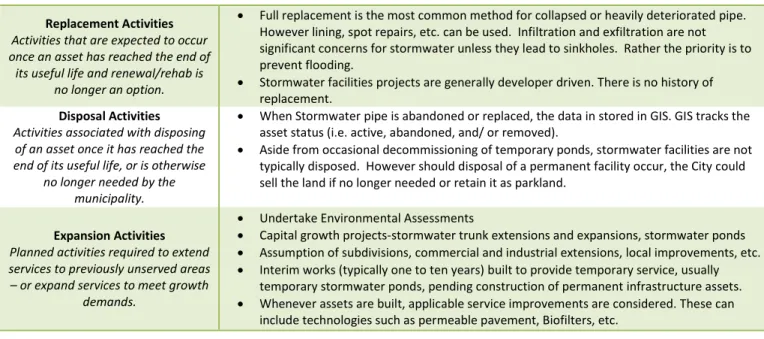
Full replacement is the most common method for collapsed or heavily deteriorated pipe. However lining, spot repairs, etc. can be used. Infiltration and exfiltration are not significant concerns for stormwater unless they lead to sinkholes. Rather the priority is to prevent flooding.
Stormwater facilities projects are generally developer driven. There is no history of replacement.
Disposal Activities Activities associated with disposing
of an asset once it has reached the end of its useful life, or is otherwise
no longer needed by the municipality.
When Stormwater pipe is abandoned or replaced, the data in stored in GIS. GIS tracks the asset status (i.e. active, abandoned, and/ or removed).
Aside from occasional decommissioning of temporary ponds, stormwater facilities are not typically disposed. However should disposal of a permanent facility occur, the City could sell the land if no longer needed or retain it as parkland.
Expansion Activities Planned activities required to extend services to previously unserved areas – or expand services to meet growth
demands.
Undertake Environmental Assessments
Capital growth projects-stormwater trunk extensions and expansions, stormwater ponds
Assumption of subdivisions, commercial and industrial extensions, local improvements, etc.
Interim works (typically one to ten years) built to provide temporary service, usually temporary stormwater ponds, pending construction of permanent infrastructure assets.
Whenever assets are built, applicable service improvements are considered. These can include technologies such as permeable pavement, Biofilters, etc.
5.2.3.1
Wastewater – Stormwater Decision Making Approach
TABLE 5-7 DECISION MAKING APPROACH- WASTEWATER, STORMWATER
Determination of Asset Condition
A close circuit sewer inspection (CCTV) service contract is used to obtain overall condition ratings on designated stormwater sewers. Results from the CCTV investigations are used to develop strategic full replacement, lining, and spot repair and excavation repair programs. Condition inspection and video information is stored in Sewer Sleuth and used to plan renewal activities. Filed inspections and observations reported by concerned citizens add to the condition information base.
The majority of stormwater facility equipment is too new to have reached the end of its useful life. Routine operator inspection and maintenance activities tend to trigger any significant responses if needed. Ad hoc surveys are also completed.
Evaluation of Renewal Alternatives
Stormwater pipe renewal is triggered by condition analysis based on CCTV inspection, age, failure history, pipe material, capacity and importance factors. Sewer Sleuth rates the pipe as Good, Fair 1, 2, 3 Poor 1, 2, 3, etc. Replacements are planned based on condition and available funding.
Renewal of facilities has not been a significant need as yet although there have been some instances of premature failure which have been rectified on an unplanned basis. Alternate disposal mechanisms and new technologies are kept under consideration at all major lifecycle steps for stormwater facilities.
Project Prioritization/Co
ordination
When determining the program for future years, a number of factors are considered, including: o CCTV assessments (where available)
o Capacity
o Environmental impacts/ issues (source water protection) o Incidents of basement flooding
o Spatially located assets (e.g. Water, Roads, utilities) age and condition rating o Water and road replacement program
Renewal and rehabilitation activities are identified based on maintenance and condition assessments. Capital projects are prioritized based on growth, coordination with spatially located assets, age and condition of the asset.
Financial Planning
The City uses a 20 Year Wastewater Financial Plan to plan wastewater rates and infrastructure renewal. It derives its information from estimates prepared by the Wastewater Engineering group. Approval of the current year projects and wastewater rates are set annually through the budget process and generally conform to the Plan.
5.2.4
Roads & Structures
TABLE 5-8 CURRENT ASSET MANAGEMENT PRACTICES FOR ROADS & STRUCTURES SERVICE AREA
Non-Infrastructure Solutions Actions or policies that can lower
costs or extend useful lives
Operational improvements.
Improvements to employee capabilities, communications, training, etc.
Ongoing search for funding mechanisms, fees, rates, lobby for transfer funding, P3’s, etc.
Public transit incentives
Changes to levels of service
Public involvement practices such as adopt a road, spring cleanup
Updating and applying design standards
Coordination efforts to optimize construction between city projects and external parties (UCC); one of the UCC’s goals is to minimize utility cuts
Financial and Planning strategies to control costs
Development controls and approvals
Promote intensification of land use
Developing Corporate Asset Management program
Developing computerized maintenance management system
Maintenance Activities Including regularly scheduled inspection and maintenance, or more significant repair and activities
associated with unexpected events.
24 hour maintenance response capability
Routine maintenance such as street sweeping, pothole patching, utility cut repairs, sidewalk levelling, etc. (3717 km road, 1471 km sidewalk)
Snow and ice removal maintenance
Meet Provincial Minimum Maintenance Standards.
Scheduled preventative maintenance programs such as the rout and seal program to stop leakage damage.
Scheduled inspection programs -25% per year pavement quality and once every 2 years for structures
Reactive maintenance for significant portion of asset inventory
Maintenance also triggered by the public ‘inspection’ through phone and web interface available for public reports/complaints, Transportation Operations Public Service (TOPS)
‘Report a Pot Hole’ Program
Maintenance of Lighting and Signals infrastructure is contracted out. The nature and frequency of re-lamping and pole maintenance are based on best practices and requirements in the contracts. The City is directly responsible for signal timing and operation.
Signage -Major regulatory signs (e.g. Stop Signs) are tested for reflectivity on a rotating basis and maintained based on the evaluation results. Minor regulatory (e.g. No Parking) and Guide/Information signs are managed reactively based on citizen inquiries and staff observations.
Line markings on major routes are reapplied semi-annually. The condition of the line markings vary throughout the year based on traffic, type of marking and time since reapplication.
Renewal/Rehab Activities Significant repairs designed to
extend the life of the asset.
Road & structures are maintained on a lifecycle basis through the selection of the optimal treatment based on their current condition and projected deterioration. Road renewal and rehabilitation treatments range from patching and crack sealing, to resurfacing, to total reconstruction, and are selected to minimize the lifecycle cost of operating each asset within its target state. Road sections that are at an optimal time for specific rehabilitation treatments are placed on a list for prioritization. Rehabilitation is dependent on budget availability.
Structures rehabilitation or replacement is based on structure age and assumed life spans and the result of condition surveys: Renewal and rehabilitation treatments include: Asphalt deck resurfacing, joint replacement, patching or waterproofing of concrete deck, etc.
Replacement Activities Activities that are expected to occur once an asset has reached the end of
its useful life and renewal/rehab is no longer an option.
Roadways are maintained on a lifecycle basis through the selection of the optimal treatment based on their current condition and projected deterioration. Congestion is an issue in London and leads to early deterioration. Replacement activities are selected to minimize the lifecycle cost of operating each asset within its target state. Road sections that are at an optimal time for replacement are placed on a list for prioritization and
Disposal Activities Activities associated with disposing
of an asset once it has reached the end of its useful life, or is otherwise
no longer needed by the municipality.
Roadway disposals are infrequent and generally related to rerouting. Should a section of a road be permanently closed, the section can be deconstructed and the land sold or repurposed.
Expansion Activities Planned activities required to extend services to previously unserved areas – or expand services to meet growth
demands.
Undertake Environmental Assessments
Identify needs through traffic counts
Capital growth projects-road extensions and expansions, additional lanes, new bridges.
Assumption of subdivisions, commercial and industrial extensions, etc.
Whenever assets are built, applicable service improvements are made. These can include technologies such as traffic calming equipment, pavement material alternatives, etc.
5.2.4.1
Road & Structures Decision Making Approach
TABLE 5-9 DECISION MAKING APPROACH- ROADS
Determination of Asset Condition
Condition surveys of the paved road network, are completed on approximately one- quarter of the network annually such that the entire network is assessed every four years. The assessment, using the custom built London program by Stantec called RoadMatrix, summarizes condition using the following Performance Indicators:
o Riding Comfort Index (RCI), which represents the surface roughness on a scale of zero (0) to 100, where 100 indicates a very smooth surface.
o Surface Distress Index (SDI), which represents the presence, severity, and extent of various surface defects on a scale of zero (0) to 100, where 100 indicates a pavement with no distress.
o Pavement Quality Index (PQI), which represents the overall performance of the pavement through a combination of the individual indices described above. This index is also evaluated on a scale of zero (0) to 100, where 100 indicates a "perfect" pavement.
Condition inspections for structures (Culvert, bridges, retaining walls, etc.) are completed in a 2 year cycle for all major structures. Bridge components are assessed for severity and extent of deterioration as well as overall condition. An overall Bridge Condition Index is provided. A value of 10 indicates that the bridge is in excellent condition and a value of zero indicates that the bridge is in extremely poor condition.
Sidewalks are inspected annually on a visual basis primarily for tripping hazards.
Evaluation of Renewal Alternatives
The condition of the road determines which type of available treatment (i.e. maintenance or rehabilitation activities) is applied such as rout and seal, shave and pave, or a full rebuild. New technologies, (i.e. new pavement materials, paint type, etc.), are tested and used based on their merit.
The optimal rehabilitation alternative is determined using life cycle economic analysis techniques, which involves an assessment of both the effectiveness of each alternative and an estimate of the capital cost to implement it. The ratio of effectiveness to cost produces a cost- effectiveness number (or more accurately a net benefit/cost ratio), which allows rehabilitation alternatives to be compared to each other.
Project Prioritization/Co
ordination
Road renewal planning is accomplished via sophisticated modeling tools; Maintenance and
Rehabilitation Analysis and Priority Programming (Budget) Analysis, using a number of road condition indices. Condition data is collected from the road surveys and processed to generate network averages which help set the different options available to renew the individual pavement segments from crack sealing to full replacement as warranted. Single pavement sections that exceeded rehabilitation triggers were historically selected for renewal but this practice has evolved away from “worst-first” to promote more cost-effective proactive and preventive rehabilitations. The capabilities of the road maintenance analysis have increased to the point where performance of the road can be managed more efficiently than segment by segment. The City invests in maintaining the network averages at an acceptable level rather than the individual section. The combination of pavement type and functional class define network goals as the following parameters:
o Minimum acceptable PQI - when the average for the network is measured or predicted to have a PQI less than or equal to the following recently updated trigger values.
o Expressway and Freeway PQI network average = 70 o Arterials and Primary Collectors PQI network average = 65 o Secondary Collectors PQI network average = 60
o Local Streets PQI network average = 55
o Minimum acceptable life - used to reject a treatment recommendation. o PQI terminal value - used to calculate a road section's remaining service life. o Traffic Limit - used to determine sectional traffic.
o EGT Limit - used to determine sectional structure class (i.e. Thin, Medium, Thick). o Subgrade Limit - used to determine sectional subgrade class.
o RCl/SDl/SAl/PQI (Riding Comfort Index/Surface Distress Index/Structural Adequacy Index/Pavement Quality Index) curve set settings - used to select the standard deterioration
o RCl/SDl/SAl/PQI curve set for a given pavement type and functional class.
The final product of the analysis becomes a list of road segments with suggested repair methodologies and the cost estimated for the work.
Transportation employs a decision tree approach to determine the road rehabilitation strategy. The result is a documented list of roads, with a recommended rehabilitation treatment and the cost of the work. This forms the base for the road life cycle renewal budget deliberations.
Similarly Structures inspection reports recommend routine, minor or major maintenance practices and include their corresponding cost for use in budget deliberations.
Transportation works in conjunction with internal and external parties and developers to establish priorities and coordinate construction in order to optimize project costs and reduce social impact.
Financial Planning
In a perfect world, pavement sections would be rehabilitated whenever required. In the real world, budgetary constraints determine rehabilitation implementation strategies. The Road Matrix Budget Analysis procedure is used to prioritize the projects in the most cost-effective manner through user defined budget scenarios. The budget and minimum regulatory requirements drive the road rehabilitation strategy rather than the need to optimize service delivery and asset performance.
5.2.5
Remaining Service Areas Current Asset Management Practices
The following summary (Table 5-10) is intended to briefly illustrate the existing asset management practice for
the remaining service areas that although excluded from the priority provincial requirements remain important
to the City’s corporate asset management interests and currently fall within the scope of the Corporate Asset
Management Program.
TABLE 5-10 ASSET MANAGEMENT PRACTICES OF OTHER CITY SERVICE AREAS
Service Area Discussion
Parking
Parking Meters-The City is transitioning from the existing mechanical single/double meters to solar powered digital pay stations covering from an average of 10 on-street parking stalls to entire or partial parking lots. The conversion is expected to be completed within the next five years. Spreading the transition over several years allows life cycle asset management to be used in the future once the new stations approach the end of their useful lives.
Parking Surface lot maintenance is primarily reactive based on responding to observations by staff and feedback from the public. The Parking service area has plans underway to complete a condition study for surface lots and address any concerns that are raised.
Parking defends their capital projects through business cases and the annual budget process.
Solid Waste
Solid Waste has a long history of meticulous planning to manage their assets. The nature of the landfilling business is that it takes many years to garner approval for the creation or expansion of a site. The permanent nature of the land use requires a diligent assessment of alternatives. The environmental assessment process and the amount of public involvement are significant. Solid Waste formalizes major asset investment plans through a 10 year capital plan. They routinely track and document the cost of delivering services through annual budget and business plans. Solid Waste uses triple bottom-line analysis, complaint data and customer satisfaction surveys to prepare capital projects and future roadmaps. Business expansion and waste reduction programs are defined in the Road Map 2.0 - The Road to Increased Resource Recovery and Zero Waste and the Solid Waste business plan.
Routine rehabilitation and replacement activities are based on field observations against attributes determined by staff, including mechanic inspection reports. Some maintenance is triggered by feedback from the public.
Based on projected use, the current landfill will reach capacity in about 2023, at which point it will require an expansion (or other long term disposal solution) to provide the city with the space needed to meet its future needs.
Maintenance and renewal of the garbage fleet is managed by the Fleet service area, while recycle pickup is contracted such that asset management of these vehicles is the responsibility of the contractor.
Recreation
Recreation includes arenas, aquatics, community centers, golf, attractions and senior centers.
Buildings - The condition of the structures used for Recreation activities is regularly evaluated through comprehensive condition assessments using an industry-standard Facility Condition Index (FCI) that accurately reflects the overall condition of the facilities (building envelope, mechanical and electrical systems, etc.). Building maintenance is undertaken by the Facilities group.
Equipment -Similar programs do not exist for the recreational equipment inside the facilities albeit critical to the function of the service. Equipment is monitored and problems addressed when triggered by staff observations and public feedback.
Recreation asset management decisions are made using criteria from the Planning Act, policy, the Official Plan, bylaws and are guided by design standards and Master Plans.
Parks
Land is an important element in the overall value of Parks but unlike most assets, land does not have a life cycle. It is maintained into perpetuity. Asset Management practices are focused on assets other than land.
Parks facilities (structures) are formally assessed as part of the City’s Facilities program, with issues resolved operationally or as part of capital improvements.
The approach to asset management for the living portion of Parks assets is somewhat unique because it entails living assets, grass, trees, etc. The product can be qualitative and not easily measured. Typically maintenance is undertaken based on available resources, routine schedules like grass cutting, and field observations.
Currently data on the condition on the majority of the Parks equipment assets, like benches, is not formally collected and recorded. Maintenance is predominantly reactive. Regular visual safety inspections are conducted as part of maintenance and grounds keeping activities. All significant safety issues are addressed immediately. Maintenance issues, along with concerns identified by staff and the public are prioritized and
Service Area Discussion
addressed based on need.
Parks does not currently have computerized asset management or maintenance management capability although work has been initiated to implement a computerized maintenance management system.
Urban Forestry
The City manages its trees through planning and maintenance activities including trimming, removals, plantings, treatment and watering based on available resources.
In general, the total number and condition of trees is decreasing with respect to the inventory of older trees and specific vulnerable species such as ash which is being devastated by Emerald Ash Borer.
Where practical trees are preserved. However, tree removal is often necessary in boulevard locations due to the ongoing replacement of aging infrastructure, increased urban intensification and development pressure, poor historical maintenance practices and environmental factors such as storms and old age. Manicured park trees are often impacted by the level of use and management practices while woodland trees are impacted more by environmental factors such as invasive species, disease and adjacent development.
Fire
Given the critical nature of the fire protection service, these assets are rigorously maintained to support the reliable delivery of front line service. They receive monthly and more rigorous biannual and annual inspections. Unlike the rest of the City’s Fleet assets, Fire maintains their own equipment.
Fire Stations and Facilities (Buildings) are formally assessed as part of the City’s Facilities program. Investment needs are identified and prioritized based on service impact, and addressed operationally and through capital renewal.
Fire Vehicles & Equipment replacement decisions are based on age and expected useful life estimates for each unit, and not on condition assessment and maintenance records.
Fire & Rescue manages their assets based on a ten year plan that defines the investments needed to support ongoing facility improvements. Single purpose Fire Engines and dedicated Rescue Units are being replaced over the long term with multi-purpose vehicles capable of providing more operational flexibility, resiliency and depth of coverage; resulting in a change of the configuration of the Fire fleet.
Fire does not have a systemized asset management system to assist its decision makers.
Long Term Care
Levels of service for Long Term Care are primarily dictated by regulatory requirements. The focus is appropriately on patient care rather than maximizing asset use.
Building -The City’s Facilities Division is responsible for maintaining and operating the Dearness buildings in compliance with the Long-Term Care Homes Act, Provincial regulations and safety standards. The condition of the Dearness buildings are regularly evaluated through comprehensive condition assessments, which establishes and updates an industry-standard Facility Condition Index (FCI) score that reflects accurately the overall condition of the facilities (building envelope, mechanical and electrical systems, etc.).
Dearness does not have asset management capability with respect to its other equipment assets like beds and lifts, etc. Although minor in value compared to the other City of London assets, Dearness provides a critical service and would benefit from a formal asset inventory and management system regarding its equipment assets. This would reduce service delivery risks and is planned as part of the CAM program.
Corporate & Culture Facilities
Most City owned buildings are maintained and renewed through the Facilities group in partnership with the service provider using the building. This includes the direct care of the building envelope, mechanical and electrical systems, etc. Most have been discussed in the previous sections. The remainder consist of facilities used by multiple service areas such as office buildings and cultural facilities.
Facilities - The condition of all Facilities is regularly evaluated through comprehensive condition
assessments, which establish and update an industry-standard Facility Condition Index (FCI) that reflects the overall condition of the facilities.
Contents - Office facilities have limited asset management information on contents although IT deals with systems equipment. Remaining information gaps will be dealt with as part of the CAM program.
Public Art - Murals, sculptures, historical artifacts, memorials and water features- the City of London owns more than 30 pieces of public art that can be found throughout the city. One of the priorities of the Culture Office, with support from the Facilities Division has been to update the cultural asset inventory with preventative maintenance and life cycle renewal plans and costs. This will ensure that there is future longevity for each cultural asset in the City of London inventory.
The City generally budgets within service areas following a business case process when constructing a new or modifying an old facility. For significant buildings, special studies are undertaken by third parties to define needs and options for renewal. With facilities, there can be significant involvement from Boards, agencies and even contracted third parties particularly with regard to cultural assets.
Service Area Discussion
Fleet
The Fleet Division uses highly evolved asset management practices covering the acquisition, maintenance, repair, disposal and management of the corporate fleet. These include:
o Operating on a full cost recovery position
o Adopting a life cycle approach to fleet replacement including fleet replacement planning along with taking into account emerging technology and trends and reducing environmental impacts where possible.
o Utilizing a comprehensive computerized fleet and fuel management system for tracking vehicles and equipment, work order, preventative maintenance and inspection programs, parts inventory, purchasing fuelling and associated costs
o Carrying out regular preventive maintenance of all vehicles
o Utilizing the optimum mix of in-house rental of vehicles supplemented by contracts with external providers of cars and construction equipment
Information Technology
Unlike most types of assets owned by the City, many Information Technology Services (ITS) assets, like desktops and printers, have short estimated useful lives of 3 to 4 years. Many of the assets are leased rather than owned by the City. The asset base is located throughout the City. Given the normally short useful life, it is not practical to implement a condition monitoring program. Most City owned IT assets are run to failure, obsolescence or the end of useful life. However there is limited inventory information for technology assets directly owned by the City while leased inventory is well documented.
This service area is in the process of implementing a program called the Information Technology Asset Management (ITAM) which will provide more robust asset information and be useful for planning IT investments.
Technology asset concerns are captured on a reactive basis through routine maintenance program executions or problems reported by the user to the internal IT Helpdesk.
5.3
Future Asset Management Program
In the past, the City guided asset management investments primarily by considering the condition and age of the
asset. Where new assets were considered for service improvements and growth, the City used business cases at
a high level usually excluding information on risk or level of service and exercising little standardized
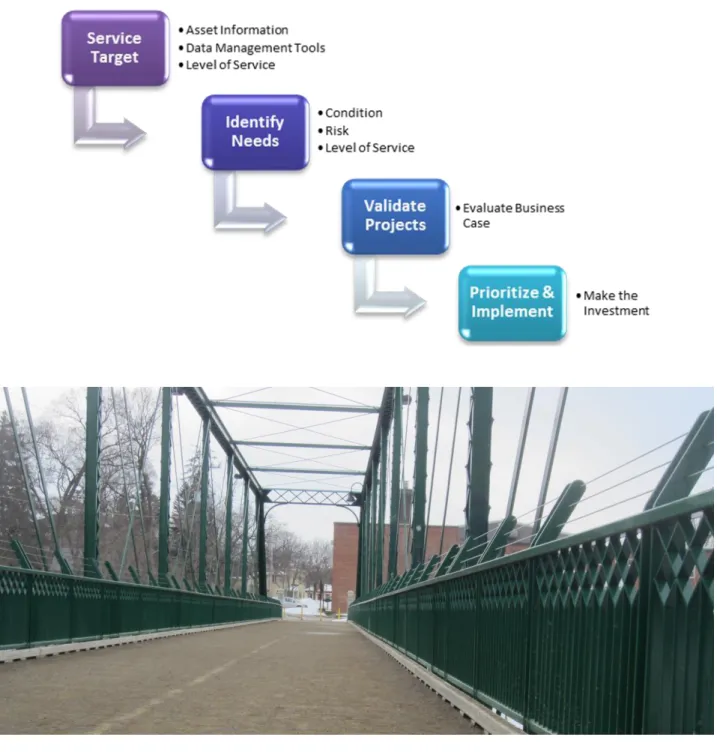
methodology across the service areas. The Corporate Asset Management program is under way that will change
this circumstance by adopting recognized asset life cycle management practices that include considerations for
risk and level of service (Figure 5-1). An asset management policy has been approved and program strategies
finalized. Pilot Trials are underway. This section of the report describes the program strategies currently being
piloted in London.
5.3.1
Overview of the New Asset Management Program
The new Corporate Asset Management strategy is centered on an overall implementation approach supported
by seven specific strategies addressing different aspects of asset management intended for standardized use
across the corporation (Figure 5-2).
FIGURE 5-2 CORPORATE ASSET MANAGEMENT STRATEGIES
The upgrading of asset management practices in London is intended to:
Manage assets on the principles of sustainability, continuous improvement and simplicity
Provide comparable information for intelligent decision-making (Lifecycle Management Strategy)
Enable the integration of corporate priorities (Integration Strategy)
Provide reliable data with the integrity to meet or surpass regulatory demands (Data Management
Strategy)
Quantify the outcome of decisions based on triple bottom line considerations(economical,
environmental, and social) (Lifecycle Management Strategy)
Reduce risk of environmental violations or service interruptions due to failed or poorly performing
assets (Risk Management Strategy)
Minimize lifecycle cost and link capital budget needs to the business planning process (Lifecycle
Management Strategy)
Maximize the return on corporate investment, and spend tax dollars wisely (Level of Service Strategy)
Quantify the impact of work that does not get done (Infrastructure Gap)
Reduce knowledge losses as the experienced workforce retires (Governance, Communications Strategy)
Enhance the way London does business
In order to achieve these objectives the City will develop and implement a number of asset management tools
that will include:
A living city-wide asset registry in a formal hierarchy for use by all city staff. It will include asset
management parameters as wells conventional asset parameters such as description, location, size, etc.
A city-wide level of service registry in a formal hierarchy for use by all.
A city-wide risk registry for use by all.
Modeling tools for level of service, risk and optimized decision-making.
A computerized system or systems that enable all of the above in a user friendly fashion allowing for the
analysis of options during decision-making.
Documentation templates for reports, plans, cases, etc. to ensure the considerations of asset
management are embedded in day-to-day activities.
Procedures that embed asset management practices.
Once implemented, the new asset management practices will address the items described in the Ministry’s
‘Guide for Municipal Asset Management Plans’ and more. The strategies form the general approach for the City
to implement the new asset management practices and are summarized in Table 5-11. Full strategy documents
are available upon request.
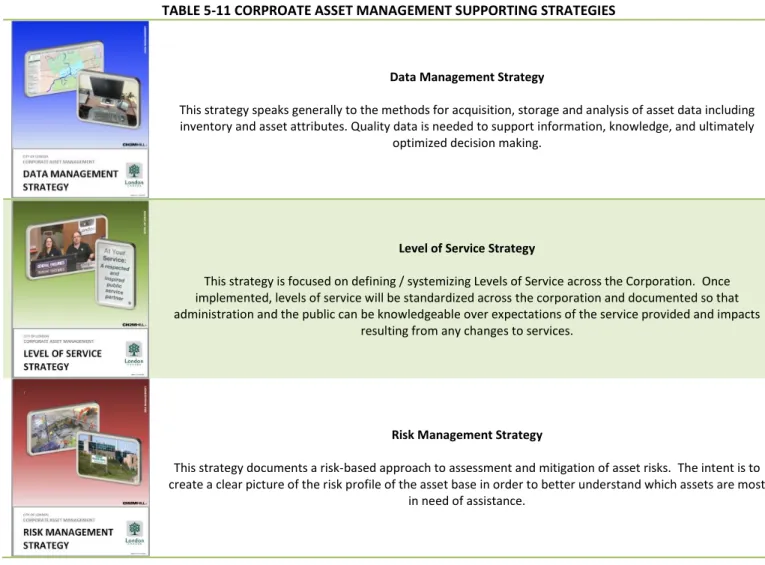
TABLE 5-11 CORPROATE ASSET MANAGEMENT SUPPORTING STRATEGIES
Data Management Strategy
This strategy speaks generally to the methods for acquisition, storage and analysis of asset data including inventory and asset attributes. Quality data is needed to support information, knowledge, and ultimately
optimized decision making.
Level of Service Strategy
This strategy is focused on defining / systemizing Levels of Service across the Corporation. Once implemented, levels of service will be standardized across the corporation and documented so that administration and the public can be knowledgeable over expectations of the service provided and impacts
resulting from any changes to services.
Risk Management Strategy
This strategy documents a risk-based approach to assessment and mitigation of asset risks. The intent is to create a clear picture of the risk profile of the asset base in order to better understand which assets are most
Asset Lifecycle Management Strategy
At the core of asset management is the process to manage the life cycle of an asset. This supporting strategy speaks to the processes for maximizing the performance of an asset while minimizing its costs throughout
the course of its life cycle using tools to optimize decision-making.
Integration Strategy
This Strategy takes a corporate-wide approach to integrating asset management practices. Practices are intended to be standardized to a degree that enables comparisons and prioritization of asset investments.
Communication Strategy
This strategy is focused on facilitating the changes required to manage assets on a cross corporation basis. Good communications are critical for managing change that impacts the entire City including development
and implementation of corporate asset management.
Governance Strategy
This strategy documents and clarifies the roles and responsibilities of stakeholders involved in the management of assets through the Corporate Asset Management program.
The Corporate Asset Management program and its strategies cover all physical assets owned, operated, or
maintained by the City. The program is designed to cover core services with significant assets and over time will
expand to include City services provided by Boards and Agencies as well. Civic Administration is committed to
ensuring that assets across the corporation are optimally managed, balancing service level expectations with
cost efficiency and effectiveness. The support obtained through the implementation of the new corporate asset
management strategy will ensure that the City of London is receiving the maximum return for its investment in
assets, spending tax dollars wisely while mitigating risk, and meeting customer expectations for levels of service.
5.4 Procurement Methodologies
The City of London Procurement of Goods & Services Policy can be found as Schedule C under Section 270 of the
Municipal Act - Council Policy By-law No. A.-6151-17 Consolidated March 26, 2013.
This is a By-law to establish policies for the sale and other disposition of land, hiring of employees, procurement
of goods and services, public notice, accountability and transparency, and delegation of powers and duties, as
required under section 270(1) of the Municipal Act, 2001.
The mission statement for Schedule C the Procurement of Goods & Services Policy reads:
The procurement policy addresses the acquisition of an asset in great detail including consideration of
socio-economic factors and health and safety. The full policy can be found on the City’s website.
The Guide for Municipal Asset Management Plans states that ‘to ensure the most efficient allocation of
resources, best practice is for a number of delivery mechanisms to be considered — such as working with other
municipalities to pool projects and resources, or considering an AFP model.’ The design-build-finance-maintain
AFP (Alternate Financing and Procurement) model takes a lifecycle perspective and builds effective asset
management directly into the contract. The Guide also states that municipalities should have procurement
by-laws in place to serve as the basis for considering various delivery mechanisms. The City of London meets both
of these requirements through existing by-laws and practices.
Numerous agreements with third parties exist to pool projects and resources, one of the most noteworthy
being, the Regional Water Boards that provide water to much of southwestern Ontario. Emergency Services
operate under mutual aid agreements. Facilities such as the Budweiser Gardens and the North London
Community Center exist in partnership with third parties. The City even provides solid waste and sanitary
sewage opportunities to third parties. Third party agreements over shared assets use and maintenance are a
standard of business in London. The City’s door is open to discuss any mutually effective offer regarding the
delivery of service.
5.5 Risks Associated with the Plan and Strategy
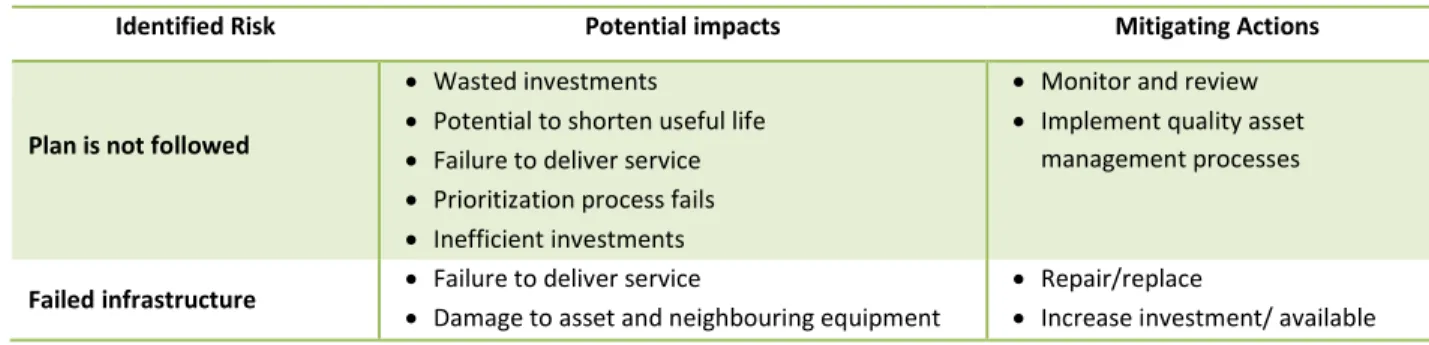
Failure to deliver the Plan will ultimately impact the ability of the City to deliver established levels of service.
Table 5-12 is an overview of the ways the plan could fail to generate the expected service levels and actions that
can be taken in response.
TABLE 5-12 RISKS ASSOCIATED WITH THE PLAN AND STRATEGY
Identified Risk Potential impacts Mitigating Actions
Plan is not followed
Wasted investments
Potential to shorten useful life
Failure to deliver service
Prioritization process fails
Inefficient investments
Monitor and review
Implement quality asset management processes
Failed infrastructure Failure to deliver service
Damage to asset and neighbouring equipment
Repair/replace
Increase investment/ available
To obtain the right goods and/or services when needed while achieving best value
through a transparent, fair and competitive process with a high focus on Customer
Identified Risk Potential impacts Mitigating Actions
and property (private or public)
Injury, death - staff and public
Customers unable to carry on their business
Non-compliance
Litigation
Damage to environment
Additional unplanned costs
Asset Loss
Negative social impacts
Etc.
funding
Innovative technology
Non-infrastructure solutions
Reduce or stop delivering service
Inadequate Funding
Increased risk of failure
Service reductions
Rising maintenance costs
Prematurely shortens useful life if not maintained
Asset Loss
Shift and increment burden to future ratepayers
Defeat planning efforts
Plans become redundant
Lost opportunities
Unpredicted future impacts
Reduce or stop delivering service
Find additional sources of funding
Increase investment/ available funding
Update Planning
Discard efforts on past planning
Poor quality asset information
Inefficient maintenance program
Poor prioritization/projections
Poor decision-making
Improper investments
Inability to deliver service
Invest in data systems and condition assessment
Determine appropriate level of service and risk metrics and ratings
Planning Assumptions incorrect
Defeat planning efforts Monitor Plan, update and correct projections
Regulatory requirements, standards, criteria change or do not exist
Non-compliance
Mandatory investments and schedule
Disruption to Planning Efforts
Investment due to regulation reduces available funding for others
Additional costs
Lobby against additional expenditures
Lobby for additional transfer funding
Reduce or stop delivering service
Find additional sources of funding
Increase investment/ available funding
Lobby organizations to provide standards
Economic fluctuations, inflation, downturns, revenue and use reduces/increases
Reduced/increased needs
Wasted expense maintaining oversized/undersized infrastructure
Change, create or stop delivering service
Occurrence of Climate Change/Adverse
Weather/Unforeseen events and emergencies, resulting in funds being diverted to assets that were not originally planned for
Additional unplanned costs
Damage and loss of assets
Defeat planning efforts
Plans become redundant
Lost opportunities
Unpredicted future impacts
Deferral of planned renewals
Assess/increase insurance coverage
Increase/develop reserve funds
Develop contingency/emergency plans
Identified Risk Potential impacts Mitigating Actions Growth projections not as
planned
Infrastructure oversized or undersized
Inefficient use of available service
Defer or advance capital projects related to growth and update plan
Service Provision Changes Plan either does not address or contains
redundancies