Optimizing release planning under Scrum in complex
multi-team software projects. Case: Nokia Siemens
Networks
Technology Management and Policy Master's thesis
Anatoly Tolstukhin 2012
Abstract
Aalto University April 14, 2012
School of Economics Master’s Thesis Anatoly Tolstukhin
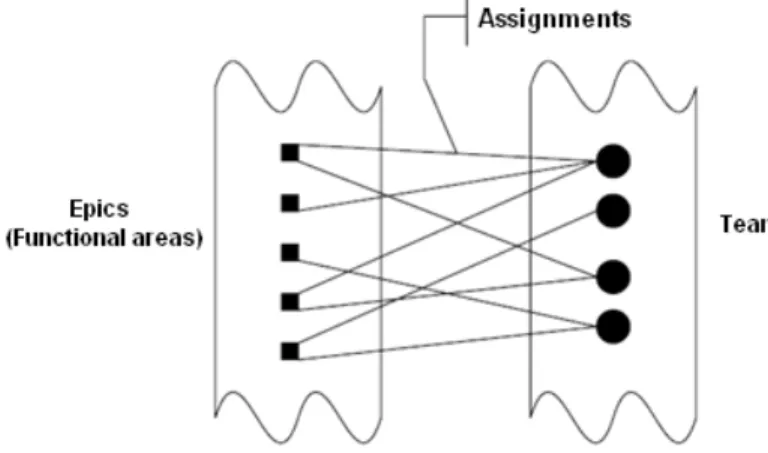
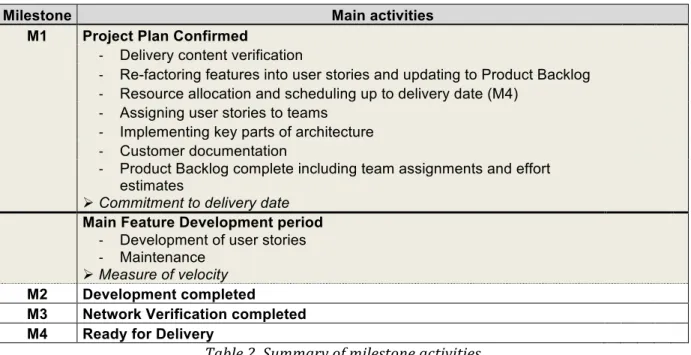
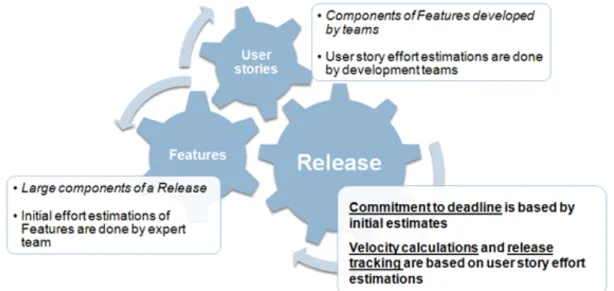
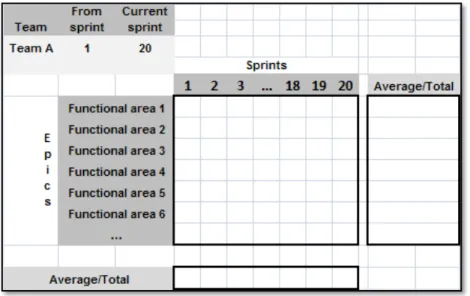
The aim of this thesis was to identify and explore existing challenges in large-‐scale agile projects and to provide recommendations on how to optimize release planning and tracking methods under Scrum in a complex multi-‐team software development environment. Importance of velocity and effort estimations, as well as visibility and allocation of user stories in a multi-‐team setting were particularly addressed in this study. The results of this study include empirical findings related to agile release planning and tracking methods in a complex agile development environment to support more accurate decision-‐making. New management tools were developed for practical use, which support the main results of this thesis.
The findings are based on an actual case study and full-‐time thesis work at Nokia Siemens Networks. The results were presented to the leadership team and management of the organization where I worked, and demonstrated practical benefit for the case company. Additionally, this thesis includes a practical application of results to highlight how improved visibility could support better release planning and tracking in multi-‐team agile software development projects. The tools proved to be useful and were put to deployment in the case company.
Key words
agile release planning, effort estimations, velocity, multi-‐team agile software development,
Foreword
I have applied for a thesis worker position at Nokia Siemens Networks to write my Master’s thesis in the topic, which particularly interested me. From the beginning, I had high motivation to do my best and gain valuable practical experience in project management and agile methods. Looking back at my accomplishments during last six months, I am more than thankful to the company for giving me the opportunity and tools to develop further my personal skills and professional knowledge, as well as to complete the final stage of my studies. It has been particularly interesting and motivating to work on a task, which was of high importance for the company and that results had practical benefits.
I owe special gratitude to people who have helped me to succeed in this project, supported me along the way and shared their opinions and knowledge about current processes and management from the practical side, thus leading me to making right conclusions and practical recommendations.
I would like to thank NSN program management, who have been very supportive and guided me throughout the thesis work. From the beginning I was provided with all necessary information and kick-‐off sessions needed to start my work independently, as well as numerous meetings and discussions on the regular basis.
Also, I would like to thank Professor Matti Rossi for supervising my thesis work progress and providing feedback at all stages, as well as finalizing the published version of the thesis.
Table of contents
1. Introduction ... 1
1.1. Motivation for research ... 3
1.2. Research objectives and questions ... 3
1.3. Methodology and structure of the thesis ... 5
2. Agile Methods ... 6
2.1. Agile principles ... 6
2.2. SCRUM methodology ... 8
2.2.1. Characteristics of SCRUM ... 10
2.2.2. Management under SCRUM ... 10
2.3. SWOT Analysis ... 11
2.4. Agile Planning ... 14
2.4.1. Agile release planning ... 15
2.4.2. Velocity ... 19
2.4.3. Effort estimation ... 21
2.4.4. Release tracking ... 24
2.4.5. Multi-‐team agile environment ... 28
3. Case Study: Nokia Siemens Networks ... 33
3.1. Agile Software Development in Flexi ... 34
3.1.1. Release development under Scrum ... 34
3.1.2. Scrum teams ... 36
3.1.3. Functional areas ... 37
3.1.4. Product Backlog ... 39
3.2. Release planning in Flexi ... 40
3.2.1. Milestone activities ... 40
3.2.2. Effort estimations ... 42
3.2.3. Velocity ... 44
3.3. Analysis of current problems ... 46
3.3.1. Identified problems ... 46
3.3.2. Analysis methods ... 51
3.3.3. Analysis ... 54
3.4. Root causes of problems based on “5 Whys” ... 75
3.4.1. Teams do multitasking ... 75
3.4.2. Effort estimations are not managed sufficiently ... 76
3.4.3. Velocity calculations are incorrect ... 78
3.4.4. Management tools lack visibility of development progress ... 79
3.5. Improvement suggestions ... 79
3.5.1. Allocation of user stories ... 80
3.5.2. Team structure ... 81
3.5.3. Effort estimations ... 82
3.6. Other recommendations ... 85
4. New Product Backlog and Management Tool ... 86
4.1. Building release management tool ... 86
4.1.1. Product Backlog ... 87
4.1.2. Management tools ... 90
4.2. Evaluation and deployment ... 101
5. Summary and conclusions ... 102
5.1. Practical implications ... 105
5.2. Academic implications ... 105
5.3. Further Studies ... 105
References ... 107
Appendices ... 110
Appendix 1. SWOT Analysis ... 110
Appendix 2: Questionnaire ... 111
Table of figures
Figure 1. Values of Agile Methods (Agile Manifesto, 2001) 6 Figure 2. Scrum cyclical process 8 Figure 3. Agile planning levels (Cohn, 2006) 15 Figure 4. Agile project hierarchy (Vähäniitty, 2010) 16 Figure 5. Release scheduling. (Cohn, 2006) 18 Figure 6. Release Burn Down Chart (a) and Iteration Burn Down Chart (b)
(Miranda & Bourque, 2009) 26 Figure 7. Effort development graph showing (Miranda & Bourque, 2009) 27 Figure 8. Cumulative flow diagram (Anderson, 2004) 27 Figure 10. Visual traceability matrix (Heikkilä et al., 2010) 29 Figure 11. Continuous release and sprint cycles 35 Figure 12. Epics and teams relation 37 Figure 13. Required effort of different teams within different functional areas 38 Figure 14. Team contribution in Flexi release development 38 Figure 15. Release and effort estimations 42 Figure 16. Inaccuracies in effort estimations 43 Figure 17. Single-‐dimensional analysis of Product Backlog data sample 52 Figure 18. Multi-‐dimensional analysis of Product Backlog data sample 53 Figure 19. Total effort across functional areas 55 Figure 20. Number of completed user stories across functional areas 55 Figure 21. Average user story size across functional areas 56 Figure 22. Average user story size in Functional area 1 56 Figure 23. Average user story duration across functional areas 57 Figure 24. Average user story duration in Functional area 1 57 Figure 25. Duration of user stories across functional areas 58 Figure 26. Total effort across teams 59 Figure 27. Total number of user stories completed across teams 59 Figure 28. Average user story duration across teams 60 Figure 29. Average user story duration across functional areas in Team G 61 Figure 30. Total duration of user stories across teams 61 Figure 31. Total effort completed by team Bravo (Sprints 1-‐8) 62 Figure 32. User stories completed by Team B 63 Figure 33. Ongoing user stories each sprint by Team B (Sprints 1-‐8) 63 Figure 34. Velocity update of Team B 64 Figure 35. Total effort completed overall and in individual release 67 Figure 36. User stories ongoing in Team B (Overall and Release-‐specific) 67 Figure 37. Cross-‐team questionnaire 69
Figure 38. Most teams are not multifunctional within 69 Figure 39. Teams do multitasking 70 Figure 40. Different metrics are used in effort estimations 71 Figure 41. Common basis of effort estimations are missing 71 Figure 42. Most teams don’t know their velocity 73 Figure 43. Velocity is affected by parallel activities 73 Figure 44. Root cause of the problem with user story allocation 75 Figure 45. Root cause of the problem with inaccurate effort estimations 76 Figure 46. Root cause of the problem with inaccurate velocity 78 Figure 47. Root cause of the problem with lack of visibility over the development 79 Figure 48. Proposed allocation of user stories 80 Figure 49. Proposed allocation of user stories across multiple teams within a functional area 81 Figure 50. Expertise levels within an ideal team 81 Figure 51. Initial effort estimations are documented on user story level 82 Figure 52. Tracking velocity for each team in each functional area 83 Figure 53. The proposed development structure 84 Figure 54. Tracking estimations on multiple levels 84 Figure 55. Screenshot of the new product backlog 87 Figure 56. Screenshot of the Team Data spreadsheet (E.g. Team A) 91 Figure 57. Screenshot of the Team Category Data spreadsheet 94 Figure 58. Screenshot of the Sprint Data spreadsheet 95 Figure 59. Screenshot of the CFD spreadsheet 96 Figure 60. Screenshot of the Feature Summary spreadsheet 98 Figure 61. Screenshot of the Release Summary spreadsheet 100
Table 1. Current Product Backlog structure 39 Table 2. Summary of milestone activities 41 Table 3: Current methods to calculate sprint velocity 44 Table 4. Sprint and average velocity of Team B 64 Table 5. Sprint and average velocity of feature development 66 Table 6. Open-‐text answers on effort estimation (Questionnaire results) 72 Table 7. Open-‐text answers on velocity (Questionnaire results) 74 Table 8. Proposed content of the new Product Backlog 88 Table 9. Functions in the Teams Spreadsheet 94 Table 10. Function in Feature teams Spreadsheet 95 Table 11. Functions in the Feature Summary spreadsheet 99 Table 12. Functions in the Release Summary spreadsheet 101
Introduction
1.
Introduction
In contemporary software development projects companies are facing challenges, such as constantly changing requirements, pressure to deliver faster, and the need to cut costs due to competition (Alleman, 2002; Huss, 2007). In an attempt to deal with these
challenges new methods evolved, which became known as agile project management and
agile software development (Cohn, 2006). The agile approach aims to produce high-‐quality software products faster, to create more value and to satisfy customers’ needs better (Beck, 2001). Studies have been done, showing that agile methods improve productivity and project success in software development. The popularity of agile methods has grown since then and having initially proved to fit software development in smaller companies, currently many large organizations also started moving to agile approach. While in the early 2000s most literature has related to small-‐scale agile software development projects (Tolstukhin, 2009), only recently literature started shifting towards research of agile methods in complex projects and large organizations. (Stober and Hansman, 2009; Vähäniitty et al., 2010).
Planning and tracking development processes in agile software development are fundamental for successful projects (Chow and Cao, 2008), including efficient management of resources and continuous monitoring of development progress using the agile metrics. Multi-‐team context and large product size complicate planning and tracking processes in the agile environment. Failing to identify and address additional factors makes planning unreliable and visibility of progress ineffective, thus posing further risks on project success.
Therefore, applying agile methods in a complex environment requires a more organized approach than in simple agile software development projects. Apart from assessing uncertainty and risks, multiple additional factors need to be considered in agile release planning. These factors include prioritizing and estimating size of requirements, planning resource availability, as well as calculating velocities and tracking progress of different
teams. Combining and managing these factors in release planning is called release planning optimization (Heikkilä et al., 2010).
Since generally agile methods are still quite new, there is a growing demand to understand the challenges in complex and large-‐scale development environment. Heikkilä et al. (2010) mentioned that the existing studies on agile software development projects focus on discussions about the positive aspects of agile methods in an ideal agile world and highlighted the importance of additional studies related to challenges. Further, whereas earlier in the studies planning has not been considered important or useful in agile software development context, Mike Cohn (2006) wrote a famous book called “Agile estimating and planning” covering extensively agile planning methods on the theoretical level in a single-‐team context. Among other authors, Chow and Cao (2008) have carried out a literature review and a survey study to identify the success factors of agile software projects. Dybå and Dingsoyr (2008) have carried out a practical research on identifying agile methods’ dynamics in a real business context. Recently, a simulation of software development under Scrum was carried out in an academic environment, highlighting the main aspects and success factors in implementing agile methods (Mahnic, 2011). Even though the results have been interesting, there are many limitations to apply these results in a real world situation. Heikkilä et al. (2010) carried out a case study on the adoption of agile methods in a multi-‐team development environment of complex systems. Vähäniitty, Rautiainen, Heikkilä and Vlaanderen (2010) have done an extensive research on current situation in the software development industry. The authors emphasize growing complexity of agile development projects and provide guidelines how the planning should be carried out in multi-‐team environment. One research was also found on how to approach release planning through statistical methods and simulations. Momoh and Ruhe (2006) provide an industrial case study analysis on strategic release planning through the use of the intelligent planning tool called ReleasePlanner. Overall, one can observe that the importance of planning in agile software development has been lately recognized.
It was identified that little practical research exists on agile release planning processes and challenges in the large-‐scale development setting. This thesis focuses on the study of Scrum release planning methods and metrics in large and complex software development
projects. Further, I will discuss my motivation for the study and the research objectives, as well as state the research problem, research questions, methods and the thesis structure.
1.1. Motivation for research
Having done my Bachelor’s thesis on the values and success factors of agile project management (Tolstukhin, 2009), I got a good understanding of the agile processes and became interested to extend knowledge in this area also in my Master’s thesis. Nowadays, agile methodologies are of high interest, as they offer more lean and rapid development methods in growing and highly competitive software markets. As discussed, while large organizations have adopted agile methodologies, few studies have yet been done about the applicability and specificities of these methods in large software development projects. Facing several difficulties in scaling agile methods to a more complex environment, this research on agile project management methods in a large-‐scale software projects should currently be of high value to many companies. Effective management in a complex environment requires better understanding about agile teams’ dynamics, as well as knowledge how to adapt and keep agile methods and metrics under control when the characteristics of the development environment change.
Understanding the importance of release planning processes and the need for a tool to assist release planning and tracking, Nokia Siemens Networks showed interest in the case study of Flexi software product on the topic of agile release planning optimization. The company has initially expressed a view that more precise velocity calculations and effort estimations for planning purposes would be extremely useful. Through in-‐depth study of these parameters, together with the analysis of the case company’s existing development structure under Scrum provided empirical findings about the specificities and challenges of agile practices, as well as practical recommendations to optimize release planning in such projects.
1.2. Research objectives and questions
While some studies have been done related to challenges in agile release planning, the existing models are designed based on theoretical assumptions and have not been
validated in real business case situations (Heikkilä et al., 2010). This thesis will deal with the actual problem faced by a global company in agile project management, where the main challenge is optimization of methods given complex and large development structure. Analyzing the case and identifying the parameters that effect the velocity and effort estimations in multi-‐team agile projects, a model will be created to perform release planning and tracking more accurately.
This thesis provides an empirical evidence-‐driven study about challenges of Scrum processes in a complex development environment. None of the existing research papers were found to address problems of agile release planning in a large organization’s scenario through the study of velocity and effort estimations as the key measures. Also, resulting from the findings and extensive studies of the case company’s agile development methods, this thesis sets the requirements needed in agile management tools to support planning and tracking of development in similar software development environments.
The objectives of this research are to improve the reliability of agile release planning at Nokia Siemens Networks by:
-‐ Determining what information is necessary in the product backlog to enable reliable forecasting and monitoring
-‐ Investigating the velocity and effort estimations parameters across the teams in the company
-‐ Performing analytical study of historical data to identify problems in earlier development under Scrum
-‐ Proposing improvement actions and recommendations
-‐ Creating management tool in Excel to improve accuracy of release planning and visibility of development progress
As a result, the aim of this thesis is to provide empirical results on how release planning and tracking should be conducted when there are multiple development teams working on one complex software product. In particular, the main research questions are related to the velocity and effort estimations in a multi-‐team development environment, including
-‐ How can effort estimations be improved and standardized across the distributed teams?
-‐ What are other methods to make planning and development of the Flexi more accurate and efficient?
Since this study was facilitated and verified in a real business environment, it can also serve as a guide for companies on how to implement changes and to optimize Scrum methods to larger and more complex software development projects.
1.3. Methodology and structure of the thesis
The research methodology is the documentation of full-‐time work for Nokia Siemens Networks on agile release planning optimization in Flexi software development as the case study. This thesis is organized in three distinctive parts: Theoretical background, Analytical Part and Practical part.
The Theoretical Background is based on a literature review related to agile release planning and other parameters used to estimate velocity and plan project resources. This section is important to familiarize the reader with agile practices and to set the baseline for the analysis.
The Analytical Part includes practical work and familiarizes the reader with Scrum methods applied at NSN. Considering the complexities of the development environment in the case company, the following analysis methods were carried out:
-‐ Regular discussions with the Flexi management at NSN -‐ Data analysis of product backlog
-‐ Questionnaire across all development teams
Reflecting on the theoretical studies and the analysis results, this section aims to discuss the identified main problems and root causes in the case organization, as well as to provide practical recommendations and improvement actions.
The last section of the thesis, i.e. the Practical Part includes applying the results to build new agile management tools in Excel, which would provide higher accuracy and visibility in planning and tracking release development within the case organization. The tools were designed based on the analysis results from the study and thus should reflect on the main
Theoretical Background
2.
Agile Methods
The aim of this section is describe the principles of agile development and Scrum methodology in particular based on the review of the existing literature. Firstly, the common practices behind the agile development will be explained including the values and principles. Further, within the scope of this thesis I will discuss agile planning methods in software projects and the challenges that exist when applying these concepts in a multi-‐ team environment. This section aims to familiarize a reader with agile release planning processes through the literature review and serves as a basis for the case study and the empirical research.
2.1. Agile principles
For the past decade agile methods have gained a lot of attention and popularity in the areas of project management and software development over the traditional methods, which have had poor results. Agile methods were developed in attempt to perform better in the new market environment, where businesses are becoming more complex, requirements are changing quickly, and the pressure to cut costs and deliver results fast is growing (Augustine, 2005).
The values and principles of the agile methodologies have been documented in the “Agile Manifesto” in 2001. Figure 1 illustrates the main values behind agile methods as explained in the purpose of Agile Manifesto.
“We are uncovering better ways of developing software by doing it and helping others do it. Through this work we have come to value:
1. Individuals and interactions over processes and tools 2. Working software over comprehensive documentation 3. Customer collaboration over contract negotiation 4. Responding to change over following a plan
That is, while there is value in the items on the right, we value the items on the left more” Figure 1. Values of Agile Methods (Agile Manifesto, 2001)
Agile software development clearly differs from the traditional methods. Under traditional methods, the whole project goes through the development process in one cycle known as the waterfall model, which includes extensive planning of the entire project, followed by design, development, testing, delivery and maintenance. The planning stage carries high investment, and the main assumptions under the traditional method are a stable environment and fixed requirements. Therefore, any changes will require returning to the planning stage and abandoning the completed work. Furthermore, if the project is abandoned before completion, there is no return on investment.
The main idea behind the agile method is that the whole project is split into parts called iterations or sprints, each lasting from two to four weeks. Every sprint involves work through all stages of the project including requirements analysis, planning, design etc. and delivers to the customer a set of working features. The features are prioritized in such way that the most valuable and profitable components of the product are delivered first while less important components are postponed until later. Importantly, the evolving project requirements are continuously re-‐assessed based on the feedback from the product owner (Alleman, 2002). Iterative development mode allows a team to continuously re-‐evaluate and improve the methods used. In such way, maximum value is delivered continuously throughout development, even when requirements change.
Due to the adaptive nature of agile projects, the overall risk is minimized and the total value is much higher. Under agile method the value is created continuously as the project evolves, whereas with traditional model the value is generated only upon completion. Higher value is also generated because the requirements are understood better and the parts of functionality are delivered faster to the end user. Since agile method allows flexibility and adaptability to changing requirements, the risk of project failure due to changing customer needs is lower (Augustine, 2005). Since this method provides first functional results early in the project, even if the project was cancelled there would be some salvage of value.
Agile principles are a set of methodologies, which address different areas in the software development. While the methods of how the development is approached differ, principles are fairly similar (Hass, 2007). The most common agile methodologies are Scrum, Extreme Programming (XP) and Feature-‐driven development. Due to the scope of
this thesis, I will focus on and discuss the Scrum methodology in the software development projects context.
2.2. SCRUM methodology
Scrum methodology is the most common practice used in agile software development nowadays (Vähäniitty, 2010). Scrum focuses on situations where it is difficult to plan ahead and the process can only be roughly described as an overall process. Since the activities in such settings are loose, rigid rules are used to keep the development process under control and to tackle possible risks. Scrum is a very flexible approach, where the overall project deliverables are partitioned into prioritized fractions. Fractions have a clean interface and are developed by self-‐organizing teams iteratively in sprints. Among others, according to Cohn (2006) and Larman (2006), using this approach one can test the feasibility and technology of the software requirements already after initial cycles and continuously through sprints.
In Scrum, the duration of a sprint is from two to four weeks long. Each sprint includes planning, design, development and review. The work is coordinated by the team members and the team manager, also known as Scrum Master, who is in charge of maintaining processes, assisting in solving problems and assuring that all tasks flow smoothly (Cohn, 2006). Figure 2 below illustrates the cyclical process of software development propagated by the Scrum methodology and each step is discussed further.
Figure 2. Scrum cyclical process
The Scrum development process begins with collecting all potentially relevant features into a common list called the Product Backlog. Product backlog is updated when the requirements change or need to be updated. Once the list is created, the team needs to identify which of the features should be included in the next release from their importance and value to the customer. Some unnecessary features may be excluded from the list if they are not feasible. It is vital to identify the core features (also called unbreakable features), which must be included in the release. Core features are the absolute minimum that has to be completed before the given release can be delivered to the customer. These requirements are listed in the release backlog together with other high priority supporting features. Release backlog is a subset of a product backlog, which includes the requirements only for one specific release. The product backlog and the release backlog are the most important elements used in planning and tracking the progress on each level.
When the release backlog is created, the highest priority items are assigned to earliest sprints. Each sprint should have a Sprint Backlog containing a set of requirements assigned. During each sprint teams break down the requirements into smaller tasks and use cards and task board to identify the type of task (e.g. coding, integrating etc.). Stick-‐on notes on a board are a common way to coordinate the sprint tasks. As work progresses the cards are moved based on the status, i.e. from pending to being completed. Task board assists team members to monitor tasks within the sprint. Daily Scrum meetings are brief stand-‐up meetings meant for checking up on project status and keeping it on track. In these meetings, the team members report their work progress during the last 24 hours, what is going to be done next and possible obstacles to reaching the goal.
On the sprint review meeting, sprint achievements and obstacles are discussed and shared among the teams and managers. In the end of each sprint a set of tested and working items need be completed, which could be potentially shippable to the customer. Also, uncompleted features are moved to later sprints and the release backlog is updated. Each sprint is summarized on a Retrospective meeting, where participants may suggest improvements based on lessons learnt during the previous sprint. As customer needs change the requirements may be re-‐prioritized and next top priority requirements will go through the development cycles in the following sprints. After all sprints are completed, the working product can be delivered to the customer.
2.2.1. Characteristics of SCRUM
Under the Scrum methodology, the processes are defined during the release planning and closure phases (Larman, 2006). On the other hand, during the development phase the project is highly responsive to changing requirements and the final deliverable can be modified throughout the development. Scrum has a high level of engagement with the user or product owner throughout all stages including design, development, test and maintenance until the product is stable and useful (Gill, 2011). Continuous collaboration with the customer and adaptive nature of development assure that the final product will have the highest value.
In Scrum, the actual development takes place during the sprints. The team is given full responsibility to perform tasks and follows certain rules, such as daily meetings, sprint duration. Thus, the development process under Scrum takes place in a controlled black box. (Cohn, 2006). In order for a project to be successful, team flexibility and creativity must be unlimited. Also, team members should be skillful and cross-‐functional, i.e. be able to perform various tasks across the project. Due to the low level of documentation, close collaboration and communication among team members is essential for the success of the project.
Team size also plays an important role and should be kept small to around 6 members, but there may be multiple teams for bigger projects (Cohn, 2006). Small and collaborative teams are better able to share tacit knowledge about the development process across team members. Larger team size, on the other hand, will decrease the productivity because team collaboration becomes too unproductive (Stober et al., 2006).
Since a project evolves throughout the sprints, the final product scope, cost and completion date become more clear during development. Therefore, while one of these parameters is fixed in the planning stage and other are flexible.
2.2.2. Management under SCRUM
On the product level, the management defines the initial content and timing of the release based on the metrics, which will be explained in more detail later in Section 2.4. Since the requirements are changing, unpredictability and complexity need to be controlled
project management software are commonly used instruments for managing the requirements and monitoring project progress with charts. Due to minimal documentation, also face-‐to-‐face meetings are essential throughout the project to plan and track activities, and ultimately to control the project.
On the sprint level, the team is given the responsibility to manage the activities assigned for the respective sprints. Scrum master is assigned to the team to assure that the team members don’t face obstacles and the project runs smoothly. During the sprint, lightweight management methods are common, such as using post-‐it notes and whiteboard for listing features and their status. In larger projects, agile project management software is highly recommended because it makes communication easier and enhances project progress visibility.
Due to the nature of agile practices, tracking the progress is extremely important for the management. Since work progress can be tracked upon completion of the requirements, rigid rules exist regarding the status of different activities. Thus, a user story will get a status of being completed only if it meets all criteria pre-‐set in the Definition of Done (DOD), which includes both development and testing activities. The duration of sprints is strictly set and uncompleted items will be moved to a later sprint or possibly canceled. Therefore, even if an item has been partly done during a sprint, it will not be counted in the actual work done for that sprint.
After every sprint, the teams reflect on the processes and suggest possible improvements, which are then included in retrospectives. Retrospectives serve as a feedback tool for managers to improve the processes and team spirit.
Therefore, communication and visibility of work performed by self-‐managing teams are the key aspects of management under Scrum development.
2.3. SWOT Analysis
Agile methods are a set of techniques used in current software development practices that apply a human-‐centered approach (Ceschi, 2005). These methods have proved to deliver products faster and with better quality. However, no method is perfect and apart from strengths, these methods also have threats and weaknesses. Shahir et al. (2008) have
discussed and suggested some improvement strategies for agile processes. In the following section I will cover the strengths, weaknesses, opportunities and threats based on the literature review. The aim of this section is to highlight problematic issues in agile processes, as well as the opportunities for managers and team members how to tackle those problems. The summary table of the SWOT analysis can be found in Appendix 2. Strengths
The main strengths of the agile methods have been already addressed to some extent earlier in this thesis. Most importantly, agile methods allow the project to be flexible and adapt to changing requirements even in the later stages of the development process. This allows the results of the project to be relevant even if the development takes several months. Stakeholders and users are more satisfied with the results of agile projects compared to the traditional methods because under agile development the products match customer needs better. Additionally agile methods deliver higher value and more frequently, as well as the quality is higher since the increments of the final product are continuously tested after every sprint. Due to improved quality, flexibility, high level of communication and requirements prioritization, the overall delivered value is higher.
Shahir et al. (2008) also discussed other strengths of agile methods, including regular effective planning and visibility of the progression of the project. Everybody involved can see precisely the project status. Further, simplicity of the processes and design, as well as elimination of waste by doing only the required tasks -‐ are collectively considered to be the strengths of the agile methods.
Weaknesses
Surprisingly only few sources discuss the weaknesses of the agile methods. No doubt, agile development is a major improvement over the traditional methods. However, like any other process it has drawbacks.
Since agile development is a human centered approach, the lack of documentation and inefficient communication may cause problems, including communication issues in globally distributed development teams due to limited communication possibilities, as well as cultural and organizational differences (Shahir et al, 2008). It is not as easy to delegate progress across multiple teams in different locations. While changes in the product backlog
have to be delegated to all teams, there is a risk that especially the time spent on meetings can grow out of proportion.
Secondly, the people-‐oriented approach causes heavy reliance on the development team. While it is assumed that all members in agile development teams are cross-‐ functional, in larger projects it is not always the case. A crucial team member leaving in the middle of the project may pose a serious risk on deadlines and the project in general. Also, as the team size increases, agile mechanisms fail to act effectively. Thus, with multiple
teams managing teamwork issues and keeping track of the individual teams’ progress becomes more complex. This makes many agile projects difficult to control effectively.
Allowing frequent changes to the requirements is an agile principle. However, it complicates the estimation of time and cost, making it difficult to forecast and plan resource allocation. Lack of overall planning poses risk and bottlenecks, which may not be noticed initially, but the project may fail to fulfill the requirements. Even though agile development is a very useful technique, in developing large and complex software agile methods have limitations. Some large and complex systems require a central architecture and detailed initial planning. These estimations are usually very imprecise, especially as the requirements change. Additionally, as requirements become more complex and increase the workload, tracing dependencies between different items becomes difficult.
Lack of documentation and poor estimates cause limitations with contracts, where precise requirement specifications are needed. Problems also arise where guidelines for testing and “the definition of done” are insufficient or the guidelines are not strictly followed.
Opportunities
Having addressed the weaknesses of the agile processes, I will now aim to identify the possible opportunities how teams and managers can strategically improve their agile processes.
Both, inter-‐team and intra-‐team communication should be valued by all members. In distributed software development teams, teleconferencing and web-‐based development environments should be utilized to the maximum. Planning and forecasting are the core activities in controlling the development of the project. Thus, adding more functional
metrics and measures may improve planning and forecasting reliability, even with constant change of requirements.
Improved agile management tools can create an opportunity to better manage information and to apply agile methods especially in more complex and large projects (Tolstukhin, 2009). In this way organizational, people, process and technical aspects in agile projects can be further improved. Thus the use of tools should be considered as an opportunity for future growth in large companies who already use agile methods.
Finally, expert advice and knowledge should be utilized fully to adjust the agile methodology to fit the product development at hand.
Threats
The major threat of agile methods is lack of interest in utilization of agile methodologies in traditional organizations and failure to incorporate real changes to the processes. Companies may be reluctant to dramatically changes in their processes, underestimating the benefits of correctly implemented agile methods.
Companies that already utilize agile practices should continuously seek for possible improvements in the operational processes. Since the processes in agile methods are more or less based on trial and error, companies need to be innovative and try out new methods that might better suit their product and culture.
In large organizations the failure to adjust to changes, and to utilize new techniques and tools may become an obstacle to success. Large companies may start implementing agile methods in a small team, and after the initial success expand it quickly to the company level. There is a threat that when scaling up agile development, there is a need to change the techniques and adjust methods. Large companies may either not have the experience or time to switch to new tools. Utilizing less productive and potentially impractical methods poses a threat to the company.
2.4. Agile Planning
While agile methods are promoted by a lack of long-‐term planning, the truth is that the process of planning is extremely important in all kinds of projects. The process of agile
planning is carried out in a different manner as compared to the traditional methods, and thus is often misunderstood.
Estimating and planning are crucial to the success of any software development project. These activities affect the investment decisions and give information, which helps tracking project progress (Cohn, 2006). Planning is difficult and many projects fail to meet the planned deadlines. It should be carried out in right amounts because too little planning will not give the needed information, while too much planning will cause plan updates after every change in requirements. Progress tracking is strongly interrelated to planning because the actual progress is evaluated based on the plans providing hints to the corrective actions and decreasing uncertainty.
The following section will cover planning and tracking processes in single team and multi-‐team agile software development environments. Due to the scope of my thesis, the main focus will be on the release level.
2.4.1. Agile release planning
Agile software development consists of planning at multiple levels including strategy, portfolio, product, release, iteration and daily levels (Cohn, 2006). Different levels of agile planning are illustrated in Figure 3.
Figure 3. Agile planning levels (Cohn, 2006)
Strategy, portfolio and product levels are part of a company’s long-‐term goals, which should provide a roadmap for product management i.e. an overview of product development in future planned and upcoming releases (Vähäniitty, 2010). According to
Cohn, long-‐term plans are very abstract, and agile teams plan in the short-‐term on release, iteration and daily levels.
Figure 4 below shows the Agile project hierarchy where the software project is the highest level. The software project consists of a number of releases, from which some are minor updates and others are major softare improvements. Further, each release is dividied into sprints. Each level has a respective specified definition of requirements definition (Vähäniitty, 2010). On the program level, the requirements belong to epics, which are used to define different categories within the product. On the release level, the requirements are called features, which are part of epics. Further, features are broken down into user stories and added to the list of requirements on development level. In sprint planning, user stories are broken down into tasks. As we go down the hiearachy the size and complexity of the requirements is decreased. However, attention should be paid to tracking back the requirments up the hierarchy tree as well.
Figure 4. Agile project hierarchy (Vähäniitty, 2010)
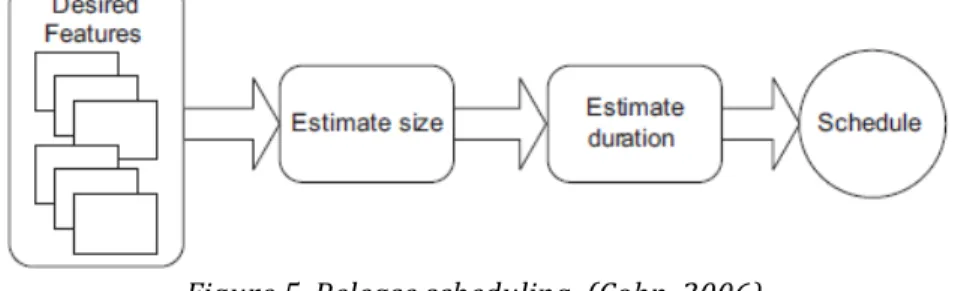
Release planning deals with gathering and assigning the features to a deliverable package so that the business, technical and resource constraints are met (Vähäniitty, 2010). Planning the next product release is one of the most crucial success factors in agile software development projects (Rautiainen, 2010). The aim of the release planning process is to identify when a releasable version of a software product would be made ready and what functionality it should include (Logue & McDaid, 2008). The subject of release planning has been addressed in the literature as a challenging process. Failing to optimize the required features with the available resources commonly results in problems to meet deadlines (Kittlaus & Clough, 2009). In agile release planning, developers need to have deep understanding of the technical features required in a release to be able to make accurate estimations and balance the resources with the desired requirements.