8
The Effect of Essential Oils on Performance of Laying Hens
Henrieta Arpášová, Branislav Gálik,
Cyril Hrnčár, Martin
Fik, Róbert Herkeľ, Veronika Pistová
Slovak University of Agriculture, 949 76-Nitra, Tr. A. Hlinku 2, Slovak Republic
Abstract
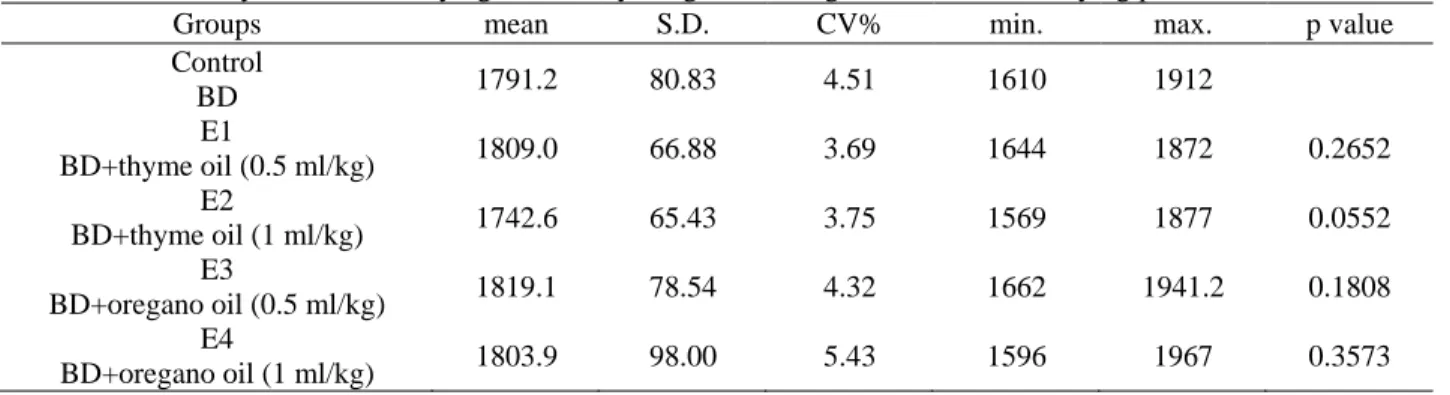
Herbs, spices and their extracts (botanicals) have a wide range of activities. They may have a beneficial effect on the gastrointestinal micro flora of animals, performance and quality of animal products. In this experiment the effects of supplementation of the diet for laying hens with different doses of thyme or oregano essential oil addition on body weight, feed consumption and egg production were studied. Hens of laying hybrid Hy-Line Brown (n=50) were randomly divided into 5 groups (n=10) and fed for 20 weeks with diets with thyme or oregano essential oil supplemented. In the control group hens received feed mixture with no additions. The diets in the first and second experimental groups were supplemented with 0.5 ml/kg or 1.0 ml/kg thyme essential oil. The diets in the third and fourth experimental groups were supplemented with 0.5 or 1.0 ml/kg oregano essential oil. Average body weight for the whole period was in the order of the groups 1791.2±80.83; 1809.0±66.88; 1742.6±65.43; 1819.1±78.54 and 1803.9±98.00 g (p>0.05). In the feed consumption per feeding day, per egg, or in the feed conversion were observed statistically non-significant differences compared to the control group (p>0.05). Number of eggs per hen during the reporting period was in order of the groups: 135.6; 140.7; 139.1; 137.3 and 138.5 pcs at an average intensity of laying 90.4; 93.80; 92.73; 91.53 and 92.33%. The results suggest that the body weight, feed consumption, feed conversion, egg production, egg mass and egg weight were not significantly influenced with thyme or oregano oil addition (p>0.05).
Keywords: body weight, egg production, feed consumption, laying hens, oregano essential oil, thyme essential oil
1. Introduction
The essential oils have a stimulating effect on animal digestive systems. These effects could be due to the increased production of digestive enzymes and the improved utilization of digestive products through enhanced liver functions [1]. Hertrampf (2001) [2], reported that essential oils derived from spices and herbs could be successfully used as growth promoters, since they increased the feed intake due to their aromatic characteristics in chickens. Based on the results of the work of several authors, essential oils in poultry affect feed intake, weight gain, nutrient utilization [3], egg weight [4], egg production,
* Corresponding author: Henrieta Arpášová Email: [email protected]
body weight of laying hens [5, 6], and feed intake [7].
9 material can be used flowers, buds, seeds, leaves, twigs, bark, herbs, wood, fruits and roots [11].
Herb Thyme contains at least 1.0% essential oils,
and a minimum of 0.5% phenol. Essential oils are quantitatively determined by steam distillation. The percentage of phenols expressed as thymol is determined by spectrophotometric analysis [12].
Origanum vulgare belongs to the family
Lamiaceae. It's aromatic and medicine often used
medicinal plant. Can be used as a phytotherapeutic agent as biocidium because essential oil of oregano is toxic against phytopathogenic bacteria and fungi. Active ingredients in oregano can be more widely utilized in anti-inflammatory processes also exhibit antioxidant and anti-tumor activity [13].
The aim of this work was to observe the influence of thyme essential oil or oregano essential oil
additions on performance parameters of Hy-Line Brown laying hens.
2. Materials and methods
Animals, diets and treatments
Hens (n=50) of the laying hybrid Hy-Line Brown, 17 weeks old, were randomly divided into 5 groups (n=10) and fed for 20 weeks with diet containing of different amounts of thyme or oregano essential oils.
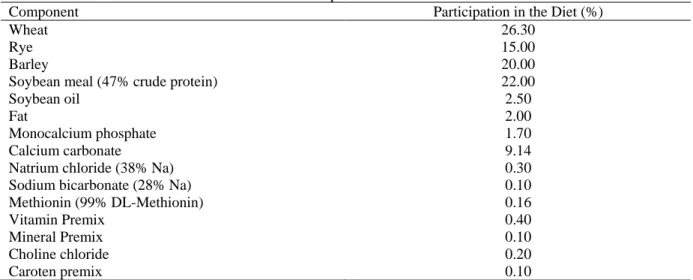
At the beginning of the experiment, the hens were kept in the three–deck cage technology system, model AGK 2000/616. The technology system was in accordance with requirements specified by the Directive 1999/74 EC. The layer hens were kept by the standard bioclimatic conditions. The composition of the basal diet (BD) fed to the laying hens is shown in Table 1 and Table 2.
Table 1. Composition of the trial diets
Component Participation in the Diet (%)
Wheat 26.30
Rye 15.00
Barley 20.00
Soybean meal (47% crude protein) 22.00
Soybean oil 2.50
Fat 2.00
Monocalcium phosphate 1.70
Calcium carbonate 9.14
Natrium chloride (38% Na) 0.30
Sodium bicarbonate (28% Na) 0.10
Methionin (99% DL-Methionin) 0.16
Vitamin Premix 0.40
Mineral Premix 0.10
Choline chloride 0.20
Caroten premix 0.10
Table 2. Nutrient content in the trial diets
Nutrient Nutrient Content in Mixture
MEN(MJ.kg-1 of DM) 11.5
CP (g.kg-1 of DM) 177
LYS (g.kg-1 of DM) 8.81
MET (g.kg-1 of DM) 4.17
M + C (g.kg-1 of DM) 7.41
THR (g.kg-1 of DM) 6.27
LA (g.kg-1 of DM) 19.0
Ca (g.kg-1 of DM ) 39.1
Pavail. (g.kg-1 of DM) 3.8
Na (g.kg-1 of DM) 1.5
* MEN: metabolisable energy for poultry, CP: crude protein, LYS: lysine, MET: methionine, M+C: methionine plus cysteine, THR: threonine, LA: linoleic acid, Ca: calcium, Pavail.: available phosphorus, Na: natrium.
In the control group hens received feed mixture without additions. The diets in the first and second
10 in the third and fourth experimental groups were supplemented with 0.5 and 1.0 ml/kg oregano essential oil (Calendula a.s. Nová Ľubovňa, SR). Laying hens accepted fodder ad libitum.
All kinds of feed supplements used in the experiment were homogenously incorporated into the feed mixture in the feed mill.
Sample Analysis
During the trial were monitored following performance parameters: body weight of hens (g), egg production (%), egg mass production (kg), feed consumption on the day of feeding (g), feed consumption per eggs (g), and feed consumption per kg of produced egg mass (kg). Body weight of hens and feed consumption were determined once
a month. Total number of eggs produced and their weights were recorded daily. Experiment lasted 20 weeks.
Statistical analysis
Statistical analysis was done using one–way analysis of variance (ANOVA) with the post hoc Tukey’s multiple comparison test in the program SAS.
3. Results and discussion
Body weight, egg production, feed consumption and feed conversion are given in Tables 3 to 5.
Table 3. Effect of thyme or oregano essential oil addition into laying hens feed mixture on the alterations of Hy-Line Brown laying hens’ body weight in average for all observed laying period
Groups mean S.D. CV% min. max. p value
Control
BD 1791.2 80.83 4.51 1610 1912
E1
BD+thyme oil (0.5 ml/kg) 1809.0 66.88 3.69 1644 1872 0.2652
E2
BD+thyme oil (1 ml/kg) 1742.6 65.43 3.75 1569 1877 0.0552
E3
BD+oregano oil (0.5 ml/kg) 1819.1 78.54 4.32 1662 1941.2 0.1808
E4
BD+oregano oil (1 ml/kg) 1803.9 98.00 5.43 1596 1967 0.3573
Significant difference (p≤0.05); Values are means
Table 4. Feed consumption of laying hens of Hy-Line brown strain after addition thyme essential oil or oregano essential oil in average for observed laying period
Groups
Feed consumption (g) Feed conversion
per FD per 1 egg kg feed/kg EM 1000 g
pcs (60 g) EM (g)
Control
BD 119.49 132.17 2.30 7.56 434.78
E1
BD+thyme oil (0.5 ml/kg) 119.63 127.53 2.23 7.84 448.43
E2
BD+thyme oil (1 ml/kg) 120.70 130.15 2.28 7.68 438.59
E3
BD+oregano oil (0.5 ml/kg) 120.75 131.9 2.29 7.58 436.68
E4
BD+oregano oil (1 ml/kg) 120.35 130.86 2.26 7.64 442.47
p value 0.9999 0.9867 0.9994
FD–feed day; EM–egg mass; (p≤0.05)–statistically significant difference; (p>0.05)-statistically insignificant difference
In the experimental group with thyme supplement in dose 0.5 ml/kg (Table 1), the average body weight compared to the control group was insignificantly higher, in the experimental group
11 average body weight of hens in compare to the control group slightly higher (p>0.05). Similarly, Yalcin et al. (2009) [14] after addition of Nigella
sativa seeds filed too little influence. Also Özek
(2012) [15] and Kaya et al. (2003) [16] found a insignificant effect on body weight complement
Yucca schidigera. On the contrary Gurbuz et al.,
(2011) [17] reported that final body weight was higher in the YCW, Yucca schidigera extract groups than in the control group. Insignificant differences reported Azeke-Ekpo (2009) [18] as well. On the contrary Hosseini Vashan et al. (2008) [19] recorded a higher live weight gain after food supplements palm oil at a dose of 4.5%. Dietary thyme significantly increased body weight and body weight gain, and improved feed conversion ratio in the experiment El-Ghousein-Al-Beitawi (2009) [20] too.
As is apparent from the values in Table 2, the feed consumption per feeding day were not statistically significant differences between groups (p>0.05). Feed consumption per feeding day on average in groups ranged from 119.49-120.75 g. Similarly, the consumption of feed per one egg has been recorded insignificant difference between groups (p>0.05). Feed consumption per egg ranged from 132.17–127.53 grams. In all experimental groups was slightly lower feed conversion compared to the control group. The most favorable conversion
rate was in the experimental group with complement thyme. With a comparison of the treatment groups to the control group were relatively equal value (p>0.05). The values in the order of groups 2.30; 2.23; 2.28; 2.29; 2.26 kilograms. Similarly, in the experiment Güçlü et al. (2003) [21], Niu et al. (2008) [22], respectively Canogullari et al. (2009) [23] was not significantly affected by the consumption of feed supplement.
Radwan et al. (2008) [24] indicated that addition of herbs as natural antioxidants during the laying period can improve the production performance especially at 1.0% thyme, rosemary, oregano or 0.5% Curcuma longa increased egg production, egg mass and improved feed conversion. In the experiment Ariana et al. (2011) [25] extract of green tea decreased feed consumption and feed conversion ratio. The results of the study Ahmad et al (2013) [26] demonstrated that egg production and feed intake decreased, while feed conversion ratio per dozen of eggs significantly increased with increasing dietary linseed levels.
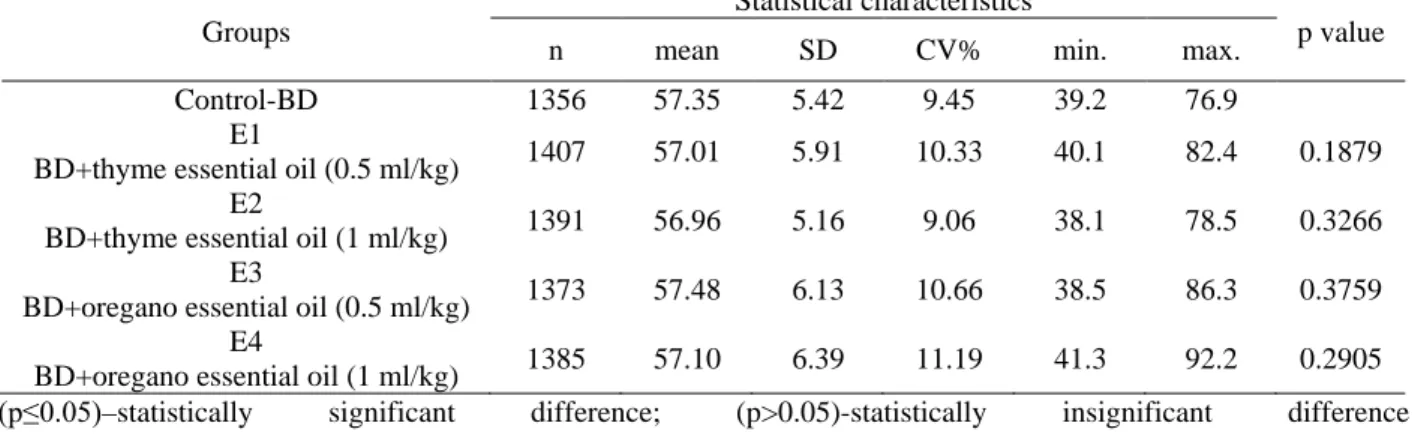
Egg production and average weight of all eggs are shown in Table 5. Egg production was the highest in experimental group with lower dose of thyme oil. The values in the order of groups: (1356; 1407; 1391; 1373 and 1385 pieces). The addition of essential oil mixture, organic acid and essential oil mixture+organic acid supplementation to diets had not a significant effect on egg productivity traits but it tends to increase egg weight in experiment of Ozeku et al. (2011) [27]. The results of Bozkurt et al. (2009) [28] study showed that supplementing diets with essential oil mixture improved fertility and the hatchability of total eggs, however the hen-day egg production and hatching egg weight, were not affected significantly. In the treatment of Yalcin et al. (2012) [29] the usage of black cumin seed in the diets decreased (p<0.05) egg weight. Gurbuz et al (2011) [17] reported that while the egg production and feed intake of the hens was significantly affected, overall feed efficiency, damaged-egg ratio, dirty-egg ratio, egg weight and specific gravity did not differ between the control group and the group with Yucca schidigera extract complement.
Table 5. Effect of thyme oil or oregano oil addition into laying hens feed mixture on the egg production and average egg weight of Hy-Line Brown laying hens in individual groups in average for laying period
Groups
Statistical characteristics
p value
n mean SD CV% min. max.
Control-BD 1356 57.35 5.42 9.45 39.2 76.9
E1
BD+thyme essential oil (0.5 ml/kg) 1407 57.01 5.91 10.33 40.1 82.4 0.1879
E2
BD+thyme essential oil (1 ml/kg) 1391 56.96 5.16 9.06 38.1 78.5 0.3266
E3
BD+oregano essential oil (0.5 ml/kg) 1373 57.48 6.13 10.66 38.5 86.3 0.3759
E4
BD+oregano essential oil (1 ml/kg) 1385 57.10 6.39 11.19 41.3 92.2 0.2905
12
Egg production and egg mass per hen and laying average intensity in all groups during the reporting period, on average, is shown in Table 6. In all experimental groups with complementary thyme and oregano to complement the trend has been a
moderate increase in egg production compared
with the control group (Table 3), with the most positive impact of thyme essential oil in the dose 0.5 ml/kg. The authors Bölükbaşi et al. (2009) [30] with the addition of oil of Nigella sativa, respectively Suchý et al (2010) [5] with the addition of the herbs premix observed improvement of egg production, but no
statistically significant difference (p>0.05). The results of the experiment the authors Florou-Paneri et al. (2005) [31] showed that the dried rosemary leaves, stems and oregano essential oil present in the feed of laying hens did not affect significantly the production of eggs.
Essential oil mixture supplementation to the laying hen diet significantly increased the egg production rate and egg weight as compared to the control diet alone, but egg mass output, feed consumption, and feed conversion ratio were not affected by the dietary treatments in the experiment of Bozkurt et al. (2012) [32].
Table 6. Effect of thyme oil or oregano oil addition into laying hens feed mixture on the egg production and egg mass production of Hy-Line Brown laying hens in average for laying period
Parameter
Groups Control
BD
BD+thyme oil 0.5 ml/kg
BD+thyme oil 1 ml/kg
BD+oregano oil 0.5 ml/kg
BD+oregano oil 1 ml/kg Egg production
Egg production per hen
for 150 days (pcs) 135.6 140.7 139.1 137.3 138.5
Average intensity of
egg production (%) 90.4 93.80 92.73 91.53 92.33
Egg weight (g)
Average egg weight (g) 57.35 57.01 56.96 57.48 57.10
Egg mass production
FD (g) 51.84 53.47 52.82 52.61 52.72
per 1 hen (kg) 7.77 8.02 7.92 7.89 7.98
Number of eggs per hen during the period (Table 6) in the control group was 135.6 pieces at an average intensity of laying 90.4%. Number of eggs per hen in the first experimental group with thyme in the dose 0.5 ml/kg supplement was 140. 7 pieces eggs at a laying intensity of 93.80%. In the second experimental group with the addition of higher dose of thyme oil were produced 139.1 pcs eggs. In the third and fourth experimental groups with the addition of both doses of oregano were produced 137.3 and 138.5 pcs eggs, respectively. The average intensity of laying was
in the order of the groups: 90.4; 93.80; 92.73;
91.53 and 92.33%. Production of egg mass per hen during monitored laying period was 7.77;
8.02; 7.92; 7.89 and 7.98 kg. The average weight of all eggs produced in these groups was in the order of groups 57.35; 57.01; 56.96; 57.48 and 57.10 g (p>0.05). Essential oils addition in relation to the average weight of the eggs showed not expressive influence (p>0.05). Botsoglou et al. (2005) [33] tested the effect of plant Sonchus
arvensis, oregano and saffron on performance and
13 (2012) [29] did not affect body weight, feed intake, egg production, mortality, excreta moisture, interior and exterior egg quality characteristics, egg yolk triglyceride or yolk malondialdehyde concentration.
4. Conclusions
In all experimental groups with complementary thyme and oregano to complement the trend has
been a moderate increase in egg production
compared with the control group, with the most positive impact of thyme essential oil in the dose 0.5 ml/kg(p>0.05). The addition of both types of
oils indistinctive affected egg weigh (p>0.05). The
results suggest that the body weight, feed consumption, feed conversion, egg production, egg mass and egg weight were not significantly influenced with thyme or oregano oil addition (p>0.05).
Acknowledgements
This study was supported by Grant Agency for Science, VEGA of Slovak Republic, Grant No.1/0493/12 and KEGA035SPU-4/2015
References
1. Langhout, P., New additives for broiler chickens. World Poultry-Elsevier, 2000, 16, 2000(3), 22-27. 2. Hertrampf, J. W., Alternative antibacterial performance promoters. Poultry International, 2001, 40, 2(1), 50-52.
3. Amrik, B., Bilkei, G., Influence of farm application of oregano on performances of sows. Canadian Veterinary Journal-Revue Veterinaire Canadienne, 2004, 45, 674–677.
4. Abd, E. L., Motaal, A. M., Ahmed, A. M. H., Bahakaim, A. S. A., Fathi, M. M., Productive Performance and Immunocompetence of Commercial
Laying Hens Given Diets Supplemeted with
Eucalyptus. International Journal of Poultry Science, 2008, 7(5), 445-449.
5. Suchý, P., Strakova, E., Mas, N., Serman. V., Vecerek, V., Bedrica, L., Lukac, Z., Horvat, Z., The effect of a herbal additive on performance parameters in layers. Tierarztliche Umschau, 2010, 65(2), 74-78.
6. Arpášová, H., Fytobiotiká ako náhrada
antibiotických stimulátorov rastu aich vplyv na úžitkovosť akvalitu vajec sliepok znáškového typu. Vedecká monografia. SPU: Nitra, 2011, pp.101
7. Angelovičová, M., Kačániová, M., Angelovič, M., Lopašovský, Ľ., Per os use of Thymi aetheroleum for
growth performance of the broiler chickens. In Potravinárstvo. roč. 4, 2010, mimoriadne číslo, s 127-132.
8. Wenk, C., Herbs and botanicals as feed additives in monogastric animals. Asian-Australasian Journal of Animal Sciences, 2003, 16(2), 282–289.
9. Panda, A., Rama, R. S., Raju, M., Phytobiotics, a natural growth promoter. Poultry International, 2009, 7, 10-11.
10. Fletcher, J. C., Hargreaves Riley, M. J., Essential oil composition. United States Patent 6280751, 2001 11. Burt, S., Essential oils: their antibacterial properties and potential applications in foods-a review. International Journal of Food Microbiology, 2004, 94(33), 223-253.
12. Franz, CH., Bauer, R., Carle, R., Tedesco, D., Tubaro, A., Zitterl-Eglseer, K., Assessment Of Plants/Herbs, Plant/Herb Extracts And Their Naturally Or Synthetically Produced Components As “Additives”
For Use. Animal Produktion
CFT/EFSA/FEEDAP/2005/01.
13. Zeytinoglu, H., Incesu, Z., Baser, K. H., Inhibition of DNA synthesis by carvacrol in mouse myoblast cells bearing a human NRAS oncogene. Phytomedicine, 2003, 10, 292–299.
14. Yalcin, S., Yalcin, S., Erol, H., Bugdayci, K. E., Ozsoy, B., Cakir, S., Effects of dietary black cumin seed (Nigella sativa L.) on performance, egg traits, egg cholesterol content and egg yolk fatty acid composition in laying hens. Journal of the Science of Food and Agriculture, 2009, 89(10), 1737-1742.
15. Özek, K., Effects of dietary herbal essential oil mixture and/or mannan-oligosaccharide supplementation on laying performance, some serum biochemical markers and humoral immunity in laying hensexposed to heat. Revue de Medecine Veterinaire, 2012, 163(3), 153-159.
16. Kaya, S., Erdogan, Z., Erdogan, S., Effect of different dietary levels of Yucca schidigera powder on the performance, blood parameters and egg yolk cholesterol of laying quails. Journal of Veterinary Medicine Series a-Physiology Pathology Clinical Medic, 2003, 50(1), 14-17.
17. Gurbuz, E., Balevi, T., Kurtoglu, V. et al., Use of yeast cell walls and Yucca schidigera extract in layer hens' diets. Italian Journal of Animal Science, 2001, 10(2), 134-138
18. Azeke, M. A., Ekpo, K. E., Egg yolk cholesterol lowering effects of garlic and tea. Journal of Medicinal Plant Research, 2009, 3(12), 1113-1117.
14
20. El-Ghousein, S. S., AL-Beitawi, N. A., The effect of feeding of crushed thyme (Thymus valgaris L) on growth, blood constituents, gastrointestinal tract and carcass characteristics of broiler chickens. Journal of Poultry Science, 2009, 46(2), 100-104.
21. Güçlü K. B., Üniversitesi E., Fakültesi V., Dali A., The Effects of Yucca schidigera extract added to quail rations on egg production, egg quality and some blood parameters, Turkisch Journal of Veterinary and Animal Sciences, 2003, 27, 567-574.
22. Niu, Z., Fu, J., Gao, Y., Liu, F., Influence of paprika extract supplement on egg quality of laying hens fed wheat-based diet. International Journal of Poultry Science, 2008, 7(9), 887-889.
23. Canogullari, S., Karaman, M., Erdogan, Z., Baylan, M., Kucukgul, A., Duzguner, V., Kemali Ozugur, A., Effect of garlic powder on egg yolk and serum cholesterol and performance of laying hens. Bulletin of the Veterinary Institute in Pulawy, 2009, 53(3), 515-519.
24. Radwan N., L., Hassan, R. A., Qota, E. M., Fayek, H. M., Effect of natural antioxidant on oxidative stability of eggs and productive and reproductive performance of laying hens. International Journal of Poultry Science, 2008, 7(2), 134-150.
25. Ariana, M., Samie, A., Edriss, M. A., et al. Effects of powder and extract form of green tea and marigold, and alpha-tocopheryl acetate on performance, egg quality and egg yolk cholesterol levels of laying hens in late phase of production. Journal of Medicinal Plants Research, 2011, 5(13), 2710-2716
26. Ahmed, D., et al., In vitro analysis of antioxidant activities of oxalis corniculata linn. Afr J Tradit Complement Altern Med., 2013, 10(1), 158-165, [online] http://dx.doi.org/10.4314/ajtcam.v10i1.21 165 5.
27. Ozeku, K., Wellmann, K. T., Ertekin, B., Tarim, B., Effects of dietary herbal essential oil mixture and organic acid preparation on laying traits, gastrointestinal tract characteristics, blood parameters and immune response of laying hens in a hot summer season. Journal of Animal and Feed Sciences, 2011, 20(4), 575-586.
28. Bozkurt, M., Alcicek, A., Cabuk, M., Kucukyilmaz, K., Catli, A. U., Effect of an herbal essential oil mixture on growth, laying traits, and egg hatching
characteristics of broiler breeders. In Poultry Science, 2009, 88(11), 2368-2374
29. Yalcin, S., Yalcin, S., Uzunoglu, K., et al., Effects of dietary yeast autolysate (Saccharomyces cerevisiae) and black cumin seed (Nigella sativa L.) on performance, egg traits, some blood characteristics and antibody production of laying hens.Livestock Science, 2012, 145(1-3), 13-20
30. Bölükbaşi, S. C., Kaynar, O., Erhan, M. K., Urupan, H., Effect of feeding Nigella sativa oil on laying hen performance, cholesterol and some proteins ratio of egg yolk and Escherichia coli count in feces. Archiv für Geflügelkunde, 2009, 73(3), 167–172 31. Florou-Paneri, P., Nikolakakis, I., Giannenas, I., KOidis, A., Botsoglou, E., Dotas, V., Mitsopoulos, I., Hen performance and egg quality as affected by dietary oregano essential oil and tocopheryl acetate supplementation. International Journal of Poultry Science [online], 2005, 4(7), 449-454
32. Bozkurt, M., Kucukyilmaz, K., Pamukcu, M., Cabuk, M., Alcicek, A., Catli, A. U., Long-term effects of dietary supplementation with an essential oil mixture on the growth and laying performance of two layer strains. Italian Journal of Animal Science, 2012, 11(1) Article Number: e5
33. Botsoglou, N., Florou-Paneri, P., Botsoglou, E., Dotas, V., Giannenas, I., Koidis, A., Mitrakos, P., The effect of feeding rosemary, oregano, saffron and alpha-tocopheryl acetate on hen performance and oxidative stability of eggs. South African Journal of Animal Science, 2005, 35(3), 143-151.
34. Nasiroleslami, M., Torki, M. Including essential oils of fennel (Foeniculum vulgare) and ginger (Zingiber officinale) to diet and evaluating performance of laying hens, white blood cell count and egg quality characteristics. Advances in Environmental Biology, 2010, 4(3), 341-345.
35. Kakani, R., Fowler, J., Haq, A-U., Murphy, E. J., Rosenberger, T. A., Berhow, M., Bailey, A. CH., Camelina Meal Increases Egg n-3 Fatty Acid Content Without Altering Quality or Production in Laying Hens. Lipids, 2012, 47(5), 519-526.