ORIGINAL RESEARCH ARTICLE
Examining the Role of Couples’ Characteristics in Contraceptive
use in Nigeria and Zambia
DOI: 10.29063/ajrh2017/v21i4.10
Lorretta Favour. C. Ntoimo
1* and Pamela Chirwa-Banda
2Department of Demography and Social Statistics, Federal University Oye-Ekiti, Nigeria1; Provincial Education Offices, Ministry of Education, Lusaka, Zambia2
*For Correspondence: Email: [email protected]; Phone: +234 803 767 2580
Abstract
Relationship-related characteristics influence diverse health and demographic outcomes. This study examined the role of couples‘ characteristics in contraceptive use. Data were obtained from 2013 Nigeria and 2013-14 Zambia Demographic and Health Surveys. The study population consisted of couples in monogamous union (married or living together) who had at least one live birth and the wife was not pregnant at the time of the survey. Prevalence of contraceptive use among couples in Nigeria was 27% and 63% in Zambia. Couples‘ educational attainment, religious affiliation, the frequency of listening to the radio, reported number of children, fertility preference, region of residence and household wealth index were significant predictors of contraceptive use among couples in Nigeria and Zambia. Given the significant role of couples‘ characteristics in the uptake of contraceptives, there is the need to encourage interventions that target couples, particularly those of poor socioeconomic status.
(Afr J Reprod Health 2017; 21[4]: 93-101).
Keywords: Contraceptive, relationship-related characteristics, monogamous union, couples, Nigeria, Zambia
Résumé
Les caractéristiques liées aux relations influencent les divers résultats sanitaires et démographiques. Cette étude a examiné le rôle des caractéristiques des couples dans l'utilisation de la contraception. Les données ont été obtenues à partir des enquêtes sur la démographie et la santé menées en 2013 au Nigéria et en 2013-2014 en Zambie. La population étudiée était composée de couples en union monogame (mariés ou vivant ensemble) qui avaient au moins une naissance vivante et dont la femme n'était pas enceinte au moment de l'enquête. La prévalence de l'utilisation des contraceptifs parmi les couples au Nigéria était de 27% et 63% en Zambie. Le niveau d'instruction des couples, leur affiliation religieuse, la fréquence d'écoute de la radio, le nombre d'enfants déclarés, la préférence de fécondité, la région de résidence et l'indice de richesse des ménages sont des indices significatifs de l'utilisation des contraceptifs au Nigeria et en Zambie. Étant donné le rôle important des caractéristiques des couples dans l'absorption des contraceptifs, il est nécessaire d'encourager les interventions ciblant les couples, en particulier ceux qui ont une situation socioéconomique médiocre. (Afr J Reprod Health 2017; 21[4]: 93-101).
Mots-clés: Utilisation de la contraception, Caractéristiques des couples, Nigeria, Zambie, union monogame
Introduction
The effort by government and non-governmental agencies to promote the right of women and men to be informed, access and use safe, affordable and effective methods of fertility regulation has yielded some improvement in the uptake of contraceptives in many sub-Saharan African countries. However, the pace of improvement varies, with some countries such as Zambia making substantial progress while others such as
usage has remained very low. In 1990, only 3.5% of women in union in Nigeria used any modern contraceptive method, by 2013 the prevalence had increased to 9.8%, whereas 82.8% of women in union and 95.7% of their partners knew any modern method 4. In Zambia, family planning has been a priority project of the government; it is emphasized in the country‘s Sixth National Development Plan 2013-2016. As in Nigeria, knowledge of any modern contraceptive method is nearly universal among currently married women and men in Zambia, but less than one-half of women in union use any modern contraceptive. Unlike Nigeria, the percentage of women in union who use any modern contraceptive method increased from 8.9% in 1992 to 44.8% in 20145. Given the significance of contraceptive use for maternal and child health, family and national wellbeing 6, the persistent gap between knowledge and use of contraceptives underscores the need for more research, particularly those that focus on couples.
Most births in sub-Saharan African countries take place in union, and many of such births are mistimed and unwanted particularly in Eastern, Middle and Western Africa where the unmet need for family planning is highest2. Mistimed and unwanted pregnancies are risk factors for maternal death because of their association with no or late commencement of antenatal care and unsafe induced abortion7. Given the dominant role men in sub-Saharan Africa play in household decisions including matters about the woman‘s reproductive health8
, it is important to investigate the role of couples‘ characteristics in predicting contraceptive use in order to increase use of contraceptives among couples in the region. Many previous studies indicate that relationship-related characteristics influence diverse health and demographic outcomes. For instance, couples‘ characteristics influence their fertility behavior9,10, desired number of children11,12, and attitude and use of contraceptives13,8. However, studies in sub-Saharan Africa that related characteristics of persons in union to contraceptive use paid attention to specific couples‘ characteristics, such as spousal communication14,15, age disparity between partners16, autonomy and spousal communication17, fertility intention and
communication18, couples characteristics and use of condom in non-marital cohabiting relationships 19
, and attitude to family planning 20. Spousal communication is important in couple‘s uptake of contraceptive, but the outcome of such communication will be significantly influenced by the similarities and differences in the personal characteristics of the spouses. For instance, couples who have similar cultural orientation, such as same religion and ethnic origin, are more likely to have similar attitude and value about children, ideal family size, and fertility regulation through the use of contraceptive methods. A couple where one is better educated than the other may have difficulty agreeing to use contraceptive because of different interests and values. Therefore, the current study extends these previous studies by examining diverse couples‘ characteristics in relation to the use of contraceptives by couples in two sub-Saharan African countries with different levels of contraceptive use, Nigeria, and Zambia. Given the important role of personal characteristics in determining human behavior, understanding the differences and similarities in couple‘s personal characteristics will be useful information for interventions in increasing uptake of contraceptives among couples.
Methods
Data for this study were obtained from Demographic and Health Surveys (DHS) conducted in 2013 in Nigeria and 2013-14 in Zambia. DHS uses standardized interviewer-administered questionnaires to collect data from a nationally representative sample of women and men of reproductive age on several socio-demographic and health variables. The study population for this research was couples in monogamous union (married or living together) who had at least one live birth and the wife was not pregnant at the time of the survey. The weighted sample was 6,229 couples in Nigeria, and 6,573 couples in Zambia.
Responses from man and partner in monogamous union in the DHS couple recode were matched to obtain the outcome variable for this study. Thus, the outcome variable was contraceptive use, measured as a couple using none (coded 0) and a couple using any method (coded 1). Explanatory variable was couple‘s characteristics measured as the difference in couples‘ age, education, religion, ethnic origin, work status, reported number of living children, the frequency of listening to the radio, fertility preference, de facto region of residence, place of residence, and household wealth index. Region, place of residence and household wealth index were similar for man and wife in the dataset. Some factors that are likely to influence contraceptive use by couples as shown in past studies were added as control variables, such as type of union (married and living together), wife‘s participation in household decision about her own health, purchases and visits to friends and family (a measure of female autonomy), and distance to a health facility.
Two levels of analysis (univariate and multivariate) were conducted in the data analysis. At the univariate level, descriptive analysis using percentages was used to describe the study population by selected variables. At the multivariate level, two logistic regression models were fitted to examine the odds of a couple using a contraceptive method or not. Model 1 contained only the explanatory variables and Model 2 adjusted for the control variables. All the analyses were conducted using Stata version 12 for Windows. Svy command in Stata was used to adjust for the complex survey design of the DHS data.
Results
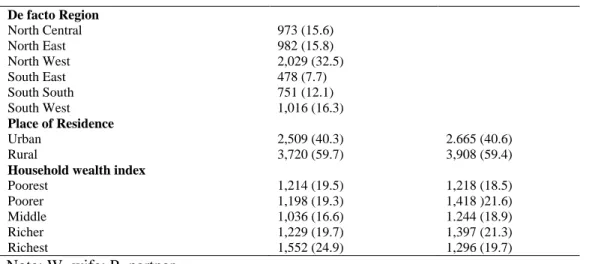
Description of the study population by selected couples‘ characteristics is presented in Table 1 with weighted frequencies and percentage. Results of the multivariable logistic regression analysis are presented in Table 2 showing the odds ratio (OR), adjusted odds ratio (AOR) and their 95% confidential intervals (CI).
In Nigeria, 27% of the couples used contraceptives whereas, in Zambia, 63% reported using a
contraceptive. In both countries, most of the respondents were in union where the wife is 5-9 years younger than her partner. In Zambia, 53% of the couples had the same level of education, whereas only 1.9% had no education; in Nigeria, 33% attained a similar level of education, and 25% were both not educated. Most of the couples shared same religious affiliation and ethnic origin in both countries. However, in Zambia inter-ethnic union was more prevalent than in Nigeria with about 47% of the couples in inter-ethnic union. The majority of the couples in Nigeria (65.3%) and Zambia (51.6%) were working, 30.7% in Nigeria and 39.9% in Zambia were in union where the wife was not working. Distribution of respondents by the frequency of listening to the radio in both countries showed that slightly above one-third of the couples in Nigeria listened to the radio at least once a week, and one-third listened every day in Zambia. The frequency of listening to the radio was higher among men than their partners in both countries. The majority of couples in both countries reported having the same number of living children, but in Zambia in about 28% of the unions, husbands had more children than wives. Most couples had similar fertility preference where both want another child or undecided. Close to 60% of couples in both countries resided in rural areas.
Table 1: Percent Distribution of Nigerian and Zambian Couples by selected Characteristics
Characteristic Nigeria Zambia
Number (%) Number (%)
Contraceptive use
Couple not using Couple using
4,554 (73.0) 1,675 (27.0)
2,403 (36.6) 4,170 (63.4)
Age difference
Same age Wife older
Wife 1-4 years younger Wife 5-9 years younger Wife 10 + years younger
110 (1.8) 130 (2.1) 1,462 (23.4) 2,703 (43.4) 1,824 (29.3)
176 (2.7) 198 (3.0) 2,299 (35.0) 2,848 (43.3) 1,052 (16.0)
Education Difference
Both no education Partner more educated Wife more educated Both same but not none
1,578 (25.3) 1,904 (30.6) 677 (10.9) 2,070 (33.2)
126 (1.9) 2,200 (33.5) 741 (11.3) 3,506 (53.3)
Religion difference
Both Catholic Both Other Christian Both Muslim
WCatholic/P other Christian WChristian/PMuslim, Trad/Other WChristian/Pother
427 (7.3) 1,923 (32..7) 3,295 (56.1) 126 (2.2) 99 (1.7) -
872 (14.3) 4,818 (78.8) -
293 (4.8) - 128 (2.1)
Ethnicity Difference
Inter-ethnic Same Ethnic origin
875 (14.1) 5,354 (85.9)
3,105 (47.2) 3,468 (52.8)
Work Difference
Both working
W not working/P working W working/P not working Both not working
4,045 (65.3) 1,903 (30.7) 143 (2.3) 104 (1.7)
3,372 (51.6) 2,607 (39.9) 243 (3.7) 314 (4.8)
Frequency of listening to radio
Both not at all Both once a week Both at least once a week Both everyday
Wife not at all /Partner listens Wife listens/Partner not at all
689 (14.8) 402 (8.7) 1,636 (35.2) -
1,494 (32.1) 425 (9.2)
790 (16.5) 104 (2.2) 271 (5.7) 1,579 (33.0) 1,641 (34.3) 396 (8.3)
Couples’ children
Same Wife has more Husband has more
5,040 (80.9) 385 (6.2) 804 (12.9)
4.135 (62.9) 507 (9.2) 1,831 (27.9)
Fertility preference difference
Both no more Both want/undecided
Wife wants or undecided/P no more Wife no more/P wants or undecided
458 (7.4) 4,972 (80.9) 327 (5.3) 391 (6.4)
1,568 (24.0) 3,481 (53.2) 648 (9.9) 841 (12.9)
De facto Region
Central Copperbelt Eastern Luapula Lusaka Muchinga Northern North Western Southern Western
De facto Region North Central North East North West South East South South South West 973 (15.6) 982 (15.8) 2,029 (32.5) 478 (7.7) 751 (12.1) 1,016 (16.3)
Place of Residence
Urban Rural 2,509 (40.3) 3,720 (59.7) 2.665 (40.6) 3,908 (59.4)
Household wealth index
Poorest Poorer Middle Richer Richest 1,214 (19.5) 1,198 (19.3) 1,036 (16.6) 1,229 (19.7) 1,552 (24.9) 1,218 (18.5) 1,418 )21.6) 1.244 (18.9) 1,397 (21.3) 1,296 (19.7)
Note: W=wife; P=partner
Table 2: Unadjusted and Adjusted Logistic Regression Model Predicting the Relationship between Couples‘ Characteristics and Contraceptive use in Nigeria and Zambia
Characteristic Nigeria Zambia
OR/95 %CI AOR/95% CI OR/95% CI AOR/95% CI
Age difference
Same age (RC) Wife older
Wife 1-4 years younger Wife 5-9 years younger Wife 10 + years younger
1.00 0.66(0.26-1.66) 1.06(0.53-2.09) 1.00(0.51-1.95) 1.00(0.51-1.97) 1.00 0.66(0.26-1.71) 1.11(0.55-2.20) 1.03(0.52-2.04) 1.08(0.54-2.15) 1.00 0.82(0.45-1.50) 1.32(0.82-2.14) 1.41(0.88-2.28) 1.07(0.66-1.73) 1.00 0.82(0.44-1.50) 1.33(0.82-2.15) 1.42(0.88-2.28) 1.07(0.66-1.73) Education Difference
Both no education (RC) Partner more educated Wife more educated Both same but not none
1.00 1.70(1.02-2.83)* 1.74(0.97-3.11)† 2.00(1.20-3.35)** 1.00 1.76(1.05-2.95)* 1.77(0.99-3.18)† 2.02(1.20-3.39)** 1.00 1.66(1.00-2.77)* 1.76(1.02-3.05)* 1.94(1.19-3.18)** 1.00 1.64(0.98-2.73)† 1.72(0.99-2.99)† 1.88(1.14-3.08)* Religion difference
Both Catholic (RC) Both other Christian Both Islam
WCath/P other Christian WChristian/P Islam/Trad/Other WChristian/P Other 1.00 0.85(0.59-1.22) 0.46(0.29-0.73)** 0.87(0.42-1.82) 0.64(0.35-1.19) - 1.00 0.86(0.59-1.24) 0.53(0.34-0.82)** 0.85(0.39-1.82) 0.65(0.35-1.20) - 1.00 0.91(0.73-1.13) - 0.66(0.45-0.97)* - 1.28(0.76-2.16) 1.00 0.92(0.74-1.14) - 0.64(0.43-0.94)* - 1.26(0.75-2.12) Ethnicity Difference Inter-ethnic (RC) Same Ethnicity 1.00 0.77(0.57-1.04) 1.00 0.78(0.58-1.06) 1.00 1.07(0.91-1.26) 1.00 1.08(0.92-1.27) Work Difference
Both working (RC) W none/Partner working W working/Partner none Both not working
1.00 0.76(0.57-1.01)† 0.90(0.44-1.85) 0.72(0.32-1.63) 1.00 0.86(0.64-1.14) 1.03(0.51-2.08) 0.72(0.31-1.66) 1.00 1.10(0.90-1.35) 1.46(1.03-2.08)* 1.00(0.65-1.54) 1.00 1.11(0.91-1.35) 1.31(0.92-1.87) 1.00(0.65-1.54)
Frequency of listening to radio
Both not at all (RC) Both <once a week Both at least once a week Both everyday
Wife no/Partner listens Wife listens/Partner no
1.00 1.57(0.96-2.57)† 1.97(1.19-3.28)** - 1.24(0.75-2.05) 1.09(0.57-2.10) 1.00 1.47(0.87-2.47) 1.91(1.13-3.22)* - 1.23(0.74-2.05) 1.15(0.60-2.22) 1.00 1.09(0.68-1.73) 0.87(0.61-1.23) 1.24(0.97-1.59)† 1.11(0.89-1.39) 1.06(0.77-1.45) 1.00 1.07(0.67-1.70) 0.88(0.62-1.25) 1.22(0.95-1.57) 1.10(0.88-1.37) 1.04(0.76-1.43) Couples’ children Same (RC) Wife has more
Husband has more 0.72(0.53-0.98)* 0.70(0.51-0.95)* 0.96(0.80-1.15) 0.96(0.80-1.15)
Fertility preference difference
Both no more (RC) Both want/undecided
W wants & undecided/P no more W no more/P wants & undecided
1.00
0.29(0.21-0.41)*** 0.52(0.33-0.82)** 0.68(0.44-1.05)†
1.00
0.31(0.21-0.43)*** 0.54(0.34-0.85)** 0.65(0.41-1.02)†
1.00
0.76(0.63-0.91)** 1.29(0.95-1.75)† 0.90(0.71-1.15)
1.00
0.77(0.64-0.93)** 1.28(0.94-1.75) 0.93(0.72-1.18)
De facto Region
Central (RC) Copperbelt Eastern Luapula Lusaka Muchinga Northern North Western Southern Western
1.00
1.30(0.85-1.98) 1.66(1.13-2.43)** 0.64(0.42-0.95)* 1.10(0.76-1.60) 1.24(0.81-1.90) 1.20(0.80-1.80) 0.73-0.49-1.10) 1.22(0.83-1.80) 1.09(0.72-1.66)
1.00
1.27(0.83-1.96) 1.74(1.17-2.57)** 0.63(0.42-0,95)* 1.09(0.75-1.60) 1.26(0.81-1.96) 1.20(0.80-1.80) 0.74(0.49-1.12) 1.24(0.84-1.83) 1.12(0.73-1.72)
De facto Region
North Central (RC) North East North West South East South South South West
1.00
0.49(0.29-0.81)** 0.79(0.47-1.32) 0.73(0.47-1.14) 0.69(0.46-1.03)† 1.39(0.94-2.04)†
1.00
0.45(0.26-0.75)** 0.79(0.49-1.29) 0.70(0.46-1.08) 0.61(0.40-0.92)* 1.22(0.83-1.79)
Place of Residence
Urban (RC) Rural
1.00
0.86(0.65-1.13)
1.00
0.87(0.67-1.15)
1.00
0.81(0.65-1.02)† 1.00
0.81(0.64-1.03)†
Household Wealth index
Poorest (RC) Poorer Middle Richer Richest
1.00
1.59(0.95-2.64)† 2.48(1.39-4.41)** 3.14(1.81-5.45)*** 3.48(1.90-6.39)***
1.00
1.64(0.96-2.79)† 2.48(1.37-4.47)** 3.28(1.86-5.80)*** 3.47(1.85-6.49)***
1.00
1.26(1.02-1.56)* 1.33(1.04-1.71)* 1.43(1.04-1.97)* 1.80(1.19-2.73)**
1.00
1.26(1.02-1.57)* 1.33(1.03-1.71)* 1.41(1.01-1.95)* 1.80(1.17-2.75)**
reduced in all the categories. Couples who were homogenous in the attained level of education were 88% more likely to be using any contraceptive than those who had no education in Zambia.
In Nigeria, the likelihood of using contraceptives was significantly less for couples where both were Muslims than where both were Catholics (AOR 0.53 p<0.01). In Zambia, a significant inverse association was found among couples where the wife is Catholic, and her partner was affiliated with other Christian denomination relative to where both were Catholics (AOR 0.64 p<0.05). In Nigeria, the difference in work status was of marginal significance where the wife did not work but partner worked (OR 0.76 p<0.10), albeit the significance was lost in the adjusted model. In Zambia, couples where wife worked, and partner had no work were significantly more likely to be using contraceptives (OR 1.46 p<0.05)
but the association became insignificant in the adjusted model. Holding other variables constant, the frequency of listening to the radio was associated with contraceptive use in Nigeria for couples who listened at least once a week compared to those who did not listen at all (AOR 1.91 p<0.05). In Zambia, a marginally significant positive association was observed among couples who listened to the radio every day (OR 1.24 p<0.10) but the odds did not reach statistical significance when covariates were adjusted.
the odds of using contraceptives were significantly less for couples where the wife wanted another child or undecided, but her partner wanted no more, relative to where both wanted no more (AOR 0.54 p<0.01). On the contrary in Zambia, the odds of using contraceptive were higher for couples where the wife wanted more or undecided, but partner wants no more, but the level of significance was only marginal. Where wife wanted no more children and partner wanted more or undecided, the likelihood of using contraceptive was less than where both wanted no more in Nigeria (AOR 0.65 p<0.10).
With respect to the region of residence in Zambia, couples in Eastern region were significantly more likely to use contraceptives than couples in the Central region (AOR 1.74 p<0.01), whereas couples in Luapula were less likely to be using contraceptives (OR 0.63 p<0.05). In Nigeria, contraceptive use was significantly less likely among couples in the North East (AOR 0.45 p<0.01) and South-south (AOR 0.61 p<0.05), compared to couples in the North central region. Couples who were resident in the rural areas in Zambia were less likely than their urban counterparts to be using contraceptives (AOR 0.81 p<0.10). The household wealth index was significantly associated with contraceptive use by couples in both countries. Compared to the poorest, all other categories were more likely to be using contraceptives but in Nigeria, the significant difference between the poorest and the poorer was only marginal. The odds of using contraceptives increased with higher wealth quintile in both countries. For instance, the odds were 2.48 times among the middle and 3.48 times among the richest in Nigeria.
Discussion
Examining the role of couples‘ characteristics in the use of contraceptives by couples in Nigeria and Zambia showed that some couple characteristics were significantly associated with couples‘ use of contraceptives. Interestingly, many characteristics were significant in the same direction despite the different prevalence of contraceptive use in the two countries.
The difference in educational attainment between man and partner strongly predicted contraceptive use in both countries. This result gives some insight into understanding the gap in contraceptive use among couples in the two countries. Zambia has less than 2% of couples who had no education, unlike Nigeria where slightly above a quarter had no education. The positive association between spousal education difference and contraceptive use stresses the importance of education in behavior modification toward uptake of contraceptives by couples 16,18,21,22. Couples who are not educated are not likely to know the benefits of optimal spacing and limiting childbearing. Even when they are informed, they will still be less likely to believe that reproduction should be interfered with through contraceptives. There is the need for governmental and non-governmental agencies working in the area of contraception to intensify family planning programmes and incentives targeted at uneducated couples, especially in Nigeria.
Consistent with findings by Irani et al.18 in urban Kenya, the religious affiliation of couples was associated with contraceptive use in Nigeria and Zambia although not in all the categories. Thus, confirming the influence of religion on contraceptive use23,24. Other aspects of religion may have a stronger influence on contraceptive use than religious affiliation. For instance, in rural Malawi, women who attended congregations where their leaders approved of contraception and speak of morality often were more likely to use contraceptives 25. There is a need for more research that will explore the diversity in sect in both Islam and Christianity and other aspects of religion and contraception in Nigeria, Zambia, and other sub-Saharan African countries.
The difference in the reported number of children by a couple is likely to be an indication of a wife or husband having had children outside the current union. It was expected that wife or husband reporting more children will encourage the use of contraceptive in a union because the partner who has more children would like to limit births in the current union, but this was not the case in Nigeria, supporting a previous finding in Nigeria by Ibisomi16. On the other hand, it is more likely that the partner who has more children would want to have children with the current spouse, but this depends on the number of children they have outside and in the current union, which is not available in the data used for this study.
One of the strongest determinants of nonuse of contraceptive among couples in both countries is fertility preference especially when both man and partner are undecided or wants another child, and when the wife wants more children, but partner does not want. This finding is similar to the result in Irani et al18 in urban Kenya, a couple who differed in their fertility preferences were also less likely to use contraceptives. Also, a previous evidence from Bankole and Audam28 in nine sub-Saharan African countries showed that higher fertility preference by wives was inversely associated with the use of contraceptives in seven out of the nine countries they studied. This result is suggestive of the need for more research to understand the dynamics of fertility preferences of individuals in a union Regional variation in contraceptive use among couples in Nigeria and Zambia indicates the likely influence of region-level factors on the uptake of contraceptives by couples. It suggests the need for studies that will investigate contextual influences at the regional level and to intensify region-based programmes aimed at encouraging couples to use contraceptives. Couples in the poorest wealth quintile in both countries were less likely to use contraceptives than their more privileged counterparts in higher quintiles. This is an indication of deprivation and inequality in access to reproductive health based on socioeconomic status.
Limitations of the Study
Using DHS data constrained inference of causation given that the data are cross-sectional. Thus, the predictors are only temporal factors associated with couples‘ contraceptive use. Studies using longitudinal data are encouraged to establish the causal factors associated with contraceptive use and nonuse by couples in sub-Saharan Africa. The extent of involvement in religious activities, and other socio-cultural factors that may influence contraceptive use could not be measured due to the limitation of the data source. Despite these limitations, the findings highlight the importance of couple‘s characteristics in the uptake of contraceptive using comparable indicators across countries.
Conclusion
This study shows that differences in some couples‘ characteristics matter in the uptake of contraceptives. Couples‘ educational attainment, religious affiliation, the frequency of listening to the radio, reported number of children, fertility preference, region and household wealth index were significant predictors of contraceptive use among couples in Nigeria and Zambia. Increasing acceptance and use of contraceptives involve behavioural changes that have to do with altering deep-seated cultural and religious beliefs and even political convictions about the importance of numbers. Given the significant role of couples‘ characteristics in the uptake of contraceptives, there is the need to encourage interventions that target couples, particularly those of poor socioeconomic status.
Acknowledgement
The authors acknowledge AuthorAID colleagues, Eva Magambo, Dan Adipo and Protasio Chipulu for their valuable comments on this paper.
Contribution of Authors
References
1. Creanga AA, Gillespie D, Karklins S and Tsui AO. Low use of contraception among poor women in Africa: an equity issue. Bull World Health Organ. 2011;89(4):258-266. doi:10.2471/BLT.10.083329. 2. United Nations, Department of Economic and Social
Affairs, Population Division. Trends in
Contraceptive Use Worldwide 2015.; 2015. 3. Federal Ministry of Health [Nigeria]. National
Reproductive Health Working Group Meeting Report. Abuja, Nigeria: Federal Ministry of Health; 2013.
4. NPC, ICF International. Nigeria Demographic and Health Survey 2013. Abuja, Nigeria, and Rockville, Maryland, USA: National Population Commission, Nigeria, and ICF International; 2014.
5. Central Statistical Office (CSO) [Zambia], Ministry of Health (MOH) [Zambia], and ICF International.
Zambia Demographic and Health Survey 2013-14. Rockville, Maryland, USA: Central Statistical Office, Ministry of Health, and ICF International; 2014.
6. Sonfield A, Hasstedt K, Kavanaugh ML and Anderson R.
The Social and Economic Benefits of Women‘s Ability to Determine Whether and When To Have Children. New York: Guttmacher Institute; 2013.
<www.guttmacher.org/pubs/
social-economic-benefits.pdf>.
7. World Health Organization. Trends in Maternal Mortality: 1990 to 2015. Estimates by WHO, UNICEF, UNFPA, The World Bank and the United Nations Population Division. Geneva, Switzerland: World Health Organization; 2015.
8. Mesfin G. The role of men in fertility and family planning program in Tigray Region. Ethiop J Health Dev. 2002;16(3):247-255.
9. Gyimah SO, Takyi B and Tenkorang EY. Denominational affiliation and fertility behaviour in an African context: An examination of couple data from Ghana. J Biosoc Sci. 2008;40(3):445.
10. Tsou MW, Liu JT and Hammitt JK. Parental age difference, educationally assortative mating and offspring count: evidence from a contemporary
population in Taiwan. Biol Lett.
2011:rsbl20101208.
11. DeRose LF, Dodoo FNA and Patil V. Fertility desires and perceptions of power in reproductive conflict in Ghana. Gend Soc. 2002;16(1):53-73.
12. Izugbara CO and Ezeh AC. Women and high fertility in Islamic northern Nigeria. Stud Fam Plann. 2010;41(3):193-204.
13. Mason KO and Smith HL. Husbands‘ versus wives‘ fertility goals and use of contraception: The influence of gender context in five Asian countries.
Demography. 2000;37(3):299-311.
14. Feyisetan BJ. Spousal communication and contraceptive use among the Yoruba of Nigeria. Popul Res Policy Rev. 2000;19(1):29-45.
15. Ogunjuyigbe PO, Ojofeitimi EO and Liasu A. Spousal communication, changes in partner attitude, and contraceptive use among the Yorubas of Southwest Nigeria. Indian J Community Med. 2009;34(2):112. 16. Ibisomi L. Is age difference between partners associated
with contraceptive use among married couples in Nigeria? Int Perspect Sex Reprod Health. 2014;40(1):39-45.
17. Haile A and Enqueselassie F. Influence of women‘s autonomy on couple‘s contraception use in Jimma town, Ethiopia. Ethiop J Health Dev. 2006;20(3). 18. Irani L, Speizer IS and Fotso JC. Couple characteristics
and contraceptive use among women and their partners in urban Kenya. Int Perspect Sex Reprod Health. 2014;40(1):11.
19. Benefo KD. Are partner and relationship characteristics associated with condom use in Zambian nonmarital relationships? Int Fam Plan Perspect. 2004:118-127.
20. Odimegwu CO. Family Planning Attitudes and Use in Nigeria: A Factor Analysis. Int Fam Plan Perspect. 1999;25(2):86-91.
21. Ainsworth M, Beegle K and Nyamete A. The impact of women‘s schooling on fertility and contraceptive use: A study of fourteen sub-Saharan African countries. World Bank Econ Rev. 1996;10(1):85-122.
22. Stephenson R, Baschieri A, Clements S, Hennink M and Madise N. Contextual influences on modern contraceptive use in sub-Saharan Africa. Am J Public Health. 2007;97(7):1233-1240.
23. Agadjanian V. Religious denomination, religious involvement, and modern contraceptive use in
Southern Mozambique. Stud Fam Plann.
2013;44(3):259-274.
24. Wusu O. Religious influence on non-use of modern contraceptives among women in Nigeria: a comparative analysis of 1990 and 2008 NDHS. J Biosoc Sci. 2015;47(05):593-612.
25. Yeatman SE and Trinitapoli J. Beyond denomination: The relationship between religion and family planning in rural Malawi. Demogr Res. 2008;19(55):1851-1882. 26. Agha S and Van Rossem R. Impact of Mass Media Campaigns on Intentions to Use The Female Condom in Tanzania. Int Fam Plan Perspect. 2002;28(3):151-158.
27. Van Rossem R and Meekers D. The reach and impact of
social marketing and reproductive health
communication campaigns in Zambia. BMC Public Health. 2007;7(1):1-12.