Dependency Modeling of a SOA Based
System Through Colored Petri Nets
Pawan Kumar and Ratneshwer Gupta
Department of Computer Science (MMV), Banaras Hindu University, India
Dependency relationships play an important role in testing, maintenance and configuration management of software systems. The informal dependency represen-tations fail to observe behavioral connections among subsystems and cause ambiguity in representing dif-ferent types of dependency relationships. Therefore, dependency in a software system requires a formal and unambiguous representation so that its correct effects can be visualized. In this paper, we present a Colored Petri Net based dependency analysis of a Service Ori-ented Architecture (SOA) based system that represents specification of dependency relationships and models the dependencies in a SOA based system at conceptual level. Different types of dependency relations are rep-resented in a formal manner by using Service Algebra. A module SOA based system ‘Online Bookshop’ has been developed and used for the purpose of modeling and example demonstration. Such modeling can help in identification of inconsistency among services, and web services can be verified for safety and reliability. ACM CCS (2012) Classification: Information systems
→ World Wide Web → Web services
Software and its engineering → Software organiza-tion and properties → Software system structures →
Software system models → Petri nets
Software and its engineering → Software organiza-tion and properties → Contextual software domains
→ Software infrastructure → Middleware
Keywords: Service Oriented Architecture, web ser-vices, Petri Net, Colored Petri Net, Service Algebra, dependency analysis
1. Introduction
Software organizations are aware of the fact that without sufficient understanding of the sys-tems they develop, maintenance and evolution become expensive and unpredictable. Service Oriented Architecture (SOA) is an approach to
have no-where to find what dependencies are missing. A user may expect dependency infor-mation recorded in the documentation distrib-uted along with the software. However, neither the availability nor accuracy of such documen-tation is guaranteed [3]. Thinking about depen-dency relationships is about being sensitive to the desirable and undesirable effects of de-pendencies in various situations. The tasks of unlinking, moving, re-linking in an organiza-tional context are usually expensive and time consuming. They are also fraught with risk, since a neglected dependency could result in an undesirable disturbance to another system when the move occurs. This is why projects are so expensive, and why organizations prefer to work around dependencies rather than address them head-on. In this process, they often cre-ate fresh dependencies that can pose an even bigger problem in future. When using Service Oriented Architecture for application develop-ment, dependency analysis becomes even more complex. As a result, building a dependency hi-erarchy between all the components in a SOA becomes extremely difficult, but nevertheless all the more important to ensure that the overall system stays functional while changes are in-troduced at different levels [4].
In this paper, we present a Colored Petri Net based dependency analysis of a Service Ori-ented Architecture (SOA) based system that represents specification of dependency relation-ships and models the dependencies in a SOA based system at conceptual level. Different types of dependency relations are represented in a formal manner by using Service Algebra. A module SOA based system Online Bookshop
has been developed and used for the purpose of modeling and example demonstration. Such modeling can help in identification of inconsis-tency among services, and web services can be verified for safety and reliability. The proposed work does not address the definition and inter-nal details of web services. Rather, the main aim of this work is to describe the observable dependencies among web services as a form of logical and temporal relationships.
The rest of the paper is organized as follows. In Section 2, some research efforts, related to the topic, are summarized briefly. In Section 3, a brief introduction of Petri net and service al-gebra are given. In Section 4, the description of
module SOA based system Online Bookshop is given, which has been used for modeling and example demonstration. Section 5 describes dependency relationships among web services using Petri nets and service algebra operators. In Section 6, dependency modeling of a SOA based system, through colored Petri net is ex-plained in detail. A comparative study between our approach and other similar approaches are given in Section 7. Finally, we conclude the pa-per in Section 8.
2. Related Work
The importance of Colored Petri net as a mod-eling and analysis tool has been recognized by several researchers. Here we limit the discus-sion only to SOA based systems and especially works related to dependency analysis of SOA based systems.
Valero et al. [5], in their paper, have focused on the development of a methodology for the de-sign and validation of composite web services using WS-CDL as the language for describing web services interactions and Petri nets as a formalism that allows to simulate and validate the described systems. They specifically intend, then, to capture timed and prioritized collabo-rations in composite web services. Zhang et al. [6] have introduced a Web Services Net (WS-Net), which is an executable architectural de-scription language incorporating the semantics of Colored Petri Nets with the style and under-standability of the Object-Oriented concept and Web services concept. Gehlot et al. [3] report on their experience with using Colored Petri Nets (CPNs) for model driven development and quality assessment of a defense-targeted service oriented software architecture. They identified the features of CPN that have resulted in ease of adoption as a modeling tool in present setting. Preliminary results are provided which support the use of CPNs as a basis for model driven software development, and verification and val-idation (V&V) for quality assurance of highly concurrent and mission-critical SOAs. Deng et al. [7] presented an approach for transforming the composition language WSCI into Colored Petri nets (CPNs) so as to verify the model with existing CPNs-specialized tools. The Colored Petri nets model of a typical use case Plan and Book Trip is constructed, analyzed, verified and
line banking. To sell books, this program takes an orders from customers, confirms the order, and cancels the order, as suggested by the cus-tomer. There are two perspectives in this case, one from customers’ point of view and another from sellers’ point of view. In the context of customer, the main goal is to buy the appro-priate books at least price on right time. In the context of seller, the main goal is to sell more and more books and provide service timely to build goodwill.
Suppose we consider the customers point of view. For purchasing books, there are two sit-uations, either purchasing offline or online. To purchase books offline we have to go to a book shop. Search catalogue to find appropri-ate books. After finding appropriappropri-ate books, we need to make payment. Payment can be made by either using cash or debit/credit card. To purchase books online, first a customer visits websites to find appropriate site for purchasing books. When he decides about the book pur-chase, then he registers himself to the partic-ular website. After registering himself, he logs in to the website. Again he searches for desired books. Desired books are placed in shopping cart and order for the desired books is placed. Appropriate delivery address is provided so that books delivery could be done successfully at right place and to the person. Payment is done using either cash on delivery or debit card or online banking.
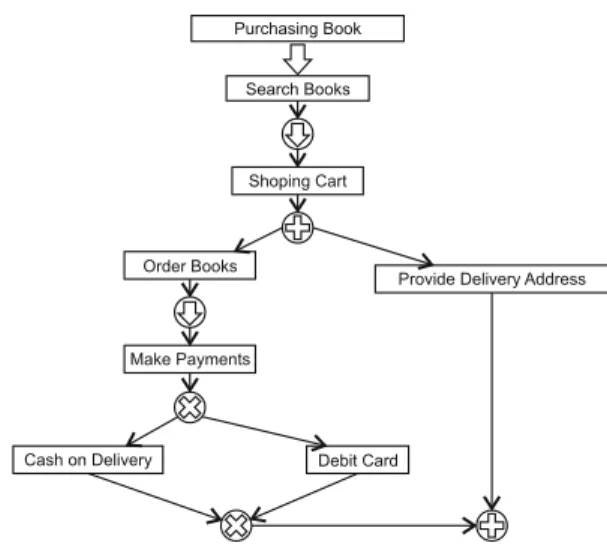
Model of Purchasing Books has been shown in Figure 1 which shows a model of decomposi-tion of the goal Purchasing Book. This goal is decomposed up to manageable sub-goals and a web service is developed for each sub-goal. If a web service does not exist corresponding to a sub-goal, we decompose this sub-goal to further smaller sub-goals so that corresponding to these sub-goals, web services exist. Web ser-vices are connected by three types of relation-ships i.e. sequence, concurrent and exclusion which are denoted by circled arrows, pluses and crosses respectively. In Figure 1, Search Website, Decide a Website, Search Books and
Shopping Cart sub-goals are sequentially at-tached. Order the Book and Provide Delivery Address are performed concurrently. Payment by Cash and Payment by Debit Card are done exclusively.
simulated as a prototype of WSCI model with the CPNs tools. In his dissertation Wells [8] fo-cuses on the use of colored Petri nets for simu-lation based performance analysis of industrial sized systems. He has presented an overview of improved facilities for performance anal-ysis using colored Petri nets and a framework for implementing monitoring facilities that ob-serve, inspect, and control simulations of Col-ored Petri nets (CPNs). Bhubaneswar et al. [9] in their paper, deal with the usage of CPNs to verify the semantic web service composition plan represented by Ontology Web Languages for Web Services (OWL-S). The verification is carried out by employing reachability anal-ysis of an algebraic CP-net and simulation us-ing CPN tools. Kolb et al. [10] have described orchestration of heterogeneous services in which BPEL and Workflows (WF) are used. They have made effort to convert WFs to Open Workflow nets (oWFNs) so that compiler for executing this net can be mentioned. But their approach is not sufficient to handle dependency issue effectively. Abbassi et al. [11] have used a formal model Event-B for web service com-position this but approach is not sufficient for dependency analysis.
It can be observed that several works on appli-cations of Colored Petri nets are available in service oriented architecture and other domains. But a specific work of dependency modeling of a SOA based system through Colored Petri nets is rarely available. This work extends the above contributions further by representing de-pendency relationships, in a SOA based system, through Colored Petri nets which will prove a valued component for validating services at de-sign time.
3. A SOA Based
Online
Bookshop
System for
Example Demonstration
card/on-have no-where to find what dependencies are missing. A user may expect dependency infor-mation recorded in the documentation distrib-uted along with the software. However, neither the availability nor accuracy of such documen-tation is guaranteed [3]. Thinking about depen-dency relationships is about being sensitive to the desirable and undesirable effects of de-pendencies in various situations. The tasks of unlinking, moving, re-linking in an organiza-tional context are usually expensive and time consuming. They are also fraught with risk, since a neglected dependency could result in an undesirable disturbance to another system when the move occurs. This is why projects are so expensive, and why organizations prefer to work around dependencies rather than address them head-on. In this process, they often cre-ate fresh dependencies that can pose an even bigger problem in future. When using Service Oriented Architecture for application develop-ment, dependency analysis becomes even more complex. As a result, building a dependency hi-erarchy between all the components in a SOA becomes extremely difficult, but nevertheless all the more important to ensure that the overall system stays functional while changes are in-troduced at different levels [4].
In this paper, we present a Colored Petri Net based dependency analysis of a Service Ori-ented Architecture (SOA) based system that represents specification of dependency relation-ships and models the dependencies in a SOA based system at conceptual level. Different types of dependency relations are represented in a formal manner by using Service Algebra. A module SOA based system Online Bookshop
has been developed and used for the purpose of modeling and example demonstration. Such modeling can help in identification of inconsis-tency among services, and web services can be verified for safety and reliability. The proposed work does not address the definition and inter-nal details of web services. Rather, the main aim of this work is to describe the observable dependencies among web services as a form of logical and temporal relationships.
The rest of the paper is organized as follows. In Section 2, some research efforts, related to the topic, are summarized briefly. In Section 3, a brief introduction of Petri net and service al-gebra are given. In Section 4, the description of
module SOA based system Online Bookshop is given, which has been used for modeling and example demonstration. Section 5 describes dependency relationships among web services using Petri nets and service algebra operators. In Section 6, dependency modeling of a SOA based system, through colored Petri net is ex-plained in detail. A comparative study between our approach and other similar approaches are given in Section 7. Finally, we conclude the pa-per in Section 8.
2. Related Work
The importance of Colored Petri net as a mod-eling and analysis tool has been recognized by several researchers. Here we limit the discus-sion only to SOA based systems and especially works related to dependency analysis of SOA based systems.
Valero et al. [5], in their paper, have focused on the development of a methodology for the de-sign and validation of composite web services using WS-CDL as the language for describing web services interactions and Petri nets as a formalism that allows to simulate and validate the described systems. They specifically intend, then, to capture timed and prioritized collabo-rations in composite web services. Zhang et al. [6] have introduced a Web Services Net (WS-Net), which is an executable architectural de-scription language incorporating the semantics of Colored Petri Nets with the style and under-standability of the Object-Oriented concept and Web services concept. Gehlot et al. [3] report on their experience with using Colored Petri Nets (CPNs) for model driven development and quality assessment of a defense-targeted service oriented software architecture. They identified the features of CPN that have resulted in ease of adoption as a modeling tool in present setting. Preliminary results are provided which support the use of CPNs as a basis for model driven software development, and verification and val-idation (V&V) for quality assurance of highly concurrent and mission-critical SOAs. Deng et al. [7] presented an approach for transforming the composition language WSCI into Colored Petri nets (CPNs) so as to verify the model with existing CPNs-specialized tools. The Colored Petri nets model of a typical use case Plan and Book Trip is constructed, analyzed, verified and
line banking. To sell books, this program takes an orders from customers, confirms the order, and cancels the order, as suggested by the cus-tomer. There are two perspectives in this case, one from customers’ point of view and another from sellers’ point of view. In the context of customer, the main goal is to buy the appro-priate books at least price on right time. In the context of seller, the main goal is to sell more and more books and provide service timely to build goodwill.
Suppose we consider the customers point of view. For purchasing books, there are two sit-uations, either purchasing offline or online. To purchase books offline we have to go to a book shop. Search catalogue to find appropri-ate books. After finding appropriappropri-ate books, we need to make payment. Payment can be made by either using cash or debit/credit card. To purchase books online, first a customer visits websites to find appropriate site for purchasing books. When he decides about the book pur-chase, then he registers himself to the partic-ular website. After registering himself, he logs in to the website. Again he searches for desired books. Desired books are placed in shopping cart and order for the desired books is placed. Appropriate delivery address is provided so that books delivery could be done successfully at right place and to the person. Payment is done using either cash on delivery or debit card or online banking.
Model of Purchasing Books has been shown in Figure 1 which shows a model of decomposi-tion of the goal Purchasing Book. This goal is decomposed up to manageable sub-goals and a web service is developed for each sub-goal. If a web service does not exist corresponding to a sub-goal, we decompose this sub-goal to further smaller sub-goals so that corresponding to these sub-goals, web services exist. Web ser-vices are connected by three types of relation-ships i.e. sequence, concurrent and exclusion which are denoted by circled arrows, pluses and crosses respectively. In Figure 1, Search Website, Decide a Website, Search Books and
Shopping Cart sub-goals are sequentially at-tached. Order the Book and Provide Delivery Address are performed concurrently. Payment by Cash and Payment by Debit Card are done exclusively.
simulated as a prototype of WSCI model with the CPNs tools. In his dissertation Wells [8] fo-cuses on the use of colored Petri nets for simu-lation based performance analysis of industrial sized systems. He has presented an overview of improved facilities for performance anal-ysis using colored Petri nets and a framework for implementing monitoring facilities that ob-serve, inspect, and control simulations of Col-ored Petri nets (CPNs). Bhubaneswar et al. [9] in their paper, deal with the usage of CPNs to verify the semantic web service composition plan represented by Ontology Web Languages for Web Services (OWL-S). The verification is carried out by employing reachability anal-ysis of an algebraic CP-net and simulation us-ing CPN tools. Kolb et al. [10] have described orchestration of heterogeneous services in which BPEL and Workflows (WF) are used. They have made effort to convert WFs to Open Workflow nets (oWFNs) so that compiler for executing this net can be mentioned. But their approach is not sufficient to handle dependency issue effectively. Abbassi et al. [11] have used a formal model Event-B for web service com-position this but approach is not sufficient for dependency analysis.
It can be observed that several works on appli-cations of Colored Petri nets are available in service oriented architecture and other domains. But a specific work of dependency modeling of a SOA based system through Colored Petri nets is rarely available. This work extends the above contributions further by representing de-pendency relationships, in a SOA based system, through Colored Petri nets which will prove a valued component for validating services at de-sign time.
3. A SOA Based
Online
Bookshop
System for
Example Demonstration
card/on-Suppose we take a general book purchase by a client. There are two choices to purchase a book by customer. Either he can go to a book shop and search book catalogue or go online and search books i.e. either he can purchase books online or offline. A goal tree has been drawn for the goal Purchasing Books in Figure 2. Figure 2 gives a lot of information how to achieve goal of Purchasing Books. To purchase a book is not an automate activity. For achieving this goal, a
number of activities have to be performed as is given is Figure 2. In this goal tree there are four levels. Without showing interaction among same level elements, it is not possible to know the relationship among these components. The relationships among same level elements have been depicted by block arrow in Figure 2. There may be three types of relationship: sequence, concurrency and mutual exclusion. Sequence relationships have been depicted by circled ar-row, concurrency by circled plus and mutual exclusion by circled cross.
4. Colored Petri Nets (CPNs)
CPN is an established concept for formal mod-eling of concurrent and distributed system. It is based on functional language standard ML. CPN has capacity of both Petri nets and program-ming language. Jensen and Kristiansen [13] have defined CPNs formally as follows:
Definition. A CPN is a nine tuple (P, T, A, Σ, V, C, G, E, I), where:
● P is the finite set of places.
● T is the finite set of transitions such that P ∩ T = ϕ.
● A ⊆ P × T ∪ T × P is a set of directed arcs. ● Σ is a finite set of non-empty color sets. ● V is a finite set of typed variables such that
Type[v] ∈ Σ for all variables v ∈ V. ● C: P → Σ is a color set function that as
-signs a color set to each place.
● G: T → EXPR is a guard function that as-signs a guard to each transition t ∈ T such that Type [G(t)] ∈ Bool.
● E: A → EXPR is an arc expression func-tion that assigns an arc expression to each arc a ∈ E such that Type [E (a)] = C(p)MS, where p is the place connected to the arc a. ● I: P → EXPR is an initialization function
that assigns an initialization expression to each place p such that Type [I(p)] = C(p)MS By above definition of Colored Petri nets, it is clear that every tuple is formally defined and it becomes unambiguous.
5. Dependency Types
Representation Through Petri
Nets and Service Algebra
The client-server relationship between multiple pairs of services has to be under constraints of various assumptions that they have regarding each other's structure, functionality and dynamic behavior. Merely stating that a service is depen-dent on another service is not sufficient. Types of dependency relations along with their critical factors are also important to be explored. This section focuses on formalization of dependency types by means of Petri nets i.e. how different types of dependency relationships, in a SOA based system, can be modeled through Colored Petri nets. We have considered four types of service dependency: control dependency, data dependency, sequence dependency and compo-sition dependency. SOA based system is concur-rent, distributed and dynamic by nature. Petri net is suitable modeling approach for this purpose. Petri net model has capacity to handle both static and dynamic dependency and it supports formal and graphical approaches.
In the following subsections, an attempt has been made to model different types of dependency.
5.1. Control Dependency Modeling
A control dependency between two services Si and Sj specifies the conditions under which ser-vice Sj is allowed to enter a state stj based on the state sti of service Si.
Suppose there are two services in Online Book-shop, namely Order Service and Payment Ser-vice. We have considered services as black boxes. Order Service and Payment Service are control dependent. Suppose a customer gives the order for a book. In addition, he gives the information of postal address. Order Service
sends the control to Payment Service. Payment Service takes payment from customer. After completing payment, Payment Service again sends control to the Order Service. Thus Order Service and Payment Service are control depen-dent on each other because Order Service sends control to Payment Service for payment and
Payment Service after its execution sends con-trol to Order Service for completion of order. We have formalized this dependency using Petri net. In Petri net of Order Service, initial state has a token. So when a customer decides to purchase a book, he invokes Order Service
and gives the mailing address and state t1 fires. After firing transition t1, token goes to the place payment buffer (Pb) and payment service becomes eligible for execution. In this case transition tr1of Payment Service is enabled to fire. When Payment Service completes its ex-ecution, final state fn of Payment Service gets a token and transition tk of Order Service be-comes enable to fire. When final state f of Or-der Service gets token, it means Order Service
has been executed successfully.
Figure 3. Formal representation of control dependency.
Using the concept of transition firing, it is clear from the diagram that without initiating of Or-der Service, Payment Service cannot be initi-ated for execution.
Figure 2. Goal tree for the goal Purchasing Book. Figure 1. Model of the goal Purchasing
Suppose we take a general book purchase by a client. There are two choices to purchase a book by customer. Either he can go to a book shop and search book catalogue or go online and search books i.e. either he can purchase books online or offline. A goal tree has been drawn for the goal Purchasing Books in Figure 2. Figure 2 gives a lot of information how to achieve goal of Purchasing Books. To purchase a book is not an automate activity. For achieving this goal, a
number of activities have to be performed as is given is Figure 2. In this goal tree there are four levels. Without showing interaction among same level elements, it is not possible to know the relationship among these components. The relationships among same level elements have been depicted by block arrow in Figure 2. There may be three types of relationship: sequence, concurrency and mutual exclusion. Sequence relationships have been depicted by circled ar-row, concurrency by circled plus and mutual exclusion by circled cross.
4. Colored Petri Nets (CPNs)
CPN is an established concept for formal mod-eling of concurrent and distributed system. It is based on functional language standard ML. CPN has capacity of both Petri nets and program-ming language. Jensen and Kristiansen [13] have defined CPNs formally as follows:
Definition. A CPN is a nine tuple (P, T, A, Σ, V, C, G, E, I), where:
● P is the finite set of places.
● T is the finite set of transitions such that P ∩ T = ϕ.
● A ⊆ P × T ∪ T × P is a set of directed arcs. ● Σ is a finite set of non-empty color sets. ● V is a finite set of typed variables such that
Type[v] ∈ Σ for all variables v ∈ V. ● C: P → Σ is a color set function that as
-signs a color set to each place.
● G: T → EXPR is a guard function that as-signs a guard to each transition t ∈ T such that Type [G(t)] ∈ Bool.
● E: A → EXPR is an arc expression func-tion that assigns an arc expression to each arc a ∈ E such that Type [E (a)] = C(p)MS, where p is the place connected to the arc a. ● I: P → EXPR is an initialization function
that assigns an initialization expression to each place p such that Type [I(p)] = C(p)MS By above definition of Colored Petri nets, it is clear that every tuple is formally defined and it becomes unambiguous.
5. Dependency Types
Representation Through Petri
Nets and Service Algebra
The client-server relationship between multiple pairs of services has to be under constraints of various assumptions that they have regarding each other's structure, functionality and dynamic behavior. Merely stating that a service is depen-dent on another service is not sufficient. Types of dependency relations along with their critical factors are also important to be explored. This section focuses on formalization of dependency types by means of Petri nets i.e. how different types of dependency relationships, in a SOA based system, can be modeled through Colored Petri nets. We have considered four types of service dependency: control dependency, data dependency, sequence dependency and compo-sition dependency. SOA based system is concur-rent, distributed and dynamic by nature. Petri net is suitable modeling approach for this purpose. Petri net model has capacity to handle both static and dynamic dependency and it supports formal and graphical approaches.
In the following subsections, an attempt has been made to model different types of dependency.
5.1. Control Dependency Modeling
A control dependency between two services Si and Sj specifies the conditions under which ser-vice Sj is allowed to enter a state stj based on the state sti of service Si.
Suppose there are two services in Online Book-shop, namely Order Service and Payment Ser-vice. We have considered services as black boxes. Order Service and Payment Service are control dependent. Suppose a customer gives the order for a book. In addition, he gives the information of postal address. Order Service
sends the control to Payment Service. Payment Service takes payment from customer. After completing payment, Payment Service again sends control to the Order Service. Thus Order Service and Payment Service are control depen-dent on each other because Order Service sends control to Payment Service for payment and
Payment Service after its execution sends con-trol to Order Service for completion of order. We have formalized this dependency using Petri net. In Petri net of Order Service, initial state has a token. So when a customer decides to purchase a book, he invokes Order Service
and gives the mailing address and state t1 fires. After firing transition t1, token goes to the place payment buffer (Pb) and payment service becomes eligible for execution. In this case transition tr1of Payment Service is enabled to fire. When Payment Service completes its ex-ecution, final state fn of Payment Service gets a token and transition tk of Order Service be-comes enable to fire. When final state f of Or-der Service gets token, it means Order Service
has been executed successfully.
Figure 3. Formal representation of control dependency.
Using the concept of transition firing, it is clear from the diagram that without initiating of Or-der Service, Payment Service cannot be initi-ated for execution.
Figure 2. Goal tree for the goal Purchasing Book. Figure 1. Model of the goal Purchasing
Formal representation of control dependencies is given here using service algebra. In Figure 3, S1 represents Order Service and S2 represents
Payment Service. Two services are connected to each other by payment buffer service (Pb). Payment buffer (Pb) is a temporary buffer that help to establish communication between Or-der Service and Payment Service.
In service algebra, it can be represented as fol-lows:
1( )
( )
1 2
1 2
t via Pb
tk via fn
S S
S S
→ →
The symbol ‘→’ is used for flow operator. We have used the following symbols as indi-cated operators:
: Control Dependency Operator : Data Dependency Operator : Composite Dependency Operator
: Sequence Dependency Operator con
⇒ ⇒
data
⇒seq
com
⇒
So, control dependency can be represented for-mally as follows.
*
1. 1con 2. 1 2. con 1.
S t via Pb S tr S fnS tk
An algorithm for formalization of control de-pendency is mentioned here. Similar type of algorithms can be written for data dependency, sequence dependency and composite depen-dency.
Algorithm: Construction of Petri net for control flow dependency
● Model each service using Petri net concepts.
● For each control flow dependency between service Si and Sj add a buffer place bf by which control can flow from service Si to ser-vice Sj. This buffer place has input transition in Si and output transition in Sj.
● If control returns from service Sj to service Si, then there is a flow from a place in Sj to a transition in Si.
5.2. Data Dependency Modeling
Data dependency among services can be mod-eled using Petri net effectively. Suppose there are two services S1 and S2.
Execution of S1 needs some data which can provide service S2? In this case service S1 is data dependent on service S2. Service S1 calls service S2 and service S2 provides information needed by service S1.
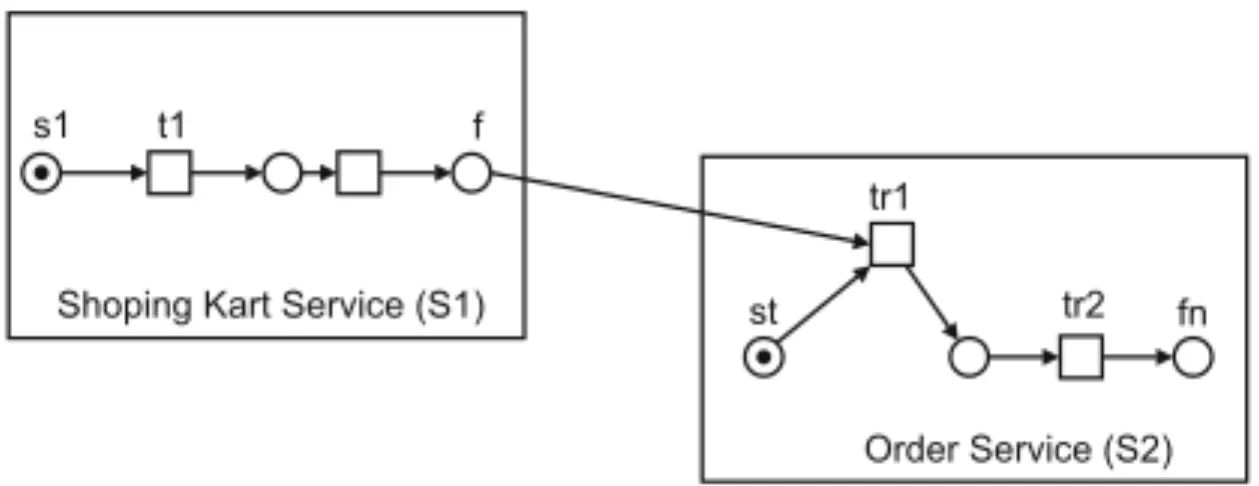
Suppose we take an example of Shopping Kart Service and Order Service. First a customer searches books and he places books in shop-ping kart. Order is given in shopshop-ping kart and information about books is given to Order Ser-vice. So here Order Service is data dependent on Shopping Kart Service. It can be represented using Petri net as in the following diagram. From this diagram, it is clear that without pro-viding information from Shopping Kart Service
to Order Service, Order Service cannot execute.
Figure 4. Formal representation of data dependency.
In web service algebra terms, it can be repre-sented as follows:
*
1. 1 2. 1 2.
S t * S f1. data⇒ S tr →S fn
It means, first enabling transition is t1 of S1. Af-ter a number of firing in S1, token reaches the place f of service net of S1. Now tr1 of service S2 becomes eligible for firing. The resources which need to execute service S2 are available. Service S2 is waiting for data from service S1 which be-comes available at this time. After a number of transition firing in service S2, token reaches the place fn of service net of service S2. It means that service S2 has been executed successfully.
5.3. Sequence Dependency Modeling
Sequence dependency among services means execution of services takes place one by one i.e. output of first service is input of second service.
Suppose there are three services S1, S2 and S3. If execution of service S1 is inevitable for initi-ating the execution of S2 and execution of S2 is essential for initiating the execution of S3, then S3 is sequentially dependent on S2 and S2 is sequentially dependent on S1. This concept can be modeled using service net effectively.
In our example Online Book Shopping, first we login, so Login Service is called. Then we search books which we have to purchase, so
Search Service is called. After searching books, we give order for purchase, so Order Service is called. In this situation Order Service is sequen-tially dependent on Search Service and Search Service is sequentially dependent on Login Ser-vice.
Petri net model of sequential dependency can be described as in the following diagram (Figure 5):
Figure 5. Formal representation of sequence dependency.
In this diagram, there are three services S1, S2 and S3. In this net, the only enabled transition for firing is t1. After completing the execution of service S1, the token goes to place f1. Medi-ator transition Mt1 plays a role for initiating the execution of service S2. When transition Mt1 fires, then place s2 gets a token and service S2 becomes eligible for initializing execution. Af-ter a number of transitions, the token goes to place f2, and mediator transition Mt2 becomes enabled for firing. When Mt2 fires, then initial place s3 of service S3 gets a token and service S3 becomes enabled for initiating the execu-tion. From this diagram, it is clear that S3 is se-quentially dependent on service S2, and service S2 is sequentially dependent on service S1. Sequence dependency can be described using service algebra terms as in the equation below.
1. 1
S s * 1.
S f1seqvia Mt1S s2. 2 * 2. 2 S f
seqvia Mt2S s3. 3 * 3. 3
S f
5.4. Composite Dependency Modeling
When a service S is constructed using the ser-vices S1, S2, S3 ... Sm, service S is composed of services S1, S2, S3...Sm.
Service S is dependent on services S1, S2, S3 ... Sm. Any defect in any automatic service affects the overall service S. In this way whole SOA based system can be also called a composite service. A SOA based system can be used as a service in a larger project.
This can be represented by the Petri net as fol-lows (Figure 6). There are three services S1, S2
Formal representation of control dependencies is given here using service algebra. In Figure 3, S1 represents Order Service and S2 represents
Payment Service. Two services are connected to each other by payment buffer service (Pb). Payment buffer (Pb) is a temporary buffer that help to establish communication between Or-der Service and Payment Service.
In service algebra, it can be represented as fol-lows:
1( )
( )
1 2
1 2
t via Pb
tk via fn
S S
S S
→ →
The symbol ‘→’ is used for flow operator. We have used the following symbols as indi-cated operators:
: Control Dependency Operator : Data Dependency Operator : Composite Dependency Operator
: Sequence Dependency Operator con
⇒ ⇒
data
⇒seq
com
⇒
So, control dependency can be represented for-mally as follows.
*
1. 1con 2. 1 2. con 1.
S t via Pb S tr S fnS tk
An algorithm for formalization of control de-pendency is mentioned here. Similar type of algorithms can be written for data dependency, sequence dependency and composite depen-dency.
Algorithm: Construction of Petri net for control flow dependency
● Model each service using Petri net concepts.
● For each control flow dependency between service Si and Sj add a buffer place bf by which control can flow from service Si to ser-vice Sj. This buffer place has input transition in Si and output transition in Sj.
● If control returns from service Sj to service Si, then there is a flow from a place in Sj to a transition in Si.
5.2. Data Dependency Modeling
Data dependency among services can be mod-eled using Petri net effectively. Suppose there are two services S1 and S2.
Execution of S1 needs some data which can provide service S2? In this case service S1 is data dependent on service S2. Service S1 calls service S2 and service S2 provides information needed by service S1.
Suppose we take an example of Shopping Kart Service and Order Service. First a customer searches books and he places books in shop-ping kart. Order is given in shopshop-ping kart and information about books is given to Order Ser-vice. So here Order Service is data dependent on Shopping Kart Service. It can be represented using Petri net as in the following diagram. From this diagram, it is clear that without pro-viding information from Shopping Kart Service
to Order Service, Order Service cannot execute.
Figure 4. Formal representation of data dependency.
In web service algebra terms, it can be repre-sented as follows:
*
1. 1 2. 1 2.
S t * S f1. data⇒ S tr →S fn
It means, first enabling transition is t1 of S1. Af-ter a number of firing in S1, token reaches the place f of service net of S1. Now tr1 of service S2 becomes eligible for firing. The resources which need to execute service S2 are available. Service S2 is waiting for data from service S1 which be-comes available at this time. After a number of transition firing in service S2, token reaches the place fn of service net of service S2. It means that service S2 has been executed successfully.
5.3. Sequence Dependency Modeling
Sequence dependency among services means execution of services takes place one by one i.e. output of first service is input of second service.
Suppose there are three services S1, S2 and S3. If execution of service S1 is inevitable for initi-ating the execution of S2 and execution of S2 is essential for initiating the execution of S3, then S3 is sequentially dependent on S2 and S2 is sequentially dependent on S1. This concept can be modeled using service net effectively.
In our example Online Book Shopping, first we login, so Login Service is called. Then we search books which we have to purchase, so
Search Service is called. After searching books, we give order for purchase, so Order Service is called. In this situation Order Service is sequen-tially dependent on Search Service and Search Service is sequentially dependent on Login Ser-vice.
Petri net model of sequential dependency can be described as in the following diagram (Figure 5):
Figure 5. Formal representation of sequence dependency.
In this diagram, there are three services S1, S2 and S3. In this net, the only enabled transition for firing is t1. After completing the execution of service S1, the token goes to place f1. Medi-ator transition Mt1 plays a role for initiating the execution of service S2. When transition Mt1 fires, then place s2 gets a token and service S2 becomes eligible for initializing execution. Af-ter a number of transitions, the token goes to place f2, and mediator transition Mt2 becomes enabled for firing. When Mt2 fires, then initial place s3 of service S3 gets a token and service S3 becomes enabled for initiating the execu-tion. From this diagram, it is clear that S3 is se-quentially dependent on service S2, and service S2 is sequentially dependent on service S1. Sequence dependency can be described using service algebra terms as in the equation below.
1. 1
S s * 1.
S f1seqvia Mt1S s2. 2 * 2. 2 S f
seqvia Mt2S s3. 3 * 3. 3
S f
5.4. Composite Dependency Modeling
When a service S is constructed using the ser-vices S1, S2, S3 ... Sm, service S is composed of services S1, S2, S3...Sm.
Service S is dependent on services S1, S2, S3 ... Sm. Any defect in any automatic service affects the overall service S. In this way whole SOA based system can be also called a composite service. A SOA based system can be used as a service in a larger project.
This can be represented by the Petri net as fol-lows (Figure 6). There are three services S1, S2
and S3. Each service S1, S2 and S3 have their own functionality. Service S is composed from services S1, S2 and S3. For demonstration pur-pose, two special places s and f are added in the figure which is used for starting place and final place respectively. Two special transitions ct1 and ct2 are added to establish the relationship. Initially, token is only in place s and enabled transition is only ct1. When transition ct1 fires, it transfer control to S1, S2 and S3 at the same time. Finally all control comes through transi-tion ct2 and then control transfers to final place f. Service S2 is also dependent on service S1 for the message which is provided by the message place m. Service S will be executed success-fully if and only if f gets a token. It is possible only if services S1, S2 and S3 have been exe-cuted successfully.
Using service algebra terms it can be shown as in the equation below.
. 1 1. 1, 2. 2, 3. 3
1. , 3. 3 2 .
com
S s via ct S s S s S s
S f S f S f via ct S f
com
1, 2. 2
*
6. Modeling of Dependency
Relationships Through Colored
Petri Nets (CPN)
In this section, different types of dependency in a SOA based system has been modeled us-ing Colored Petri nets. Conventional Petri net based modeling has few limitations. In Petri net modeling, places have only black tokens i.e. resources cannot be differentiated. Petri Net models have no manipulating power on data. In Petri net model, it is not possible to detect which types of data are stored in places. Ab-straction and modular concept is not available in Petri net model. Modeling a SOA based sys-tem using Petri net may fail to extract some aspects of dependency relationships. There is no concept of time in classical Petri net. So it does not cover temporal aspect of dependency in SOA based system.
We attempt to model the dependency relation-ships in a SOA based system with the help of Colored Petri Nets (CPNs). CPN provides a full spectrum of input/output facilities and user
de-fined functions so that one can parameterize all relevant input data and read it from data files. This also made it possible for a third party to run simulation and gather data with different input values. CPN offers the following four possible analysis approaches: interactive and automatic simulation, performance analysis, state space and invariant analysis and temporal logic based analysis of state space [13]. CPN extends the Petri nets to model both the static and dynamic properties of a system. The graph-ical part of the CPNs depicts the static archi-tectural structure of a system. Combined with other powerful elements such as colored tokens and simulation rules, CPN is very powerful in modeling dynamic behaviors of a system [14]. The main purpose of coloring places is to help people understand the usages of a component at the architectural level. Therefore the only imperative information here is what kind of in-formation needs to be provided to invoke the service of the component.
In CPN model, tokens in a place can be distin-guished. Every place has its own colored set i.e. data type. By this, it becomes transparent which types of token can reside in a place. CPNs have all the features of classical Petri net in addition to programming features. Due to programming features of CPNs, data flow, and control flow can be manipulated according to requirements. Dependency can be handled effectively using CPN modeling. CPNs has concept of time so it also captures temporal aspects of dependency in SOA based system. Abstraction is the back-bone for a SOA based system. Abstraction is achieved in CPN modeling using the concept of hierarchy in CPN. So a complex system can be modeled using hierarchy in a more effective way. Dependency relationships of a complex SOA based system can be understood easily by using CPNs. Thus CPNs modeling provide more generalized view of SOA based system than conventional Petri net modeling.
To represent dependency relationships using CPNs, basically we represent primitive activi-ties of web services and their interactions with other web services. These dependency relations are captured by token firing rules and imme-diate transitions. We have considered control, data, sequence, composite and hierarchical de-pendency relationships for the purpose.
6.1. CPN Modeling of Control Dependency
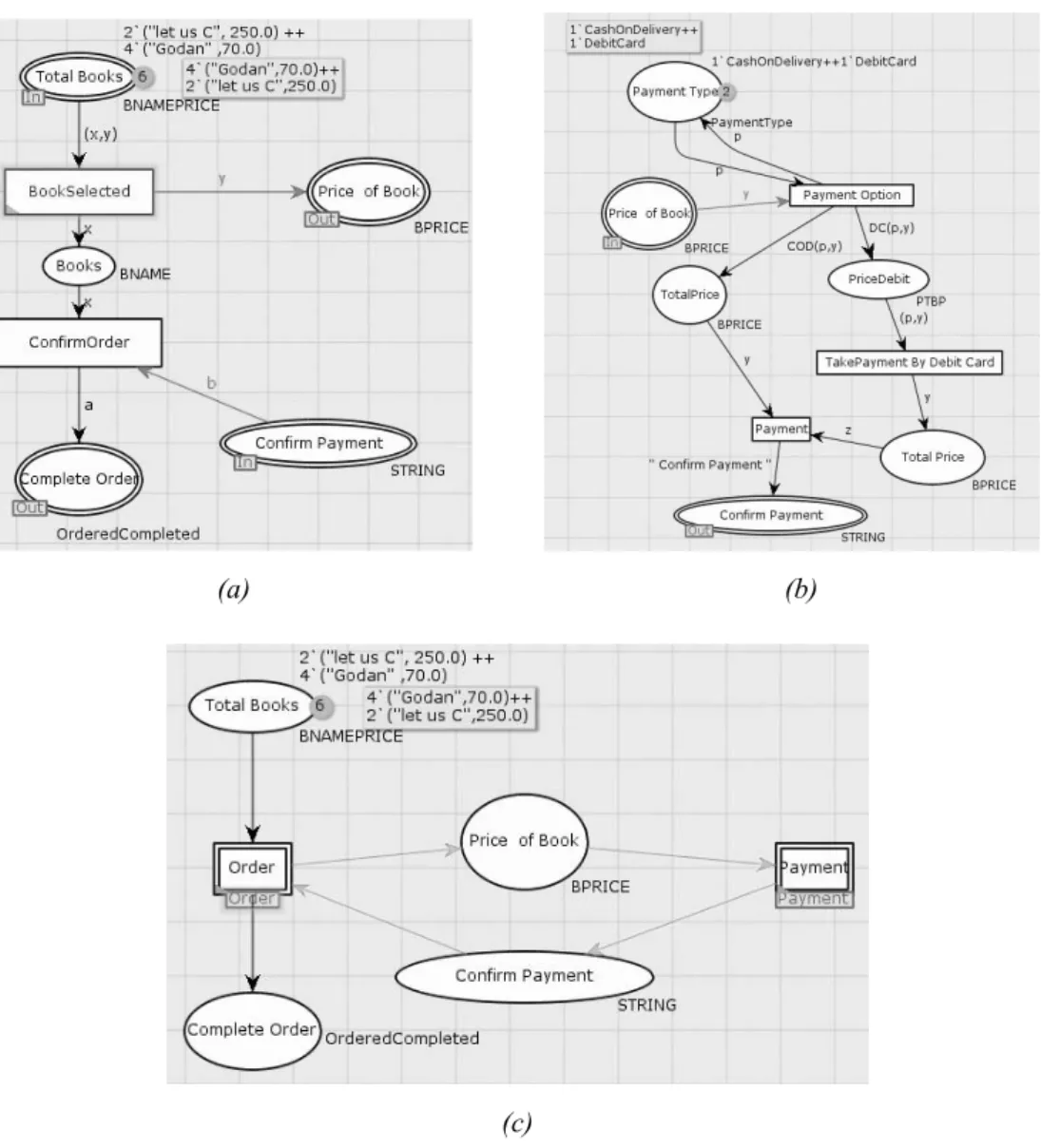
Besides the system variables, there are dependen-cies between the controls of the components and sometimes, the controls, especially the choices of the paths, rely on both the formal control infor-mation and the current system status [15]. A ser-vice S2 is control dependent on serser-vice S1 if and only if S2’s execution is conditionally guarded by S1. For demonstration of control dependence, we have taken two services Order Service and
Payment Service. In the diagram, double line arrows show the control flow between services.
Order Service sends control for taking payment to Payment Service. Payment Service takes payment from customer in two ways, either by ‘cash on delivery’ or by ‘debit card’. After tak-ing payment Payment Service sends control to
Order Service. From the CPN diagram of Con-trol Dependency, place Total Books has tokens for all books which have been searched by cus-tomers. From these books, the customer selects books for purchase. This facility is given by the transition Book Selected. When transition Book Selected fires, then Order Service sends control to the Payment Service for making payment and transition Payment Option becomes enabled for firing. From the diagram it is clear that after pay-ment confirmation, Payment Service sends con-trol to Order Service for Order Confirmation.
ColsetBNAME = string; colset BPRICE = real;
colsetOrderCompleted = string;
colsetPaymentType = with CashOnDelivery | DebitCard;
colset BNAMEPRICE = product BNAME * BPRICE;
colset PTBP = product PaymentType * BPRICE; colset STRING = string;
var x: BNAME; var y,z: BPRICE;
val a = Books Delivered; var p: PaymentType; var b: STRING;
fun COD(p,y) = if p = CashOnDelivery then 1`y else empty;
fun DC(p,y) = if p = DebitCard then 1`(p,y) else empty;
Figure 7 (a). Declarations of CPN modeling of control dependency.
6.1.1. State Space Analysis for
CPN Modeling of Control Dependency
A central point in more formal methods is to con-duct formal analysis and verification based on a constructed model, i.e. to determine whether or not a system under development or analysis sat-isfies certain formally stated properties. State space analysis is one of the most prominent approaches for conducting formal analysis and verification. The basic idea of state space is to
and S3. Each service S1, S2 and S3 have their own functionality. Service S is composed from services S1, S2 and S3. For demonstration pur-pose, two special places s and f are added in the figure which is used for starting place and final place respectively. Two special transitions ct1 and ct2 are added to establish the relationship. Initially, token is only in place s and enabled transition is only ct1. When transition ct1 fires, it transfer control to S1, S2 and S3 at the same time. Finally all control comes through transi-tion ct2 and then control transfers to final place f. Service S2 is also dependent on service S1 for the message which is provided by the message place m. Service S will be executed success-fully if and only if f gets a token. It is possible only if services S1, S2 and S3 have been exe-cuted successfully.
Using service algebra terms it can be shown as in the equation below.
. 1 1. 1, 2. 2, 3. 3
1. , 3. 3 2 .
com
S s via ct S s S s S s
S f S f S f via ct S f
com
1, 2. 2
*
6. Modeling of Dependency
Relationships Through Colored
Petri Nets (CPN)
In this section, different types of dependency in a SOA based system has been modeled us-ing Colored Petri nets. Conventional Petri net based modeling has few limitations. In Petri net modeling, places have only black tokens i.e. resources cannot be differentiated. Petri Net models have no manipulating power on data. In Petri net model, it is not possible to detect which types of data are stored in places. Ab-straction and modular concept is not available in Petri net model. Modeling a SOA based sys-tem using Petri net may fail to extract some aspects of dependency relationships. There is no concept of time in classical Petri net. So it does not cover temporal aspect of dependency in SOA based system.
We attempt to model the dependency relation-ships in a SOA based system with the help of Colored Petri Nets (CPNs). CPN provides a full spectrum of input/output facilities and user
de-fined functions so that one can parameterize all relevant input data and read it from data files. This also made it possible for a third party to run simulation and gather data with different input values. CPN offers the following four possible analysis approaches: interactive and automatic simulation, performance analysis, state space and invariant analysis and temporal logic based analysis of state space [13]. CPN extends the Petri nets to model both the static and dynamic properties of a system. The graph-ical part of the CPNs depicts the static archi-tectural structure of a system. Combined with other powerful elements such as colored tokens and simulation rules, CPN is very powerful in modeling dynamic behaviors of a system [14]. The main purpose of coloring places is to help people understand the usages of a component at the architectural level. Therefore the only imperative information here is what kind of in-formation needs to be provided to invoke the service of the component.
In CPN model, tokens in a place can be distin-guished. Every place has its own colored set i.e. data type. By this, it becomes transparent which types of token can reside in a place. CPNs have all the features of classical Petri net in addition to programming features. Due to programming features of CPNs, data flow, and control flow can be manipulated according to requirements. Dependency can be handled effectively using CPN modeling. CPNs has concept of time so it also captures temporal aspects of dependency in SOA based system. Abstraction is the back-bone for a SOA based system. Abstraction is achieved in CPN modeling using the concept of hierarchy in CPN. So a complex system can be modeled using hierarchy in a more effective way. Dependency relationships of a complex SOA based system can be understood easily by using CPNs. Thus CPNs modeling provide more generalized view of SOA based system than conventional Petri net modeling.
To represent dependency relationships using CPNs, basically we represent primitive activi-ties of web services and their interactions with other web services. These dependency relations are captured by token firing rules and imme-diate transitions. We have considered control, data, sequence, composite and hierarchical de-pendency relationships for the purpose.
6.1. CPN Modeling of Control Dependency
Besides the system variables, there are dependen-cies between the controls of the components and sometimes, the controls, especially the choices of the paths, rely on both the formal control infor-mation and the current system status [15]. A ser-vice S2 is control dependent on serser-vice S1 if and only if S2’s execution is conditionally guarded by S1. For demonstration of control dependence, we have taken two services Order Service and
Payment Service. In the diagram, double line arrows show the control flow between services.
Order Service sends control for taking payment to Payment Service. Payment Service takes payment from customer in two ways, either by ‘cash on delivery’ or by ‘debit card’. After tak-ing payment Payment Service sends control to
Order Service. From the CPN diagram of Con-trol Dependency, place Total Books has tokens for all books which have been searched by cus-tomers. From these books, the customer selects books for purchase. This facility is given by the transition Book Selected. When transition Book Selected fires, then Order Service sends control to the Payment Service for making payment and transition Payment Option becomes enabled for firing. From the diagram it is clear that after pay-ment confirmation, Payment Service sends con-trol to Order Service for Order Confirmation.
ColsetBNAME = string; colset BPRICE = real;
colsetOrderCompleted = string;
colsetPaymentType = with CashOnDelivery | DebitCard;
colset BNAMEPRICE = product BNAME * BPRICE;
colset PTBP = product PaymentType * BPRICE; colset STRING = string;
var x: BNAME; var y,z: BPRICE;
val a = Books Delivered; var p: PaymentType; var b: STRING;
fun COD(p,y) = if p = CashOnDelivery then 1`y else empty;
fun DC(p,y) = if p = DebitCard then 1`(p,y) else empty;
Figure 7 (a). Declarations of CPN modeling of control dependency.
6.1.1. State Space Analysis for
CPN Modeling of Control Dependency
A central point in more formal methods is to con-duct formal analysis and verification based on a constructed model, i.e. to determine whether or not a system under development or analysis sat-isfies certain formally stated properties. State space analysis is one of the most prominent approaches for conducting formal analysis and verification. The basic idea of state space is to
calculate all reachable states and state changes of the system and represent these as directed graphs. State space can be constructed auto-matically with the help of a CPN tool. From a constructed state space it is possible to answer a large set of analysis and verification quantities concerning the behavior of the system such as absence of deadlocks, the possibility of always being able to reach a given state, and the guar-anteed delivery of a given service.
The applicability of state space methods is closely tied to the existence of suitable com-puter tool support and manual calculation, while the inspection of the state space for more than trivial systems is time consuming, error prone and impossible for practical purposes. One of the main advantages of state space methods is that they can provide counter examples i.e. debugging information as to why an expected property does not hold [16].
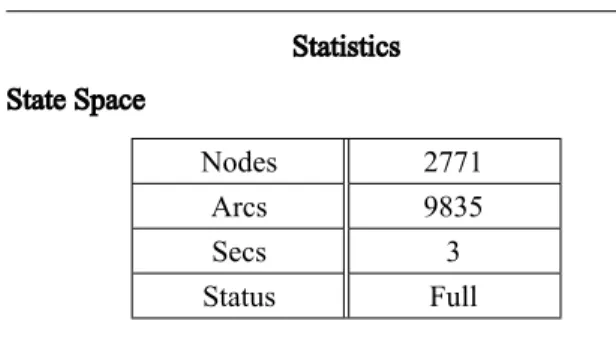
State space analysis gives important proper-ties for verification and validation of a system design. Some important properties as bound-edness, liveness and fairness can be deduced using state space analysis. We have used state space tool of CPN tool software for state space analysis. State space tool can generate reports automatically. On the basis of this report we can observe the control dependency among the ser-vices. The state space report on Control Depen-dency has been shown on Table 1.
Here, we analyze the CPN model of the control dependency. We aim at illustrating the support for state space analysis provided by the tool and the steps provided in conducting the analysis, rather than at giving an exhaustive analysis of the control dependency model.
The first step towards state space analysis of a CP-Net is generation of the state space. This step is fully automatic. The generation statistics for the data dependency model are shown in Table 1. In the CPN modeling of control dependencies there are nine places. The report shows that in all places, upper and lower bound of tokens (maximum and minimum number of tokens) in any reachability marking are mentioned. Home property explains that control starts from a ser-vice and after passing through some intermedi-ate services, again it reaches to originating po-sition. Home properties of state space analysis show that there is no home marking in the CPN modeling of Control Dependency i.e. from ini-tial marking to any reachable marking no cycle
Table 1. State space analysis report for Control Dependency Modeling.
Statistics State Space
Nodes 2771
Arcs 9835
Secs 3
Status Full
Scc Graph (Strongly Connected Components of State Space)
Nodes 2771
Arcs 9835
Secs 0
BoundednessProperties Best Integer Bounds
Places Upper Bound Lower Bound
Books 6 0
Complete Order 3 0
Payment Type 2 2
PriceDebit 6 0
Price_of_Book 6 0
TotalPrice 6 0
Total_Books 6 0
Total_PricebyDB 6 0
Confirm_Payment 3 0
Home Properties Home Markings
None
Liveness Properties Dead Markings
35 [2771, 2770,2769,2768,2767...] Dead Transition Instances
None
Live Transition Instances None
Fairness Properties No infinite occurrence sequences
is formed. Liveness property plays a major role in the analysis of any system. Liveness property may indicate about the presence of deadlock in the system. Reports show that reachability graph of CPN model has 35 dead markings i.e. after reaching that marking there is no enabled transition to fire. There is no live transition in CPN modeling of Control Dependency i.e. that transition is always enabled to fire. By the live-ness property of CPN modeling, control depen-dencies among services can be extracted.
6.2. CPN Modeling of Data Dependency The general purpose of the software system is data manipulation, which means to compute the new system status according to existing data, which we call dependency of data. Once the existing system states (called variables) contain faults, the faults could spread to other variables or other components. How the faults spread de-pends on how the new variables are manipu-lated from the existing ones. So it is necessary to define the data dependency to specify the way of fault spreading [15].
Service S2 is data dependent on service S1 if and only if service S2 needs some data form service S1 for full execution of service S2. In CPN modeling of Data Dependency, we have modeled two services ShoppingCart and Order
using CPN tools as in Figure 3. The bold arrow shows the transfer of data from ShopingCart
service to Order service. ShoppingCart ser-vice has two places and one transition: Select
Books, and Order service has four places and two transitions: Order Confirm and Make Pay-ment. Transition Order works as the mediator for data flow from service ShoppingCart to ser-vice Order. In Figure 8, the only enabled tran-sition to fire is Select Books. By firing this tran-sition one by one book is selected and removed from place Total Books in Search and put into the place Books for Order as list. Transition Or-der is enabled to fire if and only if place Books for Order has non empty list of books. Tran-sition Order Confirm is enabled to fire if and only if some data from ShoppingCart service is available to the place Ordered Books. When transition Order Confirm fires then variables r and p take data of books list and delivery type respectively from input place and put data as a pair of r and p to the place BooksDeliveryType. After firing transition Make Payment, order is completed.
colset STRING = string; colset BS = list STRING; (*Books Selected for Order) colset BDT = product BS * STRING; (*Books and Delivery type)
val TotalBooks = 3`"Let Us C" + + 2`"Software Engineering" + + 5` "Automata Theory"; val DT = 1`"Cash On Delivery" ++1` "Debit Card";
var p: STRING; var q,r: BS;
Figure 8 (a). Declarations of CPN modeling of data dependency.
calculate all reachable states and state changes of the system and represent these as directed graphs. State space can be constructed auto-matically with the help of a CPN tool. From a constructed state space it is possible to answer a large set of analysis and verification quantities concerning the behavior of the system such as absence of deadlocks, the possibility of always being able to reach a given state, and the guar-anteed delivery of a given service.
The applicability of state space methods is closely tied to the existence of suitable com-puter tool support and manual calculation, while the inspection of the state space for more than trivial systems is time consuming, error prone and impossible for practical purposes. One of the main advantages of state space methods is that they can provide counter examples i.e. debugging information as to why an expected property does not hold [16].
State space analysis gives important proper-ties for verification and validation of a system design. Some important properties as bound-edness, liveness and fairness can be deduced using state space analysis. We have used state space tool of CPN tool software for state space analysis. State space tool can generate reports automatically. On the basis of this report we can observe the control dependency among the ser-vices. The state space report on Control Depen-dency has been shown on Table 1.
Here, we analyze the CPN model of the control dependency. We aim at illustrating the support for state space analysis provided by the tool and the steps provided in conducting the analysis, rather than at giving an exhaustive analysis of the control dependency model.
The first step towards state space analysis of a CP-Net is generation of the state space. This step is fully automatic. The generation statistics for the data dependency model are shown in Table 1. In the CPN modeling of control dependencies there are nine places. The report shows that in all places, upper and lower bound of tokens (maximum and minimum number of tokens) in any reachability marking are mentioned. Home property explains that control starts from a ser-vice and after passing through some intermedi-ate services, again it reaches to originating po-sition. Home properties of state space analysis show that there is no home marking in the CPN modeling of Control Dependency i.e. from ini-tial marking to any reachable marking no cycle
Table 1. State space analysis report for Control Dependency Modeling.
Statistics State Space
Nodes 2771
Arcs 9835
Secs 3
Status Full
Scc Graph (Strongly Connected Components of State Space)
Nodes 2771
Arcs 9835
Secs 0
BoundednessProperties Best Integer Bounds
Places Upper Bound Lower Bound
Books 6 0
Complete Order 3 0
Payment Type 2 2
PriceDebit 6 0
Price_of_Book 6 0
TotalPrice 6 0
Total_Books 6 0
Total_PricebyDB 6 0
Confirm_Payment 3 0
Home Properties Home Markings
None
Liveness Properties Dead Markings
35 [2771, 2770,2769,2768,2767...] Dead Transition Instances
None
Live Transition Instances None
Fairness Properties No infinite occurrence sequences
is formed. Liveness property plays a major role in the analysis of any system. Liveness property may indicate about the presence of deadlock in the system. Reports show that reachability graph of CPN model has 35 dead markings i.e. after reaching that marking there is no enabled transition to fire. There is no live transition in CPN modeling of Control Dependency i.e. that transition is always enabled to fire. By the live-ness property of CPN modeling, control depen-dencies among services can be extracted.
6.2. CPN Modeling of Data Dependency The general purpose of the software system is data manipulation, which means to compute the new system status according to existing data, which we call dependency of data. Once the existing system states (called variables) contain faults, the faults could spread to other variables or other components. How the faults spread de-pends on how the new variables are manipu-lated from the existing ones. So it is necessary to define the data dependency to specify the way of fault spreading [15].
Service S2 is data dependent on service S1 if and only if service S2 needs some data form service S1 for full execution of service S2. In CPN modeling of Data Dependency, we have modeled two services ShoppingCart and Order
using CPN tools as in Figure 3. The bold arrow shows the transfer of data from ShopingCart
service to Order service. ShoppingCart ser-vice has two places and one transition: Select
Books, and Order service has four places and two transitions: Order Confirm and Make Pay-ment. Transition Order works as the mediator for data flow from service ShoppingCart to ser-vice Order. In Figure 8, the only enabled tran-sition to fire is Select Books. By firing this tran-sition one by one book is selected and removed from place Total Books in Search and put into the place Books for Order as list. Transition Or-der is enabled to fire if and only if place Books for Order has non empty list of books. Tran-sition Order Confirm is enabled to fire if and only if some data from ShoppingCart service is available to the place Ordered Books. When transition Order Confirm fires then variables r and p take data of books list and delivery type respectively from input place and put data as a pair of r and p to the place BooksDeliveryType. After firing transition Make Payment, order is completed.
colset STRING = string; colset BS = list STRING; (*Books Selected for Order) colset BDT = product BS * STRING; (*Books and Delivery type)
val TotalBooks = 3`"Let Us C" + + 2`"Software Engineering" + + 5` "Automata Theory"; val DT = 1`"Cash On Delivery" ++1` "Debit Card";
var p: STRING; var q,r: BS;
Figure 8 (a). Declarations of CPN modeling of data dependency.