Improving Branch Prediction Performance with a Generalized Design for
Dynamic Branch Predictors
Wei-Ming Lin, Ramu Madhavaram and An-Yi Yang Department of Electrical Engineering
University of Texas at San Antonio San Antonio, TX 78249-0669, USA E-mail: [email protected]
Keywords:Branch Prediction, Two-Level Predictor, Gshare, Generalized Branch Predictor
Received:January 1, 2004
Pipeling delays from conditional branches are major obstacles to achieving a high performance CPU. Pre-cise branch prediction is required to overcome this performance limitation imposed on high performance architecture and is the key to many techniques for enhancing and exploiting Instruction-Level Parallelism (ILP). A generalized branch predictor is proposed in this paper. This predictor is a general case of most of the predictors used nowadays, including One-Level Predictor, Two-level predictor, Gshare, and all their close and distant variations. Exact pros and cons of different predictors are clearly analyzed under the same general format. The concept in the traditional Gshare predictor is then extended to form a more flexible predictor under the same construct. By following this generalized design scheme, we are able to fine-tune various composing parameters to reach an optimal predictor and even allow the predictor to adjust accord-ing to various types of applications. From our simulation results, it is evident that significant improvement over traditional predictors is achieved without incurring any additional hardware.
Povzetek: ˇClanek opisuje novo metodo za napovedovanje vejitve za CPU.
1 Introduction
In the past decade, by taking advantage of RISC archi-tecture and advanced VLSI technology, computer design-ers were able to exploit more Instruction-Level Parallelism (ILP) by using deeper pipelines, wider issue rates and superscalar techniques. However, these techniques suf-fer from disruption caused by branches during the issue of instructions to functional units. How to appease such a performance-degrading effect from branch instructions, which typically make up twenty or more percentage of an instruction stream, has to be paid with more attention.
Branch prediction is a common technique used to over-come this performance limitation imposed on high per-formance architectures and is the key to many techniques for enhancing ILP. Branch prediction essentially involves a guess on the likely stream direction that is to take place after a branch instruction; whenever such a guess is cor-rect, penalty in pipeline delay is either reduced or com-pletely avoided. There have been various branch prediction schemes proposed in this area [1, 2, 6, 7, 8, 10, 13, 15, 21]. They are usually classified as static or dynamic according to how prediction is made. Static prediction schemes al-ways assume same outcome for any given branch, whereas a dynamic scheme uses run-time behavior of branches to adjust the database for later predictions. Focus of this pa-per is on the dynamic ones which usually show far better prediction accuracy than the static ones.
A typical dynamic prediction mechanism relies on a pre-diction table, or the so-called Pattern History Table (PHT) to record the behavior of past branches. One of the very early predictors used was the One-Level Predictor which has a one-dimensional PHT and uses only program counter (PC) as the index to retrieve past branch behavior and record new branch behavior. Usually one-bit or two-bit sat-urating up-down counters are used in the PHT to record the behavior of branches. When these branches are encoun-tered again they are predicted based on their entries in the table, i.e., based on their previous behavior. It was fol-lowed by the more widely used Two-Level Adaptive Pre-dictor [17], which has the PHT but organized into a two-dimensional table. Such a PHT is addressed using both the PC index and a history register (HR) index. The HR is used to record behaviors of either the most recent per-address branch or the most recent global branches. The two-level predictor easily outperforms the one-level one by exploit-ing potential correlation between branches at run-time.
been discussed, nor has a complete analysis on their bene-fits ever been presented.
After carefully analyzing the structure of all the afore-mentioned predictors, we propose a general prediction scheme which encompasses all these popular designs. This generalized scheme displays a standard organization for the PHT and a flexible selection for HR index. This proposed scheme provides a platform with which one can easily un-derstand the similarities and/or differences among different predictors proposed so far. In addition, based on this, we can provide a more systematic explanation for the benefits a predictor provides and the drawbacks it may come with.
The remainder of the paper is organized as follows. A brief overview of the well-known counter-based dynamic branch prediction schemes is presented in section 2. The proposed generalized predictor is then described in the fol-lowing section along with its variations. In section 4, our simulation and performance comparison results are pre-sented. Concluding remarks are given in the last section.
2 Dynamic Branch Prediction
There have been many dynamic branch prediction schemes proposed in the past decade. A few representative ones are described in the following for the sake of completeness.
2.1 One-Level Predictor
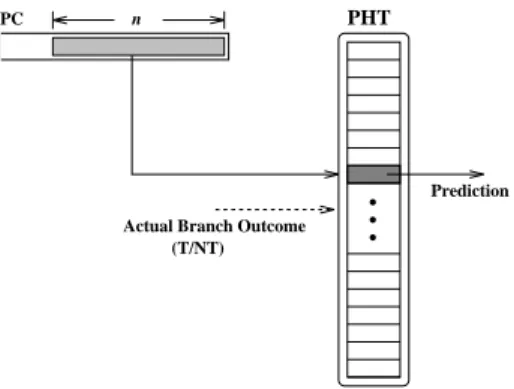
The prediction table is usually indexed by the lower-order address bits in the program counter (PC), although other portions of the PC have been used as well. Figure 1 illus-trates the design of such a scheme. Each entry in the
predic-● ● ●
PC
Actual Branch Outcome (T/NT)
Prediction
n PHT
Figure 1: Implementation of Simple One-Level Branch Prediction
tion table (PHT) is used to provide prediction information for the branch instruction mapped to it, and is implemented by a counter which goes up or down according to the ac-tual outcome of the corresponding branch instruction. Each branch is predicted based on its most recent outcome. In-stead of the simple one-bit counter, a well-known two-bit up-down counter has been extensively used in this scheme so as to render a damping effect which enhances predic-tion accuracy for typical reentrant loop constructs. Dam-age caused by alternating occurrences between two aliasing
branches can also be alleviated using the two-bit counters. Such an observation prompts most later advanced designs to use such a two-bit counter prediction table as a design base.
2.2 Correlation-based or Two-Level
Adaptive Predictor
Outcome of a branch is usually affected by some previ-ously executed branches. Such a correlation could exist among different branch instructions executed temporally close to one and other, or simply refers to the effect on a branch from its own recent execution behavior. The lat-ter one has been partially considered in the simple one-level two-bit counter design. Such an approach requires a separate table, the so-called history table, to record the necessary history information. A general design block di-agram is shown in Figure 2 in which the PHT organized as a two-dimensional table is addressed by two separate indices, the PC index and the history index. History in-formation established in a history table can be either in per-address (per-branch) format as shown in Figure 2 or in global format as shown in Figure 3. In a per-address case, a
●
● ● ● ● ● ●●● ●●●
● ● ● ●
● ●
PC m n-m
PHT
m n-m
HR
Prediction
Figure 2: Implementation of Per-Address Correlation-based Branch Prediction
HR
● ● ●
● ● ● ● ● ● ●●● ●●●
Prediction PC
m n-m
PHT
n-m m
Figure 3: Implementation of Gloabl Correlation-based Branch Prediction
a selection does not lead to any significant discrepancy in performance.
2.3 Gshare Predictor
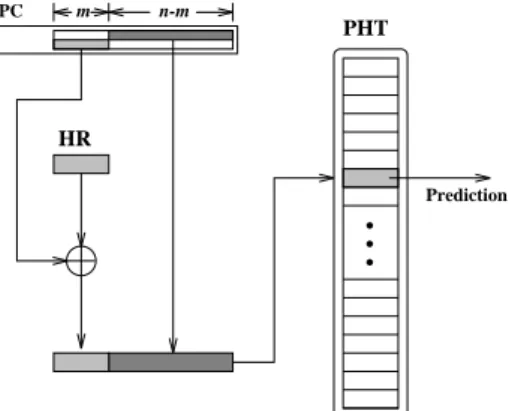
In the Gshare scheme [9], as shown in Figure 4, the predic-tion table is addressed by an index established by XORing a global history and part of the PC index. Gshare scheme does lead to improvement in most cases compared to a sim-ple two-level predictor; however, the exact cause for such an improvement has never been clearly analyzed. (Note that, in one of the original Gshare designs, the XORing function is performed over the entire PC index; that is,m
is set to be equal ton, which in general leads to worse per-formance than a simple two-level predictor.)
HR
● ● ●
PC m n-m
Prediction
PHT
Figure 4: Implementation of Sharing Index Branch (Gshare) Prediction
2.4 Others Well-Known Predictors
The possibility of combining different branch predictors is exploited by McFarling in [9]. It comes from the obser-vation that some schemes work well on one type of pro-grams while not so on another. The selective scheme is implemented with two different predictors, with each mak-ing prediction separately. A third table is then used to make decision between the two prediction outcomes based on various program scenarios. Such a scheme is claimed
to perform well on different circumstances, yet it has a hardware cost roughly three times of what a non-selective one would cost. A predictor called LGshare has also been proposed [4] to further improve on Gshare by using both global as well as per-address history of a branch to predict its behavior. Among many more others in this field, a new predictor discussed in [6] is based on Simultaneous Sub-ordinate MicroThreading (SSMT), which provides a new means to improve branch prediction accuracy. SSMT ma-chines run multiple concurrent microthreads in support of the primary thread to dynamically construct microthreads that can speculatively and accurately pre-compute branch outcomes along frequently mispredicted paths. Another technique is introduced in [5] to reduce the pattern history table interference by dynamically identifying some easily predictable branches and inhibiting the pattern history ta-ble update for these branches.
In general, there are a few types of well-known potential problems that would lead to a misprediction result due to the nature of the predictor employed:
– Initialization –
Every branch instruction that has a predictable behav-ior needs to have its behavbehav-ior history properly estab-lished in the prediction table before a meaningful pre-diction can be made.
– Alias –
This problem occurs when different branches are mapped to the same entry in the PHT. Such a prob-lem is unavoidable unless a sufficiently large number of entries to cover all potential program sizes are pro-vided.
– Undetected Correlation –
Due to the limited size of history register, correlation among branches far apart in time/trace may not be de-tected.
– “Random” (Unpredictable) Branch Behavior – A branch’s behavior, either at times or throughout the life of the program, may be simply run-time data-dependent which is either completely “random” or un-predictable based on any of the known branch predic-tion schemes.
3 Proposed Generalized Predictor
A generalized predictor is proposed in this section to show that most of the predictors mentioned above fall under this category. With the introduction of this design scheme, po-tential performance-influencing factors can be more clearly analyzed. Additional design flexibility is also incorporated in this design to allow adjustment of certain design param-eters to accommodate for various program behaviors. In order to have a fair comparison among all predictors, all are assumed to be of unified cost, i.e. predictors with simi-lar hardware are compared.
3.1 Generalized Predictor
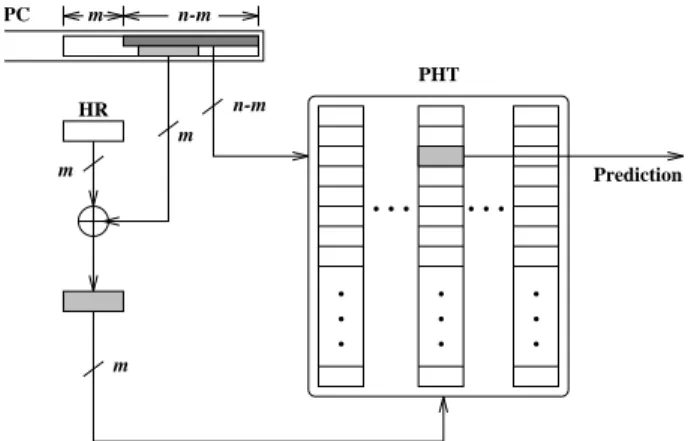
Figure 5 illustrates the proposed generalized predictor de-sign. In this design, the PHT is organized as a
two-PC XOR mask
● ● ●
● ● ● ● ● ● ●●● ●●●
Prediction HR
PC
n-m m
m m
m n-m
PHT
Figure 5: The Proposed Generalized Predictor
dimensional table similar to the traditional two-level pre-dictor. The primary hardware cost resides in the PHT, the size of which is thus fixed at2n. The lower portion of PC from bit 0 to bitn−m−1 is used to address the PHT as the row index, while the column index is composed by XORing them-bit HR and a “floating” portion of PC. This portion of PC is called as the “PC XOR mask” throughout this paper.
3.2 Special Case #1: One-Level Predictor
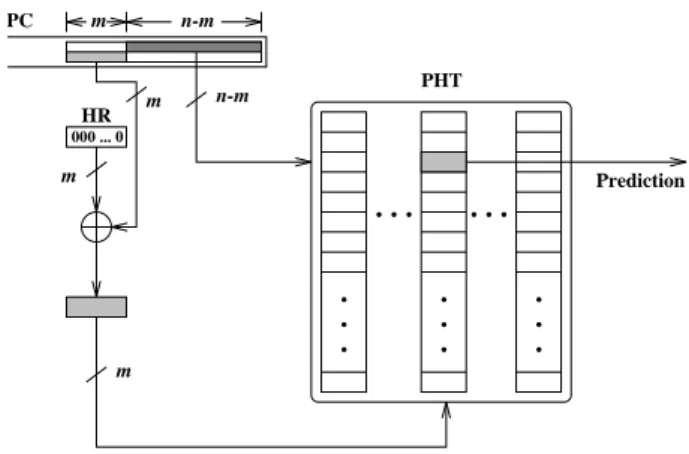
The one-level predictor as shown in Figure 1 can be reor-ganized as a special case of the proposed generalized pre-dictor. Figure 6 illustrates such an arrangement. By having the PC XOR mask fixed at the highest position of then -bit index, and XOR-ing it with the non-existing HR (0’s throughout the HR content), the original one-dimensional PHT is then re-arranged as a two-dimensional PHT. The se-quence of addressing in the original one-dimensional PHT is then mapped to a column-major-order sequence in this new two-dimensional PHT, i.e. one column followed by the next one. Such a rearrangement presents us a platform for a direct comparison between any advancement from this technique and the original one.
● ● ●
● ● ● ● ● ● ●●● ●●●
Prediction HR
PC
n-m m
m m
m n-m
PHT
000 ... 0
Figure 6: One-Level Predictor as A Special Case
3.3 Special Case #2: Two-Level Predictor
Comparing the two-level predictor with the one-level Pre-dictor, one can obviously see that the former intends to im-prove prediction accuracy by using more history to exploit correlation information among different branches’ behav-ior. However, with the cost fixed, the two-level predictor introduces potentially more alias problem into the picture by having a smaller PC index (row index) used. That is, for every additional bit of HR employed (mbeing increased by 1), the number of row entries of the PHT is reduced by half. It has been shown that such a tradeoff usually is worthwhile to a certain extent ofmdue to the following reasons:
– Benefit from exploiting correlation among branches usually outweighs the potential performance loss from the alias problems thus incurred.
– Alias problem between two branches thus incurred can sometimes be relieved if they have a different global history pattern in HR even though they are “aliased” into the same row entry. In this case, the alias problem is removed since their prediction entries are mapped into different columns albeit in the same row.
The two-level predictor based on a global history HR as shown in Figure 3 can be also reorganized as a special case of the proposed generalized predictor. Figure 7 illustrates such an arrangement. The new arrangement has the XOR mask confined to within the row index, i.e. the firstn−m
● ● ●
● ● ● ● ● ● ●●● ●●●
Prediction HR
PC
m m
m n-m
PHT n-m
m
Figure 7: Two-Level Predictor as A Special Case
HR
m
HR
HR HR
m
m m
01 00
10
11 11
01 00
10
PC m n-m
11 10 01 00 00
n-m m n-m
m
11 10 01 00
PC m n-m
11 10 01 00
PC PC
11 10 01 00
11 10 01 00
11 10 01 00
01 10 11
Figure 8: Index Swapping Effect from XOR Function
will be still mapped to the same row except that it may be using a different column index mapping according to its run-time HR content. Thus, the prediction result would remain the same comparing the original arrangement and the new arrangement pertaining to a non-alias case. For an alias case between two different branches that are mapped to the same row, the alias effect still remains the same since both instructions would have the same XOR-mask content from within their identical row index content. An exam-ple showing such a swapping between two instructions is given in Figure 9. It happens so because no extra PC in-formation is used and thus two aliased branches cannot be differentiated with the same PC index. As shown in Fig-ure 9 two aliased branches A and B with different histories are mapped to different columns along the same row before XORing with XOR-mask from the PC. Consequently, after XORing as shown in the second figure, both A and B are mapped to different columns but are just swapped around which does not lead to different prediction result from the two-level predictor. So it can be concluded that two-level predictor is also a special case of this generalized predictor.
3.4 Special Case #3: Gshare
Gshare is one of the global two-level predictors, which ex-ploits correlation by basing the prediction on the outcome of the recently executed branches. The XORing is done to incorporate history information into the PC index thereby differentiating interfering branches with the help of history bits. Similarly Gshare can be organized as a special case of our proposed predictor, through which we can easily
an-A
B A
Y X
(b) Re-organized as a special case
B A
B A
Y X
(a) Original Two-Level Predictor
B
● ● ● ● ● ● ● ● ● ● ● ●
● ● ● 1 1
0 1 HR
00 01 10 11
● ● 01 10 01
01 10 01 ●
● ● ● ● ● 1 1
0 1 HR
00 01 10 11
01 10 01
01 10 01
●
PC 2 6
Figure 9: Index Swapping between Two Aliased Instruc-tions
alyze the benefits brought by this technique. Figure 10 demonstrates this new arrangement. In the following, a
● ● ●
● ● ● ● ● ● ●●● ●●●
Prediction HR
PC
m m
m n-m
PHT n-m
m
Figure 10: Gshare Predictor as A Special Case
thorough analysis on how Gshare compares to the two spe-cial cases thus far introduced is given.
3.4.1 Gshare vs. One-Level Predictor
alias problem and loss of correlation in a more delicate manner, which is to be described in the following section.
3.4.2 Gshare vs. Two-Level Predictor
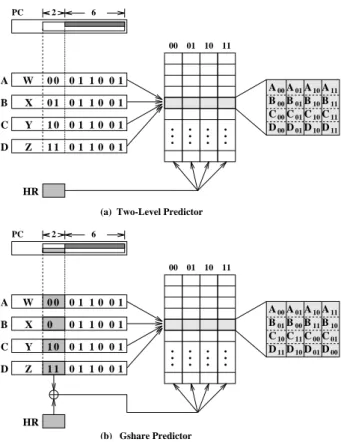
Gshare, when compared to the two-level predictor, is said to be advantageous due to the XORing effect and can be explained as shown in Figure 11. The benefit comes from that fact that, in most programs, global history (HR) con-tent tends to exhibit one dominant pattern, either00. . .00
or11. . .11, due to loop constructs especially when the
his-tory depth used (m) is small. This claim has also been confirmed by our simulation results. Consider four aliased branches A, B, C and D that are aliased into the same row in the PHT. The mapping of these branches with different values of HR is shown for both two-level predictor in (a) and Gshare predictor in (b). A00, B00, C00and D00, where the subscripts denote the HR contents, are mapped to dif-ferent columns of the same row in Gshare as compared to same column in two-level. Same scenario applies to the case when HR has a content of11. This is one of the advan-tages of Gshare because aliased branches with most domi-nant history patterns are now mapped to different locations thereby reducing destructive overlapping. That is, assum-ing that they have the same history, all the four branches are mapped to the same column in a two-level predictor and so cannot be distinguished. In Gshare on the other hand, these aliased branches are “dispersed” to different columns and so the problem is resolved.
The mapping difference described above is the only dis-tinction between the Gshare and the two-level predictor, and such a distinction may not always favor the Gshare due to different program behavior. A very important conclusion that can be drawn from this is that the Gshare is essentially identical to the two-level predictor if the (n−m)-bit row index does not lead to any alias problem. That is, the dis-persion of dominating entries among aliasing branches no long exists, thus leading to no more difference in prediction result.
Size of the XOR mask also plays a very important role in Gshare’s potential performance. Similar to the two-level predictor, the larger the mask is (largerm), the more his-tory correlation among branches can be exploited. On the other hand, a larger mask leads to more alias problems, al-though the column mapping of Gshare may provide a bet-ter alias-differentiating support than the two-level one from our discovery. As one of the most extreme case, in one of the original Gshare designs, the XORing function is per-formed over the entire PC index; that is,mis set to be equal ton. This in general leads to an undesirable performance due to its excessive alias problems.
3.5 The Proposed Generalized Predictor
with Extensions
A generalized predictor as proposed can be specified with the position of them-bit XOR mask in PC. Let the
Z X W 1 Y Z X W 00
1 0 1 1 0 D 1
(b) Gshare Predictor
Y A
D C B
(a) Two-Level Predictor
A C B 11 11 11 ● 11 ● ● ● ● ● ● ● ● ● ● ●
00 01 10
10 10 10 01 01 01 ● ● ● ● 01 ● ● 10D C ● D 11 ● ● ● ● B ● A D
PC 2 6
01 10 01 01 10 01
C
01 10 01
B A 01 10 01
C B A 00 D 00 C 00 B 00
PC 2 6
01 10 01 01 10 01
01 10 01
A
01 10 01
00 01 10 11
11 A00 B C D A B C D A B C D A B C D 01 10 HR HR
01 00 11 10 10 11 00 01 11 10 01 00 0 0 0 0 1 1 1
Figure 11: Difference between Gshare Predictor and Two-Level Predictor
least significant bit of this mask be starting at bit Ws; that is, the mask ranges from bit Ws to Ws+m −1. Each of the special cases is then defined as in the following:
Case Range ofWs HR value
(a) 0≤Ws≤n−2m run-time
(b) n−2m+ 1≤Ws≤n−m−1 run-time
(c) Ws=n−m 00. . .00
(d) Ws=n−m run-time
(e) n−m+ 1≤Ws run-time
Clearly, case (a) corresponds to the two-level predictor, case (c) to the one-level predictor and case (d) corresponds to the Gshare predictor, while cases (b) and (e) have never been addressed.
Z X W A
D C B
Y
2 6
PC
HR
● ● ● ● ●
1 0 1
1 0
01 10 01
● ●
01 10 01 ● ●
01 10 01
● ● ●
0
00 01 10 11
11 A00
B C D
A B C D A B C D
A B C D 01 10 01 00 11 10 0
0
1
1 1
00 01 10 11 01 00 11 10 1
0
0
Figure 12: A Hybrid Design of Two-Level and Gshare Pre-dictors
andCremain aligned and so doB andD among the four aliasing branches. Performance from such a hybrid predic-tor is usually unpredictable due to its nature.
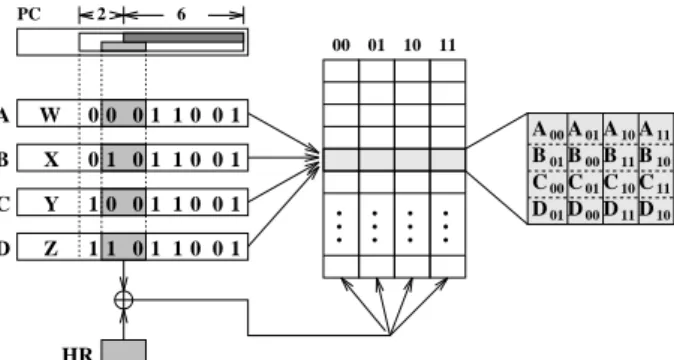
Case (e) is an extension of Gshare aimed at programs with larger address space and/or with a small PHT. The ex-ample in Figure 13 shows that, between the two aliasing instructionsA andB, the dispersing effect does not take place in the traditional Gshare since both instructions have the same XOR mask value. That is, under such a
circum-X
B A
Y 1
HR
0 1
1 0
01 10 01
0
0
PC 2 6
0
1 0
0 0
Figure 13: An Extended Design from Gshare
stance, Gshare performs exactly like the two-level predic-tor. Moving the XOR mask to the higher portion of PC allows the dispersion effect to re-emerge.
4 Simulation
Our trace analysis and simulation are performed on a SPARC 20 system. Data are obtained using Shade ver-sion 5.25 analyzing program. Shade is a dynamic code tracer, which combines instruction set simulations, trace generation and custom trace analysis in a process. Our test programs include a benchmark program from the Stanford Body Benchmark Suite, sfloat, and seven standard Unix utility programs. A brief description of these programs on various aspects of their branch instructions is given in Ta-ble 1. A trace analysis has been performed on these eight test programs to show the percentage improvement in mis-prediction rate.
program # instr # taken # not-taken sfloat 7730261 111170 125382
ls 1207004 112180 91466
gcc 677017 61258 58096
cc 543900 50519 46536
chmod 492158 45812 42507
grep 491016 45672 42382
awk 490911 45524 42365
pack 486776 45159 42173
Table 1: Description of Test Programs
4.1 Simulation Results
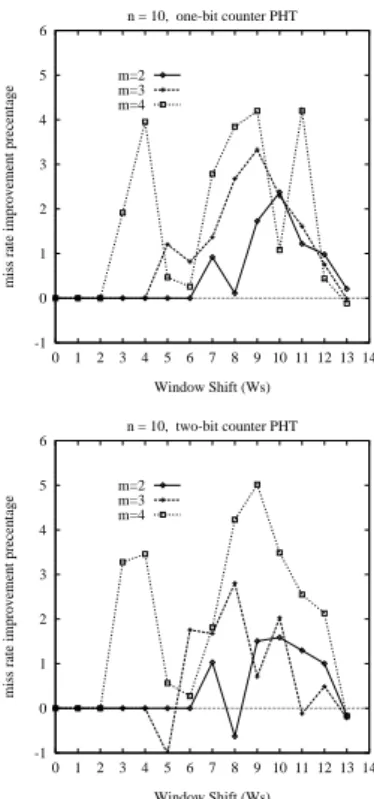
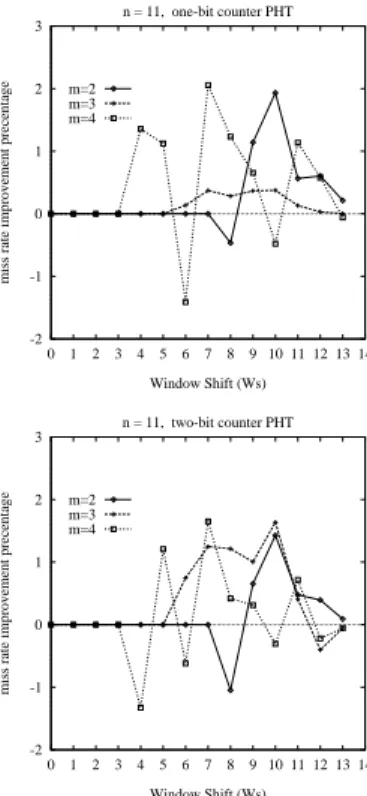
A series of simulation runs are performed by varying the following three parameters on one-bit and two-bit predic-tion schemes: (1) Number of index bits (n), (2) Number of history bits (m), and (3) Shift in the window (Ws). Perfor-mance comparison results are plotted after taking the aver-age of improvement in miss prediction rate for all the above eight programs. The “miss rate improvement percentage” is defined as:
Mtwo-level−Mgeneralized Mtwo-level ×100
where Mtwo-level and Mgeneralized denote the miss rate of two-level prediction scheme and that of the generalized one, respectively. Each point in these results corresponds to the average of results from the eight test programs. Fig-ure 14, FigFig-ure 15 and FigFig-ure 16 show the results for both one-bit and two-bit counters prediction schemes.
We can see that, from all these figures, performance of the generalized predictor is identical to that of the two-level one (i.e. improvement equals to0) when
0≤Ws≤n−2m
Gshare’s results (whenWs=n−m), in general, are among the better ones forn= 11, but are outperformed by most of cases with largerWsvalues (the Extended Gshare scheme) for n = 10andn = 9. This finding verifies our analy-sis that the Extended Gshare scheme allows the dispersion effect to reappear when a small PHT is used. The Hybrid scheme (whenn−2m+ 1≤Ws≤n−m−1) does not distinguish itself clearly from the two-level one.
5 Conclusion
the Gshare design, a direct notion from the generalized de-sign, can outperform Gshare in many cases. This is an im-provement at no additional cost on hardware. A dynamic selection of the XOR-mask position according to the nature of the program may bring additional improvement. Also, one potential direction that is worthwhile looking into is the understanding and classification of different kinds of conditional branches, which may help predict the otherwise declared “random” branches that have not been addressed by the prediction methods investigated so far.
-6 -5 -4 -3 -2 -1 0 1 2 3 4 5 6 7 8
0 1 2 3 4 5 6 7 8 9 10 11 12 13 14
miss rate improvement precentage
Window Shift (Ws) n = 9, one-bit counter PHT
m=2 m=3 m=4
-6 -5 -4 -3 -2 -1 0 1 2 3 4 5 6 7 8
0 1 2 3 4 5 6 7 8 9 10 11 12 13 14
miss rate improvement precentage
Window Shift (Ws) n = 9, two-bit counter PHT
m=2 m=3 m=4
Figure 14: Improvement Results versus Window Shift for
n= 9
References
[1] T. Ball and J. Larus, “Branch Prediction for Free,”
Proc. ACM SIGPLAN 1993 conf. on Prog. Lang. De-sign and Implementation, June, 1993.
[2] B. Bray and M. J. Flynn, “Strategies for Branch Tar-get Buffers,”24th Workshop on Microprogramming and Microarchitecture, 1991, p.42-p.49.
[3] B. Calder and D. Grunwald, “Fast & Accurate In-struction Fetch and Branch Prediction,”Intl. Symp. on Computer Architecture, April, 1994.
[4] M.-C. Chang and Y.-W. CHou, “Branch Prediction using both Global and Local Branch History informa-tion,”Computers and Digital Techniques, IEE Pro-ceedings, Volume: 149 Issue: 2, March 2002.
-1 0 1 2 3 4 5 6
0 1 2 3 4 5 6 7 8 9 10 11 12 13 14
miss rate improvement precentage
Window Shift (Ws) n = 10, one-bit counter PHT
m=2 m=3 m=4
-1 0 1 2 3 4 5 6
0 1 2 3 4 5 6 7 8 9 10 11 12 13 14
miss rate improvement precentage
Window Shift (Ws) n = 10, two-bit counter PHT
m=2 m=3 m=4
Figure 15: Improvement Results versus Window Shift for
n= 10
[5] P.-Y. Chang, M. Evers and Y.N. Patt, “Improving branch prediction accuracy by reducing pattern his-tory table interference,” Parallel Architectures and Compilation Techniques, 1996.
[6] R. S. Chappell, F. Tseng, A. Yaoz and Y. N. Patt, “Difficult-path Branch Prediction Using Subordinate Microthreads,”Proc. 29th Annual International Sym-posium on Computer Architecture, 2002.
[7] J. Fisher and S. Freudenberger, “Predicting Condi-tional Branch Direction From Previous Runs of a Pro-gram,”Proc. 5th Annual Intl. Conf. on Architectural Support for Prog. Lang. and Operating System, Octo-ber, 1992.
[8] J. K. F. Lee and A. Smith, “Branch Prediction Strate-gies and Branch Target Buffer Design,”IEEE Com-puter, January, 1984, p.6-p.22.
[9] S. McFarling, “Combining Branch Predictor,” Tech-nical Report, Digital Western Research Laboratory, June, 1993.
[10] S. McFarling and J. Hennessy, “Reducing the Cost of Branches,”The 13th Annual Intl. Symposium of Com-puter Architecture, 1986, p.396-p.403.
-2 -1 0 1 2 3
0 1 2 3 4 5 6 7 8 9 10 11 12 13 14
miss rate improvement precentage
Window Shift (Ws) n = 11, one-bit counter PHT
m=2 m=3 m=4
-2 -1 0 1 2 3
0 1 2 3 4 5 6 7 8 9 10 11 12 13 14
miss rate improvement precentage
Window Shift (Ws) n = 11, two-bit counter PHT
m=2 m=3 m=4
Figure 16: Improvement Results versus Window Shift for
n= 11
[12] D. Patterson and J. Hennessy, “Computer Architec-ture: A Quantitative Approach, 2nd Edition,”Morgan Kaufmann Publishers, Inc., 1995.
[13] C. Perleberg and A. J. Smith, “Branch Target Buffer Design and Optimization,” IEEE Transactions on Computers, April, 1993, P396-412.
[14] J. Smith, “A Study of Branch Prediction Strategies,”
Proc. 8th Annual Intl. Symp. on Computer Architec-ture, May, 1981, p.135-p.147.
[15] Z. Su and M. Zhou, “A Comparative Analysis of Branch Prediction Schemes,”Technical Report, Uni-versity of California at Berkeley, 1995.
[16] “Shade Manual,”Sun Microsystems, 1995.
[17] T. Yeh and Y. Patt, “Two-level Adaptive Branch Pre-diction,” Proc. 24th Annual ACM/IEEE Intl. Symp. and Workshop on Microarchitecture, Nov. 1991.
[18] T. Yeh and Y. Patt, “Alternative Implementations of Two-level Adaptive Branch Prediction,” Proc. 19th International Symp. on Computer Architecture, May. 1992.
[19] T. Yeh and Y. Patt, “A Comparison of Dynamic Branch Predictors that use Two Levels of Branch His-tory,”Proc. 20th Annual Intl. Symp. on Computer Ar-chitecture, May. 1993.
[20] T. Yeh and Y. Patt, “Two-level Adaptive Branch Pre-diction and Instruction Fetch Mechanism for High Performance Superscalar Processors,”Computer Sci-ence and Engineering Div. Tech. Report CSE-TR-182-93, University of Michigan, Oct. 1993.
[21] C. Young and M. Smith, “Improving the Accuracy of Static Branch Prediction Using Branch Correlation,”