VOLUME 15 ISSUE 1 (2017), Page 279 – 288
THE TOURIST BEHAVIOUR IN DIFFERENT ENVIRONMENTS: A LITERATURE REVIEW
Asra Zaliza Asbollah1, Norhaslina Hassan2, Safiah @ Yusmah Muhammad Yusoff3, & Hanizah Idris4
1,2,3,4
Faculty of Arts and Social Sciences UNIVERSITY OF MALAYA
Abstract
In ensuring the tourism destinations are successful and sustained, good quality environments are needed. Furthermore, without an attractive environment, there would be no tourism activities. Nevertheless, people generate and encompass many different types and patterns of changes in the environment and in turn, the environment can facilitate and even reduce stress to people. In this context, it is necessary to understand the perspective of tourists and knowing what they look for in a particular destination to obtain a better understanding of spatial tourism behaviour and areas of sustainable tourist destinations. The primary focus of this paper is to understand the perceptions, expectations, experiences and motivations that tourists have when they choose to visit specific tourist destinations. Based on the literature, identifying and examining the elements of tourist attractions, tourist preferences, the values which characterize the tourism demand and their relationship to the environment would highlight challenges as well as implications for tourism development especially in Malaysia.
Keyword: Tourist behaviour, environment, perceptions, expectations,
experiences, motivations
INTRODUCTION
Despite a wide range of publications assessing the behaviour of tourists to various environmental settings, little is actually known about the complexity of demand responses towards different environments in the Malaysian context. The purpose of this paper is to review and discuss existing studies and provide a framework for a better understanding of tourist behaviour. The literature indicates that tourism has a significant effect on social life globally that can no longer be understood as merely what happens at the location of the destination, nor why tourists choose to do something different from their normal life and work. Tourism is a central part of understanding the social organization of destination and is no longer simply a specialist consumer product or mode of tourist consumption (Inglis, 2000; Framke, 2002). In other words, tourism is not only about supply and demand but also relates to the behaviour of tourists.
The reasons for undertaking a literature review is because it provides as complete a list as possible especially all the published and unpublished studies relating to particular subject areas and towards the end, this study summarizes and draws conclusions about the relevant topic. This study undergone a few stages of the literature review. It began with an extensive review to establish the context and rationale for this study so as to confirm the choice of research focus or question. Then, the topic is refined by narrowing down the relevant and detailed literature. The topic is then divided into key themes to make it easier to look for information. This study also uses different journal articles and books to identify key authors and significant theories that relate to the themes and make them as a starting point. Finally, this study relates the findings from the literature and identifies the implications for this study.
TOURIST BEHAVIOUR
In order to identify behaviour in relation to tourism, it is crucial for researchers to understand what motivates tourist, their perceptions, expectations and also their experiences. This begins with a particular focus on the perception of the tourist. Tourism is no longer simply regarded as a universal and homogenous phenomenon, it is essentially a contemporary phenomenon and thus needs to be analysed in view of the larger context of modernity (Wang, Yamada & Brothers, 2011). It can be stated as the linkages between travel and knowledge recognized in contemporary travel practices which people in modern world tend to explore other parts that are different from their normal place. In other words, people use traveling as a mean to perform their own modernity.
reasons to support the shaping of the movement patterns. Thus, it can be said that contemporary tourism is fundamentally constructed culturally, socially and materially through images and performances of destinations.
The term perception refers to a view of the total environment that is cognitively sensed and experienced and becomes the basis for decision-making (Morin, Gates & Zimmerman, 2009). Furthermore, people construct views through space, and organize the acquired knowledge, information and experience through the senses (Lau & McKercher, 2006). Thus, the tourist perception is generally referred to the outcomes that visitors have constructed for a physical and social environment they have visited. This perception differs between each individual, as there are various perception within individuals depending on their past and present experiences through values, needs, memories, moods, social circumstances, and expectations (Saarinen, 1976). This means that perception is different for each individual tourist at any time regarding anything or towards different environment setting. This is indeed because of the perception is strongly linked to psychology, and people construct their views based on cognitive processes that capture and organize knowledge, experiences and information through the senses (Lau & McKercher, 2006). Thus, a destination’s pull factors, such as their promotional activities, weather, beaches, scenery, facilities and attractions are also important influences in setting expectations, and subsequently, in meeting the needs of tourists.
Tourists’ perception of a destination is also likely to be influenced not only by their own experience but also by their expectations of that destination. These expectations are built on the representations permeating their own culture and absorbed from the media, the advice from friends and relatives, and guidebooks and travel brochures (Jenkins, 2000). However, tourists’ expectations of a destination do not necessarily match as what the guidebook or travelogue describes. In short, different expectations held by different tourists in different kinds of environments resulted in different types of behaviours. Expectation derives from a number of sources that include the qualities and perceptions which will be influenced by tourists’ cultural backgrounds (Fountain, Espiner & Xie, 2011). Once tourists activated their needs and requirements of travel, motivation is the key factor in the formation of expectations. The expectation, conversely, determines the perception of a performance of the products and services at a destination, and the perception of the experience. Tourist behaviour may have distinctive phases of expectation, partly because tourists have the ability to transform their expectation through their experience. Presumably, the understanding of what to expect at a destination also colours the behaviour that different tourists use to interpret their travel experience.
McIntosh (2003) reported that gazing and authenticity are among the dimensions of the tourist experience. Chui, Rahim, Hassan, Musa, Yusof and Hashim (2010) defined tourist experience “as a temporal account of the tourist gaze as to describe the process through which a tourist reminisces the place or experience he or she encounters”. In other words, the gaze is a recollection of the temporal experience which, there is an aura to the fullest extent of the experience. However, tourist’s experiences vary according to the varieties of people and their geographical distribution. At the same time, tourist experience is influenced by different factors such as traveling experience, destination attributes and attractions (Li, 2000). Apparently, destinations can offer and provide more than just one type of tourism experience. In relation to that, to provide a high-quality experience, one must understand what factors can motivate and influence people to travel.
Figure 1 Formation of Travel Motivation
Source: Humphreys & Holloway (2009)
(2011) add that when people have a need to travel, they must also have equivalent individual factors and external environmental conditions, such as physical fitness, financial status, weather, and transport, etc. as shown in Figure 2 below.
Figure 2 The Formation of Travel Motivation and Travel Actions
Source: Education Bureau (2009)
Thus, motivation is essential to be successful in any activities and is still needed in order to boost behaviour. In short, motivation can be defined as the inside or outside stimulant that drives humans to satisfy their needs. Motives and motivations, thus explain why people (tourists) behave or are about to perform an action. In parallel, it can be stated that features or the environment, which attract tourists to a site, can be considered as motivations (and when acted upon, become activities).
Tourist decisions about destination and motivation are related to images that are created based on personal experience and knowledge, recommendations and opinions of others and information provided by the media. Images developed and travelled to many places, and became a train of ideas to another object, places, cultures and people.In short, the image of the destination is actually referred to the perception of tourists towards attractions that available in the destination. In fact, the perception of the image of tourist destination is a major factor that plays a role or motivation to bring tourists to visit a destination. Accordingly, tourism motivations may help to predict tourist behaviour (Patterson, 2006), whereby tourist behaviour is the interplay of forces – avoidance of routine or stressful environments and seeking recreation places for certain psychological rewards. Motivation obviously impacts on satisfaction formation. As stated by Murphy (2004), closing the distance between what stakeholders want and expect with what they experience, increases their satisfaction. In this sense, motivations and preferences play a role in the formation of satisfaction and enhances the experience in destinations.
Bhuiyan, Siwar and Mohamad Ismail (2013) conclude that Malaysian government has played a significant role in instituting a legal and institutional framework for ensuring sustainable tourism. It can be seen from the number of foreign tourist’s arrival and tourist expenditure that is increasing year by year. The study also reveals that the Government has given special emphasis on the tourism sector during each Malaysia Plan period by adopting and formulating various laws and regulations to ensure sustainable tourism development as well as implement necessary policies.
However, despite these actions, Bhuiyan, Siwar and Mohamad Ismail (2013) also emphasise that many other issues need to be addressed, including identifying the benefits that community will get, attracting foreign investment and identifying region based tourism development which is necessary to enhance tourism sector in Malaysia. Other than that, initiatives for sufficient human resource and entrepreneurship development, and emphasis on education and research activities can be developed as to enhance Malaysia’s tourism sector.
DISCUSSION
The discussion above clearly indicates that the tourist experience is affected by the availability of attractions, destination features and amenities. The
performance of a place bounds to how the tourists remember that particular
place (Baerenholdt et.al, 2004). Tourists perceive destinations in varying ways, hence, each is looking for different signs to lead them to different experiences (Backhaus, 2003). Some look for the extraordinary, where signs will suggest the potential for experiences that differ from normal expectations; but most signs also serve to contribute to the selection of a destination. These interactions and involvement between the tourists and their destinations can significantly influence the level of experiences experienced by the tourist. As Urry (2003) emphasizes that tourists are attracted to features which are unique and not in their everyday experience because it provides them with intense pleasure and anticipation. Thus tourists are often perceived as being more motivated by destinations’ attributes such as sun, sea and local culture than their internal disequilibrium, which they wish to consume.
type of tourist holds different views predicated on a relationship between the centre of their own societies and the centre of other societies.
In short, a destination which is the space of tourism is a place of experience and as such, tourist behaviour influences tourist experience, which in turn is
heavily influenced by external factors such as
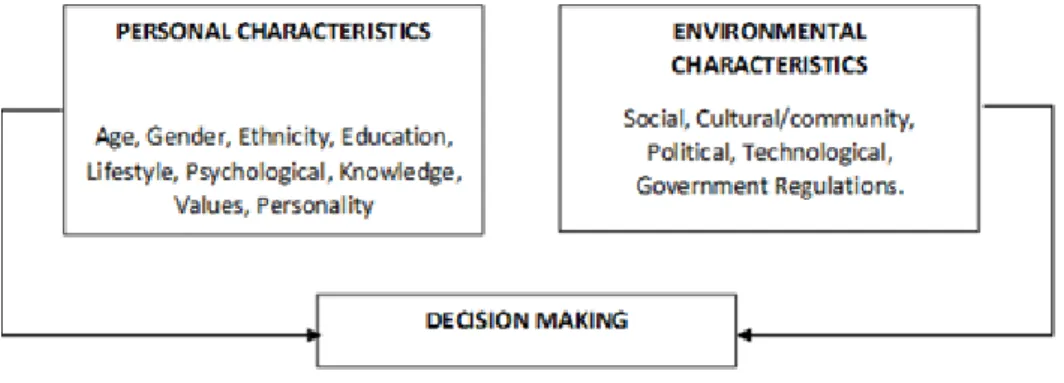
the attractions, place features and amenities. To sum up, it can be summarized that there are two independent uncontrollable variables considered during tourism decision making (Figure 3).Figure 3 Tourist Behaviour Model
Arguably, tourists are looking for an extraordinary experience that is totally different from their normal lives, and regardless of what happens during their travel experience, will shape tourist destination selection and repetition. Thus, attitudes, mood and expectations also affect the evaluation of tourist’s own experience rather than just the quality of the product which offered by the destination. As mentioned, people desire to visit other places to experience the cultural, social and environmental differences that exist, although this desire varies between individuals. To state the obvious, an individual’s perceptions and responses to a place will vary according to differences in gender, ethnicity, religion, culture, wealth as well as education.
defining tourism development and also the behaviour of the tourist. However, the main concern is how to incorporate all elements in order to make the resultant environment and view more useful and beautiful for the tourists to experience. The good environment is essential for tourist satisfaction and repeat visitation. Thus, the measurement of tourist expectations and perceptions of the environment in the context of tourism development plays a vital role in the future success of a destination.
CONCLUSIONS
From the discussion above, it is clearly shown that there is the variation of tourist behaviour, especially their perceptions, expectations, experiences and motivation, depending on the characteristics of the environment. Thus, it can be concluded that the influence of environments on tourism demand patterns can be shaped by the response of tourists' perceptions, motivations, expectations and experiences. Tourists have the largest adaptive capacity of elements within the tourism system because of their flexibility to substitute the place, timing and type of holiday, even at very short notice. Consequently, understanding tourist behaviour and reactions to the impacts of destination environment is essential to anticipate the potential different environment in tourism demand, as well as the decline or increase of specific tourism markets.
ACKNOWLEDGMENT
REFERENCES
Backhaus, N. (2003). Non-place jungle: the construction of authenticity in national parks of Malaysia. Indonesia and the Malay World, 31(89), 151-160.
Baerenholdt, J., Haldrup, M., Larsen, J., & Urry, J. (2004). Performing tourist places. Ashgate: Aldershot.
Bhuiyan, M. A. H., Siwar, C. & Mohamad Ismail, S. (2013). Tourism development in Malaysia from the perspective of development plans. Asian Social Science, 9(9), 11-18.
Chui, C. T. B., Rahim, F. A., Hassan, F. H., Musa, R., Yusof, J. M., & Hashim, R. H. (2010). Segmenting nature-based tourists and perception of servicescape at Taman Negara (National Park Malaysia). 2010 International Conference on Business, Economics and Tourism Management. Singapore.
Cohen, E. (1972). Towards a sociology of international tourism. Social Research, 39, 164-182.
Dann, G. M. S. (1981). Tourist motivation: an appraisal. Annals of Tourism Research, 8(2), 187-219.
Deci, E. L., & Ryan, R. M. (2000). The 'what' and 'why' of goal pursuits: Human needs and the self-determination of behavior. Psychological Inquiry, 11, 227-268. Education Bureau. (2009). Manual on Module I: introduction to tourism. Hong Kong:
Social and Humanities Education Section.
Fountain, J., Espiner, S., & Xie, X. A. (2011). Cultural framing of nature: Chinese tourists’ motivations for, expectations of, and satisfaction with, their New Zealand tourist experience. Tourism Review International, 14(2-3), 71-83.
Framke, W. (2002). The destination as a concept: a discussion of the business-related perspective versus the socio-cultural approach in tourism theory. Scandinavian Journal of Hospitality and Tourism, 2(2), 92-108.
Humphreys, C., & Holloway, J. C. (2009). The Business of Tourism (9th Edition). London: Pearson.
Inglis, F. (2000). The delicious history of the holiday. London: Routledge.
Jenkins, J. (2000). The dynamics of regional tourism organisations in New South Wales, Australia: history, structures, and operations.Current Issues in Tourism, 3(3), 175-203.
Khalilah, Z. (2006). Refining Tourist’s Place Experience through Placemaking: A Case Study on Middle East Tourists in Kuala Lumpur City Centre (Master’s thesis). Universiti Teknologi Malaysia, Skudai, Malaysia.
Lau, G., & McKercher, B. (2006). Understanding tourist movement patterns in a destination: a GIS approach. Tourism and Hospitality Research, 7(1), 39-49. Li, Y. (2000). Geographical consciousness and tourism experience.Annals of Tourism
Research, 27, 863-883.
McIntosh, A. J. (2003). Tourists’ Appreciation of Maori Culture in New Zealand. Tourism Management, 25, 1-15.
Morin, J., Gates, C., & Zimmerman, T. (2009). Scared landscapes in Anatolia and neighboring regions. London: Archaeopress.
Murphy, P. E., & Murphy, A. E. (2004). Strategic management for tourism communities: bridging the gaps. Clevedon: Channel View Publications.
Patterson, M. (2006). Consumption and everyday life. Abingdon: Routledge.
Saarinen, T. F. (1976). Environmental planning: perception and behaviour. Boston: Houghton Mifflin Company.
Urry, J. (2002). The tourist gaze (2nd ed.). London: Sage Publications.