VOLUME 17 ISSUE 2 (2019), Page 215 – 224
SOCIAL IMPACT EVALUATION OF TEA PRODUCTION USING SOCIAL LIFE CYCLE ASSESSMENT (S-LCA) METHOD IN
CAMERON HIGHLANDS, PAHANG, MALAYSIA
Yeoh Geok Wah1, Amir Hamzah Sharaai12 & Khairul Izzuddin Muhammad3
2,3Faculty of Environmental Studies
UNIVERSITI PUTRA MALAYSIA
1,2Institute of Plantation Studies
UNIVERSITI PUTRA MALAYSIA
Abstract
Commercial convention of tea production and plantation at the largest scale in this country has shown an escalation year by year, together with the high demand for tea products in the Malaysian market. This may have a direct social impact throughout the life cycle of tea production. Thus, this research sought to identify the social impacts from the overall process of tea production. This study used the Social Life Cycle Assessment (S-LCA) involving descriptive analysis by assessing the social impacts associated with the stakeholders of tea production using three sets of questionnaires. The studies were conducted at one of the highest tea production companies in Cameron Highlands, Malaysia. The findings of the stakeholders showed a good level of satisfaction because there was no significant negative effect. Overall, the social aspects of the tea production met the required criteria in terms of social significance. However, there were some social aspects that can be improved by the factory in the future such as health and safety, discrimination, job opportunity and local community involvement.
Keywords: Social Life Cycle Assessment (S-LCA), job satisfaction; job
INTRODUCTION
The tea bush is botanically known as Camellia Sinensis. It is an evergreen plant with smooth, shiny, oval-shaped leaves and small white flowers. Today, tea is grown in more than 25 countries around the world. In Malaysia, the best place for tea is in Cameron Highlands, which has been planted with the world’s most flavoured beverage made from the dried leaves and buds of the tea bush. Tea is also one of the precursors to Cameron Highlands development as a hill station before its transformation into a major tourist destination. Recently, tea industry in Cameron Highlands is facing difficulties to sustain and survives. The tea industry is facing many challenges in its expanding its operations and in handling the social impact of tea companies such as the discrimination toward workers, cultural & heritage conservation, water shortages, and demands of fair wages from workers. Not only that, some local communities had to depend on polluted source of drinking water and had been inflicted with diseases as the result of extensive use of fertilizers and herbicides in the plantations, and untreated effluent discharge from tea mill into majority of the streams.
Tea production is one of the major economic income generators that provides high rate of employment in Cameron Highlands, Pahang. The high demand for tea in the manufacturing industry for tea-based products contributes to the opening of large-scale tea cultivation and creates more employment opportunities to the local community. The demands come not only from the domestic market, but also from international markets. According to the Food and Agriculture Organization (FAO) of the United Nations (2016), the production of tea in Malaysia has been continuously increasing year by year. In 2015, the total production of tea was 9,760 tonnes and it has increased to 11,600 tonnes in 2016. In order to meet the overwhelming demand, tea plantations require expansion and the use of more lands. In some producing countries, the expansion of tea plantations led to new areas being developed for plantation and leading to conflicts between the plantations and the local communities especially regarding their lands that have been misappropriated by the plantations.
The main objective in this study is to assess the social implications of tea production toward workers, local communities and consumers. S-LCA is a technique of social impact assessment, which is aimed at assessing the social and socio-economic aspects of a product as well as the positive and negative impacts on the whole life cycle (Amir Hamzah, 2016). The assessment begins from the comprehensive production and processing of raw materials, production, distribution, use, reuse, maintenance, recycling and final disposal of a particular product (Muhammad, Sharaai, Ismail, Harun, & Wong, 2019).
the social impacts generated throughout the life cycle of tea production. Moreover, there is no study yet for S-LCA on tea production especially in Malaysia.
MATERIALS AND METHODS
The S-LCA study adapted the framework of the Life Cycle Assessment (LCA), of which it has four important steps; 1) goal and scope definition, 2) Life Cycle Inventory (LCI) analysis, 3) Life Cycle Impact Assessment (LCIA), and 4) interpretation. In other words, it was conducted based on the guidelines of the ISO 14040 and ISO 14044 (International Organization Standardization, 2006). This study was carried out at a selected tea production company in Cameron Highlands, Pahang. The area of study was based on its high production and plantation of tea in Malaysia.
Goal and Scope Definition
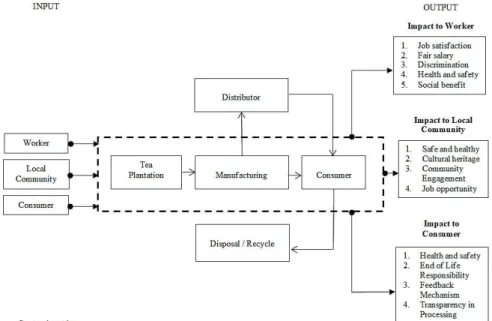
The first step in the S-LCA process is to define a clear goal that determines how a study is to be conducted. The goal of this study was to identify the social hotspots in the tea production process for product development in supply chain establishments of purchasing procedures or development of public and worker policies. The system boundary of this study is cradle-to-gate involving tea plantation up to the factory process (tea manufacturing) (Figure 1).
Social Life Cycle Inventory Analysis (S-LCI)
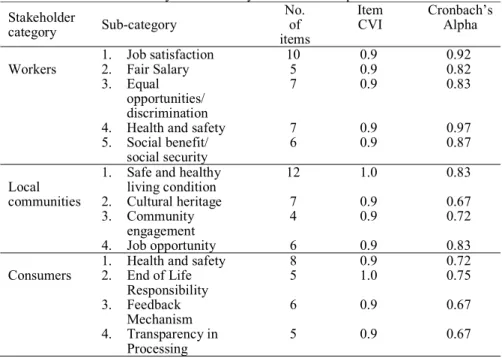
The social life cycle inventory analysis concerns the process in which data are collected. In order to obtain the potential social impacts in a system boundary, a survey was used to obtain the related information from three stakeholders: the workers, the local communities and the consumers. Three sets of questionnaires were employed as the instrument to obtain the related information from the three stakeholders. The questionnaires were constructed based on a subcategory proposed by UNEP (2009), which included five subcategories for workers, four subcategories for the local communities and four subcategories for the consumers.
Research instrument
The three sets of questionnaires contained 35 items for workers, 29 items for the local communities and 24 items for the consumers. All data collected from the questionnaire survey was analysed descriptively after which the analysed data was used to support the expected outcomes. The questionnaires were assessed based on validity and reliability tests before they were distributed in the actual study. Two languages, Malay and English, were used in the questionnaires so that the respondents could better understand and answer them. A 5-point Likert scale was used, ranging from ‘strongly disagree’ (1 point), ‘disagree’ (2 point), ‘neutral’ (3 point), ‘agree’ (4 point) and ‘strongly disagree’ (5 point).
Validity of the questionnaire
Table 1 Validity and reliability of items in the questionnaires Stakeholder
category Sub-category
No. of items
Item
CVI Cronbach’s Alpha
Workers 1.2. Job satisfaction Fair Salary
3. Equal
opportunities/ discrimination 4. Health and safety 5. Social benefit/
social security 10 5 7 7 6 0.9 0.9 0.9 0.9 0.9 0.92 0.82 0.83 0.97 0.87 Local communities
1. Safe and healthy living condition 2. Cultural heritage
3. Community
engagement 4. Job opportunity
12 7 4 6 1.0 0.9 0.9 0.9 0.83 0.67 0.72 0.83
Consumers 1.2. Health and safety End of Life Responsibility
3. Feedback
Mechanism
4. Transparency in
Processing 8 5 6 5 0.9 1.0 0.9 0.9 0.72 0.75 0.67 0.67 Pilot study
A total of 30 respondents for the local community, 20 respondents for workers and 30 respondents for consumer were selected as subjects for the pilot study. The reliability of the items was executed using the internal consistency reliability test. Based on Table 1, the average value of the internal consistency reliability (Cronbach’s alpha values) for workers, local communities and consumers were 0.886, 0.764 and 0.69 respectively. The questionnaires were confirmed to have a high reliability because its Cronbach’s alpha values were greater than 0.65 and the data was normally distributed. The questionnaires for this pilot study were valid to be used in the real study.
Number of Sampling
The total population in Cameron Highlands in year 2010 was 37,147 (District Council of Cameron Highlands, 2010). In line with Krejcie and Morgan formulation, as cited in Saleh and Bista (2017), 380 respondents from Brinchang, Cameron Highlands were chosen in this study to represent the population.
Sampling Technique
were distributed evenly to the local communities, mostly distributed around the housing area surrounding primary schools and night markets. The respondents were selected randomly in each area. For workers, there were only 20 workers allowed by the company to be selected as respondents due to private and confidential issues in the management system at the tea production company. Lastly, a total of 380 questionnaires were distributed randomly to consumers of the tea products.
RESULTS AND DISCUSSION
Social Impact of the Workers
The social impact result for this study constitutes the third step (LCIA) in the S-LCA. The impact category for workers aimed to cover social problems on tea plantation and production such as job satisfaction, salary, discrimination, and health and safety. Table 2 shows the total points from the Likert scale for each section. The percentage of each subcategory was obtained by dividing each subcategory with the total of the impact.
Table 2 The social impact of worker at tea production
Social Impact subcategory Total point of respondent responds
1. Job Satisfaction 1,312 (50%)
2. Salary/ wages 413 (16%)
3. Discrimination 306 (12%)
4. Health and Safety 562 (22%)
GRAND TOTAL 2593 (100%)
indicates that companies obeyed the minimum wage policy set by the Malaysian government that was RM1,000 for local workers (Minimum Wage Order, 2016). In addition, a study by Chen (2009) on tea growers in China, where each tea growing household runs a 1,500-2,000 square metres of tea farm, found their average income is only half of the average income of farmers, which has caused tea growing to become unattractive.
The lowest level of satisfaction was discrimination, which was 12%. All employees and applicants for employment should receive fair treatment and are not subjected to discrimination based on race, nationality, religion, disability, gender, age, sexual orientation, union membership, political bodies and other related issues. It is believed that this was not a serious issue in the mills and tea companies because both employees and employers were bound by the provisions of protection under the Labour Act (Wild Asia, 2016).
Social Impact of the Local Communities
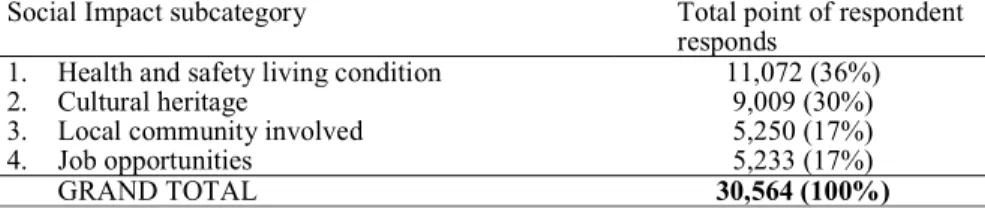
The impact category for the local communities aimed to cover social problems on tea plantation and tea production such as safe living conditions, cultural heritage, community engagement and local employment. Table 3 shows the four sections in the questionnaire for the local community, which covered health and safety living conditions, cultural heritage, local community involvement and job opportunity. There were 275 respondents and the percentage of each section was obtained by dividing each section with the total points of every subcategory in the questionnaire.
Table 3 The social impact of local communities at tea production
Social Impact subcategory Total point of respondent
responds
1. Health and safety living condition 11,072 (36%)
2. Cultural heritage 9,009 (30%)
3. Local community involved 5,250 (17%)
4. Job opportunities 5,233 (17%)
GRAND TOTAL 30,564 (100%)
public. They had even allocated scholarships for primary school students who scored excellently in the primary school evaluation test (known as UPSR). The majority of the local communities have a good impression of the brand of the company and they believed that the company helped to reduce the negative impact to the earth with its production of tea products.
Social Impact of the Consumers
The impact category for the consumers aimed to cover social problems in the final damage on the Area of Protection such as health and safety, end of life responsibility, feedback mechanism and transparency in the processing process. Table 4 shows the total points from the Likert scale for each section covering the 380 respondents. The percentage of each section was obtained by dividing each section with the total point of 30,891.
Table 4 The social impact of consumers at tea production
Social Impact subcategory Total of respondent respond
1. Health and safety 8,733 (28.3%)
2. End of life responsibility 6,745 (21.8%)
3. Feedback mechanism 8,293 (26.9%)
4. Transparency in processing process 7,120 (23.0%)
GRAND TOTAL 30,891 (100%)
According to Table 4, all social impacts had almost the same value. This shows that there was no impact category that had a high value of satisfaction compared to the other. In short, consumers had the same value of satisfaction for all social midpoint impacts. Therefore, it can be assumed that the company of tea products has been a great hit and mostly received the support from the consumers. The meaning of its “Ummph!” slogan represented feelings of enjoyment. According to Jorgensen, Le Bocq, Nazarkina and Hauschild (2012), S-LCA has a more holistic perspective on the impact of products than comparable social assessment tools, including several stages in the life cycle. Activities that the respondents claimed the company had been doing was cleaning the village and organising running events. Based on the company’s website, with a production capacity approaching 3,000kg per hectare, the plantation company produced four million kilogrammes of tea annually, which translates to about 5.5 million cups per day. This represents about 70% of all tea produced in Malaysia. The respondents felt safe to consume the company’s tea products and they believed it has high quality as no food poisoning reports had ever occurred.
Life Cycle Interpretation
conclusion, explain the limitations of the study, and give suggestions and recommendations (UNEP, 2009). This is a positive strength for the company as the products are not required to be replaced or reinvented to replace the obsolete products. The company can save cost from creating new products and spend additional revenue to maintain the premium grade of their black tea. The market is saturated by tea products from multiple manufacturers. Other competitors are pushing products into the market, increasing competition and eating the company’s market share. Since tea products have been around for a long time, there is not much diversification that can be improvised to the product for improvement and might lead to product stagnation.
CONCLUSION
Contrary to what most people believe, this study proved that the existence of tea plantation and mills had led to positive impacts to the stakeholders i.e. workers local communities and consumers. The overall social aspects derived from the S-LCA for tea production met the required criteria in terms of social significance for those who had direct contact with this operation. However, there are marginal aspects such as discrimination to workers and poor local community involvement and feedback mechanism that needs to be reviewed and improved.
In overall, this study presents an important product conducted using S-LCA in this country. The results of this study can be interpreted and applied to reduce social impacts and improve efficiency across every stage of the production line. This can contribute to the long-term success of the company’s owner by enhancing the product with the customers, retailers and staff to promote social sustainability. By understanding the relative impacts of the various operations over which farmers as a producer ultimately have control, it enables the company to take targeted initiatives and investment into procurement, energy and process efficiency measures, and production design.
The results of this study will be forwarded to relevant factories coupled with recommendations for best manufacturing practices, which are specifically aimed at reducing the negative social impacts of tea production. Nevertheless, this study only focused on two life cycle phases (tea plantation and manufacturing processing), which do not represent the whole life cycle of tea production. Research still needs to be carried out for the rest of the phases to determine the overall potential social impacts especially regarding the other two important phases in tea production i.e. the distributors and consumers.
ACKNOWLEDGEMENTS
REFERENCES
Amir Hamzah, S, (2016, September). Penilaian kitar hayat sosial: Analisis kesan sosial
produk. Persidangan Kebangsaan Pembangunan dan Pendidikan Lestari 2012.
September 19-20, 2012, Pulau Pinang, Malaysia.
Chen, W. (2009). From tea garden to cup: China’s tea sustainability report. (n.p.): Social Resources Institute, China.
District Council of Cameron Highlands (2010). Available at
http://www.mdcameron.gov.my/en.
Food and Agriculture Organization of the United Nations (2016). Available at http://www.fao.org/publications/sofa/2016/en/.
International Organization Standardisation (2006). Environmental management – Life Cycle Assessment – Requirements and guidelines. Geneva: Author.
Jørgensen, A., Le Bocq, A., Nazarkina, L., & Hauschild, M. (2008). Methodologies for social life cycle assessment. The International Journal of Life Cycle Assessment, 13(2), 96-103.
Muhammad, K. I., Muhamad Pauzi, M. F., & Sharaai, A. H. (2015). Social Life Cycle Assessment (SLCA) for palm oil production in Malaysia. Advances in Environmental Biology, 9(23), 89-94.
Muhammad, K. I., Sharaai, A. H., Ismail, M. H., Harun, R., & Wong, S. Y. (2019). Social implications of palm oil production through social life cycle perspectives in Johor, Malaysia. The International Journal of Life Cycle Assessment,24(5), 935-944.
Saleh, A., & Bista, K. (2017). Examining factors impacting online survey response rates in educational research: Perceptions of graduate students. Journal of MultiDisciplinary Evaluation, 13(29), 63-74.
Schierbeck, J. (2006). A framework for social life cycle impact assessment. The International Journal of Life Cycle Assessment, 11(2), 88-97.
UNEP (2009). Guidelines for social life cycle assessment of product. Paris: United Nations Environment Programme.
Wild Asia (2016). Verification assessment of social management and practices - Felda
Global Ventures Plantations (Malaysia) Sdn Bhd. Retrieved from
http://www.feldaglobal.com/wp-content/uploads/2016/10/FGV-Group-Review-and-Field-Report_04032016.pdf.