VOLUME 16 ISSUE 2 (2018), Page 314 – 323
PHYSICOCHEMICAL PROPERTIES AND POZZOLANIC PERFORMANCE OF ULTRAFINE TREATED RICE HUSK ASH
(UFTRHA) AS ADDITIVE IN CONCRETE
Siti Asmahani Saad1, Nasir Shafiq2 & Maisarah Ali3
1,3Kulliyyah of Engineering,
INTERNATIONAL ISLAMIC UNIVERSITY MALAYSIA 2Faculty of Engineering,
UNIVERSITI TEKNOLOGI PETRONAS, MALAYSIA
Abstract
Rice husk ash (RHA) contains high amount of amorphous silica that is ubiquitous in the pozzolanic reaction of SCM in concrete. However, usage of conventional RHA is currently unfavourable in concrete industry due to its properties inconsistency. In this regard, improvement on the RHA properties by introduction of thermochemical pre-treatment prior to burning procedure is seen as an excellent way to reach the goal. In this paper, raw rice husk was pre-treated using 0.1N hydrochloric acid (HCl) and heated at 80oC. It was then mechanically
activated by high energy planetary ball mill for 15 minutes at speed of 300rpm and ball-to-powder ratio (BPR) of 15:1. The chemical composition, mineralogical properties, particle size analysis, specific surface area as well as microstructure properties of ultrafine treated rice husk ash (UFTRHA) were determined accordingly. As for amorphous silica content of the optimum sample was recorded as 98.60% incinerated at 600oC with four hours of pre-treatment soaking
duration. In terms of particle size and specific surface, it was also observed that, burning temperature of 600oC, pre-treated at four hours were recorded to produce
finest size of UFTRHA where d(0.1), d(0.5) and d(0.9) were obtained as 1.416 µm, 4.364 µm and 14.043 µm respectively. Largest specific surface area value was obtained at 219.58 m2/g with the similar pre-treatment conditions.
Meanwhile, the strength activity of UFTRHA from the optimum pre-treatment process was measured by testing the compressive strength of mortars. The highest compression value obtained was 50.17MPa with 3% UFTRHA replacement at 28 days.
Concrete
INTRODUCTION
In current research trend, most researchers have promoted green technology application widely. This phenomenon encourages recent explorations of the application of additive materials in concrete industry. Additive materials are commonly used in concrete as admixtures to enhance its properties and also to promote greener concrete production. Rice husk ash (RHA) is regarded as one of concrete additive materials due to its high silica content. Production of RHA is done via thermal activation, which involves burning process of the rice husk from agricultural waste.
Rice plant is a type of plant that has the ability to absorb silica content from soil. The absorbed silica eventually assimilates into the plant structure during its growth. Therefore, the outer part, which is the rice husk, possesses high silica content with value of more than 80% (Juenger & Siddique, 2015) Approximately 1,000 million tons of rice are annually produced in the world, which usually leaves about 400 million tons of rice husks as waste material (Food Agriculture Organization (FAO), 2015). Hence, the potential of producing ash from husk is about 100 million tons per annum. Therefore, utilizing RHA in concrete is possible. Furthermore, high content of amorphous silica and high specific surface area (SSA) of RHA are possible to be achieved by adopting suitable burning condition (Mehta & Monteiro, 2006). Thus, incorporation of RHA in concrete production promotes environmental as well as economic relief. Compared to other additive types such as silica fume (SF) and fly ash (FA), RHA is proven to have greater reaction with portlandite (Ca(OH)2) in pozzolanic reaction, contributes towards increment in compressive strength value and durability of high performance concrete (Feng, Yamamichi, Shoya, & Sugita, 2004; Salas, Delvasto, de Gutierrez, & Lange, 2009; Van, Rößler, Bui, & Ludwig, 2013) and ultra-high performance concrete as well (Van, Rößler, Bui, & Ludwig, 2014a; . Van, Rößler, Bui, & Ludwig, 2014b; Van Tuan, Ye, Van Breugel, & Copuroglu, 2011; Van Tuan, Ye, Van Breugel, Fraaij, & Bui, 2011).
METHODOLOGY
Ultrafine Treated Rice Husk Ash (UFTRHA) Pre-treatment Process Flow Raw rice husk was obtained from local rice factory (BERNAS) located in Sungai Ranggam, Perak. Prior to incineration procedure, the rice husk was treated with 0.1N analytical grade (A.G.) hydrochloric acid (HCl). The specimens were soaked and heated at 80⁰C in the acid solution. After completion of pre-treatment process, the samples were washed using distilled water until its neutral pH obtained and dried using laboratory oven at 110⁰C. It was then burned by using conventional furnace in laboratory. The burning process was done at 600⁰C, 700⁰C and 800⁰C with 1 hour retention time. The ultrafine treated rice husk ash (UFTRHA) was then ground using planetary ball mill for 15 minutes with ball-to-powder ratio (BPR) of 15:1 and rotation speed at 300rpm.
Physicochemical Characteristic of (UFTRHA)
In this study, chemical composition of UFTRHA prepared at various burning temperatures was examined using X-ray fluorescence (XRF) test. The test was done for UFTRHA sample that undergone pre-treatment in 0.1N HCl solution at 80oC. The analysis was done by using spectrometer of Bruker Axs S4 Pioneer.
The test was in compliance with BS EN 12677. As for mineralogical properties determination, X-Ray diffraction (XRD) analysis was done accordingly. This test was conducted using Bruker Axs D8 Advance X-Ray Diffractometer instrument. Brunnet emmet teller (BET) nitrogen adsorption test was done to examine particle specific surface area of the ground UFTRHA powder. The test was completed with degassing temperature of 300⁰C using surface area and pore analyser model micromeritics ASAP 2020. Meanwhile, particle size analysis (PSA) was done using Malvern instrument mastersizer, model Scirocco 2000.
Pozzolanic / Strength Activity Index
In order to ensure that the UFTRHA is a reactive pozzolan, it is vital to conduct strength activity index test. Thus, this test was completed in accordance to ASTM C311-98b specifically for ordinary Portland cement (OPC) mortar (ASTM, 2016). The mortars were prepared by blending OPC with the highest SiO2 content
of UFTRHA at 20% replacement level. The strength activity index was calculated as the following equation:
Strength Activity Index (SAI) = (B/A) x 100
Concrete
RESULTS AND DISCUSSION
Chemical Composition of UFTRHA
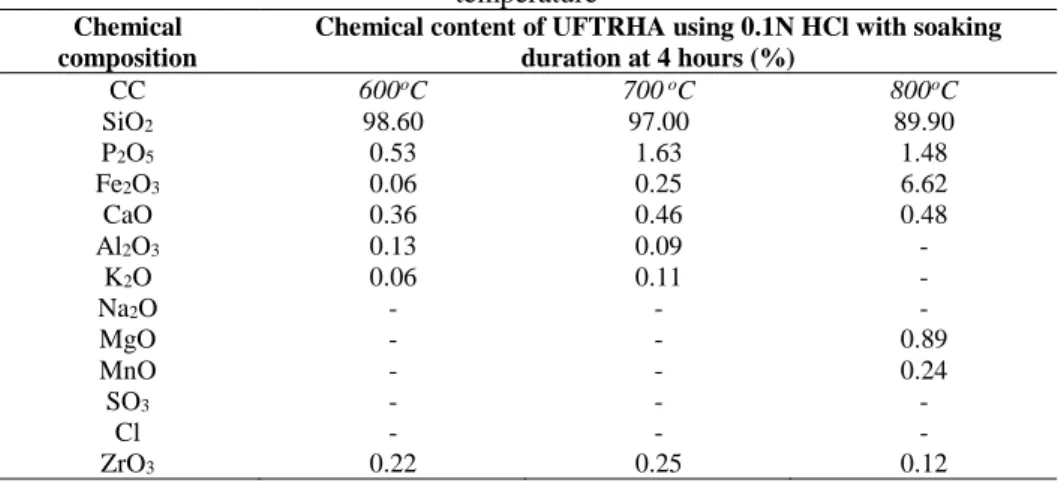
Based on the experimental result, it can be observed that the predominant content of rice husk ash is silica (SiO2). In addition, the SiO2 composition in UFTRHA
incinerated at 600oC has highest value among other samples that were prepared
at 700oC and 800oC. According to the XRF analysis result, the SiO
2 content in
UFTRHA sample produced at 600oC increased with percentage values of 1.62%
and 8.82% as compared to the samples extracted at 700oC and 800oC respectively.
This finding also indicate that the ideal burning temperature to produce UFTRHA is 600oC. The chemical composition determination of UFTRHA, X-Ray
Fluorescence (XRF) data is summarized in Table 1.
In addition, the amount of alkali metal oxides i.e. sodium oxide (Na2O),
magnesium oxide (MgO), calcium oxide (CaO) and potassium oxide (K2O)
contents at all three different burning temperatures were obtained less than 1%. Less in amount of these metallic impurities is vital to enhance the purity of silica extracted from rice husk. By lowering the content of these metallic oxides, especially potassium and sodium, surface melting of SiO2 particles can be
reduced effectively. The surface melting of SiO2 phenomenon will accelerate
early crystallization of amorphous SiO2 into cristobalite as suggested by several
researches in this area (James & Subbarao, 1986; Kalapathy, Proctor, & Shultz, 2001; Krisnarao & Godkhindi, 1992; Real, Alcala, & Criado, 1996).
Table 1: Chemical composition of UFTRHA treated for 4 hours at various burning temperature
Chemical composition
Chemical content of UFTRHA using 0.1N HCl with soaking duration at 4 hours (%)
CC 600oC 700 oC 800oC
SiO2 98.60 97.00 89.90
P2O5 0.53 1.63 1.48
Fe2O3 0.06 0.25 6.62
CaO 0.36 0.46 0.48
Al2O3 0.13 0.09 -
K2O 0.06 0.11 -
Na2O - - -
MgO - - 0.89
MnO - - 0.24
SO3 - - -
Cl - - -
ZrO3 0.22 0.25 0.12
Minerological Characteristics of UFTRHA
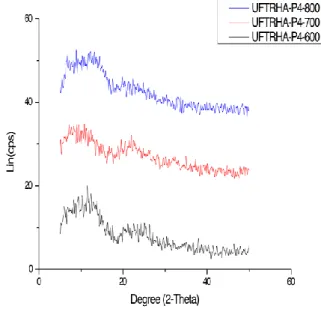
mineral presence in the tested material. Figure 1 illustrates the XRD patterns of UFTRHA incinerated at 600oC, 700oC and 800oC respectively.
Based on the XRD analysis, it was noted that all samples of UFTRHA prepared at all temperatures variation i.e. 600oC, 700oC and 800oC were
amorphous and without the presence of high intensity peaks. Hence, it is proven that sensitivity towards burning temperature has been eliminated by removing impurities on the surface of the raw rice husk via the pre-treatment process prior to incineration stage. Amorphous state of silica content is vital in order to produce high quality additive material in concrete industry application.
Figure 1: XRD patterns of UFTRHA incinerated at 600oC, 700oC and 800oC
respectively
Physical Properties of UFTRHA
Among many of the feasible methods to be used for material size reduction is the mechanical milling process. Hence, this method was adopted in order to reduce size of UFTRHA powder particle. This milling mechanism is attainable using planetary ball mill (Saad, Nuruddin, Shafiq, & Ali, 2016). In this regard, several parameters of the mechanical milling process are to be considered namely milling speed, ball-to-powder ratio (BPR) and duration of grinding.
Concrete
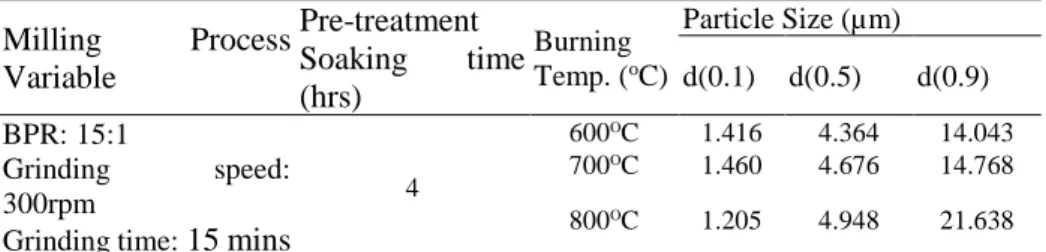
Table 2: Particle size analysis of UFTRHA at various burning temperature at 4 hours of soaking time.
Milling Process
Variable
Pre-treatment
Soaking time
(hrs)
Burning Temp. (oC)
Particle Size (µm)
d(0.1) d(0.5) d(0.9)
BPR:15:1
Grinding speed:
300rpm
Grinding time: 15 mins
4
600OC 1.416 4.364 14.043
700OC 1.460 4.676 14.768
800OC 1.205 4.948 21.638
High speed of the grinding process resulted in greater velocity of the ball movements in the milling bowl. Therefore, shearing impact between grinding media (balls) and feed stock (UFTRHA) occurs vigorously in the system hence the smaller particle size obtained (Saad et al., 2016). Based on the data in Table 3, UFTRHA that had been treated for four hours and incinerated at 600oC has
finest particle size compared to other UFTRHA samples with d(0.1), d(0.5) and d(0.9) of 1.416µm, 4.364µm and 14.043µm respectively.
On the other hand, Table 3 shows the influence of different burning temperature towards specific surface area (SSA) value of UFTRHA pre-treated using 0.1N HCl for four hours as well. Specific surface area (SSA) value plays an important role in accelerating the pozzolanic reaction of additive materials. Furthermore, large surface area of the pozzolanic material particle also acts as seeds for the generation of denser calcium-silicate-hydrate phase (C-S-H) in enhancing concrete strength development. From the SSA analysis, the highest specific surface area of UFTRHA sample was obtained as 219.58 m2/g. This
finding is in agreement with the previous experimental analysis where the highest SiO2 content and finest median particle size were obtained from UFTRHA that
was burned at 600oC with four hours of acid pre-treatment procedure. According
to data in Table 3, the SSA values reduced as the burning temperature rose up to 800oC.
Table 3: Response of Brunnet Emmet Teller – Specific Surface Area (BET-SSA) values to different burning temperatures of UFTRHA pre-treated at 4 hours
BET-SSA Value for Different
Sample Type (m2/g)
Burning Temperature (oC)
600 oC 700 oC 800 oC
UFTRHA (acid pre-treated) 219.58 180.72 133.91
Pozzolanic / Strength Activity Index Analysis
proportion of SAI test is tabulated in Table 4, where compression values of 50mm3 cube samples with 20% of UFTRHA replacement were determined at 7
and 28 days respectively.
From the analysis, the SAI values of UFTRHA blended mortar were recorded as 137.17% and 148.21% at 7 and 28 days respectively. These findings give an indication that UFTRHA possesses an excellent pozzolanic / cementing properties, where minimum requirement of strength activity index (SAI) of 75% at both 7 and 28 days as per outlined in ASTM C618-00 (ASTM, 2015).
Table 4: Mix proportions for strength activity index (SAI) analysis
Constituent Control Mix (A) UFTRHA Blended Mix (B)
OPC (g) 450 360
Sand (g) 1350 1350
UFTRHA(g) - 90
Water (g) 225 225
CONCLUSION
The results obtained shows that, the optimum conditions in pre-treatment process play important roles in terms of enhancing the physicochemical properties of UFTRHA. These properties are important in order to produce high quality additive material for concrete technology application. As for the chemical composition analysis, the highest purity of silica content (SiO2) is achieved by
incineration at 600oC of four hours pre-treated rice husk. On the other hand, the
mineralogical assessment concluded that the silica is amorphous as no significant sharp peak presence in XRD analysis at all burning temperatures. The highest amorphous silica content (SiO2) of the UFTRHA sample was recorded at 98.60%
with particle size median of 4.364µm and specific surface area of 219.58 m2/g.
Meanwhile, the strength activity index of UFTRHA than that of the control mortar at 7 and 28 days were calculated as 137.17% and 148.21% subsequently.
ACKNOWLEDGEMENT
The author would like express profound gratitude to the Ministry of Education of Malaysia (MoE) for funding the research work under MyRa Grant Scheme.
REFERENCES
ASTM. (2015). ASTM C618-15 standard specification for coal fly ash and raw or
calcined natural pozzolan for use in concrete. doi.org/10.1520/C0618-15
ASTM. (2016). C311/C311m-16 standard test methods for sampling and testing fly ash
or natural pozzolans for use. doi.org/10.1520/C0311-11a.2
Feng, Q., Yamamichi, H., Shoya, M., & Sugita, S. (2004). Study on the pozzolanic
properties of rice husk ash by hydrochloric acid pretreatment. Cement and
Concrete
Ceramic Society Bulletin, 65(8), 1177-1180.
Juenger, M. C. G., & Siddique, R. (2015). Recent advances in understanding the role of
supplementary cementitious materials in concrete. Cement and Concrete
Research, 78, 71-80.
Kalapathy, U., Proctor, A., & Shultz, J. (2001). A simple method for production of pure silica from rice hull ash. Fuel and Energy Abstracts, 42(1), 45.
Krisnarao, R. V., & Godkhindi, M. M. (1992). Studies on the Formation of SiC Whikers
from Pulverized Rice Husk Ashes. Ceramics International, 18, 35-42.
Mehta, P. K., & Monteiro, P. J. M. (2006). Concrete: microstructure, properties, and materials. McGraw-Hill Education.
Park, C., Salas, A., Chung, C.-W., & Lee, C. J. (2014). Freeze-thaw resistance of concrete using acid-leached rice husk ash. KSCE Journal of Civil Engineering, 18(4), 1133-1139.
Real, C., Alcala, M. D., & Criado, J. M. (1996). Preparation of silica from rice husks.
Journal of the American Ceramic Society, 79(8), 2012-2016.
Saad, S. A., Nuruddin, M. F., Shafiq, N., & Ali, M. (2016). The effect of incineration temperature to the chemical and physical properties of Ultrafine Treated Rice
Husk Ash (UFTRHA) as Supplementary Cementing Material (SCM). Procedia
Engineering, 148, 163-167.
Salas, A., Delvasto, S., de Gutierrez, R. M., & Lange, D. (2009). Comparison of two
processes for treating rice husk ash for use in high performance concrete. Cement
and Concrete Research, 39(9), 773-778.
Van, V. T. A., Rößler, C., Bui, D., & Ludwig, H. (2014a). Cement & Concrete Composites Rice husk ash as both pozzolanic admixture and internal curing
agent in ultra-high performance concrete. Cement and Concrete Composites, 53,
270-278.
Van, V. T. A., Rößler, C., Bui, D. D., & Ludwig, H. M. (2014b). Pozzolanic reactivity of
mesoporous amorphous rice husk ash in portlandite solution. Construction and
Building Materials, 59, 111-119.
Van, V. T. A., Rößler, C., Bui, D. D., & Ludwig, H. M. (2013). Mesoporous structure
and pozzolanic reactivity of rice husk ash in cementitious system. Construction
and Building Materials, 43, 208-216.
Van Tuan, N., Ye, G., Van Breugel, K., & Copuroglu, O. (2011). Hydration and microstructure of ultra high performance concrete incorporating rice husk ash.
Cement and Concrete Research, 41(11), 1104-1111.
Van Tuan, N., Ye, G., Van Breugel, K., Fraaij, A. L. A., & Bui, D. D. (2011). The study
of using rice husk ash to produce ultra high performance concrete. Construction
and Building Materials, 25(4), 2030-2035.
Vayghan, A. G., Khaloo, A. R., & Rajabipour, F. (2013). The effects of a hydrochloric acid pre-treatment on the physicochemical properties and pozzolanic