International Journal of Research in Engineering & Applied Sciences Email:- [email protected], http://www.eur oasiapub.org
29
AQUADRONE FOR MULTIPURPOSE
Swetha S*
Mohammed Nabeel**
Nagaraj***
Naveen kumar S ****
Sukesh B S****
Article history:
Abstract
Received June 30th, 2016; Approved July 20th , 2016; Available online: Aug 2st, 2016.
In the last spans we have evidenced an unprecedented development of Unmanned Air Vehicles (UAVs) for their operation with high societal impact. They have been widely used for military applications and the new advances in communication and control systems and cameras and also in civilian applications such as inspection, state of emergency, search and rescue, traffic enforcement. In Future UAV systems will replace the major current trends due to its longer endurance, levels of liberty, lower cost, and networking capabilities. The aquatic unmanned aerial vehicle (AquaUAV or Aquadrone), a type of aircraft that can land both on water and on land, which has no onboard crew or passengers. The developed prototype model of remote piloted Aquadrone is used to transport the payload to the isolated areas to ease the human effort, offering lower cost and also secured means of control. The key consideration while designing this model are material availability, cost, light-weight, structural properties & ease of fabrication etc. This model can lift pay load up to 500gms. And in this model we are providing an option for fixing camera and fire extinguisher, it can also be used for other purpose according to the required application. A 1270 mAh battery supplies the power to the electronic speed controller and also to the flight control board. This electronic speed controller intern feed power to the motor which will help in rotating the propeller to produce lift. Servo will be fixed to operate the nozzle spray. A separate 9 V battery is also fixed for the camera operation.
Keywords:
Aquadrone, Aqua UAV, Remotely piloted vehicles.
2395-7492© Copyright 2016 The Author. Published by International Journal of Engineering and Applied Science. This is an open access article under the
All rights reserved.
Author Corrospondence
Swetha S *
Assistant Professor,
Department of Aeronautical Engineering,
International Journal of Research in Engineering & Applied Sciences
Email:- [email protected], http://www.eur oasiapub.org
30
1. Introduction:- In our country our defense departments are facing lot of problems near the
coastal region, where so many illegal activities are being carried out (For an example Drugs, smuggling, weapon transportation). To overcome these major problems our prototype model is useful for the defense system to surveillance the coastal region without human effort & also during the fire hazards in the remote/isolated areas which again reduces human efforts, cost and time. UAV is a flying design which is used to carry the mission specific payload. An Unmanned aerial vehicle (UAV) is a type of aircraft that can land both on water and also on land, which has no onboard crew or passengers. UAVs include both autonomous drones and remotely piloted vehicles (RPVs). It is capable of controlled, sustained level flight and is powered by a jet, reciprocating, can also fly upside down or electric engine. In the 21st century, technology reached a point of sophistication that the UAV is now being given a greatly expanded role in many areas of aviation. UAV differs from a cruise missile in that a UAV is recovered after its mission while a cruise missile impacts its target. Aquadrone which comes under medium short UAV’s category and it has a short flight range. Design of an unmanned aerial vehicle (UAV) involves several complexities like aerodynamic complexities, choice of number of rotors, mechanical difficulties, controlling processor, control algorithm and control system designing etc.
2. Aerodynamic Design:-
In this Aquadrone 4 rotor are used and fixed as Y4.
Fig 2.1 Rotor position and orientation of Y4 Aquadrone.
Air pressure plays a very important role in aerodynamic design and it exploited to create a lift force. While designing a model pressure ratio relates the current pressure with pressure at sea level, temperature & density are considered and expressed as
ρ=P/RT
Dynamic pressure equation q=1/2 × ρV2
Where ρ is the density of air, R is the gas constant,
P is pressure, T is the temperature V is the speed of the air.
*Assistant Professor, Department of Aeronautical Engineering, Acharya Institute of Technology, VTU ** under graduate student, Department of Aeronautical Engineering, Acharya Institute of Technology, VTU. ***under graduate student, Department of Aeronautical Engineering, Acharya Institute of Technology, VTU. ****under graduate student, Department of Aeronautical Engineering, Acharya Institute of Technology,VTU
International Journal of Research in Engineering & Applied Sciences
Email:- [email protected], http://www.eur oasiapub.org
31
For flight stability, Lift force and magnus effect are considered. For the Y4 Aquadrone, the counter rotating blades torques cancels each other out thus, preventing the system from drift. Lift force is calculated by using
L=CdqS
Where Cd is the lift coefficient q is the dynamic pressure
S represents the area of the airfoil.
Magnus effect assumes a cylinder of infinite length which rotates. If the rotation of cylinder is moving relatively upwards air has a tendency to induce a lift. Grounding effects is a leading factor in faster take-off flight because more air being pushed back into the airflow of the blades leading to an initial cyclonic effect surrounding the blades and creating further stress on the frame.
The designed Y4 Aquadrone is fitted with four motors with each a rotor attached. Due to the spinning of rotor, lift is generated and when it is aligned with the horizontal plane the sum of the lift is generated (F lift) becomes equal to the gravitational force. If lift F is increases, it climbs and if lift F is decreases it descents.
Fig 2.2 Lift force resolving into vertical & horizontal component
If the Aquadrone is tilted, the direction of F lift is no longer aligned with the earth frame z-axis but the force can be resolved in a z-axis component and a horizontal component. The horizontal component results in acceleration in the horizontal plane.
The rotors spin in opposite direction in pairs to prevent the Y4 Aquadrone from spinning around the z-axis that results the effect of counter torque generated by the spinning rotors. When the rotors spin in opposite direction, this counter torque generated will be equalized if all rotors rotates with the equal speed. Tilting of the Y4 Aquadrone can be done by altering the speed of the rotors.
International Journal of Research in Engineering & Applied Sciences
Email:- [email protected], http://www.eur oasiapub.org
32
Fig 2.3 Representation of Roll, Pitch and Yaw.
3. Material & Methods
Key considerations while selecting the materials for designing Aquadrone model are
Light-weight
Good structural properties
Material availability and cost
Ease of fabrication
Also failure modes such as fracture, buckling, excessive elastic deformation, fatigue, impact damage, creep and corrosion also consideration.
There are plenty of materials and methodologies to construct a UAV. Through analyzing various UAVs model we have chosen aluminum square tube material for better structure integrity and cost of material is low to compare with carbon fiber. Also, it exhibit good strength to weight ratio. The dimension of aluminum hollow square tube is 12cm x 12cm.
This floating landing skids made of foam sheet which has density less than water which can lift up to 3kgs. These landing skids are used to land the model both on land and water as well.
Brushless motors operate differently as compared to electric motors. The rotor has permanent magnets attached along the casing and the stator has coils. They are 3 phase alternating current (AC) synchronous motors. The electrical speed controller send pulses of current to each set of coils in a 120 degree pattern, frequency at which the speed controller sends the pulses would determine the speed of the motor. From the batteries voltage is supplied to the coils to generate a rotating magnetic field, which is followed by the rotor. There is no physical contact between the magnets and the coils. We have chosen 10”x4.5” propeller blade for this motor. An electronic speed control or ESC is an electronic circuit used for the purpose to vary an electric motor's speed, its direction and possibly also to act as a dynamic brake.
Lithium Polymer (LiPo) battery is used for powering the Aquadrone by converting the stored chemical energy into electrical energy.
Flight controller board having dimensions 43x14x16.5mm & weight: 11g is chosen &2 Mega pixel camera is fixed for surveillance, image capture etc., Here we are using wireless camera for capture the image.
International Journal of Research in Engineering & Applied Sciences
Email:- [email protected], http://www.eur oasiapub.org
33
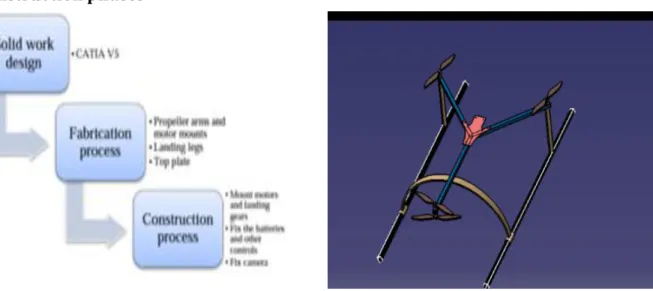
4. Construction phases
Fig 4.1 Work process Fig 4.2 Solid work design: CATIA VS
5. Working Principle
To achieve forward pitch, speed of the front two rotors must be decreased and that of the rear two rotors must be increased proportionally keeping the net vertical thrust same to maintain altitude. To perform roll, the speed of front rotor (any one) must be decreased and that of the other rotor
BATTERY
ELECTRONIC
SPEED
CONTROLLER
RECIEVER
FLIGHT
CONTROL
BOARD
FIRE EXTINGUISHER
SERVO
PROPELLER
MOTOR
International Journal of Research in Engineering & Applied Sciences
Email:- [email protected], http://www.eur oasiapub.org
34
speed must increase. For anticlockwise yaw, the upper one rotor speed must be higher than the lower one.
1.
Result & Discussion
This project gave the team a deep insight and better understanding of the construction and
mechanism of an Aquadrone.
The performance of the Aquadrone met the objectives that the team had initially set out.
Firstly, the Aquadrone managed to hover over an area in a stable altitude hold.
Secondly, the Aquadrone maneuverability was put to the test by pitching and yawing and it
responded well to the pilot’s input.
Thirdly, with no payload, it only requires 45% of maximum thrust to lift off the ground to maintain
hover. This leaves the remaining thrust to lift a possible maximum payload of 3.5 Kg.
As for the structures, despite numerous flips and a high impact drop during test flights, it was able
to withstand the high forces while at rest and in flight. This was because the materials were chosen for its high weight to strength ratio and toughness and it was proven true through these test flights. As a result, there was no catastrophic failure in any point during the experimental phase.
This project can be further carried out to make our Aquadrone to travel inside the water covering
the electronic parts with water proof material.
Payload can be replaced with any other carriage system so that it can carry medical assistance,
food supply during floods etc.
2.
References
[1] Craig S Issod, “Getting started with hobby quad copters and drones: learn about buy and fly
these amazing aerial vehicles”, AerotechnicalMissiliSpazio Vol. 87 5/2008.
[2] Fju, P G Jenkins, D A Ettinger, and Shyy,W., “Flexible-Wing-Based Micro Air Vehicles,”
Proceedings of the AIAA 40th Aerospace Sciences Meeting and Exhibit, AIAA Paper No.2002-0705, Jan.2002.
[3] Grasmeyer J M and Keennon T M, “Development of the black widow micro air vehicle,”
Proceedings of the AIAA 39th Aerospace Sciences Meeting and Exhibit, AIAA Paper No.2001-0127, Jan.2001.
[4] Mueller, T.J. and DeLaurier, J.D “Aerodynamics of Small Vehicles,” Annual Review of Fluid
Mechanics, Vol.35, 2003, pp.89-111.
[5] Nelson R C, Flight Stability and Automatic Control, 2nd ed., Mc Graw Hill, Boston, 1998.
[6] Rauw - A SIMULINK Toolbox for Flight Dynamics and Control Analysis, Feb.1998, available
online at http:/www.mathworks.com(cited Nov.2004).
[7] Roskam,J, Airplane Flight Dynamics and Automatic Flight Controls, Parts1&2, DAR corporation,
Lawrence, KS,1998
Acknowledgement:-
We thank Dr S K Maharana, Prof, Head & Dean (R&D) and all the faculties ofInternational Journal of Research in Engineering & Applied Sciences
Email:- [email protected], http://www.eur oasiapub.org
35
Photographs of model