Implicit and Explicit Averaging Strategies for Simulation-Based Optimization
of a Real-World Production Planning Problem
Juan Esteban Diaz and Julia Handl
Manchester Business School, The University of Manchester, Booth Street West M15 6PB Manchester, United Kingdom
E-mail: [email protected], [email protected]
Keywords: discrete event simulation, failure-prone manufacturing, genetic algorithms, noise handling, production plan-ning, simulation-based optimization, uncertainty
Received:December 1, 2014
In this study, we explore the impact of noise handling strategies on optimization performance in the context of a real-world production planning problem. Uncertainties intrinsic to the production system are captured using a discrete event simulation (DES) model, and the production plan is optimized using an evolutionary algorithm. The stochastic nature of the fitness values (as returned by the DES simulation) may impact on optimization performance, and we explore explicit and implicit averaging strategies to address this issue. Specifically, we evaluate the effectiveness of different strategies, when a limited budget of evaluations is available. Our results indicate a general advantage of implicit averaging in this setting, and a good degree of robustness with regard to population size. On the other hand, explicit averaging is found to be non-competitive, due to the cost of repeat-evaluations of the same solution. Finally, we explore a hybrid approach that uses explicit averaging to refine fitness estimates during final solution selection. Under increasing levels of fitness variability, this hybrid strategy starts to outperform pure implicit and explicit averaging strategies.
Povzetek: V študiji smo raziskali vpliv strategij za ravnanje s šumom na uspešnost optimizacije v okviru realnega problema naˇcrtovanja proizvodnje. Negotovosti, ki se pojavljajo v proizvodnem sistemu so bile zajete z modelom simulacije diskretnih dogodkov (DES), proizvodni naˇcrt pa je bil optimiran z uporabo evolucijskega algoritma. Ker stohastiˇcna narava vrednosti kriterijske funkcije (kot jo vraˇca DES) lahko vpliva na uspešnost optimizacije, smo raziskali eksplicitne in implicitne strategije povpreˇcenja za reševanje tega problema. Natanˇcneje, oceniti smo uˇcinkovitost razliˇcnih strategij v primerih, ko je na voljo omejeno število ocenitev kriterijske funkcije. Rezultati v splošnem kažejo na prednost implicitnega povpreˇcenja in dobro stopnjo robustnosti glede na velikost populacije. Po drugi strani pa smo za eksplicitno povpreˇcenje ugotovili, da ni konkurenˇcno zaradi stroškov veˇckratnih ovrednotenj iste rešitve. Konˇcno, raziskali smo hibridni pristop, ki uporablja eksplicitno povpreˇcenje za izpopolnitev ocene kriterijske funkcije pri konˇcni izbiri rešitev. S poveˇcano stopnjo spremenljivosti kriterijske funkcije zaˇcne hibridna strategija prekašati ˇcisti, eksplicitni in implicitni strategiji.
1
Introduction
Optimization problems that include uncertainty pose chal-lenges that are difficult to address using standard optimiza-tion methodologies. While a poroptimiza-tion of the optimizaoptimiza-tion literature is concerned with the development of method-ologies capable of identifying optimal solutions to prob-lems with uncertainty, the application of these methods often requires stringent assumptions and / or simplifica-tions that are necessary to satisfy relevant optimality con-ditions. Those methods are often insufficiently powerful to accurately incorporate the full complexity and uncertainty intrinsic to real-world problems into the problem formu-lation, even when their consideration is essential for the generation of reliable and feasible solutions. For this rea-son, solutions obtained from traditional approaches to op-timization under uncertainty (such as fuzzy, stochastic and
stochastic dynamic programming) may often be of limited value in producing realistic solutions for real-world prob-lems.
approaches [14]. The feasibility and reliability of solutions become the primary consideration in such settings [8], and the EAs’ flexibility in this respect typically offsets its dis-advantages (specifically, the lack of guaranteed optimality of its identified solutions).
When EAs are employed as optimizers of simulation-based optimization models, fitness values become sub-ject to the variability arising from the stochastic responses within the simulation model. The resulting noisy nature of the fitness values poses a challenge to the evolutionary opti-mizer, for it may mislead selection procedures [1] and lead to the propagation of inferior individuals or to the elimina-tion of superior ones, thereby undermining algorithm per-formance [17]. Under these circumstances, noise handling strategies can play an important role in compensating for the impact of noise on the optimizer, and, specifically, in helping the optimizer to identify solutions that exhibit low fitness variability and give rise to high average fitness. Mul-tiple studies have analysed situations in which noise causes perturbations during fitness evaluation, thus generating dis-crepancies between the observed and “true" fitness [14]. We refer the reader to [10] for a comprehensive survey of noise handling strategies proposed in the existing literature. Implicit and explicit averaging are the two strategies most commonly employed to reduce the influence of noise in evolutionary optimization under noise. Implicit averag-ing relies on the EA mechanism itself to compensate for the impact of noise. Specifically, it assumes that the use of sufficiently large populations will ensure that individu-als from promising regions of the search space are sampled repeatedly [10, 17], and the impact of noise can be reduced in this manner. On the other hand, explicit averaging strate-gies ensure that individuals are evaluated using average fit-ness values obtained across a specific number (n) of fitness evaluations (replicates). Statistically, this approach ensures that the expected error of fitness estimates (i.e. the differ-ence between the observed and the “true" fitness mean) re-duces with a factor of√n[10].
Both implicit and explicit averaging strategies incur ad-ditional fitness evaluations due to (i) the increase in popula-tion size and due to (ii) the increase in the number of trials, respectively. Fitness evaluations present an important con-sideration in simulation-based optimization, as each repli-cation of a simulation is time-consuming and the number of these replications may be limited by available computa-tional time. Here, we investigate the efficiency and effec-tiveness of different noise-handling strategies in a realistic simulation-based optimization setting, in which the compu-tational budget available for the optimization (and, there-fore, the overall number of simulation replicates) is lim-ited. Specifically, we compare explicit averaging against implicit averaging strategies for two different population sizes. Finally, we investigate a hybrid scheme that aims to combine the strengths of both approaches.
The remainder of this paper is organized as follows. Sec-tion 2 introduces the real-world optimizaSec-tion problem con-sidered and the corresponding simulation-based
optimiza-tion model developed in this study. Explicit averaging, im-plicit averaging and a hybrid strategy combining both ap-proaches are described in Section 3. Section 4 presents de-tails about the comparative analysis, and empirical findings are presented in Section 5. Overall conclusions, as well as the limitations of this study and future research directions, are discussed in Sections 6 and 7, respectively.
2
Simulation-Based Optimization
Model
In this study, a simulation-based optimization approach based on the integration of discrete event simulation (DES) and a genetic algorithm (GA) is applied to address the pro-duction planning problem of a real manufacturing company presented by Diaz Leiva and Handel [6] with the difference that, here, the objective is to achieve profit maximization. Additional modifications made to the original DES and op-timization models presented in [6] are stated in Sections 2.1 and 2.2, respectively.
This problem corresponds to a big bucket, multi-product, multi-level (sub-products), capacitated (constraints are considered) production planning problem of a failure-prone manufacturing system, consisting of multiple work centres with insufficient capacity to fully cover demand require-ments.
The DES model was developed in SimEventsr (The MathWorks, Inc., 2014) and Matlab’s GA (MI-LXPM) im-plementation [5] was used as the optimizer. This is the de-fault MATLABr R2014a’s (The MathWorks, Inc., 2013) implementation for solving integer and mixed integer prob-lems with GA. The GA employs Laplace crossover, power mutation and binary tournament selection as operators. The truncation procedure, which ensures compliance with in-teger constraints after crossover and mutation is described in [5]. The inbuilt constraint-handling method is the param-eter free penalty function approach proposed by Deb [4].
All computations were executed in parallel on a 12 core Intel(R) Xeon(R) CPU L5640 @ 2.27GHz with 24 GB of RAM running Scientific Linux, release 6.2.
2.1
Simulation Model
The DES model employed in this study is a modified ver-sion of the model presented by Diaz Leiva and Handel [6]. The DES model represents the production of 31 prod-uctskwithin 7 work centresl. A work centre corresponds to the set of resources (e.g., machines, people, etc.) needed to manufacture certain products. Given that some prod-ucts can be manufactured in several work centres a total of 41 processes jare considered in the DES model. A pro-cessj includes all series of events involved in the initial-ization of orders of a productk, its manufacturing in a spe-cific work centreland its storage in an specific sinks(with
This model intends to capture the delays (αl) caused by work centre failures and provides the stock of products manufactured during a production period of one month (24 days composed of 3 shifts of 8 hours each). The total stock of a specific product (Sk) corresponds to the sum of lots
manufactured across the different work centres as shown by the following equation:
Sk= 7
X
l=1
Sk,l, (1)
whereSk,lis the stock of productkmanufactured in work centrel.
The first modification to the original model is that in-stead of using probability distribution functions (PDFs) to represent the time required to manufacture a specific pro-duction lot (Tj), constant values are assigned to those at-tributes according to specifications provided by the com-pany.
Moreover, unlike the original DES model, the probabil-ity of occurrence of a work centre failure during the manu-facturing of a product lot is here denoted asPland is mod-elled as attributes assigned to each work centre (rather than to each process). The probabilities used forPl, as well as the PDFs employed to represent the delays caused by those failures (αl), are summarized in Table 2.
Finally, an additional server was added to each process, so that the first lot of every process is processed by this server during the entire duration of each simulation repli-cation (24 days). This modifirepli-cation was made to allow de-cision variables to take values equal to zero, a possibility not accounted for in the original model [6].
2.2
Optimization Model
The objective here is to generate production plans that try to maximize the expected sum of contributions to profit gen-erated from processes undertaken by a failure-prone man-ufacturing system. The expected sum of contributions to profit is later referred to as “profit" for simplification pur-poses.
A total of 41 decision variables (xj) are considered,
which correspond to the number of lots to be produced in each processj, and are constrained to be non-negative inte-gers. Those decision variables, specified by the GA, con-stitute the input to the DES model and the responses Sk
obtained from the DES model are used for computing the value of the fitness function.
The fitness value f is calculated across n independent simulation replicates for each individualxas follows:
maximize f(x) = ¯c= 1
n n
X
m=1
cm, (2)
where the value ofnvaries depending on the strategy ap-plied (see Section 4 for details aboutn).
For each replicationm, the responses (Sk) of the DES model are used to calculatecmas follows:
cm= 31
X
k=1
Pk, (3)
where the total profit derived from productkis defined as:
Pk=Sk×ρk, (4)
whereρkdenotes the contribution margin per lot of product
k.
Additional constraints are imposed in the form of Equa-tion 5 to avoid producEqua-tion levels greater than the maximum demand, to represent the requirement of sub-products and labour needed to undertake each process.
41
X
j=1
ai,j×xj ≤bi (i= 1,2, . . . ,44), (5)
wherebidenotes the magnitude of constraintiandai,j
cor-responds to the amount deployed frombiby manufacturing one lot in processj.
3
Noise Handling Strategies
In this study we focus exclusively on implicit and ex-plicit averaging strategies, as these are straightforward to implement in any EA and present the approaches most commonly employed in practice. Other noise handling strategies, such as averaging by means of approximated models [3, 12, 16] and modifications of the selection scheme [2, 15] have been proposed in the literature, but are not considered here.
An explicit averaging strategy uses a fixed numbernof simulation replicates to obtain an average fitness value for each individual, as described in Equation 2. These average fitness estimates are then used to inform selection proba-bilities in the evolutionary algorithm. Therefore, under the explicit averaging strategy (ES) here analysed, fitness of an individualxis computed across 10 independent fitness evaluations (n= 10) and the population size employed cor-responds to 50 individuals. nis set at this relatively small level because a limited computational budget of25,000 fit-ness evaluations is available, and assigning higher values to
nor using a larger population size would reduce the num-ber of generations that can be executed under ES.
ES, and therefore, twice as many generations are evolved compared to IS.
Moreover, we further describe a hybrid strategy (HS) that attempts to combine aspects of implicit and explicit averaging. This strategy applies implicit averaging (n= 1
and a population size of 100 individuals) throughout the evolution process, but switches behaviour towards the end of the optimization: instead of choosing the final solution based on a single fitness value, we propose to select from the final population the feasible individual with the best av-erage fitness. Consequently, we implement a mechanism that computes the average fitness of every feasible indi-vidual of the final population across a numberγof fitness evaluations, generated from independent simulation repli-cations. The value ofγdepends on the number of feasible individuals (δ) in the final population and on the computa-tional budget available for this last step (E), which in this case corresponds to 1000 fitness evaluations.γis computed as follows:
γ= E
δ
. (6)
Therefore, having a population size of 100, if every in-dividual in the final population is feasible, 10 fitness eval-uations are used to compute the average fitness of each in-dividual. However, if infeasible individuals are present in the final population, those 1000 fitness evaluations are dis-tributed amongst feasible individuals only.
Parameters specified for all four noise handling strate-gies introduced in this section are presented in Table 1.
4
Comparative Analysis
In order to test the effectiveness of the strategies under dif-ferent levels of fitness variability, the following compar-ative analysis is undertaken for two different problem in-stances. Table 2 shows the different levels of uncertainty incorporated into each instance of the problem.
The performance of the EA under the proposed HS is compared with the performance observed for IS, ES and BS. In order to provide a fair comparison of the four strate-gies analysed, the stopping criteria selected to terminate the optimization procedure is the number of fitness evaluations. As mentioned in Section 3, a total budget of25,000fitness evaluations is allocated for every strategy as shown in Ta-ble 1.
The simulation-based optimization model is run 60 dif-ferent times for each strategy; in each run, the best solution (based on last fitness evaluations) is selected from the final population. Consequently, 240 production plans are gen-erated per problem instance. The precise quality of each of these plans is evaluated using extensive simulation: av-erage profit, measured in United States Dollar (USD), is computed for every production plan across 1000 profit val-ues obtained via stochastic simulation.
Subsequently, the four sets of average profit values are depicted as cumulative distribution functions (CDFs) and stochastic dominance criterion [18] is applied to determine whether or not the optimization performance, as measured in average profit values, differs between strategies.
Furthermore, Mann-Whitney U test [11] is then con-ducted for paired comparisons to test whether the optimiza-tion performance achieved under the different strategies is statistically significant, expressed in the form of the follow-ing hypotheses:
– Ho : stochastic homogeneity of CDFs of average profit values obtained under both strategies
– Ha: average profit values obtained under one strategy are stochastically smaller than the ones obtained under the other strategy
Mann-Whitney U test is employed instead of t-test, since distributions of the samples analysed do not fulfil the nor-mality assumption.
5
Results
Descriptive statistics (means, minimum values, maximum values and standard deviations) of the average profit values (as computed across 1000 independent replications) ob-tained under the four strategies as well as the corresponding average computation times are presented in Tables 3 and 4 for problem instance 1 and 2, respectively.
Since our intention is to test the hypothesis presented in section 4 among the four strategies, homogeneity of vari-ances of the ranked values across the different samples is a necessary condition for Mann-Whitney U test to be a reli-able test [9]. Therefore, non-parametric Levene tests [13] were performed on every combination of samples in both problem instances. In both problem instances, results from these tests indicate that variances did not differ significantly (p > 0.05) between the samples of ranks analysed, con-firming the suitability of Mann-Whitney U test to evaluate the hypothesis above mentioned (Section 4).
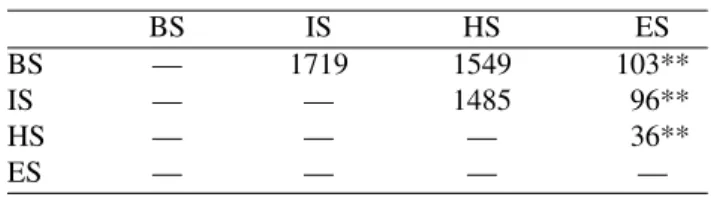
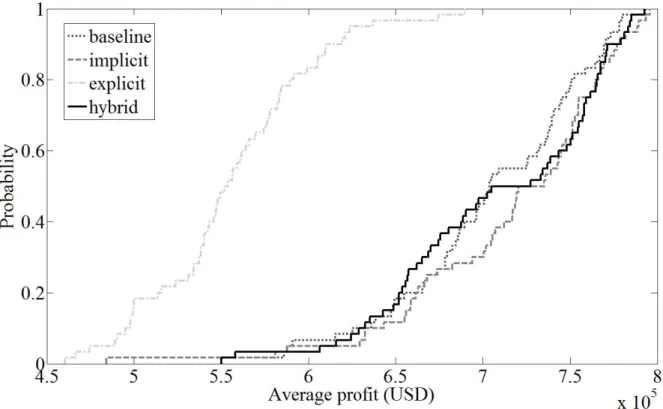
Figures 1 and 2 illustrate as CDFs the 60 average profit values obtained with production plans generated under each strategy in problem instance 1 and 2, respectively. Both figures clearly show that the CDFs of average profit obtained under BS, IS and HS dominate the CDF of profit obtained under ES (first-order stochastic dominance). Fur-thermore, results from Mann-Whitney U test statistically show that average profit values obtained under ES are stochastically smaller (p < 0.01) than the ones obtained under BS, IS and HS in both problem instances, as shown in Tables 5 and 6.
Table 1: Parameters used for baseline, implicit averaging, explicit averaging and hybrid strategies
BS IS ES HS
n 1 1 10 1
P opulationSize 50 100 50 100
Generations 500 250 50 240
Fitness evaluations 25,000 25,000 25,000 ≤25,000
Table 2: Probabilities forPland PDFs forαl
Instance 1 Instance 2 Instance 1 and 2
Work centre (l) Pl Pl αl
PDF Mean (d)
1 0.00 0.00 — —
2 0.10 0.30 Exponential 0.0847
3 0.25 0.45 Exponential 0.0935
4 0.15 0.35 Exponential 0.1338
5 0.00 0.00 — —
6 0.00 0.00 — —
7 0.00 0.00 — —
Table 3: Descriptive statistics of average profits and average computation times per strategy in problem instance 1
BS IS ES HS
Mean (USD) 703,689 715,376 555,932 707,503
Minimum (USD) 550,417 484,229 460,416 550,014
Maximum (USD) 793,316 795,716 689,685 792,696
Std dev (USD) 55,539 60,416 47,322 60,754
Average computation time (s) 1256 1144 1235 1369
Table 4: Descriptive statistics of average profits and average computation times per strategy in problem instance 2
BS IS ES HS
Mean (USD) 707,600 703,420 543,140 723,460
Minimum (USD) 536,840 538,990 437,930 561,550
Maximum (USD) 785,810 783,040 656,800 790,460
Std dev (USD) 60,137 61,744 43,412 51,258
No dominance (neither first nor second degree stochas-tic dominance) can be determined among the CDFs of av-erage profit obtained under BS, IS and HS in problem in-stance 1, where all three strategies appear equally compet-itive. These results are in accordance with results from Mann-Whitney U test, which indicate stochastic homo-geneity (p >0.05) among samples obtained under BS, IS and HS in problem instance 1. It is interesting that popula-tion size (i.e. different setups of implicit averaging) has no significant effect in this setting as evidenced under BS and IS.
In problem instance 2, results from Mann-Whitney U tests also indicate stochastic homogeneity (p > 0.05) among samples obtained under BS, IS and HS. However, the CDFs of average profit obtained under HS dominates the CDFs of average profit obtained under IS and under BS, respectively (first and second-order stochastic dominance). These results indicate that, even in a setting with a lim-ited evaluation budget, the accurate fitness estimates from explicit averaging can be beneficial to optimization. It is clear that the difference between IS and HS arises during the final stages of the optimization only, while IS contin-ues optimization during additional generations, HS focuses resources on explicit averaging across its last population. When seen in combination with the poor performance of ES, our results suggest that the trade-off between improved exploration (from evaluating more individuals) and accu-rate fitness evaluations (through simulation replicates for the same individual) needs to be carefully balanced in this setting. This finding appears in line with previous research that has delivered contradictory results regarding the rela-tive performance of explicit and implicit averaging.
Table 5: Values for Mann-Whitney U statistic obtained in problem instance 1
BS IS HS ES
BS — 1525 1705 107**
IS — — 1662 117**
HS — — — 113**
ES — — — —
**p <0.01
Table 6: Values for Mann-Whitney U statistic obtained in problem instance 2
BS IS HS ES
BS — 1719 1549 103**
IS — — 1485 96**
HS — — — 36**
ES — — — —
**p <0.01
6
Conclusion
Implicit averaging strategies reduce the impact of noise by having a sufficiently large population, which ensures that individuals from promising regions of the search space are sampled repeatedly [10, 17]. On the other hand, explicit averaging strategies use average fitness values, obtained across a specific number of fitness evaluations, to ensure that evaluation of individuals is based on fitness estimates that are more robust to noise [10].
One of the key findings of this study was that, in the con-text of our real-world problem, a noise-handling strategy based on explicit averaging did not provide a competitive performance. More generally, this points to the fact that the computational costs incurred by simulation replicates may be problematic in constrained time settings.
Furthermore, we found that implicit averaging per-formed robustly for both of the population sizes used. The performance of our hybrid strategy does indicate that some effort towards explicit averaging may become important with increasing variability. Under low levels of fitness variability, the hybrid strategy, implicit averaging and our baseline showed a comparable performance. This situation changed with increasing levels of fitness variability, when HS started to enhance overall performance.
Compared to a pure, implicit averaging strategy, the hy-brid strategy misses out on the last few generations of op-timization. Our results show, however, that this disadvan-tage is more than counter-balanced by the benefits from an accurate final selection step that reduces the likelihood of choosing an inferior individual (in terms of average fitness) as the final solution.
7
Limitations and Future Research
The relevance of obtaining more reliable fitness estimates increases with the level of variability, since there is a higher risk of choosing an inferior solution. It is, therefore, intu-itive that the final selection mechanism implemented in HS would be more beneficial in such circumstances. But at the same time, the number of fitness evaluations needed to obtain reliable estimates is expected to raise with higher fitness variability, leaving to the evolutionary process a smaller share of the computational budget. Therefore, fur-ther research may focus on investigating the right trade-off between exploration (IS) and accurate fitness evaluation (ES). In this sense, the application of different sampling techniques (e.g., Latin Hypercube) during the final selec-tion mechanism might be worthy of future investigaselec-tion, as it may allow a reduction in the number of fitness evalua-tions required in this last step.
Figure 1: CDFs of average profit values obtained with production plans generated under the four different strategies in problem instance 1.
may consider the possibility of using explicit averaging at earlier points during the optimization process.
Acknowledgement
Juan Esteban Diaz expresses his gratitude to the Secretariat for Higher Education, Science and Technology of Ecuador, who has supported him with a doctoral scholarship.
References
[1] M. Bhattacharya, R. Islam, A. N. Mahmood (2014) Uncertainty and evolutionary optimization: A novel approach,Proceedings of the 9th IEEE Conference on Industrial Electronics and Applications (ICIEA), pp. 988–993.
[2] J. Branke, C. Schmidt (2003) Selection in the pres-ence of noise,Proceedings of the Genetic and Evolu-tionary Computation Conference (GECCO), pp. 766– 777.
[3] J. Branke, C. Schmidt, H. Schmec (2001) Efficient fit-ness estimation in noisy environments.Proceedings of the Genetic and Evolutionary Computation Con-ference (GECCO), pp. 243–250.
[4] K. Deb (2000) An efficient constraint handling method for genetic algorithms,Computer methods in applied mechanics and engineering, vol. 186, no. 2, pp. 311–338.
[5] K. Deep, K. P. Singh, M. Kansal, C.Mohan (2009) A real coded genetic algorithm for solving integer and mixed integer optimization problems,Applied Math-ematics and Computation, vol. 212, no. 2, pp. 505– 518.
[6] J. E. Diaz Leiva, J. Handl (2014) Simulation-based ga optimization for production planning,Proceedings of the Student Workshop on Bioinspired Optimization Methods and their Applications (BIOMA), pp. 27–39.
[7] C. Ehrenberg, J. Zimmermann (2012) Simulation-based optimization in make-to-order production: scheduling for a special-purpose glass manufacturer,
Proceedings of the Winter Simulation Conference (WSC), pp. 1–12.
[8] G. Figueira, B. Almada-Lobo (2014) Hybrid simulation-optimization methods: A taxonomy and discussion, Simulation Modelling Practice and Theory, vol. 46, pp. 118–134.
[9] M.-R. Ghasemi, J. Ignatius, A. Emrouznejad (2014) A bi-objective weighted model for improving the dis-crimination power in MCDEA,European Journal of Operational Research, vol. 233. no. 3, pp. 640–650.
[10] Y. Jin, J. Branke (2005) Evolutionary optimization in uncertain environments - a survey,IEEE Transactions on Evolutionary Computation, vol. 9, no. 3, pp. 303– 317.
[11] H. B. Mann, D. R. Whitney (1947) On a test of whether one of two random variables is stochasti-cally larger than the other,The annals of mathemati-cal statistics, vol. 18, no. 1, pp. 50–60.
[12] F. Neri, X. del Toro Garcia, G. L. Cascella, N. Salva-tore (2008) Surrogate assisted local search in pmsm drive design, COMPEL: The International Journal for Computation and Mathematics in Electrical and Electronic Engineering, vol. 27, no. 3, pp. 573–592.
[13] D. W. Nordstokke, B. D. Zumbo (2010) A new non-parametric levene test for equal variances, Psicológ-ica, vol. 31, no. 2, pp. 401–430.
[14] C. Qian, Y. Yu, Y. Jin, Z.-H. Zhou (2014) On the ef-fectiveness of sampling for evolutionary optimization in noisy environments, Lecture Notes in Computer Science, vol. 8672, pp. 302–311.
[15] G. Rudolph (2001) A partial order approach to noisy fitness functions, Proceedings of the Congress on Evolutionary Computation (CEC), vol. 1, pp. 318– 325.
[16] Y. Sano, H. Kita, I. Kamihira, M. Yamaguchi (2000) Online optimization of an engine controller by means of a genetic algorithm using history of search, Pro-ceedings of the 26th IEEE Annual Conference of the Industrial Electronics Society (IECON), vol. 4, pp. 2929–2934.
[17] A. Syberfeldt, A. Ng, R. I. John, P. Moore (2010) Evolutionary optimisation of noisy multi-objective problems using confidence-based dynamic resam-pling, European Journal of Operational Research, vol. 204, no. 3, pp. 533–544.