POWER QUALITY ANALYSIS VIA WAVELET TRANSFORM
Megha Khatri *Harsha Vanjani **
ABSTRACT
The dependence of modern life upon the continuous supply of electrical energy makes power quality of utmost importance in the power systems area.
In this paper work, a new approach to detect, localize and investigate the feasibility of classifying various types of power quality disturbances is presented, wavelet transform analysis is done as well as the concept of mother wavelet is also explained. In quality of power, the current state of art is the use of Daubechies wavelets. Daubechies wavelets belong to a special class of mother wavelet and actually they are the most used for detection, localization and classification of disturbances. The key idea underlying the approach is to decompose the disturbance signal developed with the help of matlab 7.0.5 version simulink into other signals which represent a approximated version and a detailed version of the original signal by using the wavemenu toolbox. The signal under investigation is often corrupted by noises, especially the ones with overlapping high-frequency spectrum of the transient signals. The signal firstly separated and then analysed using different techniques step by step.
The decomposition is performed using multi-resolution signal decomposition techniques. The demonstration is done with the distribution system to detect and localize disturbance with actual power line disturbances. In order to enhance the detection outcomes, utilization of wavelet transform coefficients of the analysed power line signals. The results of various other methods are compared and presented the best suitable method. The simulation results clearly demonstrate the superiority and effectiveness of the wavelet transform in both current and voltage signal noise reduction.
Keywords— Power Quality, Fourier Transform, Wavelets, Multi Resolution Analysis, Filters.
INTRODUCTION
In 1980s Power Quality become one of the prosodic buzzword. This is due to the fact that the electronic equipments and electronic based loads are used in bulk for distributive systems. These equipments and loads are sensitive to power quality disturbances such as voltage sag, voltage swell, transients, interruptions, harmonics, etc. Technically a disturbance is a phenomenon that may degrade the performance of a device, equipment or system. It may adversely affect living or inert matter. While in power quality, any deviation from the ideal voltage or current can be labeled as a disturbance or noise, which is unwanted electrical signal. Thus the goal of denoising is to maintain fundamental power frequency a nd normal voltage level without disturbing the distributive network. Classification of Power quality disturbances phenomena includes a significant number of types, which cover a broad frequency spectrum, starting from a few Hz (flicker) to a few MHz (trans ient phenomena). Power electronic devices control circuits, arcing equipments, and loads with solid-state rectifiers and switching power supplies cause noise in power system. A typical magnitude of noise is less than 1% of the voltage magnitude.
Detection of power quality event is an important aspect before denoising the signal. Peak detection, RMS value, dq transformation of voltage and wavelet transformation are used for detection and decomposition of signal.
TRANSFORMATION
WAVELET TRANSFORMS AND MOTHER WINDOW CONCEPT
Wavelet transformation has ability to analysis different power quality problems simultaneously in both time and frequency domains. The wavelet transform is useful in detecting disturbance features of various types of electric power quality disturbances because it is sensitive to signal irregularities.
Wavelet analysis expands functions not in terms of trigonometric polynomials but in terms of wavelets, which are generated in the form of translation of a fixed function called mother wavelet. The continuous wavelet transform (CWT) or integral wavelet transform was developed as an alternative approach to the short time fourier transform (STFT) to overcome the resolution problem. The main difference between the STFT and the CWT is the fourier transform of windowed signals are not taken and therefore single peak will be seen corresponding to a sinusoid i.e. negative frequencies are not computed and width of the window is changed as the transform is computed for every single spectral component, which is probably the most significant characteristic of the wavelet transform. The CWT is defined as where as 0 , 1 ) (
, a a
b t a t a b
As seen in the above equation, the transformed signal is a function of two variables, the translation (a) and scale (b) parameters, respectively. The term translation is related to the location of the window, as window is shifted through the signal. The parameter high scales correspond to a non-detailed global view (of the signal) and low scales corresponds to a detailed view. ψ(t) is the transforming function and it is called the mother wavelet . The
mother wavelet is a prototype for generating the other window functions.
We must have a window function whose radius increases in time (reduce in frequency) while resolving the low frequency contents, and decreases in time (increase in frequency) while resolving the high contents of a signal. This concept leads us to the development of the
wavelet functions, unlike the window of STFT, in which (0) 1was a time window. Here dt t t f a b f a b
W
( , ) ( ) ( )wavelet window (0) 0, which is a time- frequency window, whereas ( ) exhibit band
pass filter characteristics. For a general window function (t), we define its center t as
dt t t t
2
2 ( )
1
and the radius as
2 / 1 2 2 ) ( ) ( 1 dt t t t
The function
(
t
)
described above with finite is called a time window. Similarly , we canhave a frequency window ( ) with center and the radius defined analogous to above
as
d 2
2 ( )
1 2 / 1 2 2 ) ( ) ( 1 d
Here (t)with finite and is called a time- frequency window in STFT.
Considering positive frequencies, defining the center and radius on the positive
The definitions for t* and remains the same with φ(t) replaced by ψ(t) for wavelets the
uncertainty principle gives
2 1
If t* is a center and is the radius of ψ(t), then
W
f(b,a) contains the information of f(t)in the time window. at b a ,at b a Applying Parseval‟s identity, the
frequency window is represented as
d a f a dt a b t t f a a b f
e
W
jb ) ( ) ( 2 ) ( 1 ) , (The frequency window becomes
) ( 1 ), ( 1 a a
Time-frequency window product
4 2
2
a
a constant
From here we observe that the flexible nature of window in the wavelet transform, whereas in STFT, time-frequency window is fixed regardless of the frequency level.
IMPLEMENTATION OF WAVELET FAMILY
MATLAB SIMULATION
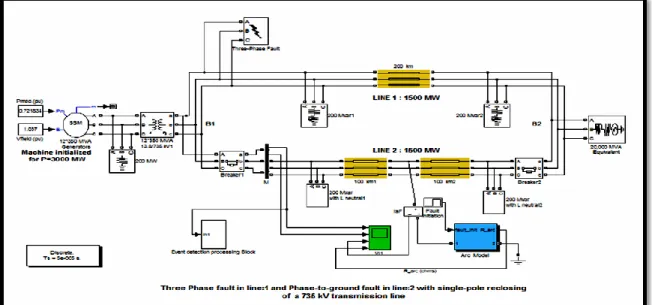
Fig. 1: 3 Phase fault introduced in Line 1 and PG Fault in Line 2 of Distribution System of 735 KV Trans mission Line.
ANALYSIS USING GUI
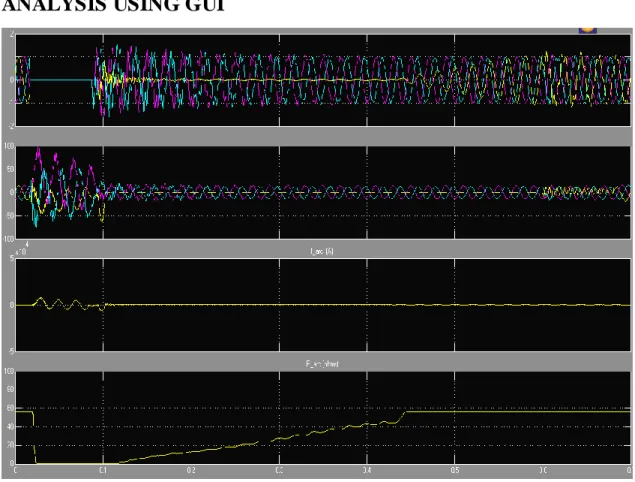
Fig. 1.3: Analysis of 3 Phase and PG Fault introduced in Distribution System
Fig. 1.3.1 : Va Phase.
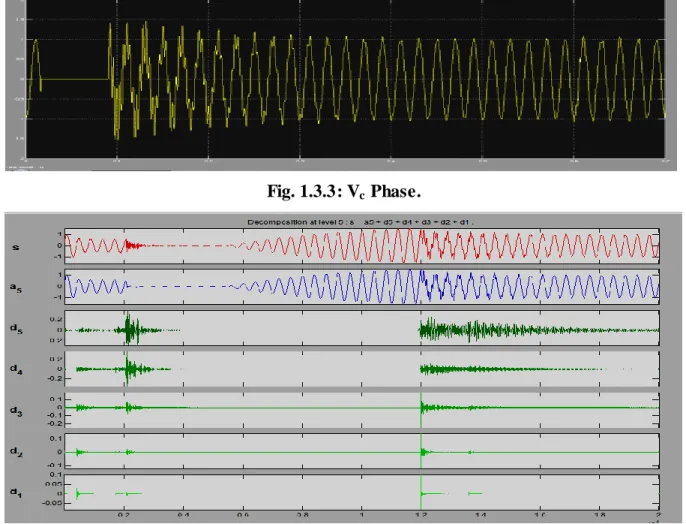
Fig. 1.3.3: Vc Phase.
Fig. 1.3.1.1: Analysis done on Phase Va by using db4 wavelet upto level 5.
CONCLUSION
disturbances featured in remarkable magnitude changing situations, such as sags, swells and interruptions. The fundamental voltage component is proved as a more appropriate magnitude characterization approach in most situations. Further by taking the individually each voltage of each phase the analysis is done on it and the results are compared as shown previously. Thus we can conclude from the above all that the wavelets used for analysing the signals gives better results than any other method.
REFERENCES
1. H. Zhang P. Liu and O.P. Malik “Detection and classification of power disturbances in noisy
conditions” IEEE Proc.-Gener. Transm. Distrib, vol.150.no.5, September 2003
2. SHI Yunhui And RUAN Qiuqi “ Continuous Wavelet Transforms” IEEE Trans. Info.
Theory,0-7803-8406-7/04 C 2004
3. IEEE Standards 1159-1995,”IEEE recommended practice for monitoring electric power
quality”, November 1995
4. Jan-olov Stromberg “Construction of wavelets” published by MGA tutorials September
08,2004
5. Book on Signal Processing Of Power Quality Disturbances By Math H.J. Bollen and Irene
Y.H Gu IEEE Press Series on power engineering Mohamed E. EL.-Hawary, Series Editor A
John Wiley & Sons, Inc., Publication.
6. Oscar C. Montero-Hernández and Prasad N.Enjeti „A Fast Detecting Algorithm Suitable For
Mitigating Of Numorous Power Quality Disturbances” Vol.41, NO.6, November/December
2005.
7. N.S.D. Brito, B.A. Souza And F.A.C. Pires “ Daubechies wavelets in Quality of Electrical Power” 0-7803-5105-3C 1998 IEEE.
8. Tao LIN Mineo TSUJI Eiji YAMADA “Wavelet Approach To Power Quality Monitoring”
0-7803-7108-9/0 C 2001
9. G.T. Heydt and A.W. Galli, “Transient power quality problems analyzed using wavelets”,
IEEE Trans. Power Delivery, vol. 12, no. 2, pp. 908-915, Apr. 1997.
10. S. Santoso, W. M. Grady, E. J. Powers, J. Lamoree and S. C. Bhatt, “Characterization of distribution power quality events with fourier and wavelet transforms”, IEEE Trans. Power Delivery, vol. 15, no. 1, pp. 247-254, Jan. 2000.
11. L.Angrisani, P.Daponte, M.D‟Apuzzo And A.Testa “A Measurement Method Based On The
Wavelet Transform For Power Quality Analysis” IEEE Transactions on Power Delivery, Vol.
13, No. 4, October 1998
12. Dogan Gokhan ,Omer Nezih Gerek “ Power Quality Event Detection using Joint 2D- Wavelet Subspaces” IEEE Transactions On Instrum. And Measure. Vol. 14, No.4, 1999.
of Distribution Power Quality Events with Fourier and Wavelet Transforms”, IEEE Trans. on
Power Delivery, Vol. 15, No. 1, 2000.
14. L. Angrisani, P. Daponte, and M. D‟Apuzo, “Wavelet network-based detection and classification of transients,” IEEE Trans. Instrum. and Measure., vol. 50, Oct. 2001.
15. C.H. Lin and C.H. Wang, “Adaptive wavelet networks for power quality detection and discrimination in a power system”, IEEE Trans. Power Delivery, vol. 21, no. 3, pp.
1106-1113, July 2006.
16. A. I. Megahed, A.M. Moussa and A.E. Bayoumy, “Usage of wavelet transform in the
protection of series compensated transmission lines”, IEEE Trans. Power Delivery, vol. 21,
no. 3, pp. 1213-1221, July 2006.
17. Rieder P., Gotze J. and Nossek J.A., “Multiwavelet Transforms Based on Several Scaling Functions”, IEEE , pp.393-396,1994.
18. O. Poisson, P. Rioual, and M. Meunier, “New signal processing tools applied to power quality analysis”, IEEE Transactions on Power Delivery, vol. 14, no. 2, April 1999.
19. S.K Pandy and L.Satish “Multiresolution Signal Decomposition:A new tool for fault detection
in power transformers during impulse tests”, IEEE Transactions on power
delivery,vol.13,no.4,1998.
20. A.W.Galli, G.I.Heydt and P.F.Ribeiro,”Exploring the power of wavelet analysis ”IEEE
computer Applications in power vol.9, no.4, October 1996
21. E. Styvaktakis, M.H.J. Bollen; and I.Y.H. Gu, “Expert system for classification and analysis of power system events,” IEEE Trans. On Power Delivery, vol. 17, no. 2,pp. 423-428, Apr.