VOLUME 15 ISSUE 3 (2017), Page 105 – 114
CRITICAL REVIEW ON THE EXISTENCE OF
TRANSGENERATIONAL ENTREPRENEURSHIP IN TOURISM BUSINESSES: CURRENT TREND AND INTEREST
Mohd Alif Mohd Puzi1, & Hairul Nizam Ismail2
1Department of Urban and Regional Planning, Faculty of Built Environment
UNIVERSITI TEKNOLOGI MALAYSIA
2Centre for Innovative Planning and Development (CIPD), Faculty of Built
Environment
UNIVERSITI TEKNOLOGI MALAYSIA
Abstract
Tourism, one of Malaysia’s fastest growing economic sector, has created many business opportunities, the majority of which are family-controlled businesses. New ventures are started by founders who will eventually invite their relatives, especially as successors for their businesses. Nowadays, a successful family business is not determined by traditional methods alone such as profit, assets, or capital, but also take into account survivability or entrepreneurship transmission between generations. Unfortunately, entrepreneurship researchers have not fully embraced tourism because of the prevailing assumption that tourism is a just regular business. Both tourism and transgenerational entreprenership fields employ empirical studies to justify their idiosyncrasies but remain separate from each other. If studied together, it would lead to better understanding of both fields and would even spark the curiosity of researchers to investigate family relationships in conglomerate tourism businesses. Further research into this mixture of fields will also provide a conceptual economic model for tourism destination development bodies that will enhance and promote local community entrepreneurship.
Keyword: Transgenerational entrepreneurship, tourism development, tourism entrepreneurship
Date Received: 1st November 2016
INTRODUCTION
The Emergence of Transgenerational Entrepreneurship in Tourism Businesses
Habbershon, Nordqvist and Zellweger (2010) triggered the notion of transgenerational entrepreneurship. They focused on a family’s ability to transfer entrepreneurship skills to the new generation. Habbershon, Nordqvist and Zellweger (2010) suggest that family pervasively affects a new venture. Aldrich and Cliff (2003), and Stafford et al. (1999) found that the close relationships between family and business could lead to a potentially sustainable business. Aldrich and Cliff (2003) identify that family resources and characteristics influence an individual to create new ventures, which later become successful, hence creating suitable grounds to nurture new entrepreneurship. Solvoll, Alsos and Bulanova (2015) introduce tourism entrepreneurship as a potential research gap in both fields. Entrepreneurship is not entirely accepted as a distinctive characteristic of tourism (Solvoll, Alsos & Bulanova, 2015) and until recently there has been a lack of research in tourism entrepreneurship. Getz, Carlsen and Morrison (2004) started a similar research on family business and tourism development relationship, but they only discussed on the usual old family business theory in a tourism environment. Nevertheless, Getz, Carlsen and Morrison (2004) paved the way for other researchers to explore new boundaries of tourism development and transgenerational entrepreneurship.
Only successful family businesses maintained throughout several generations have managed to achieve the transgenerational entrepreneurship level. In other words, a family business must survive and transmit their entrepreneurial traits on to several generations to be acknowledged as a transgenerational entrepreneur. The objective of this paper is to analyse the emergence of transgenerational entrepreneurship in tourism research. Hence, the chronological method is chosen to achieve the objective.
Existing Literature on Transgenerational Entrepreneurship
entrepreneur measurements such as profit or other financial characteristics.
Figure 1 Sustainable Family Business Model
Source: Stafford et al. (1999)
In the beginning, Stafford et al. (1999) introduce a Sustainable Family Business Model that explained the relationship between a family and its business dimensions. Stafford et al. (1999) argue that family and business dimension overlap and both should integrate well with each other, so as to avoid any disruptions. The family and business transactions of resources and interpersonal aspects create a positive environment that enables sustainability.
services. Venture creation capitalises on the reduction of kinship involvement in business with abundant adequate resources to use where women can be the human resource, and social and financial capital. A new generation will gain entrepreneurship opportunity based on the family trend of their predecessors. Besides that, there are researches on family business in Southeast Asia region, but focusing on immigrant Chinese rather than local community.
The family embeddedness perspective in the new venture creation model introduced by Aldrich and Cliff (2003) aligns with Habbershon, Nordqvist and Zellweger’s (2010) and their intention, which was to focus on family entrepreneurship through each generation. Zellweger, Nason and Nordqvist (2011) argue that a family business should focus on family-level analysis rather than on an organisation or individual level. This new level of analysis presents a new perspective that could explain family entrepreneurial behaviour (Habbershon, Nordqvist & Zellweger, 2010; Zellweger, Nason & Nordqvist, 2011). Habbershon, Nordqvist and Zellweger (2010) introduced a research framework for European Successful Transgenerational Entrepreneurship Practice (STEP) with a school partner from 2005-2008 implying that the family business has transformed into transgenerational entrepreneurship.
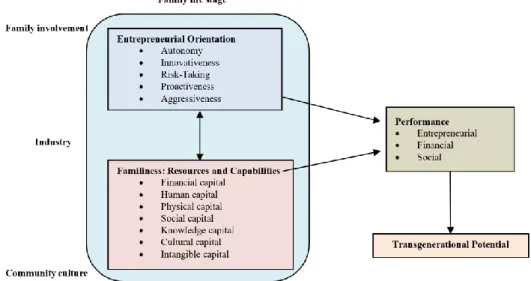
The transgenerational entrepreneurship model uses a measurement of entrepreneurial orientation (EO) by Lumpkin and Dess (1996), which has five identified dimensions. The first dimension is proactiveness, which refers to the ability to react to future problems and pursue new opportunities. The second dimension is risk taking, which relates to the entrepreneur’s commitment to achieving his/her objective. The third element, innovativeness, refers to new ideas regarding products, process, and attitudes to gain positive growth. The fourth dimension, autonomy, refers to a decision to realise ideas. Competitive aggressiveness, the fifth dimension, relates to a competitive attitude to improve one’s business and react to competitor’s challenge. A family business that succeeds in entrepreneurial, financial, and social aspects has the potential to turn into transgenerational entrepreneurship. EO can explain entrepreneurial transmission from the founder generation to the young generation, in line with the objective of the study conducted by Habbershon, Nordqvist and Zellweger (2010), which was to determine entrepreneurial behaviour in a family.
IMPORTANT FACTORS OF TOURISM BUSINESSES IN
TRANSGENERATIONAL ENTREPRENEURSHIP
is one of the key concepts in tourism research (Park et al., 2015). Tourism is a multidisciplinary study within social studies (Park et al., 2015). Park et al. (2015) observe that the definition of tourism aims to include an understanding of spatial areas, so as to determine the home region, destination region, and transit routes related to planning development. Rapid economic growth is evidence of exquisite entrepreneurship in a community and has led to the creation of more new business start-ups (Solvoll, Alsos & Bulanova, 2015). Furthermore, tourism should be looked from another perspective such as supply rather than demand (tourist).
Over 90 percent of all businesses in the free economies of the world are controlled by families (Poza & Daugherty, 2014), including tourism businesses. So, transgenerational entrepreneurship can potentially be developed into the primary economic driver in a tourism destination. Aldrich and Cliff (2003) mention that all entrepreneurs are created by their family environment and their idiosyncratic resources (Habbershon, Nordqvist & Zellweger, 2010). City planners need to be aware of each family’s capability, as these families are the central pillar in developing and driving a city’s growth from an economic aspect.
Figure 2 Family Embeddedness Perspective on New Venture Creation
Source: Aldrich and Cliff (2003)
EXISTING
GAPS
OF
TRANSGENERATIONAL
ENTREPRENEURSHIP IN TOURISM BUSINESS STUDIES
is involved in the business. It could also come from family entrepreneurship orientation, as introduced by Zellweger, Nason and Nordqvist (2011). There are several items in family entrepreneurial orientation, which are preservation orientation, transgenerational outlook, change orientation, internal and external autonomy, risk orientation, resource focus, proactiveness, innovativeness, stability versus growth, and formality of strategising. These items guide a family to create or implement its idiosyncratic entrepreneurship in a business such that it even seems that the family perceives the business as an extension of their life or as another family member.
Figure 4 The Framework for European Successful Transgenerational Entrepreneurship Practice
Source: Habbershon et al. (2010)
CONCLUSION
There is little-known information about family business governance from the perspective of creating long-term intergenerational entrepreneurship (Au, Craig & Ramachandran, 2011). Several researchers have suggested focusing on family-level analysis to arrive at a clear explanation regarding family entrepreneurship through generations (Au,Craig & Ramachandran, 2011; Habbershon, Nordqvist & Zellweger, 2010; Nordqvist et al., 2011; Zellweger, Nason & Nordqvist, 2011). There is some evidence that the entrepreneurial spirit can be transmitted to the younger generation either via family’s experience or the youngsters’ involvement (Laspita et al., 2012; Jaskiewics, Combs & Rau, 2015). The study of entrepreneurship from an intergenerational perspective is still in the development stage. From the standpoint of family business chronology in tourism and the family business field, transgenerational entrepreneurship is well acknowledged. However, family businesses still have a long way to go to gain recognition in the tourism industry.
experiences. Malaysia has great potential in this regard, as tourism is one of her major economic industries and familiness attitude is part of her culture, proving that transgenerational entrepreneurship could become an economic model for developing countries that rely on tourism as a major economic sector.
ACKNOWLEDGMENTS
This work is supported in part by FRGS under grant no. R.J130000.7821.4F774 and by GUP under grant no. Q.J130000.2521.11H51.
REFERENCES
Aldrich H., & Cliff, J. (2003). The pervasive effects of family on entrepreneurship: toward a family embeddedness perspective. Journal of Business Venturing, 18, 573-596.
Au. K., Craig J., & Ramachandran, K. (2011). Family enterprise in Asia Pacific: Exploring transgenerational in family firms. Cheltenham: Edward Elgar. Chua J., Chrisman J., & Sharma, P. (1999). Defining the family business by behaviour. Journal of Entrepreneurship Theory and Practice, 23(4), 19-39.
Evert R., Martin J., McLeod M., & Payne, T. (2015). Empirics in family business research: Progress, challenges and the path ahead. Family Business Review. Published Online July 15 1-27.
Getz D., Carlsen J., & Morrison, A. (2004). The family business in tourism and hospitality. Oxfordshire: CABI Publishing.
Gupta V., & Levenburg, N. (2010). A thematic analysis of cultural variations in family business: The CASE Project. Family Business Review, 23(2) 155-169.
Habbershon T., Nordqvist M., & Zellweger, T. (2010). Transgenerational entrepreneurship. In M. Nordqvist & T. Zellweger (Eds.), Transgenerational entrepreneurship: Exploring growth and performance in family firms across generations (pp. 1-38). Cheltenham: Edward Elgar.
House R., Hanges P., Javidan M., Dorfman P., & Gupta, V. (2004). Culture, leadership and organizations: The GLOBE Study of 62 Societies. London: SAGE Publications.
Jaskiewics P., Combs J., & Rau, S. (2015). Entrepreneurial legacy: Toward of how some family firms nurture transgenerational entrepreneurship. Journal of Business Venturing, 30, 29-49.
Lumpkin G., & Dess, G. (1996). Clarifying the entrepreneurial orientation construct and linking it to performance. Academy of Management Review, 21(1), 135-172.
Nordqvist M., Marzano G., Brenes E., Jimenez G., & Fonseca-Paredes, M. (2011). Understanding entrepreneurial family business in uncertain environments: Opportunities and resources in Latin America. Cheltenham: Edward Elgar.
Nordqvist M., & Melin, L. (2010). Entrepreneurial families and family firms. Entrepreneurship & Regional Development, 22(3), 211-239.
Park J., Wu B., Morrison A., Shen Y., Cong L., & Li, M. (2015). The tourism system research categorization framework. Asia Pacific Journal of Tourism Research, DOI: 10.1080/10941665.2015.1085885.
Peters M., & Kallmuenzer, A. (2015). Entrepreneurial orientation in family firms: The case of the hospitality industry. Current Issues in Tourism, DOI: 10.1080/13683500.2015.1053849.
Poza E., & Daugherty, M. (2014). Family Business (Fourth Edition). South-Western College Publication.
Solvoll S., Alsos G., & Bulanova, O. (2015). Tourism entrepreneurship-review and future directions. Scandinavian Journal of Hospitality and Tourism, 15(1), 120-137.
Stafford K., Duncan K., Dane S., & Winter, M. (1999). A research model of sustainable family businesses. Family Business Review, 12(3), 197-208. Wilson, L. (2007). The family farm business? Insights into family, business and
ownership dimensions of open-farms. Leisure Studies, 26(3), 357-364. Zellweger T., Nason R., & Nordqvist, M. (2011). From longevity of firms to
transgenerational entrepreneurship of families: introducing family entrepreneurial orientation. Family Business Review, 20(10), 1-20. Zellweger T., & Sieger, P. (2012). Entrepreneurial orientation in long-lived