This white paper aims to throw light on Platform BPO, its merits, risks and impact on outsourcing. At a high level, it will help buyer organizations to understand the relevance of Platform BPO to their organizations and judge their impact.
Platform BPO and its Impact on
Outsourcing
Introduction
Spending on Platform BPO is expected to increase from about 18% of the entire BPO spending in 2012 to about 22% in 2013. Compared to 2010 levels, the spending almost doubles in 2013 in a matter of four years. Research also predicts that in 2015, 50% of all BPO will have certain element of Platform BPO. So, what is Platform BPO and how will it impact the dynamics in the current scheme of outsourcing?
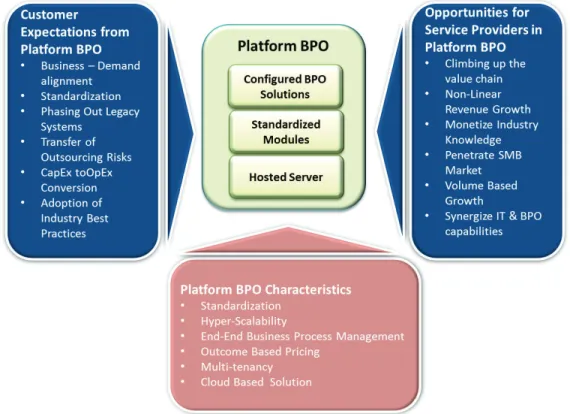
Platform BPO is also known as Business Platform as a Service (BPaaS) or Business Process as a Utility (BPU) and is essentially an end-to-end process management service hosted on cloud. Platform BPO provides an alternative to legacy outsourcing that has been coming under pressure in the current volatile economic scenario due to its inflexible contracting structure, lack of innovation and want of business value addition. Platform BPO can be viewed as a union of Software as a Service and Infrastructure as a Services for an entire Business Process.
Service providers with capabilities to host large server spaces and experience in product devel-opment and service delivery are providing Platform BPO services either in a fully integrated or a modular form. The leading service providers are looking to build these capabilities both organi-cally and inorganiorgani-cally.
Platform BPO with its low upfront capital requirements are very beneficial to Small and Medium size businesses that are cash starved. Moreover, the large organizations are also demanding additional benefits to cost arbitrages from traditional outsourcing. For Service providers, moving to Platform BPO creates a new non-linear revenue stream from the SME buyers while climbing higher in the client value chain.
The adoption of Platform BPO is driven by no upfront investment requirement, on-demand scalability and pay-as-you-go facility. Buyers of traditional outsourcing are now looking to make their businesses models more flexible to adapt to fluctuating business demands and Platform BPO makes it easier for them. Further, it also eliminates the management overhead of infra-structure, software, process services, licensing and up-gradations, allowing the buyer to focus on their core competencies.
This white paper aims to throw light on Platform BPO, its merits, risks and impact on outsourc-ing. At a high level, it will help buyer organizations to understand the relevance of Platform BPO to their organizations and judge their impact.
What is Platform BPO?
Platform BPO is a cloud based solution that offers end-to-end process management on a tech-nology platform. Platform BPO offers domain specific solutions like customer analytics, claims processing and collection management. The BPO solutions are standardized and are based on the knowledge of industry wide best practices that a service provider gains while moving up the value chain. In a platform BPO offering, the process is owned by the service provider and is hosted on a shared infrastructure. Here, a service provider invests upfront in infrastructure host-ing and application development and also takes care of support and maintenance, security, software licensing and human resources. For this, the buyer is priced based on his usage of the BPO services. Traditionally a buyer made an upfront lump sum investment or was billed based on utilization. This model incentivized the service provider to either use scope change or to use more human resources in order to derive more business from a buyer. From a buyer’s stand-point, the service provider was being incentivized even though the service provider contributed less to the business outcome or showed less productivity. The platform BPO model transitions a traditional BPO engagement from a CAPEX intensive to an OPEX intensive solution for buyers and a linear people dependent model to a non-linear business model for service providers. This ownership aspect and non-linearity of platform BPO will encourage service providers to tightly
align their offerings with the client’s key business objectives and drive human resource produ c-tivity and efficiency. Platform BPO enables service providers to provide solutions to multiple cli-ents from a single platform. Since it is based on a cloud offering, it allows a service provider to scale up or down depending on the business requirement.
Drivers of Platform BPO Adoption
To take advantages of a platform BPO’s risk transfer and alignment with immediate business requirements, buyers are increasingly looking to adopt platform BPO as the next generation so-lution. Some of the drivers of this adoption are:
1. Transfer of ownership: Since the service provider will take ownership of executing the business process and performance as per business expectations, the management overhead of the buyer is reduced. Even the frequent system upgrades are done by the service provider. The buyer can use this freed up resources to focus on core business activities.
2. On-demand pricing: Buyers can now estimate and control the budgets for a shorter pe-riod of time as platform BPO requires pay-as-you-go pricing
3. Reduction of process times: Cycle time is reduced for business critical processes like concept to sales and time to resolve as platform BPO comes with configurable and ready to deploy modules
4. Direct contribution by the service provider: As the service providers are rewarded by di-rect business outcomes and not just cost arbitrages, service providers will tend to
per-form better and contribute directly to the achievement of buyer’s business targets
5. Cheaper to get started: Buyers are more inclined towards OPEX than signing multi-million dollar long term deals. This is clearly shown by the fact that sourcing contract sizes are reducing world wide
6. Adoption of Industry wide best practices: Buyers today are more concerned about using the most efficient and effect technology solutions instead of worrying about customiza-tion, especially for non-core processes. Platform BPO, with their provision of standard-ized best practices fit the bill
7. Better integration of IT and business: By being able to standardize processes and offer just in time solutioning, platform BPOs will better integrate shared service centres and businesses, especially for those with global reach.
Service providers, especially the larger ones will also benefit from platform BPO in the following way:
1. Competitiveness enhancement: Service providers can now use their maturity and learn-ing in various domains in a tangible way to gain competitive advantage. Buyers now are focusing more on domain specific solutions that tie in with their business goals rather than cost arbitrages
2. Multi tenancy: Service providers create their knowledge management based on best practices gained from their experience across many clients in a particular domain. With platform BPO, service providers can use this knowledge to serve multiple clients from a single platform. This enables service providers to gain unprecedented resource produc-tivity and efficiencies.
3. Non-Linearity: Service providers will be able to reduce their dependence on wage infla-tion and attriinfla-tion and still grow their revenue
4. Higher profits: Product based solutions offer more margins that resource based services. Platform BPO achieve this by charging a premium for the value created and risks owned.
5. Lower costs and efforts: Given the experience and knowledge of incumbent service providers, costs and efforts for development efforts are estimated to be comparatively lit-tle. Typically, for incumbents, it should take 40-60 resources to develop a platform solu-tion.
Adoption of Platform BPO
Many researches show that about CIOs are actively looking to adopt Platform BPO as their turn-key solutions for their BPO requirements. Consistently, 30%-50% of the organizations surveyed either show an inclination to either understand Platform BPO or implement a pilot project on it. The biggest demand is coming from HRO and F&A. As mentioned earlier, the principal drivers being scalability, speed to solution, standardization based on best practices and pay per use characteristic of platform BPO.
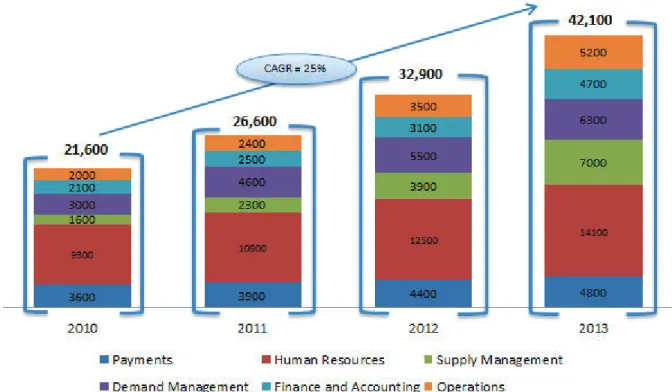
Figure 2 – Estimated Platform BPO Spend (in US$MN) from 2010-2013 (Source: CLSA, Gartner) As shown above, although Enterprise Services like HRO and F&A will form the biggest pie of the platform BPO spend, the fastest growing segment will be supply chain management function and procurement services. Within Enterprise Services, HRO will start as a biggest spender but will be overtaken by other functions such as F&A. HRO will be largely used as proof of concept or for pilot projects to test applicability of platform BPO. Under customer management, process-es such as interactive customer rprocess-esponse and customer analytics are being looked at for
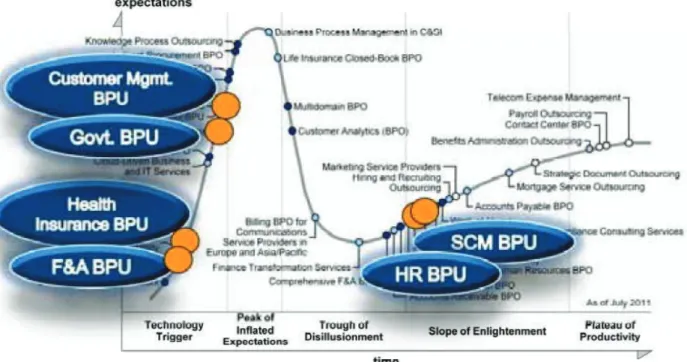
adop-tion on platform BPO. Under platform BPO offerings, Supply chain management and human resource solutions show the most maturity being followed by Customer management and F&A.
Figure 3 - Platform BPO Maturity Curve (Source: Gartner)
The following table shows some of the processes that are currently being offered on platform BPO:
Function Processes that can be offered on platform BPO
HRO · Recruitment, workforce and talent management, payroll processing, competition and benefits
F&A · Transactional Processes like accounts payable, accounts receivable and billing
· High Value processes like financial reporting and tax
Analytics · Customer analytics like customer segmentation, customer acquisition, attrition analytics etc.
· Marketing Analytics like data surveys, competitor analysis, sales effec-tiveness, campaign analysis
· Sourcing analytics like vendor and regulatory management
Procurement · e-procurement services like online tendering and auctioning, contract management and inventory management
· Other procurement services like payment processing, MIS, Compli-ance administration and contract execution
Table 1 - Current Mature Platform BPO Processes
Since platform BPO is essentially offered on top of cloud capabilities, large IT and BPO service providers that are investing in hosting capabilities and product development are most likely to
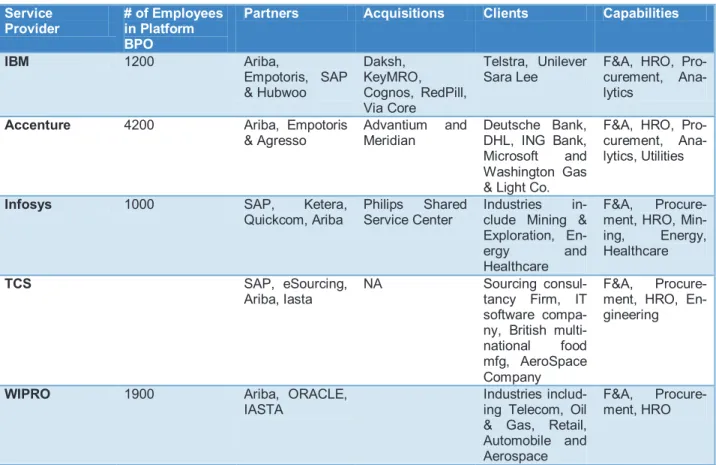
offer platform BPO services. The following table shows the trends in capability enhancement, especially organically towards platform BPO among the major IT Service providers.
Service Provider
# of Employees in Platform BPO
Partners Acquisitions Clients Capabilities
IBM 1200 Ariba, Empotoris, SAP & Hubwoo Daksh, KeyMRO, Cognos, RedPill, Via Core Telstra, Unilever Sara Lee
F&A, HRO, Pro-curement, Ana-lytics
Accenture 4200 Ariba, Empotoris
& Agresso Advantium and Meridian Deutsche Bank, DHL, ING Bank, Microsoft and Washington Gas & Light Co.
F&A, HRO, Pro-curement, Ana-lytics, Utilities
Infosys 1000 SAP, Ketera,
Quickcom, Ariba
Philips Shared Service Center
Industries in-clude Mining & Exploration, En-ergy and Healthcare
F&A, Procure-ment, HRO, Min-ing, Energy, Healthcare TCS SAP, eSourcing, Ariba, Iasta NA Sourcing consul-tancy Firm, IT software compa-ny, British multi-national food mfg, AeroSpace Company
F&A, Procure-ment, HRO, En-gineering
WIPRO 1900 Ariba, ORACLE,
IASTA
Industries includ-ing Telecom, Oil & Gas, Retail, Automobile and Aerospace
F&A, Procure-ment, HRO
Table 2 - Service Provider Capacities in Platform BPO (Source: CLSA, Avasant)
Impact on Outsourcing
1. The non-linear model of Platform BPO will be mostly propelled by IT-BPO service pro-vider, given that the IT-BPO service provider are aggressively looking for an alternative to their linear people dependent model as they are losing competitiveness amidst rising wage inflation and operating costs.
2. Platform BPO will drive more standardization. SMEs will favor this while the Fortune 500 organizations will demand more customization or will continue to use in-house built ap-plications, hosted locally. For example, although accounting has to follow certain stan-dards, the presentation of annual reports differs for different organizations.
3. As mentioned earlier, Platform BPO will not completely change the current BPO land-scape but will increase at a steady rate over till 2013 to reach 22% of BPO spend. While HRO will be the source of biggest spending, F&A and Supply Chain Management will be the fastest growing.
4. The OpEx v/s CapEx debate has still not reached conclusion. For larger organizations, it is sometimes cheaper to investment upfront than to pay monthly in a long term perspec-tive.
5. Platform BPO will drive the trend towards verticalization. The service providers will focus their efforts to build IP led industry specific solutions that will provide process improve-ments rather than only cost cutting.
6. The Small and Medium sized buyer will be the biggest benefactor however the Small and Medium Sized provider will be the biggest loser, given their inability to invest huge amounts or scale.
7. There would be a tighter and deeper integration between the IT and BPO businesses of IT service providers given the requirements to establish a strong Platform BPO practice. This may result in synchronized teams for both go-to-market and product development. 8. Given the huge investments Fortune 500 organizations make in hosting large scale
in-frastructure and developing their own products, they can very well leverage their achievements to become sellers of Platform BPO services.
9. The uncertainties surrounding the security, migration and ownership risks will remain till the adoption of Platform BPO gains critical mass and maturity. This will slow down the adoption of Platform BPO in larger organizations but the small organizations will con-tinue to leverage its speed-to-solution and pay-as-you-go features.
Risks & Challenges
Since this is a completely new service delivery model, buyers will have to be very cautious mov-ing on to platform BPO. It also cuts across various business units which means that vendor management will have to study the impact of platform BPO more holistically. Adoption of Plat-form BPO done at a pre-matured stage can sink the investment. Some of the risks pertaining to Platform BPO will also include risks pertaining to Cloud, especially for a buyer:
1. Loss of Control - Gaining trust after transferring of ownership to a third party
2. Security of Enterprise business critical data since Platform BPO will lie outside the En-terprise firewall
3. Risk of getting locked-in with a Service Provider
Following are the other risks which IT service providers will need to be cognizant of before start-ing the journey of Platform BPO:
1. Hosting and investing in a large data centre will have to be a strategic decision as a data centre requires a huge upfront investment. This will pose a huge risk if hosting is not a key business for the IT Service Provider
2. A strong business case will have to be built to win over management of data centres that have already been installed by the buyers
3. The senior management of an IT service provider will have to change their approach to sales and tailor their business model. This transformation may take time as they are used to scaling after the demand is assured. Platform BPO requires one to scale and then to generate business.
4. Migrating to centralized platform delivery model from a decentralized and diversified de-livery model can lead to a wastage of effort and investment if the end-phase is not visu-alized with exacting details
Recommendations for Buyers
Buyers of Platform BPO services will need to tread cautiously. Some of the recommendations before adopting Platform BPO are listed below:
1. Not everybody needs standardization. Buyers will first need to sift those processes that are critical to the business core operations. Secondly, they will have to map the proc-esses to understand those that can be standardized and need efficiency improvements when compared to the industry best practices. This is similar to outsourcing process mapping where consultants were called in to analyse and map the processes for out-sourcing.
2. Since Platform BPO will involve variable pricing, Business units will have to whether a fixed ceiling pricing will suit them more than pay-as-you-go pricing. To achieve this, buy-ers will have to study the seasonal business trends and forecast the average and peak demands. This will help them judge the dependency on BPO and thus, platform BPO. This in turn will assist them in deciding the investments required in Platform BPO.
3. Look for service providers that have strong capabilities in all the three sections – hosting, product development and service delivery. Typically, these service providers will have strengths in Business Process Management
4. Ensure that the buyer’s business processes are aligned with the processes managed on
Conclusion
· Platform BPO is provision of end-to-end business process management services offered by service providers that have capabilities in infrastructure management, software prod-uct development and service delivery
· Platform BPO provides flexible computing scalability and pay-as-you-go facility and re-quires no upfront investment. Its spending is expected to be in the tune of $ 33 Billion in 2012 and will increase to $42 Billion in 2013
· The most matured Platform BPO solutions are in HRO and F&A functions while the fast-est growing ones are in Procurement and Analytics
· Platform BPO will bring back the relevance of standardization to the Global IT business scenario, swinging from the current popularity of customization.
· The biggest benefactors will be SMEs as they are cash starved to invest in best-in-breed IT solutions
· Incumbent IT service vendors stand to benefit the most from the Platform BPO opportu-nity while the smaller ones lose out as they lack cash to invest in large data centers. · The biggest risks for buyers will concern the complete transfer of ownership of IT
proc-esses and assets while for service providers it will be to change the attitude from selling service to selling products and from mining large organizations to selling to SMEs · To ensure that buyers balance their investments with risks, they should look to partner
with a consulting organization to ensure that functional analysis and opportunity mapping is carried out appropriately before migrating to Platform BPO
About the author(s)
Dr. PK Mukherjee is a President and Managing Partner at Avasant and heads the Asia Office Chirag Rawat is a Consultant at Avasant
© Copyright 2012 – All Rights Reserved, Avasant LLC Page 11 of 11 Enterprise Optimization Services Sourcing Advisory Services Globalization Advisory Services About Avasant
With its global headquarters in Los Angeles, California, Avasant is a top management consulting, research, and events firm servicing global clients across the public, private, and non-profit sectors. Our talented team of consultants, lawyers and technologists average over 20 years of industry-honed experience and have conducted 1,000+ engagements in over 40 countries worldwide. Avasant drives customer value through the use of our proprietary consulting and advisory methods, which have been refined over decades of
‘real-world’ transaction and engagement experience. The comb i-nation of our world-class resources allows Avasant to yield superior business outcomes in three primary domains: Strategic Sourcing, Technology Optimization and Globalization Consulting.
For more details about Avasant’s services and capabilities, Please visit our website at: www.avasant.com Visit us for a complete list of research papers on: www.avasant.com/research
1960 East Grand Avenue, Suite 1050, Los Angeles, CA,
90245, USA
Tel: 310-643-3030
Fax: 310-643-3033
Email: [email protected]
Global Headquarters Los Angeles
North America Austin | New York | Chicago | San Diego | San Francisco
Europe London
Asia Beijing | Bangalore |Mumbai | Tokyo