Chapter 4
Functions,
Expressions, and
Equations
CONTENTS
4.1 What Is a Function?
78 Function Notation 78Dependent and Independent Variables79 Evaluating Functions80
Tables and Graphs 81
4.2 Functions and Expressions
85Using Expressions to Interpret Functions 85 Constants and Variables86
Functions and Equivalent Expressions 87
4.3 Functions and Equations
89Using Equations to Find Inputs from Outputs 89 Reading Solutions from the Graph 90
How Do We Know When Two Functions Are Equal? 91 Functions and Inequalities92
4.4 Functions and Change
95An Expression for the Average Rate of Change 96 Interpreting the Expression for Average Rate of Change97 Using Units to Interpret the Average Rate of Change98
4.5 Functions and Modeling
101 Direct Proportionality 101Solving for the Constant of Proportionality 103 Proportionality and Rates 104
Families of Functions 105
4.1
WHAT IS A FUNCTION?
In everyday language,functionexpresses the notion of one thing depending on another. We might say that election results are a function of campaign spending, or that ice cream sales are a function of the weather. In mathematics, the meaning offunctionis more precise, but the idea is the same. If the value of one quantity determines the value of another, we say the second quantity is a function of the first.
A function is a rule that takes numbers as inputs and assigns to each input exactly one number as output. The output is a function of the input.
Example 1 A 20% tip on a meal is a function of the cost, in dollars, of the meal. What is the input and what is the output to this function?
Solution The input is the amount of the bill in dollars, and the output is the amount of the tip in dollars.
Function Notation
We usefunction notationto represent the output of a function in terms of its input. The expression
f(20), for example, stands for the output of the functionf when the input is20. Here the letterf
stands for the function itself, not for a number. Iff is the function in Example 1, we have
f(20) = 4,
since the tip for a $20 meal is(0.2)(20) = $4. In words, we say “fof 20 equals 4.” In general,
f(Amount of bill) =Tip.
Example 2 For the function in Example 1, letBstand for the bill in dollars andT stand for the tip in dollars. (a) Express the function in terms ofBandT.
(b) Evaluatef(8.95)andf(23.70)and interpret your answer in practical terms. Solution (a) Since the tip is 20% ofB, or0.2B, we have
T =f(B) = 0.2B.
(b) We have
f(8.95) = 0.2(8.95) = 1.79 and
f(23.70) = 0.2(23.70) = 4.74.
4.1 WHAT IS A FUNCTION? 79
Example 3 If you buy first-class stamps, the total cost in dollars is a function of the number of stamps bought. (a) What is the input and what is the output of this function?
(b) Use function notation to express the fact that the cost of14stamps is $6.16.
(c) If a first-class stamp costs 44 cents, find a formula for the cost,C, in dollars, in terms of the number of stamps,n.
Solution (a) The input is the number of stamps, and the output is the total cost:
Total cost=f(Number of stamps).
(b) If the total cost is$6.16for 14 stamps, then
f(14) = 6.16.
(c) Since44cents is0.44dollars,nstamps cost0.44ndollars, so
C=f(n) = 0.44n.
Dependent and Independent Variables
A variable used to stand for the input, such asBin Example 2 ornin Example 3, is also called the independent variable, and a variable used to stand for the output, such asT in Example 2 orCin Example 3, is also called thedependent variable. Symbolically,
Output=f(Input) Dependent=f(Independent).
Example 4 The cost in dollars of tuition,T, at most colleges is a function of the number of credits taken,c. Express the relationship in function notation and identify the independent and dependent variables.
Solution We have
Tuition cost=f(Number of credits), or T =f(c).
The independent variable isc, and the dependent variable isT.
Example 5 The area of a circle of radiusris given byA=πr2. What is the independent variable? What is the
dependent variable?
Solution We use this function to compute the area when we know the radius. Thus, the independent variable isr, the radius, and the dependent variable isA, the area.
In a situation like Example 5, where we have a formula like
A=πr2
Evaluating Functions
Iff(x)is given by an algebraic expression inx, then finding the value off(5), for instance, is the same as evaluating the expression atx= 5.
Example 6 Iff(x) = 5−√x,evaluate each of the following
(a) f(0) (b) f(16) (c) f(122).
Solution (a) We havef(0) = 5−√0 = 5.
(b) We havef(16) = 5−√16 = 5−4 = 1. (c) We havef(122) = 5
−√122= 5−12 =−7.
Example 6 (c) illustrates that the input to a function can be more complicated than a simple number. Often we want to consider inputs to functions that are numerical or algebraic expressions.
Example 7 Leth(x) =x2
−3x+ 5. Evaluate the following
(a) h(a)−2 (b) h(a−2) (c) h(a−2)−h(a).
Solution To evaluate a function at an expression, such asa−2, it is helpful to remember thata−2is the input, and to rewrite the formula forf as
Output=h(Input) = (Input)2−3·(Input) + 5. (a) First inputa, then subtract 2:
h(a)−2 = (a)2−3(a) + 5 | {z }
h(a)
−2
=a2−3a+ 3. (b) In this case, Input=a−2. We substitute and multiply out:
h(a−2) = (a−2)2−3(a−2) + 5 =a2−4a+ 4−3a+ 6 + 5 =a2
−7a+ 15.
(c) We must evaluatehat two different inputs,a−2anda. We have h(a−2)−h(a) = (a−2)2−3(a−2) + 5 | {z } h(a−2) − (a)2−3(a) + 5 | {z } h(a) =a2 −4a+ 4−3a+ 6 + 5 | {z } h(a−2) −(a2−3a+ 5) | {z } h(a) =−4a+ 10.
4.1 WHAT IS A FUNCTION? 81
Example 8 Letn=f(p)be the average number of days a house in a particular community stays on the market before being sold for price p(in $1000s), and letp0 be the average sale price of houses in the
community. What do the following expressions mean in terms of the housing market? (a) f(250) (b) f(p0+ 10) (c) f(0.9p0)
Solution (a) This is the average number of days a house stays on the market before being sold for $250,000. (b) Sincep0+ 10is 10 more thanp0(in thousands of dollars),f(p0+ 10)is the average number
of days a house stays on the market before being sold for $10,000 above the average sale price. (c) Since0.9p0is 90% ofp0, or 10% less thanp0,f(0.9p0)is the average number of days a house
stays on the market before being sold at 10% below the average sale price.
When interpreting the meaning of a statement about functions, it is often useful to think about the units of measurement for the independent and dependent variables.
Example 9 Letf(A)be the number of gallons needed to paint a house with walls of areaAft2.
(a) In the statementf(3500) = 10, what are the units of the 3500 and the 10? What does the statement tell you about painting the house?
(b) Supposef(A) =A/350. How many gallons do you need to paint a house whose walls measure 5000 ft2? 10,000 ft2?
(c) Explain in words the relationship between the number of gallons andA. What is the practical interpretation of the 350 in the expression for the function?
Solution (a) The input,3500, is the area of the walls, so its units are ft2. The output,10, is the number of gallons of paint. The statementf(3500) = 10tells us that we need10gallons to paint3500ft2 of wall.
(b) For walls measuring 5000 ft2we needf(5000) = 5000/350 = 14.3gallons. For walls
measur-ing 10,000 ft2we needf(10,000) = 10,000/350 = 28.6gallons.
(c) The expression tells us to divide the area by 350 to compute the number of gallons. This means that 350 ft2is the area covered by one gallon.
Tables and Graphs
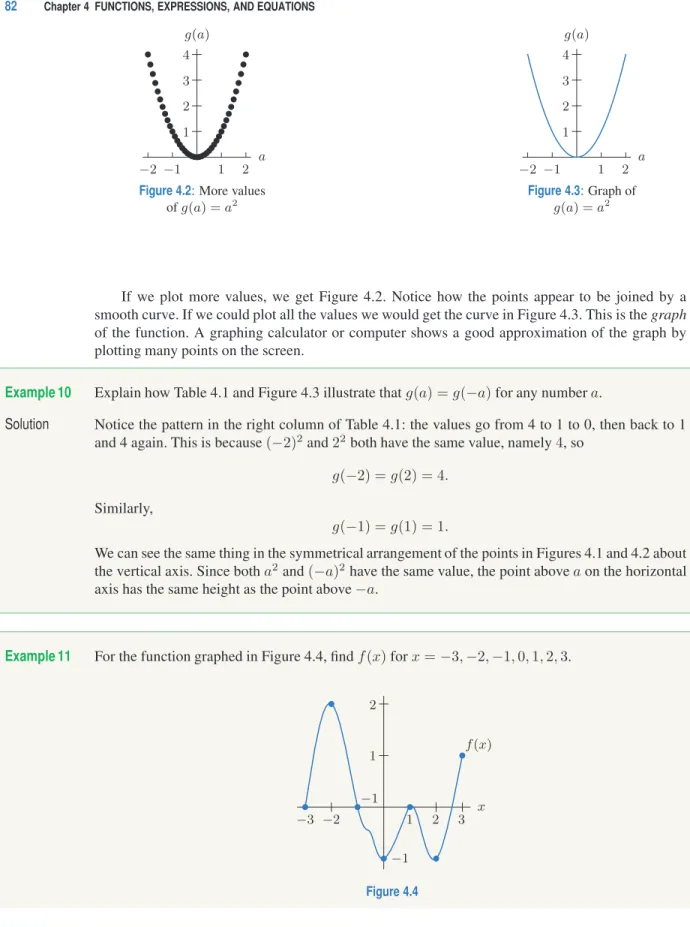
We can often see key features of a function by making a table of output values and by drawing a graph of the function. For example, Table 4.1 and Figure 4.1 show values of g(a) = a2 for a = −2,−1,0,1and2. We can see that the output values never seem to be negative, which is confirmed by the fact that a square is always positive or zero.
Table 4.1 Values of g(a) =a2 a(input) g(a) =a2 (output) −2 4 −1 1 0 0 1 1 2 4 −2 −1 1 2 1 2 3 4 a g(a)
−2 −1 1 2 1 2 3 4 a g(a)
Figure 4.2:More values ofg(a) =a2 −2 −1 1 2 1 2 3 4 a g(a) Figure 4.3:Graph of g(a) =a2
If we plot more values, we get Figure 4.2. Notice how the points appear to be joined by a smooth curve. If we could plot all the values we would get the curve in Figure 4.3. This is thegraph of the function. A graphing calculator or computer shows a good approximation of the graph by plotting many points on the screen.
Example 10 Explain how Table 4.1 and Figure 4.3 illustrate thatg(a) =g(−a)for any numbera.
Solution Notice the pattern in the right column of Table 4.1: the values go from 4 to 1 to 0, then back to 1 and 4 again. This is because(−2)2and22both have the same value, namely4, so
g(−2) =g(2) = 4. Similarly,
g(−1) =g(1) = 1.
We can see the same thing in the symmetrical arrangement of the points in Figures 4.1 and 4.2 about the vertical axis. Since botha2and(−a)2have the same value, the point aboveaon the horizontal
axis has the same height as the point above−a.
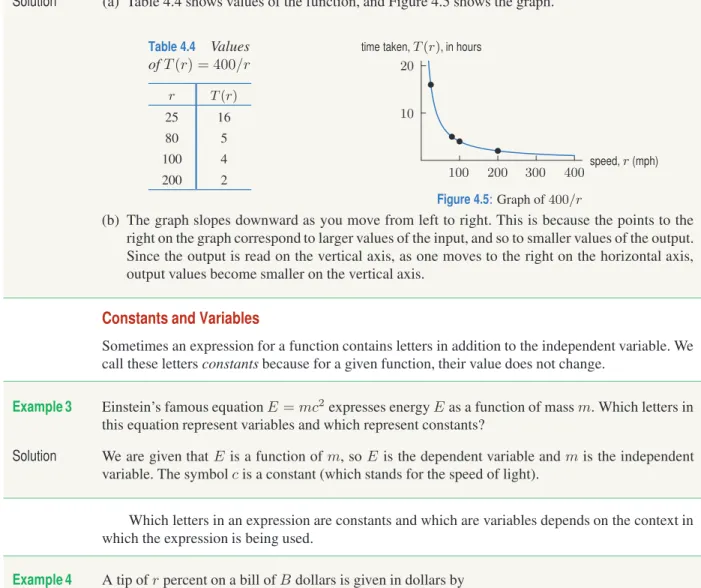
Example 11 For the function graphed in Figure 4.4, findf(x)forx=−3,−2,−1,0,1,2,3.
−3 −2 −1 1 2 3 −1 1 2 f(x) x Figure 4.4
4.1 WHAT IS A FUNCTION? 83
x
Solution The coordinates of a point on the graph off are(a, f(a))for some numbera. So, since the point (−3,0)is on the graph, we must havef(−3) = 0. Similarly, since the point(−2,2)is on the graph, we must havef(−2) = 2. Using the other marked points, we get the values in Table 4.2.
Table 4.2
x −3 −2 −1 0 1 2 3
f(x) 0 2 0 −1 0 −1 1
Exercises and Problems for Section 4.1
EXERCISES
In Exercises1–2, write the relationship using function nota-tion (that is,yis a function ofxis writteny=f(x)).
1. Weight,w, is a function of caloric intake,c.
2. Number of molecules,m, in a gas, is a function of the volume of the gas,v.
3. The number, N, of napkins used in a restaurant is
N = f(C) = 2C, where C is the number of cus-tomers. What is the dependent variable? The indepen-dent variable?
4. A silver mine’s profit,P, isP =g(s) =−100,000 + 50,000sdollars, wheresis the price per ounce of sil-ver. What is the dependent variable? The independent variable?
In Exercises5–6, evaluate the function forx=−7.
5. f(x) =x/2−1 6. f(x) =x2 −3 7. Letg(x) = (12−x)2 −(x−1)3 . Evaluate (a) g(2) (b) g(5) (c) g(0) (d) g(−1) 8. Letf(x) = 2x2 + 7x+ 5. Evaluate (a) f(3) (b) f(a) (c) f(2a) (d) f(−2)
In Exercises9–14, evaluate the expressions given that
f(x) = 2x+ 1 3−5x g(y) = 1 p y2+ 1. 9. f(0) 10. g(0) 11. g(−1) 12. f(10) 13. f(1/2) 14. g √8
In Exercises15–20, evaluate the expressions given that
h(t) = 10−3t.
15. h(r) 16. h(2u) 17. h(k−3)
18. h(4−n) 19. h(5t2) 20. h(4−t3)
21. Iff(x) = 1−x2−x,evaluate and simplifyf(1−x)
22. The sales tax on an item is 6%. Express the total cost,
C, in terms of the price of the item,P.
23. Letf(T)be the volume in liters of a balloon at tem-peratureT◦C. Iff(40) = 3,
(a) What are the units of the 40 and the 3?
(b) What is the volume of the balloon at40◦C?
In Exercises24–26 use the table to fill in the missing values. (There may be more than one answer.)
24. (a) g(0) =? (b) g(?) = 0 (c) g(−5) =? (d) g(?) =−5 y −10 −5 0 5 10 g(y) −5 0 5 10 −10 25. (a) h(0) =? (b) h(?) = 0 (c) h(−2) =? (d) h(?) =−2 t −3 −2 −1 0 1 2 3 h(t) −1 0 −3 −2 −1 −2 0
26. (a) h(?) = 2h(0) (b) h(?) = 2h(−3)+h(2)
(c) h(?) =h(−2) (d) h(?) =h(1) +h(2) t −3 −2 −1 0 1 2 3 h(t) −1 0 −4 −2 −1 −2 0
In Exercises27–29, use the graph to fill in the missing val-ues. (There may be more than one answer.)
27. (a) f(0) =? (b) f(?) = 0 −3 −2 −1 1 2 −1 1 2 3 f(x) x 28. (a) h(0) =? (b) h(?) = 0 −2 −1 0 1 2 2 4 6 h(r) r 29. (a) g(0) =? (b) g(?) = 0 −3 3 −6 6 g(u) u PROBLEMS
30. Table 4.3 shows the5top winning teams in the NBA playoffs between2000and May20,2007and the num-ber of games each team has won.
Table 4.3
Team Playoff games won Lakers 66
Spurs 66 Pistons 61 Nets 43 Mavericks 41
(a) Is the number of games a team won a function of the team? Why or why not?
(b) Is the NBA team a function of the number of games won? Why or why not?
31. Letr(p)be the revenue in dollars that a company re-ceives when it chargespdollars for a product. Explain the meaning of the following statements.
(a) r(15) = 112,500 (b) r(a) = 0
(c) r(1) =b (d) c=r(p)
32. Letd(v)be the braking distance in feet of a car trav-eling atvmiles per hour. Explain the meaning of the following statements.
(a) d(30) = 111 (b) d(a) = 10
(c) d(10) =b (d) s=d(v)
The lower the price per song, the more songs are down-loaded from an online music store. Letn =r(p)give the average number of daily downloads as a function of the price (in cents). Letp0be the price currently being charged
(in cents). What do the expressions in Problems33–40tell you about downloads from the store?
33. r(99) 34. r(p0)
35. r(p0−10) 36. r(p0−10)−r(p0)
37. 365r(p0) 38. r(0.80p0)
39. r(p0)
24 40. p0·r(p0)
Evaluate the expressions in Problems41–42given that
f(n) = 1
2n(n+ 1).
4.2 FUNCTIONS AND EXPRESSIONS 85
Different strains of a virus survive in the air for different time periods. For a strain that survives tminutes, leth(t)
be the number of people infected (in thousands). The most common strain survives fort0minutes. What do the
expres-sions in Problems43–44tell you about the number of people infected?
43. h(t0+ 3) 44.
h(2t0)
h(t0)
A car with tire pressurePlbs/in2
gets gas mileageg(P)(in mpg). The recommended tire pressure isP0. What do the
expressions in Problems45–46tell you about the car’s tire pressure and gas mileage?
45. g(0.9P0) 46. g(P0)−g(P0−5)
4.2
FUNCTIONS AND EXPRESSIONS
A function is often defined by an expression. We find the output by evaluating the expression at the input. By paying attention to the form of the expression, we can learn properties of the function.
Using Expressions to Interpret Functions
Example 1 Bernardo plans to travel400miles over spring break to visit his family. He can choose to fly, drive, take the train, or make the journey as a bicycle road trip. If his average speed isrmiles per hour, then the time taken is a function ofrand is given by
Time taken atrmiles per hour=T(r) = 400 r .
(a) FindT(200)andT(80)and give a practical interpretation of the answers.
(b) Use the algebraic form of the expression forT(r)to explain whyT(200)< T(80), and explain why the inequality makes sense in practical terms.
Solution (a) We have
T(200) = 400
200= 2 and T(80) = 400
80 = 5.
This means that it takes Bernardo 2 hours traveling at 200 miles per hour and 5 hours traveling at 80 miles per hour.
(b) In the fraction400/r, the variableroccurs in the denominator. Since dividing by a larger num-ber gives a smaller numnum-ber, makingrlarger makesT(r)smaller. This makes sense in practical terms, because if you travel at a faster speed you finish the journey in less time.
It is also useful to interpret the algebraic form graphically.
Example 2 For the functionT(r)in Example 1,
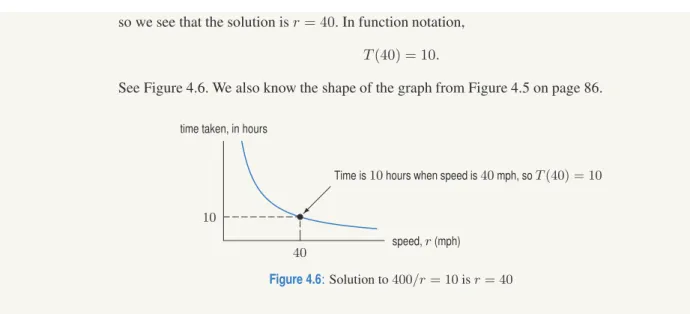
(a) Make a table of values forr= 25,80,100,and200,and graph the function. (b) Explain the shape of the graph using the form of the expression400/r.
Solution (a) Table 4.4 shows values of the function, and Figure 4.5 shows the graph. Table 4.4 Values ofT(r) = 400/r r T(r) 25 16 80 5 100 4 200 2 100 200 300 400 10 20 speed,r(mph) time taken,T(r), in hours
Figure 4.5:Graph of400/r
(b) The graph slopes downward as you move from left to right. This is because the points to the right on the graph correspond to larger values of the input, and so to smaller values of the output. Since the output is read on the vertical axis, as one moves to the right on the horizontal axis, output values become smaller on the vertical axis.
Constants and Variables
Sometimes an expression for a function contains letters in addition to the independent variable. We call these lettersconstantsbecause for a given function, their value does not change.
Example 3 Einstein’s famous equationE=mc2expresses energyEas a function of massm. Which letters in
this equation represent variables and which represent constants?
Solution We are given thatEis a function ofm, soE is the dependent variable andmis the independent variable. The symbolcis a constant (which stands for the speed of light).
Which letters in an expression are constants and which are variables depends on the context in which the expression is being used.
Example 4 A tip ofrpercent on a bill ofBdollars is given in dollars by
Tip= r 100B.
Which letters in the expression(r/100)Bwould you call variables and which would you call con-stants if you were considering
(a) The tip as a function of the bill amount? (b) The tip as a function of the rate?
Solution (a) In this situation, we regard the tip as a function of the variableBand regardras a constant. If we call this functionf, then we can write
Tip=f(B) = r 100B.
(b) Here we regard the tip as a function of the variablerand regardBas a constant. If we call this functiong, then
Tip=g(r) = r 100B.
4.2 FUNCTIONS AND EXPRESSIONS 87
Functions and Equivalent Expressions
A number can be expressed in many different ways. For example,1/4and0.25are two different ways of expressing the same number. Similarly, we can have more than one expression for the same function.
Example 5 In Example 2 on page 78 we found the expression0.2Bfor a 20% tip on a bill. Pares says she has an easy way to figure out the tip: she moves the decimal point in the bill one place to the left then doubles the answer.
(a) Check that Pares’ method gives the same answer on bill amounts of $8.95 and $23.70 as Exam-ple 2 on page 78.
(b) Does Pares’ method always work? Explain your answer using algebraic expressions.
Solution (a) For $8.95, first we move the decimal point to the left to get 0.895, then double to get a tip of $1.79. For $23.70, we move the decimal point to the left to get 2.370, then double to get a tip of $4.74. Both answers are the same as in Example 2 on page 78.
(b) Moving the decimal point to the left is the same as multiplying by 0.1. So first Pares multiplies the bill by 0.1, then multiplies the result by 2. Her calculation of the tip is
2(0.1B).
We can simplify this expression by regrouping the multiplications:
2(0.1B) = (2·0.1)B= 0.2B.
This last expression for the tip is the same one we found in Example 2 on page 78.
For each value ofBthe two expressions,2(0.1B)and0.2B, give equal values for the tip. Al-though the expressions appear different, they are equivalent, and therefore define the same function.
Example 6 Letg(a) =a2
−a. Which of the following pairs of expressions are equivalent? (a) g(2a)and2g(a)
(b) (1/2)g(a)andg(a)/2 (c) g(a+ 1)andg(a) + 1
Solution (a) In order to find the output forg, we square the input value,aand subtractafrom the square. This means thatg(2a) = (2a)2
−(2a) = 4a2−2a.The value of2g(a)is two times the value ofg(a). So2g(a) = 2(a2
−a) = 2a2−2a.The two expressions are not equivalent. (b) Since multiplying by1/2is the same as dividing by2, the two expressions are equivalent:
1 2 g(a) =1 2(a 2 −a) =a 2 −a 2 = g(a) 2 . (c) To evaluateg(a+ 1)we haveg(a+ 1) = (a+ 1)2 −(a+ 1) =a2+ 2a+ 1−a−1 =a2+a. To evaluateg(a) + 1we add one tog(a),sog(a) + 1 =a2
−a+ 1.The two expressions are not equivalent.
Often we need to express a function in a standard form to recognize what type of function it is. For example, in Section 4.5 we study functions of the formQ=kt, wherekis a constant.
Example 7 Express each of the following functions in the formQ=ktand give the value ofk.
(a) Q= 5t+rt (b) Q= −t
10 (c) Q=t(t+ 1)−t(t−1)
Solution (a) We have
Q= 5t+rt= (5 +r)t,
which is the formQ=kt, withk= 5 +r. (b) Rewriting the fraction as
Q= −t 10 = −1 10 t=−0.1t, we see thatk=−0.1. (c) We have Q=t(t+ 1)−t(t−1) =t2+t−t2+t= 2t, sok= 2.
Exercises and Problems for Section 4.2
EXERCISES In Exercises1–4
(a) Evaluate the function at the given input values. Which gives the greater output value?
(b) Explain the answer to part (a) in terms of the algebraic expression for the function.
1. f(x) = 9−x,x= 1,3 2. g(a) =a−2,a=−5,−2 3. C(p) = −p 5 ,p= 100,200 4. h(t) = t 5,t= 4,6
In Exercises5–8,f(t) =t/2 + 7. Determine whether the two expressions are equivalent.
5. f(t) 3 , 1 3f(t) 6. f(t 2 ),(f(t))2 7. 2f(t), f(2t) 8. f(4t2 ), f((2t)2 )
In Exercises9–16 are the two functions the same function?
9. f(x) =x2 −4x+ 5andg(x) = (x−2)2 + 1 10. f(x) = 2(x+ 1)(x−3)andg(x) =x2 −2x−3. 11. f(t) = 450 + 30t, andg(p) = 450 + 30p 12. A(n) = (n−1)/2andB(n) = 0.5n−0.5 13. r(x) = 5(x−2) + 3ands(x) = 5x+ 7 14. h(t) =t2 −t(t−1)andg(t) =t 15. Q(t) = t 2− 3 2andP(t) =t−3 16. B(v) = 30−480v andC(v) = 30 v−16 v . In Exercises 17–20 which letters stand for variables and which for constants?
17. V(r) = (4/3)πr2
18. f(x) =b+mx 19. P(t) =A(1−rt) 20. B(r) =A(1−rt)
PROBLEMS
21. The number of gallons left in a gas tank after drivingd
miles is given byG(d) = 17−0.05d.
(a) Which is larger,G(50)orG(100)?
(b) Explain your answer in terms of the expression for
G(d), and give a practical interpretation.
22. If you drive to work atvmiles per hour, the time avail-able for breakfast isB(v) = 30−480/vminutes.
(a) Which is greater,B(35)orB(45)?
(b) Explain your answer in terms of the expression for
4.3 FUNCTIONS AND EQUATIONS 89
23. Abby and Leah go on a 5 hour drive for 325 miles at 65 mph. Afterthours, Abby calculates the distance re-maining by subtracting 65t from 325, whereas Leah subtractstfrom 5 then multiplies by 65.
(a) Write expressions for each calculation.
(b) Do the expressions in (a) define the same function?
24. To calculate the balance after investingP dollars for two years at 5% interest, Sharif adds 5% ofP toP, and then adds 5% of the result of this calculation to it-self. Donald multipliesP by 1.05, and then multiplies the result of this by 1.05 again.
(a) Write expressions for each calculation.
(b) Do the expressions in (a) define the same function? In Problems25–30, put the functions in the formQ =kt
and state the value ofk.
25. Q= t 4 26. Q=t(n+ 1) 27. Q=bt+rt 28. Q= 1 2t √ 3 29. Q=αt−βt γ 30. Q= (t−3)(t+ 3)−(t+ 9)(t−1)
31. The price of apartments near a subway is given by Price = 1000·A
10d dollars,
whereAis the area of the apartment in square feet and
dis the distance in miles from the subway. Which let-ters are constants and which are variables if
(a) You want an apartment of 1000 square feet?
(b) You want an apartment 1 mile from the subway?
(c) You want an apartment that costs$200,000?
4.3
FUNCTIONS AND EQUATIONS
Using Equations to Find Inputs from Outputs
In the last section we saw how to evaluate an expression to find the output of a function given an input. Sometimes we want to find the inputs that give a certain output. To do that, we must solve an equation. For example, iff(x) = x2, and we want to know what inputs tof give the output f(x) = 16, we must solve the equationx2= 16. The solutionsx= 4andx=
−4are the inputs to f that give 16 as an output.
Example 1 In Example 1 on page 85 we saw that the function
T(r) =400 r
gives the time taken for Bernardo to travel 400 miles at an average speed ofrmiles per hour. (a) Write an equation whose solution is the average speed Bernardo would have to maintain to
make the trip in10hours.
(b) Solve the equation and represent your solution on a graph.
Solution (a) We want the time taken to be10hours, so we wantT(r) = 10. SinceT(r) = 400/r, we want to solve the equation
10 =400 r .
(b) Multiplying both sides byrwe get
10r= 400, r= 400
so we see that the solution isr= 40. In function notation,
T(40) = 10.
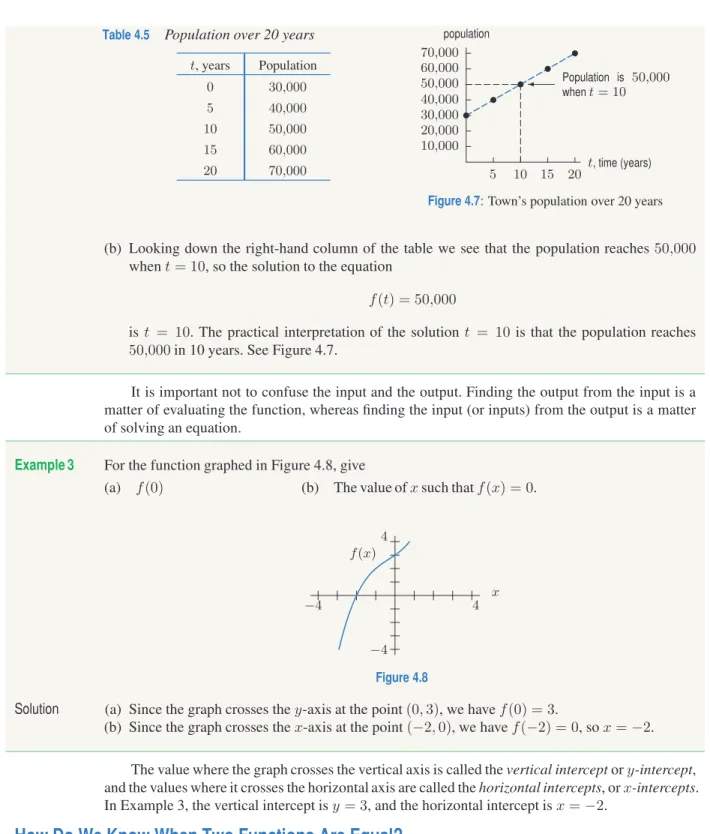
See Figure 4.6. We also know the shape of the graph from Figure 4.5 on page 86.
40 10
Time is10hours when speed is40mph, soT(40) = 10
speed,r(mph) time taken, in hours
Figure 4.6:Solution to400/r= 10isr= 40
Reading Solutions from the Graph
In Example 1 we visualized the solution on a graph. Sometimes it is possible to see the solution directly from a table or a graph.
Example 2 A town’s populationtyears after it was incorporated is given by the functionf(t) = 30,000+2000t. (a) Make a table of values for the population at five-year intervals over a 20-year period starting at
t= 0. Plot the results on a graph.
(b) Using the table, find the solution to the equation
f(t) = 50,000 and indicate the solution on your plot.
Solution (a) The initial population in yeart= 0is given by
f(0) = 30,000 + 2000(0) = 30,000.
In yeart= 5the population is given by
f(5) = 30,000 + 2000(5) = 30,000 + 10,000 = 40,000.
In yeart= 10the population is given by
f(10) = 30,000 + 2000(10) = 30,000 + 20,000 = 50,000.
4.3 FUNCTIONS AND EQUATIONS 91
Table 4.5 Population over 20 years
t, years Population 0 30,000 5 40,000 10 50,000 15 60,000 20 70,000 5 10 15 20 10,000 20,000 30,000 40,000 50,000 60,000 70,000 t, time (years) population Population is 50,000 whent= 10
Figure 4.7:Town’s population over 20 years
(b) Looking down the right-hand column of the table we see that the population reaches50,000 whent= 10, so the solution to the equation
f(t) = 50,000
ist = 10. The practical interpretation of the solutiont = 10is that the population reaches 50,000in 10 years. See Figure 4.7.
It is important not to confuse the input and the output. Finding the output from the input is a matter of evaluating the function, whereas finding the input (or inputs) from the output is a matter of solving an equation.
Example 3 For the function graphed in Figure 4.8, give
(a) f(0) (b) The value ofxsuch thatf(x) = 0.
−4 4 −4 4 f(x) x Figure 4.8
Solution (a) Since the graph crosses they-axis at the point(0,3), we havef(0) = 3.
(b) Since the graph crosses thex-axis at the point(−2,0), we havef(−2) = 0, sox=−2.
The value where the graph crosses the vertical axis is called thevertical interceptory-intercept, and the values where it crosses the horizontal axis are called thehorizontal intercepts, orx-intercepts. In Example 3, the vertical intercept isy= 3, and the horizontal intercept isx=−2.
How Do We Know When Two Functions Are Equal?
Often, we want to know when two functions are equal to each other. That is, we want to find the input value that produces the same output value for both functions. To do this, we set the two outputs equal to each other and solve for the input value.
Example 4 The populations, in yeart, of two towns are given by the functions
Town A: P(t) = 600 + 100(t−2000) Town B: Q(t) = 200 + 300(t−2000).
(a) Write an equation whose solution is the year in which the two towns have the same population. (b) Make a table of values of the populations for the years 2000–2004 and find the solution to the
equation in part (a).
Solution (a) We want to find the value oftthat makesP(t) =Q(t), so we must solve the equation
600 + 100(t−2000) = 200 + 300(t−2000).
(b) From Table 4.6, we see that the two populations are equal in the yeart= 2002.
Table 4.6
t 2000 2001 2002 2003 2004 P(t) 600 700 800 900 1000 Q(t) 200 500 800 1100 1400
Checking the populations in that year, we see
P(2002) = 600 + 100(2002−2000) = 800 Q(2002) = 200 + 300(2002−2000) = 800.
Functions and Inequalities
Sometimes, rather than wanting to know where two functions are equal, we want to know where one is bigger than the other.
Example 5 (a) Write an inequality whose solution is the years for which the population of Town A is greater than the population of Town B in Example 4.
(b) Solve the inequality by graphing the populations.
Solution (a) We want to find the values oftthat makeP(t)> Q(t), so we must solve the inequality
600 + 100(t−2000)>200 + 300(t−2000).
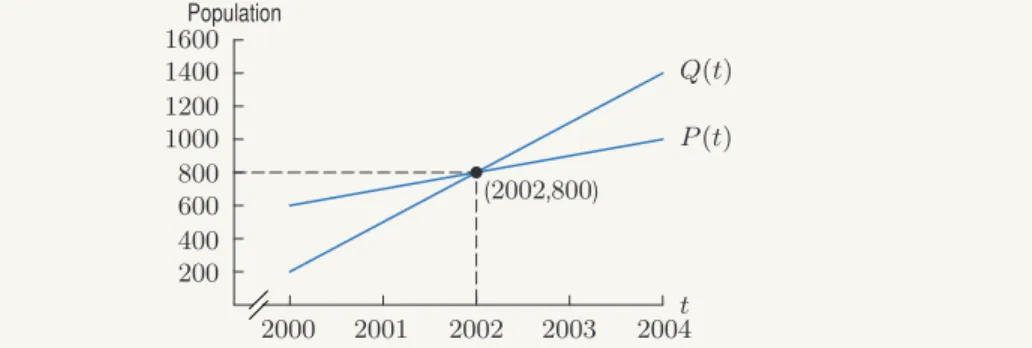
(b) In Figure 4.9, the point where the two graphs intersect is(2002,800), because the populations are both equal to 800 in the year 2002. To the left of this point, the graph ofP (the population of town A) is higher than the graph ofQ(the population of town B), so town A has the larger population whent <2002.
4.3 FUNCTIONS AND EQUATIONS 93 2000 2001 2002 2003 2004 200 400 600 800 1000 1200 1400 1600 (2002,800) P(t) Q(t) t Population
Figure 4.9:When is the population of Town A greater than Town B?
Exercises and Problems for Section 4.3
EXERCISES
In Exercises1–6, solvef(x) = 0forx.
1. f(x) =√x−2−4 2. f(x) = 6−3x 3. f(x) = 4x−9 4. f(x) = 2x2
−18
5. f(x) = 2√x−10 6. f(x) = 2(2x−3) + 2
In Exercises7–11, solve the equationg(t) =agiven that:
7. g(t) = 6−tanda= 1 8. g(t) = (2/3)t+ 6anda= 10 9. g(t) = 3(2t−1)anda=−3 10. g(t) = t−1 3 anda= 1 11. g(t) = 2(t−1) + 4(2t+ 3)anda= 0
Answer Exercises12–13based on the graph ofy=v(x)in Figure 4.10. 20 40 60 80 100 0 20 40 60 80 y=v(x) x y Figure 4.10 12. Solvev(x) = 60. 13. Evaluatev(60). In Exercises14–16, give
(a) f(0) (b) The values ofxsuch thatf(x) = 0. Your answers may be approximate.
14. −2 2 −2 2 f x 15. −5 5 −25 25 50 75 100 f x 16. −1 1 3 1 2 f(x) x Figure 4.11
17. Chicago’s average monthly rainfall,R =f(t)inches, is given as a function of month,t, in Table 4.7. (January ist= 1.) Solve and interpret:
(a) f(t) = 3.7 (b) f(t) =f(2) Table 4.7
t 1 2 3 4 5 6 7 8 R 1.8 1.8 2.7 3.1 3.5 3.7 3.5 3.4
PROBLEMS
18. The balance in a checking account set up to pay rent,
mmonths after its establishment, is given by$4800− 400m.
(a) Write an equation whose solution is the number of months it takes for the account balance to reach $2000.
(b) Make a plot of the balance form= 1,3,5,7,9,11
and indicate the solutionm= 7to the equation in part (a).
19. The number of gallons of gas in a car’s tank,dmiles after stopping for gas, is given by15−d/20.
(a) Write an equation whose solution is the number of miles it takes for the amount of gas in the tank to reach 10 gallons.
(b) Make a plot of the balance ford= 40, 60, 80, 100, 120, 140, and indicate the solutionm= 100to the equation in part (a).
20. A car’s distance (in miles) from home afterthours is given bys(t) = 11t2
+t+ 40.
(a) How far from home is the car att= 0?
(b) Use function notation to express the car’s position after1hour and then find its position.
(c) Use function notation to express the statement “For what value of tis the car 142miles from home?”
(d) Write an equation whose solution is the time when the car is 142 miles from home.
(e) Use trial and error for a few values oftto deter-mine when the car is142miles from home.
21. Iff(x) = x 2−3xsolvef(b) = 20. 22. Ifh(x) = 3−2/x, solve3h(x) + 1 = 7. 23. Ifw(t) = 3t+ 5, solvew(t−1) =w(2t). 24. Ifw(x) = 0.5−0.25x, solve w(0.2x+ 1) = 0.2w(1−x).
25. In Table 4.8, for which values ofxis
(a) f(x)> g(x)? (b) f(x) =g(x)? (c) f(x) = 0? (d) g(x) = 0? Table 4.8 x −2 −1 0 1 2 3 4 5 f(x) 4 1 0 1 4 9 16 25 g(x) 1/4 1/2 1 2 4 8 16 32
26. Table 4.9 shows values ofxand the expression3x+ 2. For which values ofxin the table is
(a) 3x+ 2<8? (b) 3x+ 2>8?
(c) 3x+ 2 = 8?
Table 4.9
x 0 1 2 3 4
3x+ 2 2 5 8 11 14
27. The height (in meters) of a diversseconds after begin-ning his dive is given by the expression10+2s−9.8s2
. For which values ofsin Table 4.10 is
(a) 10 + 2s−9.8s2
<9.89?
(b) His height greater than9.89meters?
(c) Height= 9.89meters? Table 4.10 s 0 0.25 0.5 0.75 1 10 + 2s−9.8s 2 10 9.89 8.55 5.99 2.2
28. Table 4.11 shows values of v and the expressions
12−3vand−3 + 2v. For which values ofvin the table is (a) 12−3v <−3 + 2v? (b) 12−3v >−3 + 2v? (c) 12−3v=−3 + 2v? Table 4.11 v 0 1 2 3 4 5 6 12−3v 12 9 6 3 0 −3 −6 −3 + 2v −3 −1 1 3 5 7 9
29. Table 4.12 shows monthly life insurance rates, in dol-lars, for men and women. Letm=f(a)be the rate for men at agea, andw=g(a)be the rate for women at agea.
(a) Findf(65).
(b) Findg(50).
(c) Solve and interpretf(a) = 102.
(d) Solve and interpretg(a) = 57.
(e) For what values ofaisf(a) =g(a)?
(f) For what values ofaisg(a)< f(a)?
Table 4.12
Age 35 40 45 50 55 60 65 70 f(x)(in dollars) 13 17 27 40 65 102 218 381 g(x)(in dollars) 13 17 27 39 57 82 133 211
4.4 FUNCTIONS AND CHANGE 95
30. If a company sellspsoftware packages, its profit per package is given by$10,000−100,000
p , as shown in
Figure 4.12.
(a) From the graph, estimate the number of packages sold when profits per package are $8000.
(b) Check your answer to part (a) by substituting it into the equation
10,000−100p,000 = 8000. 20 40 60 80 2000 4000 6000 8000 10,000 p profit ($) Figure 4.12
31. The tuition for a semester at a small public universityt
years from now is given by$3000 + 100t, as shown in Figure 4.13.
(a) From the graph, estimate how many years it will take for tuition to reach$3700.
(b) Check your answer to part (a) by substituting it into the equation
3000 + 100t= 3700. 1 3 5 7 9 3000 3500 4000 tyears tuition ($) Figure 4.13
32. Antonio and Lucia are both driving through the desert from Tucson to San Diego, which takes each of them 7 hours of driving time. Antonio’s car starts out full with 14 gallons of gas and uses 2 gallons per hour. Lucia’s SUV starts out full with 30 gallons of gas and uses 6 gallons per hour.
(a) Construct a table showing how much gas is in each of their tanks at the end of each hour into the trip. Assume each stops for gas just as the tank is empty, and then the tank is filled instantaneously.
(b) Use your table to determine when they have the same amount of gas.
(c) If they drive at the same speed while driving and only stop for gas, which of them gets to San Diego first? (Assume filling up takes time.)
(d) Now suppose that between 1 hour and6.5hours outside of Tucson, all of the gas stations are closed unexpectedly. Does Antonio arrive in San Diego? Does Lucia?
(e) The amount of gas in Antonio’s tank afterthours is14−2tgallons, and the amount in Lucia’s tank is30−6tgallons. When does
(i) 14−2t= 30−6t? (ii) 14−2t= 0? (iii) 30−6t= 0?
4.4
FUNCTIONS AND CHANGE
Functions describe how quantities change, and by comparing values of the function for different inputs we can see how fast the output changes. For example, Table 4.13 shows the populationP = f(t)of a colony of termitestmonths after it was started. Using the Greek letter∆(pronounced “delta”) to indicate change, we have
Change in first 6 months= ∆P =f(6)−f(0) = 4000−1000 =3000 termites Change in first 3 months= ∆P =f(3)−f(0) = 2500−1000 =1500 termites.
Although the colony grows by twice as much during the first 6 months as during the first 3 months (3000 as compared with 1500) it also had twice as long in which to grow. Sometimes it is
Table 4.13 Population of a colony of termites
t(months) 0 3 6 9 12
P=f(t) 1000 2500 4000 7000 2800
more useful to measure not the change in the output, but rather the change in the output divided by the change in the input, oraverage rate of change:
Average rate of change in first 6 months =
∆P ∆t = =
3000 termites
6 months =500 termites/month Average rate of change
in first 3 months = ∆P
∆t = =
1500termites
3 months = 500termites/month.
Thus, on average, the colony adds 500 termites per month during the first 6 months, and also during first 3 months. Even though the population change over the first 3 months is less than over the first 6 months (1500 versus 3000), the average rate of change is the same (500 termites/month).
An Expression for the Average Rate of Change
If the input of the functiony=f(x)changes fromx=atox=b, we write
Change in input=Newx-value−Oldx-value=b−a Change in output=Newy-value−Oldy-value=f(b)−f(a).
Theaverage rate of change ofy=f(x)betweenx=aandx=bis given by
Average rate of change= Change in output Change in input =
∆y ∆x=
f(b)−f(a) b−a .
Example 1 Find the average rate of change ofg(x) = (x−2)2+ 3on the following intervals:
(a) Between 0 and 3 (b) Between−1and 4.
Solution (a) We have
g(0) = (0−2)2+ 3 = 7 g(3) = (3−2)2+ 3 = 4, so Average rate of change = g(3)−g(0) 3−0 = 4−7 3 =−1. (b) We have g(−1) = (−1−2)2+ 3 = 12
4.4 FUNCTIONS AND CHANGE 97 g(4) = (4−2)2+ 3 = 7, so Average rate of change = g(4)−g(−1) 4−(−1) = 7−12 5 =−1.
Example 2 For the termite colony in Table 4.13,
(a) What is the change in the population the last 6 months? Months 6 to 9?
(b) What is the average rate of change of the population during the last 6 months? Months 6 to 9? Solution (a) In the last 6 months, we have
Change in last 6 months= ∆P=f(12)−f(6) = 2800−4000 =−1200termites Change from months 6 to 9= ∆P=f(9)−f(6) = 7000−4000 =3000 termites. The change in the last 6 months is negative because the colony decreases in size, losing 1200 termites. However, for the first 3 of those months, months 6 to 9, it increases by 3000 termites. (b) For the last 6 months, we see that
Average rate of change in last 6 months = ∆P ∆t = f(12)−f(6) 12−6 = −1200termites 6 months =−200 termites month Average rate of change
for months 6 to 9 = ∆P ∆t = f(9)−f(6) 9−6 = 3000termites 3 months = 1000 termites month .
The average rate of change over the last 6 months is negative, because the net change is negative, as we saw in (a). In general, iff(b)< f(a)then the numerator in the expression for the average rate of change is negative, so the rate of change is negative (providedb > a).
As for months 6 to 9, even though the population change over this period is the same as over the first 6 months (3000 termites), the average rate of change is larger from months 6 to 9. This is because adding 3000 termites in a 3-month period amounts to more termites per month than adding the same number of termites in a 6-month period.
Interpreting the Expression for Average Rate of Change
Suppose a car has traveledF(t)milest hours after it starts a journey. For example,F(3)is the distance the car has traveled after 3 hours andF(5)is the distance it has traveled after 5 hours. Then the statementF(5)−F(3) = 140means that the car travels 140 miles between 3 and 5 hours after starting. We could also express this as an average rate of change,
F(5)−F(3) 5−3 = 70.
Here5−3 = 2is the two-hour period from 3 to 5 hours after the start, during which the car travels F(5)−F(3) = 140miles, and the statement tells us that the average velocity of the car during the 2 hour period is 70 mph.
Example 3 Interpret the following statements in terms of the journey of the car.
(a) F(a+ 5)−F(a) = 315 (b) F(a+ 5)5−F(a) = 63
Solution (a) SinceF(a)is the distance the car has traveled afterahours andF(a+ 5)is the distance it has traveled aftera+ 5hours (that is, after 5 more hours),F(a+ 5)−F(a) = 315means it travels 315 miles betweenaanda+ 5hours after starting.
(b) Notice that(a+5)−a= 5is the five-hour period during which the car travelsF(a+5)−F(a) = 315miles. The change in input is 5 hours, and the change in output is315miles. The statement
F(a+ 5)−F(a)
5 =
F(a+ 5)−F(a) (a+ 5)−a = 63
tells us that the average rate of change ofF, or average velocity of the car, during the 5 hour period is 63 mph.
Using Units to Interpret the Average Rate of Change
It if often useful to consider the units of measurement of the input and output quantities when interpreting the average rate of change. For instance, as we saw in Example 3, if the input is time measured in hours and the output is distance measured in miles, then the average rate of change is measured in miles per hour, and represents a velocity.
Example 4 A ball thrown in the air has heighth(t) = 90t−16t2feet aftertseconds.
(a) What are the units of measurement for the average rate of change ofh? What does your answer tell you about how to interpret the rate of change in this case?
(b) Find the average rate of change ofhbetween
(i) t= 0andt= 2 (ii) t= 1andt= 2 (iii) t= 2andt= 4
(c) Use a graph ofhto interpret your answers to part (b) in terms of the motion of the ball. Solution (a) In the expression
h(b)−h(a) b−a
the numerator is measured in feet and the denominator is measured in seconds, so the ratio is measured in ft/sec. Thus it measures a velocity.
(b) We have
(i) Average rate of change betweent= 0andt= 2 h(2)−h(0) 2−0 = (90·2−16·4)−(0−0) 2−0 = 116 2 = 58ft/sec. (ii) Average rate of change betweent= 1andt= 2
h(2)−h(1) 2−1 = (90·2−16·4)−(90−16) 2−1 = 42 1 = 42ft/sec. (iii) Average rate of change betweent= 2andt= 4
h(4)−h(2) 4−2 = (90·4−16·16)−(90·2−16·4) 4−2 = −12 2 =−6ft/sec.
4.4 FUNCTIONS AND CHANGE 99
(c) Figure 4.14 shows the ball rising to a peak somewhere between 2 and 3 seconds, and then starting to fall. The average velocity is positive during the first two seconds because the height is increasing during that time period. The height is also increasing betweent = 1andt = 2, but since the ball is rising more slowly, the velocity is less. Betweent = 2andt= 4the ball rises and falls, experiencing a net loss in height, so its average velocity is negative.
1 2 3 4 50 100 150 t(sec) h(t)(ft)
Figure 4.14:Height of a ball
Exercises and Problems for Section 4.4
EXERCISES
Find the average rate of change off(x) =x2
+ 3xon the intervals indicated in Exercises1–4.
1. Between 2 and 4. 2. Between−2and4.
3. Between−4and−2. 4. Between3and1. Find the average rate of change ofg(x) = 2x3
−3x2
on the intervals indicated in Exercises5–8.
5. Between 1 and 3. 6. Between−1and4.
7. Between 0 and 10. 8. Between−0.1and 0.1.
9. The value in dollars of an investmenttyears after 2003 is given by
V = 1000·2t/6
.
Find the average rate of change of the investment’s value between 2004 and 2007.
10. Atmospheric levels of carbon dioxide (CO2) have risen
from 336 parts per million (ppm) in 1979 to 382 parts per million (ppm) in 2007.1 Find the average rate of
change of CO2levels during this time period. 11. Sea levels were most recently at a low point about
22,000 years ago.2Since then they have risen approxi-mately 130 meters. Find the average rate of change of the sea level during this time period.
12. Global temperatures may increase by up to 10◦F
be-tween 1990 and 2100.3Find the average rate of change
of global temperatures between 1990 and 2100.
1National Oceanic & Atmospheric Administration, http://www.esrl.noaa.gov/gmd/aggi. Page last accessed September
26, 2007.
2See http://en.wikipedia.org/wiki/Sea level rise, http://en.wikipedia.org/wiki/Last glacial maximum, and related links.
Pages last accessed September 13, 2006.
PROBLEMS
Table 4.14 gives values ofD=f(t), the total US debt (in $ billions)tyears after 2000.4Answer Problems13–16based on this information. Table 4.14 t D($ billions) 0 5674.2 1 5807.5 2 6228.2 3 6783.2 4 7379.1 5 7932.7 6 8507.0 7 9007.7 8 10,024.7 13. Evaluate f(5)−f(1) 5−1
and say what it tells you about the US debt.
14. Which expression has the larger value,
f(5)−f(3) 5−3 or
f(3)−f(0) 3−0 ?
Say what this tells you about the US debt.
15. Show that
Average rate of change from 2005 to 2006 <
Average rate of change from 2004 to 2005 . Does this mean the US debt is starting to go down? If not, what does it mean?
16. Project the value off(10)by assuming
f(10)−f(6) 10−6 =
f(6)−f(0) 6−0 .
Explain the assumption that goes into making your pro-jection and what your answer tells you about the US debt.
Letg(t)give the market value (in $1000s) of a house in yeart. Say what the following statements tell you about the house.
17. g(5)−g(0) = 30 18. g(10)−g(4)
6 = 3
19. g(20)−g(12)
20−12 =−1
Letf(t)be the population of a town that is growing over time. Say what must be true aboutain order for the expres-sions in Problems20–22to be positive.
20. f(a)−f(3) 21. f(3)−f(a)
3−a 22. f(t+a)−f(t+b)
Lets(t)give the number of acres of wetlands in a state in yeart. Assuming that the area of wetlands goes down over time, say what the statements in Problems23–25tell you about the wetlands.
23. s(25)−s(0) =−25,000
24. s(20)−s(10)
20−10 =−520
25. s(30)−s(20)< s(20)−s(10)
Letg(t)give the amount of electricity (in kWh) used by a manufacturing plant in yeart. Assume that, thanks to con-servation measures,gis going down over time. Assuming the expressions in Problems 26–28 are defined, say what must be true abouthin order for them to be negative.
26. g(h)−g(10) 27. g(5 +h)−g(5) h 28. g(h+ 1)−g(h−1)
Methane is a greenhouse gas implicated as a contributor to global warming. Answer Problems29–32based on the ta-ble of values ofQ=w(t), the atmospheric methane level in parts per billion (ppb)tyears after 1980.5
Table 4.15
t 0 5 10 15 20 25
Q 1575 1660 1715 1750 1770 1775
4See http://www.treasurydirect.gov/govt/reports/pd/histdebt/histdebt histo5.htm. Page last accessed April 25, 2009. 5National Oceanic & Atmospheric Administration, http://www.esrl.noaa.gov/gmd/aggi. Page last accessed September
4.5 FUNCTIONS AND MODELING 101
29. Evaluate
w(10)−w(5) 10−5 ,
and say what it tells you about atmospheric methane levels.
30. Which expression is larger,
w(10)−w(0) 10−0 or
w(25)−w(10) 25−10 ?
Say what this tells you about atmospheric methane lev-els.
31. Show that
Average rate of change from 1995 to 2000 <
Average rate of change from 2000 to 2005 .
Does this mean the average methane level is going down? If not, what does it mean?
32. Project the value ofw(−20)by assuming
w(0)−w(−20)
20 =
w(10)−w(0) 10 .
Explain the assumption that goes into making your pro-jection and what your answer tells you about atmo-spheric methane levels.
4.5
FUNCTIONS AND MODELING
When we want to apply mathematics to a real-world situation, we are not always given a function: sometimes we have to find one. Knowledge about the real world can help us to choose a particular type of function, and we then use information about the exact situation we are modeling to select a function of this type. This process is calledmodeling. In this section we consider situations that can be modeled by a proportional relationship between the variables.
Direct Proportionality
Suppose a state sales tax rate is 6%. Then the tax,T, on a purchase of priceP, is given by the function
Tax= 6%×Price or T = 0.06P.
Rewriting this equation as a ratio, we see thatT /P is constant,T /P = 0.06, so the tax is propor-tional to the purchase price. In general
A quantityQisdirectly proportionalto a quantitytif
Q=k·t,
wherekis theconstant of proportionality. We often omit the word “directly” and simply say
Qis proportional tot.
In the tax example, the constant of proportionality isk= 0.06, becauseT = 0.06P. Similarly, in Example 2 on page 78, the constant of proportionality isk= 0.2, and in Example 3 on page 79, the constant of proportionality is0.44.
Example 1 A car gets 25 miles to the gallon.
(a) How far does the car travel on 1 gallon of gas? 2 gallons? 10 gallons? 20 gallons?
(b) Express the distance,dmiles, traveled as a function of the number of gallons,g, of gas used. Explain whydis proportional togwith constant of proportionality 25.
Solution (a) The car travels 25 miles on each gallon. Thus
Distance on 1 gallon = 25·1 = 25 miles Distance on 2 gallons = 25·2 = 50 miles Distance on 10 gallons= 25·10 = 250 miles Distance on 20 gallons= 25·20 = 500 miles.
(b) Since an additional gallon of gas enables the car to travel an additional 25 miles, we have
d= 25g.
Thusdis proportional tog, with constant of proportionality25, the car’s mileage per gallon.
Notice that in Example 1, when the number of gallons doubles from 1 to 2, the number of miles doubles from 25 to 50, and when the number of gallons doubles from 10 to 20, the number of miles doubles from 250 to 500. In general:
The Behavior of Proportional Quantities
IfQ=kt, then doubling the value oftdoubles the value ofQ, tripling the value ofttriples the value ofQ, and so on. Likewise, halving the value ofthalves the value ofQ, and so on.
Example 2 Vincent pays five times as much for a car as Dominic. Dominic pays $300 sales tax. How much sales tax does Vincent pay (assuming they pay the same rate)?
Solution Since Vincent’s car costs five times as much as Dominic’s car, Vincent’s sales tax should be five times as large as Dominic’s, or5·300 = $1500.
Example 3 For the same car as in Example 1:
(a) How many gallons of gas are needed for a trip of 5 miles? 10 miles? 100 miles?
(b) Findg, the number of gallons needed as a function ofd, the number of miles traveled. Explain whyg is proportional todand how the constant of proportionality relates to the constant in Example 1.
Solution (a) We have
Number of gallons of gas for 5 miles = 5
25 = 0.2 gallon Number of gallons of gas for 10 miles = 10
25 = 0.4 gallon Number of gallons of gas for 100 miles = 100
4.5 FUNCTIONS AND MODELING 103
(b) Since each mile takes1/25gallon of gas,
g= d 25 = 1 25 d.
Thusg is proportional todand the constant of proportionality is 1/25, the reciprocal of the constant in Example 1. We can also see thatgis proportional todby solving forgind= 25g.
Sometimes we have to rewrite the expression for a function to see that it represents a direct proportionality.
Example 4 Does the function represent a direct proportionality? If so, give the constant of proportionality,k. (a) f(x) = 19x (b) g(x) =x/53 (c) F(a) = 2a+ 5a
(d) u(t) =√5t (e) A(n) =nπ2 (f) P(t) = 2 + 5t
Solution (a) Heref(x)is proportional toxwith constant of proportionalityk= 19.
(b) We rewrite this asg(x) = (1/53)x, sog(x)is proportional toxwith constant of proportionality
k= 1/53.
(c) Simplifying the right-hand side we getF(a) = 2a+ 5a= 7a, soF(a)is proportional toawith constantk= 7.
(d) Hereu(t)is proportional totwith constantk=√5.
(e) Rewriting this asA(n) =π2n, we see that it represents a direct proportionality with constant k=π2.
(f) HereP(t)is not proportional tot, because of the constant2on the right-hand side.
Solving for the Constant of Proportionality
If we do not know the constant of proportionality, we can find it using one pair of known values for the quantities that are proportional.
Example 5 A graduate assistant at a college earns $80 for 10 hours of work. Express her earnings as a function of hours worked. What is the constant of proportionality and what is its practical interpretation?
Solution We have
E=f(t) =kt,
whereEis the amount earned andtis the number of hours worked. We are given
80 =f(10) = 10k,
and solving forkwe have
k= 80 dollars
10 hours =8 dollars/hour. Thus,k= 8dollars/hour, which is her hourly wage.
Example 6 A person’s heart mass is proportional to his or her body mass.6
(a) A person with a body mass of 70 kilograms has a heart mass of0.42kilograms. Find the constant of proportionality,k.
(b) Estimate the heart mass of a person with a body mass of 60 kilograms.
Solution (a) We have
H =k·B.
for some constantk. We substituteB= 70andH = 0.42and solve fork: 0.42 =k·70
k= 0.42
70 = 0.006. So the formula for heart mass as a function of body mass is
H = 0.006B,
whereH andBare measured in kilograms. (b) WithB= 60, we have
H= 0.006·60 =0.36 kg.
Proportionality and Rates
In general the average rate of a change of a function between two points depends on the points we choose. However, the functionf(t) =ktdescribes a quantity which is growing at a constant ratek.
Example 7 Show algebraically that the average rate of change of the functionf(t) = ktbetween any two different values oftis equal to the constantk.
Solution We have f(b)−f(a) b−a = kb−ka b−a = k(b−a) b−a =k.
Thus, if two quantities are proportional, the constant of proportionality is the rate of change of one quantity with respect to the other. Using the units associated with a rate of change often helps us interpret the constantk. For instance, in Example 5 on page 103, the constant of proportionality can be interpreted as a pay rate in dollars per hour.
Example 8 Suppose that the distance you travel, in miles, is proportional to the time spent traveling, in hours: Distance=k×Time.
What is the practical interpretation of the constantk?
4.5 FUNCTIONS AND MODELING 105
Solution To see the practical interpretation ofk, we write
miles=Units ofk×hours.
Therefore,
Units ofk= miles hours. The units ofkare miles per hour, and it represents speed.
Example 9 Thedata rateof an Internet connection is the rate in bytes per second that data, such as a web page, image, or music file, can be transmitted across the connection.7Suppose the data rate is300bytes per second. How long does it take to download a file of 42,000 bytes?
Solution LetTbe the time in seconds andNbe the number of bytes. Then
N = 300T
42,000 bytes=300 bytes/sec·T T = 42,000 bytes
300 bytes/sec =140 sec, so it takes 140 seconds to download the file.
Example 10 Give the units of the constant 25 in Example 1 on page 101 and give a practical interpretation of it. Solution In the equationd= 25g,the units ofgare gallons and the units of distance,d,are miles. Thus
miles=Units ofk·gallons Units ofk= miles
gallons
=miles per gallon, or mpg.
The constant tells us that the car gets25miles to a gallon of gas.
Families of Functions
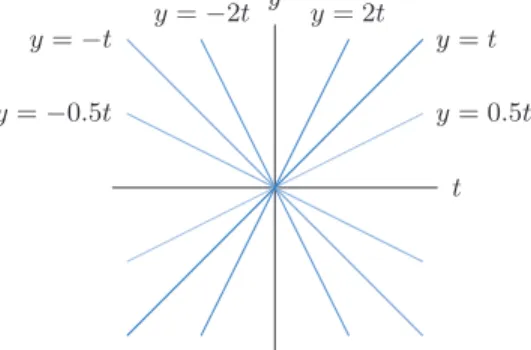
Because the functionsQ = f(t) = ktall have the same algebraic form, we think of them as a family of functions, one function for each value of the constant k. Figure 4.15 shows graphs of various functions in this family. All the functions in the family share some common features: their graphs are all lines, and they all pass through the origin. There are also differences between different functions in the family, corresponding to different values ofk. Althoughkis constant for any given member of the family, it changes from one member to the next. We callkaparameterfor the family.
y=t y= 2t y= 0.5t t y y=−t y=−2t y=−0.5t
Figure 4.15:The family of functionsy=kt
Exercises and Problems for Section 4.5
EXERCISES
In Exercises1–4 is the first quantity proportional to the sec-ond quantity? If so, what is the constant of proportionality?
1. dis the distance traveled in miles andtis the time trav-eled in hours at a speed of 50 mph.
2. P is the price paid in dollars for bbarrels of oil at a price of $70.
3. pis the sale price of an item whose original price isp0
in a 30% off sale.
4. Cis the cost of havingndrinks at a club, where each drink is $5 and there is a cover charge of $20. For each of the formulas in Exercises5–13, isy directly proportional tox? If so, give the constant of proportionality.
5. y= 5x 6. y=x·7
7. y=x·x 8. y=√5·x 9. y=x/9 10. y= 9/x 11. y=x+ 2 12. y= 3(x+ 2)
13. y= 6zwherez= 7x
In Exercises14–17, assume the two quantities are directly proportional to each other.
14. Ifr= 36whens= 4, findrwhensis5.
15. Ifp= 24whenq= 6, findqwhenpis32.
16. Ify= 16whenx= 12, findywhenxis9.
17. Ifs= 35whent= 25, findtwhensis14.
18. The interest paid by a savings account in one year is proportional to the starting balance, with constant of proportionality0.06. Write a formula forI, the amount of interest earned, in terms ofB, the starting balance. Find the interest earned if the starting balance is
(a) $500 (b) $1000 (c) $5000.
19. If y is directly proportional tox, and y = 6when
x= 4, find the constant of proportionality, write a for-mula foryin terms ofx, and findxwheny= 8.
In Exercises20–28, determine if the graph defines a direct proportion. If it does, estimate the constant of proportional-ity. 20. 3 6 9 12 5 10 15 20 x y 21. 2 4 6 8 10 2 4 6 8 x y
4.5 FUNCTIONS AND MODELING 107 22. 1 2 3 4 1 2 3 4 x y 23. −2 −1 0 1 2 −2 −1 1 2 0 x y 24. −3 0 3 −3 3 0 x y 25. −4 0 4 −5 5 0 x y 26. −3 0 3 −2 2 0 x y 27. 1 2 1 2 3 4 x y 28. 1 2 3 4 1 2 3 4 x y PROBLEMS
29. A factory makes 50 vehicles a week. Ist, the number of weeks, proportional tov, the number of vehicles made? If so, what is the constant of proportionality?
30. One store sells 70 pounds of apples a week, and a sec-ond store sells 50 pounds of apples a week. Is the total number of pounds of apples sold,a, proportional to the number of weeks,w? If so, what is the constant of pro-portionality?
31. The perimeter of a square is proportional to the length of any side. What is the constant of proportionality?
32. A bike shop’s revenue is directly proportional to the number of bicycles sold. When50bicycles are sold, the revenue is$20,000.
(a) What is the constant of proportionality, and what are its units?
(b) What is the revenue if75are sold?
33. The total cost of purchasing gasoline for your car is directly proportional to the the number of gallons pumped, and11gallons cost$36.63.
(a) What is the constant of proportionality, and what are its units?
(b) How much do15gallons cost?
34. The required cooling capacity, in BTUs, for a room air conditioner is proportional to the area of the room be-ing cooled. A room of280square feet requires an air conditioner whose cooling capacity is5600BTUs.
(a) What is the constant of proportionality, and what are its units?
(b) If an air conditioner has a cooling capacity of
10,000BTUs, how large a room can it cool?
35. You deposit $P into a bank where it earns 2% interest per year for 10 years. Use the formulaB=P(1 +r)t
for the balance $B, whereris the interest rate (written as a decimal) andtis time in years.
(a) Explain whyBis proportional toP. What is the constant of proportionality?
(b) IsP proportional toB? If so, what is the constant of proportionality?
36. The lengthm, in inches, of a model train is propor-tional to the lengthr, in inches, of the corresponding real train.
(a) Write a formula expressingmas a function ofr.
(b) An HO train is1/87th
the size of a real train.8
What is the constant of proportionality? What is the length in feet of a real locomotive if the HO locomotive is10.5inches long?
(c) A Z scale train is1/220th
the size of a real train. What is the constant of proportionality? What is the length, in inches, of a Z scale locomotive if the real locomotive is75feet long?
37. The cost of denim fabric is directly proportional to the amount that you buy. LetCbe the cost, in dollars, ofx
yards of denim fabric.
(a) Write a formula expressingCas a function ofx.
(b) One type of denim costs $28.50for 3 yards. Find the constant of proportionality and give its units.
(c) How much5.5yards of this type of denim cost?
38. The distanceM, in inches, between two points on a map is proportional to the actual distanced, in miles, between the two corresponding locations.
(a) If1/2inch represents 5 miles, find the constant of proportionality and give its units.
(b) Write a formula expressionMas a function ofd.
(c) How far apart are two towns if the distance be-tween them on the map is3.25inches?
39. The blood mass of a mammal is proportional to its body mass. A rhinoceros with body mass3000 kilograms has blood mass of150kilograms. Find a formula for the blood mass of a mammal in terms of the body mass and estimate the blood mass of a human with body mass70kilograms.
40. The distance a car travels on the highway is propor-tional to the quantity of gas consumed. A car travels 225 miles on 5 gallons of gas. Find the constant of pro-portionality, give units for it, and explain its meaning.
REVIEW EXERCISES AND PROBLEMS FOR CHAPTER 4
EXERCISES
1. Letf(r)be the weight of an astronaut in pounds at the distancer, in thousands of miles from the earth’s cen-ter. Explain the meaning of the following statements.
(a) f(4) = 180 (b) f(a) = 36
(c) f(36) =b (d) w=f(r)
2. When there areccars on campus, the number of cars without a parking space isw(c) =−2000 +c. Express in function notation the number of cars without park-ing spaces when there are 8000 cars on campus, and evaluate your expression.
Evaluate the expressions in Exercises3–8given that
f(x) = x+ 1 2x+ 1. 3. f(0) 4. f(−1) 5. f(0.5) 6. f(−0.5) 7. f1 3 8. f(π) 9. Letg(t) =t 2 + 1 5 +t. Evaluate (a) g(3) (b) g(−1) (c) g(a) 10. Letg(s) = 5s+ 3 2s−1. Evaluate (a) g(4) (b) g(a) (c) g(a) + 4 (d) g(a+ 4)
11. Use Table 4.16 to evaluate the expressions.
(a) g(10)−10 (b) 6g(0)
(c) g(10)−g(−10) (d) g(5) + 7g(5) Table 4.16
y −10 −5 0 5 10 g(y) −5 0 5 10 −10
12. Table 4.17 gives the number of passenger cars in the US from1990to1994as a function of year. (t= 0is
1990.)
Table 4.17
t(years) 0 1 2 3 4 C(t)cars (in millions) 133.7 128.3 126.6 127.3 127.9
(a) EvaluateC(1)and interpret its meaning.
(b) IfC(t) = 127.3, findtand interpret its meaning.
13. Census figures for the US population, P(t)(in mil-lions),tyears after 1950, are in Table 4.18.
Table 4.18
t(years) 0 10 20 30 40 50 P(t)(millions) 150.7 179.0 205.0 226.5 248.7 281.4
(a) EvaluateP(20)and interpret its meaning.
REVIEW EXERCISES AND PROBLEMS FOR CHAPTER 4 109
14. Using Figure 4.16, evaluate
(a) f(2)−f(1) (b) f(2)−f(−1) (c) 2f(−1) +f(2) (d) 1/f(−2) −4 −2 0 2 4 −6 0 6 f(t) t Figure 4.16
15. Using Figure 4.17, estimate
(a) d(2)/d(1) (b) d(1)·d(1) (c) 4d(−2)−d(−1) (d) 4d(−2)−(−1) −3 −2 −1 0 1 2 3 −4 −2 0 2 4 6 d(s) s Figure 4.17 In Exercises16–19,g(z) = 4z2
−3. Determine whether the two expressions are equivalent.
16. 22
g(z),4g(z) 17. 4g(z), g(4z)
18. g(√z),pg(z) 19. g(z·z), g(z2
)
In Exercises20–27, find thexvalue that results inf(x) = 3.
20. f(x) = 5x−2 21. f(x) = 5x−5
22. f(x) =2x
5 23. f(x) = 5 2x
24. The population of a town,tyears after it was founded, is given byP(t) = 5000 + 350t.
(a) Write an equation whose solution is the number of years it takes for the population to reach12,000.
(b) Make a plot of the population fort= 14, 16, 18, 20, 22, 24 and indicate the solution to the equation in part (a).
25. The number of stamps in a person’s passport,tyears after the person gets a new job which involves overseas travel, is given byN(t) = 8 + 4t.
(a) Write an equation whose solution is the number of years it takes for the passport to have 24 stamps.
(b) Make a plot of the number of stamps for t = 1,2,3,4,5,6, and indicate the solution to the equation in part (a).
26. The number of dirty socks on your roommate’s floor,t
days after the start of exams, is given bys(t) = 10+2t.
(a) Write an equation whose solution is the number of days it takes for the number of socks to reach 26.
(b) Make a plot of the number of socks for t = 2,4,6,8,10,12, and indicate the solution to the equation in part (a).
27. For accounting purposes, the value of a machine, t
years after it is purchased, is given in dollars byV(t) = 100,000−10,000t.
(a) Write an equation whose solution is the number of years it takes for the machine’s value to reach
$70,000.
(b) Make a plot of the value of the machine att = 1,2,3,4,5,6, and indicate, on the graph, the solu-tion to the equasolu-tion in part (a).
Find the average rate of change off(x) =x3 −x2
on the intervals indicated in Exercises28–30.
28. Between 2 and 4. 29. Between−2and4.
30. Between−4and−2.
31. Letf(N) = 3N give the number of glasses a cafe should have if it has an average ofNclients per hour.
(a) How many glasses should the cafe have if it ex-pects an average of 50 clients per hour?
(b) What is the relationship between the number of glasses andN? What is the practical meaning of the3in the expressionf(N) = 3N?
In Exercises 32–37, isydirectly proportional tox? If so, give the constant of proportionality.
32. x= 5y 33. y= 2x−x 34. 2y=−3x 35. y−2 = 3x 36. y/3 =√5x 37. y=ax−2x