Background
When introduced to the market in 1992, the Global system for mobile communica-tion (GSM, defined by ETSI as the interna-tionally accepted digital cellular telephony standard) was primarily a voice-only system with SMS and some low-bit-rate circuit-switched data services. Since then, howev-er, GSM has continued to evolve unabated. General packet radio service (GPRS), for ex-ample, introduced packet-data capabilities. And the subsequent introduction of En-hanced data rates for GSM evolution (EDGE) or Enhanced GPRS has greatly ex-tended the capabilities of packet-data ser-vices. EDGE technology, which is backward compatible with GPRS, offers up to a 200% increase in data bit rates.1
At present, GSM/EDGE is undeniably the most widely spread cellular technology in the world (Figure 1). Only two countries, Japan and South Korea, rely exclusively on other standards. There are currently more than 1.7 billion GSM/EDGE users world-wide, and subscriber growth continues to be high. In November 2005, the Global mo-bile Suppliers Association (GSA) reported that 121 GSM operators were offering com-mercial EDGE-based services in 70 coun-tries, and 172 operators in 92 countries had committed to providing EDGE.2
Improving service
performance
To keep GSM/EDGE competitive, even in years to come, Ericsson has proposed a num-ber of enhancements that facilitate truly conversational multimedia services and im-prove service performance and service con-tinuity. All major vendors and many oper-ators have pledged their support for a con-tinued evolution, which is being standard-ized in 3GPP.3The general objectives are to improve service performance and provide more efficient bearers. Seamless operation or service continuity between GSM/EDGE and WCDMA networks is also being addressed.
Objectives
The proposed technology enhancements are meant to improve average and peak bit rates, latency, service coverage, and spectrum ef-ficiency. Box B (Item I) shows the targets used in the standardization.
The first objective, increased spectrum ef-ficiency, mainly benefits operators. In many urban areas, the existing frequency spec-trum is being used to the maximum extent. However, by enhancing spectrum efficien-cy (that is, improved ability to withstand GSM/EDGE has evolved into the most widely deployed cellular telephony
standard in the world, offering high-performance voice and data services. To keep GSM/EDGE competitive, even in years to come, Ericsson has proposed steps to further evolve the standard.
The authors describe the proposed technology enhancements, which improve average and peak bit rates, latency, service coverage, and spec-trum efficiency. Specific solutions include dual-antenna terminals, multi-carrier EDGE, mobility enhancements, reduced transmission time inter-vals, higher-order modulation, and new coding schemes. The combination of these solutions fulfills the requirements set by 3GPP.
GSM/EDGE continued evolution
Håkan Axelsson, Peter Björkén, Peter de Bruin, Stefan Eriksson and Håkan Persson
3GPP Third Generation Partnership Project
8-PSK Octonary phase-shift keying
GSM Global system for mobile communication
MBMS Multimedia broadcast/multicast
21
All services (voice as well as packet-data) stand to benefit from improved coverage and from having terminals that are always con-nected to the most appropriate base station. Most services can benefit from faster ini-tial response from the network. This is es-pecially true for conversational services and applications with limited system interac-tivity prior to uploading or downloading ap-plication data (for example, WAP, MMS and FTP). Although not presently pursued in 3GPP, solutions have been proposed that would decrease access time (when the mo-bile terminal is known in the packet control unit, PCU) to less than 500ms.
Given that the installed base of GSM/
EDGE equipment is very large, Ericsson has tried to minimize the effects of the proposed technology enhancements on base station hardware. As a consequence, the proposed solutions have no impact on transceiver units and other base station hardware. What is more, they assume the same (current) net-work architecture (Figure 2). In general, only radio network software and terminals will need to be updated.
Proposed solutions
Ericsson has proposed solutions that fulfill the objectives outlined above, some of which coincide with proposals from other
partici-Figure 1
GSM/EDGE footprint.
Figure 2
pants in the standardization work. Most of the proposals are currently being discussed in 3GPP, either in the Future GERAN Evo-lution Work Item or other 3GPP Work Items. Some of Ericsson’s proposals address several of the desired performance enhance-ments, whereas others address only one spe-cific area.
Dual-antenna terminals
A challenge associated with radio commu-nication is that the strength of received radio signals varies rapidly relative to the position of the transmitter, the receiver, and other objects that scatter signals. This phenome-non, known as fading, can make a signal too weak to be captured. One other challenge is that other transmitters (terminals or base stations) in the vicinity can cause interfer-ence. Various techniques, such as channel coding, frequency hopping, and selective re-transmission schemes, are used to combat fading and interference.
Dual-receive-antenna systems are an effi-cient weapon against fading. To date, how-ever, these have only been used on base sta-tion receivers. Figure 3 shows how two an-tennas mounted on a terminal, separated in space, polarization, or both, can receive two signals of the same transmission with dif-ferent fading characteristics. This increases the probability that at least one of the sig-nals will be strong enough (with some mar-gin above the receiver noise floor) to be cap-tured. Moreover, by combining two signals, one can sometimes capture a transmission that would otherwise have been altogether too weak.
Dual-antenna solutions can also be used to efficiently handle interference. Obvious-ly, the desired signal as well as all other re-ceived interference is subject to fading on the two antennas. But by combining the signals, one can cancel out interference by taking into account the instantaneous
at-Multicarrier EDGE
The GSM radio interface is based on time-division multiple access (TDMA) with 200kHz carrier bandwidth. To increase bit rates, today’s GPRS and EDGE terminals can use multiple timeslots for transmission, reception, or both (Figure 5, left). The GSM standard allows for up to eight timeslots in each direction (uplink and downlink), giv-ing a theoretical peak bit rate of close to 480kbps. However, from a design and com-plexity point of view, it is best to avoid si-multaneous transmission and reception. Therefore, in practice, today’s terminals typcially receive on a maximum of five timeslots because they must also transmit (on at least one timeslot) as well as measure the signal strength of neighboring cells. The actual number of timeslots a terminal uses for transmission is also limited.
To increase bit rates, one can introduce multiple carriers for the downlink and up-link. This straightforward enhancement in-creases peak and mean bit rates in propor-tion to the number of carriers employed (Figure 5, right). For example, given four carriers with eight timeslots each, the peak bit rate would be close to 2Mbps. The lim-iting factor in this case is the complexity and cost of the terminal, which must have either multiple transmitters and receivers or a wideband transmitter and receiver. The use of multiple carriers has only a minor impact on base transceiver stations.
Mobility enhancements
The functionality needed to handle user mo-bility is a fundamental component in any cellular network. Services must be main-tained as users move from one cell to an-other, and a good or adequate radio envi-ronment must exist for the establishment of new sessions. Seen in terms of spectrum ef-ficiency, each active user should always be served by the most appropriate (closest) base
Figure 3
Received signal strength on two antennas in a mobile terminal.
Figure 4
Dual receive antennas can be used for interference cancellation. The received signal on each antenna is the sum of the desired signal and interference, weighted with different attenuation factors due to fading (denoted a, b, c and d).
23
measurements are taken to determine whether or not cell change is necessary; pro-cessing of the measurements (to reach this decision); and the actual cell change.
In idle mode, the main limitation of man-aging user mobility is that the measure-ments of neighboring and serving cells are not stringent enough for environments with tight frequency reuse. Consequently, ses-sions are sometimes initiated in a sub-optimum cell, creating extra interference and leading to service interruptions (dropped calls). Putting more stringent re-quirements on measurements of the received signal strength would eliminate this limi-tation.
In active mode, faster and more accurate measurements of neighboring cells would improve performance. At present, mobile terminals identify neighboring cells sepa-rately and infrequently by decoding the base station identity code (BSIC). Furthermore, they solely measure the total strength of the received signal. This means that if several nearby base stations use the same frequen-cy, the contribution from each base station cannot be resolved. Ericsson proposes to in-troduce simultaneous identification of neighboring cells (BSIC information) and measurements of signal strength on all bursts over the BCCH carrier.4This would significantly reduce the risk of incorrect
Figure 5
Left: Radio blocks are transmitted on five parallel timeslots on one carrier. Right: Radio blocks are transmitted on ten parallel timeslots on two carriers.
Figure 6
handover, resulting in substantially fewer dropped calls. It would also speed up the process of detecting new, strong, neighbor-ing cells.
Mobility enhancements apply equally well to voice and data services (although the detailed effects differ). They also improve service continuity, for example, by means of faster and more accurate handover between GSM/EDGE and WCDMA networks (Fig-ure 6) and enhanced handover functionality in dual-transfer mode (DTM).
Reduced TTI
Latency has a major influence on user expe-rience. In particular, conversational services, such as VoIP and video telephony, require low latency. Other services that benefit from low delay are gaming and applications with extensive handshaking, such as e-mail.
It is difficult to substantially improve la-tency without reducing the transmission time interval (TTI). The roundtrip time (RTT) in advanced GSM/EDGE networks with an Ericsson base station subsystem (BSS) is 150ms. This figure includes net-work delays but not retransmissions over the radio interface. Radio blocks are transmit-ted over four consecutive bursts on one time-slot using a 20ms TTI. Figure 7 illustrates the data flow with a 20ms TTI.
Reducing the TTI improves latency sub-stantially and immediately. To reduce TTI, one can either use fewer than four bursts (smaller radio blocks) or transmit all four bursts on more than one timeslot (for ex-ample, parallel timeslots on two carriers). Ericsson estimates that reducing the TTI from 20ms to 10ms will reduce the round-trip time from 150ms to 100ms.
Figure 8
Example of transfer using reduced TTI Figure 7
25 Faster feedback
To help the transmitter better understand the radio environment, feedback informa-tion is sent via the radio link control (RLC) protocol over the air. The RLC protocol typ-ically runs in acknowledged mode, which requires the retransmission of lost radio blocks. Although feedback information is crucial for efficient transmission over the radio interface, it is also time-consuming. The procedure requires the receiver to peri-odically send (on request)
• acknowledgements of radio transmis-sions; and
• information about the current radio envi-ronment.
Faster feedback enables the transmitter to retransmit lost data earlier and makes radio transmission more efficient. By putting more stringent requirements on reaction times and by introducing support for im-mediate response to unsuccessful radio transmissions, one can ensure that lost radio blocks are retransmitted much earlier, which reduces latency. One can reduce la-tency even further by combining faster feed-back with reduced TTI (Figure 8).
Figure 9
Top left: Gaussian minimum-shift keying (GMSK). Top right: Octonary phase shift keying (8-PSK). Bottom left: 16QAM (16-level constellation). Bottom right: 32QAM (32-level constellation).
I. MAIN 3GPP OBJECTIVES AND TARGETS
Improved spectrum efficiency (or capacity) in an interference-limited scenario
Target: 50% increase (measured in kbps/MHz/cell for data and Erl/MHz/cell for voice)
Increased peak data rates
Target: 100% increase in downlink and uplink
Improved coverage, voice and data (noise-limited scenario)
Target: Sensitivity increase of 3dB in downlink
Improved service availability (when cells are planned for voice)
Target: 50% increase in mean bit rate for uplink and downlink at cell edges
Reduced latency, initial access (“no TBF assigned”)
Target: Round-trip time (RTT) of less than 450ms (in non-ideal radio conditions over the radio interface, counting from the mobile terminal up to Giinterface and vice versa)
Reduced latency, after initial access
Target: RTT of less than 100ms (in non-ideal radio conditions over the radio interface, counting from the mobile terminal up to Giinterface and vice versa)
Compatibility
Coexistence with legacy frequency planning Coexistence with legacy mobile terminals
Minimum impact on existing BTS, BSC and core-network hardware
II. RECENT AND CURRENT 3GPP ACTIVITIES
MBMS (Rel-6)
Multimedia broadcast/multicast services (MBMS) enable a point-to-multipoint radio bearer for broadcast or multicast services (for example, mobile TV), allowing many users to receive the same information or media stream. MBMS enables efficient radio and network distribution of content, because only one bearer needs to be initiated in any given cell for use by every MBMS user in that cell.8
Packet-switched handover (Rel-6)
Packet-switched handover procedures in 3GPP Rel-6 enhance the port for real-time packet-based services, such as VoIP, as well as sup-port for sharing the load of packet-data services between GSM/EDGE and WCDMA. This feature significantly reduces interruptions of packet-switched data flow when a terminal changes cells or systems. Delay-sensitive services, such as VoIP and gaming, can thus enjoy full mobility within GSM/EDGE and between GSM/EDGE and WCDMA. This also means that operators can steer user traffic between cells and between GSM/EDGE and WCDMA with very little impact on the service.
GAN (Rel-6)
The Generic Access Network (GAN) standard enables operators to use other types of access networks, such as Bluetooth and WiFi, to access GSM services. When users leave the Bluetooth or WiFi coverage area, they are handed over to GSM cells.9
Handover of shared and dedicated resources in DTM (Rel-7)
Handover of shared packet-switched and dedicated circuit-switched resources in dual-transfer mode (DTM) will further reduce interruptions and enhance service.
Higher-order modulation: 16QAM and 32QAM
GSM uses Gaussian minimum-shift keying modulation. GMSK is a binary modulation, which means one bit can be transmitted over the radio interface per symbol (Figure 9, top left). EDGE technology introduced a new modulation constellation: octonary phase shift keying (8-PSK), a non-binary modula-tion that allows three bits to be transmitted per symbol, increasing the peak bit rate from approximately 20kbps to around 60kbps per timeslot (Figure 9, top right).
The bit rates can be increased even further by introducing higher-order modulation, such as quadrature amplitude modulation (QAM). Figure 9 (botton left and right) shows QAM constellations with 16 levels (peak rates of up to 80kbps per timeslot) and 32 levels (peak rates of up to 100kbps per timeslot).
Given these constellations, we see that as more bits are transmitted per symbol, the signal points move closer together, making the signal more susceptible to interference. On the other hand, the higher bit rates per-mit more robust channel coding to be used, which more than compensates for increased susceptibility to interference.
Figure 10
Bit rate per timeslot versus carrier-to-interference level for different modulation and cod-ing techniques.
Figure 11
Average user bit rates for 10th, 50th and 90th percentiles versus system load.
27
Figure 10 shows the relationship between bit rates and the carrier-to-interference ratio (C/I). Case Ashows bit rate per timeslot for EDGE using 8-PSK modulation. When some of the modulation and coding schemes (MCS) are replaced with 16QAM equiva-lents, the bit rate increases (Case B). In this example, 16QAM has solely been used to in-crease robustness against interference, not to increase peak data bit rates. The technique (16QAM) enables the system to handle more than three times as much interference (5dB). The introduction of MCSs with 32QAM further increases the data bit rates, as indi-cated by Case C(one new 32QAM MCS with a peak rate of 67.2 kbps per timeslot) and Case D(one more, new, 32QAM MCS with a peak rate of 79.2 kbps per timeslot).5
The introduction of 16QAM has no effect on base transceiver station (BTS) hardware. The introduction of 32QAM, however, could be a limiting factor. Figure 11 shows system performance in terms of average user bit rates when 16QAM is used (instead of 8-PSK) for MCS-7, MCS-8 and MCS-9 (solid lines).
New coding schemes: turbo codes
Channel coding is used to increase robust-ness against interference. GSM and EDGE use what are called convolutional codes, which offer good flexibility (they can easily be adapted to any bit rate and code rate) and low encoding/decoding complexity.
In terms of error correction, more sophis-ticated classes of channel coding schemes
outperform convolutional codes. One such class of coding schemes, called turbo codes, is used in other cellular systems such as WCDMA.6The process of decoding turbo codes is more complex than that of decod-ing convolutional codes, but because future terminals will generally support GSM/ EDGE as well as WCMDA, the decoding circuitry for turbo codes will already exist in terminals and can thus be reused for GSM/EDGE.
Figure 12
Peak bit rate enhancements.
Figure 13
Turbo codes perform well only when the code block size is sufficiently large, which means they are most suitable for high-bit-rate EDGE channels when used in com-bination with 8-PSK modulation or higher-order modulations.
Figure 11 also compares the average user bit rates when turbo coding is used in com-bination with 16QAM (dash-dotted lines), with normal EDGE and 16QAM without turbo coding. Compared with regular EDGE with 8-PSK, the combination of 16QAM and turbo coding improves the user bit rates 30% to 40% for the median user.
Summary of potential
gains
The various enhancements we have dis-cussed thus far have little or no effect on the GERAN architecture or radio network equipment. Major benefits can be derived by upgrading the network software but without the need for new hardware (Box C).
Moreover, the enhancements are backward-compatible, which means legacy mobile ter-minals can coexist with new mobile termi-nals, sharing the same radio channels and making efficient use of radio resources. The enhancements also benefit services, espe-cially where conversational services (for ex-ample, VoIP) are concerned.
Reduced latency and higher-bit-rate bearers yield efficient voice bearers on the packet side of the GSM network. User ses-sions are multiplexed more efficiently on the same bearer, and the mouth-to-ear delay reaches acceptable levels of around 200 to 300ms in a realistic radio environment.7In addition, web browsing and data downloads and uploads are faster, which further im-proves the user experience and is expected to benefit the use of radio resources. Figures 12 and 13 show the peak bit rate enhance-ments and spectrum efficiency gains.
Example – Conversational VoIP enhancements
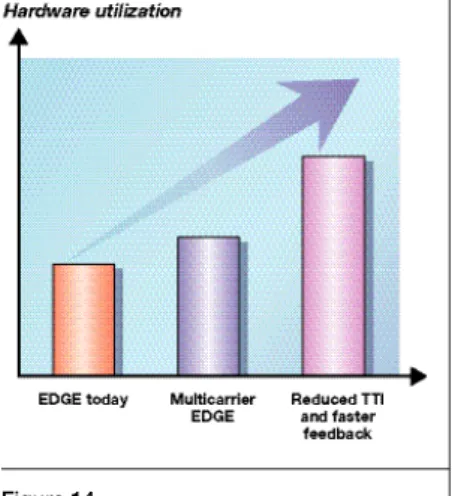
Reduced TTI and faster feedback help relax the requirements put on radio transmission for delay-sensitive services by providing suf-ficient time for retransmitting radio blocks. In other words, the techniques make it pos-sible to reduce the safety margins associat-ed with the transmission of radio blocks. This thereby reduces bandwidth require-ments, which increases spectrum efficiency and improves service coverage. Multicarrier EDGE makes it possible to share resources between more timeslots. Therefore, given a large pool of resources, trunking efficiency will improve. One example of such a service, with strict requirements put on delay, is conversational IP telephony, often referred to as Voice over IP or VoIP.
Figure 14 shows the normalized hardware utilization for VoIP at a given frequency load, assuming gradual introduction of
Figure 14
VoIP hardware utilization per cell, assuming multicarrier EDGE, reduced TTI, and faster feedback techniques.
A summary of the benefits of each individual enhancement follows below:
• Dual-antenna terminals improve capacity and mean bit rates substantially, especially when used to cancel interference in the downlink. Furthermore, receiver sensitivity is vastly improved, which improves coverage (as defined in the noise-limited case). Individual users benefit immediately. System gains are dependent on terminal penetration.
• Multicarrier EDGE yields increased bandwidth. This is manifested by increased peak and mean bit rates both over the uplink and downlink. Operators can retain the current channel structure, introducing complexity on a step-by-step basis as demand for bandwidth grows.
• Mobility enhancements increase mean bit rates and spectrum efficiency because users are always served by the most appropriate base station. Service continuity is also improved thanks to faster and more accurate handovers within GSM/EDGE networks and between GSM/EDGE and WCDMA networks.
• Reduced TTI and faster feedback reduce latency and improve overall service performance. Sessions that involve interactive data transfers will on average take less time. The enhance-ments also significantly reduce the mouth-to-ear delay and improve hardware efficiency for conversational services (for example, VoIP).
• Higher-order modulation used in combination with turbo coding substantially increases peak and mean bit rates. Service coverage is also improved thanks to increased robustness (when,
29
multicarrier EDGE, reduced TTI, and faster feedback techniques.
Standardization
All major vendors and many operators have agreed to conduct a feasibility study regard-ing the evolution of GERAN in 3GPP, the standardization body for GERAN. The 3GPP officially started the study in April 2005. Since then, the participants have agreed on various goals, for example, performance gains and implementation considerations relative to existing GSM/EDGE equipment (Box B, Item I). Several proposed enhancements are currently being evaluated. Apart from the mobility enhancements, nearly all the pro-posed enhancements described in this article are part of the current 3GPP study. Success-ful candidates will target Rel-7 or an earlier Work Item (Figure 15). Box B (Item II) lists other GSM/EDGE enhancements currently handled in 3GPP standardization.
Conclusion
GSM/EDGE has evolved into the most widely deployed cellular telephony standard in the world, offering high-performance voice and data services. To keep GSM/ EDGE competitive, even in years to come, Ericsson has proposed steps to further evolve the standard. The combination of solutions fulfills the requirements set by 3GPP: • Spectrum efficiency is improved,
allow-ing more voice and data traffic in the same spectrum.
• Higher peak and mean data bit rates en-able faster and better services.
• Reduced latency improves service perfor-mance, primarily for delay-sensitive ser-vices, such as VoIP.
• Coverage is improved and higher bit rates can be offered.
• Service continuity is enhanced within GSM/EDGE and between GSM/EDGE and WCDMA networks.
1. Furuskär, A., Näslund, J. and Olofsson, H.: EDGE – Enhanced data rates for GSM and TDMA/136 evolution. Ericsson Review, Vol. 76(1999):1, pp. 28-37
2. GSA– the Global mobile Suppliers Associ-ation, November 3, 2005,
www.gsacom.com
3. 3GPP TR 45.912 Feasibility study for evolved GSM/EDGE Radio Access Net-work (GERAN), (Release 7)
4. Tdoc GP-041348, 3GPP TSG GERAN, Enhancements of Handover Performance 5. Eriksson, M., Turina, D., Arslan, H.,
Bal-achandran, K., Cheng, J.: System Perfor-mance with Higher Level Modulation in the GSM/EDGE Radio Access Network, Pro-ceedings of IEEE Globecom 2001 6. Berrou, C., Glavieux, A. and Thitimajshima,
P.: Near Shannon limit error-correcting coding and decoding: turbo codes, Pro-ceedings of IEEE International Communi-cations Conference '93, pp. 1064-1070, May 1993.
7. ITU-T G.114
8. Bakhuizen, M. and Horn, U.: Mobile broad-cast/multicast in mobile networks. Erics-son Review, Vol. 82(2005):1, pp. 6-13 9. Bäckström, M., Havdrup, A., Nylander, T.,
Vikberg, J. and Öhman, P.:
Mobile@Home—GSM services over wire-less LAN. Ericsson Review, Vol. 82(2005):2, pp. 92-99
REFERENCES
Figure 15