action/2015
Visual Identity Guidelines
Contents
Introduction
3
The action/ signifier
8
Clear space
9
Correct usage
10
Graphic elements
11
Cause names
12
Cause/issues and tone of voice
13
Highlight bars
14
Translations
15
Colour palette
16
Spacing and position: Offline
17
Online
18
Sizing
19
Partner logos
20
How the signifier could be used
21
Contact
23
3
INTRODUCTION
BACKGROUND
We come together because 2015 is a generational
opportunity for transformational change. Two
processes (COP-UNFCCC and the finalisation of
the post-2015 sustainable development agenda)
culminate within months of each other with the
potential to shape the future of our people and
our planet. Our aim is to inspire actions that
empower the marginalised and collectively tackle
the root causes of inequality, injustice, poverty
and climate change.
VISION
“ Our vision is a transformational shift that ensures
gender justice and enables everyone to live their
lives in dignity, free from hunger and from the fear
of violence, oppression, discrimination or injustice,
in a way that protects the planetary systems
required for survival of life on earth.”
WHO WE ARE
WE ARE
a movement because we are made
up of thousands of organisations, coalitions
and partnerships that reflect the diversity of
activists fighting injustice, inequality, poverty
and climate change all over the world.
WE WANT
concrete actions taken and
ambitious agreements made in 2015 that
reflect local struggles around the world and
leave no-one behind.
WE BELIEVE
that ordinary people have the
power to create extraordinary change when
they come together and act.
WE USE
large-scale mass-mobilisation
campaigns to compel substantive political
action at COP-UNFCCC and in the design of
the post-2015 SDGs.
WE HOPE
that
action/2015
becomes a
platform for greater coordination among civil
society, as we recognise that although 2015
is a critical opportunity for transformational
change, it is just the beginning. 2015 is also
an opportunity to recruit a new generation
of change-makers who can hold power to
account and ensure that pledges made in
2015 are delivered as we move towards 2030.
5
WHAT WE DO
We channel and amplify the energy that already exists,
sharing information and light-touch support to help the
whole be greater than the sum of its parts.
We highlight unique opportunities for large-scale
public-facing actions between organisations.
We provide a platform for coordination and facilitation of
joint actions.
OUR POSITIONING
For civil society organisations engaged with the post-2015 SDGs and
COP-UNFCCC,
action/2015
is an open-source global movement focused
on mobilising millions of people to compel governments to take action
in 2015.
action/2015
is different because it focuses exclusively on mobilisation
rather than lobbying; it prizes action over discussion; it devolves
rather than dictates; it has no bias towards a specific development
issue and it is open and open source.
For citizens around the world,
action/2015
is an easy way of joining the
dots between the many campaigns and actions they will see over the
coming 18 months. Whatever issue they are passionate about, there
will be an action, or partner, they can support and engage with, be it
climate, gender, tax justice, human rights, maternal health etc.
THE GUIDELINES
The purpose of these guidelines is to explain the use of the
new
action/2015
signifer and how to use the visual identity in
all communications. This includes publications, presentations
and all other materials both online and offline.
THE ACTION/ SIGNIFIER
2015
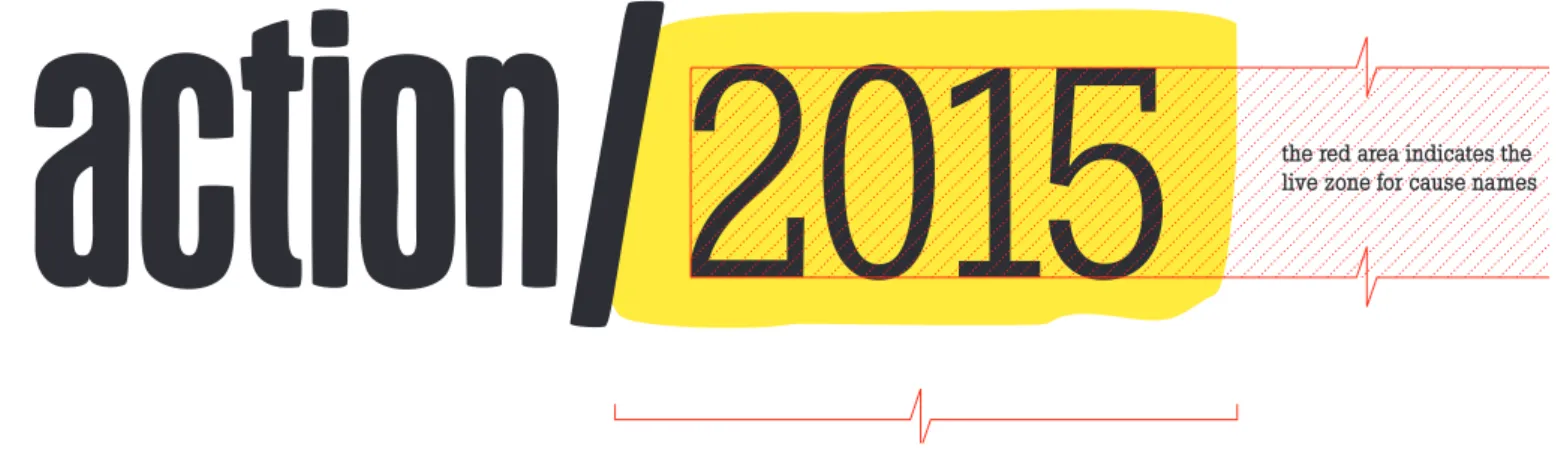
action/2015 is the primary signifier and is the essence and personality of the movement and how it represents itself globally. It has a consistent wordmark and a highlight bar which has been designated to accommodate movement cause names.
It is important to maintain the strength and values of movement at all times and this guide provides the pertinent specifications needed to reinforce its integrity.
The guidelines set in this document are not meant to inhibit, but to improve the creative process.
action/ wordmark cause & highlight bar
The action/ wordmark is based on a condensed sans serif typeface and includes a forward slash. As well as providing an introduction point for a cause name, visually, the forward slash gives a feeling of motion and action.
The wordmark is intentionally stark to improve its legibility and has a roughness to enhance its unique personality.
The yellow highlight bar serves as a point of visual focus and brings the cause to the fore. It takes the form of a spontaneous stroke adding a human touch and a sense of urgency.
9
CLEAR SPACE
2015
x
x
x
The exclusion zone
The boundary marked in blue should always be given as an area free from distraction.
Other visual elements should not encroach upon the indicated space.
CORRECT USAGE
Distortion
Proportions should be maintained at all times to ensure legibility and reinforce consistency. The signifier should be uniformly resized to fit a space and proportional dimensions should not be altered.
Spacing and balance
The cause name should sit comfortably within the highlight bar with a fairly even distance between the type and the highlight boundary.
Capitalisation
Although Action/2015 may be written with a capital A in text it should never appear in the wordmark which should not be altered in any way.
2015
2015
Cause
Cause
Cause
Cause
2015
2015
2015
Cause
Cause
Cause
Cause
2015
extended foreshortened compressed overhanging capitalisation in wordmark11
GRAPHIC ELEMENTS
2015
The cause & highlight bar
The yellow highlight area may be used to name specific causes or issues. The areas marked red are adaptable and available to accomodate named causes as shown in the examples below.
Cause names should be set in Slab Tall X Regular - available to download at: http://www.dafont.com/slab-tall-x.font
Cause
Climate
Poverty
the highlight bar can be extended to accomadate the cause name
the red area indicates the live zone for cause names
CAUSE NAMES
Adding a cause name
The illustration opposite shows areas that need to be considered when adding a cause name. The illustrations below show numbered stages to follow when adding a cause name.
Cause names should be set in
Slab Tall X Regular available to download at: http://www.dafont.com/slab-tall-x.font
Causename
Causename
Causename
Causename
1. Position a text box in red area and type in desired cause.
3. Select a highlight bar (see p.14) and position between blue guidelines and align with forward slash.
2. The name length will determine the size of the highlight bar which will extend to a point indicated in green.
4. Adjust size to align length with green guideline.
blue = top edge of highlight bar
red = insertion point and cap height of cause name
blue = bottom edge of highlight bar
13
Here are some of the causes and issues that action/2015 covers
Poverty
Injustice
Fairness
Equality
Inequality
Climate Change
Water
Children
Forests
Girls
CAUSES/ISSUES AND TONE OF VOICE
Specific causes or issues can be applied and take the form of a place name where appropriate.
The core movement is action/2015 so if a date is to be added it should only ever be 2015.
Kenya
Kenya
Kenya 2015
Kenya
GRAPHIC ELEMENTS -
HIGHLIGHT BAR
Xxxxxx
Xxxxxx
X
X
X
X
Xxxxxxx
Xxxxxxx
X
X
Xxxxx
Xxxxy
Templates
The samples shown on this page show a variety of lengths in straight format and more irregular shape. The first example shows how the irregular shape may be more suitable where descenders occur such as the letter ‘y’.
The bar serves to highlight the cause and should feel spontaneous and should not be restrictive.
15
GRAPHIC ELEMENTS -
TRANSLATIONS
The wordmark
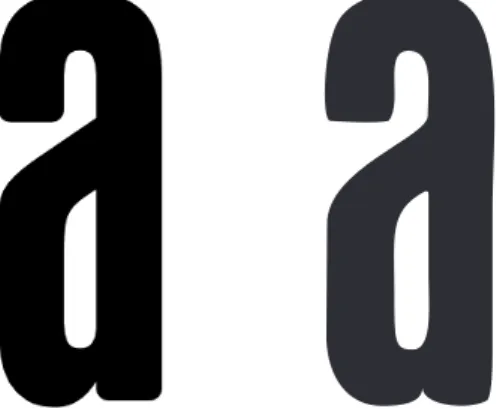
The action/ wordmark is based on the typeface Wagner Round and is slightly distressed in order to give it a character that is unique to the movement and will distinguish it from the cause name.
The Wagner Round typeface is available to buy online (see below) with the purchase of a licence for all
action/2015 participants under discussion.
The distressed alphabet is available to download as a guide for roughening or can be used directly to create the translated wordmark.
Typeface available online to purchase at: http://www.myfonts.com/fonts/canadatype/wagner-round/ The wordmark alphabet is available on the civicus action/2015 website, in the download area.
GRAPHIC ELEMENTS -
COLOUR PALETTE
Mono:
Wordmark & Cause 100%black, highlight 25% black
CMYK
breakdown for print
RGB
breakdown for online
Mono reversed:
Wordmark & Cause white, highlight 80% black
Colour reversed:
Wordmark & cause 100% yellow, highlight 80% black C0 M0 Y0 K100 C0 M0 Y100 K0 C0 M0 Y0 K80 C0 M0 Y0 K25 R26 G23 B27 R255 G237 B0 R88 G88 B90 R207 G208 B210
17
SPACING & POSITION -
OFFLINE
The position of the signifier is based on the exclusion zone and the geometry of an area, in the examples illustrated the format is A4.
The width of the mark represents about one fifth of the format width.
2015
2015
2015
51 mm 12.3 mm 17.5 mm 19 mm2015
51 mm 12.3 mm 19 mm 12.6 mmSPACING & POSITION -
ONLINE
2015
2015
2015
Skyscrapers
Full width signifier
Banners
Full size signifier
Depending on the overall content of the digital banner either a full sized or half sized signifier may be used.
Banners
19
SIZING
2015
25mm 6.75mm
Minimum reproduction size
To ensure legibilty is retained the minimum size rule should be adhered to.
The primary logo can be reproduced at minimum of 25mm width.
Where cause names apply the action/ wordmark should be set at a minimum height of 6.75mm and name set in Slab Tall X Regular (available to download at http://www.dafont.com/slab-tall-x.font) at a cap height of 17pt.
Maximum width for small spaces
A highlight bar of suitable length can be selected from the highlight bar templates. It is recommended that the bar does not exceed 3 times the length of the wordmark.
Xxxxxx
Xxxxxx
X
X
X
X
Xxxxxxx
Xxxxxxx
X
X
Xxxxx
Xxxxy
PARTNER LOGOS
The position of the mark alongside other logos is based on the exclusion zone and an additional even distance to allow a breathing space for the partner logo.
2015
2015
2015
2015
2015
2015
21