Results Based Maintenance:
Next Generation Preventive and Predictive Maintenance
By Gordon Sharp, MSEE
Introduction
For years the facility management industry has acted on the prudent belief that
preventive maintenance reduces the cost of owning and operating buildings. It is
estimated that building owners can save five to twenty percent annually on their
energy bills by implementing O&M best practices.
1Yet, how often have you been
able to validate the savings for your particular building? The technology now
exists that eliminates the complexity, and much of the cost, previously associated
with building performance evaluation. As an enhancement to existing
maintenance programs, Results Based Maintenance is an approach focusing on
the delivered performance of the building HVAC system to verify that it is
operating optimally.
Activity Based Maintenance Programs
Conventional service programs that employ preventive, full, or guaranteed maintenance are essentially activity-based programs with a set of tasks performed primarily to ensure the reliability and uptime of a building’s HVAC equipment. While it is widely accepted that preventive maintenance reduces the cost of owning and operating buildings, there has been no effective means for proving that benefits are being realized. Even the fundamental goal of equipment reliability and uptime can not be measured or even seen for at least one or more years.
Task checklist sheets are often provided as documentation however, at best they only demonstrate the task was performed, not whether it had a positive effect or was really necessary. Occasionally equipment inspection reports are provided, however this only refers to the condition of the equipment not it’s delivered performance in terms of lower energy costs, improved comfort or air quality. Lastly, since all of this documentation is without an independent assessment, appropriate checks and balances are not in place to assure building owners of accurate, unbiased feedback on the service being provided. For example, even when corrective service work is performed due to an occupant complaint, how do you verify if the job was done properly?
A Better Approach: Results Based Maintenance
An improved approach to conventional maintenance programs involves using fact based feedback on the delivered performance of the maintained HVAC equipment. This approach known as Results Based Maintenance is an enhanced PM program that measures the delivered performance of the HVAC systems to reduce facility operating costs and complaints as well as to validate the efficacy of a service program. Figure 1 shows a diagram of a typical Results Based Maintenance (RBM) program.
Fig. 2: The Building Performance Monitor
Figure 1: Results Based Maintenance
In addition to the conventional PM activities performed by a service technician, the building performance is surveyed on a periodic basis, typically 2 to 4 times a year. This performance measurement consists of evaluating a host of parameters indicative of the building system’s performance divided into three categories: comfort and ventilation, air cleanliness, and building pollutants. Once these measurements are made and analyzed, the results are documented into a report. This report is then used to validate the efficacy of the PM program and service proposals, detect means to reduce operating costs such as reducing over-ventilation, and finally to capture deficiencies in the HVAC system that can be turned into service proposals to secure additional service work.
In the past, the cost and time involved in implementing a Results Based Maintenance program would have been prohibitive. Today however, a proven, cost effective technology is now available that automates the entire process of data collection, expert analysis, and report writing.
Building Performance Evaluation System
Thanks to a new generation of sensor technologies, the Internet, and artificial intelligence (AI) based expert system technology; a system now exists for HVAC contractors to easily implement a Results Based Maintenance program. A portable, easy to use building performance monitor (Figure 2) can measure three different parameters in each of the categories of comfort and ventilation, air cleanliness, and building pollutants. This
information is uploaded to a secure web site via a wireless modem where it is organized, graphed and automatically analyzed to evaluate the delivered performance of the building systems. This information may be accessed on-line from any personal computer by way of a password protected account. With the
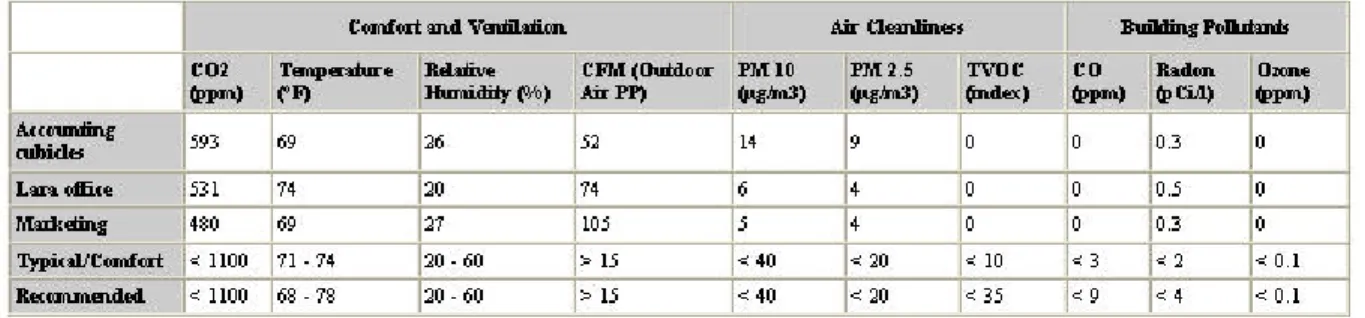
click of a screen button, a complete 30 to 40 page comprehensive building performance report is generated in less than 60 seconds, to document the system’s findings. This report, a portion of which is shown in Figure 3, specifically documents the performance of the building systems with respect to operating and energy costs, comfort and
PM proposal PM activity Invoice customer
Measure and analyze building performance Document results (report) Validation of PM program Capture service opportunities Optimize operating costs
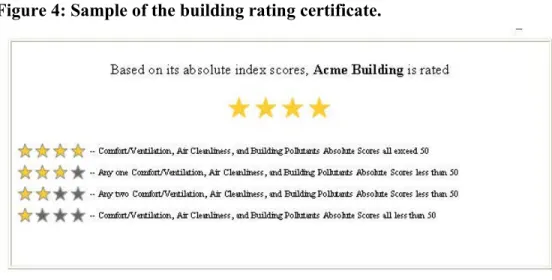
ventilation, air cleanliness and the absence of certain building pollutants. Additionally, the report benchmarks the facility’s performance against other facilities and even provides a one to four-star rating on the operating status of a building.
With this report in hand, a facility owner or manager can clearly identify ways to improve HVAC system performance to reduce energy and operating costs while optimizing occupant comfort and indoor air quality. Due to the use of the AI-based expert system technology, the report is truly an independent, third party document that quantifies potential savings, objectively identifies areas for improvement, and then impartially validates the resulting improvement efforts.
.
Figure 4: Sample of the building rating certificate.
The Tangible Benefits of Results Based Maintenance
Optimizing facility performance through a Results Based Maintenance (RBM) program can have a direct, positive effect on your bottom line, primarily by reducing energy and operating costs. The term optimization, as it is used in this context, consists of fine-tuning the operation of an installed HVAC system. Implementing RBM can produce tangible value through 1) reduced energy costs; 2) lower HVAC maintenance costs and down-time; 3) fewer complaints from occupants; 4) a faster, more thorough response to any remaining complaints; and 5) documenting and validating your building service program.
1.
Reduce energy expenses
One way the Optima™ system can be used to reduce energy expenses is derived from recent statistics showing that more than half of all office buildings may be
over-ventilated. This is significant because over-ventilation translates into unnecessary energy expense. A common cause of over-ventilation is that the building’s occupancy rate is far below the design specifications.2 Alternatively, the condition can result from poorly
adjusted control or damper settings, a broken economizer, or unrestored settings following a recent override. Whatever the reason, the incidence of over ventilation is more than four times the incidence of under ventilation as directly measured in hundreds of buildings.3
Why does over-ventilation so routinely go unmitigated? Firstly, because there hasn’t been a simple, cost-effective way for service technicians, or on-site managers, to measure ventilation rates on a regular basis to show the potential for savings. Ventilation is typically only investigated when the rate is suspected to be substandard. Secondly, without also measuring aspects of comfort, air cleanliness and the presence of certain building pollutants, ventilation can not be reduced without risking an increase in
complaints from tenants or employees. However, using the building performance monitor as part of a results based preventive maintenance plan or optimal ventilation or the potential for savings can be easily checked on a regular basis while also validating that occupant comfort and air quality have not been compromised.
By way of example, let’s assume a 100,000 square foot building was designed for a typical occupancy of 5 people/1,000 sq. ft. or 500 people. The desired ventilation rate, as recommended by ASHRAE is 20 CFM/person. When Optima is used to test the space, it finds the rate at 50 CFM, much higher than what is needed. Reducing it to 20 CFM and
multiplying the savings of 15,000 CFM by a typical energy cost of $1.63/CFM yields an annual savings of $24,450.
2.
Lower maintenance costs
The monitor technology can also lower overall HVAC maintenance costs and prevent down time. By analyzing the HVAC performance on a regular basis, the service contractor can provide early insight into potential problems which, in turn can avoid costly solutions.
By way of example, consider the following situation: The local outdoor conditions require a different filter design, or more frequent filter changes, than those originally specified. Even though design specifications are fully met, the Optima exposes the condition during routine HVAC-performance evaluation—with the physical symptom showing up as an elevated level of airborne particles in the air. Armed with this data, the filtration scheme can be modified based on present conditions and take the guesswork out of filter change frequency.
Had the situation remained undetected, it would have eventually led to coated and inefficient coils—or worse yet, contaminated ductwork. Both of these issues would be more costly to resolve than modifying filter changes or the filter type. In this example, the system has proven its value several times over by uncovering a situation and addressing it through a relatively simple and less costly means.
3.
Prevent occupant complaints
Studies have shown that the vast majority (>85%) of comfort and air quality complaints, typically reported by occupants as too hot, too cold, stuffy, smelly, dusty, etc.—can be addressed through adjustments or repairs to the HVAC system. A Results Based Maintenance program can therefore help minimize the occurrence of occupant
complaints. Regular performance analysis using the monitor-based system can expose conditions that can cause occupant discomfort, and enable correction before the condition produces a complaint.
4.
Demonstrate responsiveness to occupant complaints
In instances where there is an occupant complaint, the system provides the means to respond quickly and efficiently, and to document potential solutions. Use of the Optima system for complaint response can reduce the need to hire outside engineering or industrial hygiene (IH) consultants.
5.
Document and validate your service program
Finally, a Results Based Maintenance program provides a written report validating and proving the effectiveness of your maintenance program. A critical point to note is that this report is produced by an independent, third-party, namely the building performance monitoring system. It can be valuable as proof of your commitment to employees’ well-being, as a way to retain tenants, and simply as due diligence demonstrating an effective operations and maintenance program.
Summary
By taking advantage of this proven technology, facility managers can supplement their traditional PM program with independent validation and performance documentation. The technology exists to help you achieve balanced outcomes through its ability to:
• Document operational results
• Validate system performance and service routines
• Optimize operating costs by identifying excess energy use • Correct system deficiencies.
Those who are familiar with the system or similar results-based programs believe that in the very near future this will become the standard approach to facility management. References
1. Tudi Haasl, et al 1999. Portable Dataloggers, September 1999. Portland Energy Conservation Inc. (PECI) O&M Best Practices Series.
2. Kurt W. Roth, Ph.D., John Dieckmann, P.E., and James Brodrick, Ph.D. 2003. Demand Control Ventilation, ASHRAE Journal, July 2003: 91-92.
3. Optima Building Performance Reports Statistical Analysis, Bob Foster, Aircuity, Inc. May 2003.
About the author
Gordon Sharp is the President and CEO of Aircuity, Inc., a Newton, MA-based provider of technology to evaluate and help to optimize the comfort, health, and energy efficient aspects of a building's indoor environment.
Aircuity’s OptimaTM system won an R&D 100 Award in 2002, an honor shared by such
past technological advances as the ATM machine, the fax machine, and the LCD display. OptimaTM was developed in collaboration with Environmental Health & Engineering,