http://www.jscdss.com
Vol.5 No.1 February 2018: 27-35 Article history:
Accepted 28 February 2018 Published online 1 March 2018
Journal of Soft Computing and Decision
Support Systems
Systematic Phases for Proposing a New Model of Qualifications Gap
Based on Network Technician Data
Karrar Hameed Abdulkareem a,*, Mohd Sanusi Azmi b, Nabeel Salih Ali c, d, Mohammed Nasser Al-Mhiqani b, Haider Alsharqi c
a
Agriculture College, University of Al-Muthana, Iraq
b
Faculty of Information and Communication Technology, University Technical Malaysia Melaka, Malaysia
c
IT- RDC Centre, University of Kufa, Najaf, Iraq
d
ECE Department, Faculty of Engineering, University of Kufa, Najaf, Iraq
*Corresponding author email address: [email protected]
Abstract
Workers in the Information Technology (IT) sector are employed, selected, and evaluated based on specific qualifications. Qualifications are chosen according to an organisation’s views. Literature has examined several metrics such as skill, knowledge, ability, attitude certification, education and experience in industrial and academic areas. However, a few studies have tested the effects of Qualifications Gap (QG) among IT personnel in public universities. This study introduces a methodological framework to measure the influence of lack of the education, experience, and certification on Qualifications Gap (QG) among network technicians in Baghdad’s public universitie s. The research methodology includes preliminary study, literature review, data collection and analysis, proposal, and evaluation. Data are collected from 70 respondents through an online survey to test the proposed hypotheses. Four experts validated survey results through a structured interview. Most of the feedback of the experts matched the results of the questionnaire. The outcome of the study is a QG model for network technicians. The presented models that previously established models in industrial and public areas are compared, and the effects of the proposed factors are evaluated. The conducted model can be used as a reference by decision makers in public universities to enhance the level of the job handling by network technicians and to set employment requirements in the networking field.
Keywords: Network management, Technician knowledge, Certification, Education, Experience, Qualifications Gap (QG)
1. Introduction
Network operators upgrade their access networks to meet an increasing number of the users and the growing bandwidth required by services (Machuca et al., 2011). Due to the fast development of network technology, the complexity of the network architectures and variety of the network services have been increased and resulted in high demand for network capacity and network performance (Liu et al., 2012). Configuring a single router in a network is a task for a trained expert and setting thousands of routers and determining why a network of such size is not functioning as expected can become tasks beyond the capacity of any single human (Peterson and Davie, 2012; Falih et al., 2018). As a result, network configuration and management continue to be a challenge among operators because operators should be configured and adjust a network manually in response to changing network conditions (Kim and Feamster, 2013; Abdulkareem et al., 2016). To achieve network management smoothly, several vital problems on personnel role which is a significant
factor in network management must be considered. These issues include determining who can operate the network at the lowest cost, guaranteeing the highest quality of services, and providing services that satisfy customers (Clemm, 2007). Network management includes several aspects rather than technology such as human dimension. These dimensions refer to how people use management tools and technology to achieve a given purpose as well how users perform management functions, who are ultimately responsible for the smooth operation of networks in addition to what networking services can be supported better. Network managers or decision-makers should have a framework to select and assign skilled network operators for the management and operation of networks. Bailey and Stefaniak (2001) found the shortage of qualified professionals is not caused by a lack of applicants but by the deficiency of individuals with adequate skills (Bailey and Stefaniak, 2001). Authors partly attributed the presented scenario to the overemphasis on short training and certification programs at the expense of university education.
In this research, five methodology phases were introduced to measure the influence of lack of education, experience and certification on the Qualifications Gap (QG) among network technicians in public universities of Baghdad. The paper is organized as follows. Section 2 presents a review and discussion of the previous studies that addressed the qualifications of IT personnel in both the academe and industry areas. Section 3 provides a clear and comprehensive description of the multi methodology phase namely preliminary study, literature review, data collection and analysis, as well proposal and evaluation phase. Section 4 presents a discussion of the results of the proposed model. Section 5 discusses a comparison of the previously proposed models and studies concerning domain application and influence factors. The conclusions of the study are provided in Section 6.
2. Previous Works
The Information Technology (IT) community employs several metrics to identify qualified IT personnel. Qualifications for IT personnel differ depending on the type of the job environment and possession of technical and non-technical skills. Cheney et al. (1990) identified skills required for information system professionals through three measurements namely Knowledge, Skill, and Ability (KSA) (Cheney et al., 1990). Bailey and Stefaniak (2001) also pointed out that identification of the shortage in IT skills especially for computer programmers can be performed by using KSA (Bailey and Stefaniak, 2001). According to Lauby (2013), recruiters looked for KSA during the hiring process (Lauby, 2013). As well managers used KSA through referee employee respect to promotions and transfers. KSA used in any company for creation and updating replacement and succession plans. Different jobs in IT field complex and specialised similar to the knowledge, skills and experience required to perform them (Kundra, 2010). According to Ngadiman et al. (2011), sustainable technical skill development is a long-term integrated skill approach that adopted scientific instruments, technologies, economics and global considerations (Ngadiman et al., 2011). A possibility of the full and successful implementation requires a workforce equipped with sustainable development and KSA. The proposed study is a significant endeavour to achieve Human Resource Development (HRD) by measuring capability through KSA. HRD helps employees develop their personal and organisational KSA. HRD provides numerous opportunities such as employee training, employee career development, performance management and development coaching, mentoring, succession planning, key employee identification, tuition assistance and organisational development (Hassan, 2007). Robin (2011) as well Robin and Roggio (2012) conducted two studies on the common qualifications preferred by IT managers from many companies (Robin, 2011; Robin and Roggio, 2012). The types of educational background include high school diploma, associate degree, master degree or doctorate. Their significance varies from a
exist among IT personnel (network technicians)? II) What is the most influential factor in the QG? The current study examines the relation of QG with lack of education, experience, and certification factors.
3. Methodology
When an issue or problem occurs, a systematic approach to solving this problem must be applied. Therefore, the methodology scope is broader than methods in research (Ali, 2016; Kothari, 2004). This Section introduces the methodology that they have been employed to examine factors that affect QG among network technicians. Also
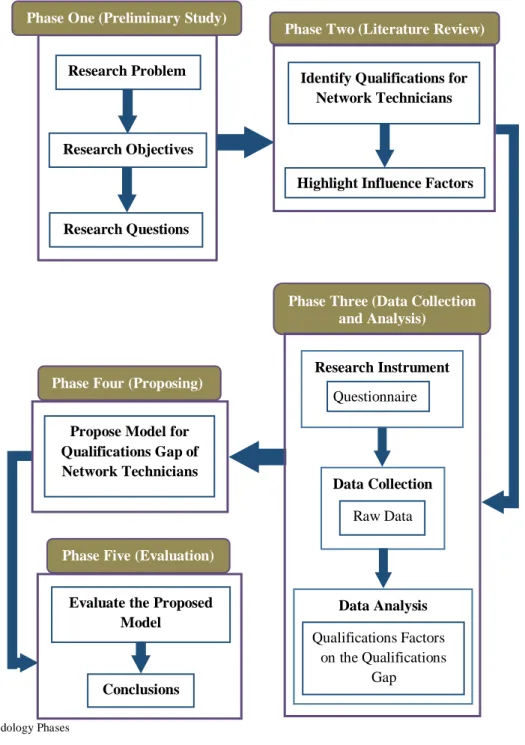
highlights all metrics which used in the IT community to select, apply and evaluate a particular IT worker. The research methodology also provides all steps for proposing a model that measures the influence of lack of education, experience and certification on QG among network technicians. The methodology is divided into a multi-phase namely preliminary study, literature review, data collection and analysis, besides proposal and evaluation phase. Each phase involves separate processes, but each phase based on the outcomes of the preceding phase. Fig. 1 illustrates the study’s methodology with five phases through a flowchart.
Fig. 1. Research Methodology Phases
Research Problem
Research Objectives
Research Questions Phase One (Preliminary Study)
Identify Qualifications for Network Technicians
Highlight Influence Factors Phase Two (Literature Review)
Data Collection
Raw Data
Phase Three (Data Collection and Analysis)
Propose Model for Qualifications Gap of Network Technicians Phase Four (Proposing)
Evaluate the Proposed Model
Conclusions Phase Five (Evaluation)
Research Instrument
Questionnaire
Data Analysis
Qualifications Factors on the Qualifications
3.1 Phase One (Preliminary Study)
In this phase, three related sub-phases that pertain to the problem statement are highlighted to address the primary objectives of this study. Besides, this phase identifies the research questions that must be answered according to the goals and problem statement.
3.1.1 Problem Statement
A detailed literature review was carried out. Issues related to the personnel qualifications were discussed. A few studies have been examined the qualifications for IT personnel in public universities. Regarding QG, a few studies have been focused on the influence of lack of education, experience and certification. The effect of skill loss by IT was also highlighted.
3.1.2 Research Objectives
The primary aim of this research is to develop a model that will verify QG depending on a measure of the causal relationship between QG and lack of education, experience and certification among network technicians with concerning the network management domain.
3.1.3 Research Questions
The third sub-phase is related to completing the map of the research objectives and research questions and how to highlight the number of critical issues that must be answered by the research objectives to solve the problem. This phase includes three central questions are I) What are the factors considered by industrial and academic facilities in measuring if a particular network technician is qualified to handle a regular job?, II) What are the effects of lack of factors on QG among network technicians? And III) What is the proposed model to identify the factors that influence QG among network technicians?.
3.2 Phase Two (Literature Review)
This phase investigates necessary qualifications considered by public and industrial sectors in deciding if a specific IT personnel is qualified to handle a particular job. The literature review helps in identifying the problem statement sub-phase. Conceptually, this study provides insights into previous and existing work that conducted in the same area according to the central components (keywords) in the title of the research. The factors that affect QG among IT personnel are highlighted and examined in the next phase.
Fig. 2. Literature Review Process
Fig. 2, the following four processes performed in phase two.
Searching: Main keywords for the research title were searched for by using several search engines. The keywords include “IT qualifications,” “shortage of IT personnel
skill,” and “education, experience, and certification”. The search process was conducted in the database provided by the library of University Technical Malaysia Melaka by using reliable search engines, such as IEEE, Science Direct, and Scopus.
Collecting: Related articles collected according to the central keywords identified in the first process (searching). As a result, more than 82 studies obtained in this process. Filtering: The obtained articles were filtered (46 over 82 studies) into the following areas I) Common metrics (qualifications) for IT personnel (general), II) Specific metrics (education, experience, and certification) for IT personnel in the public sector (specific) and III) Most influential factors in the loss of skills of IT personnel. Generating: A critical review for the related articles (7 articles) was produced to enable the researchers to compare their works to previous ones by using several criteria such as domain and employed factors (see Table 1).
3.3 Phase Three (Data Collection and Analysis)
3.3.1Research Instrument
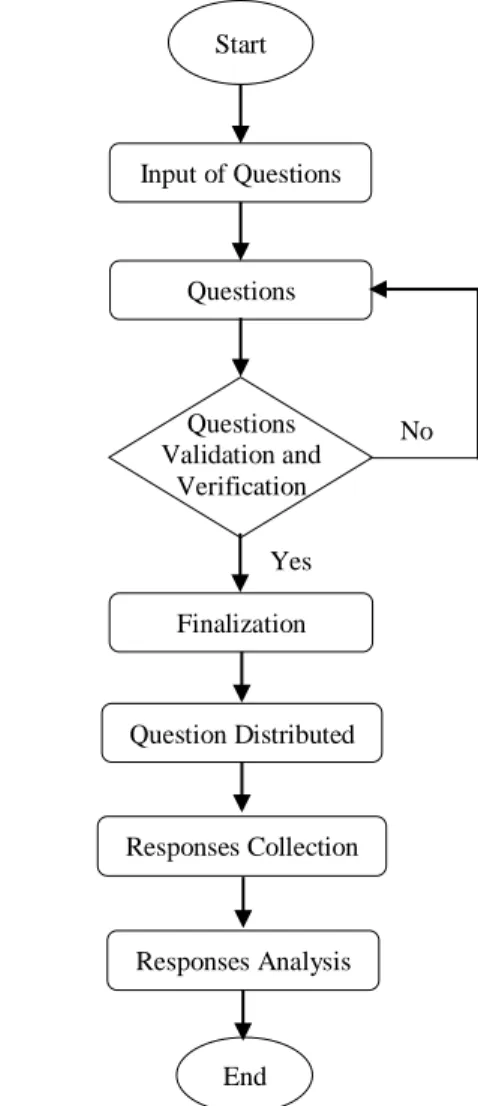
This research employed the questionnaire technique as a data collection instrument. A questionnaire is used to collect original data to describe a population to be observed directly (Mouton, 1996). The questions design was selected to meet the objectives of the study namely to identify the factors that influence QG among network technicians as a part of the network management. Fig. 3 presents the questionnaire process.
Searching Collecting Filtering Generating
Start
Input of Questions
Questions
Questions Validation and
Verification
Yes
Finalization
Question Distributed
Responses Collection
First, the questionnaire was designed using the Google Form tool. This tool possesses powerful features that support the creation of a suitable survey form. Such features include inserting questions, editing, deleting, and distributing the survey online for free. Also, the questionnaire was designed in two languages namely English and Arabic to ensure the simplicity of the study. This method helps respondents understand the survey and provide adequate answers. Furthermore, we considered respondents from four independent groups working in the networking domain and located in four different universities. These universities include the University of Technology, University of Baghdad, Al-Mustansiriya University and Al-Iraqia University. Second, the questions of the structured questionnaire were related to the influence factors of the study such as Lack of Certification (CL), Lack of Education (EL1) and Lack of Experience (EL2). The measurement of these conceptual or latent factors or variables was based on a five-point Likert scale with scale anchors from “1”-strongly disagree to “5”- strongly agree. The questionnaire divided into six sections with 49 questions in total. Most of the questions restructured from those in previous studies (surveys). Third, validation and verification were performed by interviewing and consulting with experts. In this stage, the questions were revised and polished many times to make the questionnaire clear for the respondents. A final form (finalisation) of the survey was created and readily distributed among the respondents. Fourth, distribution was conducted in two ways, namely online and hard copy. The advantage of the online survey is that the online form can be accessed directly via a link shared through the E-mail, social networks, etc. For the hard copy form, the process of distribution was completed by distributing the form among network operators in four public universities of Baghdad. Fifth, all responses collected from the particular respondents were collated (see next sub-phase). Finally, an analysis conducted after data collection.
3.3.2 Data Collection
To collect the data, an online survey was conducted using Google Form tool. The target population comprised network technicians, network managers and network operators in Baghdad public universities. This community was selected as most of them play multiple roles in the network management. Additionally, the reason for surveying via the Google Forms tool is because it is easy to obtain responses from respondents who have experience in using electronic platforms such as Facebook, email and Twitter. The questionnaire was delivered manually to the target respondents. However, most responses obtained through the electronic form. The Google Form tool provided the section concerning the collection of answers. These responses were stored in an Excel sheet containing all submitted forms. For the hard copy forms, we inputted the data manually into an Excel table. The number of responses obtained through the hard copy form was smaller than that got from the online form.
3.3.3 Data Analysis
Data analysed via the statistical package for the social sciences version 21.0. Data analysis was established to identify QG, CL, EL1, and EL2. It included different analyses such as descriptive, correlation, reliability and regression. The statistical method used to find out the relationship between the variables that affect Qualification Gap is as follows:
Y = α + β1X1 + β2X2 + β3X3 + ... + β9X9 + ε Where:
Y = qualifications gap, α = regression constant,
β1, β2, β3, to β9 = regression coefficient,
X1, X2, X3, to X9 = independent variables (based on research variable),
ε = error term.
Then to model the relationship between qualifications gap and independents variables we use the following regression model:
Z = α + β10Y + ε.
Furthermore, estimators of β1, β2, β3, to β9 (regression coefficient) and the CFA were computed using the statistical package SPSS-Amos version 21 and version 20. The hypotheses of the study are as follows:
H1: Certification lack has a significant influence on the qualifications gap.
H2: Education lack has a significant influence on the qualifications gap.
H3: Experience lack has a significant influence on the qualifications gap.
70 respondents participated in this study was obtained. Descriptive analysis was used to examine the background information of the respondents and create feedback tables. Among the 70 respondents, there were 54 (77.1 %) Males and 16 (22.1%) Females the majority (30%) of respondents in the university group was from the University of Baghdad. It is followed by (27.1%) of respondents from Iraqia University, (20%) of respondents from Al-Mustansiriya University, (22.9%) of the respondent from the University of Technology. It can be concluded there is significant responding to the questionnaire from the respondents of four Baghdad public universities.
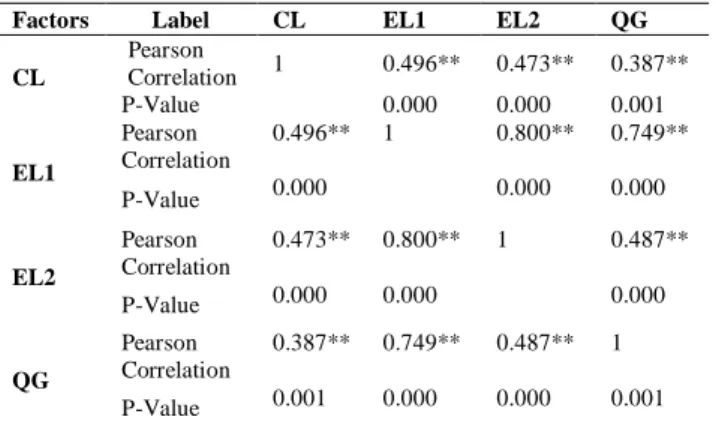
Table 1 Correlation Analysis
**Significance Correlation
Cronbach’s alpha was employed to define the reliability of the measures and to find the internal consistency of the variable and its items (questions in the questionnaire that related to each variable). Table 2 offers the name of the variables along with the number of items of each variable. The Cronbach’s alpha and its value are given in Table 2 which shows the interpretation of the amount of Cronbach’s alpha. The Table 2 shows that all the variables have good reliability because they have Cronbach’s alpha more than (0.7). A Cronbach’s alpha equals or more than (0.7) is considered acceptable (Sekaran, 2003). Reliability analysis shows that all the variables have a reliability value higher than (0.7).
Table 2 Reliability Analysis
The research has developed three main hypotheses (H1, H2, and H3) as we mentioned. These hypotheses are related to the influence of each CL, EL1 and EL2 of QG. Table 3 shows the results of the regression analysis that the P-Value of the variables of this study are less than (0.05) which indicates that all the proposed hypotheses were accepted (Awang, 2014).. Regression analysis is valuable for testing the proposed hypotheses. These hypotheses are casual due to they are interested to find the influence of one independent variable on the dependent variable. The Unstandardized Coefficient (β) is used to test the hypotheses because it measures the influence of the independent variables and the dependent variables. Besides, the P-Value indicates whether the hypothesis is significant or insignificant. If the P-Value is less than 0.05, it suggests that the hypothesis is substantial and supported (Awang, 2014).
Table 3 Regression Analysis
Variables Unstandardized Coefficients (β)
Sig. (P-Value)
CL 0.398 0.001
EL1 0.651 0.000
EL2 0.469 0.000
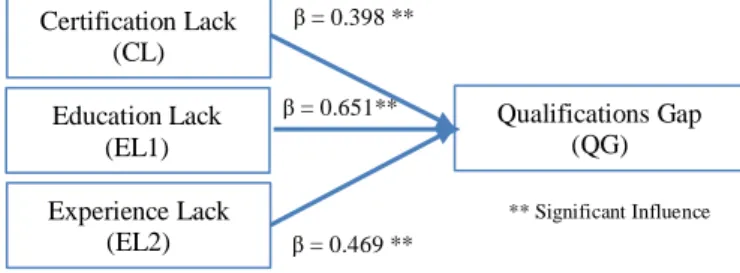
Based on the finding in the Table 3, CL significantly influences QG (β = 0.398 and P-Value = 0.001). The influence is significant because the P-Value is less than (0.05) (Awang, 2014). Thus, H1 is supported. As well, it shows that there is a positive influence of EL1 on qualifications gap. The coefficient (β = 0.651 and P-Value = 0.000) shows that the influence is significant because the P-Value is less than (0.05). Thus, H2 is supported. Also, it shows that there is a positive influence of EL2 on qualifications gap. The coefficient (β = 0.469 and P-Value = 0.000) shows that the influence is significant because the P-Value is less than (0.05). Thus, H3 is supported. Among three factors we can conclude that the biggest influence on the qualification gap is the education lack. The result of the hypothesis testing using regression analysis indicated that the influence of CL, EL1 and EL2 on QG is significant, but the most influential among them is EL1 (Abdulkareem et al., 2016).
3.4 Phase Four (Proposal)
Related literatures were reviewed to understand the factors (lack of certification, education and experience) that exhibit the potential to influence of QG. The results of the analysis performed on collected data that were used to determine the key factors to regard as an input in this phase. The purpose is to identify the influence factors and propose an appropriate model that defines QG among network technicians in the universities of Baghdad (see Fig. 4).
Factors Label CL EL1 EL2 QG
CL
Pearson
Correlation 1 0.496** 0.473** 0.387** P-Value 0.000 0.000 0.001
EL1
Pearson Correlation
0.496** 1 0.800** 0.749**
P-Value 0.000 0.000 0.000
EL2
Pearson Correlation
0.473** 0.800** 1 0.487**
P-Value 0.000 0.000 0.000
QG
Pearson Correlation
0.387** 0.749** 0.487** 1
P-Value 0.001 0.000 0.000 0.001
Variables Items No. Cronbach’s Alpha
CL 5 0.789
EL1 4 0.763
EL2 4 0.722
QG 7 0.751
Evaluation by Experts There is a lack of
qualifications gap for network technicians inside public universities in the previous studies.
Identify factors which indicate qualifications for IT personnel (network technician). Develop a hypothesis that
reflects the impact and influence of the variables.
Identify qualifications gap of technicians for network management inside Baghdad Universities.
The proposed factors were found significantly influence qualifications gap.
Certification Lack (CL)
Education Lack (EL1)
Experience Lack (EL2)
Qualifications Gap (QG)
Proposed Model
H2
Certification Lack (CL)
Education Lack (EL1)
Experience Lack (EL2)
Qualifications Gap (QG)
β = 0.398 **
β = 0.651**
β = 0.469 **
** Significant Influence
The model proposal process involved several steps. First, according to the literature review, studies on QG among network technicians are lacking. Second, we highlighted the factors that influenced qualifications for IT personnel in general. The primary focus is to determine which of the factors affect the occurrence of QG among network technicians. The proposed model focuses on measuring the influence of certain variables on QG in public universities from a personnel point of view. Third, three hypotheses were established to measure the influence of CL, EL1, and EL2 on QG. Fourth, a questionnaire with numbered items was employed to obtain feedback from respondents comprising networking personnel. Fifth, the input of the questionnaire respondents was analysed through several types of analysis such as reliability, correlation and regression. Regression analysis revealed that all the hypotheses supported the significant influence of CL, EL1 and EL2 on QG. Sixth, the model was finalised depending on the findings of previous steps. The model showed the effect pattern of the three factors that influence QG among network technicians in public universities of Baghdad. The effect pattern is as follows: CL is the first cause that positively influences QG. EL1 is the second cause that positively impacts QG. EL2 is the third factor that positively affects QG. Seventh, to validate the proposed model, the model was evaluated by experts in networking and management areas. The results showed that the experts’ feedback and comments matched the findings of the questionnaire and hypothesis testing.
3.5 Phase Five (Evaluation)
A set of factors and relationships were proposed based on literature. A survey was conducted to test these links. The findings of the study were evaluated and validated by experts. The feedback and comments of the experts were used to finalise the proposed research model. Four experts that conducted interviews in the area of networking and management were asked to validate the outcomes of the proposed model. Four experts are selected based on their expertise in such area. However, their number was depending on their willingness to participate in the current study. The majority of the results provided by the experts matched the outcome of the regression analysis. The experts indicated that the causal relationships are significant. Thus, we conclude that the research model is
acceptable. Fig. 5 presents the important influence factors for the proposed QG model of technicians for network management.
4. Results and Discussion
The result of the hypothesis testing through regression analysis indicated that the influence of CL, EL1, and EL2 in QG is significant (see Table 3). The contributions of these three factors in influencing QG among network technicians in the IT community are as follows (from largest to smallest): CL, EL1, and EL2. These factors significantly affect QG. The most influential factor is EL1, followed by EL2 and CL (see Fig. 5). The proposed model can help decision makers in public universities of Iraq to utilise these factors in enhancing the level of job handling by workers, especially in networking domains and the IT field. Moreover, the model can be used to hire new staff in the future to avoid the formation of QG. Finally, the proposed model can be used by workers themselves to focus on which of the three factors they have lacked. Thus, workers can avoid QG and can handle their jobs systematically and professionally (Abdulkareem et al., 2016).
5. Comparison of the Proposed Models
We conducted a comparison of the previous models respect to application areas and influence factors metrics. Table 4 presents models and factors of the earlier studies. Authors that attempt before have examined different factors such as education, experience and certification. These factors used as indicator to decide whether a particular IT personnel is qualified to handle a specific career in the IT domain in industry field, also avoiding the lack of qualifications (Anderson et al., 2002; Quan et al., 2007; Robin et al., 2011; Robin and Roggio, 2012). Conversely, none of the education, experience and certification factors used as indicators in an academic sector (public sector). Knowledge, skill, ability and attitude were used in the industry sector and are needed by IT personnel, and these factors were also used in public (public universities) to measure human capabilities (Bailey and Stefaniak, 2001; Ngadiman et al., 2011; Lauby, 2013). Table 4 presents the influence factors in the previous studies.
Table 4
Influence Factors in the Previous Works
Influence Factors Education Experience Certification Knowledge Skill Ability Attitude Author(s)
Bailey and Stefaniak (2001)
Anderson et al. (2002)
Quan et al. (2007)
Ngadiman et al. (2011)
Robin et al. (2011)
Robin and Roggio (2012)
Lauby (2013)
The Propose Model
The majority of the proposed factors were examined from IT managers’ point of view rather than IT personnel perspective of view. Moreover, they were employed in the industry field and the most influential ones namely education, experience, and certification. Also, knowledge, skill, ability, and attitude influenced in such field. Only knowledge, skill and attitude were used in public universities. However, none the education, experience, and certification were used in the public universities. These factors signify the indicators to decide if a particular IT personnel is qualified to handle a specific career in network management of a particular field and to avoid the lack of qualifications. Thus, the proposed model was applied to measure the influence of CL, EL1, and EL2 on QG among network technicians.
6. Conclusions
A multiple-qualification framework used by hiring managers in the IT community to define the status of a particular IT personnel. Some of the metrics were utilised to measure managerial skills and others for technical skills. To reiterate several measurements such as skill, knowledge, ability, attitude, education, experience, and certification are considered to select, hire and evaluate qualified personnel. This study was performed to determine the occurrence of QG among network technicians. The factors CL, EL1, and EL2 were tested to measure their influence on QG (see Tables 1, 2 and 3). All of the three factors exert a significant influence on QG (see Fig. 5). The outcome of this study is a new model that presented the effects of QG among network technicians in public Baghdad universities. The primary focus is to provide a methodological approach in proposing a new model to measure the causal relationship between QG and the three proposed factors (see Fig. 1). First, we started with the problem statement, research questions, and research objectives. Second, we introduced the procedure of generating a critical review based on previous studies which were supported the problem statement and highlighted the difference between the current research and the previous ones (see Fig. 2). Third, we presented tools that used for data collection and analysis (see Fig. 3). Fourth, we explained in detail the steps of proposing the model and evaluated it depending on experts’ point of view (see Fig. 4). The information presented in this article can help researchers for future studies. Future work can be proposed an efficient decision maker technique for determining network technician
References
Abdulkareem, K.H., Azmi, M.S., Ali, N.S. and Nasser, M. Factors Affecting Qualifications Gap For Network Technicians : Baghdad Universities Case Study, 2016. pp. 5–11.
Ali, N.S. (2016) A four-phase methodology for protecting web applications using an effective real-time technique’, Int. J. Internet Technology and Secured Transactions, Vol. 6, No. 4, pp.303–323. Anderson, J., Barrett, K. and Schwager, P. Information systems
certification: The perspective of the human resource manager. AMCIS 2002 Proceedings, 2002, p.291.
Applegate, L.M. and Elam, J.J. New Information Systems Leaders: A Changing Role in a Changing World. Misq, 16(4), 1992. p.469. Z.Awang. Handbook on Structural Equation Modeling, 2014, Kuala
Lumpur,Malaysia.
Bailey, J. and Stefaniak, G. Industry perceptions of the knowledge, skills, and abilities needed by computer programmers. The 2001 ACM SIGCPR conference on Computer, 2001. pp. 93–99.
Clemm, A. Network Management Fundamentals Corporate and Government Sales, Cisco Press, Indianapolis, 2007.
C.R.Kothari. Research Methodology Methods and Techniques, 2004. Evans, N., Saflund, P. and Wijenaike, M. Converging universes: New
models for IT professional certification and academic credentials. Certification Magazine, 2002. pp. 30-33.
Hassan, A. Human resource development and organizational values. Journal of European Industrial Training, 31(6), 2007. Pp.435–448. Hunsinger, D.S. and Smith, M.A. IT certification use by hiring personnel.
Journal of Computer Information Systems, 50(2), 2009. pp. 71-82. Kim, H. and Feamster, N. Improving Network Management with Software
Defined Networking. , (February), 2013. Pp.114–119.
Kundra, V. 25 Point Implementation Plan to Reform Federal Information Technology Management. Executive Office of the President Washington Dc/Office of Management and Budget Office of E-Government and Information Technology, 2010.
Lauby, S. The Difference between Knowledge, Skills and Abilities, 2013. Liu, F., Huang, W., Wang, P. and Zhang, L. Assistant Decision System for
Optimization of Private Communication Network, 2012.
Matsuo, M., Wong, C.W.Y. and Lai, K.H. Experience-based learning of Japanese IT professionals: A qualitative research. Journal of Strategic Information Systems, 17(3), 2008. pp. 202–213.
Machuca, C.M., Krauss, S. and Casier, K. Fault management and service provisioning process model of next generation access networks. 2011 7th International Conference on Network and Service Management (CNSM 2011), 2011, p.6 pp.
Morrison, R.F. and Brantner, T.M. What enhances or inhibits learning a new job? A basic career issue. Journal of Applied Psychology, 77(6), 1992. pp. 926–940.
Mouton, J. Understanding social research. Van Schaik Publishers, 1996. Miles, J., and Shevlin, M. Applying regression and correlation: A guide
for students and researchers, (2001) Sage.
Mohammed Falih, Nabeel Salih Ali, Salam Kadhim. Multi- Phase Methodology for Proposing a High Performance Switched Campus Network: University of Kufa Case Study. Journal of Engineering and Applied Sciences, 13(6), 2018.
Ngadiman.Y, Hussin.B, and A.M. A study of human skill achievement in Malaysian public universities: knowledge, skill and attitude. International Conference on Management, 1(1), 2011. Pp.1280–1292. Quan, jim J and Dattero, Ronald and Galup, S.D. Information Technology
Communications of the Assoication for Information Systems, 2007.19(6).
Peterson.L and Davie.S. Computer networks: a systems approach Fifth Edit., Morgan Kaufmann,ELSEVIER, Burlington , 2012.
Robin, G.J. Do companies look for education, certifications or experience : A quantitative analysis current industry needs/requirements? Sigmis-Cpr, 2011. pp. 1–5.
Robin, G.J. and Roggio, R.F. A Quantitative Analysis of Computing Jobs in 2012. , 2012. pp. 1–8.